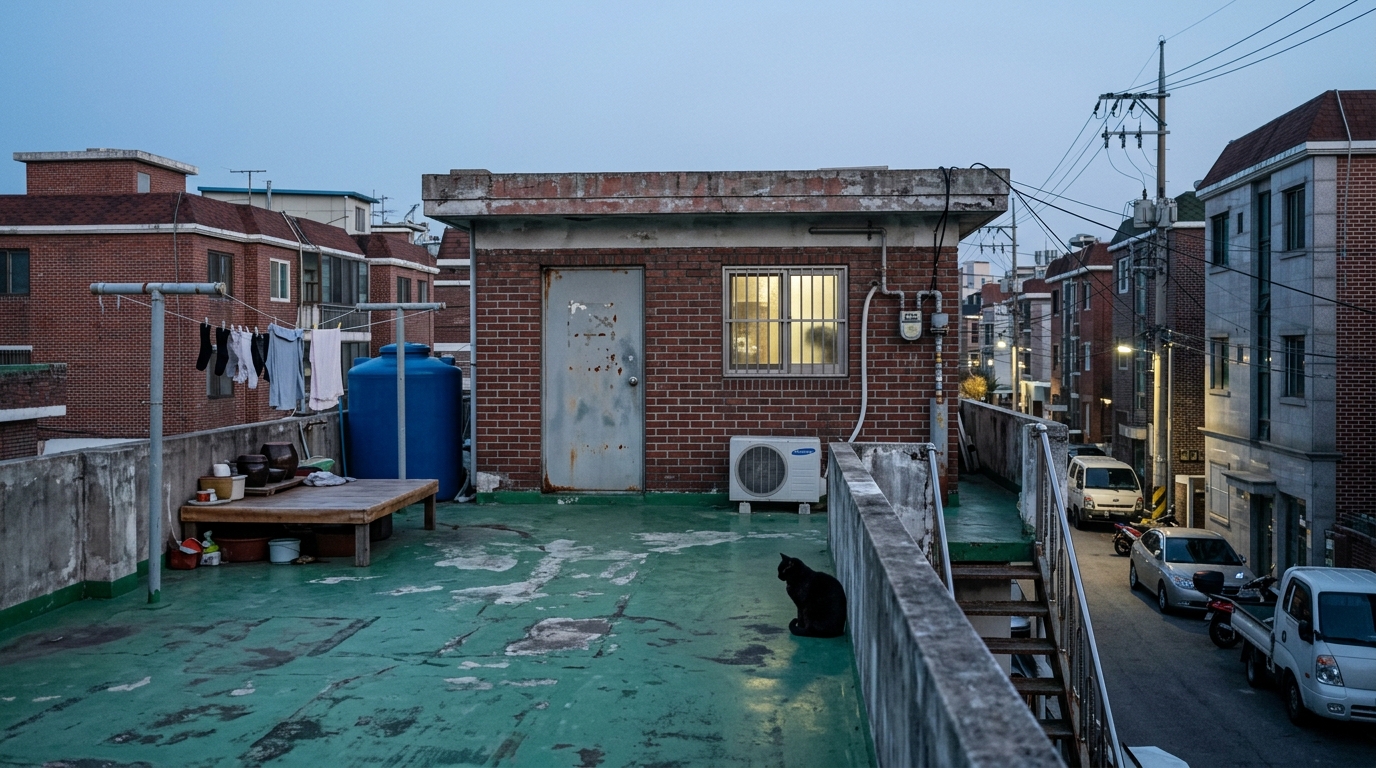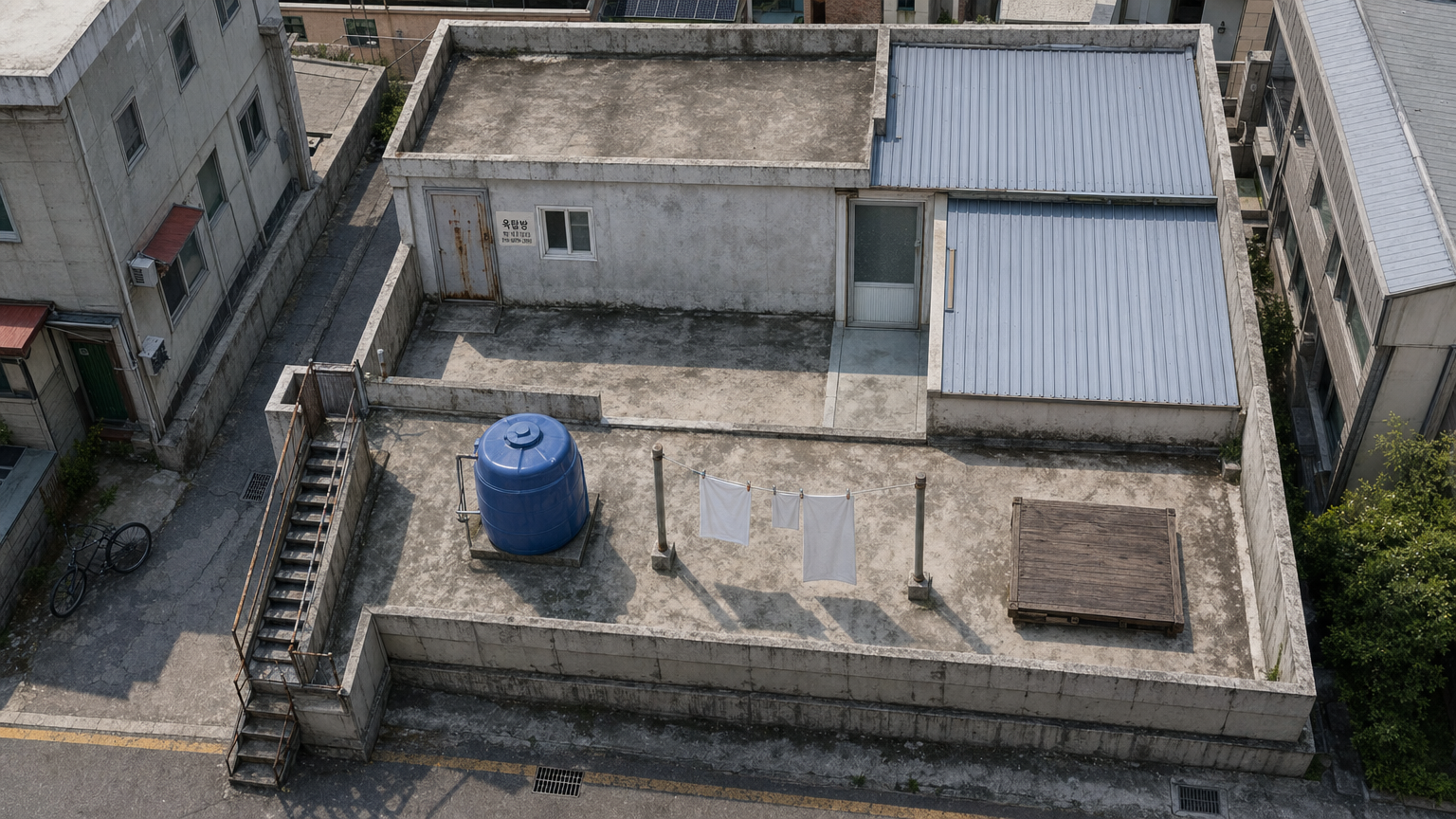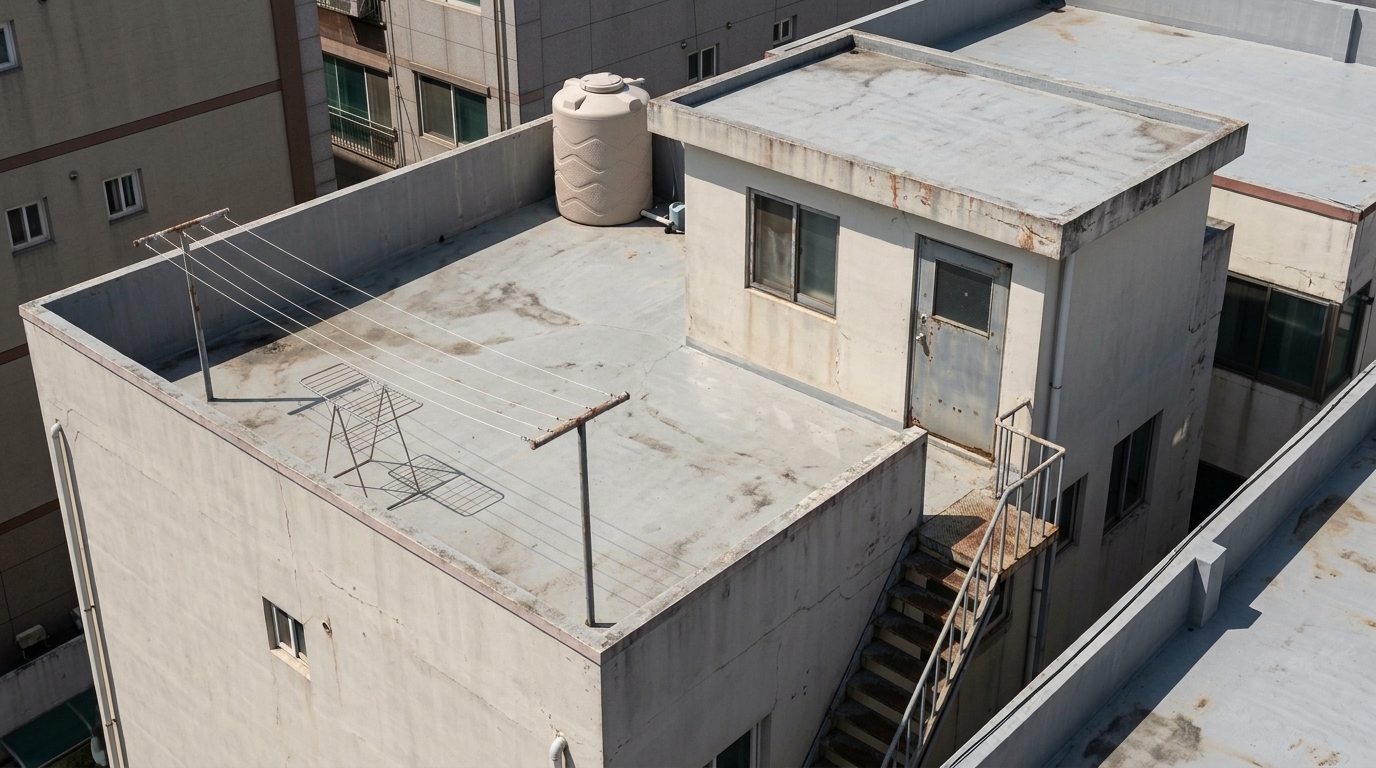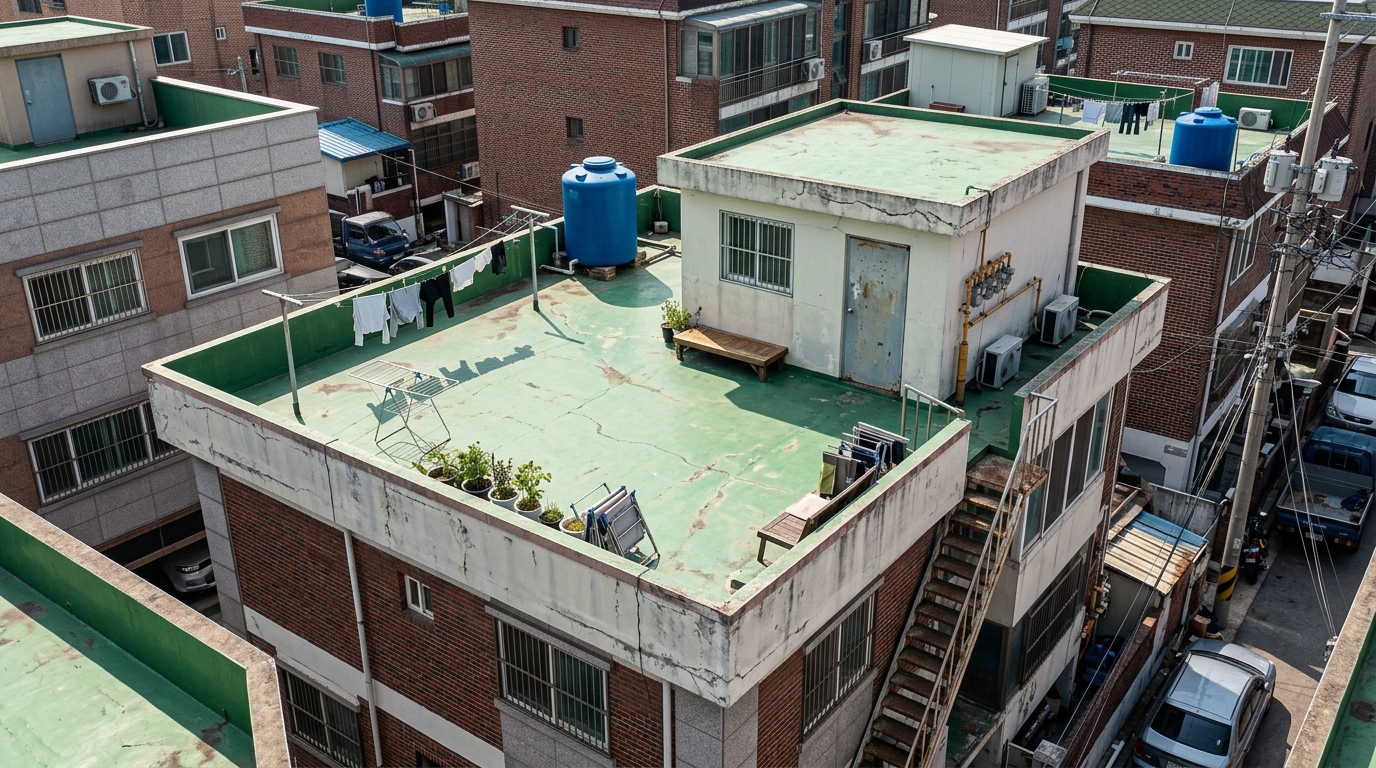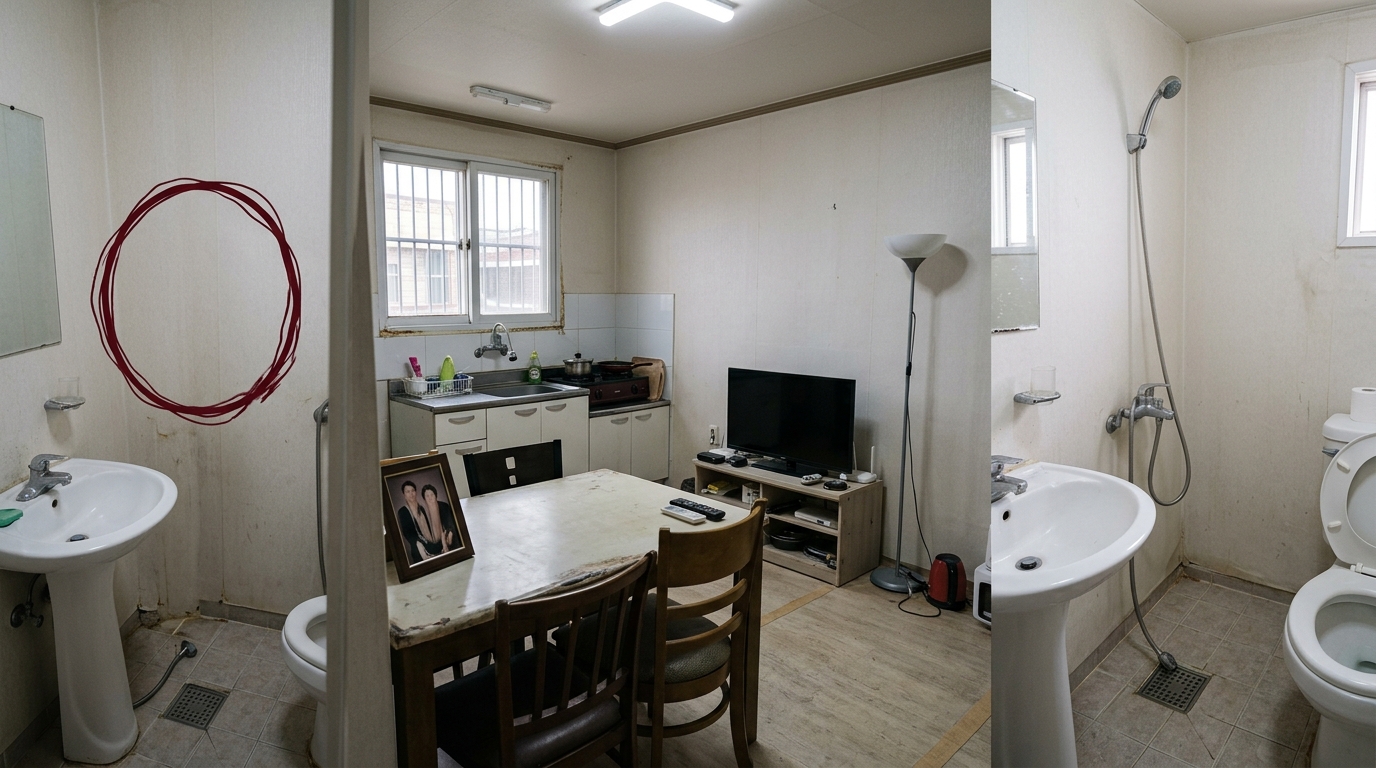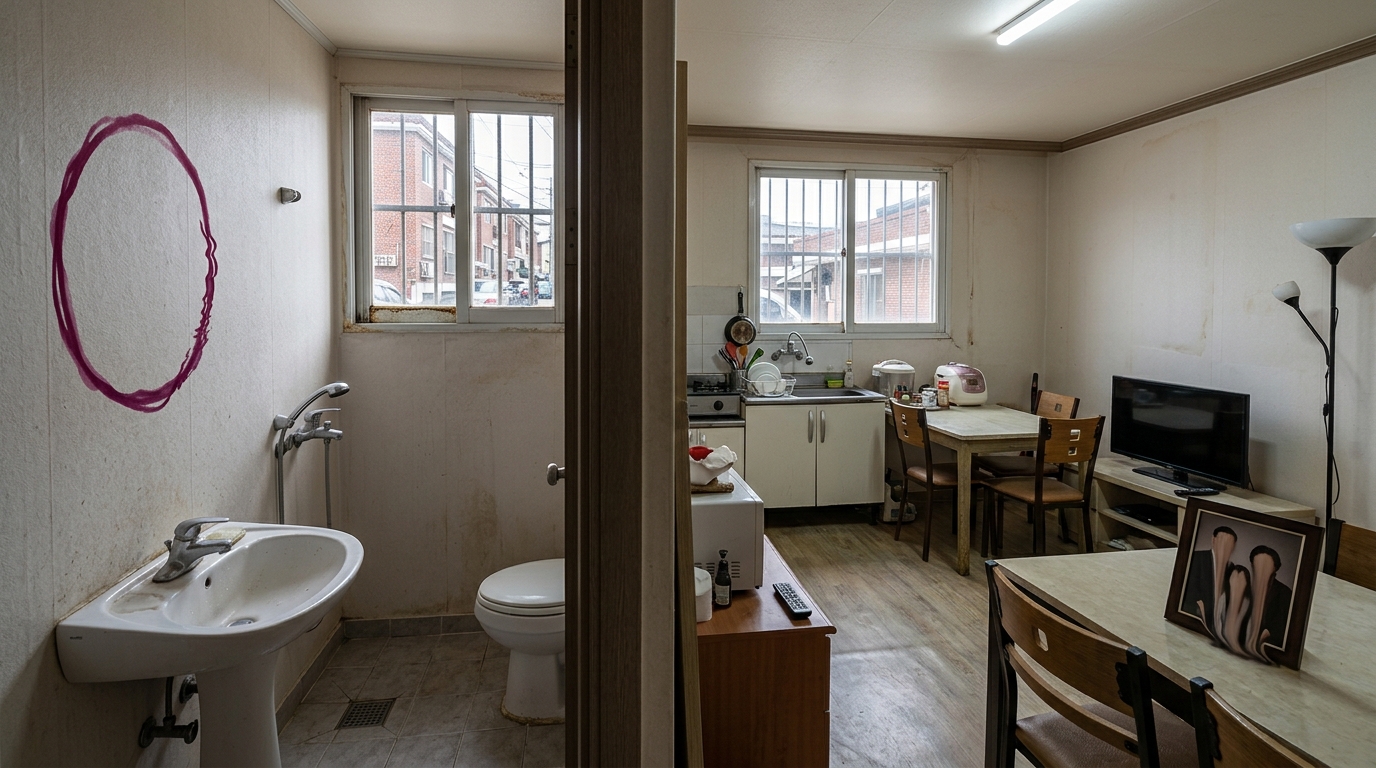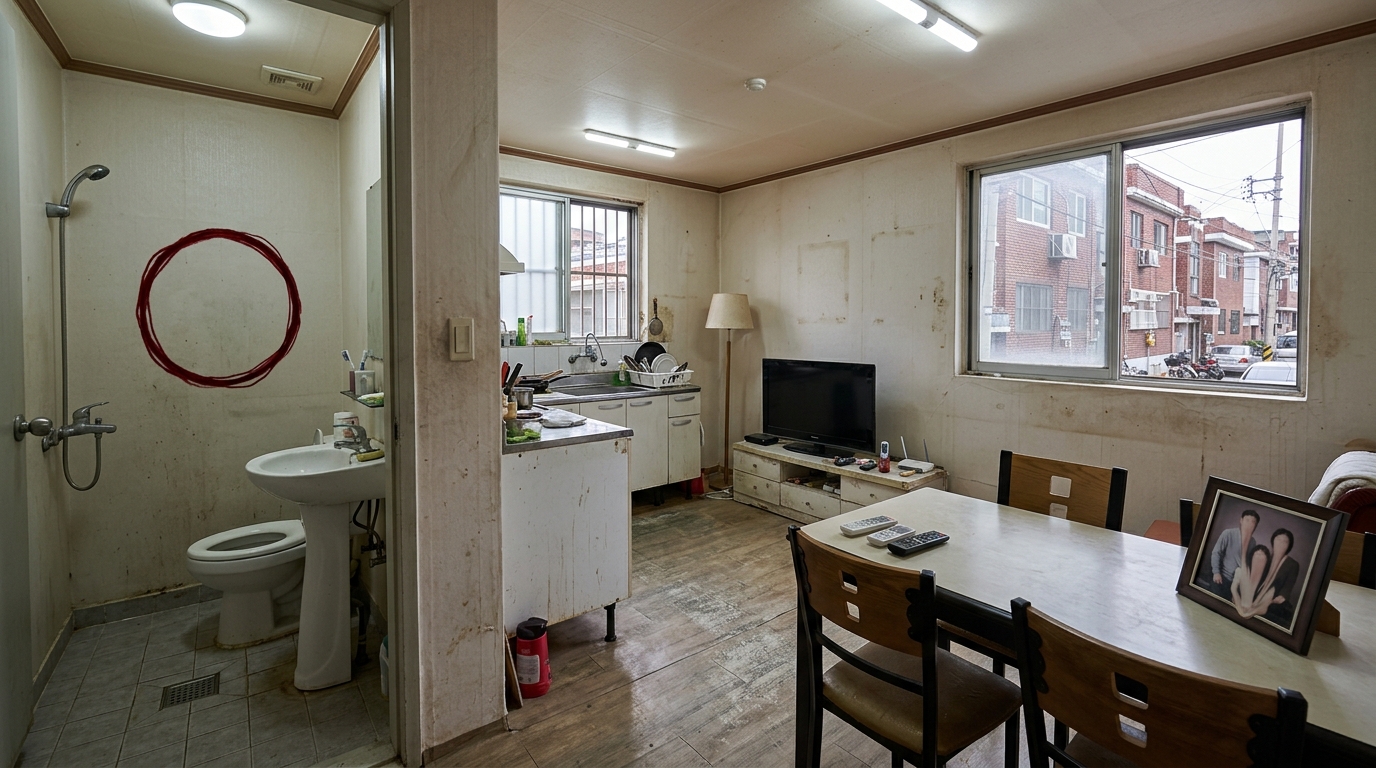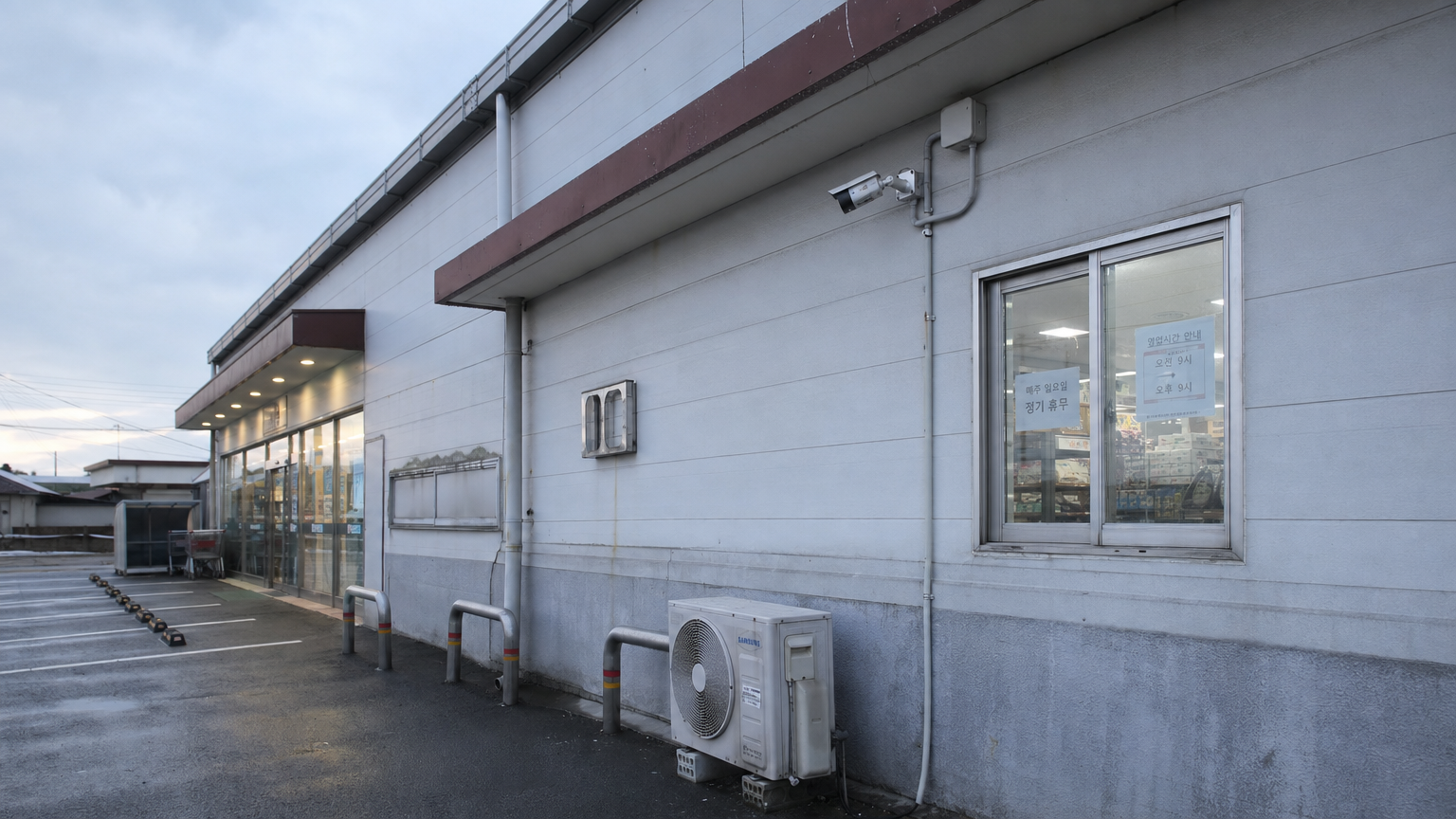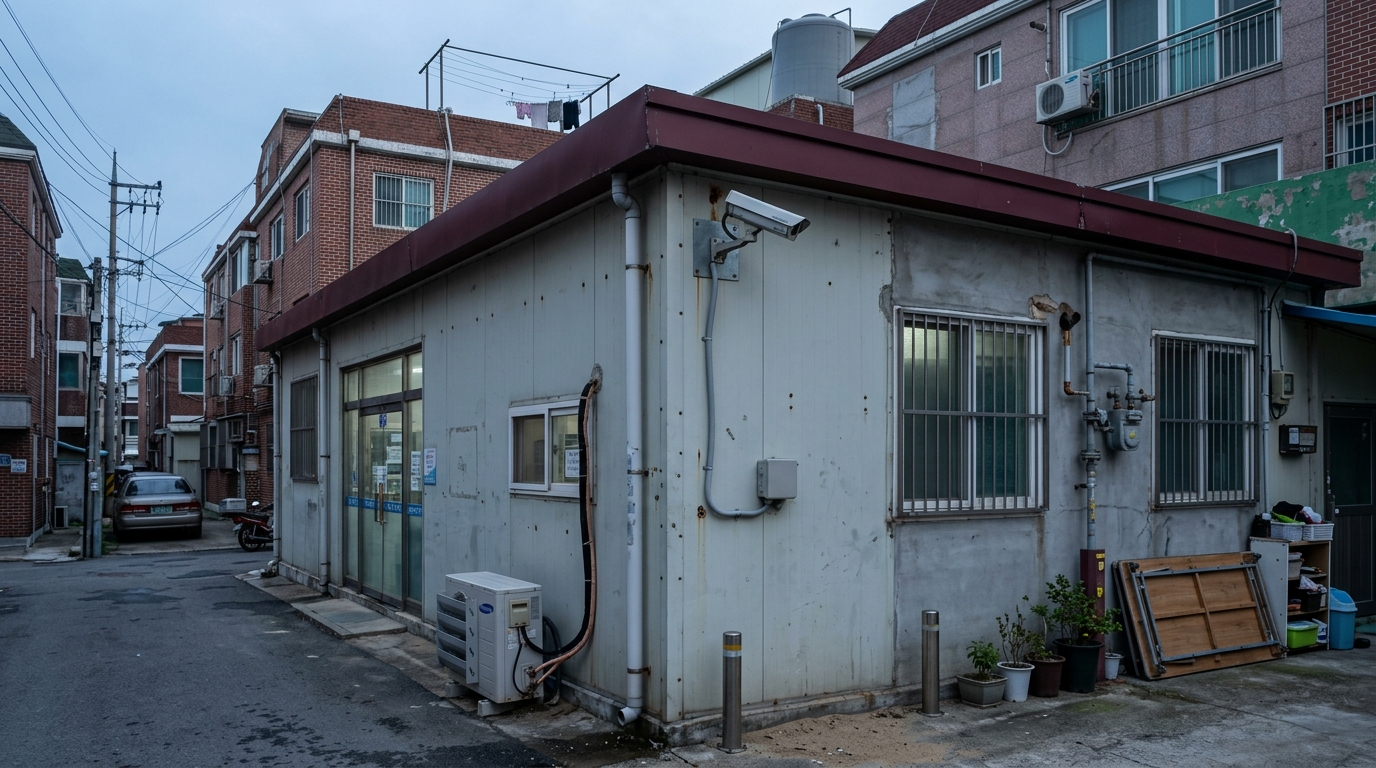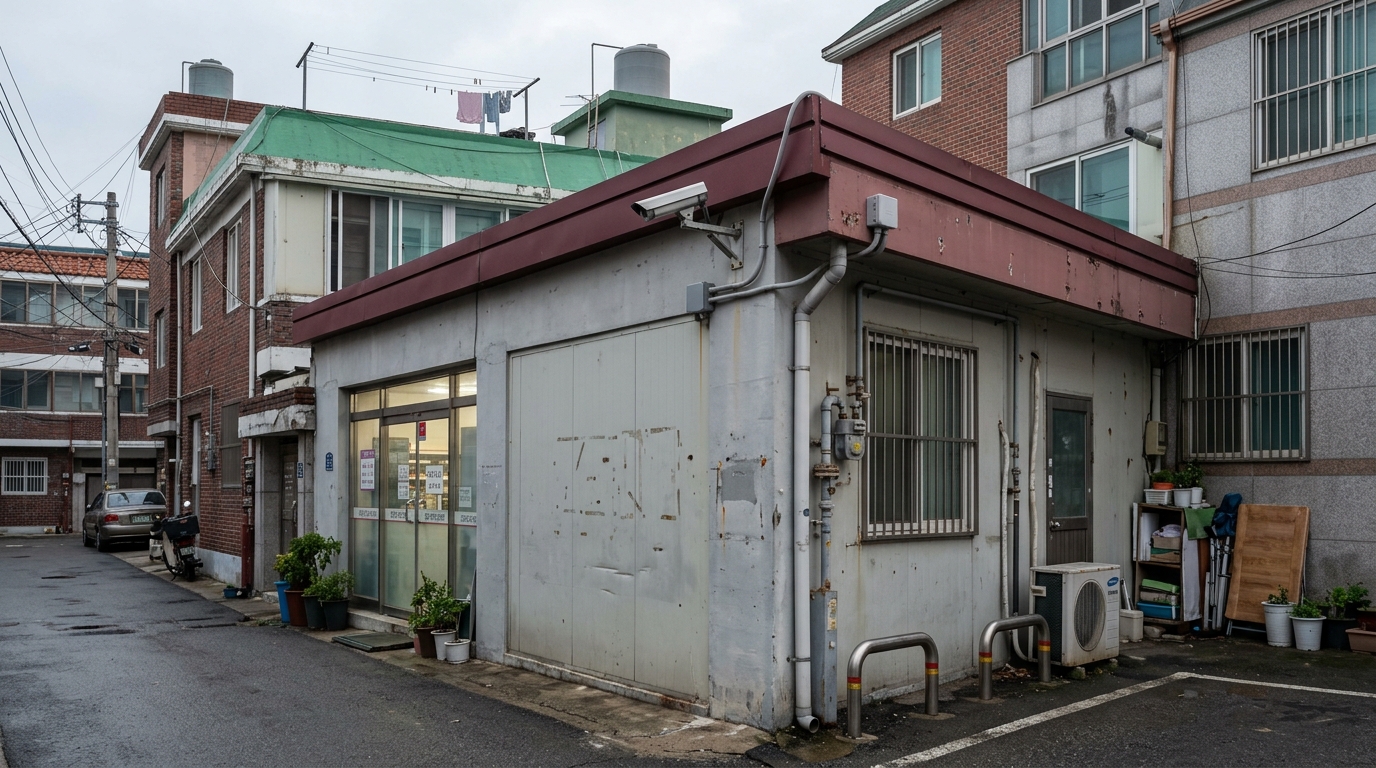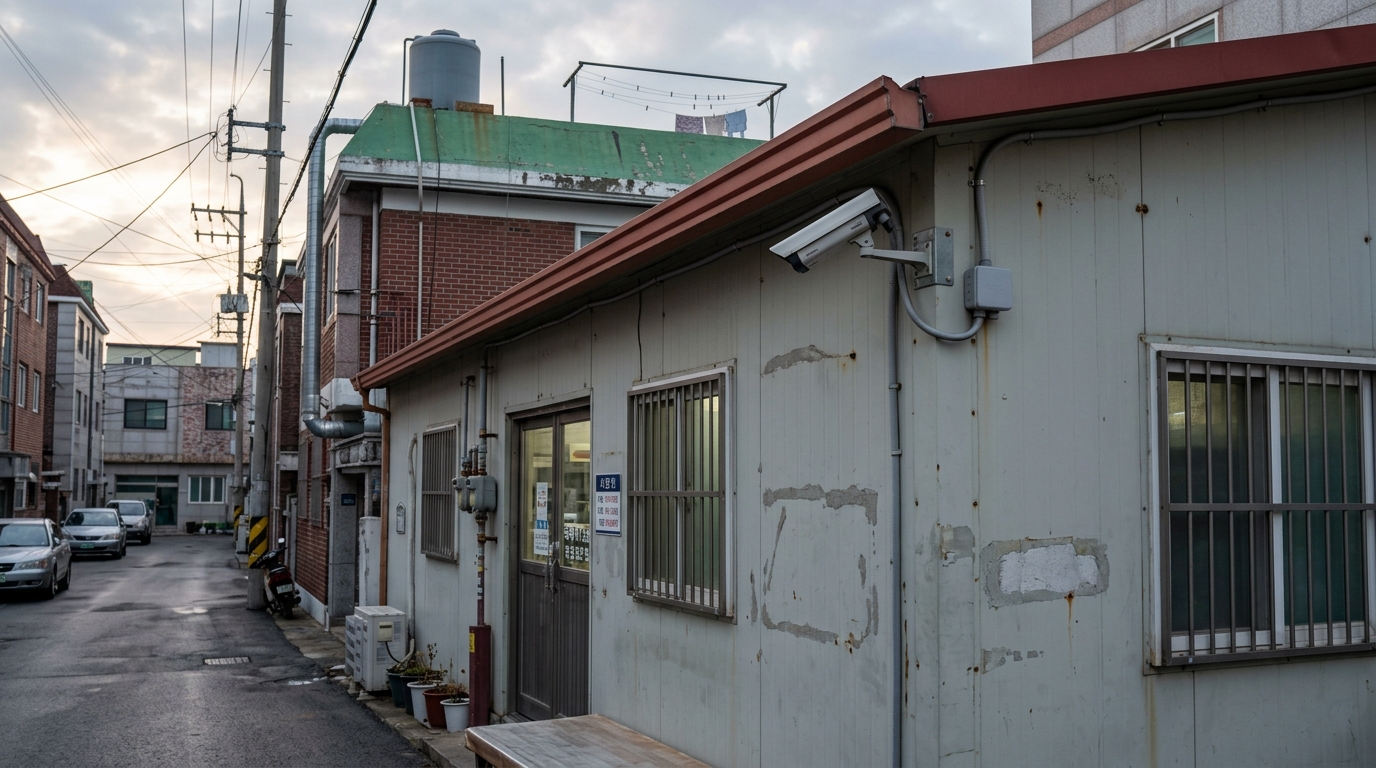
B — 4점
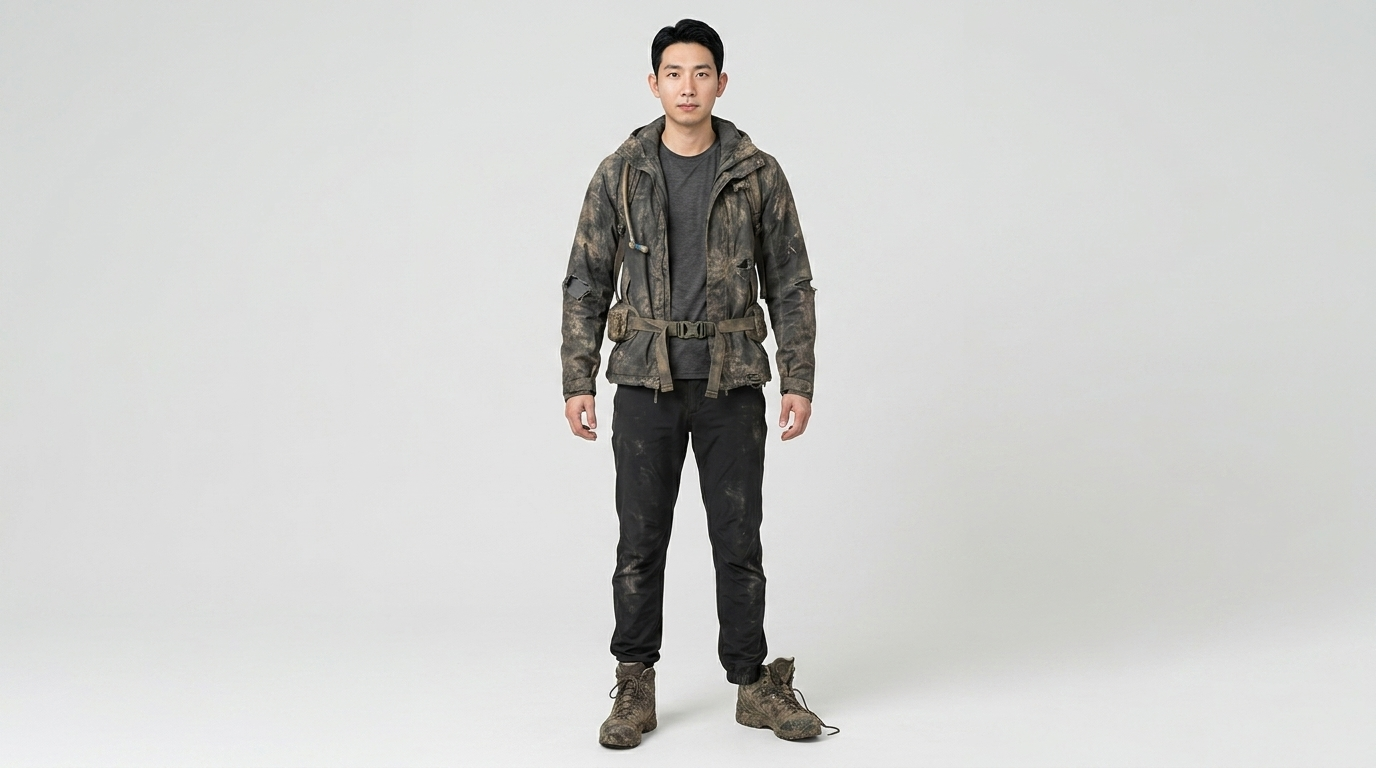
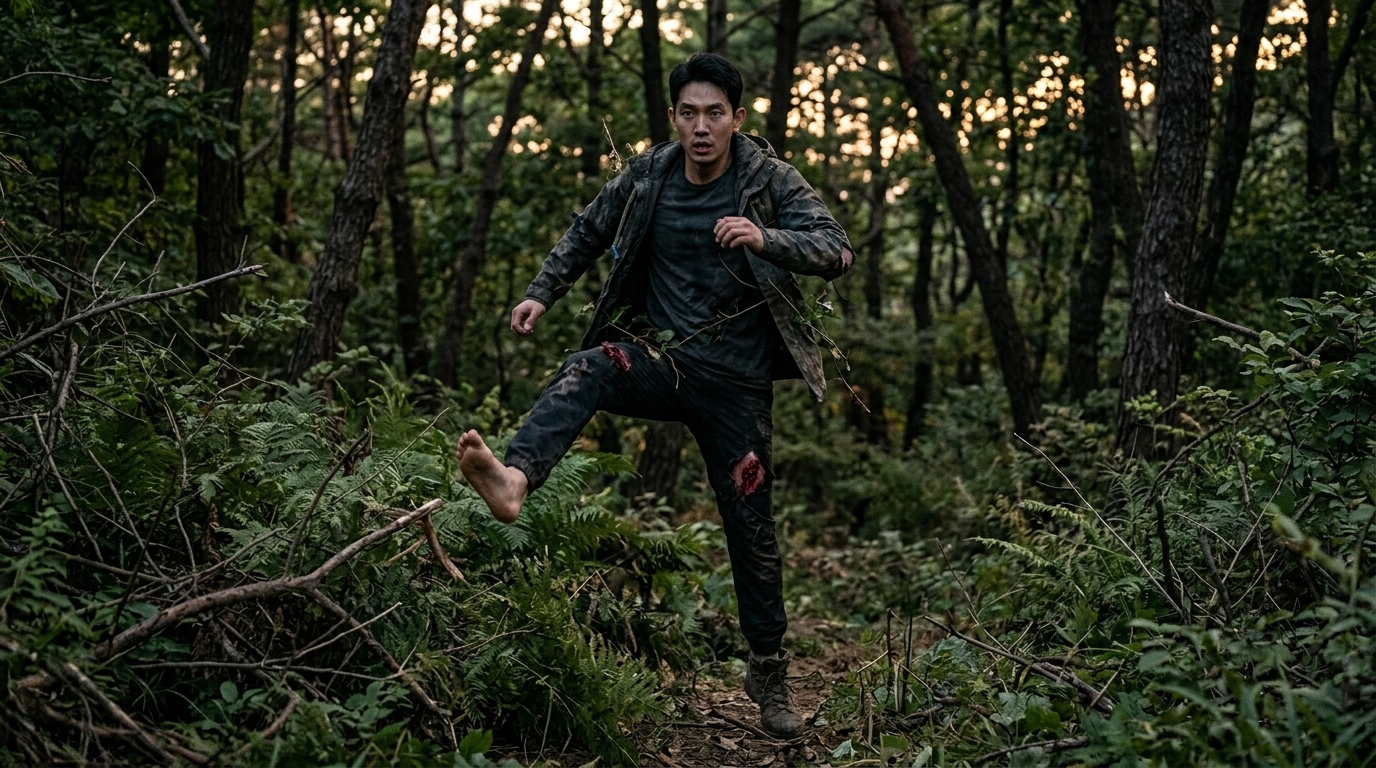
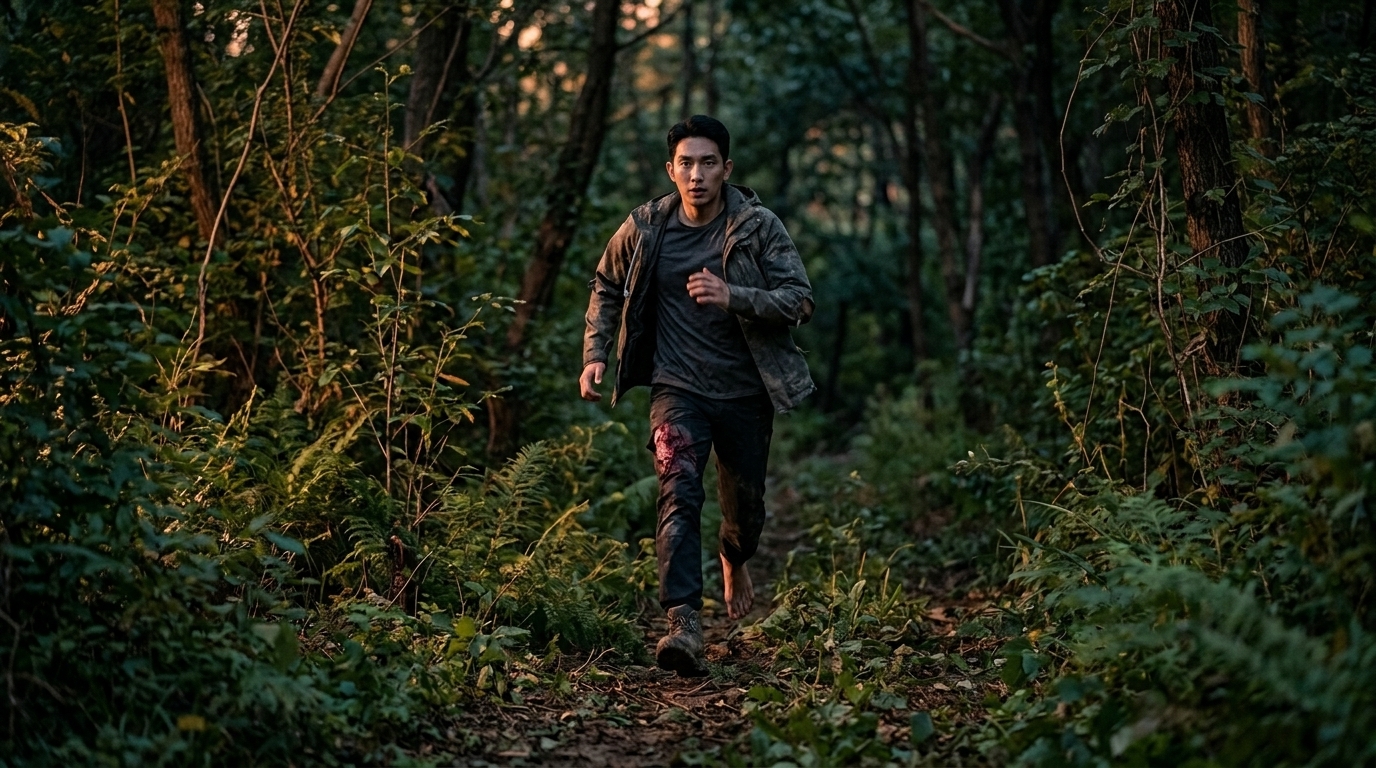
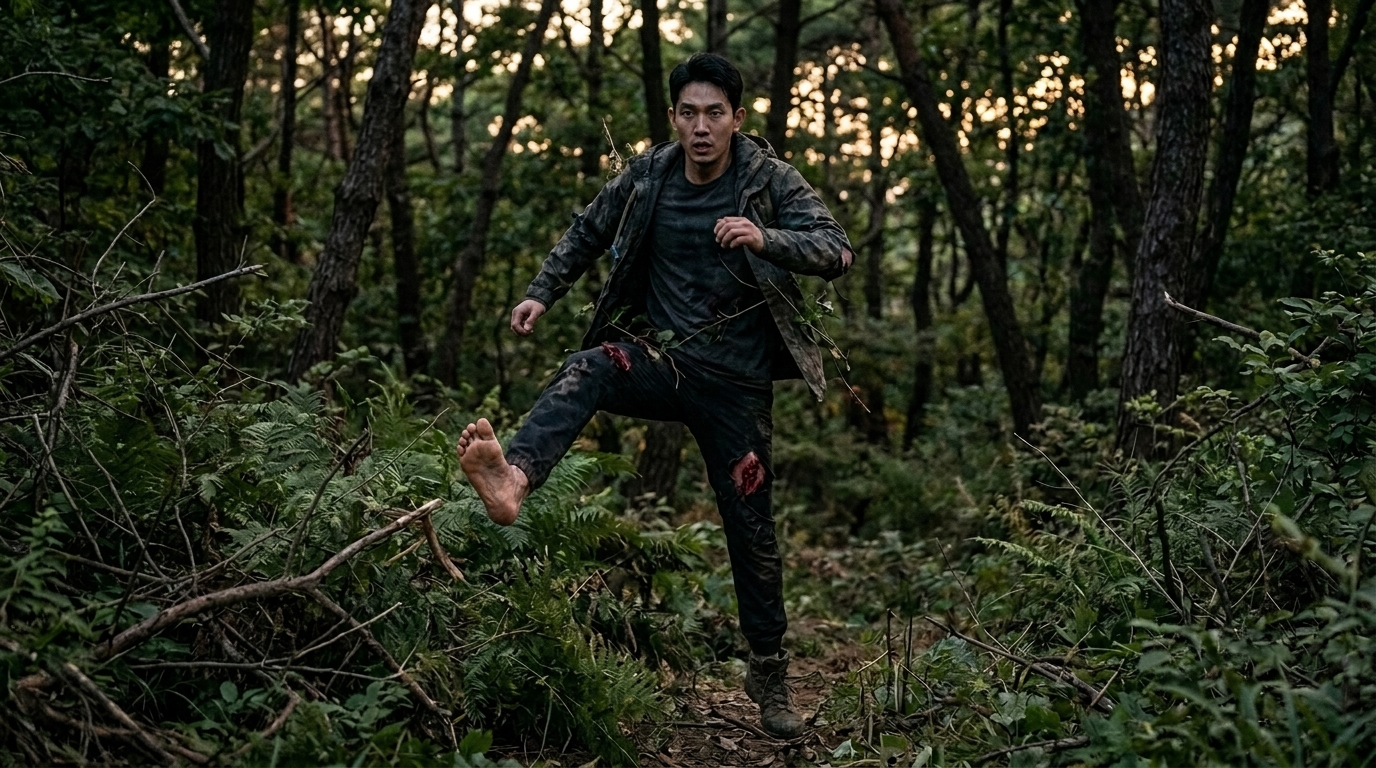
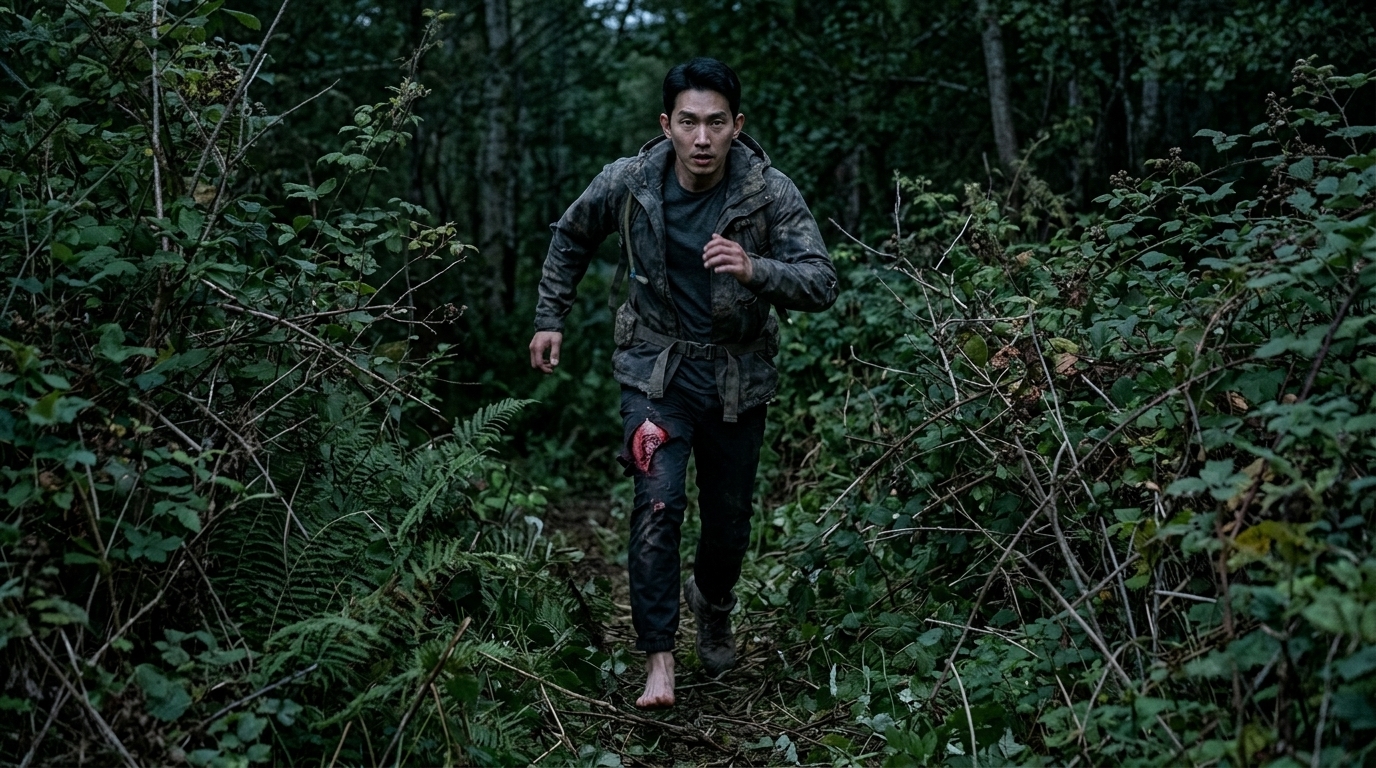
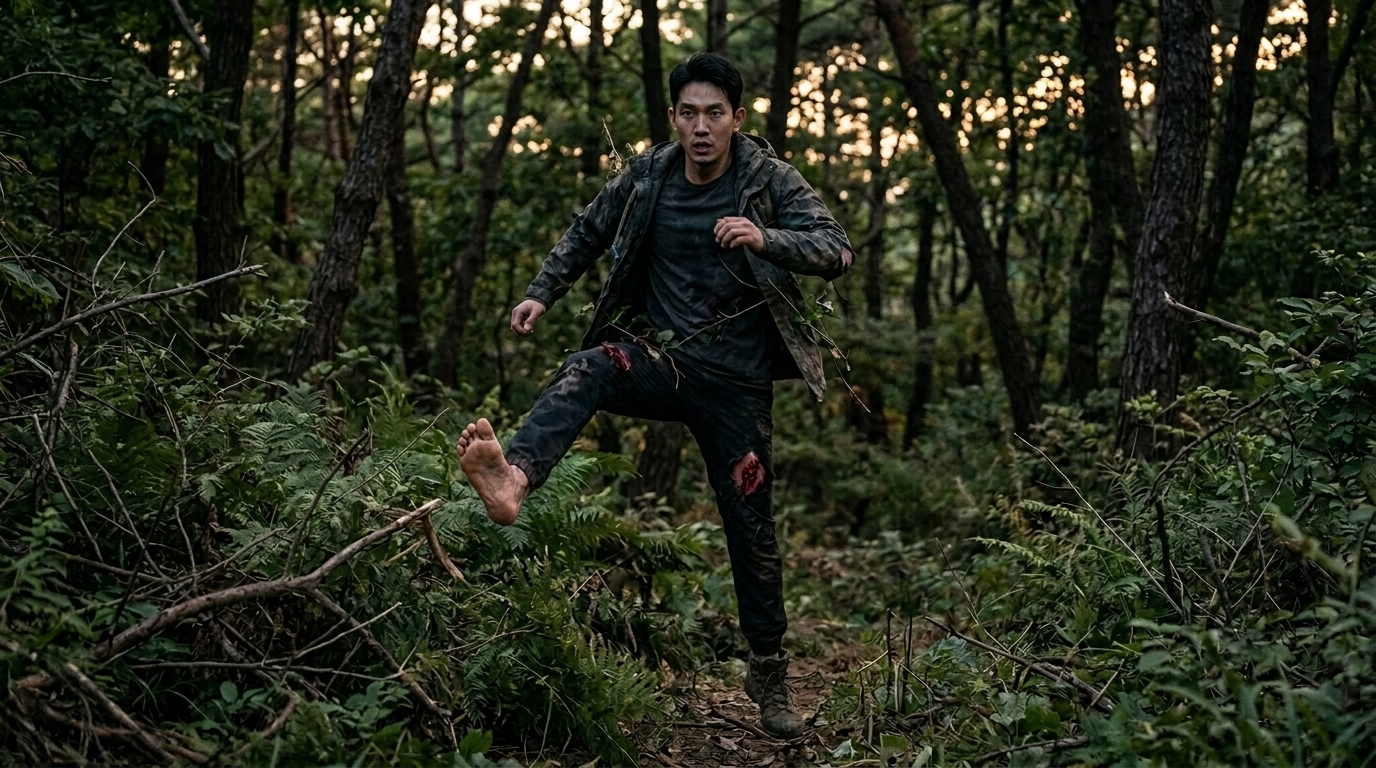
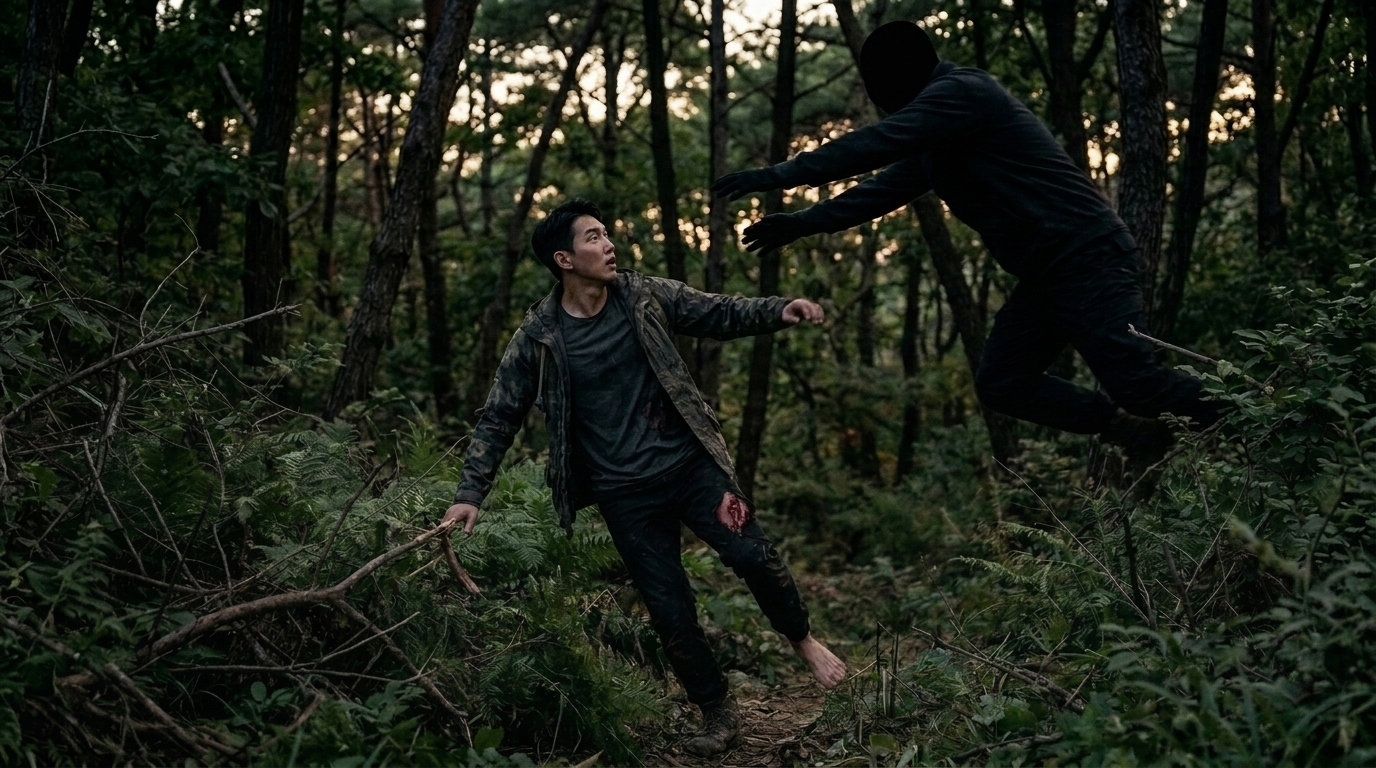
Create ONE FINAL photorealistic live-action film still of the moment below — contemporary South Korea, 2026; all people are Korean unless stated. TIME OF DAY (lock): dusk.

SHOT TEXT (authoritative, Korean): 한쪽 신발이 벗겨진 한국인 남자가 우거진 수풀 사이를 달리며 한 발을 허공에 내딛고 있는 도중의 전신 구도

LOCATION (lock): A dense forest with overgrown underbrush forming a rough escape path through the vegetation. The shot takes place here — the attached LOCATION PHOTOGRAPH shows the exact spot.

REALIZE FIGURATIVE LANGUAGE AS A LIVE-ACTION SHOT: the Korean shot
text may describe characters metaphorically, figuratively or with
exaggeration. Photograph what a real movie camera would actually
record on a physical set — exaggerated or figurative impressions
become realistic staging choices (lighting, distance, angle,
wardrobe), not literal fantasy imagery.
EVERY CHARACTER IS A HUMAN BEING: unless the story explicitly
features non-human or virtual beings (as in science fiction or
fantasy), every character — however indirectly, vaguely or
figuratively the text describes them — IS a real human. When the
text gives no direct visual description of a person, IMAGINE one
and still show them as a concrete, fully-formed human being:
always render the human form to the maximum extent — build,
posture, face, hands, clothing — never reduce a person to a shape,
blob, solid silhouette or abstract mass.

EXPRESSIONS ARE ACTED, NEVER ANATOMICAL: when the text describes a
person's eyes, face or presence emotionally or figuratively (vacant,
hollow, dazed, burning, lifeless gaze and the like), it describes an
ACTOR'S PERFORMANCE captured by a real camera — realize it ONLY
through gaze direction, focus, eyelids, facial muscles, stillness
and posture. Every living person's eyes remain anatomically normal
human eyes with a natural iris and pupil, natural sclera and normal
proportions; NEVER whiten, blank out, cloud over, glow, enlarge or
otherwise alter eyeballs, skin or anatomy — unless the story
explicitly declares that being non-human or supernatural in form.

PROPS FACE THE RIGHT WAY: every handheld or used object must be
oriented exactly as its real-world use requires. A person reading,
watching or operating something (a phone, a photograph, a paper,
any device) has its functional side — screen, front, page — facing
THEIR OWN eyes; the camera then sees whatever side the staging
geometry implies (often its back). Show the functional side to the
camera ONLY when the shot text itself stages it toward the viewer.
Never flip, mirror or reverse an object's front and back.

CARRIED STATE (persist exactly — must match the neighbouring shots of this scene): The fleeing man is missing one shoe, and the large bite wound on his thigh is visibly bleeding.

PEOPLE: the SHOT TEXT alone decides whether any person is visible in this shot. IF a person appears, they must be one of: 한국인 남자 (Korean 성인 남성, 짧은 검은 머리, 평범한 얼굴형, 일반적인 이목구비) — never anyone else, and never add a person the shot text does not show. IF only part of a person is in frame (a hand, arm, foot, back, silhouette), that body part belongs to the specific person the shot text names — its sex, age, build, skin and grooming must unmistakably match that person's profile above.

No text, captions, watermarks or annotations anywhere.
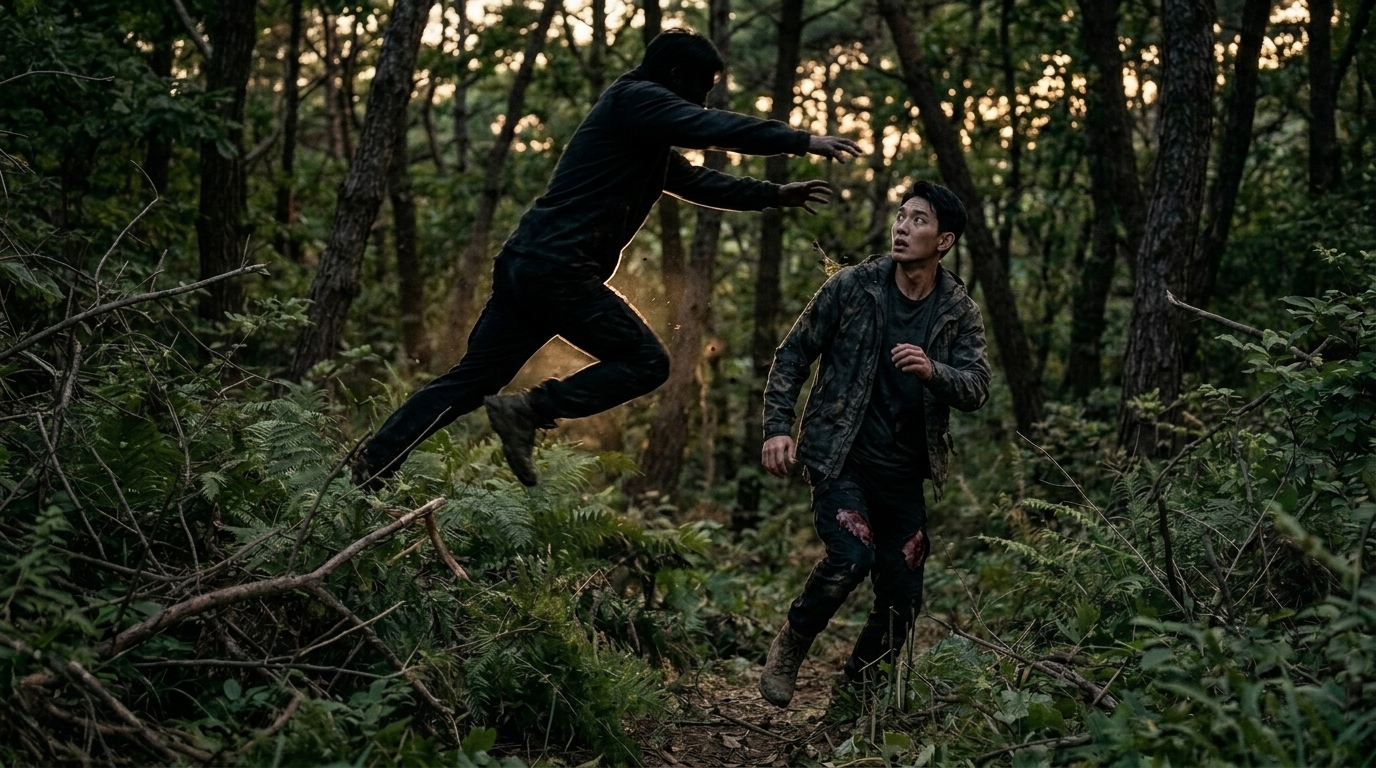
Create ONE FINAL photorealistic live-action film still of the moment below — contemporary South Korea, 2026; all people are Korean unless stated. TIME OF DAY (lock): dusk.

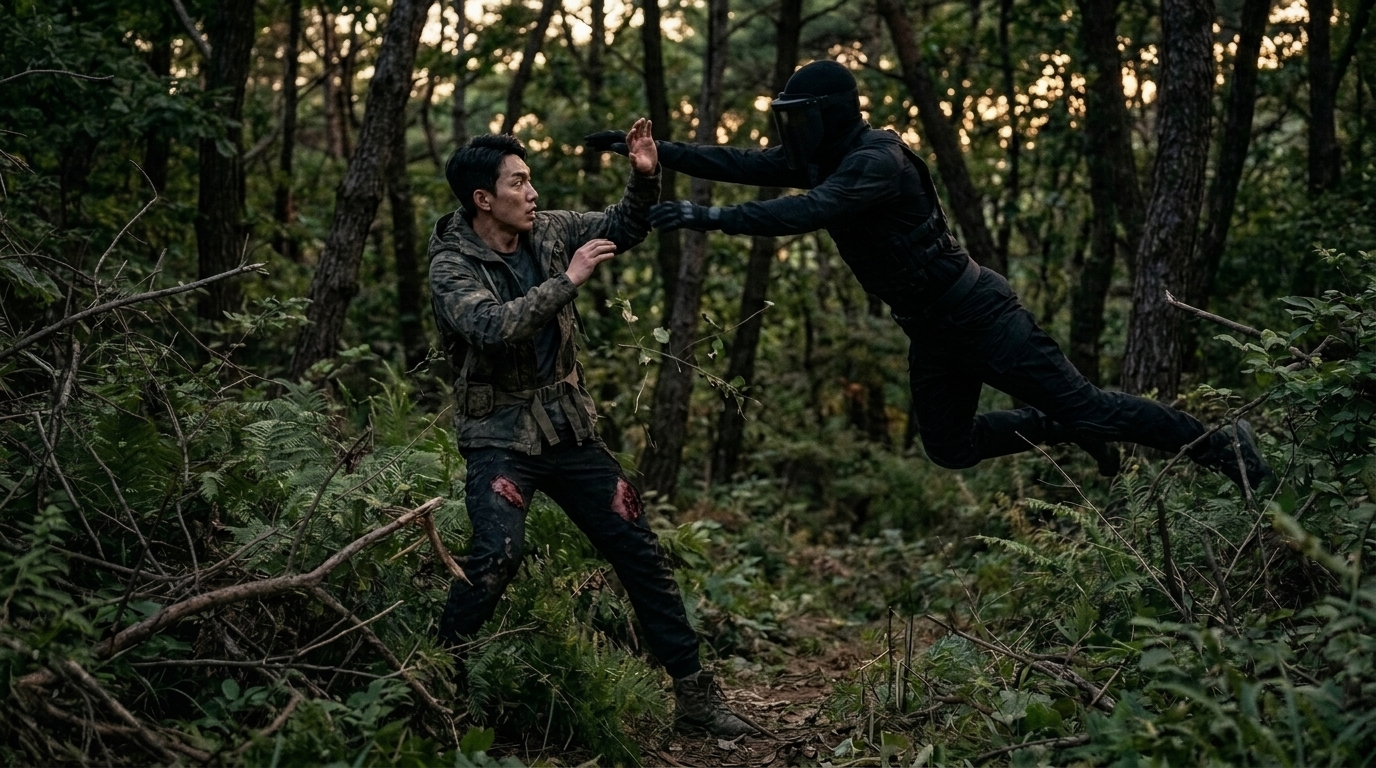
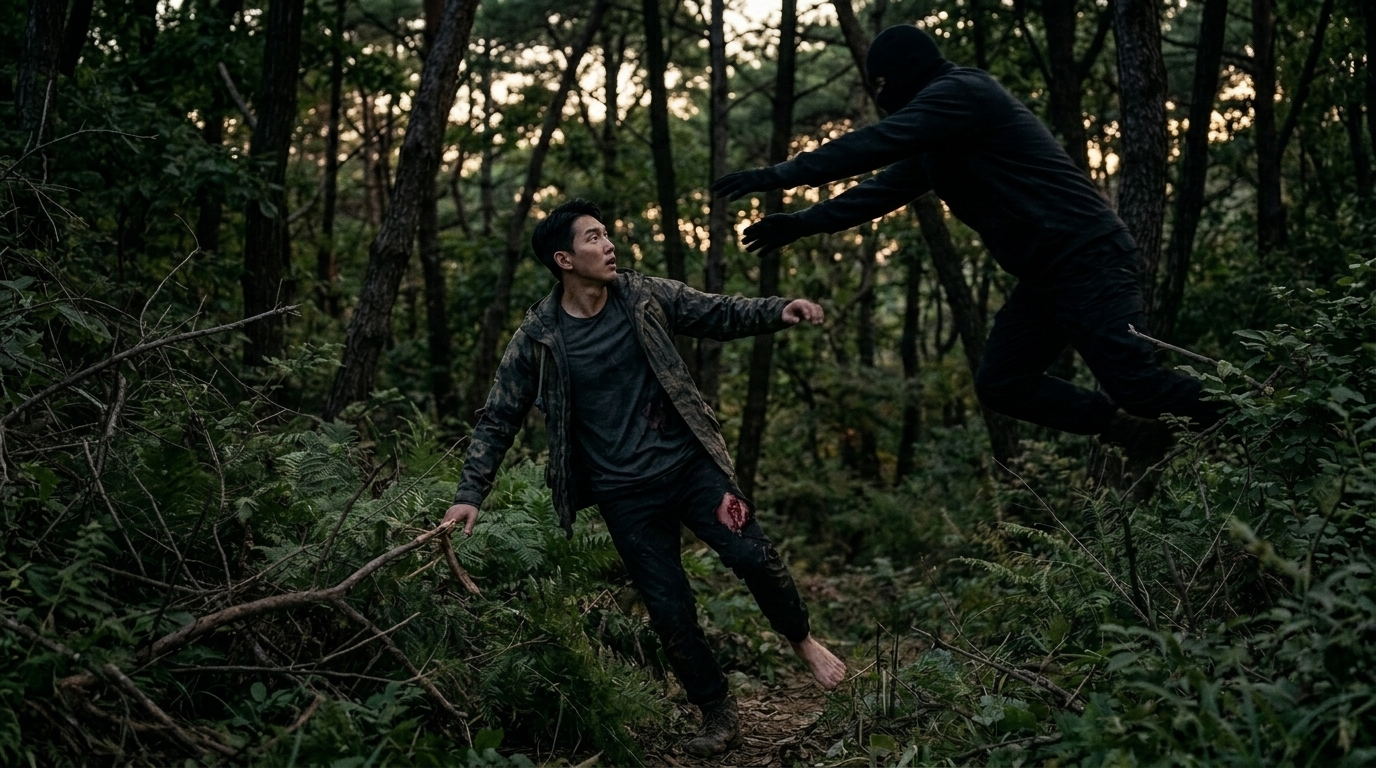
SHOT TEXT (authoritative, Korean): 검은 형상의 인영이 허공에 뛰어오른 채 한국인 남자를 향해 두 팔을 뻗고 있는 순간

LOCATION (lock): A dense forest with overgrown underbrush forming a rough escape path through the vegetation. The shot takes place here — the attached PREVIOUS SHOT STILL shows this exact place.

THIS SHOT CONTINUES THE PREVIOUS SHOT: everything the attached still established — the place, its fixed features and wear, each person's clothing and state — persists. Any person in it who cannot move stays PRECISELY as photographed (body, pose, contact points, held objects); only the camera changes.

PREVIOUS STILL USAGE (follow exactly — what to take from the attached still and what to exclude): Take the dense dusk forest, tangled undergrowth, and dim natural light from the reference. Exclude the fleeing man's exact running pose and detached shoe unless they fall naturally within this attack framing.

REALIZE FIGURATIVE LANGUAGE AS A LIVE-ACTION SHOT: the Korean shot
text may describe characters metaphorically, figuratively or with
exaggeration. Photograph what a real movie camera would actually
record on a physical set — exaggerated or figurative impressions
become realistic staging choices (lighting, distance, angle,
wardrobe), not literal fantasy imagery.
EVERY CHARACTER IS A HUMAN BEING: unless the story explicitly
features non-human or virtual beings (as in science fiction or
fantasy), every character — however indirectly, vaguely or
figuratively the text describes them — IS a real human. When the
text gives no direct visual description of a person, IMAGINE one
and still show them as a concrete, fully-formed human being:
always render the human form to the maximum extent — build,
posture, face, hands, clothing — never reduce a person to a shape,
blob, solid silhouette or abstract mass.

EXPRESSIONS ARE ACTED, NEVER ANATOMICAL: when the text describes a
person's eyes, face or presence emotionally or figuratively (vacant,
hollow, dazed, burning, lifeless gaze and the like), it describes an
ACTOR'S PERFORMANCE captured by a real camera — realize it ONLY
through gaze direction, focus, eyelids, facial muscles, stillness
and posture. Every living person's eyes remain anatomically normal
human eyes with a natural iris and pupil, natural sclera and normal
proportions; NEVER whiten, blank out, cloud over, glow, enlarge or
otherwise alter eyeballs, skin or anatomy — unless the story
explicitly declares that being non-human or supernatural in form.

PROPS FACE THE RIGHT WAY: every handheld or used object must be
oriented exactly as its real-world use requires. A person reading,
watching or operating something (a phone, a photograph, a paper,
any device) has its functional side — screen, front, page — facing
THEIR OWN eyes; the camera then sees whatever side the staging
geometry implies (often its back). Show the functional side to the
camera ONLY when the shot text itself stages it toward the viewer.
Never flip, mirror or reverse an object's front and back.

CARRIED STATE (persist exactly — must match the neighbouring shots of this scene): The man remains one-shoed with the bleeding bite wound on his thigh as the dark figure lunges at him.

PEOPLE: the SHOT TEXT alone decides whether any person is visible in this shot. IF a person appears, they must be one of: 한국인 남자 (Korean 성인 남성, 짧은 검은 머리, 평범한 얼굴형, 일반적인 이목구비); 검은 인영 (인종과 성별을 식별할 수 없는 인간형, 보이지 않는 얼굴 세부, 검은 머리 윤곽, 실루엣 형태의 머리와 얼굴) — never anyone else, and never add a person the shot text does not show. IF only part of a person is in frame (a hand, arm, foot, back, silhouette), that body part belongs to the specific person the shot text names — its sex, age, build, skin and grooming must unmistakably match that person's profile above.

No text, captions, watermarks or annotations anywhere.
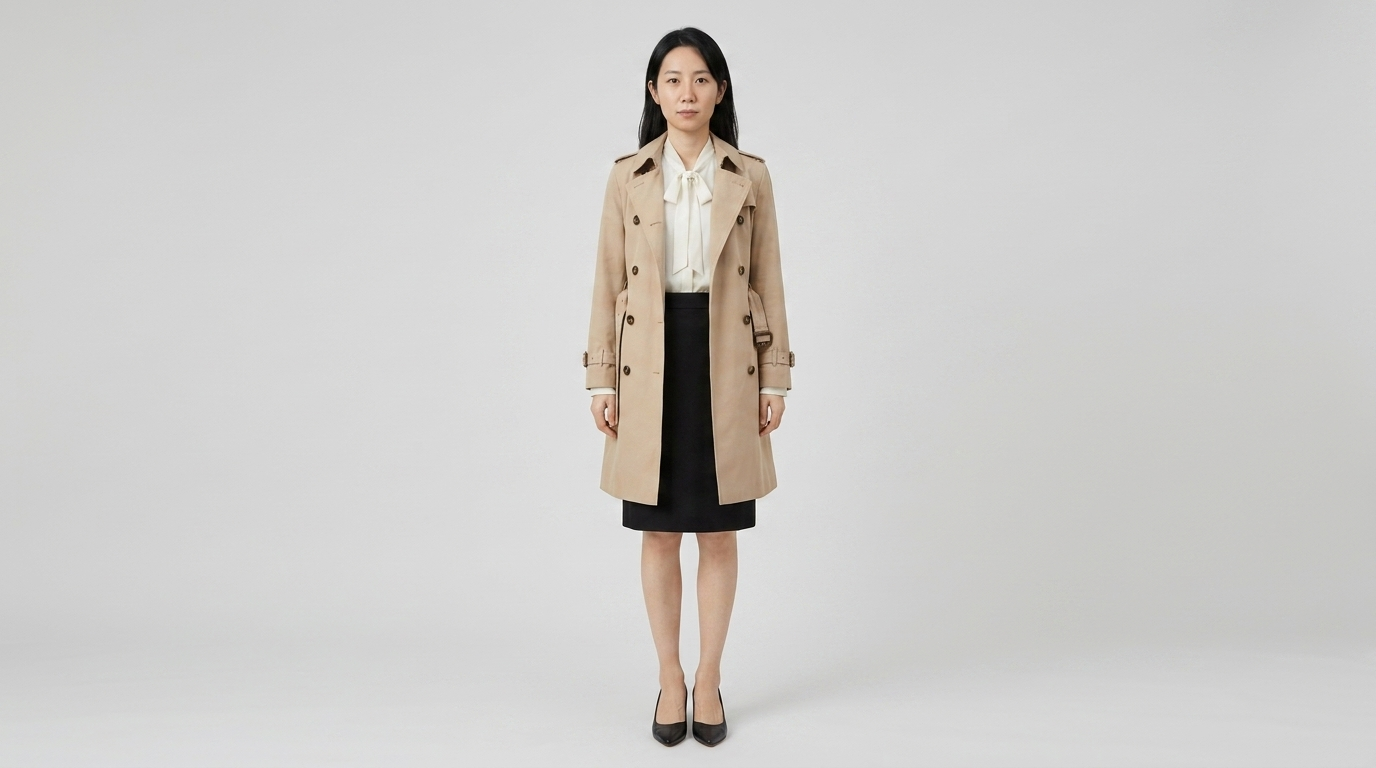
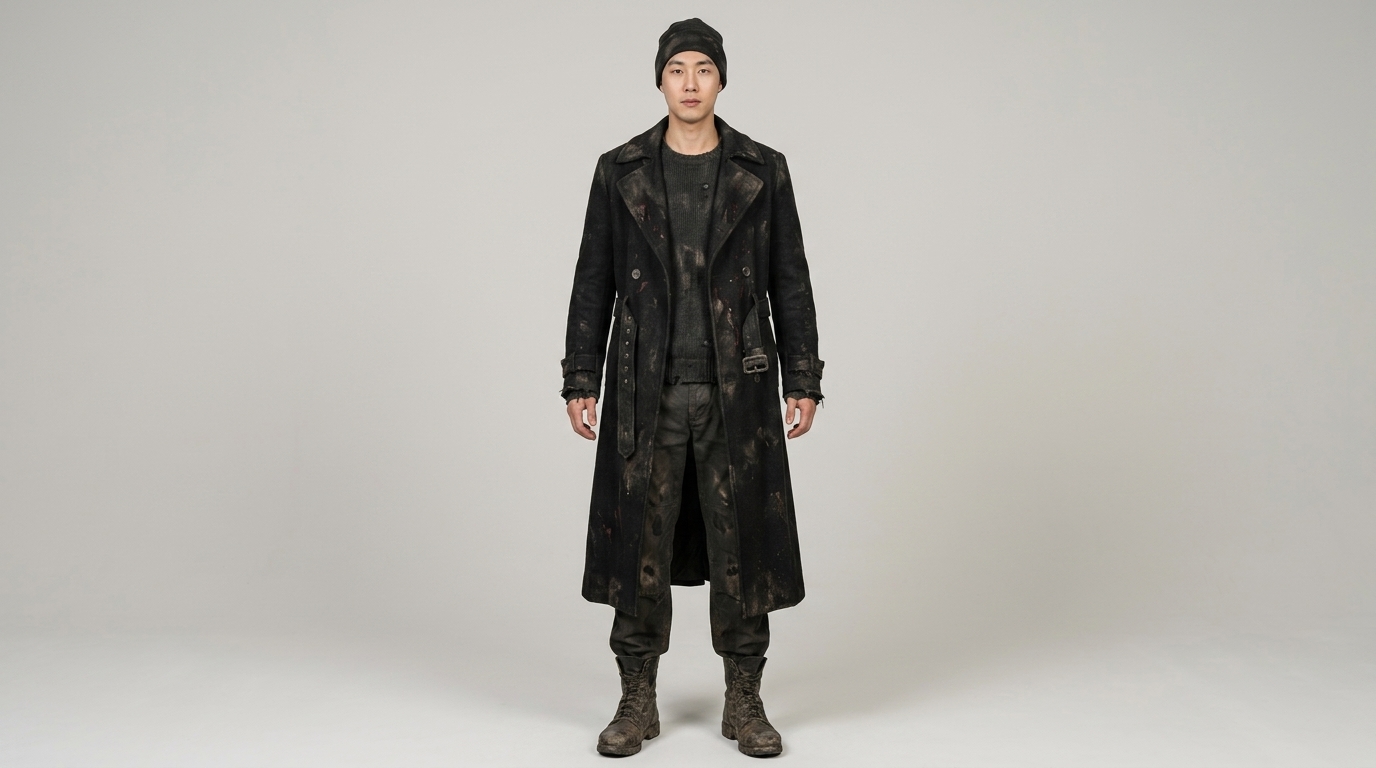
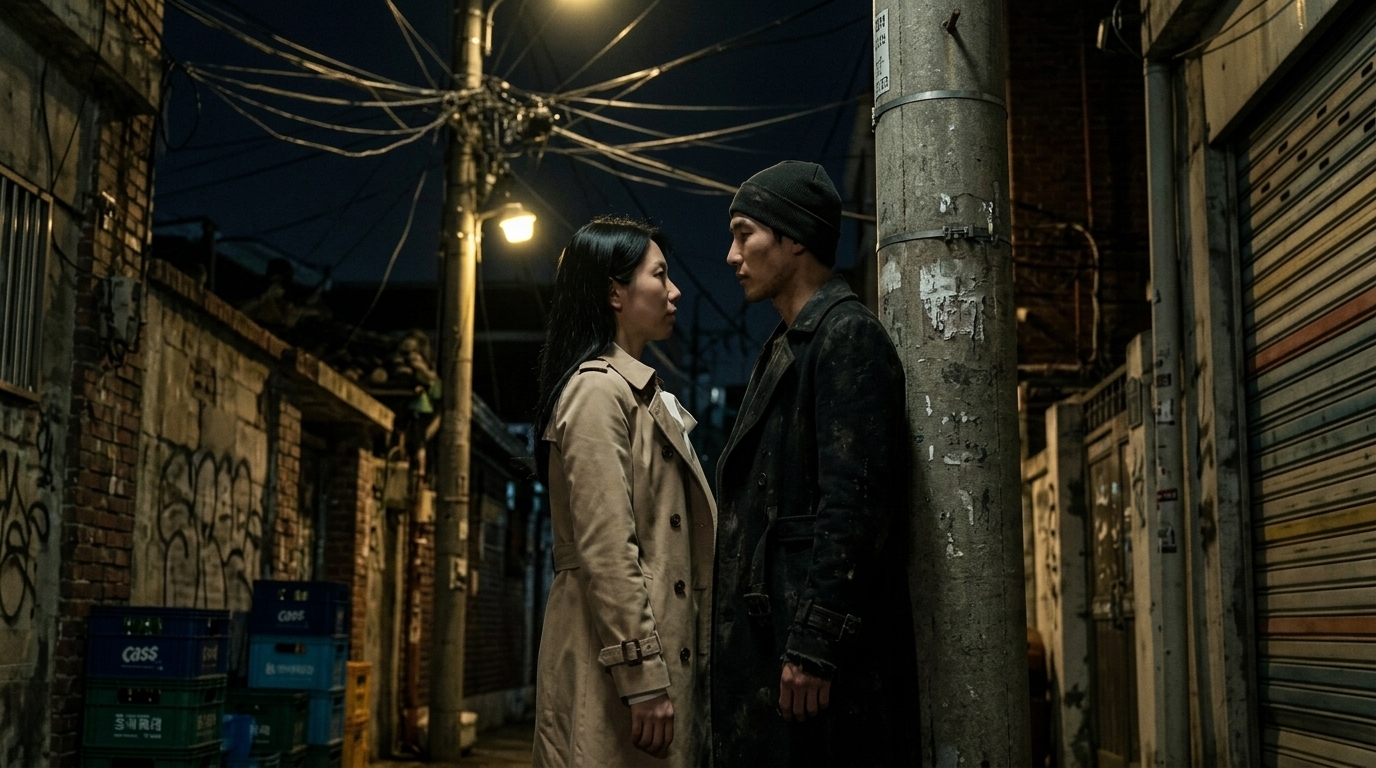
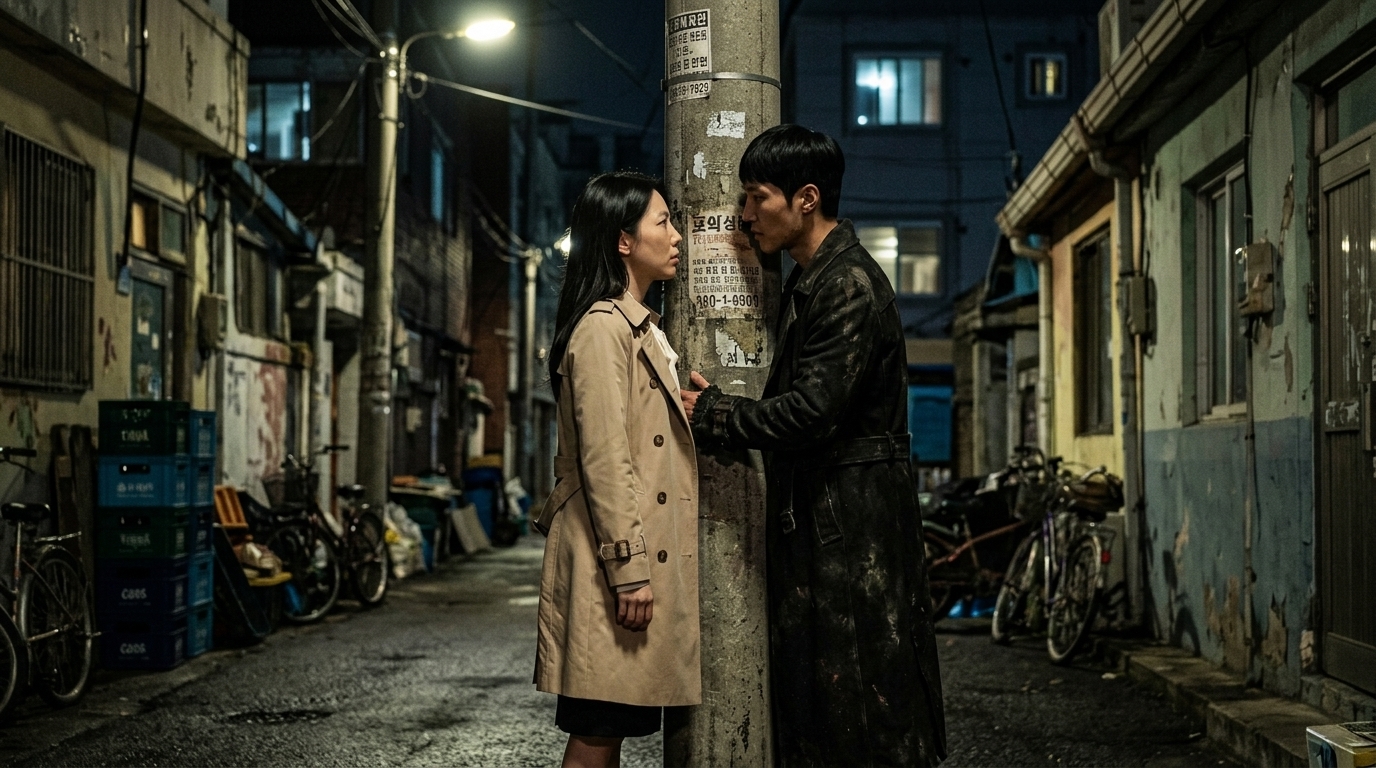
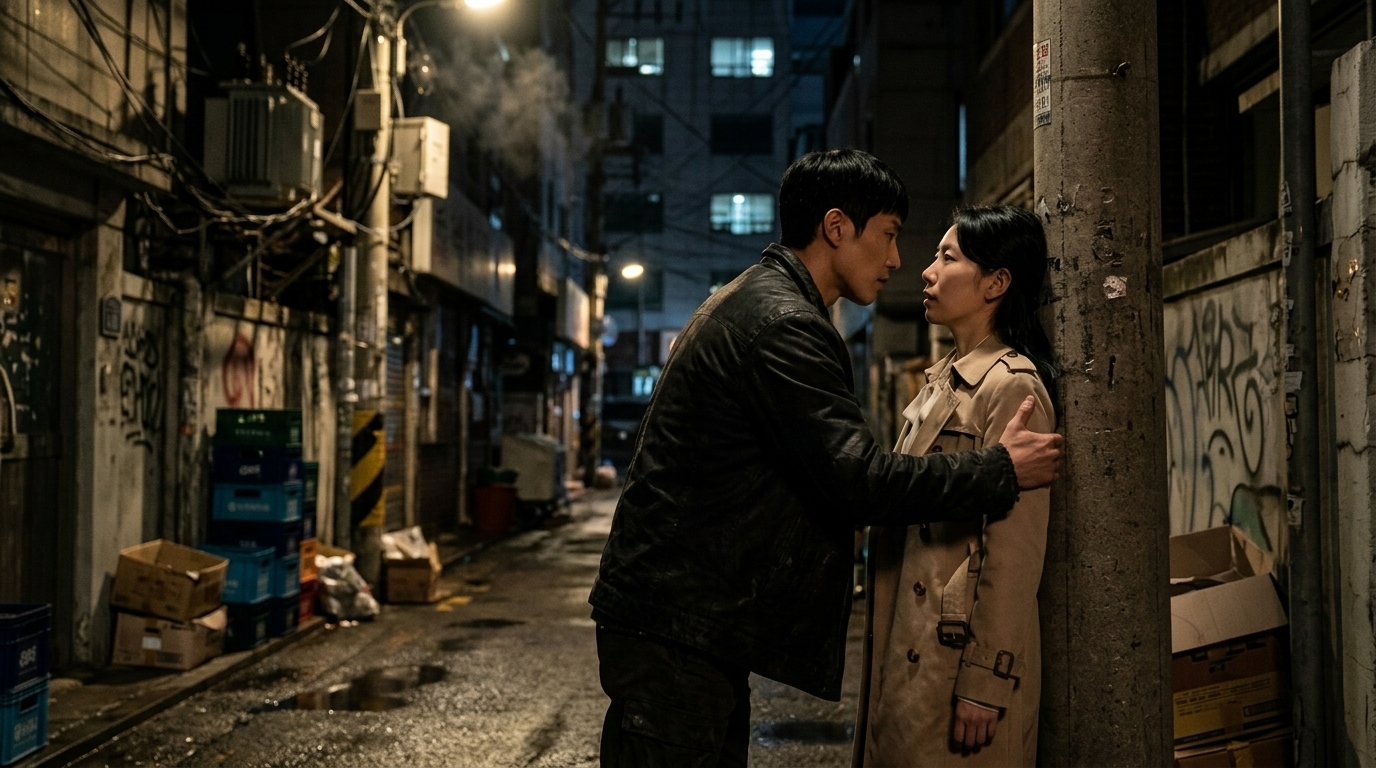
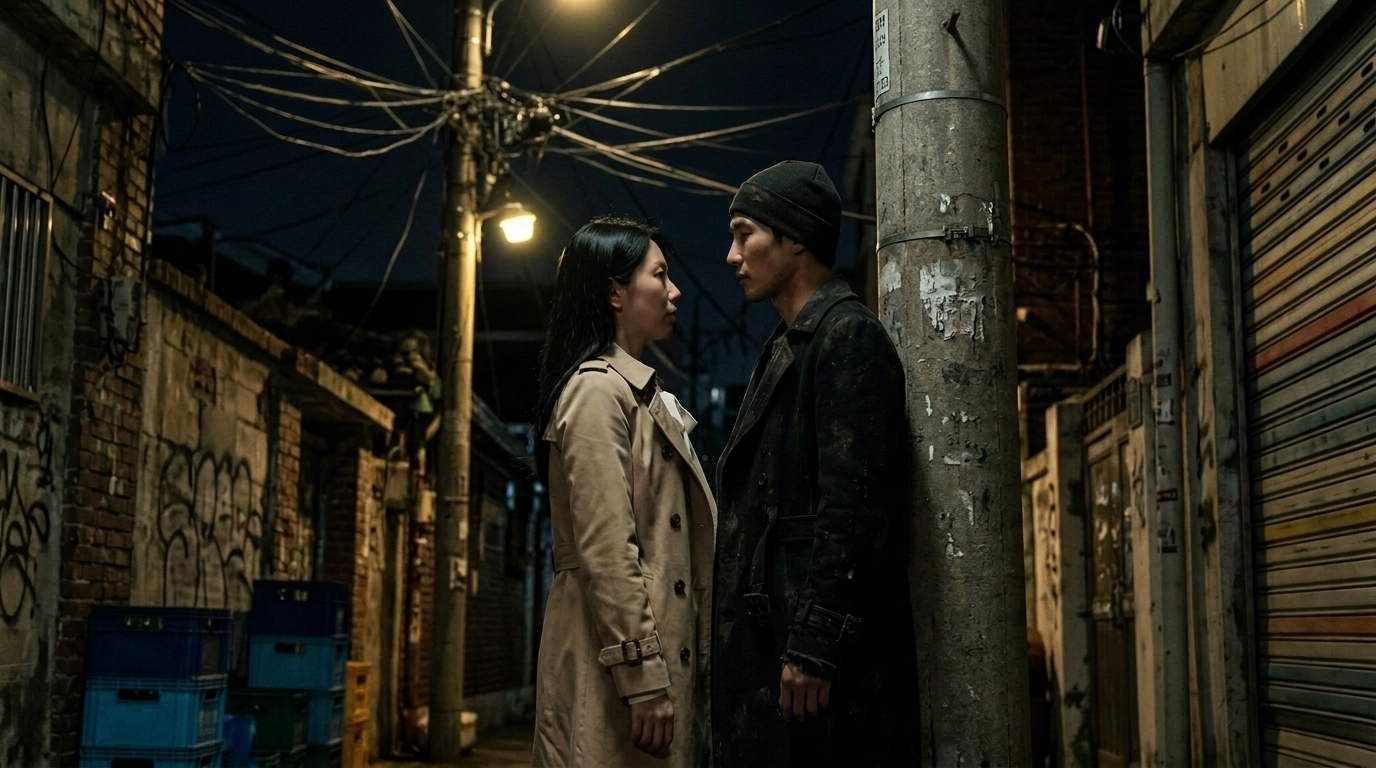
Create ONE FINAL photorealistic live-action film still of the moment below — contemporary South Korea, 2026; all people are Korean unless stated. TIME OF DAY (lock): night, dim streetlights.

SHOT TEXT (authoritative, Korean): 희미한 가로등 불빛 아래 전봇대에 밀착된 채 서 있는 한국인 남자와 한국인 여자의 옆모습

LOCATION (lock): A secluded urban back alley with utility poles and dim streetlights. The shot takes place here — the attached LOCATION PHOTOGRAPH shows the exact spot.

REALIZE FIGURATIVE LANGUAGE AS A LIVE-ACTION SHOT: the Korean shot
text may describe characters metaphorically, figuratively or with
exaggeration. Photograph what a real movie camera would actually
record on a physical set — exaggerated or figurative impressions
become realistic staging choices (lighting, distance, angle,
wardrobe), not literal fantasy imagery.
EVERY CHARACTER IS A HUMAN BEING: unless the story explicitly
features non-human or virtual beings (as in science fiction or
fantasy), every character — however indirectly, vaguely or
figuratively the text describes them — IS a real human. When the
text gives no direct visual description of a person, IMAGINE one
and still show them as a concrete, fully-formed human being:
always render the human form to the maximum extent — build,
posture, face, hands, clothing — never reduce a person to a shape,
blob, solid silhouette or abstract mass.

EXPRESSIONS ARE ACTED, NEVER ANATOMICAL: when the text describes a
person's eyes, face or presence emotionally or figuratively (vacant,
hollow, dazed, burning, lifeless gaze and the like), it describes an
ACTOR'S PERFORMANCE captured by a real camera — realize it ONLY
through gaze direction, focus, eyelids, facial muscles, stillness
and posture. Every living person's eyes remain anatomically normal
human eyes with a natural iris and pupil, natural sclera and normal
proportions; NEVER whiten, blank out, cloud over, glow, enlarge or
otherwise alter eyeballs, skin or anatomy — unless the story
explicitly declares that being non-human or supernatural in form.

PROPS FACE THE RIGHT WAY: every handheld or used object must be
oriented exactly as its real-world use requires. A person reading,
watching or operating something (a phone, a photograph, a paper,
any device) has its functional side — screen, front, page — facing
THEIR OWN eyes; the camera then sees whatever side the staging
geometry implies (often its back). Show the functional side to the
camera ONLY when the shot text itself stages it toward the viewer.
Never flip, mirror or reverse an object's front and back.

CARRIED STATE (persist exactly — must match the neighbouring shots of this scene): The man and woman remain pressed together against the utility pole beneath the dim streetlight.

PEOPLE: the SHOT TEXT alone decides whether any person is visible in this shot. IF a person appears, they must be one of: 한국인 여자 (Korean 성인 여성, 자연스러운 검은 머리, 평범한 타원형 얼굴, 일반적인 이목구비); 한국인 남자 (포식 상태) (Korean 성인 남성, 짧은 검은 머리, 평범한 얼굴형, 자연스러운 기본 이목구비) — never anyone else, and never add a person the shot text does not show. IF only part of a person is in frame (a hand, arm, foot, back, silhouette), that body part belongs to the specific person the shot text names — its sex, age, build, skin and grooming must unmistakably match that person's profile above.

No text, captions, watermarks or annotations anywhere.
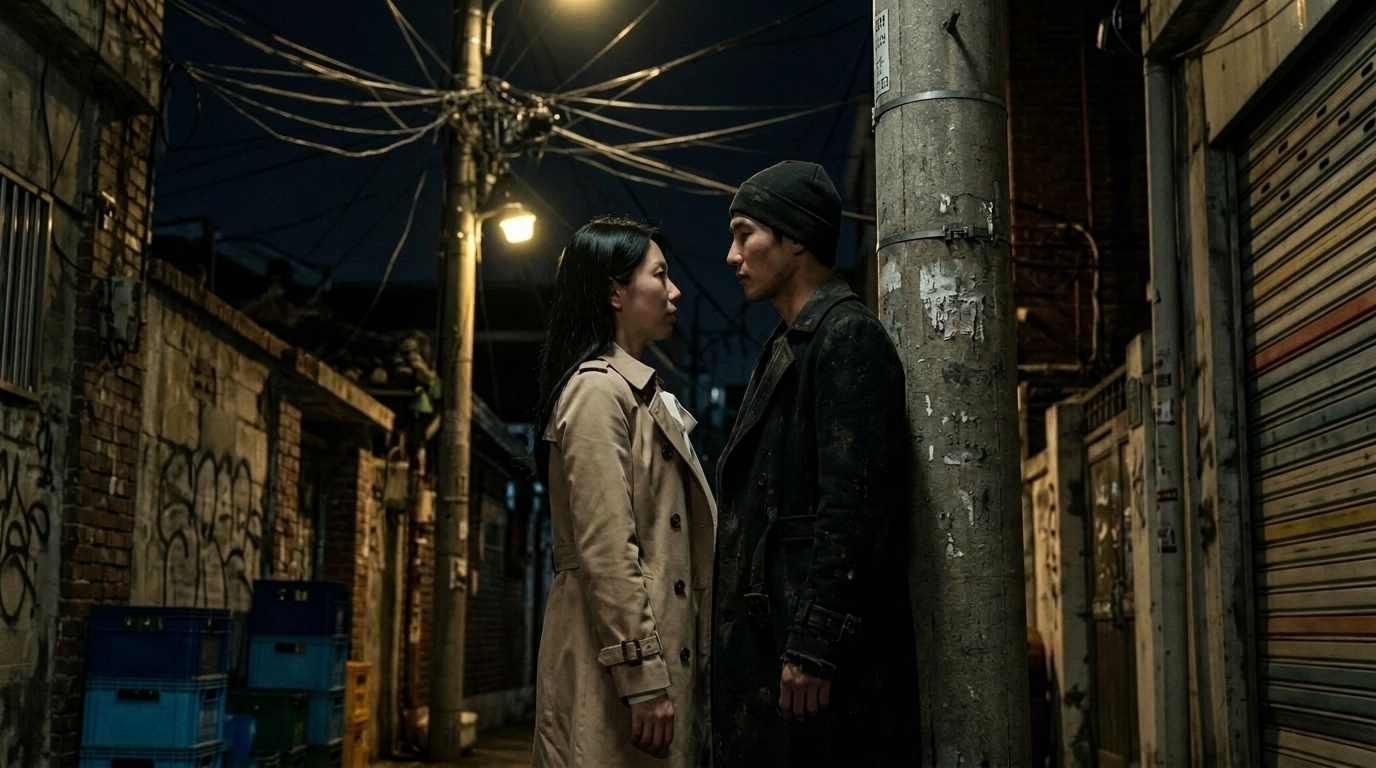
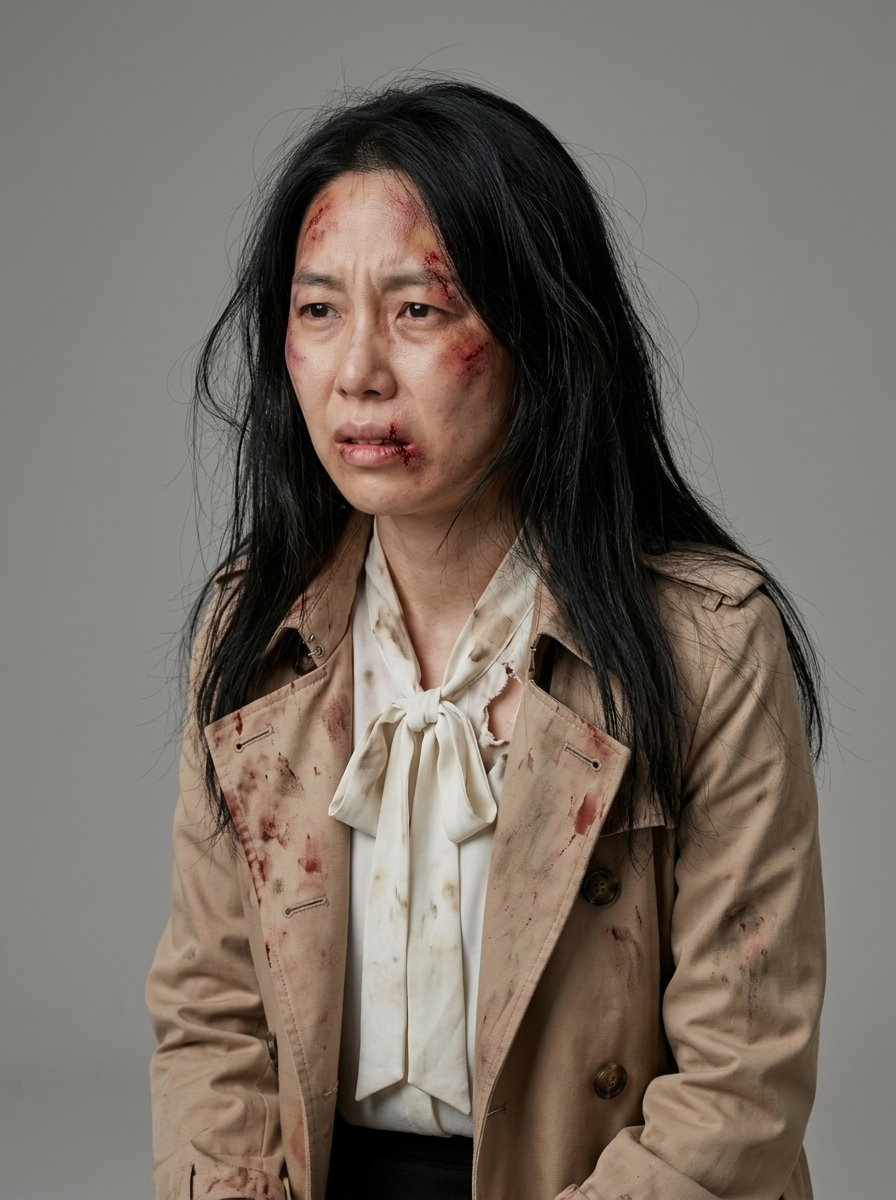
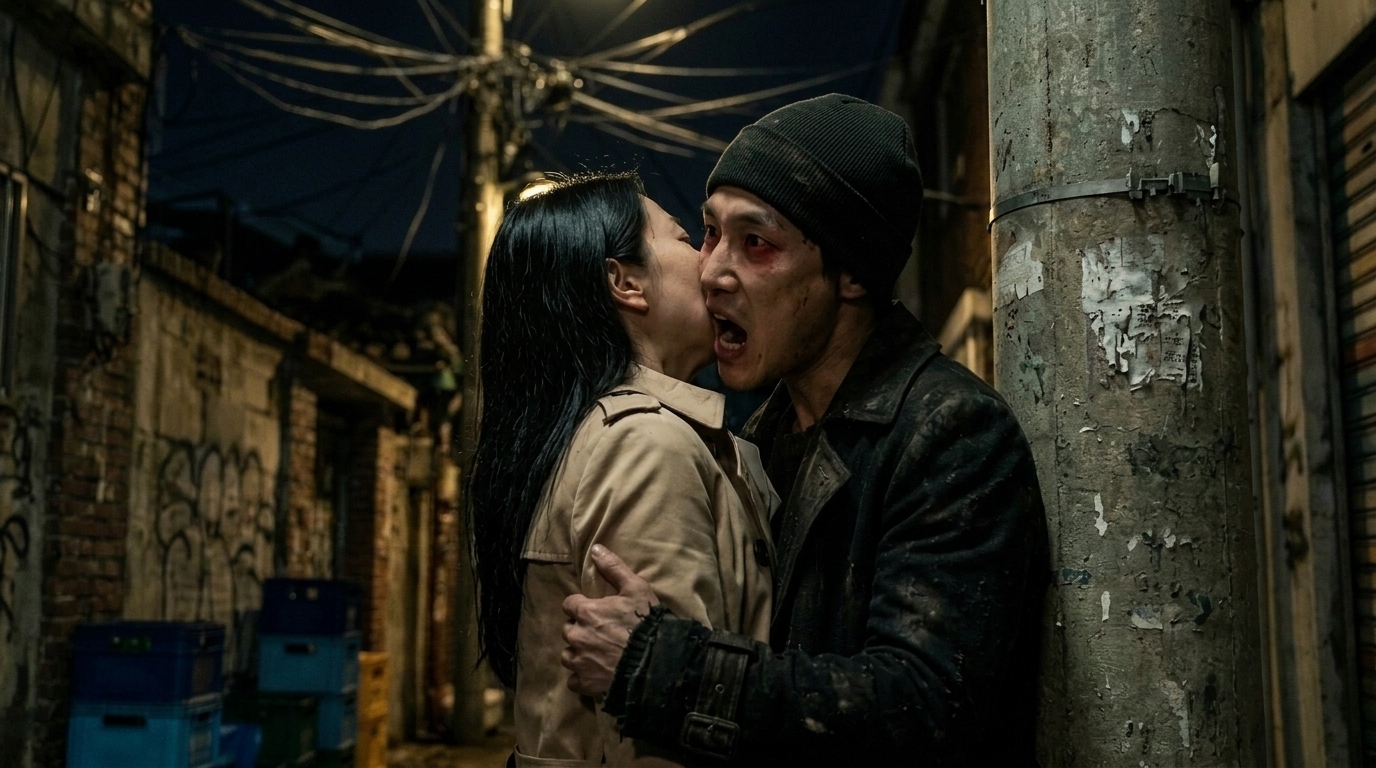
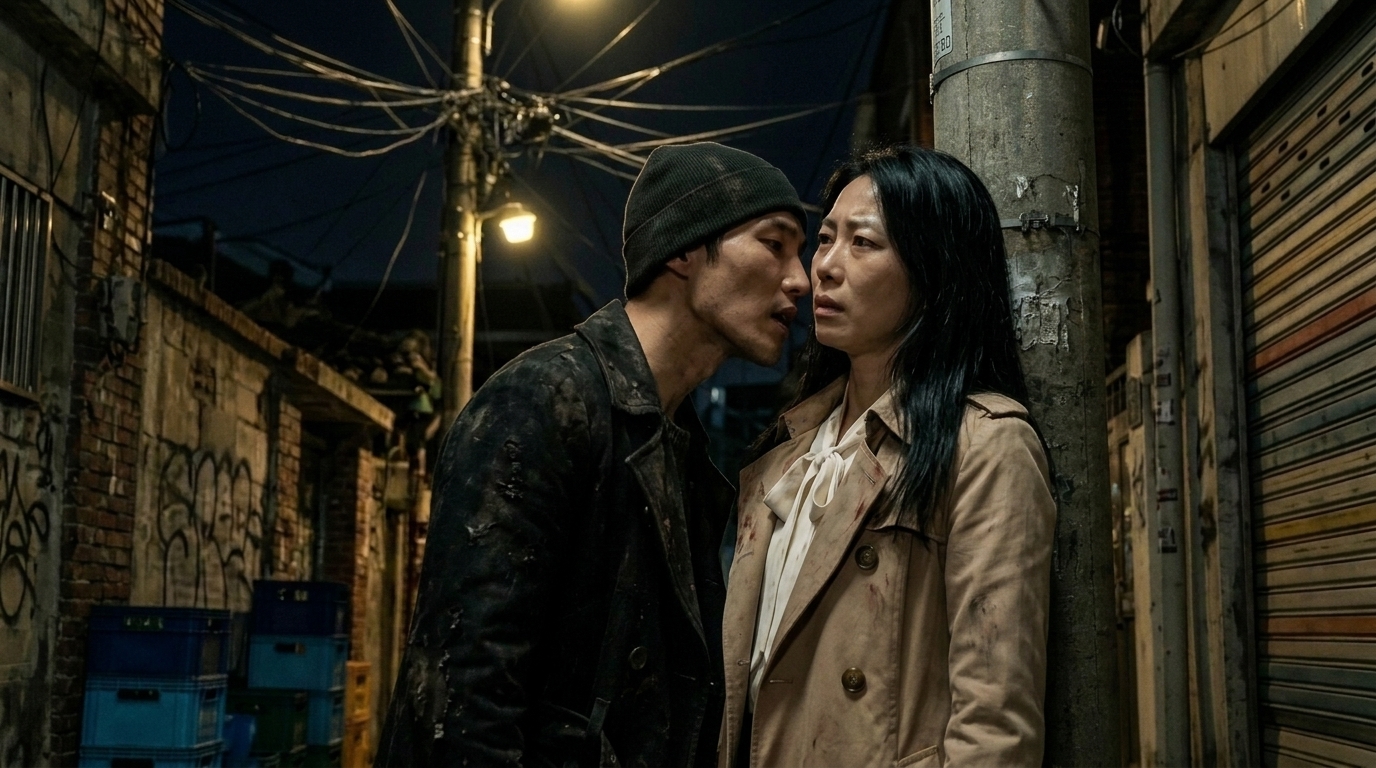
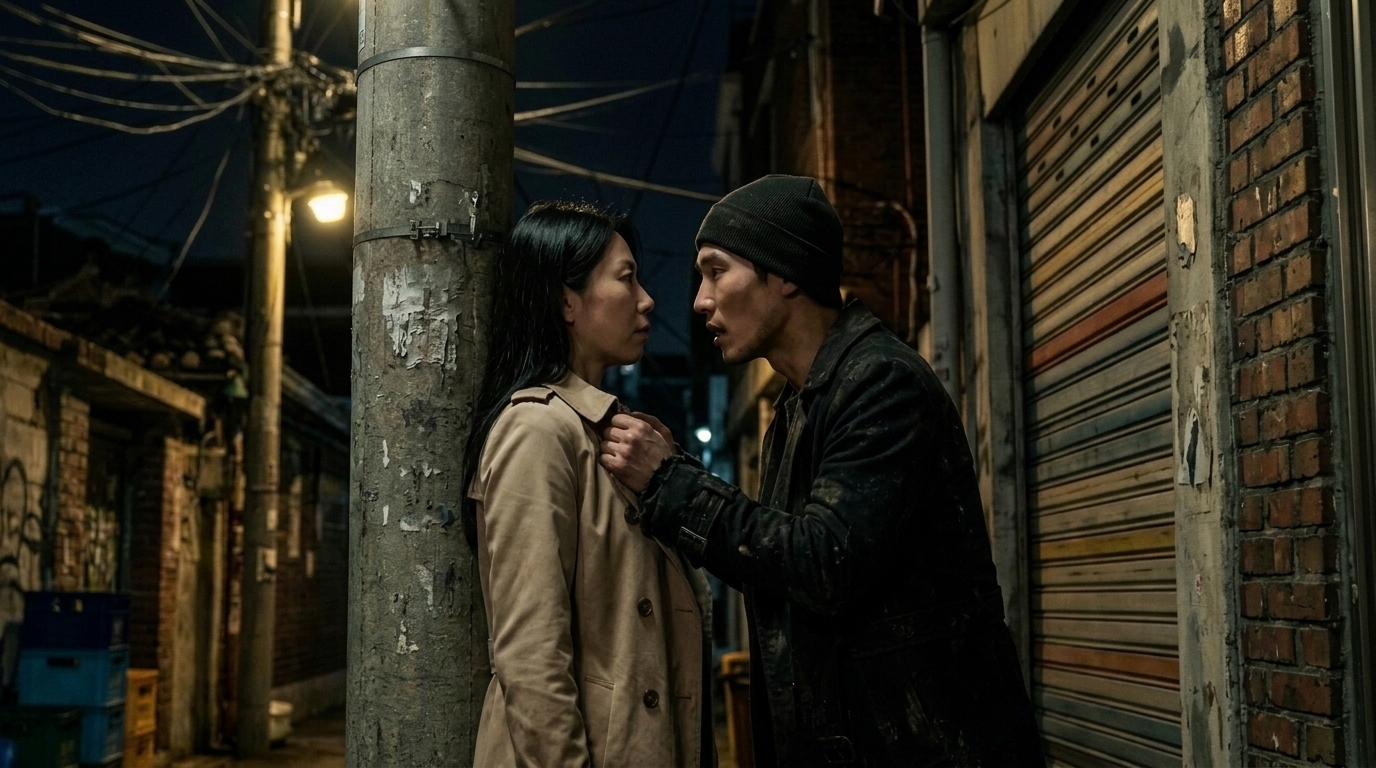
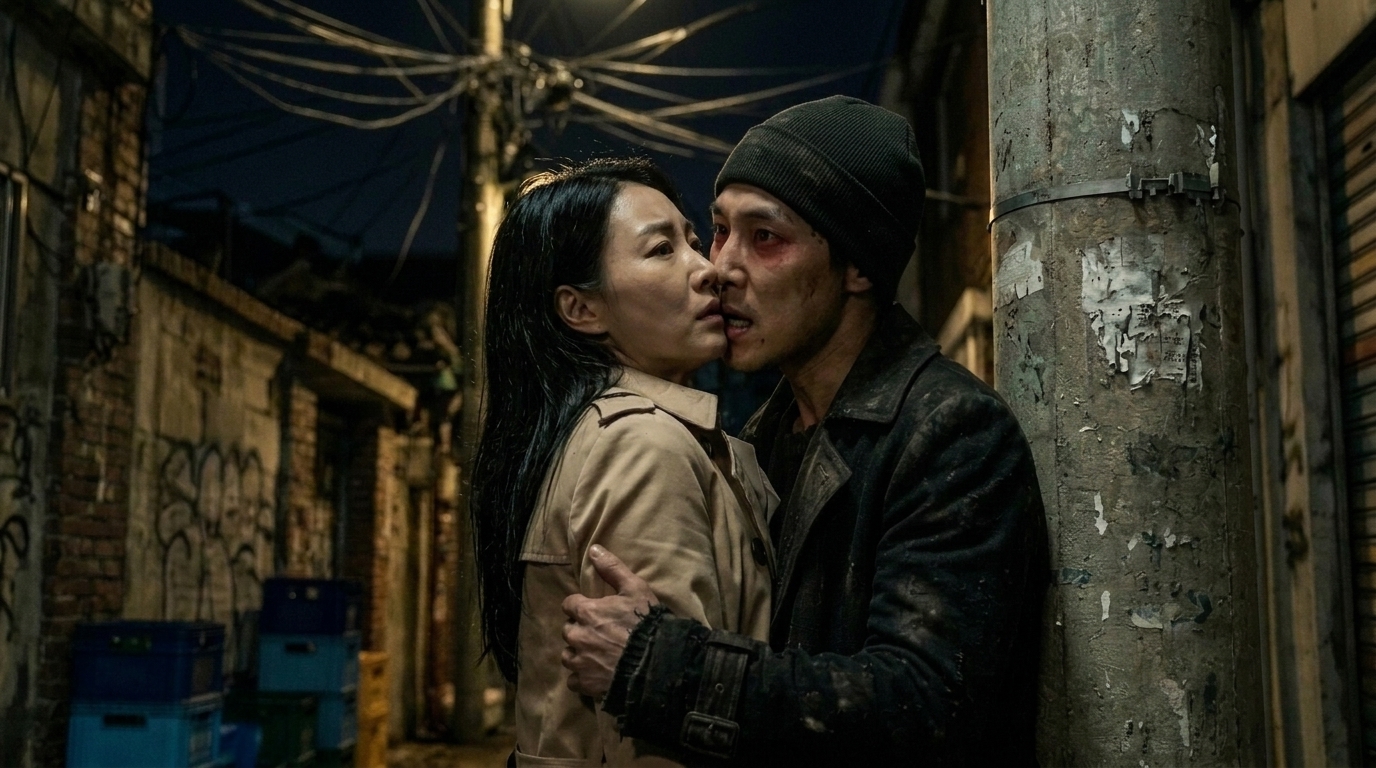
Create ONE FINAL photorealistic live-action film still of the moment below — contemporary South Korea, 2026; all people are Korean unless stated. TIME OF DAY (lock): night, dim streetlights.

SHOT TEXT (authoritative, Korean): 한국인 남자가 입을 크게 벌려 한국인 여자의 목에 이빨을 박아넣은 채 멈춘 순간

LOCATION (lock): A secluded urban back alley with utility poles and dim streetlights. The shot takes place here — the attached PREVIOUS SHOT STILL shows this exact place.

THIS SHOT CONTINUES THE PREVIOUS SHOT: everything the attached still established — the place, its fixed features and wear, each person's clothing and state — persists. Any person in it who cannot move stays PRECISELY as photographed (body, pose, contact points, held objects); only the camera changes.

PREVIOUS STILL USAGE (follow exactly — what to take from the attached still and what to exclude): Take the dim streetlamp lighting, utility pole, and shadowy alley textures from the reference. Exclude the earlier face-to-face posture and show only the positions required for the neck bite.

REALIZE FIGURATIVE LANGUAGE AS A LIVE-ACTION SHOT: the Korean shot
text may describe characters metaphorically, figuratively or with
exaggeration. Photograph what a real movie camera would actually
record on a physical set — exaggerated or figurative impressions
become realistic staging choices (lighting, distance, angle,
wardrobe), not literal fantasy imagery.
EVERY CHARACTER IS A HUMAN BEING: unless the story explicitly
features non-human or virtual beings (as in science fiction or
fantasy), every character — however indirectly, vaguely or
figuratively the text describes them — IS a real human. When the
text gives no direct visual description of a person, IMAGINE one
and still show them as a concrete, fully-formed human being:
always render the human form to the maximum extent — build,
posture, face, hands, clothing — never reduce a person to a shape,
blob, solid silhouette or abstract mass.

EXPRESSIONS ARE ACTED, NEVER ANATOMICAL: when the text describes a
person's eyes, face or presence emotionally or figuratively (vacant,
hollow, dazed, burning, lifeless gaze and the like), it describes an
ACTOR'S PERFORMANCE captured by a real camera — realize it ONLY
through gaze direction, focus, eyelids, facial muscles, stillness
and posture. Every living person's eyes remain anatomically normal
human eyes with a natural iris and pupil, natural sclera and normal
proportions; NEVER whiten, blank out, cloud over, glow, enlarge or
otherwise alter eyeballs, skin or anatomy — unless the story
explicitly declares that being non-human or supernatural in form.

PROPS FACE THE RIGHT WAY: every handheld or used object must be
oriented exactly as its real-world use requires. A person reading,
watching or operating something (a phone, a photograph, a paper,
any device) has its functional side — screen, front, page — facing
THEIR OWN eyes; the camera then sees whatever side the staging
geometry implies (often its back). Show the functional side to the
camera ONLY when the shot text itself stages it toward the viewer.
Never flip, mirror or reverse an object's front and back.

CARRIED STATE (persist exactly — must match the neighbouring shots of this scene): The pair remain against the utility pole, with the man's teeth embedded in the woman's neck and his eyes red.

PEOPLE: the SHOT TEXT alone decides whether any person is visible in this shot. IF a person appears, they must be one of: 한국인 여자 (Korean 성인 여성, 자연스러운 검은 머리, 평범한 타원형 얼굴, 일반적인 이목구비); 한국인 남자 (포식 상태) (Korean 성인 남성, 짧은 검은 머리, 평범한 얼굴형, 자연스러운 기본 이목구비) — never anyone else, and never add a person the shot text does not show. IF only part of a person is in frame (a hand, arm, foot, back, silhouette), that body part belongs to the specific person the shot text names — its sex, age, build, skin and grooming must unmistakably match that person's profile above.

No text, captions, watermarks or annotations anywhere.
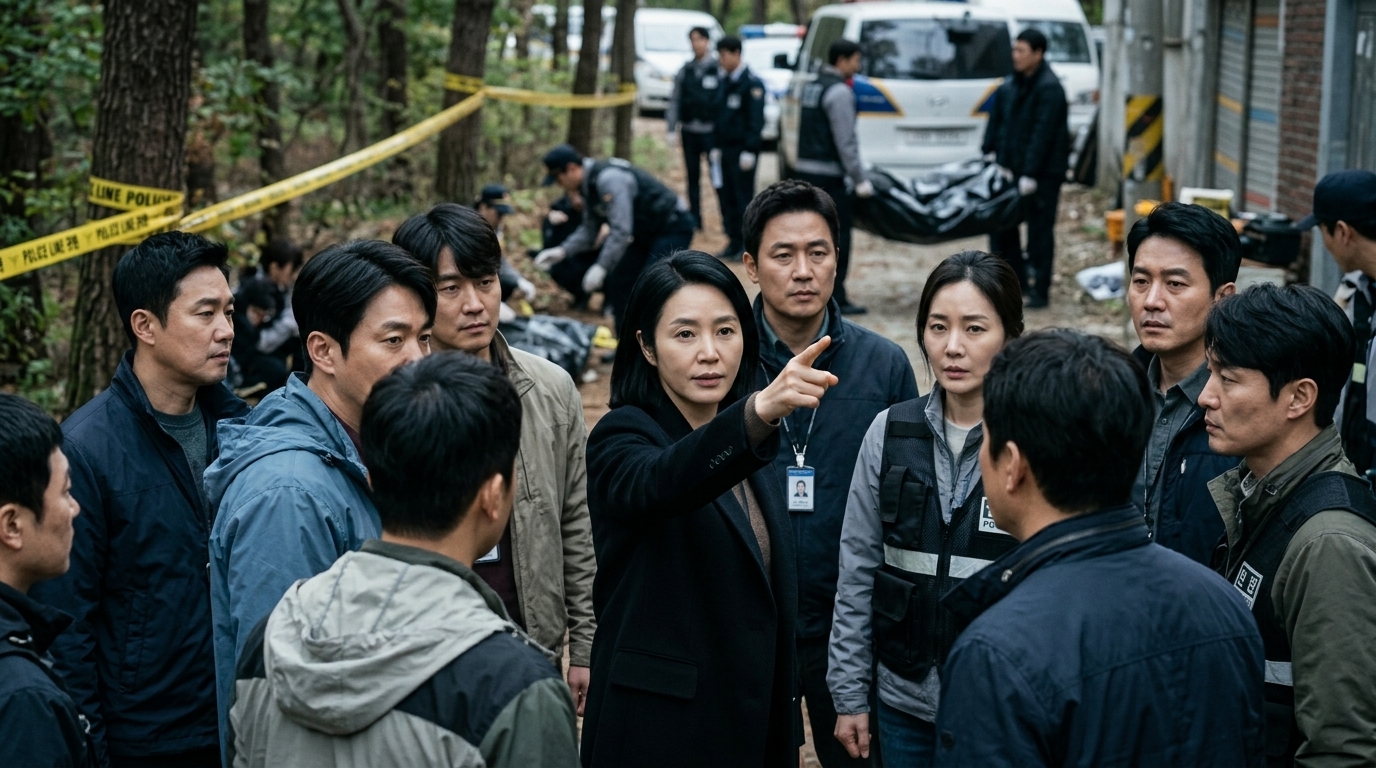
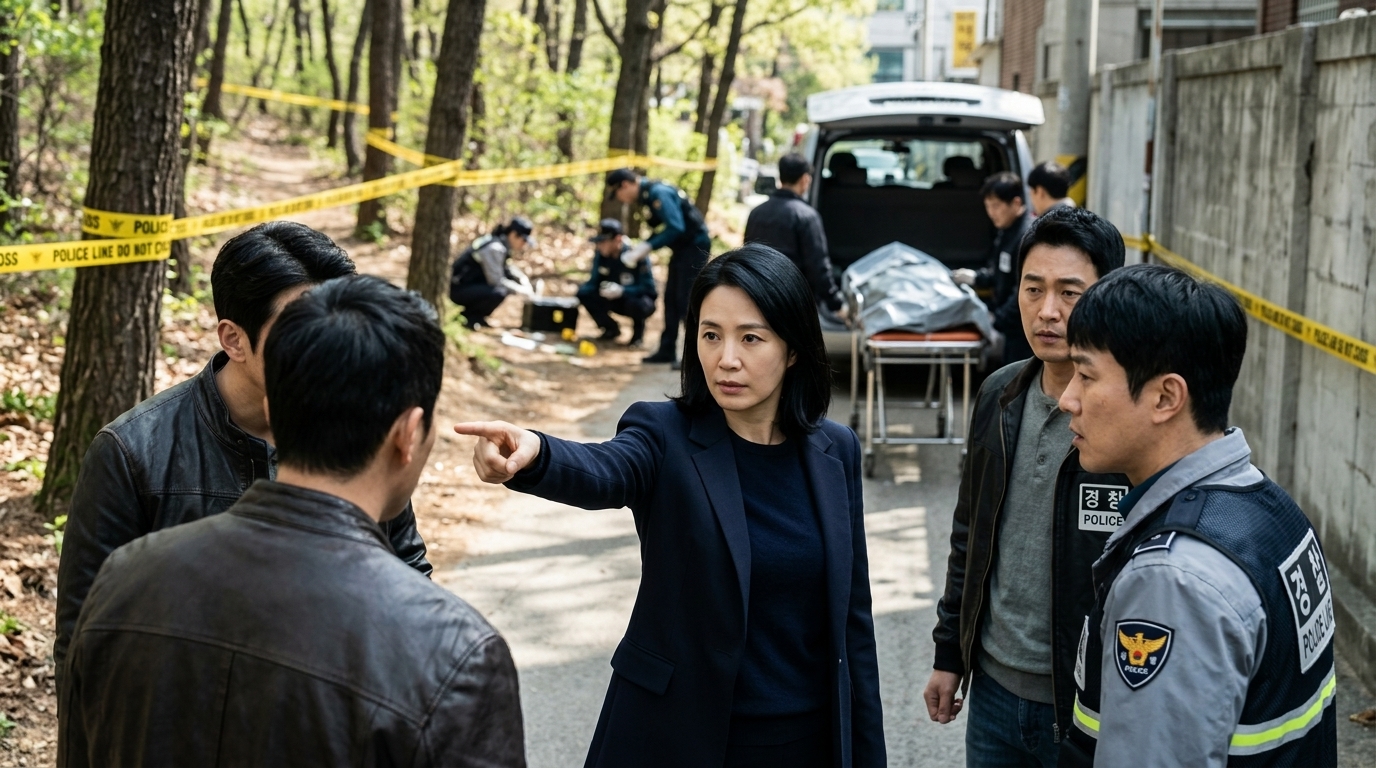
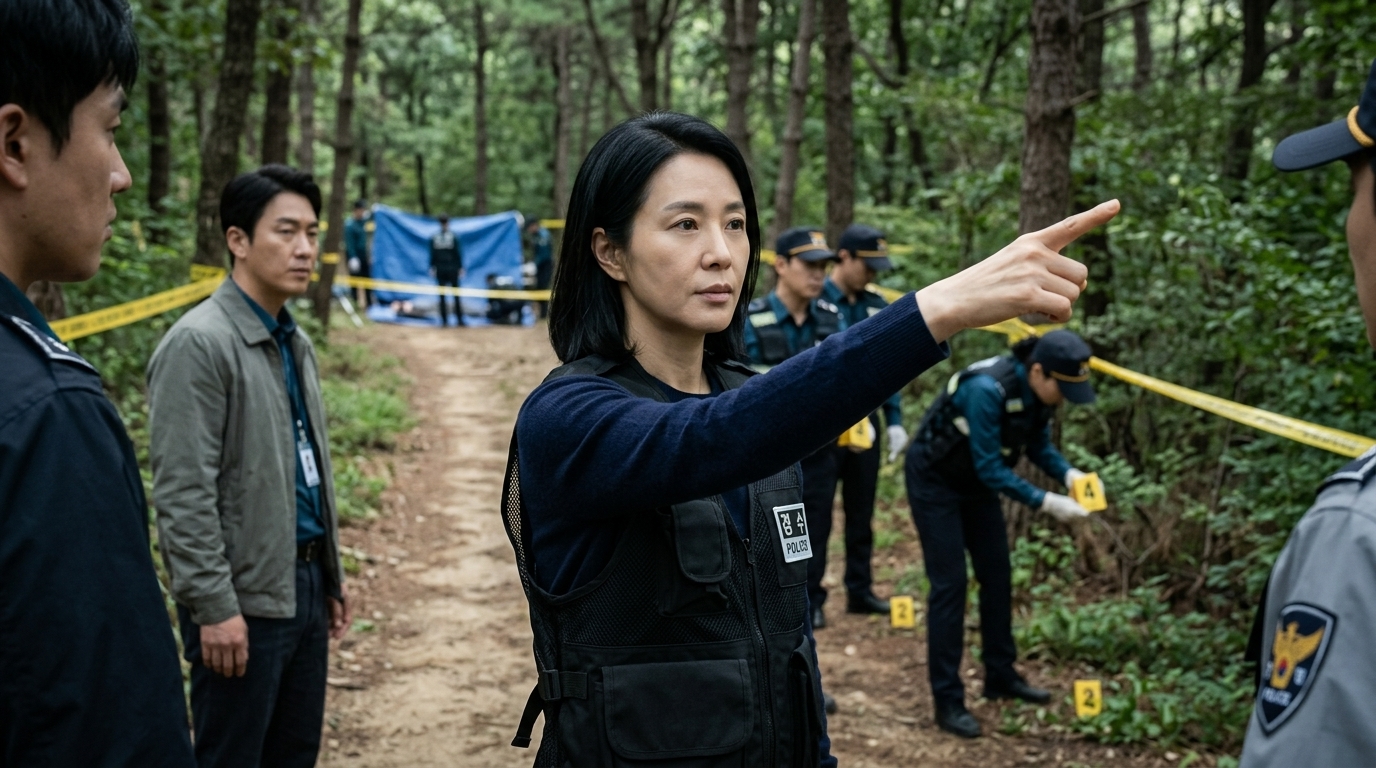
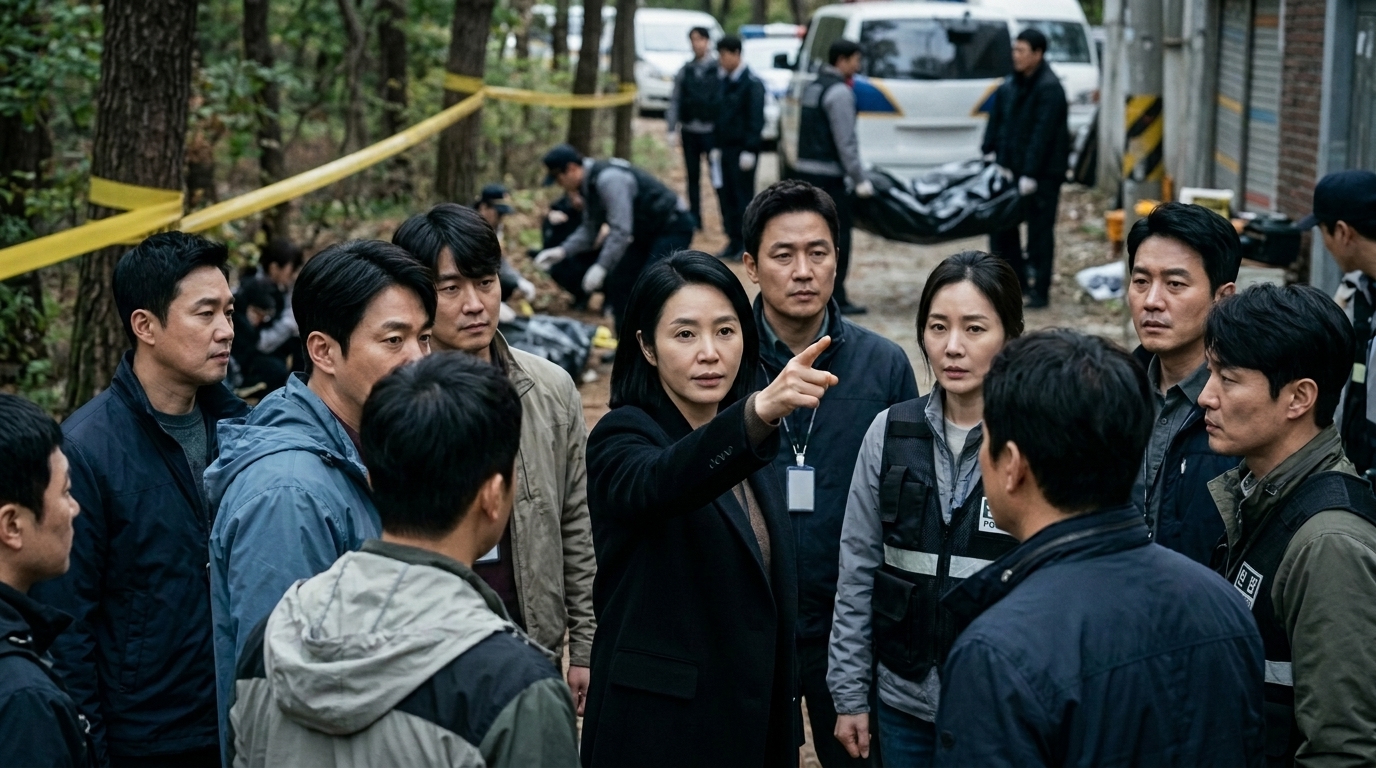
Create ONE FINAL photorealistic live-action film still of the moment below — contemporary South Korea, 2026; all people are Korean unless stated. TIME OF DAY (lock): day.

SHOT TEXT (authoritative, Korean): 형사 무리 한가운데 서서 손가락으로 한쪽을 가리키는 혜수의 상체

LOCATION (lock): A daytime crime-scene montage spanning a forest trail and an urban back alley, both secured with police lines as officers examine the ground and remove bodies. The shot takes place here — the attached LOCATION PHOTOGRAPH shows the exact spot.

REALIZE FIGURATIVE LANGUAGE AS A LIVE-ACTION SHOT: the Korean shot
text may describe characters metaphorically, figuratively or with
exaggeration. Photograph what a real movie camera would actually
record on a physical set — exaggerated or figurative impressions
become realistic staging choices (lighting, distance, angle,
wardrobe), not literal fantasy imagery.
EVERY CHARACTER IS A HUMAN BEING: unless the story explicitly
features non-human or virtual beings (as in science fiction or
fantasy), every character — however indirectly, vaguely or
figuratively the text describes them — IS a real human. When the
text gives no direct visual description of a person, IMAGINE one
and still show them as a concrete, fully-formed human being:
always render the human form to the maximum extent — build,
posture, face, hands, clothing — never reduce a person to a shape,
blob, solid silhouette or abstract mass.

EXPRESSIONS ARE ACTED, NEVER ANATOMICAL: when the text describes a
person's eyes, face or presence emotionally or figuratively (vacant,
hollow, dazed, burning, lifeless gaze and the like), it describes an
ACTOR'S PERFORMANCE captured by a real camera — realize it ONLY
through gaze direction, focus, eyelids, facial muscles, stillness
and posture. Every living person's eyes remain anatomically normal
human eyes with a natural iris and pupil, natural sclera and normal
proportions; NEVER whiten, blank out, cloud over, glow, enlarge or
otherwise alter eyeballs, skin or anatomy — unless the story
explicitly declares that being non-human or supernatural in form.

PROPS FACE THE RIGHT WAY: every handheld or used object must be
oriented exactly as its real-world use requires. A person reading,
watching or operating something (a phone, a photograph, a paper,
any device) has its functional side — screen, front, page — facing
THEIR OWN eyes; the camera then sees whatever side the staging
geometry implies (often its back). Show the functional side to the
camera ONLY when the shot text itself stages it toward the viewer.
Never flip, mirror or reverse an object's front and back.

PEOPLE: the SHOT TEXT alone decides whether any person is visible in this shot. IF a person appears, they must be one of: 혜수 (Korean 40대 중반 여성, 단정한 검은 머리, 성숙한 타원형 얼굴, 또렷한 이목구비) — never anyone else, and never add a person the shot text does not show. IF only part of a person is in frame (a hand, arm, foot, back, silhouette), that body part belongs to the specific person the shot text names — its sex, age, build, skin and grooming must unmistakably match that person's profile above.

No text, captions, watermarks or annotations anywhere.
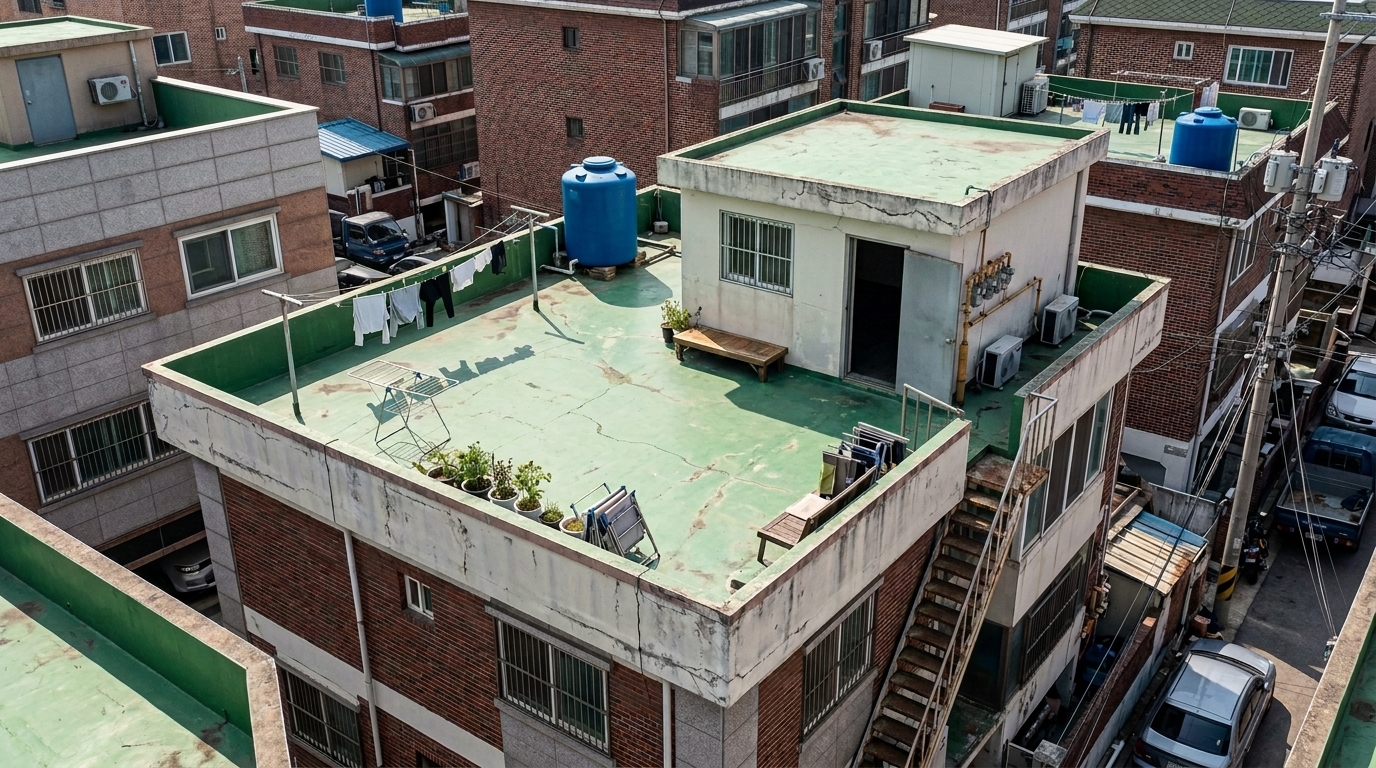
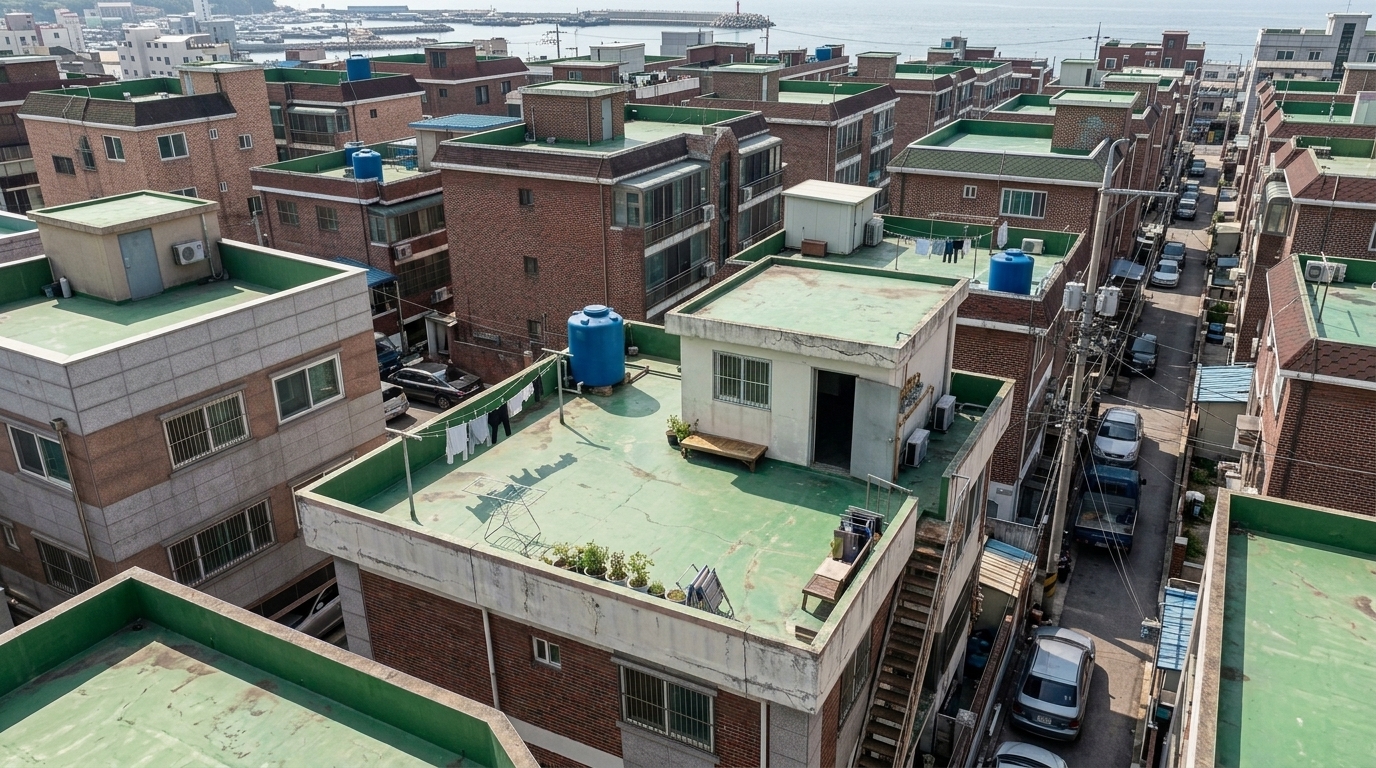
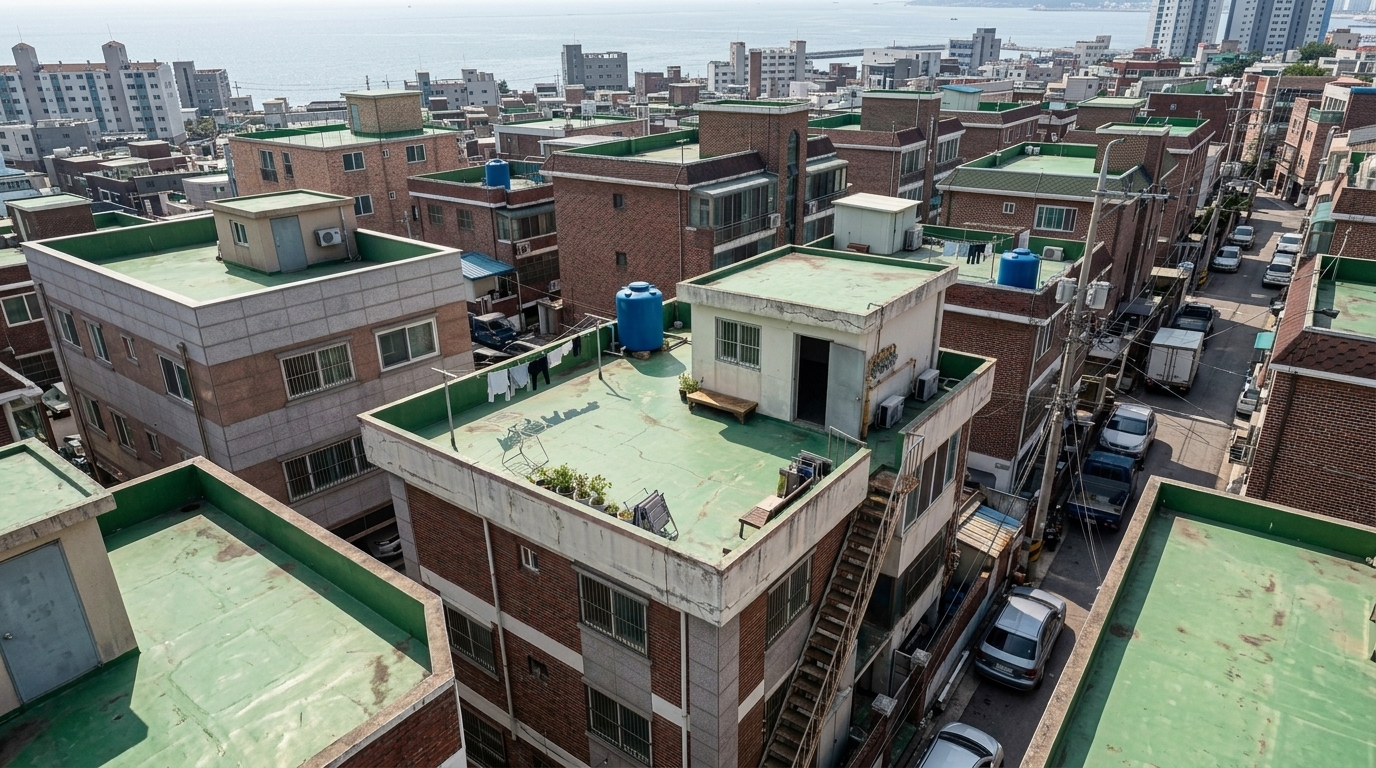
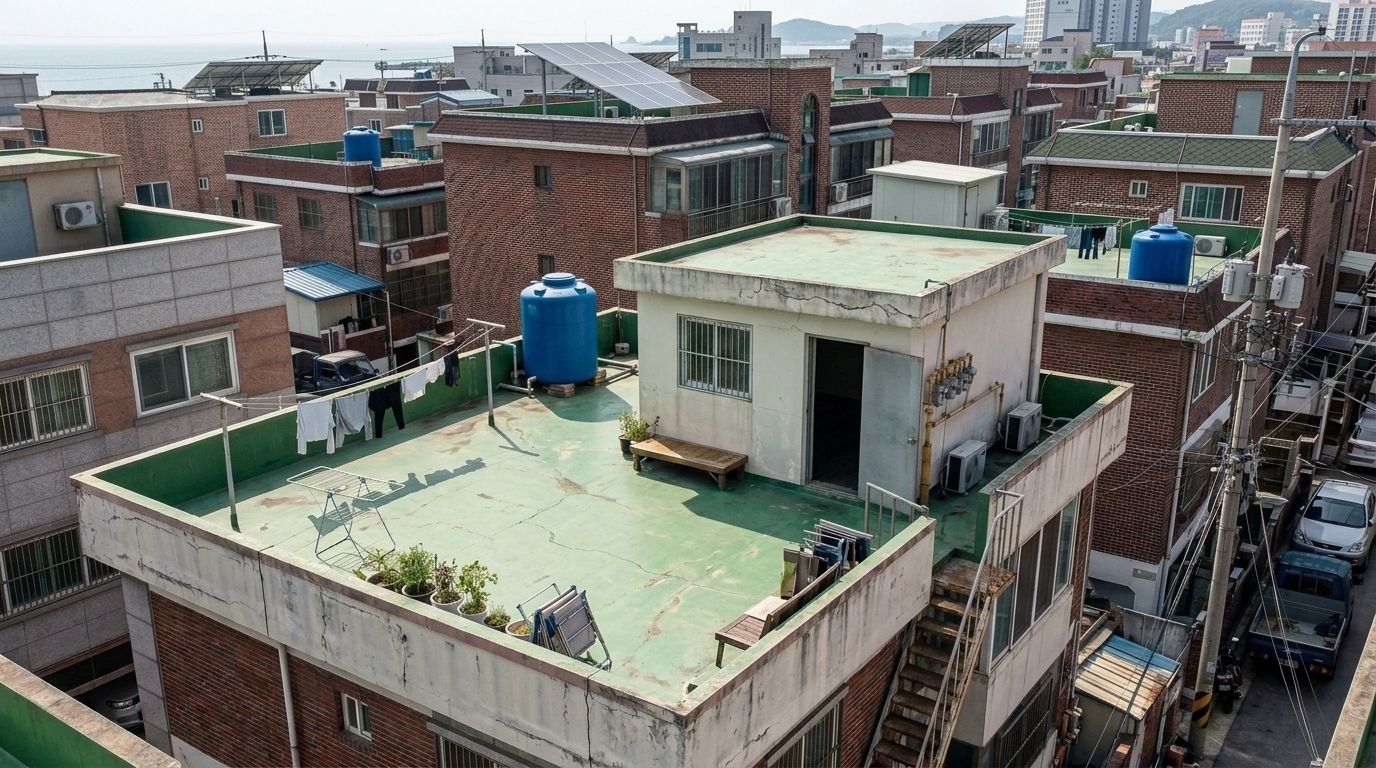
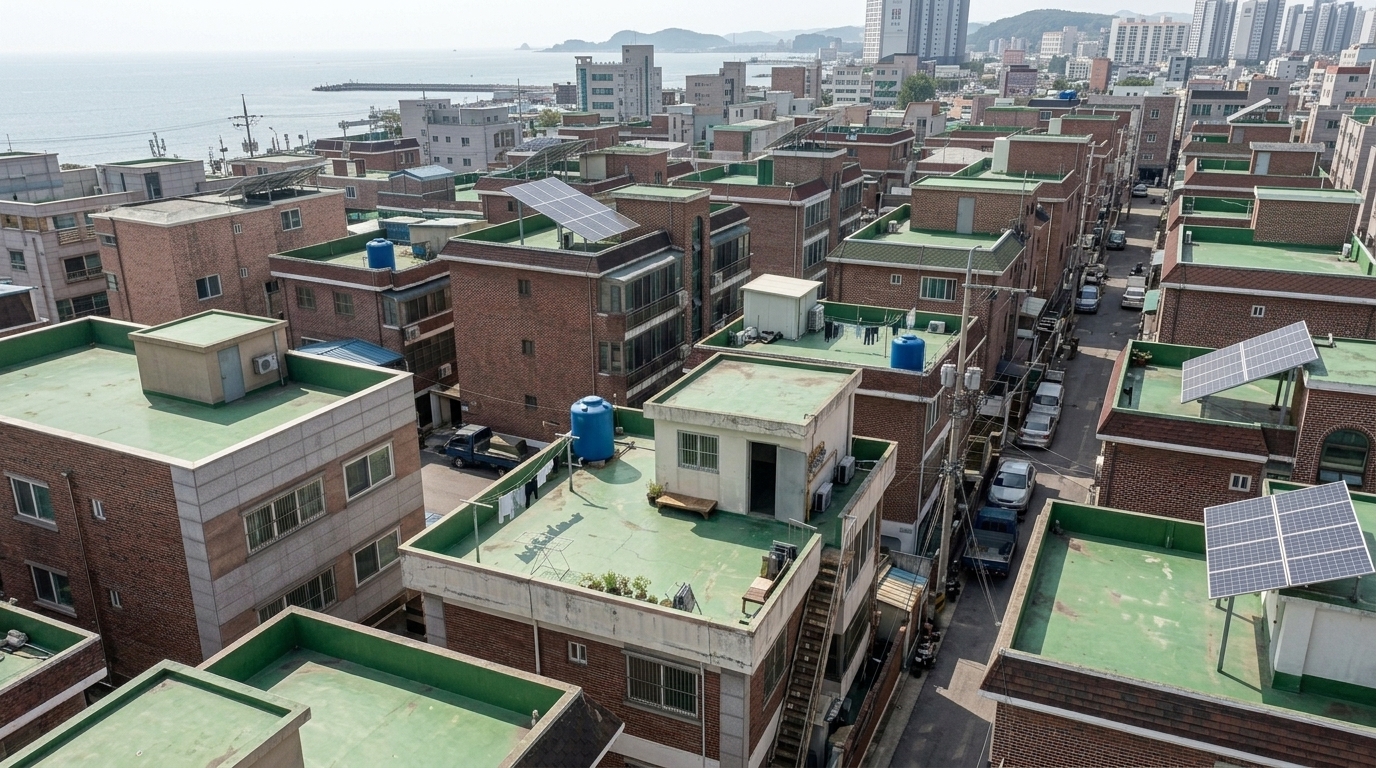
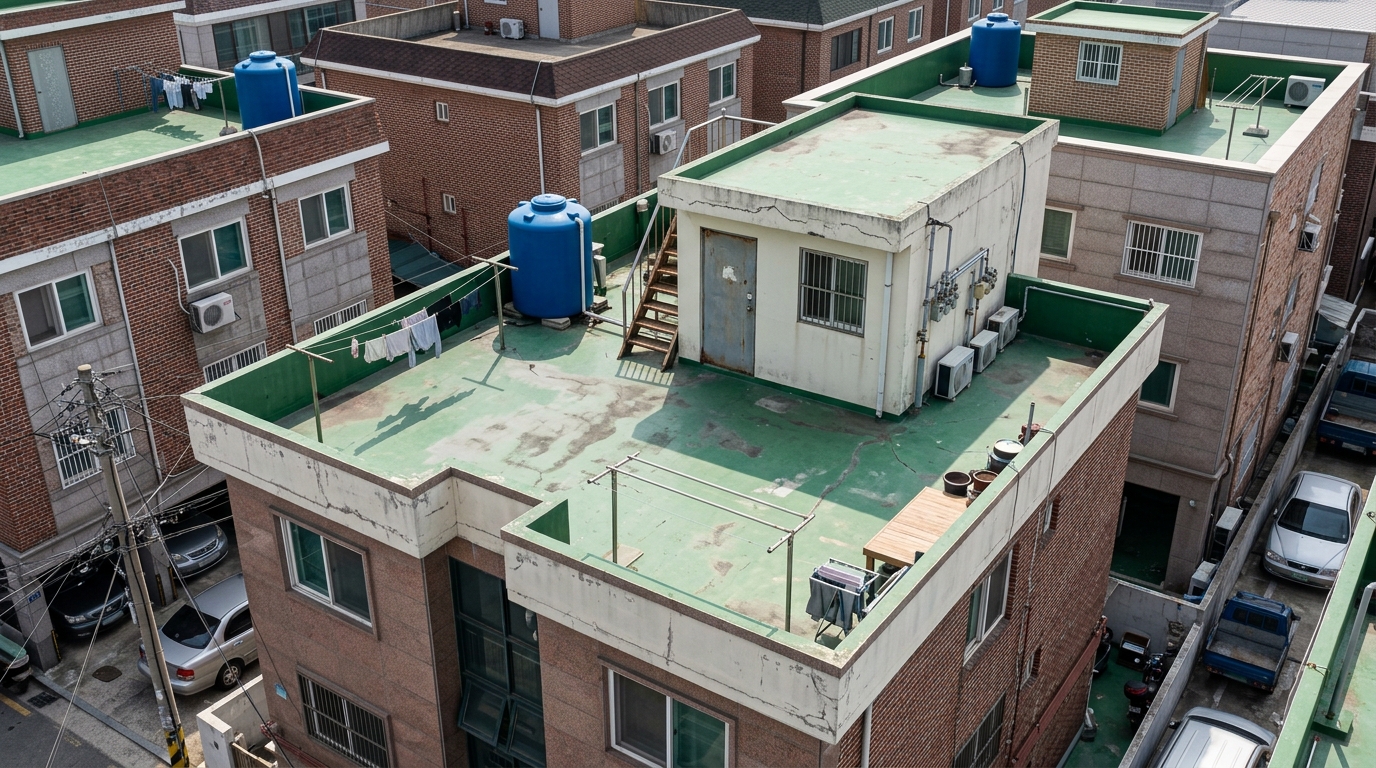
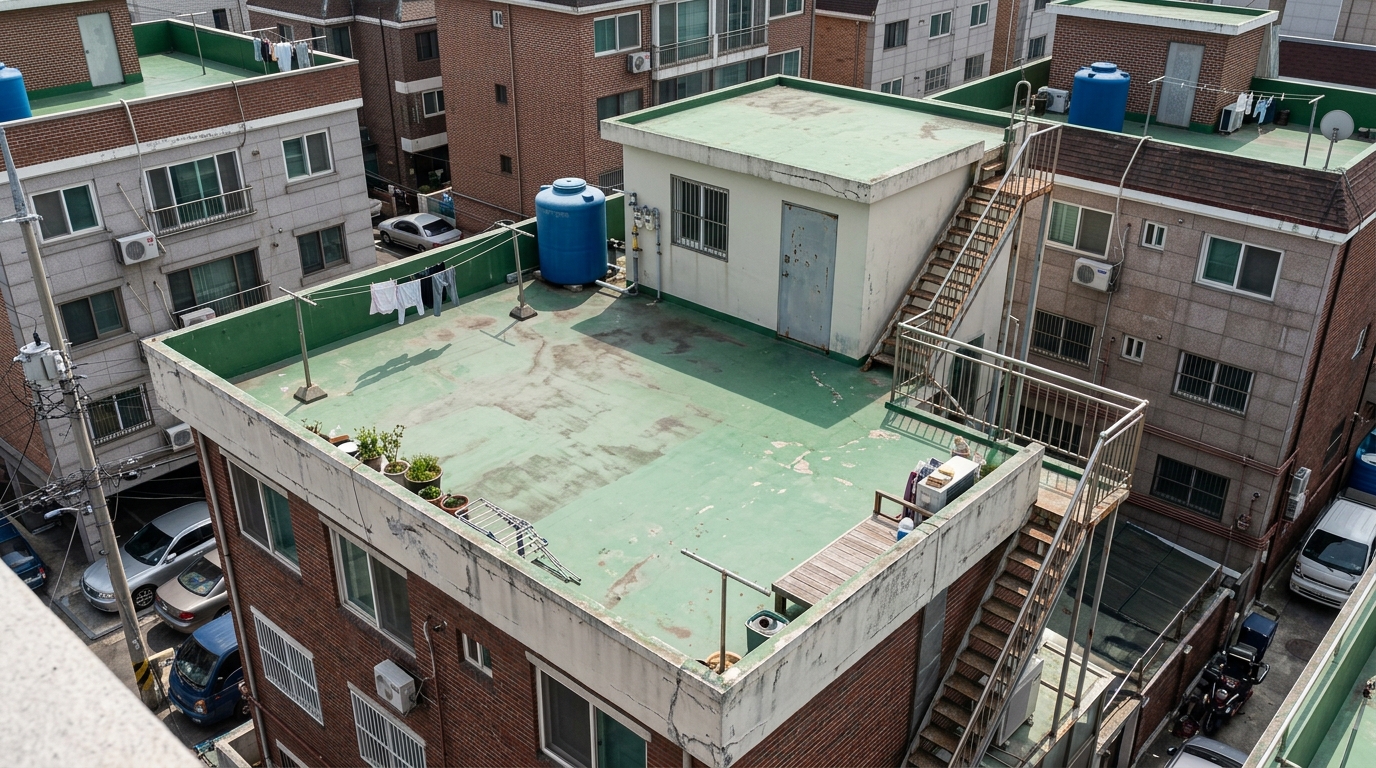
Create ONE FINAL photorealistic live-action film still of the moment below — contemporary South Korea, 2026; all people are Korean unless stated. TIME OF DAY (lock): day.

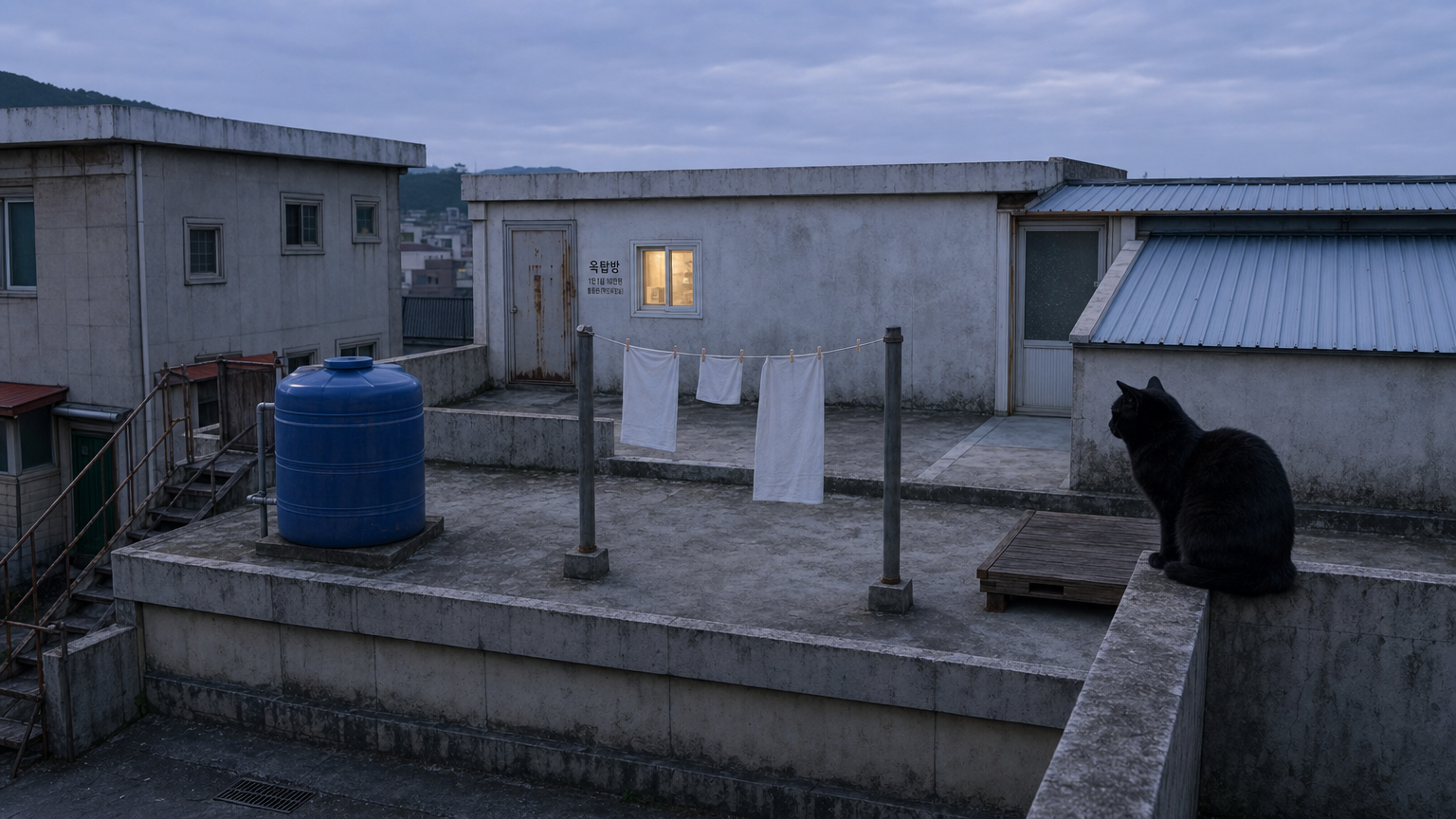
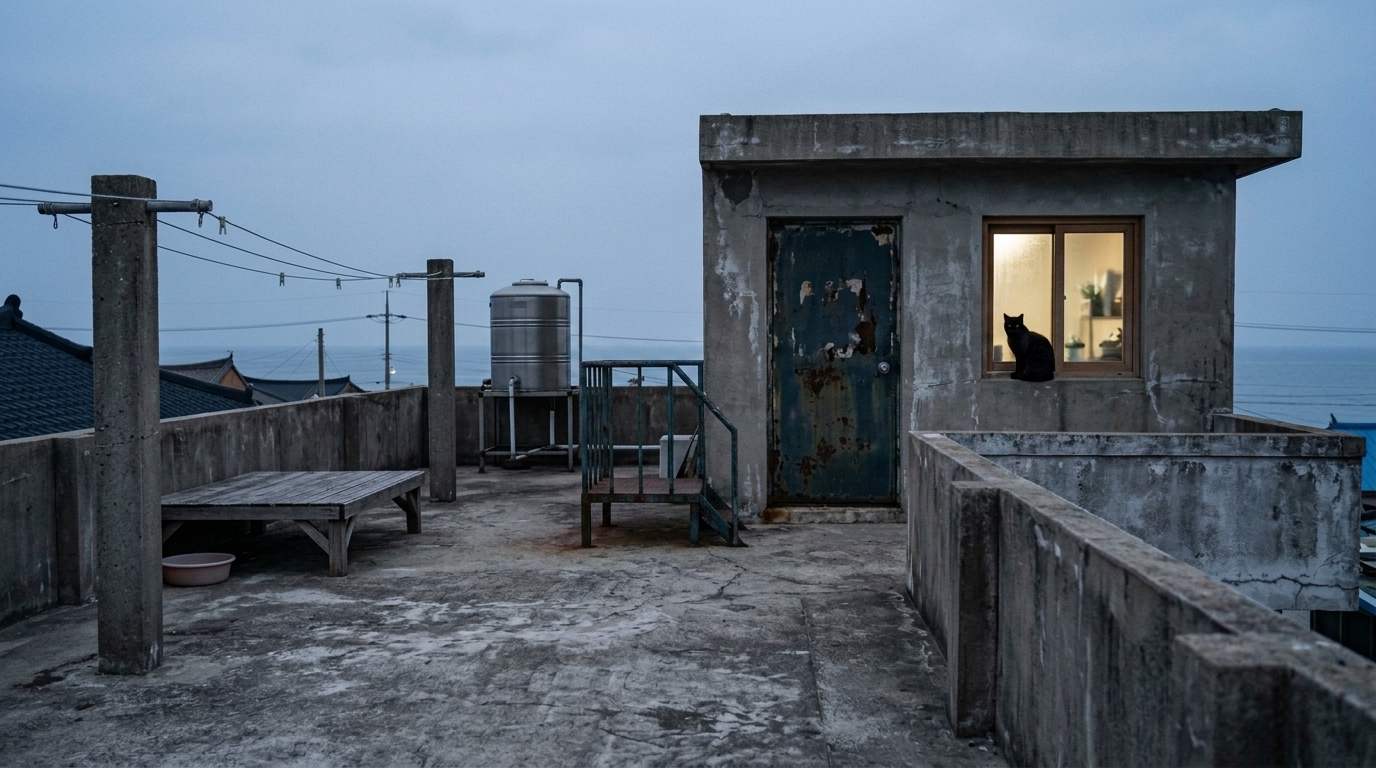
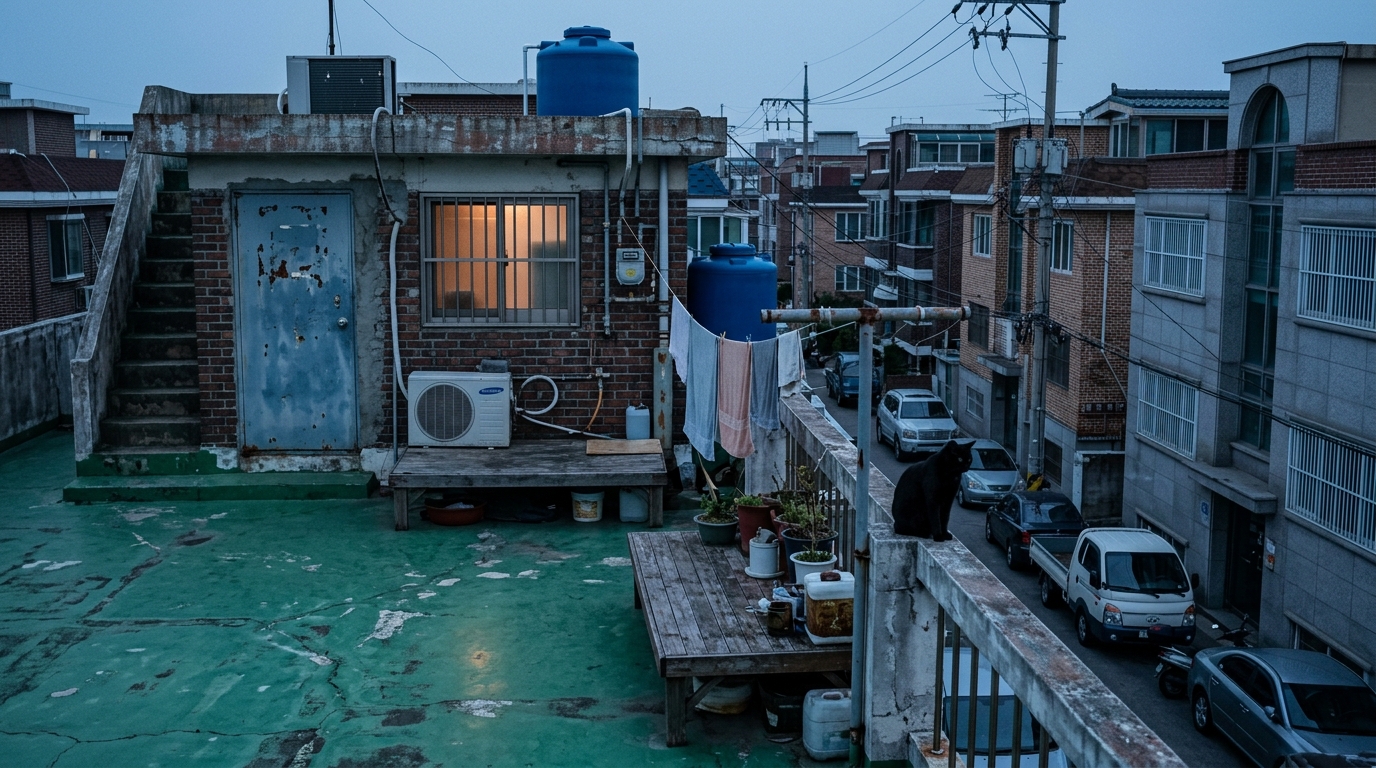
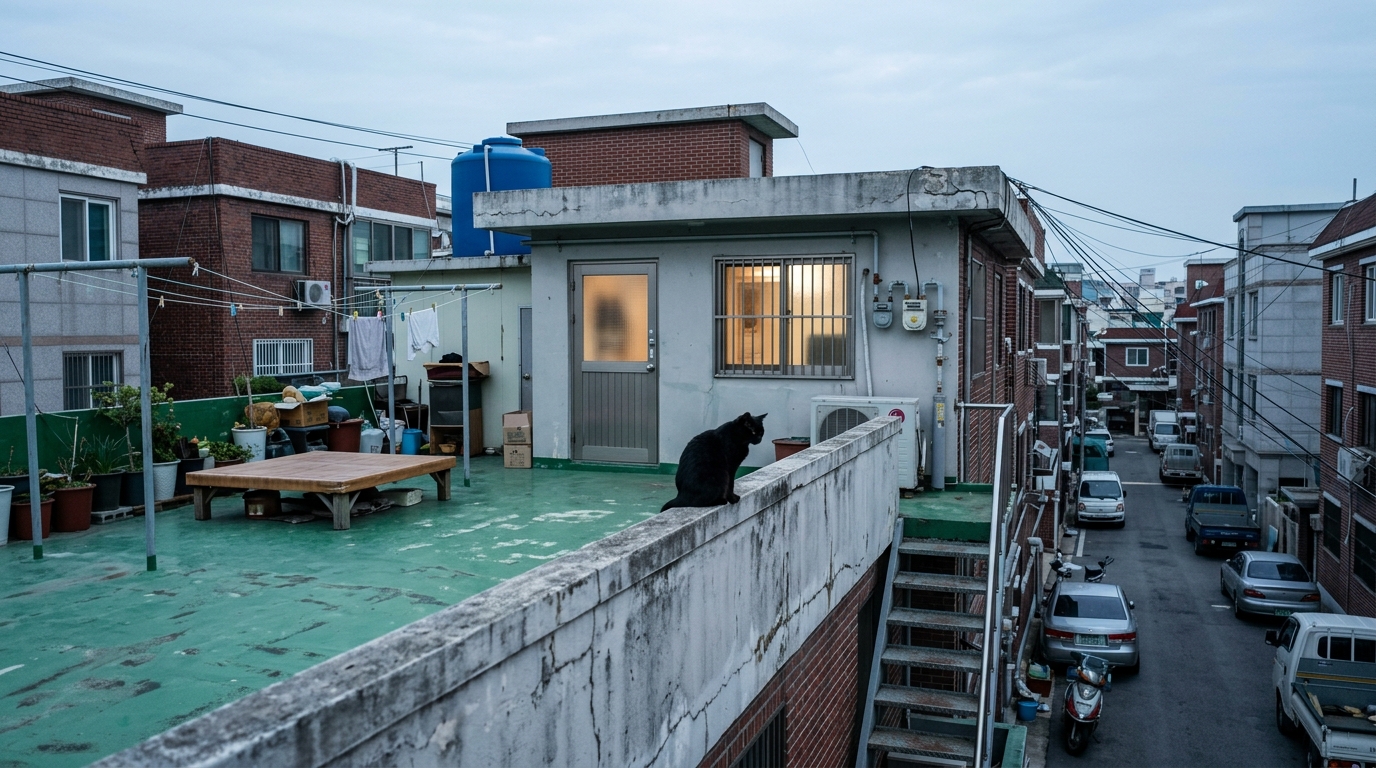
SHOT TEXT (authoritative, Korean): 맑은 낮, 오래된 다세대 빌라 옥상 위에 자리 잡은 옥탑방을 높은 곳에서 내려다본 부감 구도

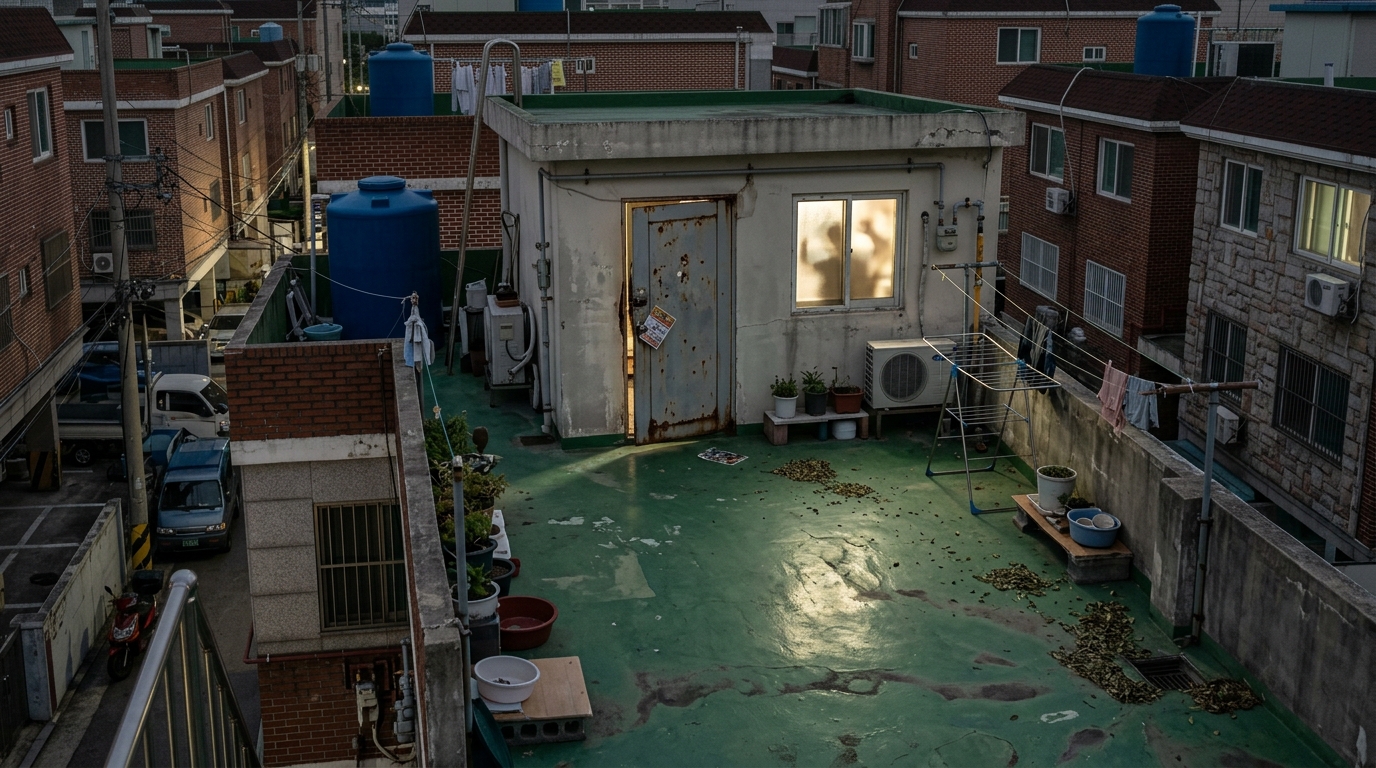
LOCATION (lock): The rooftop level of an old low-rise villa on the outskirts of a coastal city, centered on a small rooftop dwelling. The shot takes place here — the attached LOCATION PHOTOGRAPH shows the exact spot.

REALIZE FIGURATIVE LANGUAGE AS A LIVE-ACTION SHOT: the Korean shot
text may describe characters metaphorically, figuratively or with
exaggeration. Photograph what a real movie camera would actually
record on a physical set — exaggerated or figurative impressions
become realistic staging choices (lighting, distance, angle,
wardrobe), not literal fantasy imagery.
EVERY CHARACTER IS A HUMAN BEING: unless the story explicitly
features non-human or virtual beings (as in science fiction or
fantasy), every character — however indirectly, vaguely or
figuratively the text describes them — IS a real human. When the
text gives no direct visual description of a person, IMAGINE one
and still show them as a concrete, fully-formed human being:
always render the human form to the maximum extent — build,
posture, face, hands, clothing — never reduce a person to a shape,
blob, solid silhouette or abstract mass.

EXPRESSIONS ARE ACTED, NEVER ANATOMICAL: when the text describes a
person's eyes, face or presence emotionally or figuratively (vacant,
hollow, dazed, burning, lifeless gaze and the like), it describes an
ACTOR'S PERFORMANCE captured by a real camera — realize it ONLY
through gaze direction, focus, eyelids, facial muscles, stillness
and posture. Every living person's eyes remain anatomically normal
human eyes with a natural iris and pupil, natural sclera and normal
proportions; NEVER whiten, blank out, cloud over, glow, enlarge or
otherwise alter eyeballs, skin or anatomy — unless the story
explicitly declares that being non-human or supernatural in form.

PROPS FACE THE RIGHT WAY: every handheld or used object must be
oriented exactly as its real-world use requires. A person reading,
watching or operating something (a phone, a photograph, a paper,
any device) has its functional side — screen, front, page — facing
THEIR OWN eyes; the camera then sees whatever side the staging
geometry implies (often its back). Show the functional side to the
camera ONLY when the shot text itself stages it toward the viewer.
Never flip, mirror or reverse an object's front and back.

NO PEOPLE IN THIS SHOT: the shot text shows only the place and its state — no living person or any body part appears in frame, unless the shot text itself explicitly says so.

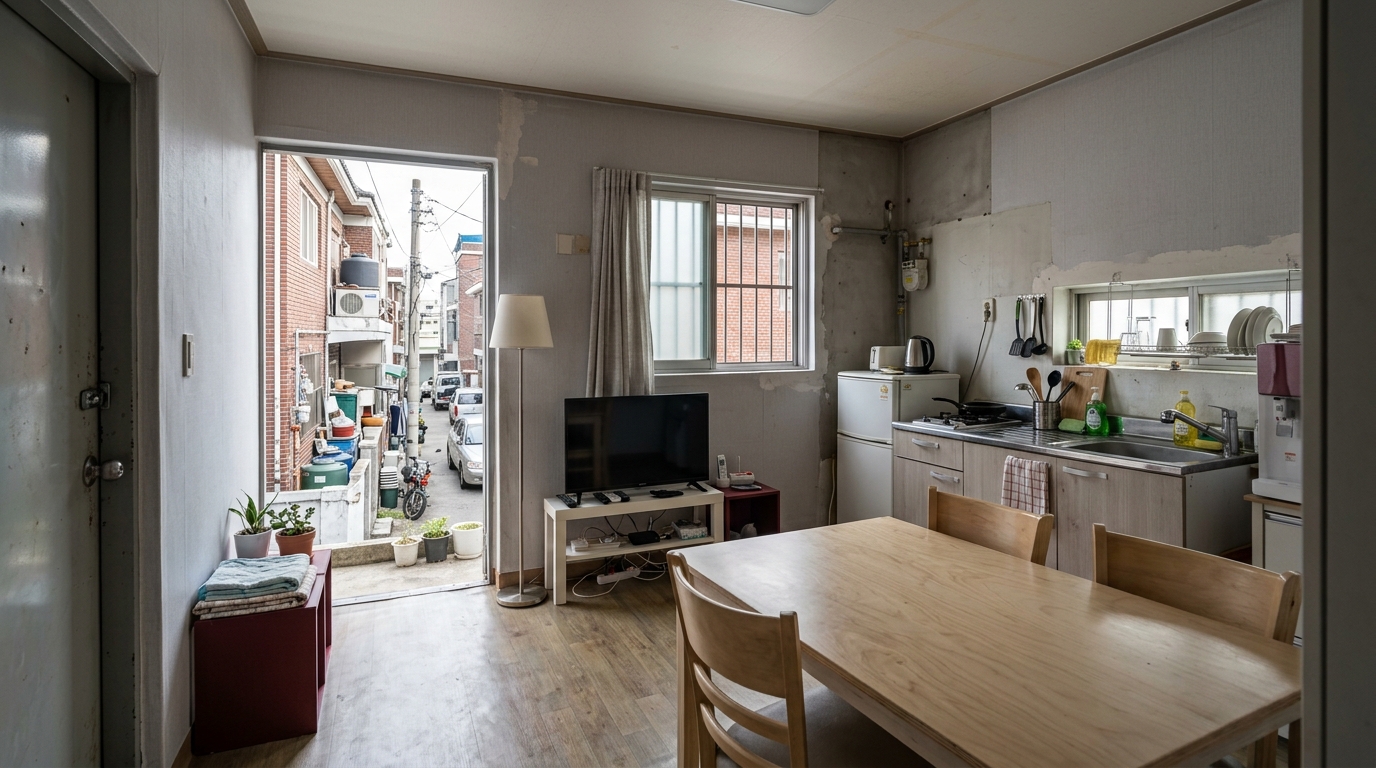
No text, captions, watermarks or annotations anywhere.
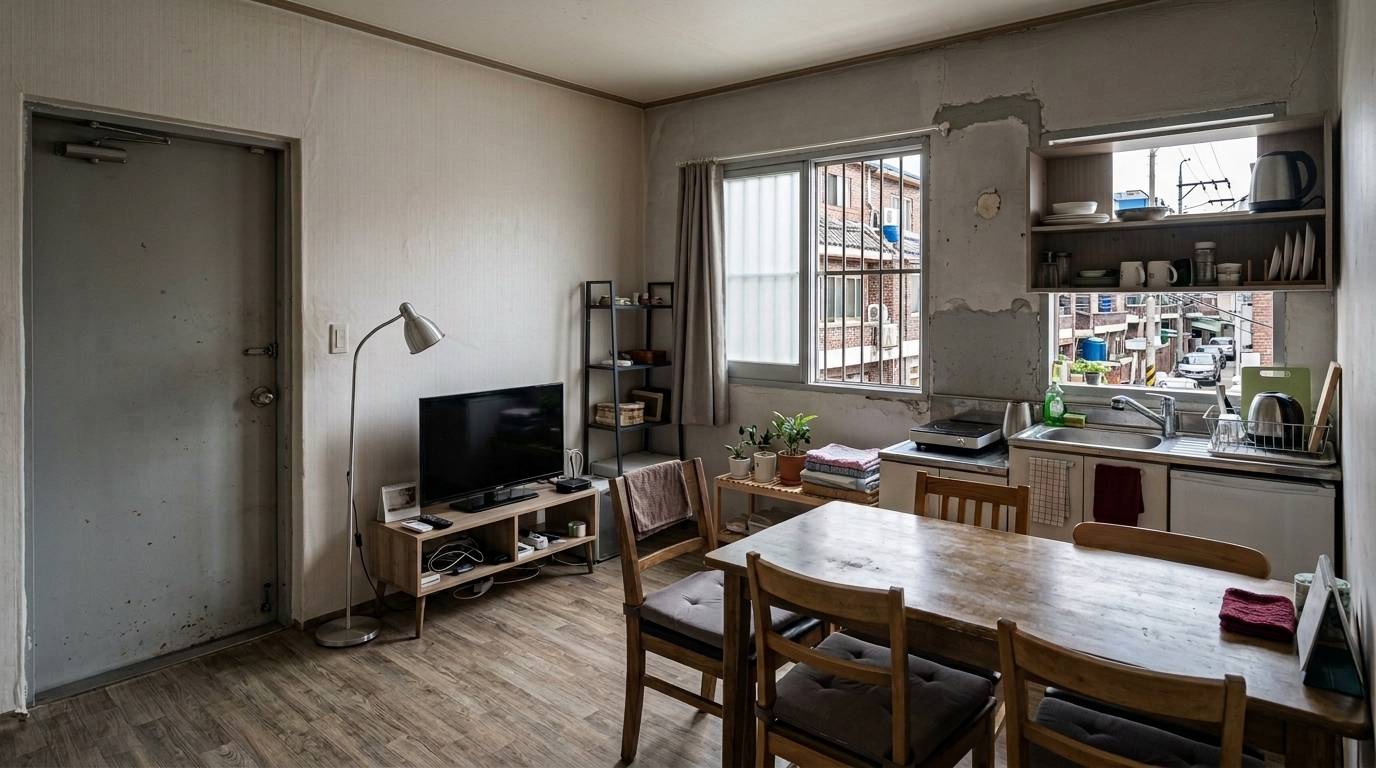
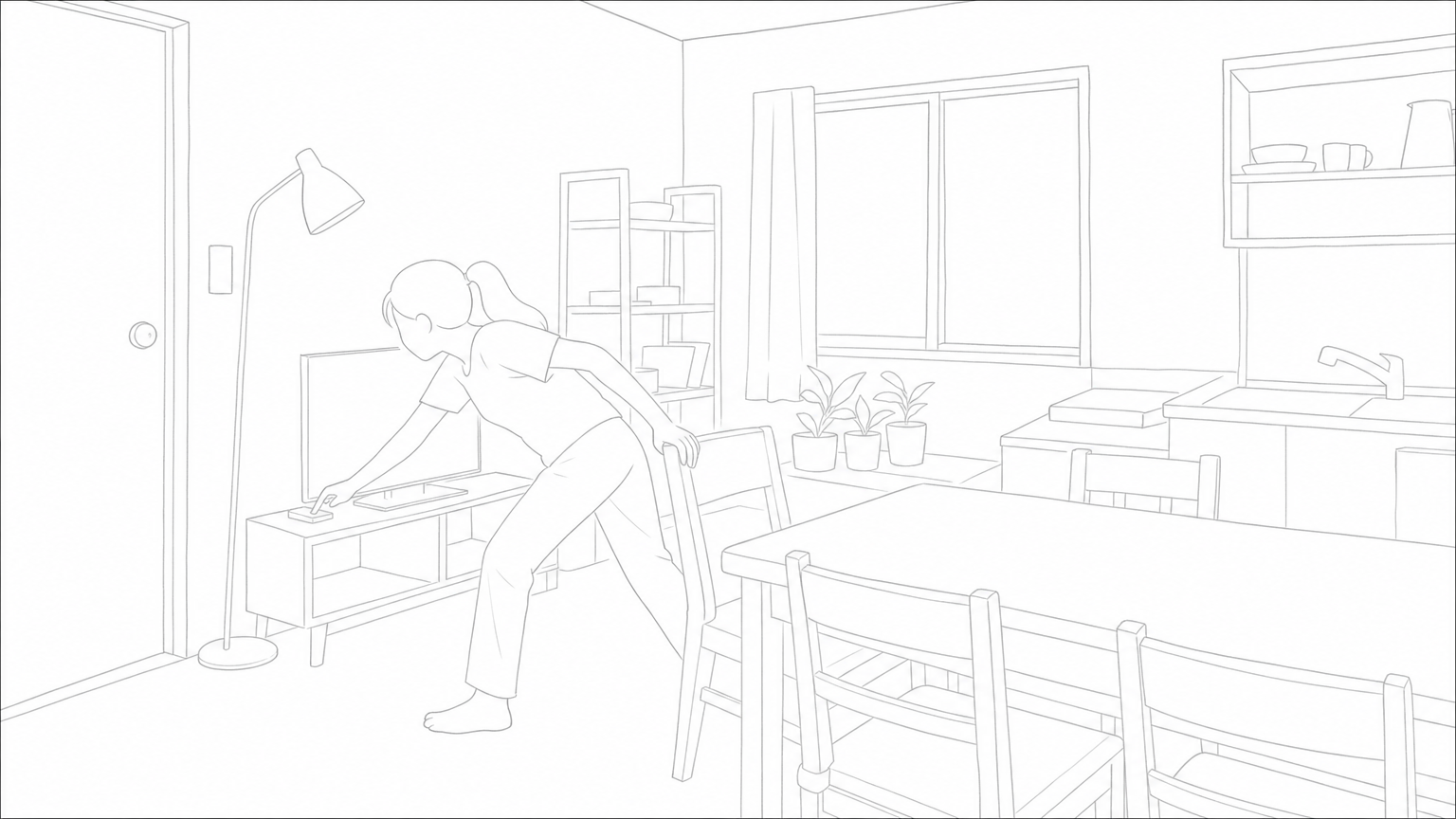
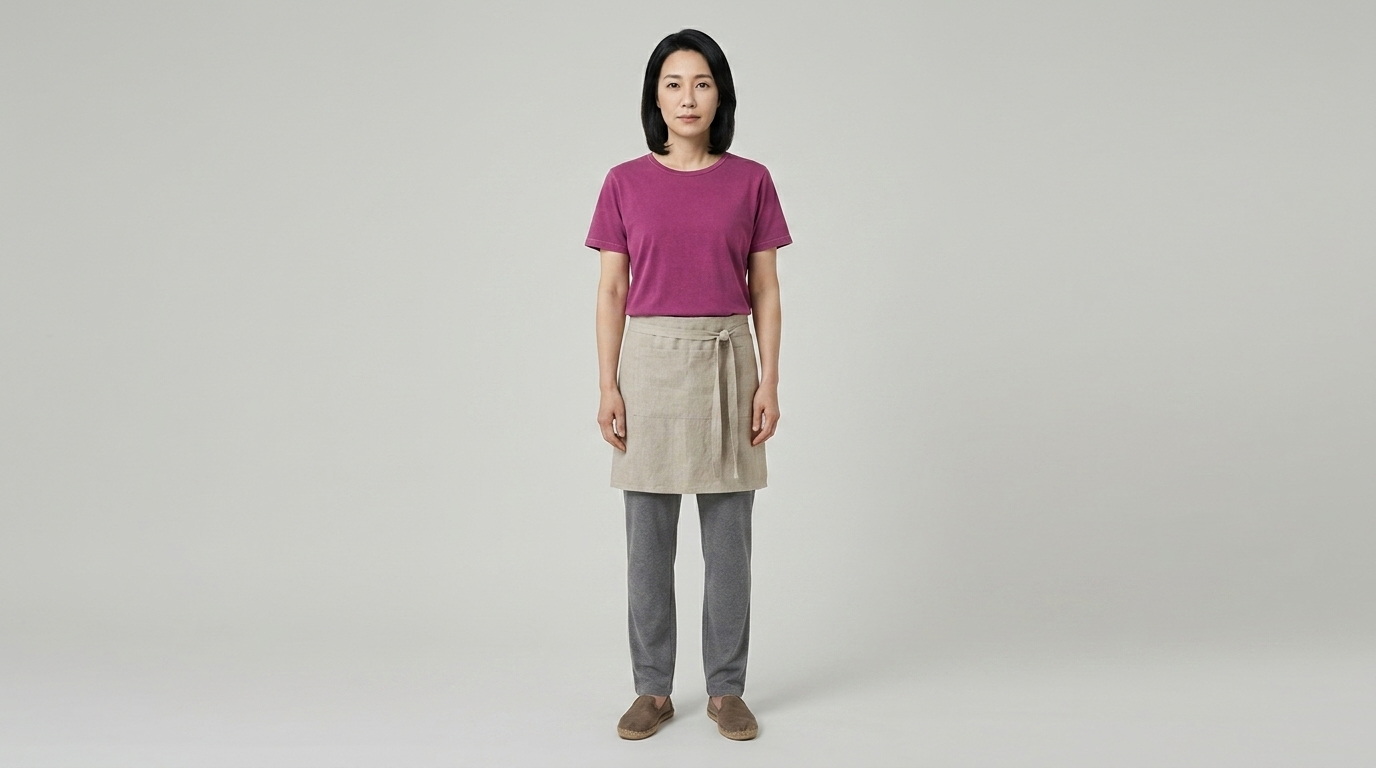
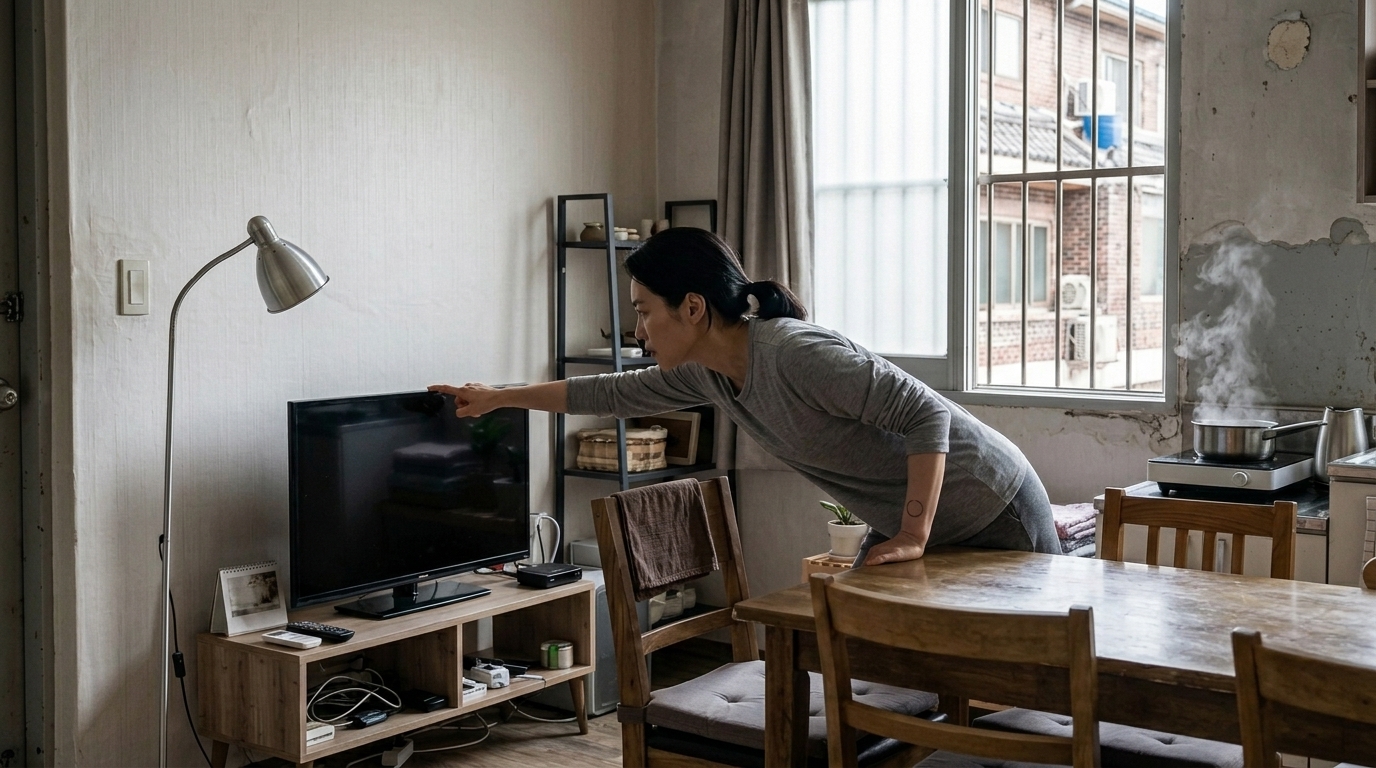
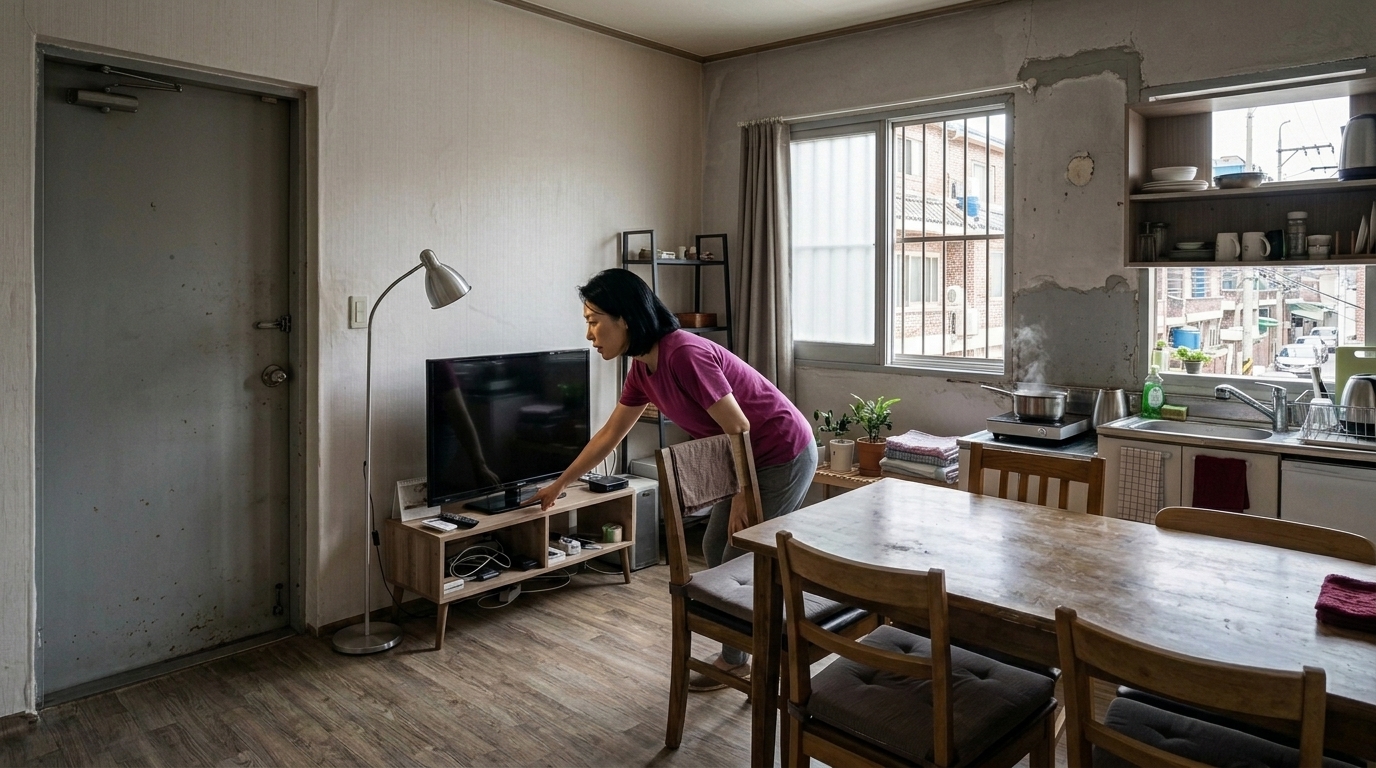
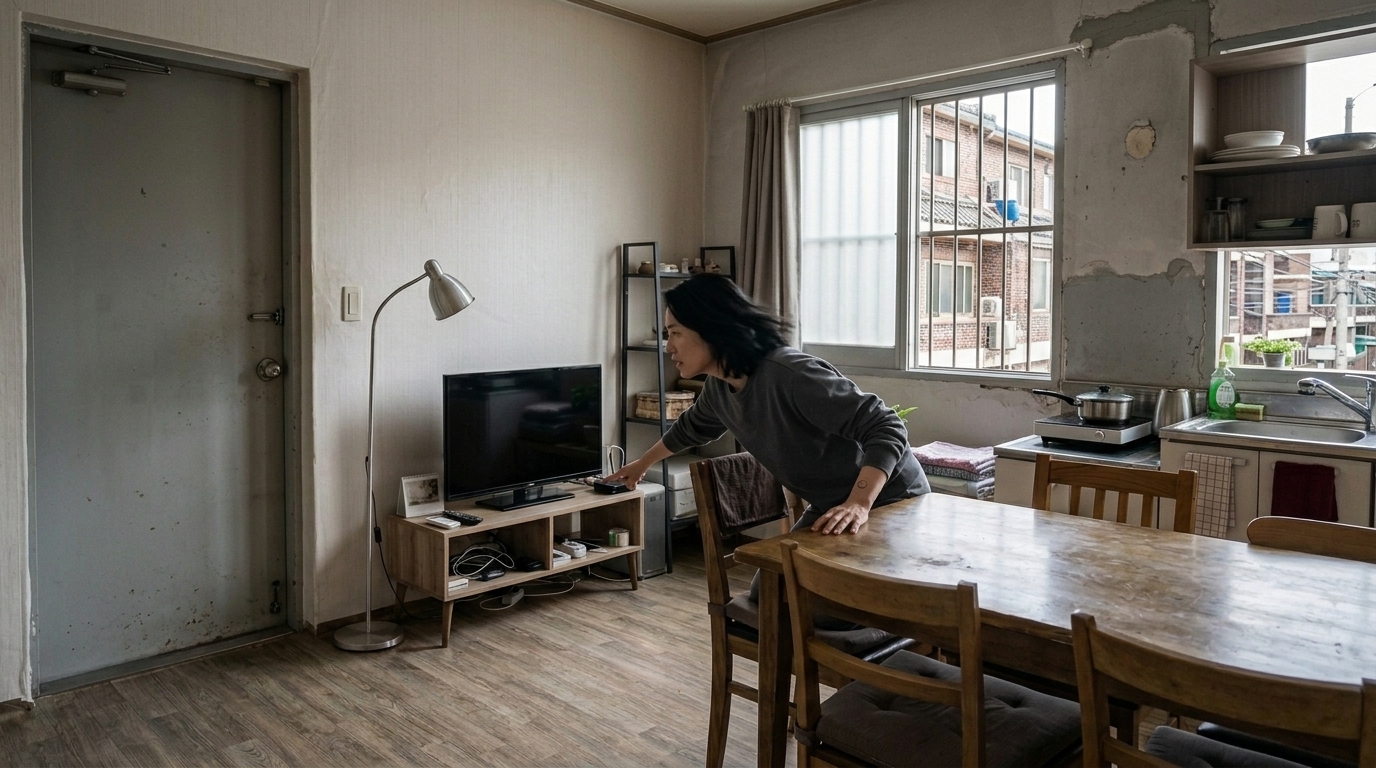
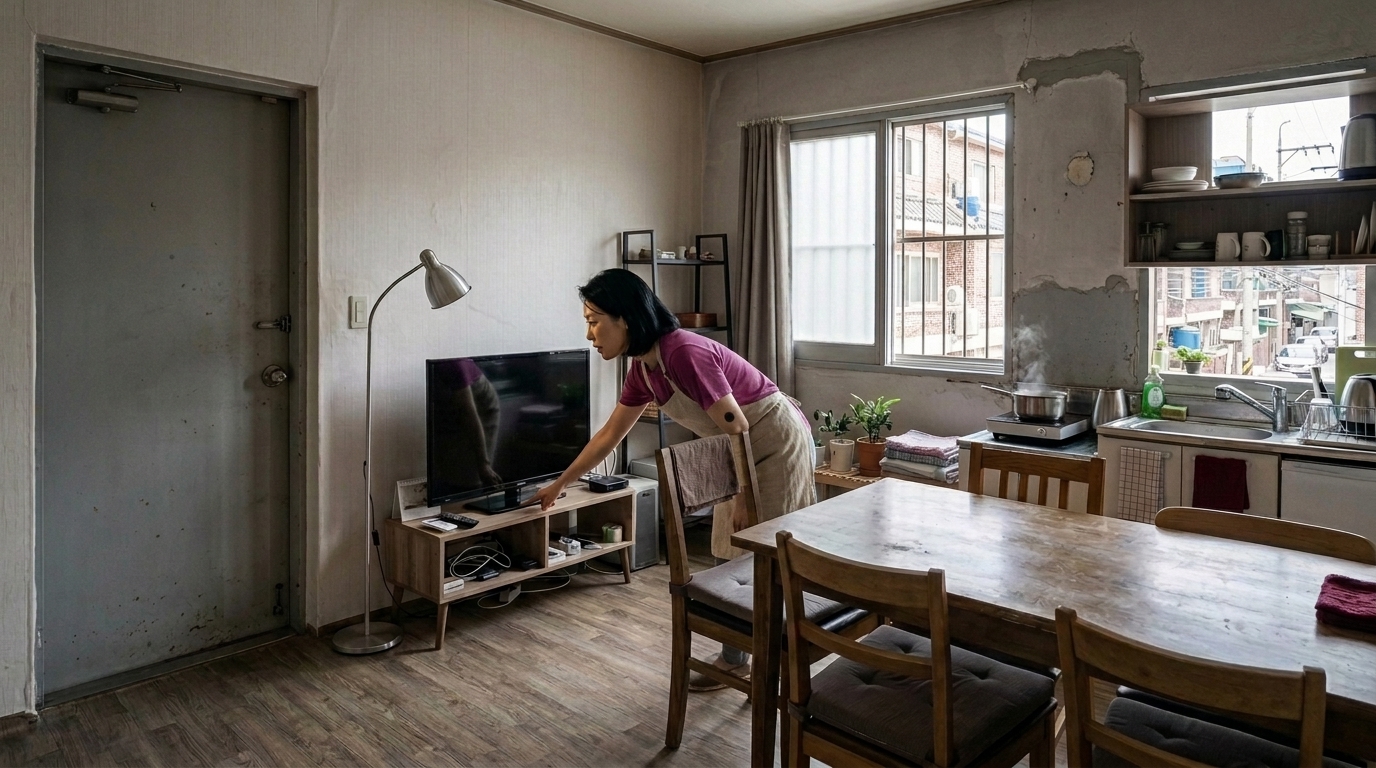
Create ONE FINAL photorealistic live-action film still of the moment below — contemporary South Korea, 2026; all people are Korean unless stated. TIME OF DAY (lock): day, thin sunlight through a small window.

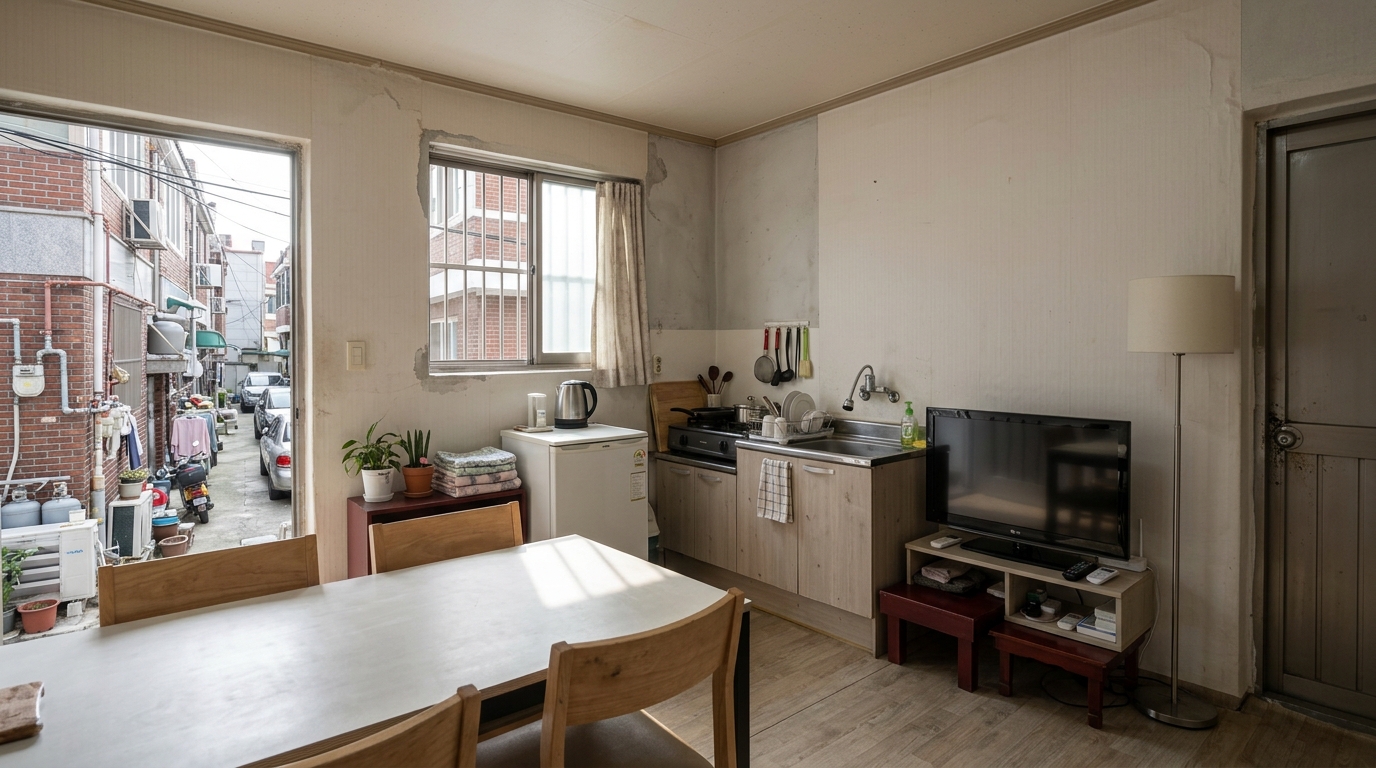
SHOT TEXT (authoritative, Korean): 다급하게 상체를 기울이며 손가락 끝으로 TV 전원 버튼을 세게 누르고 있는 민숙의 측면 구도

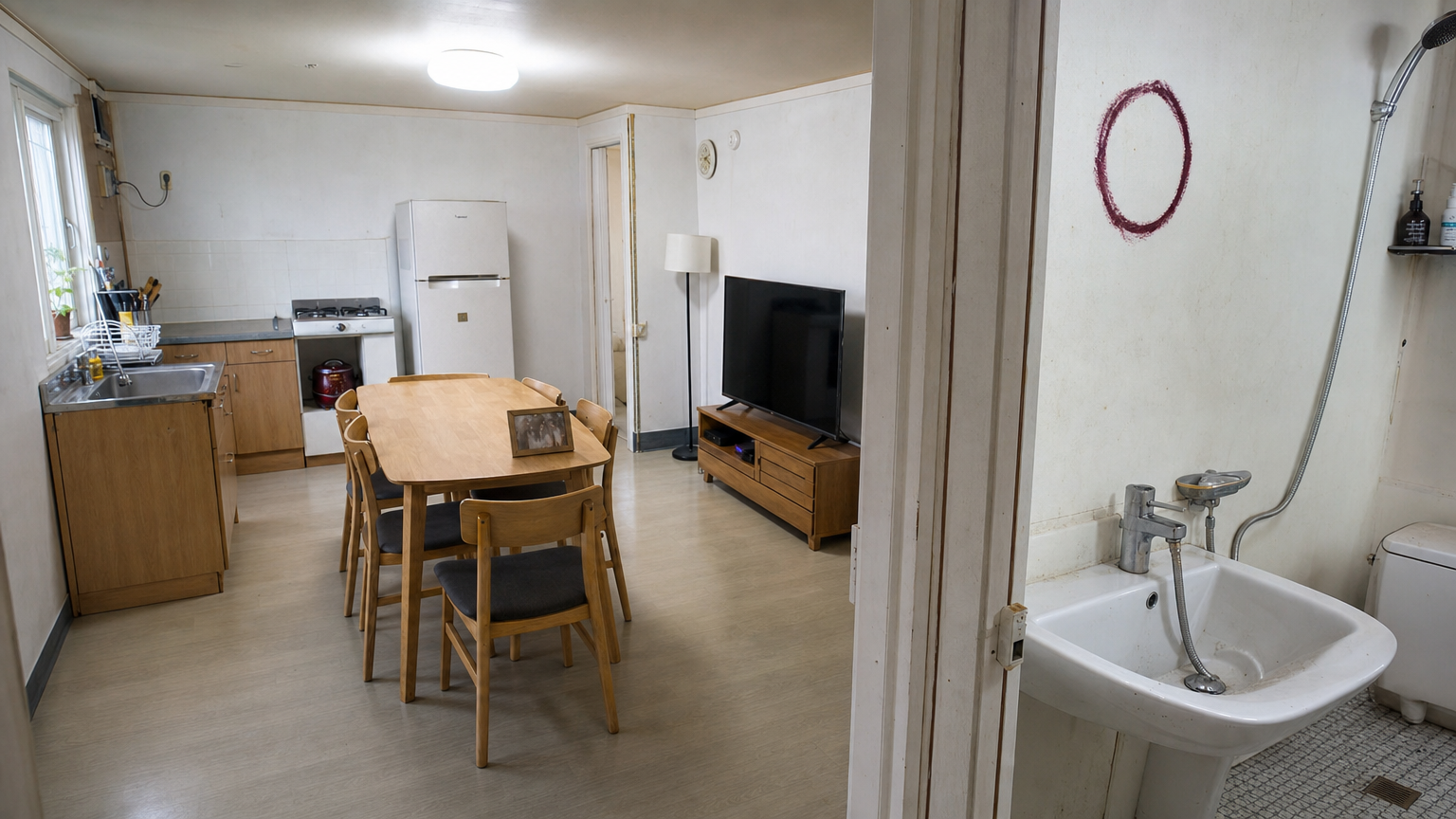
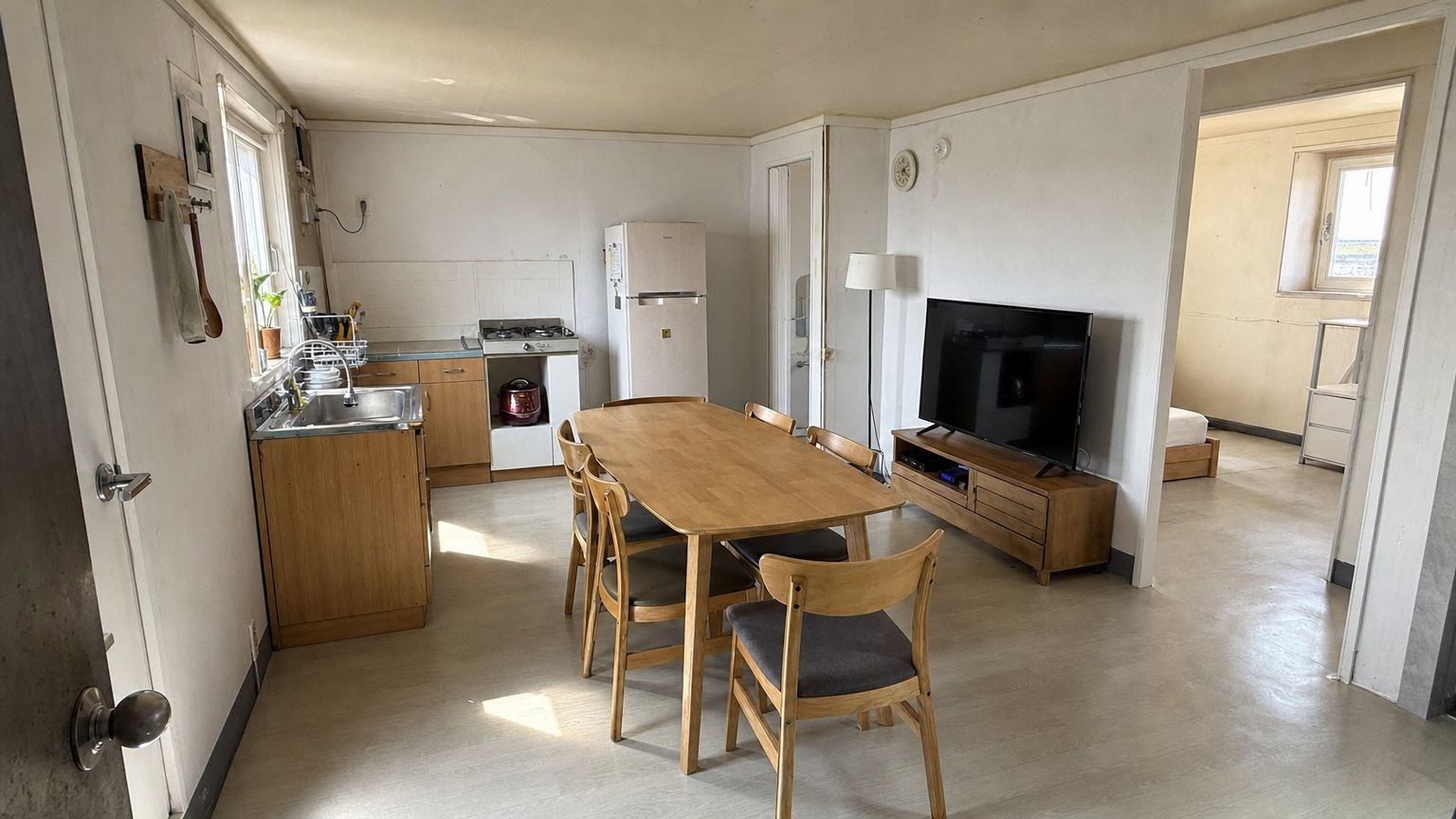
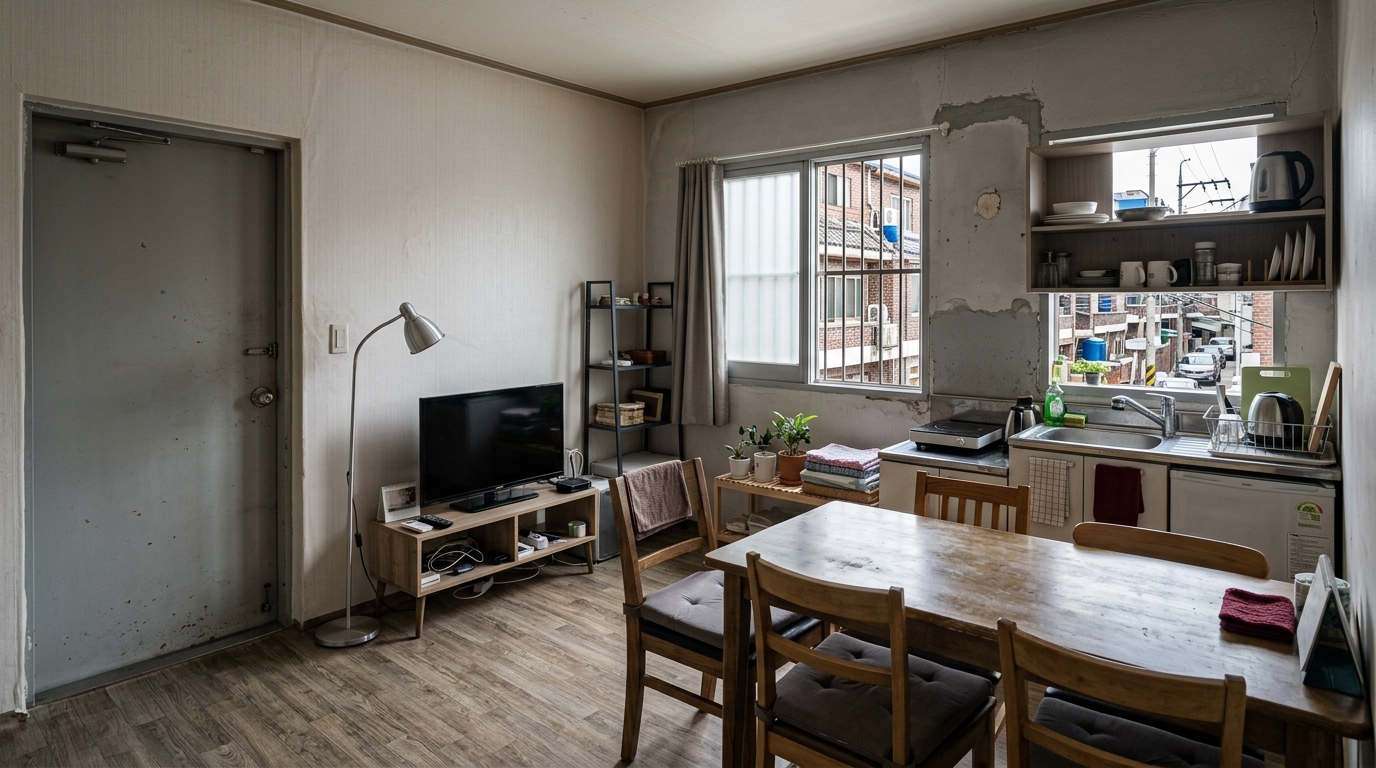
LOCATION (lock): A compact rooftop apartment interior with a small living-room window, a kitchen sink, a stove with a boiling pot, a dining table, and adjoining bedrooms. The shot takes place here — the attached LOCATION PHOTOGRAPH shows the exact spot.

REALIZE FIGURATIVE LANGUAGE AS A LIVE-ACTION SHOT: the Korean shot
text may describe characters metaphorically, figuratively or with
exaggeration. Photograph what a real movie camera would actually
record on a physical set — exaggerated or figurative impressions
become realistic staging choices (lighting, distance, angle,
wardrobe), not literal fantasy imagery.
EVERY CHARACTER IS A HUMAN BEING: unless the story explicitly
features non-human or virtual beings (as in science fiction or
fantasy), every character — however indirectly, vaguely or
figuratively the text describes them — IS a real human. When the
text gives no direct visual description of a person, IMAGINE one
and still show them as a concrete, fully-formed human being:
always render the human form to the maximum extent — build,
posture, face, hands, clothing — never reduce a person to a shape,
blob, solid silhouette or abstract mass.

EXPRESSIONS ARE ACTED, NEVER ANATOMICAL: when the text describes a
person's eyes, face or presence emotionally or figuratively (vacant,
hollow, dazed, burning, lifeless gaze and the like), it describes an
ACTOR'S PERFORMANCE captured by a real camera — realize it ONLY
through gaze direction, focus, eyelids, facial muscles, stillness
and posture. Every living person's eyes remain anatomically normal
human eyes with a natural iris and pupil, natural sclera and normal
proportions; NEVER whiten, blank out, cloud over, glow, enlarge or
otherwise alter eyeballs, skin or anatomy — unless the story
explicitly declares that being non-human or supernatural in form.

PROPS FACE THE RIGHT WAY: every handheld or used object must be
oriented exactly as its real-world use requires. A person reading,
watching or operating something (a phone, a photograph, a paper,
any device) has its functional side — screen, front, page — facing
THEIR OWN eyes; the camera then sees whatever side the staging
geometry implies (often its back). Show the functional side to the
camera ONLY when the shot text itself stages it toward the viewer.
Never flip, mirror or reverse an object's front and back.

CARRIED STATE (persist exactly — must match the neighbouring shots of this scene): Min-suk already bears the small circular mark on her wrist, though it need not be exposed in this angle.

PEOPLE: the SHOT TEXT alone decides whether any person is visible in this shot. IF a person appears, they must be one of: 민숙 (Korean 40대 초반 여성, 자연스러운 검은 머리, 성숙한 타원형 얼굴, 평범하고 단정한 이목구비) — never anyone else, and never add a person the shot text does not show. IF only part of a person is in frame (a hand, arm, foot, back, silhouette), that body part belongs to the specific person the shot text names — its sex, age, build, skin and grooming must unmistakably match that person's profile above.

No text, captions, watermarks or annotations anywhere.
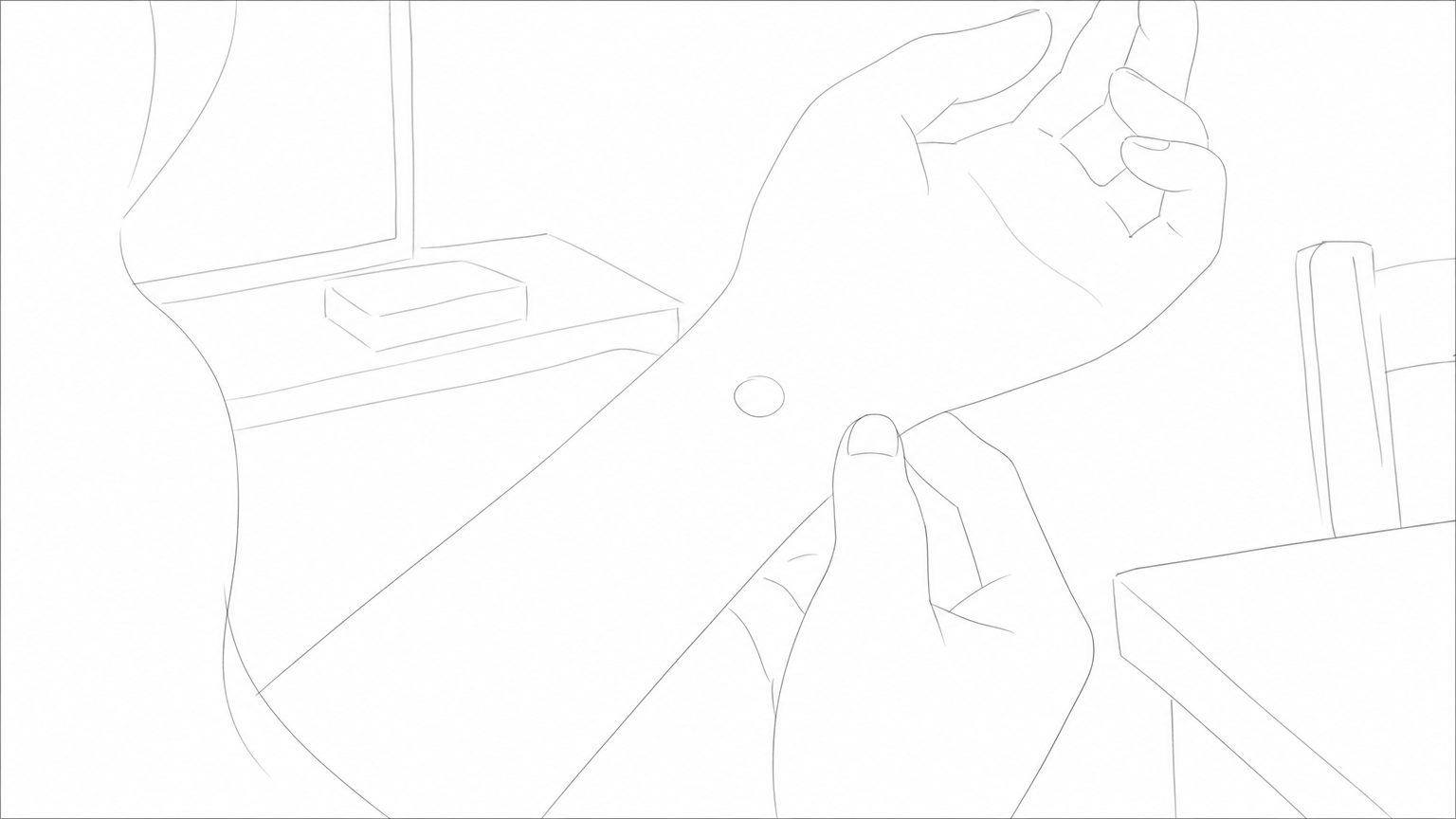
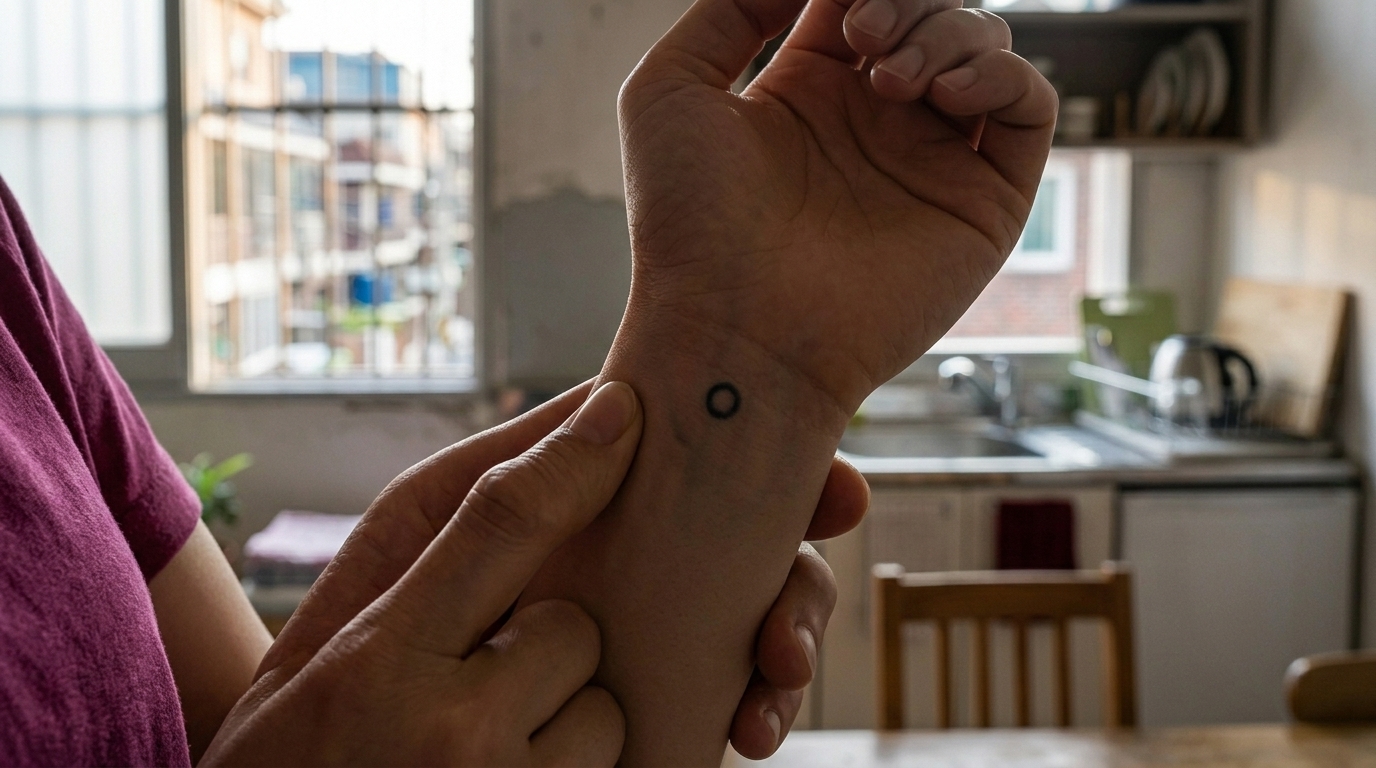
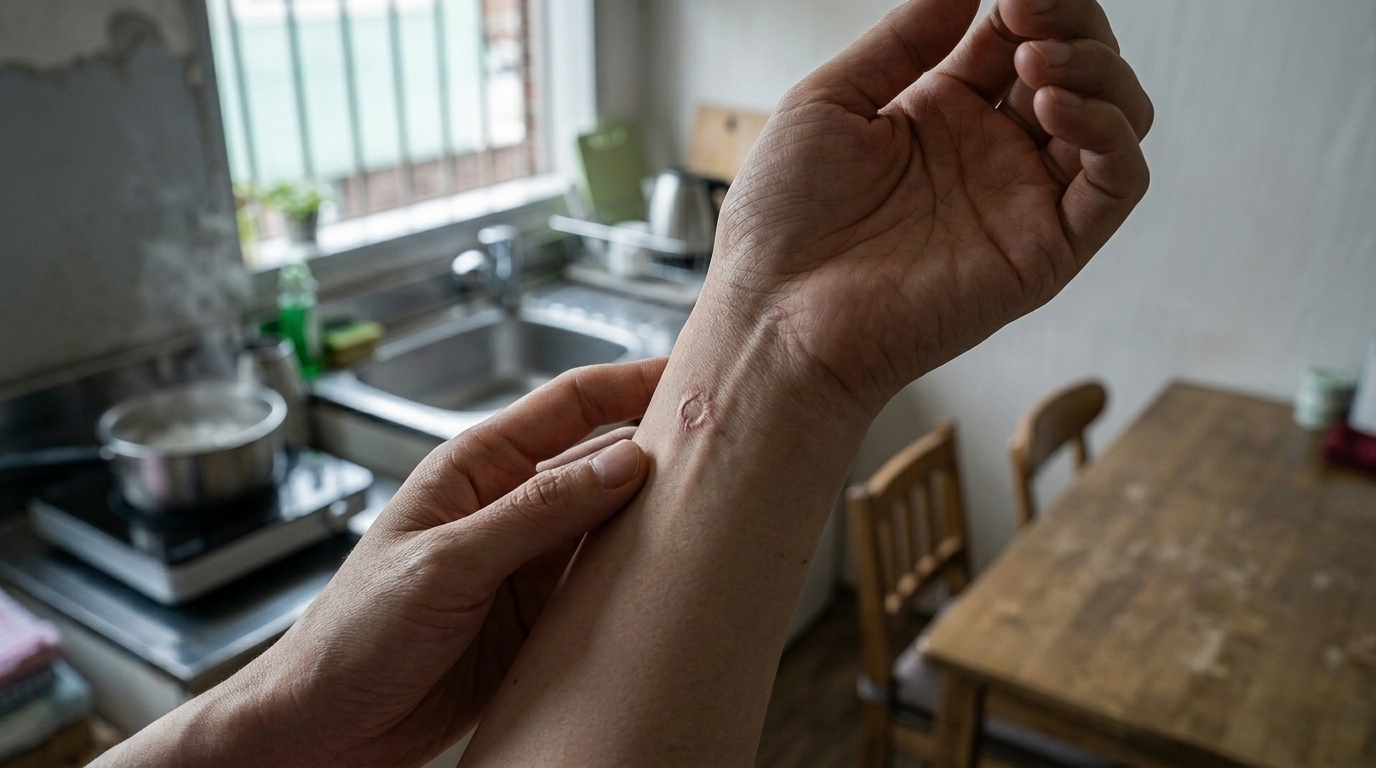
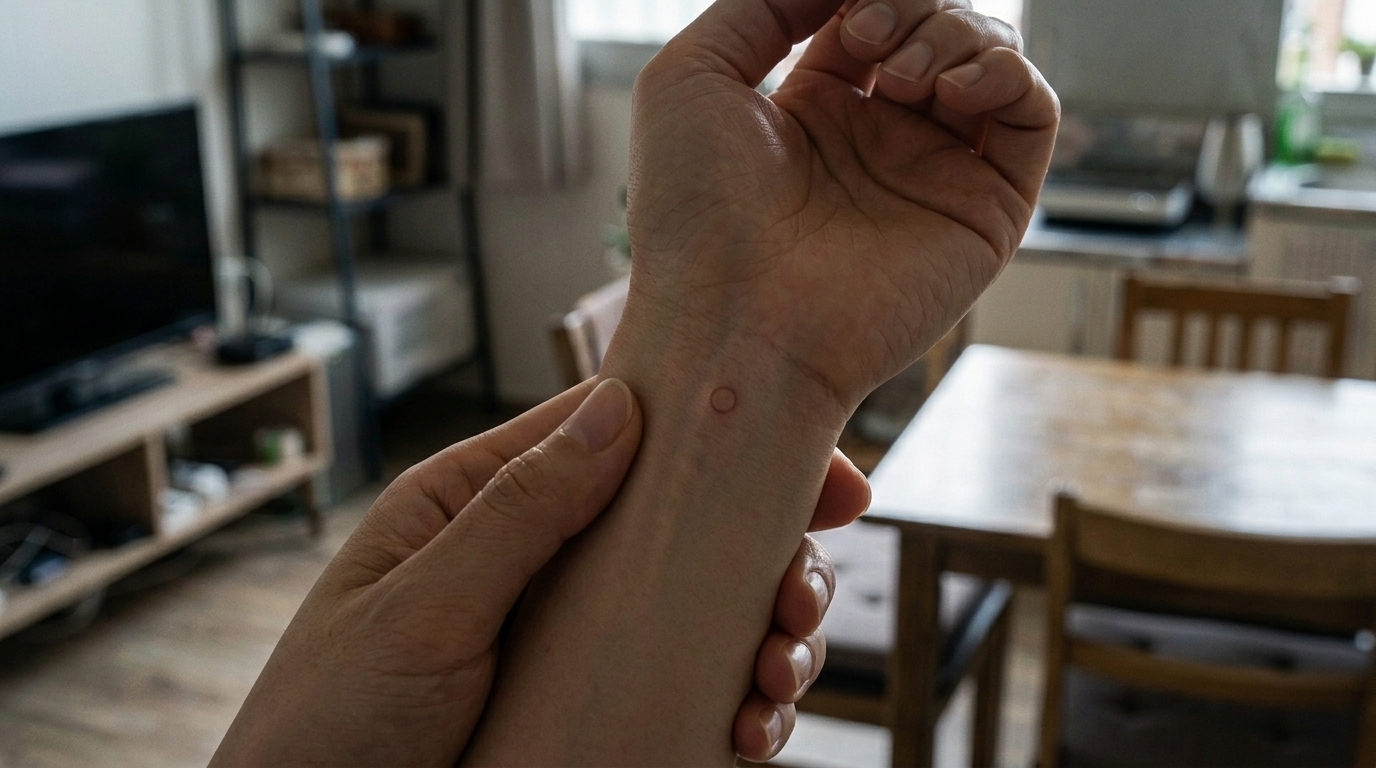
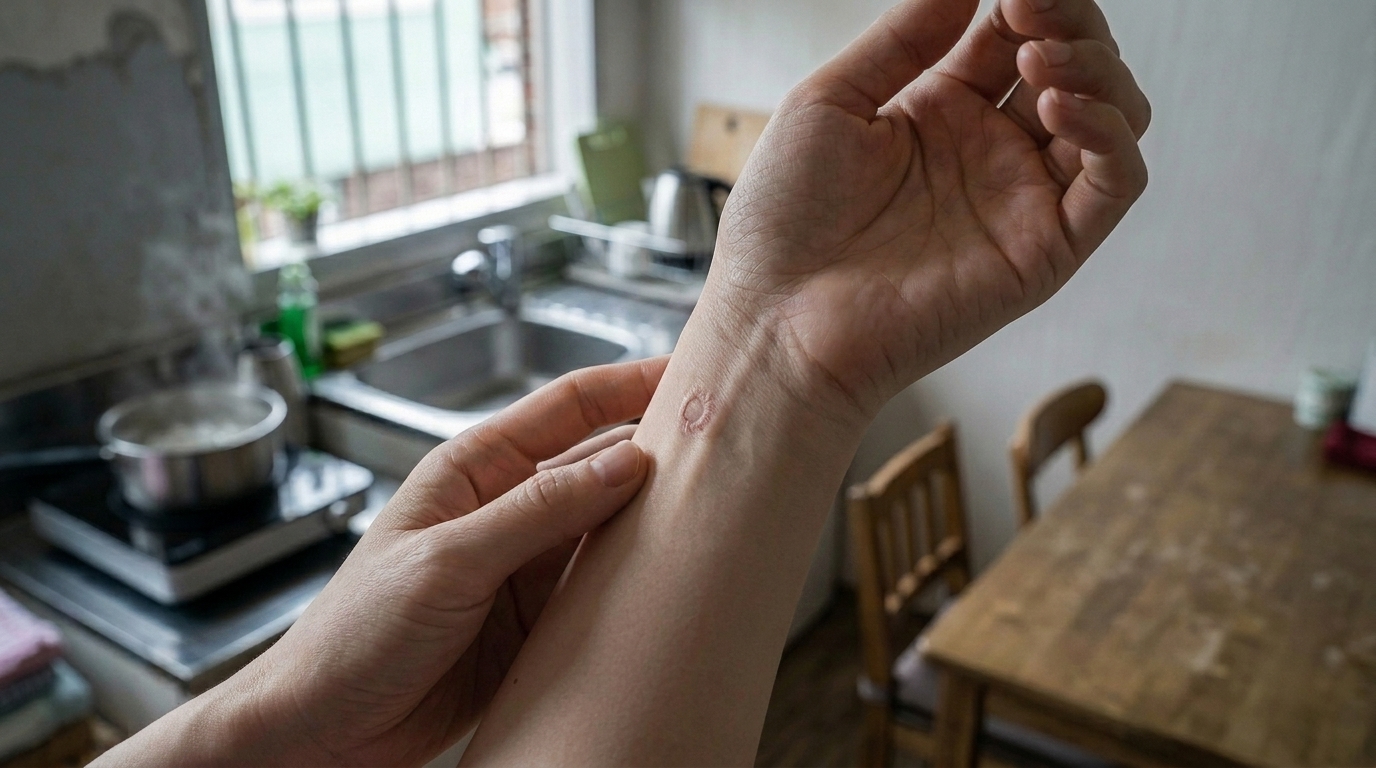
Create ONE FINAL photorealistic live-action film still of the moment below — contemporary South Korea, 2026; all people are Korean unless stated. TIME OF DAY (lock): day, thin sunlight through a small window.

SHOT TEXT (authoritative, Korean): 민숙의 손목에 선명하게 드러난 작은 원형 표식의 타이트 샷

LOCATION (lock): A compact rooftop apartment interior with a small living-room window, a kitchen sink, a stove with a boiling pot, a dining table, and adjoining bedrooms. The shot takes place here — the attached LOCATION PHOTOGRAPH shows the exact spot.

REALIZE FIGURATIVE LANGUAGE AS A LIVE-ACTION SHOT: the Korean shot
text may describe characters metaphorically, figuratively or with
exaggeration. Photograph what a real movie camera would actually
record on a physical set — exaggerated or figurative impressions
become realistic staging choices (lighting, distance, angle,
wardrobe), not literal fantasy imagery.
EVERY CHARACTER IS A HUMAN BEING: unless the story explicitly
features non-human or virtual beings (as in science fiction or
fantasy), every character — however indirectly, vaguely or
figuratively the text describes them — IS a real human. When the
text gives no direct visual description of a person, IMAGINE one
and still show them as a concrete, fully-formed human being:
always render the human form to the maximum extent — build,
posture, face, hands, clothing — never reduce a person to a shape,
blob, solid silhouette or abstract mass.

EXPRESSIONS ARE ACTED, NEVER ANATOMICAL: when the text describes a
person's eyes, face or presence emotionally or figuratively (vacant,
hollow, dazed, burning, lifeless gaze and the like), it describes an
ACTOR'S PERFORMANCE captured by a real camera — realize it ONLY
through gaze direction, focus, eyelids, facial muscles, stillness
and posture. Every living person's eyes remain anatomically normal
human eyes with a natural iris and pupil, natural sclera and normal
proportions; NEVER whiten, blank out, cloud over, glow, enlarge or
otherwise alter eyeballs, skin or anatomy — unless the story
explicitly declares that being non-human or supernatural in form.

PROPS FACE THE RIGHT WAY: every handheld or used object must be
oriented exactly as its real-world use requires. A person reading,
watching or operating something (a phone, a photograph, a paper,
any device) has its functional side — screen, front, page — facing
THEIR OWN eyes; the camera then sees whatever side the staging
geometry implies (often its back). Show the functional side to the
camera ONLY when the shot text itself stages it toward the viewer.
Never flip, mirror or reverse an object's front and back.

CARRIED STATE (persist exactly — must match the neighbouring shots of this scene): The small circular mark remains clearly visible on Min-suk's wrist.

PEOPLE: the SHOT TEXT alone decides whether any person is visible in this shot. IF a person appears, they must be one of: 민숙 (Korean 40대 초반 여성, 자연스러운 검은 머리, 성숙한 타원형 얼굴, 평범하고 단정한 이목구비) — never anyone else, and never add a person the shot text does not show. IF only part of a person is in frame (a hand, arm, foot, back, silhouette), that body part belongs to the specific person the shot text names — its sex, age, build, skin and grooming must unmistakably match that person's profile above.

No text, captions, watermarks or annotations anywhere.
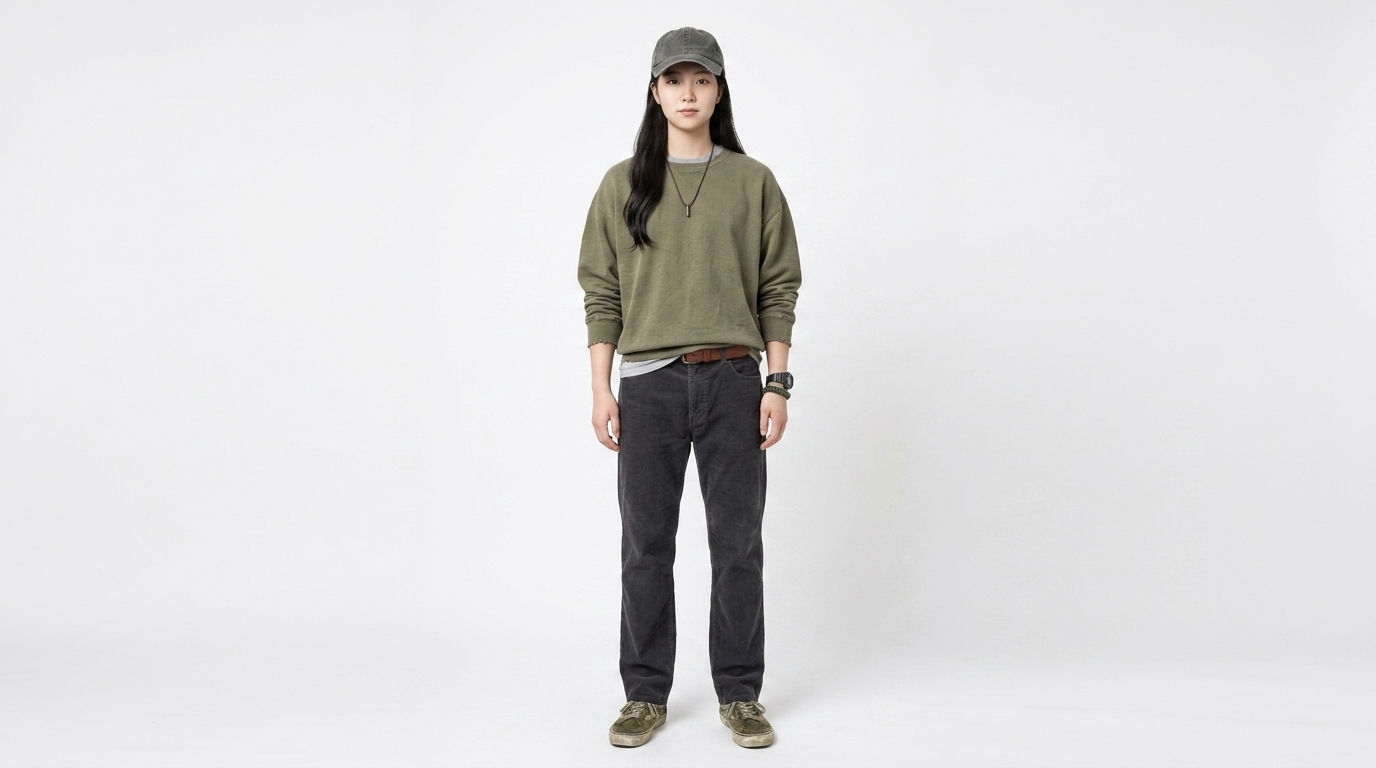
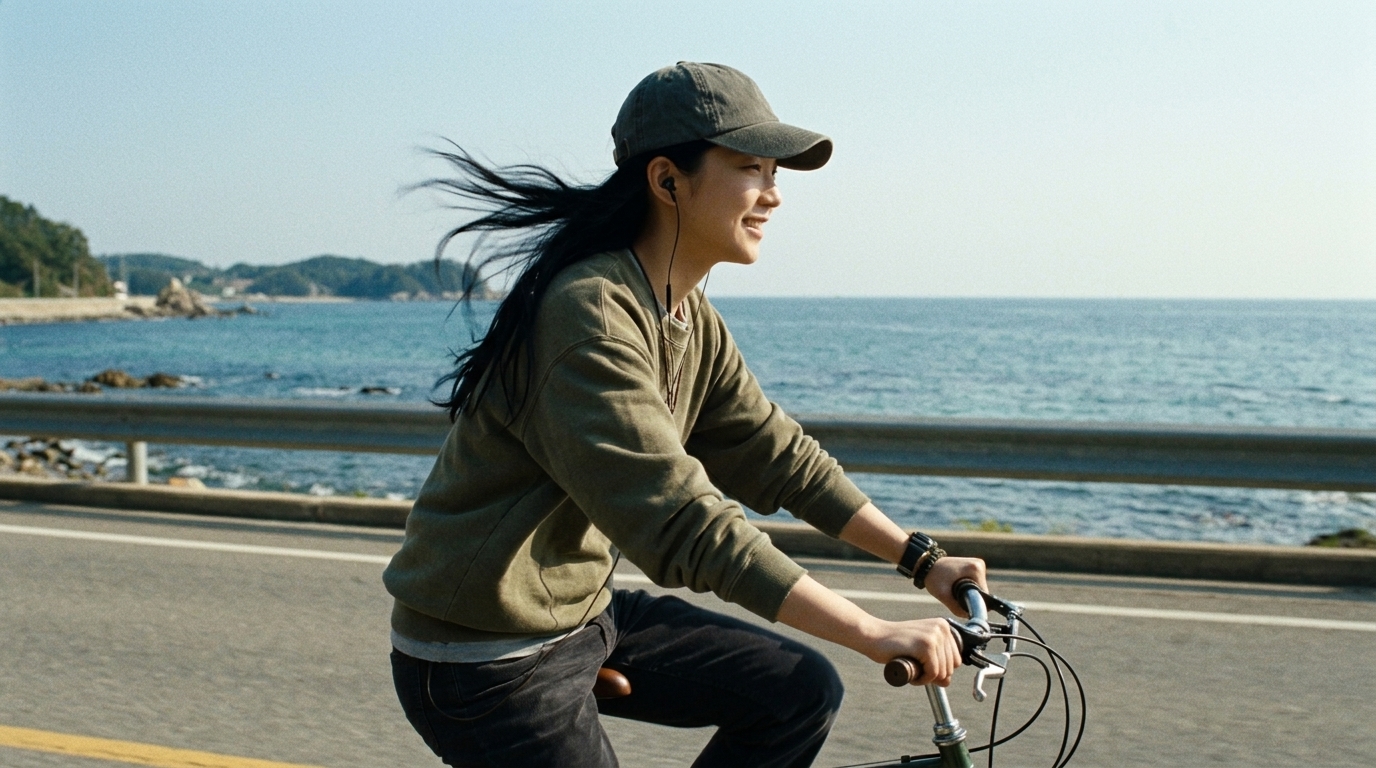
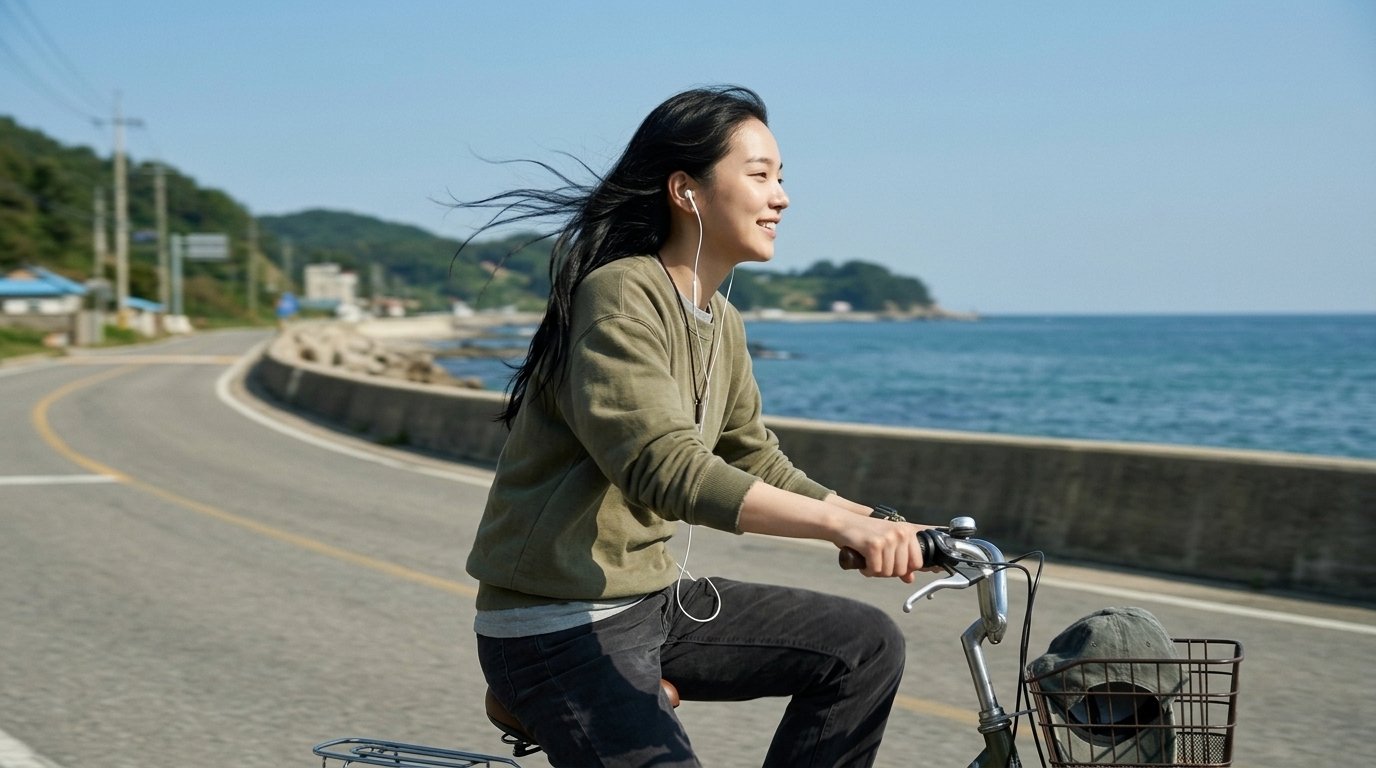
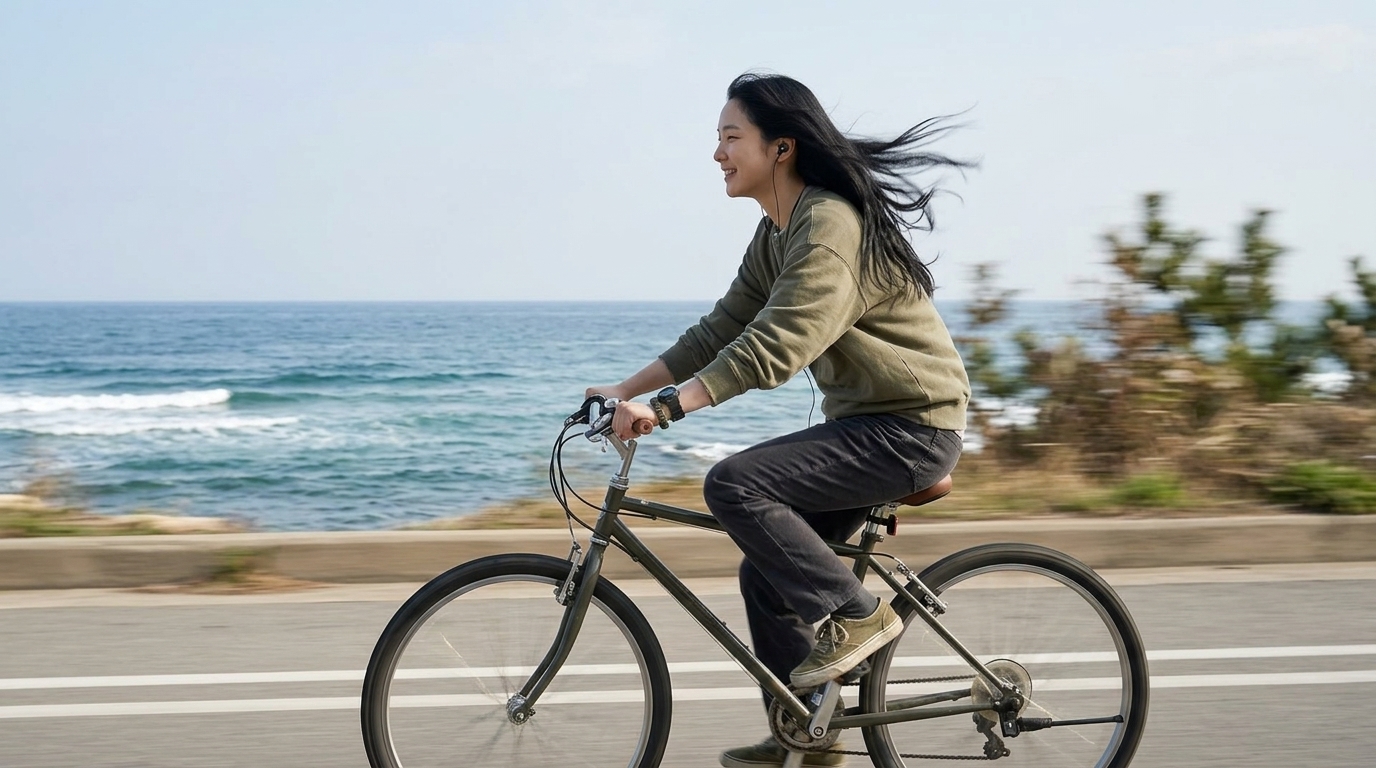
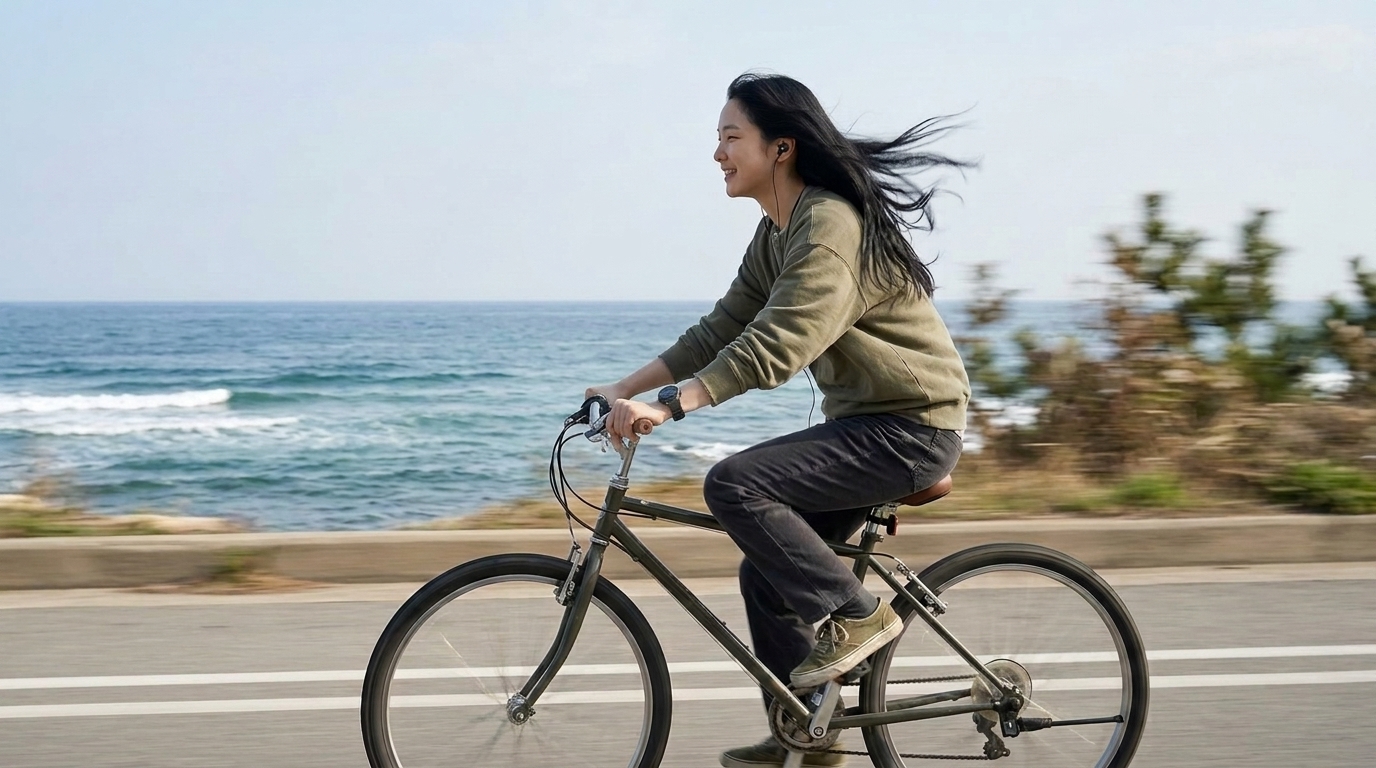
Create ONE FINAL photorealistic live-action film still of the moment below — contemporary South Korea, 2026; all people are Korean unless stated. TIME OF DAY (lock): day.

SHOT TEXT (authoritative, Korean): 낮의 해안가 도로 위, 이어폰을 낀 채 자전거 안장에 앉아 한 발로 페달을 밟아 내리는 중간 동작으로 미소 짓는 수리영의 옆모습, 자전거의 추진력에 의해 머리카락이 뒤로 흩날리는 찰나

LOCATION (lock): A coastal road running beside the sea, suitable for bicycle travel. The shot takes place here — the attached LOCATION PHOTOGRAPH shows the exact spot.

REALIZE FIGURATIVE LANGUAGE AS A LIVE-ACTION SHOT: the Korean shot
text may describe characters metaphorically, figuratively or with
exaggeration. Photograph what a real movie camera would actually
record on a physical set — exaggerated or figurative impressions
become realistic staging choices (lighting, distance, angle,
wardrobe), not literal fantasy imagery.
EVERY CHARACTER IS A HUMAN BEING: unless the story explicitly
features non-human or virtual beings (as in science fiction or
fantasy), every character — however indirectly, vaguely or
figuratively the text describes them — IS a real human. When the
text gives no direct visual description of a person, IMAGINE one
and still show them as a concrete, fully-formed human being:
always render the human form to the maximum extent — build,
posture, face, hands, clothing — never reduce a person to a shape,
blob, solid silhouette or abstract mass.

EXPRESSIONS ARE ACTED, NEVER ANATOMICAL: when the text describes a
person's eyes, face or presence emotionally or figuratively (vacant,
hollow, dazed, burning, lifeless gaze and the like), it describes an
ACTOR'S PERFORMANCE captured by a real camera — realize it ONLY
through gaze direction, focus, eyelids, facial muscles, stillness
and posture. Every living person's eyes remain anatomically normal
human eyes with a natural iris and pupil, natural sclera and normal
proportions; NEVER whiten, blank out, cloud over, glow, enlarge or
otherwise alter eyeballs, skin or anatomy — unless the story
explicitly declares that being non-human or supernatural in form.

PROPS FACE THE RIGHT WAY: every handheld or used object must be
oriented exactly as its real-world use requires. A person reading,
watching or operating something (a phone, a photograph, a paper,
any device) has its functional side — screen, front, page — facing
THEIR OWN eyes; the camera then sees whatever side the staging
geometry implies (often its back). Show the functional side to the
camera ONLY when the shot text itself stages it toward the viewer.
Never flip, mirror or reverse an object's front and back.

CARRIED STATE (persist exactly — must match the neighbouring shots of this scene): Su-ri-young is wearing her earphones while riding the bicycle.

PEOPLE: the SHOT TEXT alone decides whether any person is visible in this shot. IF a person appears, they must be one of: 수리영 (Korean 20대 초반 여성, 긴 검은 머리, 타원형의 젊은 얼굴, 부드러운 이목구비와 자연스러운 피부색상태) — never anyone else, and never add a person the shot text does not show. IF only part of a person is in frame (a hand, arm, foot, back, silhouette), that body part belongs to the specific person the shot text names — its sex, age, build, skin and grooming must unmistakably match that person's profile above.

No text, captions, watermarks or annotations anywhere.
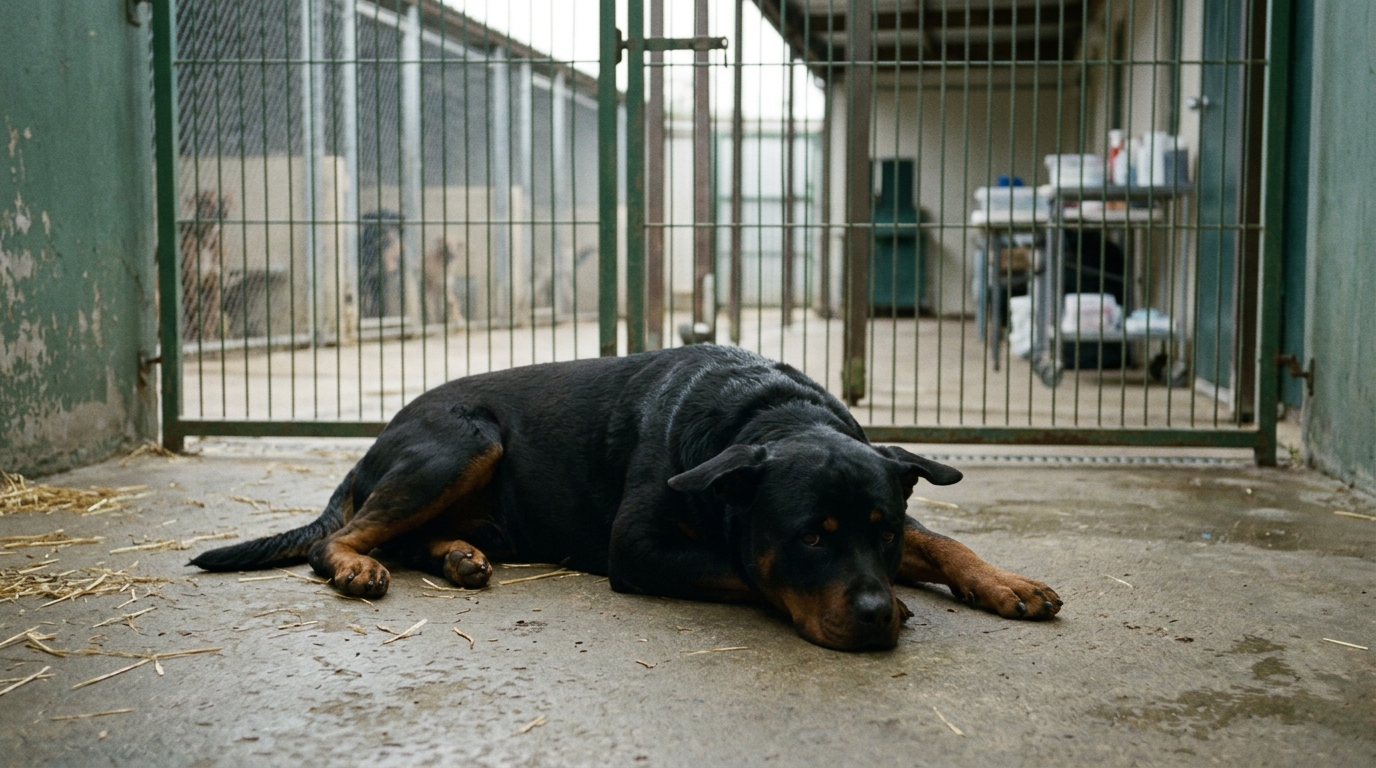
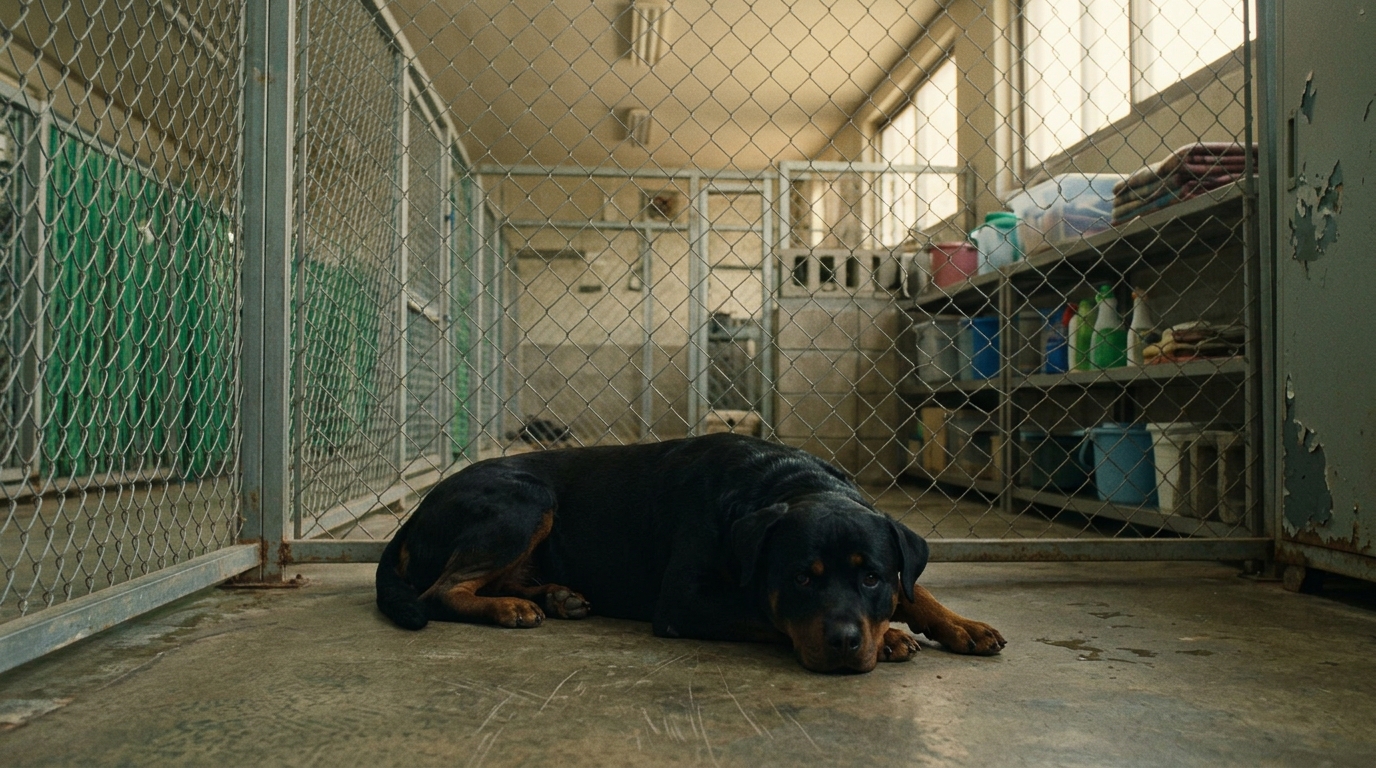
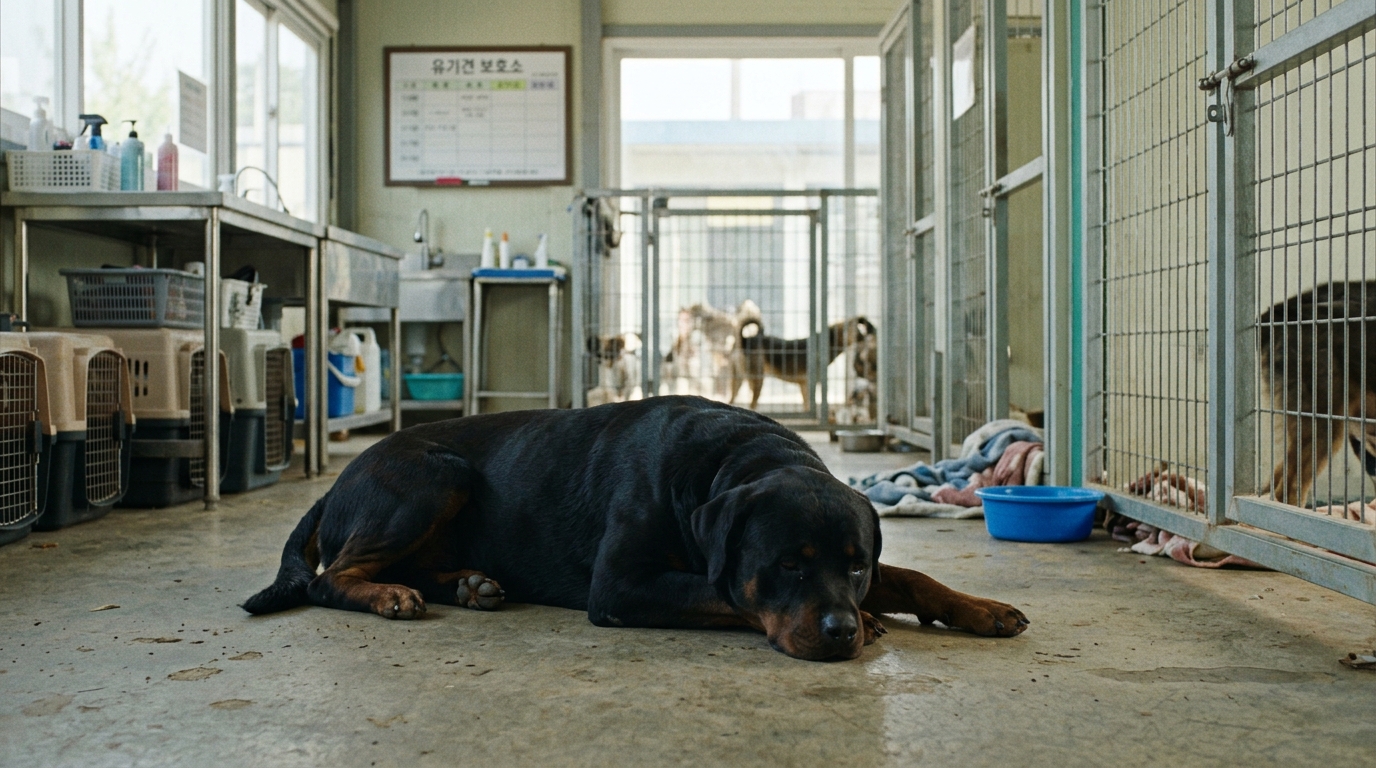
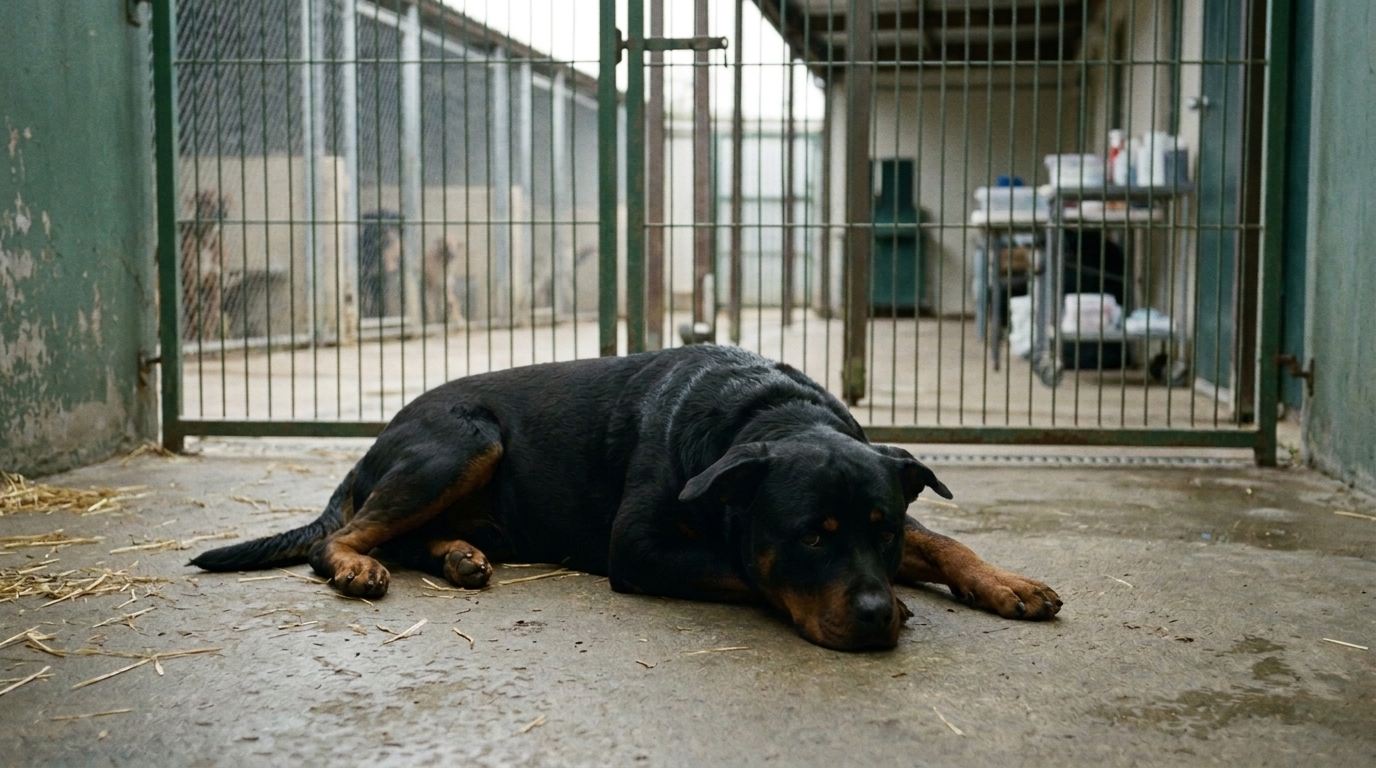
Create ONE FINAL photorealistic live-action film still of the moment below — contemporary South Korea, 2026; all people are Korean unless stated. TIME OF DAY (lock): day.

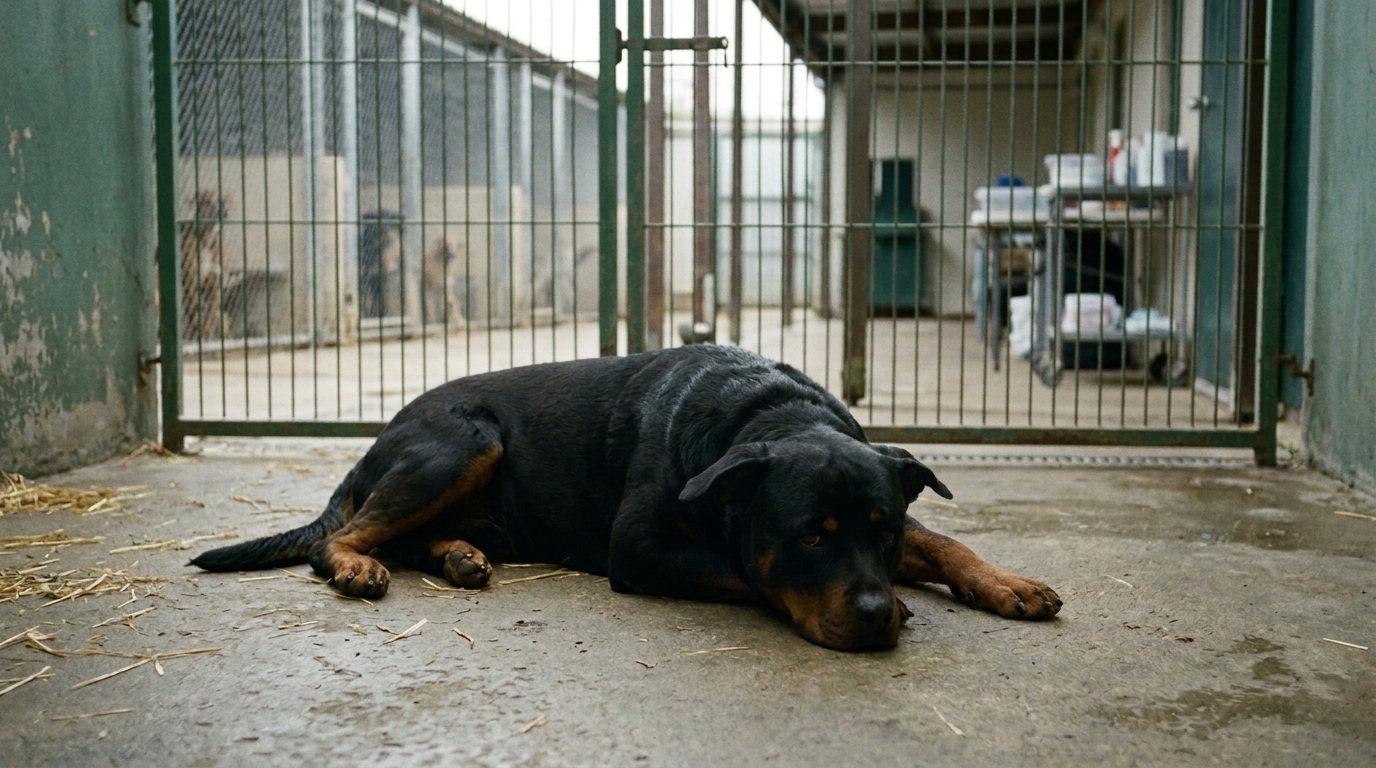
SHOT TEXT (authoritative, Korean): 로트와일러가 귀를 뒤로 젖힌 채 얌전히 바닥에 엎드린 정지 상태

LOCATION (lock): A stray-dog shelter with secured enclosures for multiple dogs and working areas for vaccinations, grooming, ointment treatment, and bathing. The shot takes place here — the attached LOCATION PHOTOGRAPH shows the exact spot.

REALIZE FIGURATIVE LANGUAGE AS A LIVE-ACTION SHOT: the Korean shot
text may describe characters metaphorically, figuratively or with
exaggeration. Photograph what a real movie camera would actually
record on a physical set — exaggerated or figurative impressions
become realistic staging choices (lighting, distance, angle,
wardrobe), not literal fantasy imagery.
EVERY CHARACTER IS A HUMAN BEING: unless the story explicitly
features non-human or virtual beings (as in science fiction or
fantasy), every character — however indirectly, vaguely or
figuratively the text describes them — IS a real human. When the
text gives no direct visual description of a person, IMAGINE one
and still show them as a concrete, fully-formed human being:
always render the human form to the maximum extent — build,
posture, face, hands, clothing — never reduce a person to a shape,
blob, solid silhouette or abstract mass.

EXPRESSIONS ARE ACTED, NEVER ANATOMICAL: when the text describes a
person's eyes, face or presence emotionally or figuratively (vacant,
hollow, dazed, burning, lifeless gaze and the like), it describes an
ACTOR'S PERFORMANCE captured by a real camera — realize it ONLY
through gaze direction, focus, eyelids, facial muscles, stillness
and posture. Every living person's eyes remain anatomically normal
human eyes with a natural iris and pupil, natural sclera and normal
proportions; NEVER whiten, blank out, cloud over, glow, enlarge or
otherwise alter eyeballs, skin or anatomy — unless the story
explicitly declares that being non-human or supernatural in form.

PROPS FACE THE RIGHT WAY: every handheld or used object must be
oriented exactly as its real-world use requires. A person reading,
watching or operating something (a phone, a photograph, a paper,
any device) has its functional side — screen, front, page — facing
THEIR OWN eyes; the camera then sees whatever side the staging
geometry implies (often its back). Show the functional side to the
camera ONLY when the shot text itself stages it toward the viewer.
Never flip, mirror or reverse an object's front and back.

CARRIED STATE (persist exactly — must match the neighbouring shots of this scene): The Rottweiler remains subdued and lying calmly after responding to Su-ri-young's stare.

NO PEOPLE IN THIS SHOT: the shot text shows only the place and its state — no living person or any body part appears in frame, unless the shot text itself explicitly says so.

No text, captions, watermarks or annotations anywhere.
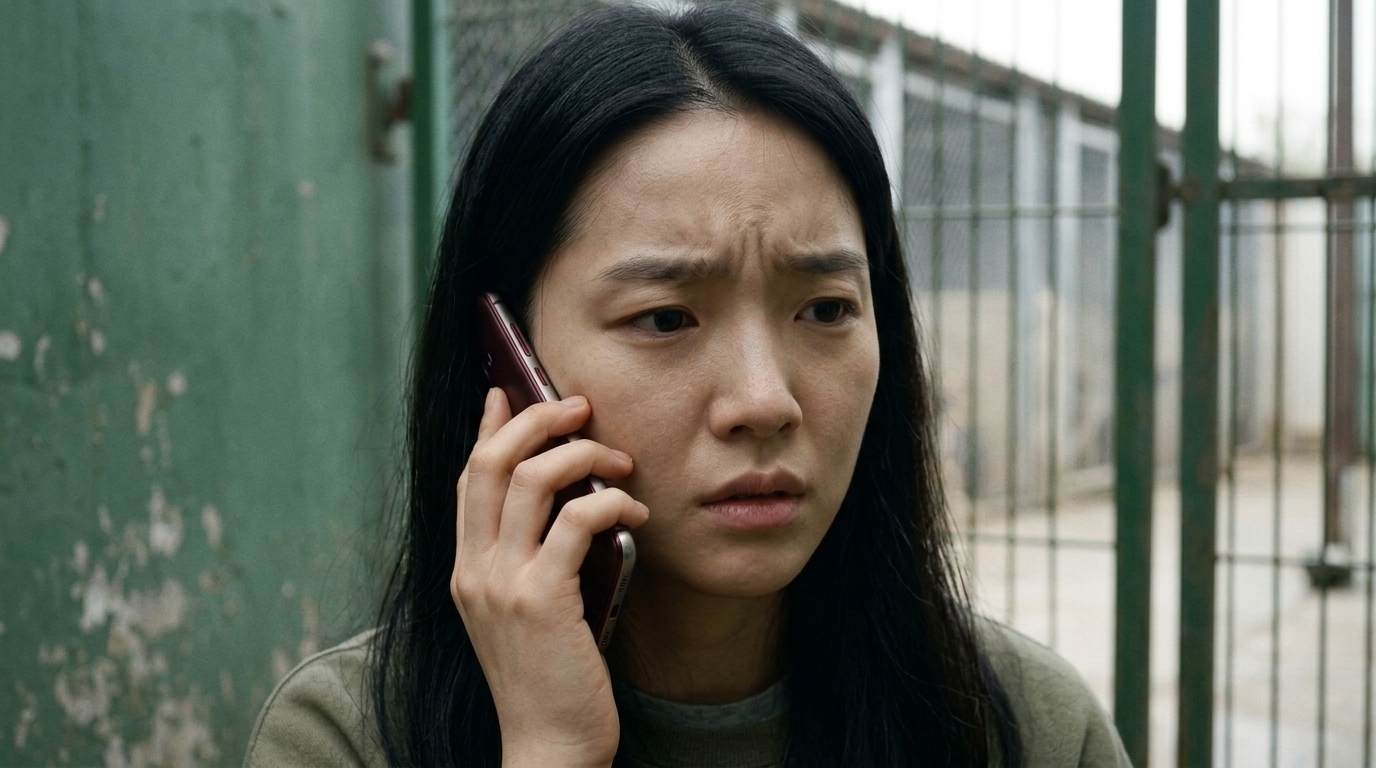
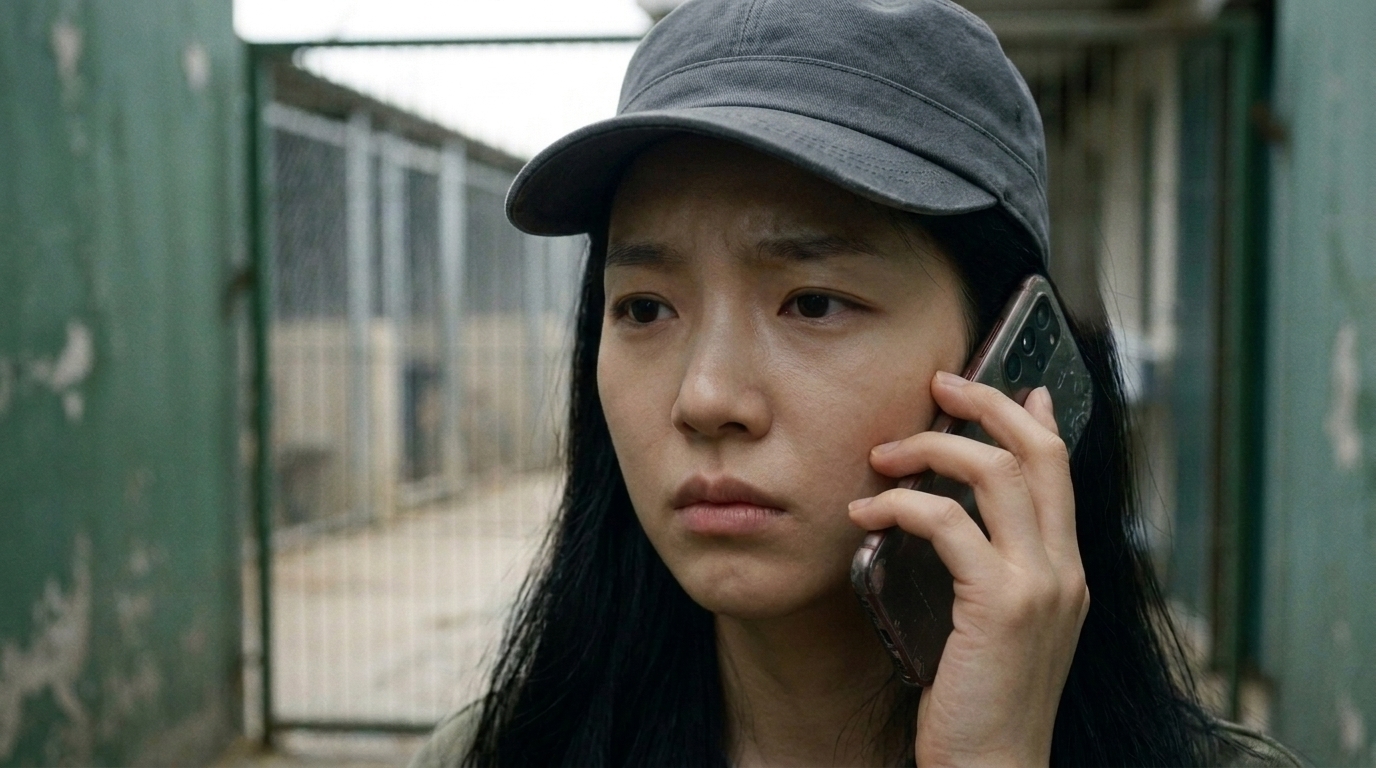
Create ONE FINAL photorealistic live-action film still of the moment below — contemporary South Korea, 2026; all people are Korean unless stated. TIME OF DAY (lock): day.

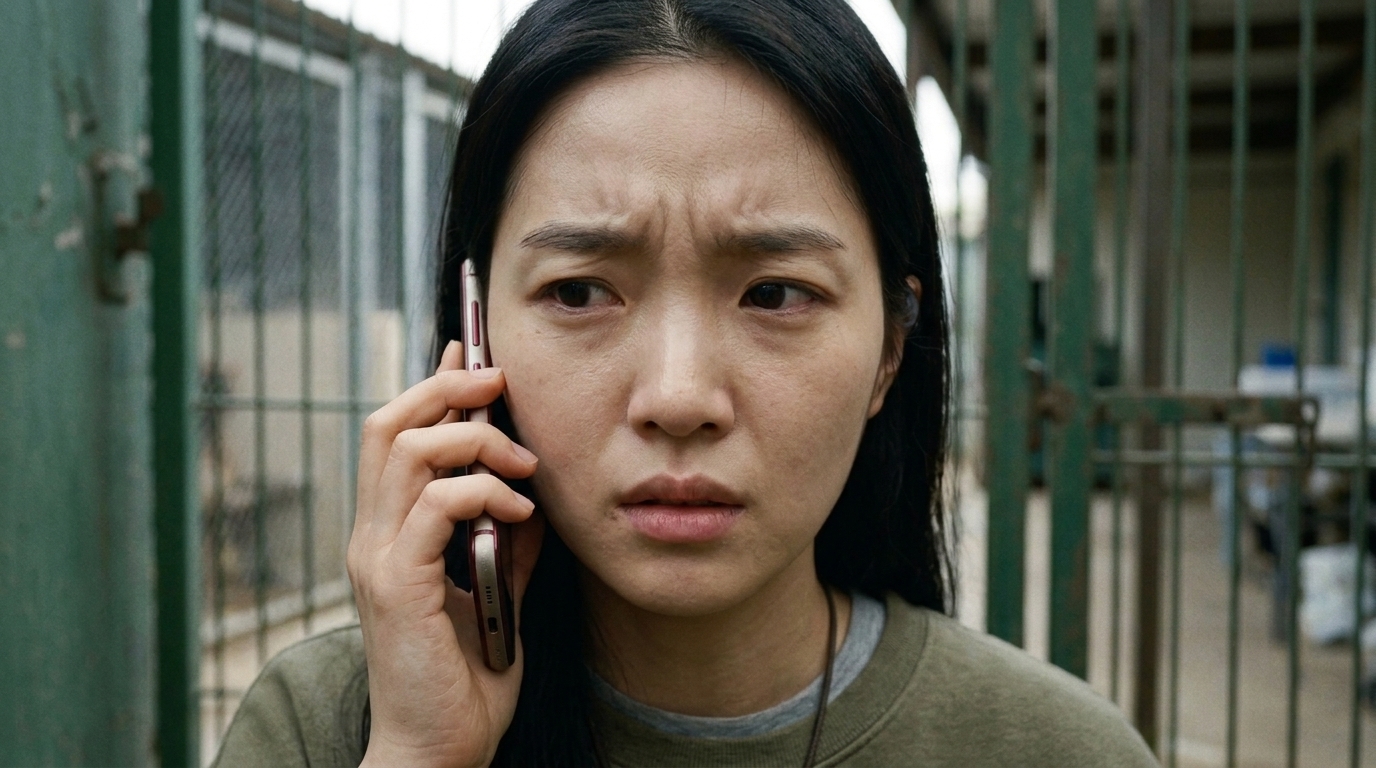
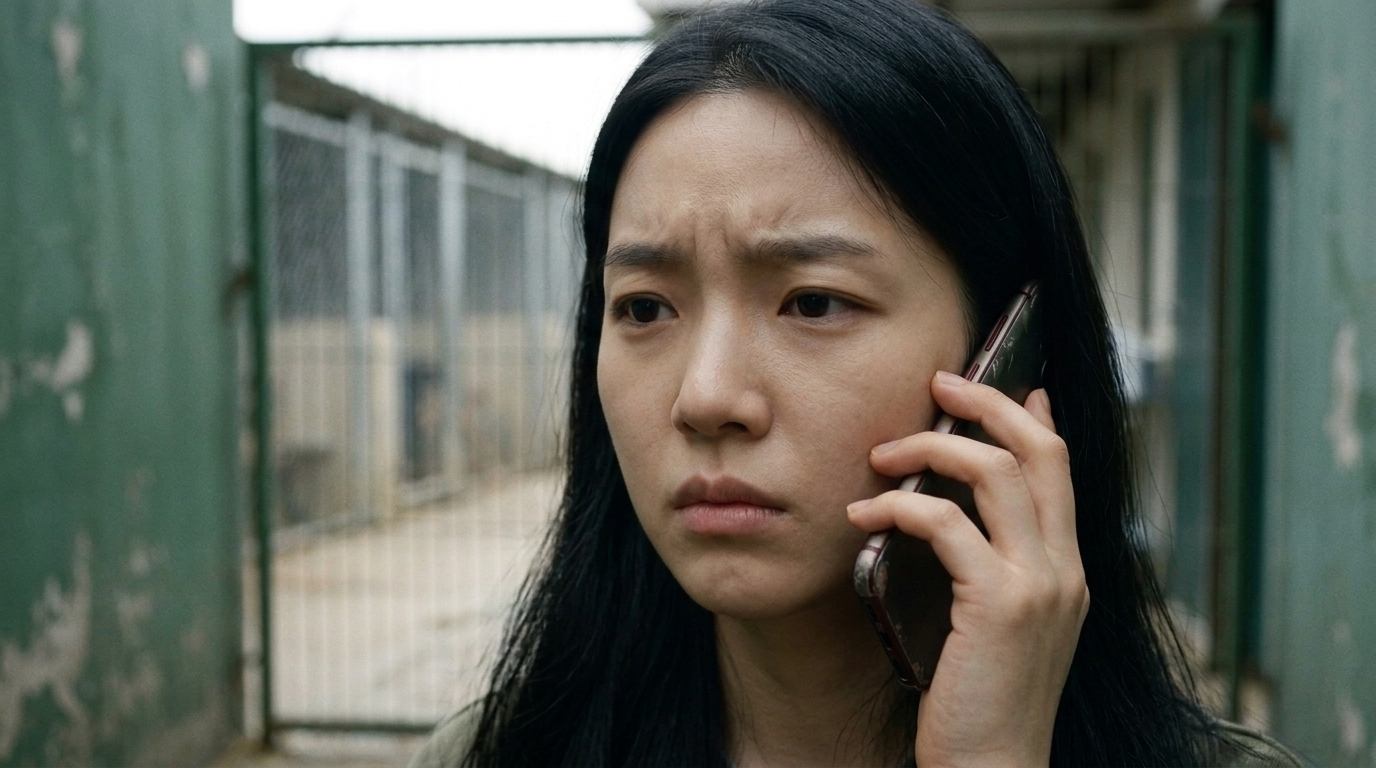
SHOT TEXT (authoritative, Korean): 수리영이 귀에 스마트폰을 댄 채 미간을 찌푸린 얼굴

LOCATION (lock): A stray-dog shelter with secured enclosures for multiple dogs and working areas for vaccinations, grooming, ointment treatment, and bathing. The shot takes place here — the attached PREVIOUS SHOT STILL shows this exact place.

THIS SHOT CONTINUES THE PREVIOUS SHOT: everything the attached still established — the place, its fixed features and wear, each person's clothing and state — persists. Any person in it who cannot move stays PRECISELY as photographed (body, pose, contact points, held objects); only the camera changes.

PREVIOUS STILL USAGE (follow exactly — what to take from the attached still and what to exclude): Take the shelter's kennel materials, indoor lighting, and subdued utilitarian look from the reference. Exclude the rottweiler's prominent foreground placement and the injection moment from this phone-call close-up.

REALIZE FIGURATIVE LANGUAGE AS A LIVE-ACTION SHOT: the Korean shot
text may describe characters metaphorically, figuratively or with
exaggeration. Photograph what a real movie camera would actually
record on a physical set — exaggerated or figurative impressions
become realistic staging choices (lighting, distance, angle,
wardrobe), not literal fantasy imagery.
EVERY CHARACTER IS A HUMAN BEING: unless the story explicitly
features non-human or virtual beings (as in science fiction or
fantasy), every character — however indirectly, vaguely or
figuratively the text describes them — IS a real human. When the
text gives no direct visual description of a person, IMAGINE one
and still show them as a concrete, fully-formed human being:
always render the human form to the maximum extent — build,
posture, face, hands, clothing — never reduce a person to a shape,
blob, solid silhouette or abstract mass.

EXPRESSIONS ARE ACTED, NEVER ANATOMICAL: when the text describes a
person's eyes, face or presence emotionally or figuratively (vacant,
hollow, dazed, burning, lifeless gaze and the like), it describes an
ACTOR'S PERFORMANCE captured by a real camera — realize it ONLY
through gaze direction, focus, eyelids, facial muscles, stillness
and posture. Every living person's eyes remain anatomically normal
human eyes with a natural iris and pupil, natural sclera and normal
proportions; NEVER whiten, blank out, cloud over, glow, enlarge or
otherwise alter eyeballs, skin or anatomy — unless the story
explicitly declares that being non-human or supernatural in form.

PROPS FACE THE RIGHT WAY: every handheld or used object must be
oriented exactly as its real-world use requires. A person reading,
watching or operating something (a phone, a photograph, a paper,
any device) has its functional side — screen, front, page — facing
THEIR OWN eyes; the camera then sees whatever side the staging
geometry implies (often its back). Show the functional side to the
camera ONLY when the shot text itself stages it toward the viewer.
Never flip, mirror or reverse an object's front and back.

CARRIED STATE (persist exactly — must match the neighbouring shots of this scene): Su-ri-young has her smartphone with her and is using it to call Min-suk.

PEOPLE: the SHOT TEXT alone decides whether any person is visible in this shot. IF a person appears, they must be one of: 수리영 (Korean 20대 초반 여성, 긴 검은 머리, 타원형의 젊은 얼굴, 부드러운 이목구비와 자연스러운 피부색상태) — never anyone else, and never add a person the shot text does not show. IF only part of a person is in frame (a hand, arm, foot, back, silhouette), that body part belongs to the specific person the shot text names — its sex, age, build, skin and grooming must unmistakably match that person's profile above.

No text, captions, watermarks or annotations anywhere.
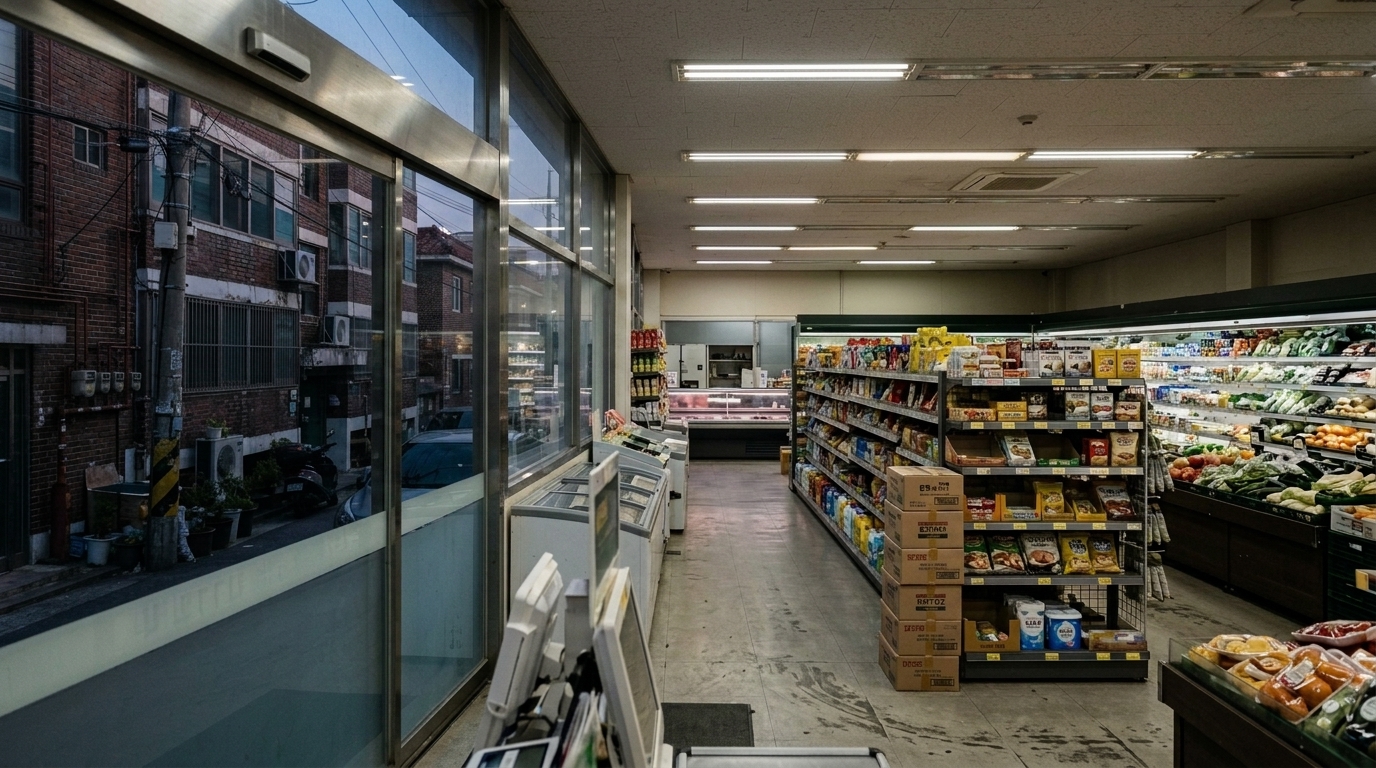
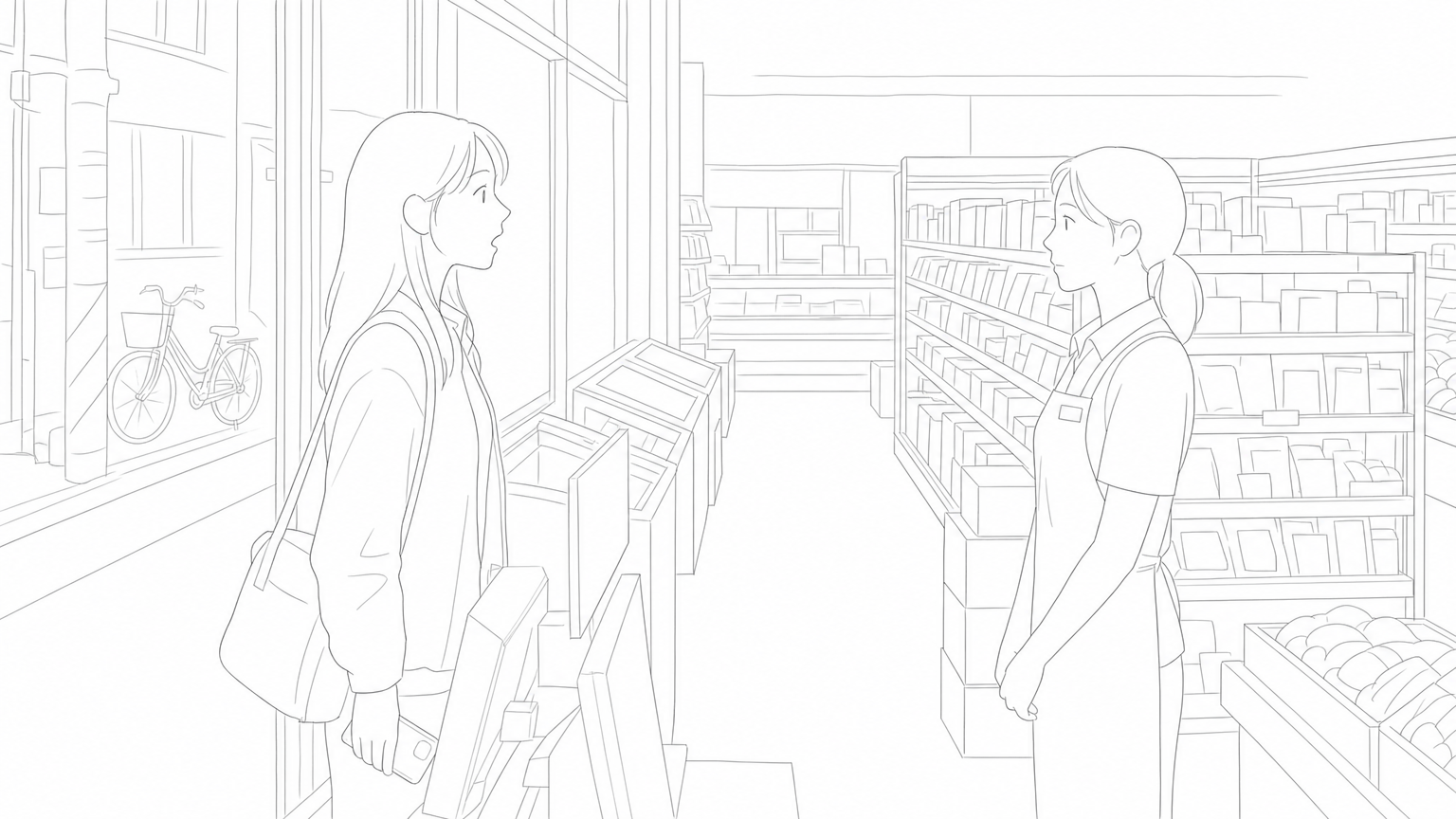
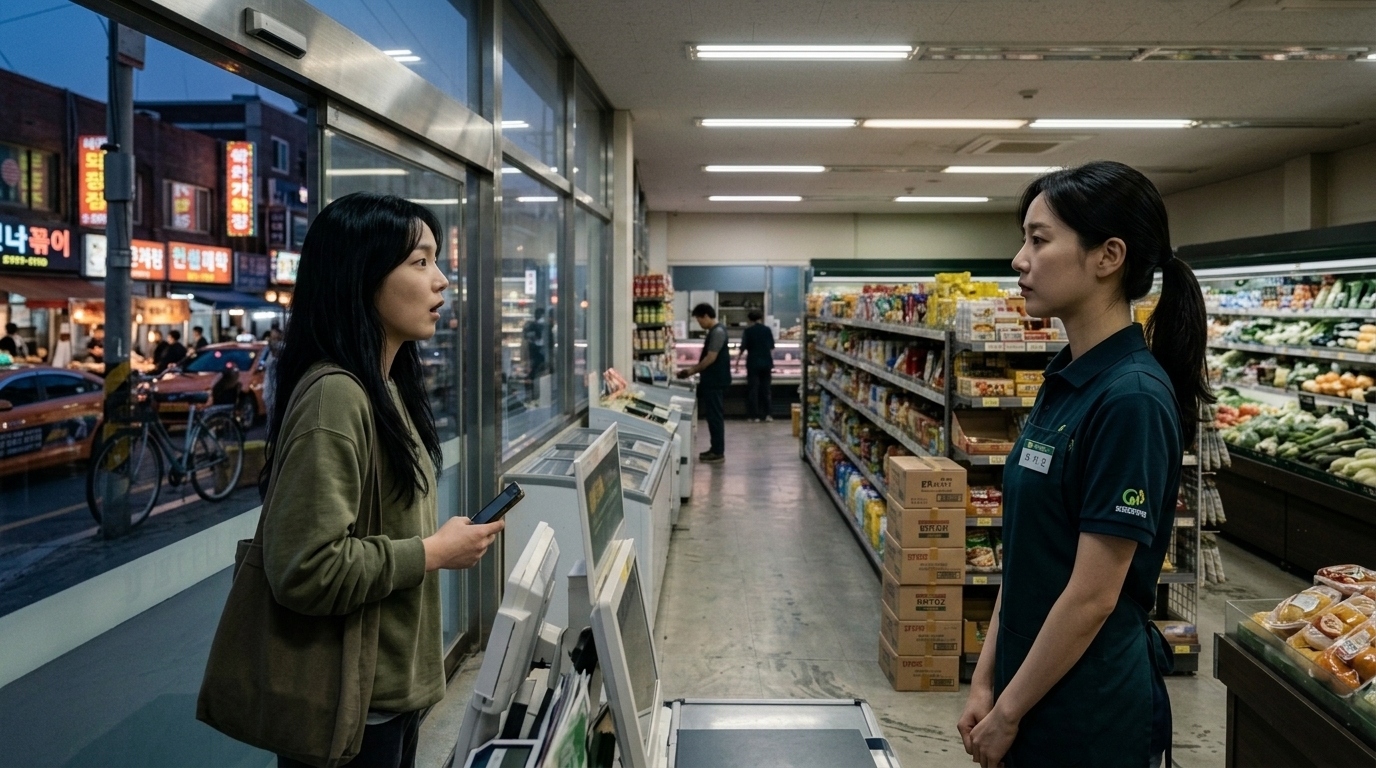
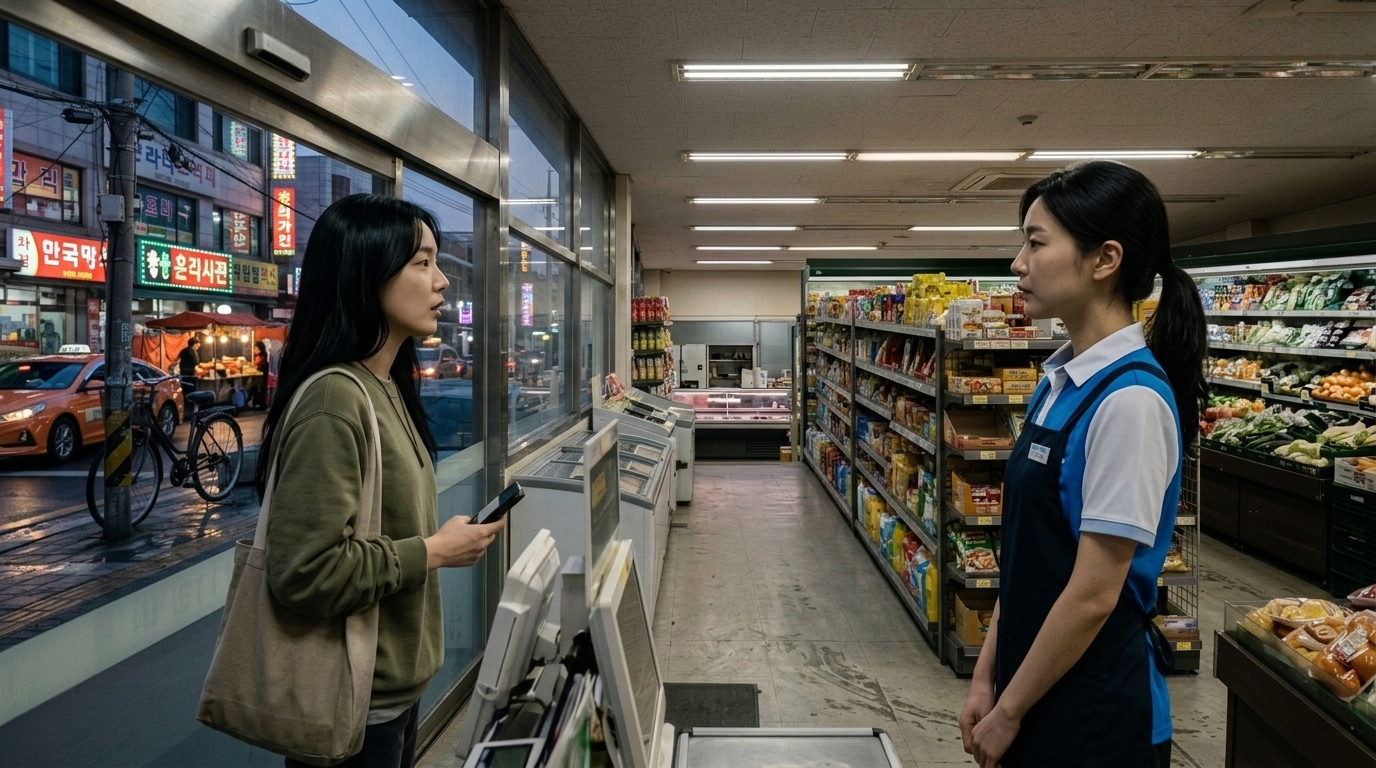
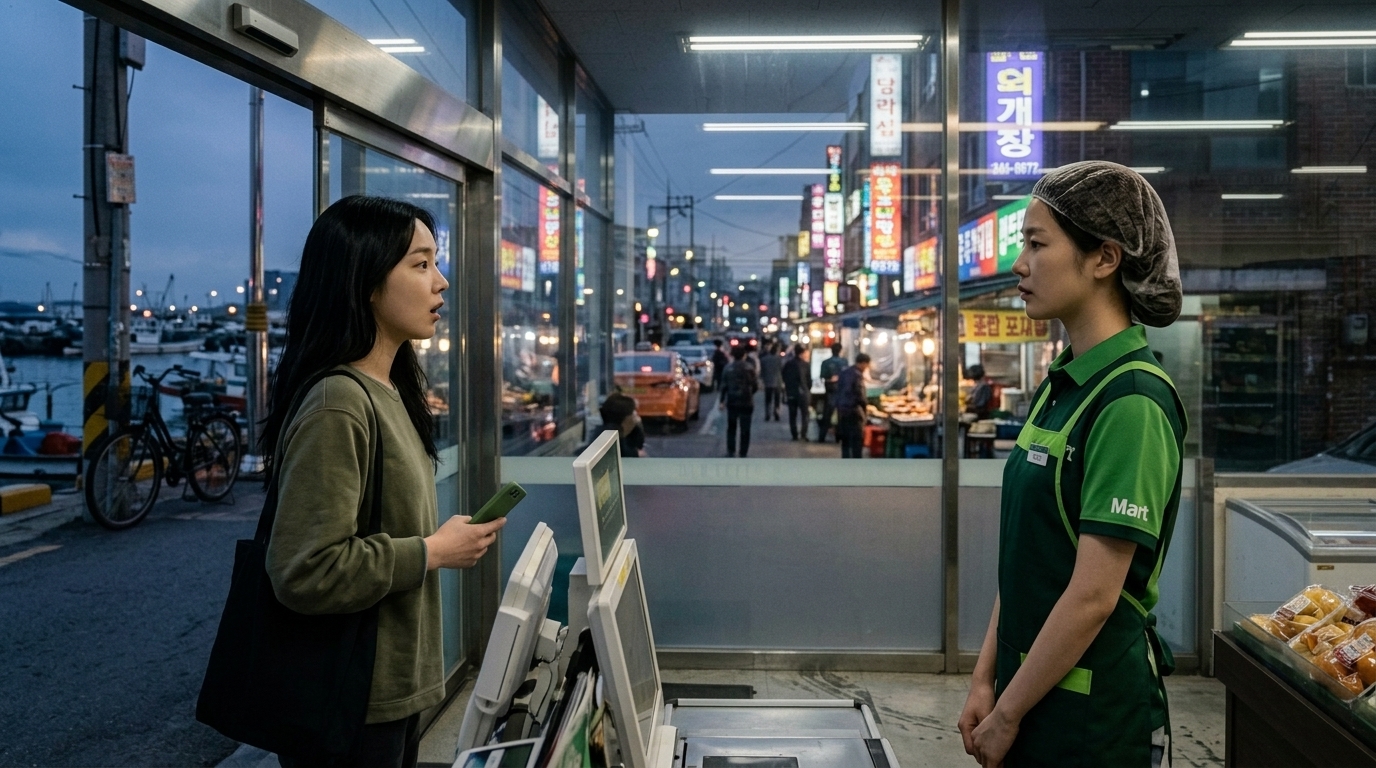
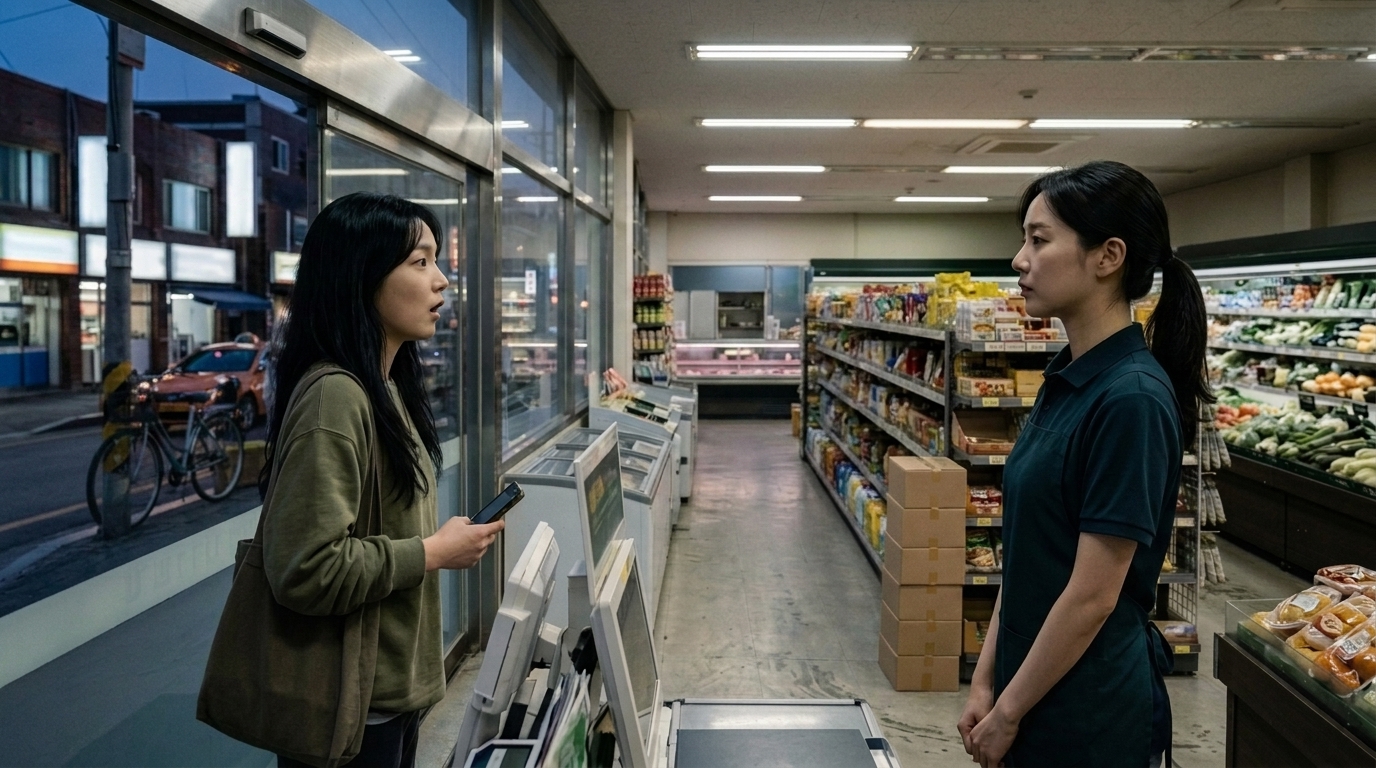
Create ONE FINAL photorealistic live-action film still of the moment below — contemporary South Korea, 2026; all people are Korean unless stated. TIME OF DAY (lock): dusk, neon signs.

SHOT TEXT (authoritative, Korean): 수리영이 마트 유니폼을 입은 한국인 여성 직원을 마주보며 입을 살짝 벌린 측면 구도

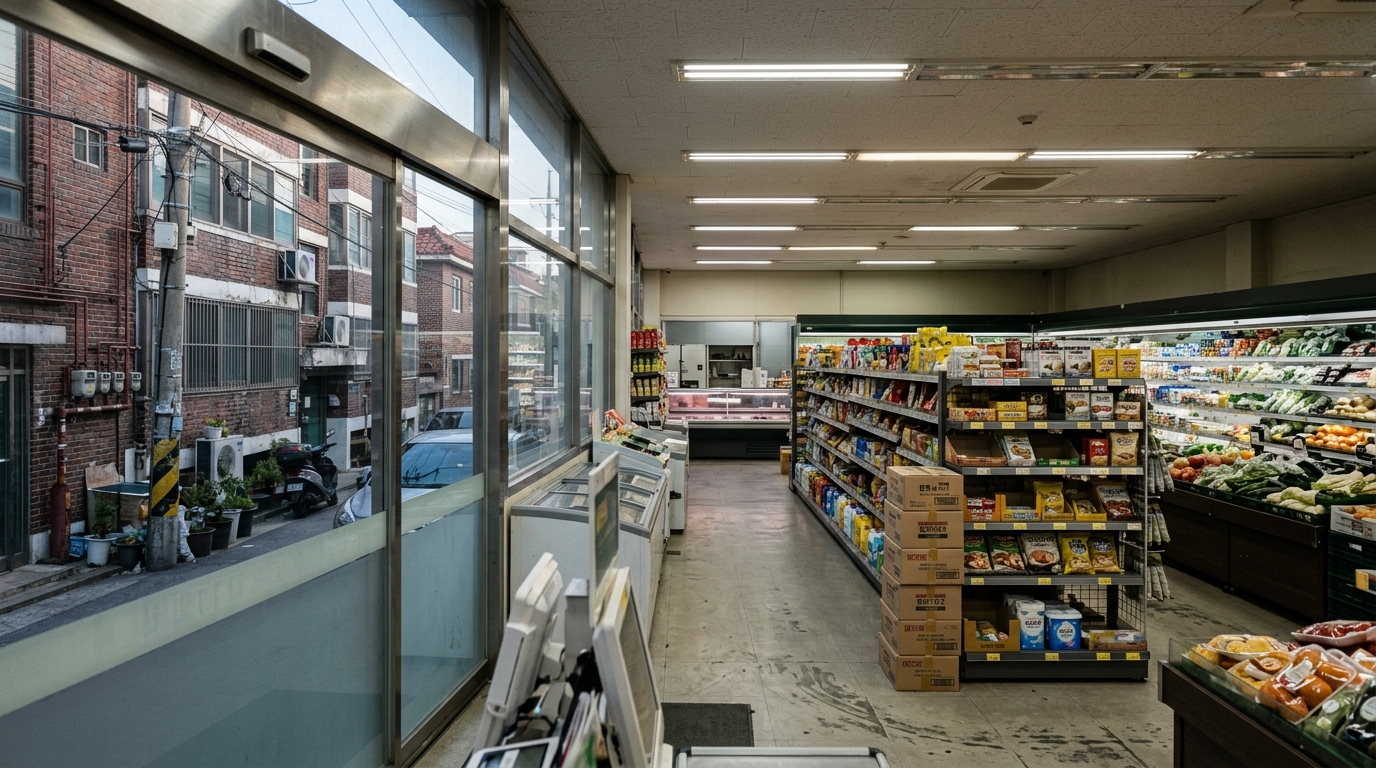
LOCATION (lock): A busy commercial district beside a harbor, filled with neon signs, taxis, street vendors, and food stalls. It connects to a large supermarket with merchandise aisles and an exterior bicycle-parking area. The shot takes place here — the attached LOCATION PHOTOGRAPH shows the exact spot.

REALIZE FIGURATIVE LANGUAGE AS A LIVE-ACTION SHOT: the Korean shot
text may describe characters metaphorically, figuratively or with
exaggeration. Photograph what a real movie camera would actually
record on a physical set — exaggerated or figurative impressions
become realistic staging choices (lighting, distance, angle,
wardrobe), not literal fantasy imagery.
EVERY CHARACTER IS A HUMAN BEING: unless the story explicitly
features non-human or virtual beings (as in science fiction or
fantasy), every character — however indirectly, vaguely or
figuratively the text describes them — IS a real human. When the
text gives no direct visual description of a person, IMAGINE one
and still show them as a concrete, fully-formed human being:
always render the human form to the maximum extent — build,
posture, face, hands, clothing — never reduce a person to a shape,
blob, solid silhouette or abstract mass.

EXPRESSIONS ARE ACTED, NEVER ANATOMICAL: when the text describes a
person's eyes, face or presence emotionally or figuratively (vacant,
hollow, dazed, burning, lifeless gaze and the like), it describes an
ACTOR'S PERFORMANCE captured by a real camera — realize it ONLY
through gaze direction, focus, eyelids, facial muscles, stillness
and posture. Every living person's eyes remain anatomically normal
human eyes with a natural iris and pupil, natural sclera and normal
proportions; NEVER whiten, blank out, cloud over, glow, enlarge or
otherwise alter eyeballs, skin or anatomy — unless the story
explicitly declares that being non-human or supernatural in form.

PROPS FACE THE RIGHT WAY: every handheld or used object must be
oriented exactly as its real-world use requires. A person reading,
watching or operating something (a phone, a photograph, a paper,
any device) has its functional side — screen, front, page — facing
THEIR OWN eyes; the camera then sees whatever side the staging
geometry implies (often its back). Show the functional side to the
camera ONLY when the shot text itself stages it toward the viewer.
Never flip, mirror or reverse an object's front and back.

CARRIED STATE (persist exactly — must match the neighbouring shots of this scene): Su-ri-young's bicycle remains parked outside the mart, and she still has her smartphone with her.

PEOPLE: the SHOT TEXT alone decides whether any person is visible in this shot. IF a person appears, they must be one of: 수리영 (Korean 20대 초반 여성, 긴 검은 머리, 타원형의 젊은 얼굴, 부드러운 이목구비와 자연스러운 피부색상태) — never anyone else, and never add a person the shot text does not show. IF only part of a person is in frame (a hand, arm, foot, back, silhouette), that body part belongs to the specific person the shot text names — its sex, age, build, skin and grooming must unmistakably match that person's profile above.

No text, captions, watermarks or annotations anywhere.
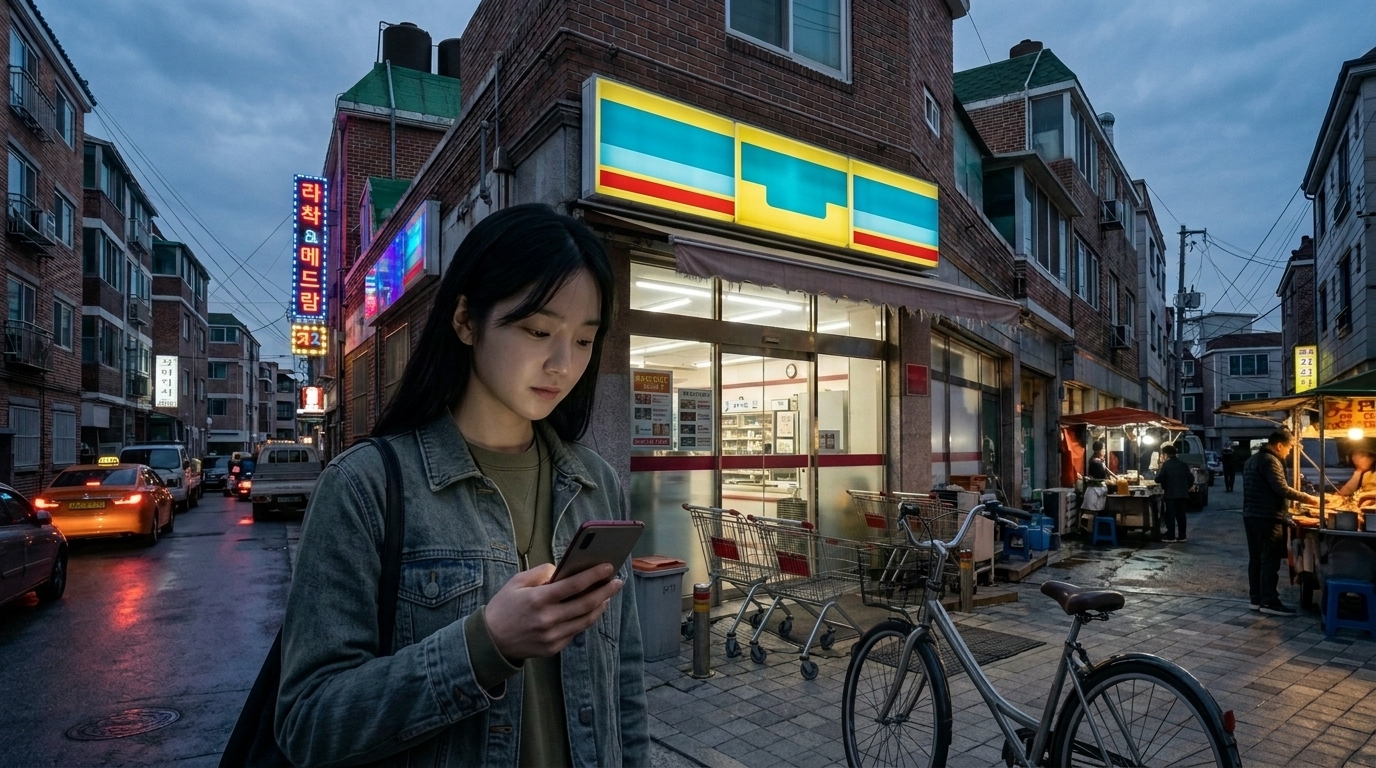
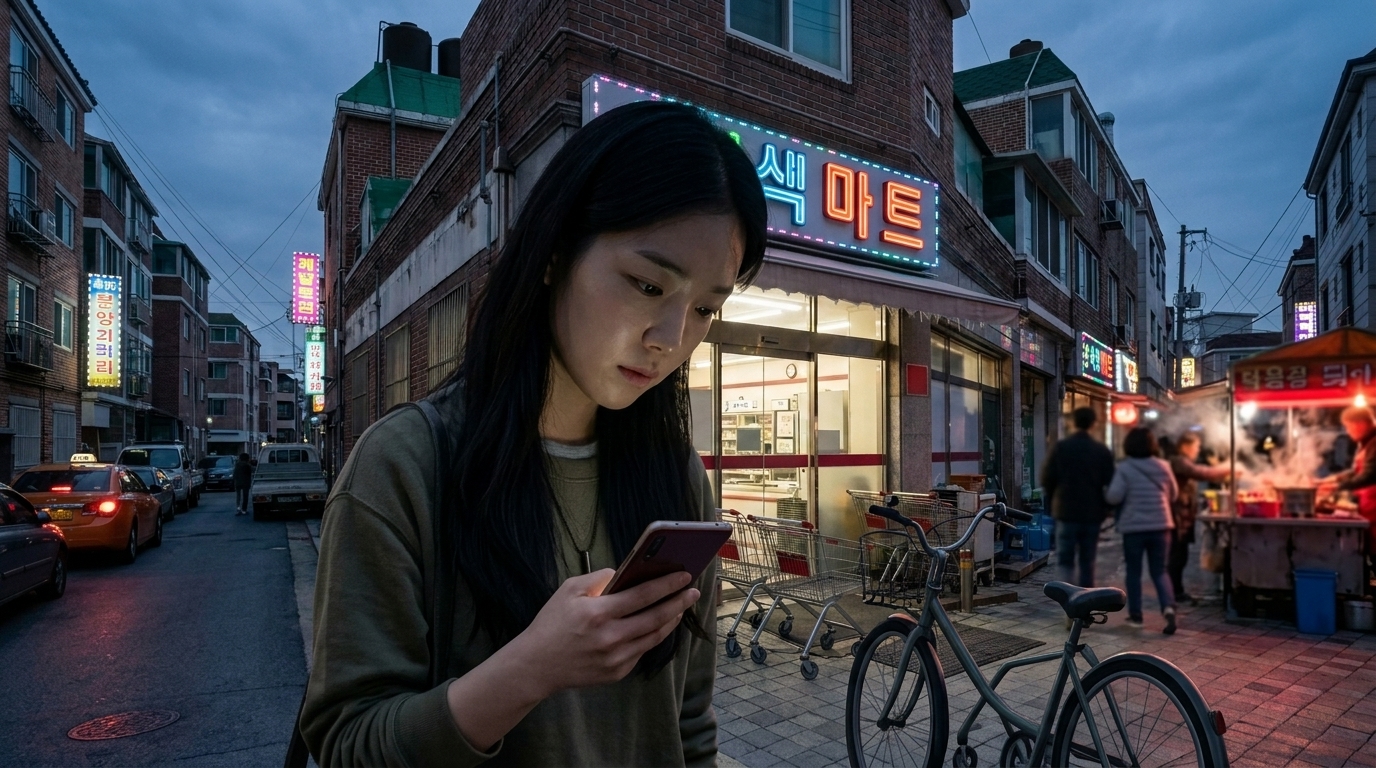
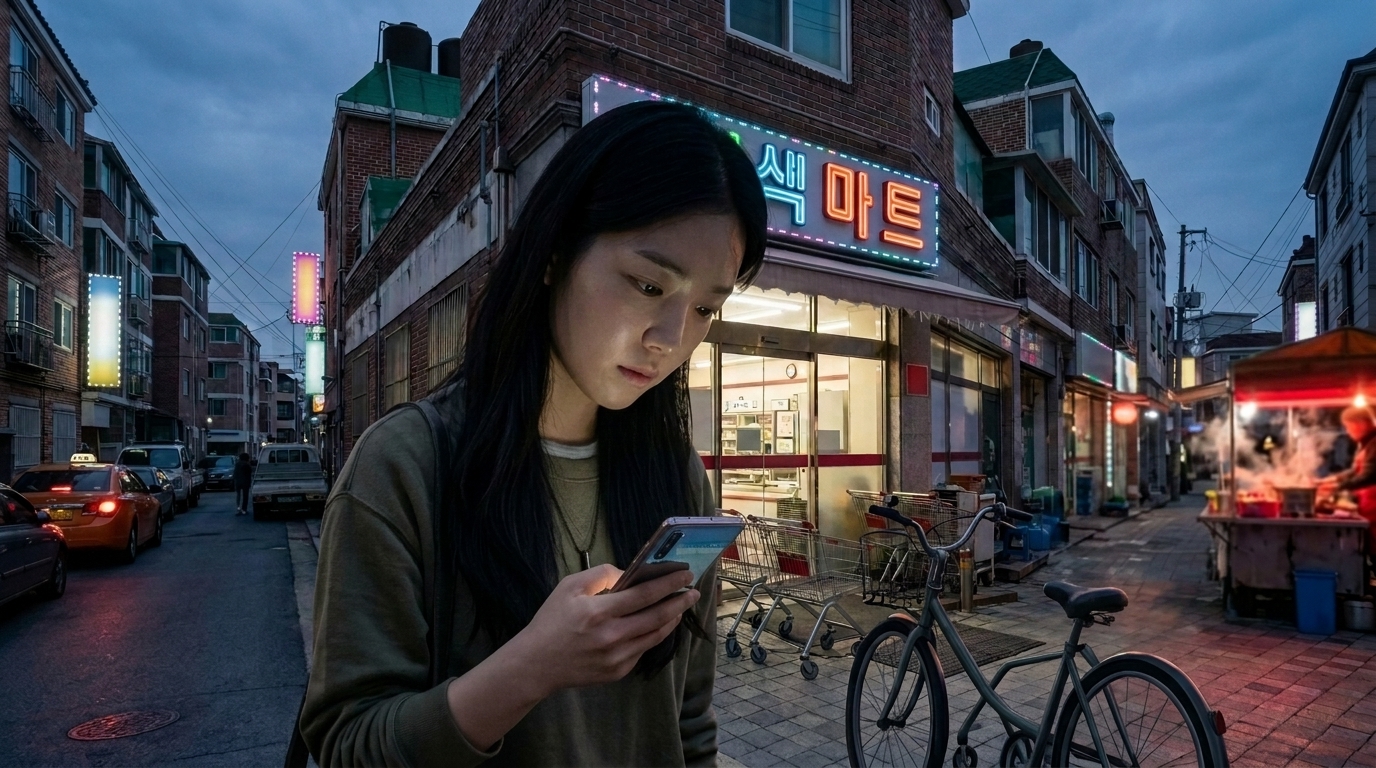
Create ONE FINAL photorealistic live-action film still of the moment below — contemporary South Korea, 2026; all people are Korean unless stated. TIME OF DAY (lock): dusk, neon signs.

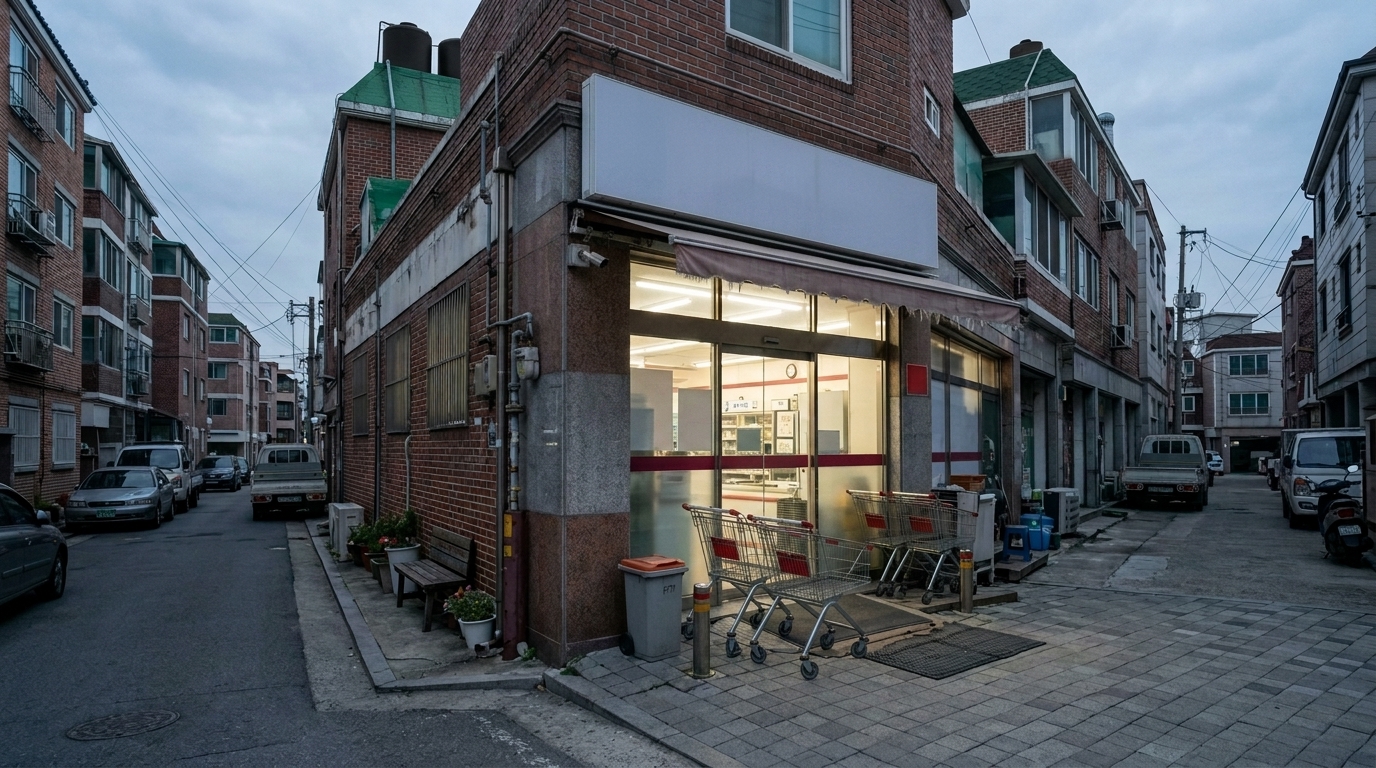
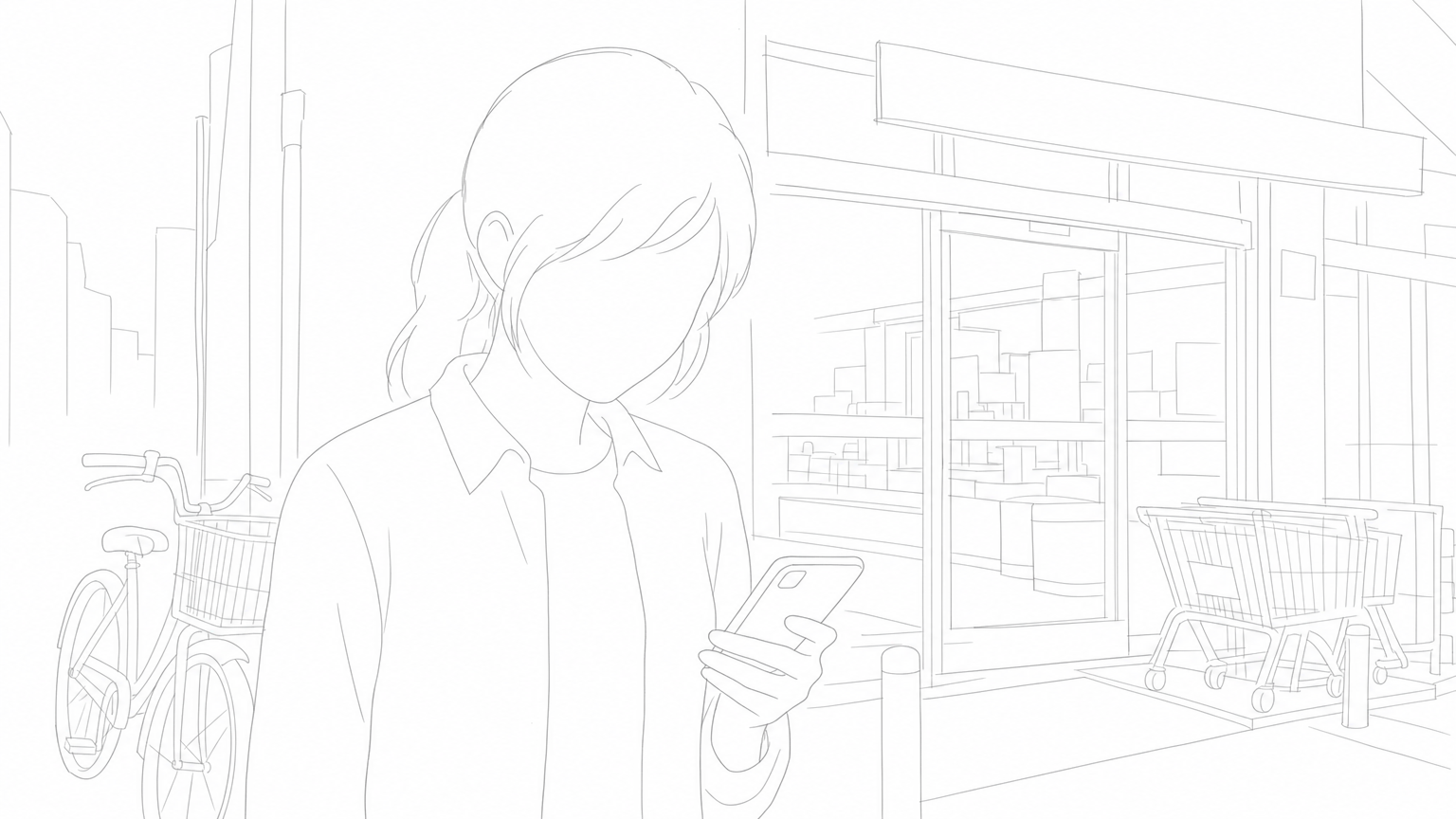
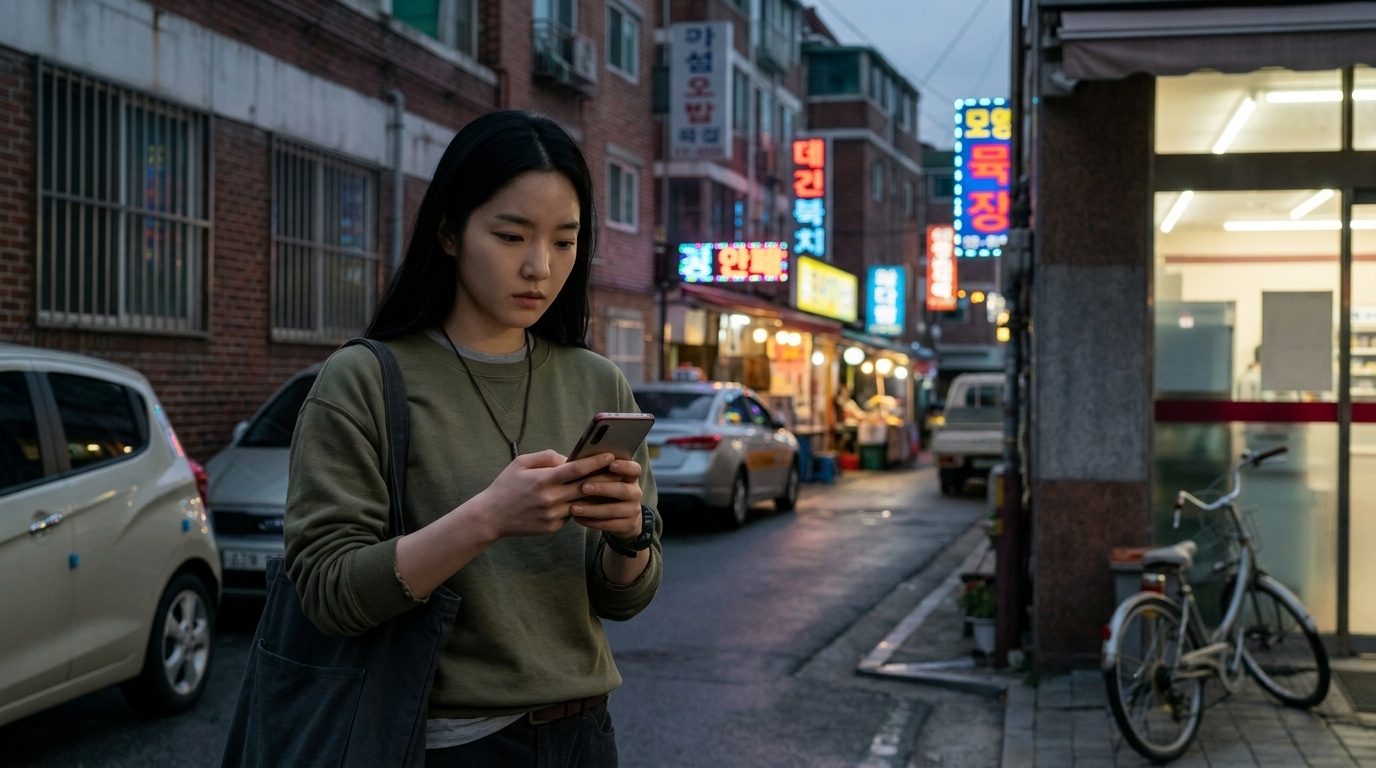
SHOT TEXT (authoritative, Korean): 마트 밖으로 나온 수리영이 손에 든 스마트폰 액정을 내려다보는 상체

LOCATION (lock): A busy commercial district beside a harbor, filled with neon signs, taxis, street vendors, and food stalls. It connects to a large supermarket with merchandise aisles and an exterior bicycle-parking area. The shot takes place here — the attached LOCATION PHOTOGRAPH shows the exact spot.

REALIZE FIGURATIVE LANGUAGE AS A LIVE-ACTION SHOT: the Korean shot
text may describe characters metaphorically, figuratively or with
exaggeration. Photograph what a real movie camera would actually
record on a physical set — exaggerated or figurative impressions
become realistic staging choices (lighting, distance, angle,
wardrobe), not literal fantasy imagery.
EVERY CHARACTER IS A HUMAN BEING: unless the story explicitly
features non-human or virtual beings (as in science fiction or
fantasy), every character — however indirectly, vaguely or
figuratively the text describes them — IS a real human. When the
text gives no direct visual description of a person, IMAGINE one
and still show them as a concrete, fully-formed human being:
always render the human form to the maximum extent — build,
posture, face, hands, clothing — never reduce a person to a shape,
blob, solid silhouette or abstract mass.

EXPRESSIONS ARE ACTED, NEVER ANATOMICAL: when the text describes a
person's eyes, face or presence emotionally or figuratively (vacant,
hollow, dazed, burning, lifeless gaze and the like), it describes an
ACTOR'S PERFORMANCE captured by a real camera — realize it ONLY
through gaze direction, focus, eyelids, facial muscles, stillness
and posture. Every living person's eyes remain anatomically normal
human eyes with a natural iris and pupil, natural sclera and normal
proportions; NEVER whiten, blank out, cloud over, glow, enlarge or
otherwise alter eyeballs, skin or anatomy — unless the story
explicitly declares that being non-human or supernatural in form.

PROPS FACE THE RIGHT WAY: every handheld or used object must be
oriented exactly as its real-world use requires. A person reading,
watching or operating something (a phone, a photograph, a paper,
any device) has its functional side — screen, front, page — facing
THEIR OWN eyes; the camera then sees whatever side the staging
geometry implies (often its back). Show the functional side to the
camera ONLY when the shot text itself stages it toward the viewer.
Never flip, mirror or reverse an object's front and back.

CARRIED STATE (persist exactly — must match the neighbouring shots of this scene): The bicycle remains outside for Su-ri-young's return, and she is holding the smartphone used to call Min-suk.

PEOPLE: the SHOT TEXT alone decides whether any person is visible in this shot. IF a person appears, they must be one of: 수리영 (Korean 20대 초반 여성, 긴 검은 머리, 타원형의 젊은 얼굴, 부드러운 이목구비와 자연스러운 피부색상태) — never anyone else, and never add a person the shot text does not show. IF only part of a person is in frame (a hand, arm, foot, back, silhouette), that body part belongs to the specific person the shot text names — its sex, age, build, skin and grooming must unmistakably match that person's profile above.

No text, captions, watermarks or annotations anywhere.
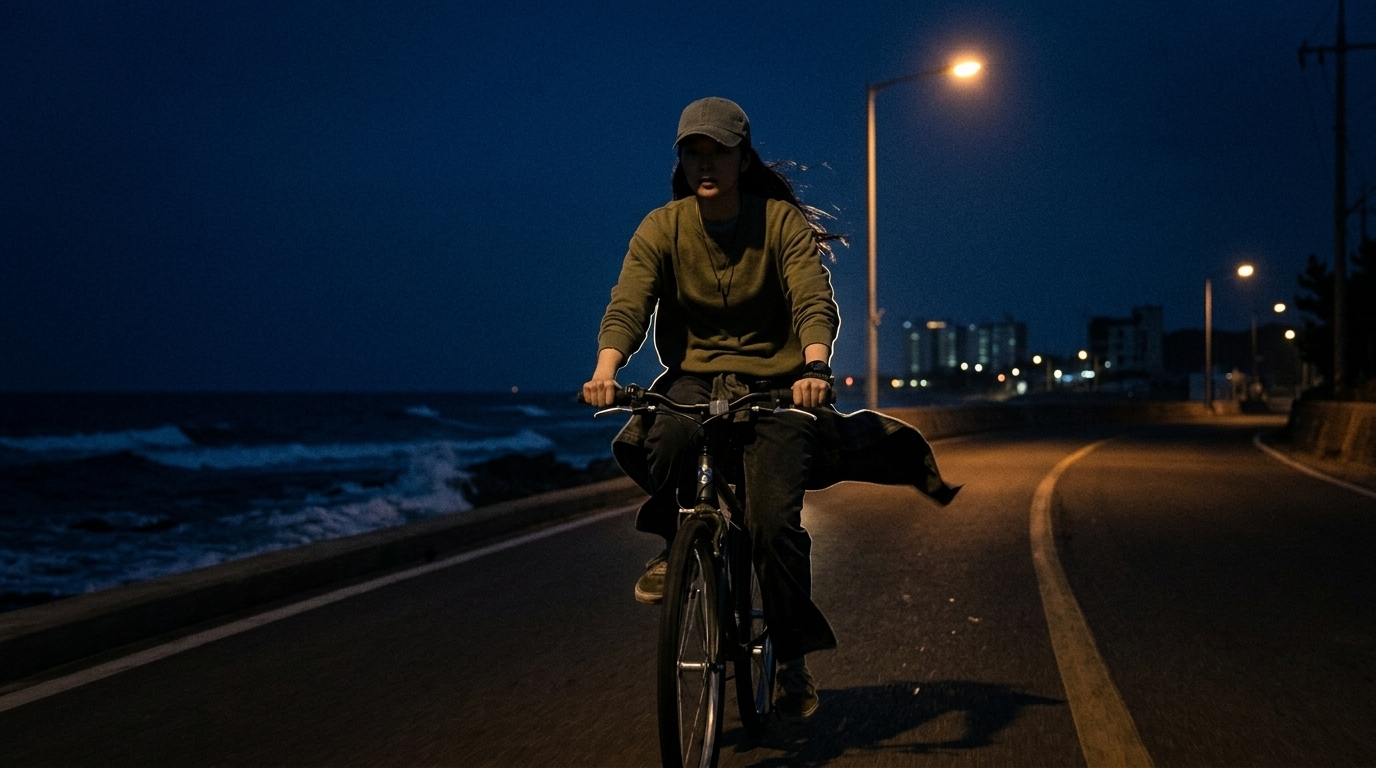
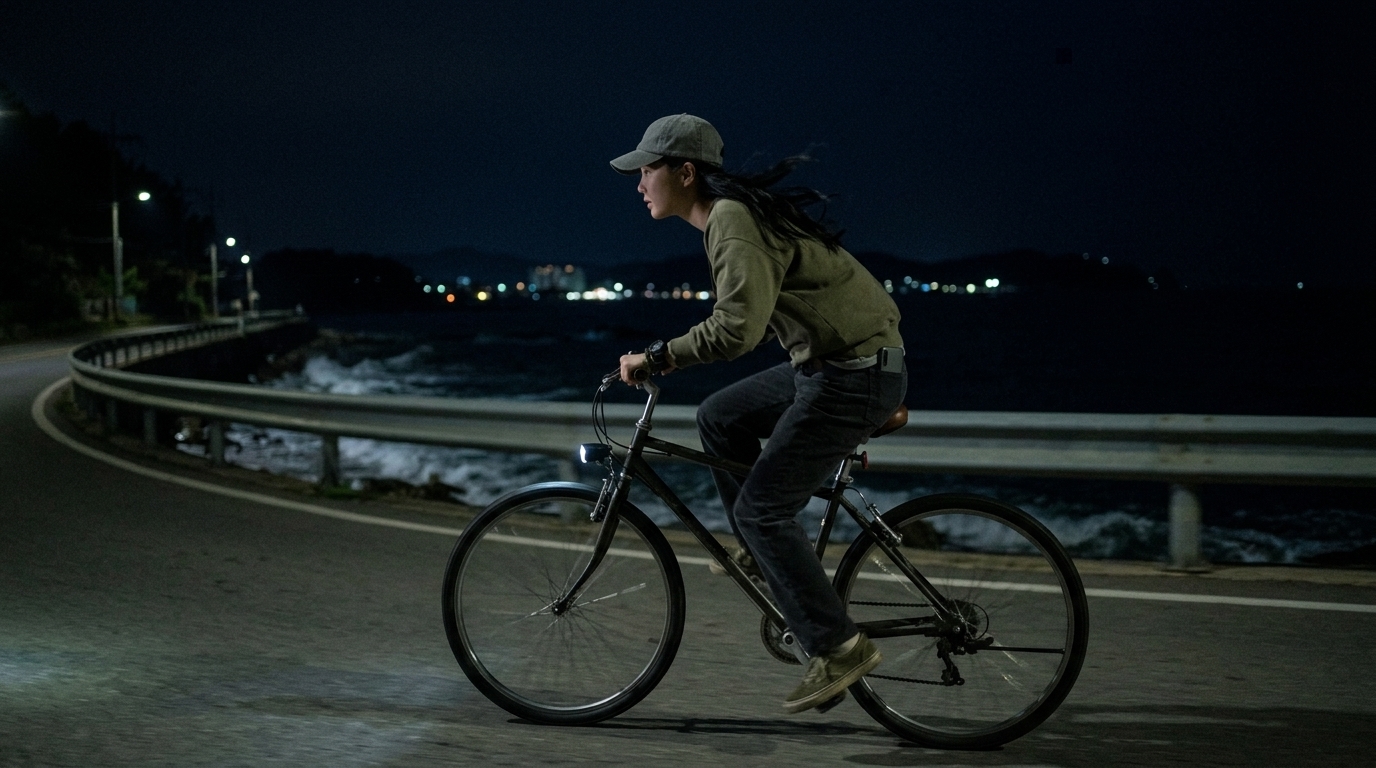
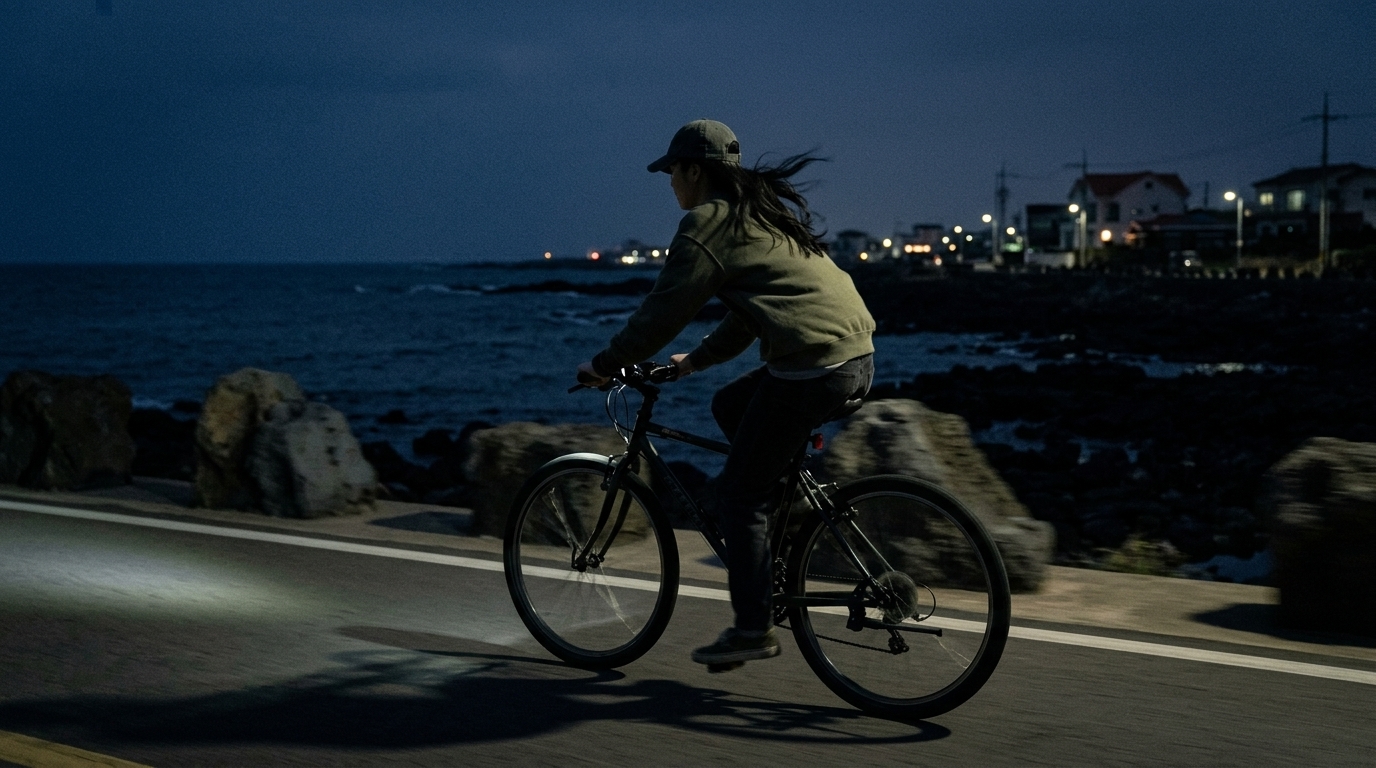
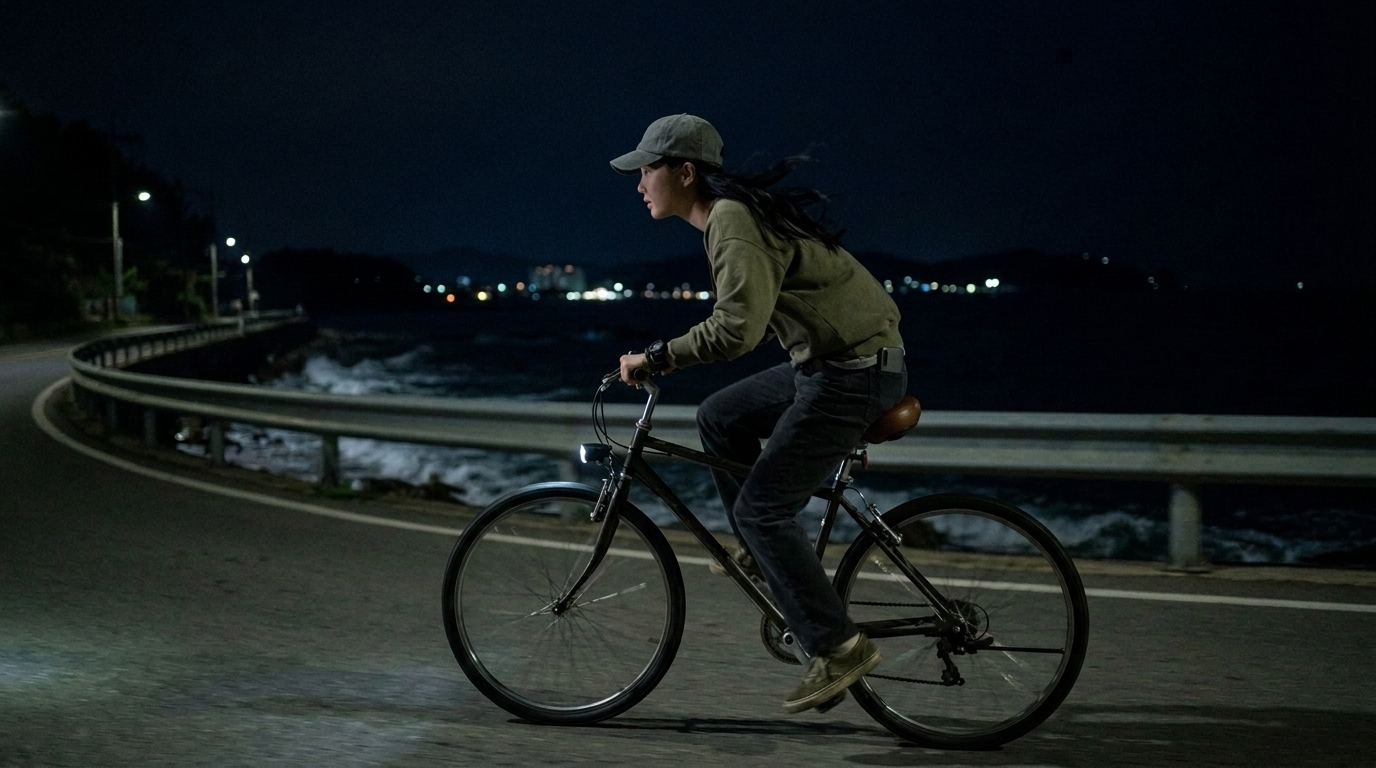
Create ONE FINAL photorealistic live-action film still of the moment below — contemporary South Korea, 2026; all people are Korean unless stated. TIME OF DAY (lock): night.

SHOT TEXT (authoritative, Korean): 어두운 해안도로 위 자전거 안장에 앉아 한쪽 다리로 페달을 밟아 내리는 중간 자세로 앞을 향해 상체를 기울인 수리영의 실루엣, 옷자락이 뒤로 휘날리는 순간

LOCATION (lock): A coastal road following the dark shoreline, used as a bicycle route toward nearby homes. The shot takes place here — the attached LOCATION PHOTOGRAPH shows the exact spot.

REALIZE FIGURATIVE LANGUAGE AS A LIVE-ACTION SHOT: the Korean shot
text may describe characters metaphorically, figuratively or with
exaggeration. Photograph what a real movie camera would actually
record on a physical set — exaggerated or figurative impressions
become realistic staging choices (lighting, distance, angle,
wardrobe), not literal fantasy imagery.
EVERY CHARACTER IS A HUMAN BEING: unless the story explicitly
features non-human or virtual beings (as in science fiction or
fantasy), every character — however indirectly, vaguely or
figuratively the text describes them — IS a real human. When the
text gives no direct visual description of a person, IMAGINE one
and still show them as a concrete, fully-formed human being:
always render the human form to the maximum extent — build,
posture, face, hands, clothing — never reduce a person to a shape,
blob, solid silhouette or abstract mass.

EXPRESSIONS ARE ACTED, NEVER ANATOMICAL: when the text describes a
person's eyes, face or presence emotionally or figuratively (vacant,
hollow, dazed, burning, lifeless gaze and the like), it describes an
ACTOR'S PERFORMANCE captured by a real camera — realize it ONLY
through gaze direction, focus, eyelids, facial muscles, stillness
and posture. Every living person's eyes remain anatomically normal
human eyes with a natural iris and pupil, natural sclera and normal
proportions; NEVER whiten, blank out, cloud over, glow, enlarge or
otherwise alter eyeballs, skin or anatomy — unless the story
explicitly declares that being non-human or supernatural in form.

PROPS FACE THE RIGHT WAY: every handheld or used object must be
oriented exactly as its real-world use requires. A person reading,
watching or operating something (a phone, a photograph, a paper,
any device) has its functional side — screen, front, page — facing
THEIR OWN eyes; the camera then sees whatever side the staging
geometry implies (often its back). Show the functional side to the
camera ONLY when the shot text itself stages it toward the viewer.
Never flip, mirror or reverse an object's front and back.

CARRIED STATE (persist exactly — must match the neighbouring shots of this scene): Su-ri-young continues toward home on the same bicycle, with her smartphone still on her person.

PEOPLE: the SHOT TEXT alone decides whether any person is visible in this shot. IF a person appears, they must be one of: 수리영 (Korean 20대 초반 여성, 긴 검은 머리, 타원형의 젊은 얼굴, 부드러운 이목구비와 자연스러운 피부색상태) — never anyone else, and never add a person the shot text does not show. IF only part of a person is in frame (a hand, arm, foot, back, silhouette), that body part belongs to the specific person the shot text names — its sex, age, build, skin and grooming must unmistakably match that person's profile above.

No text, captions, watermarks or annotations anywhere.
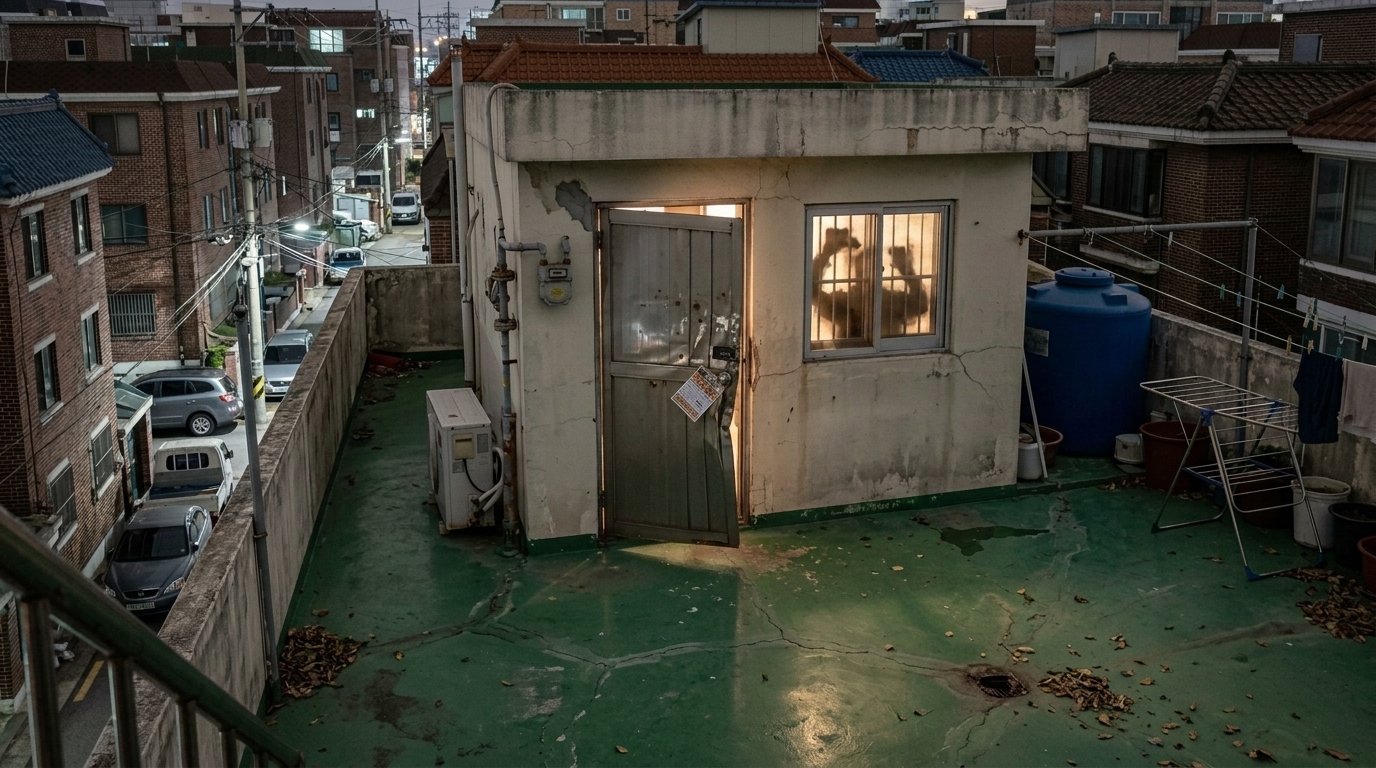
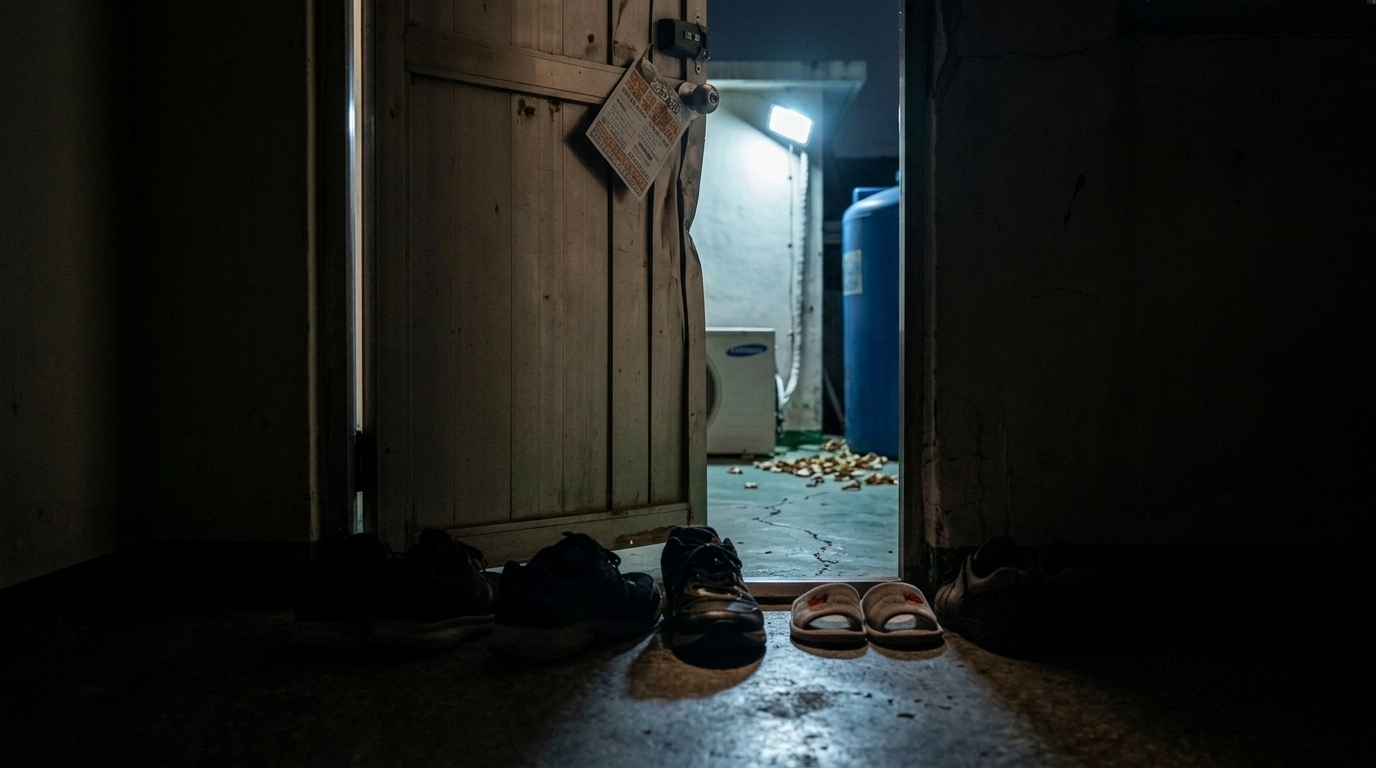
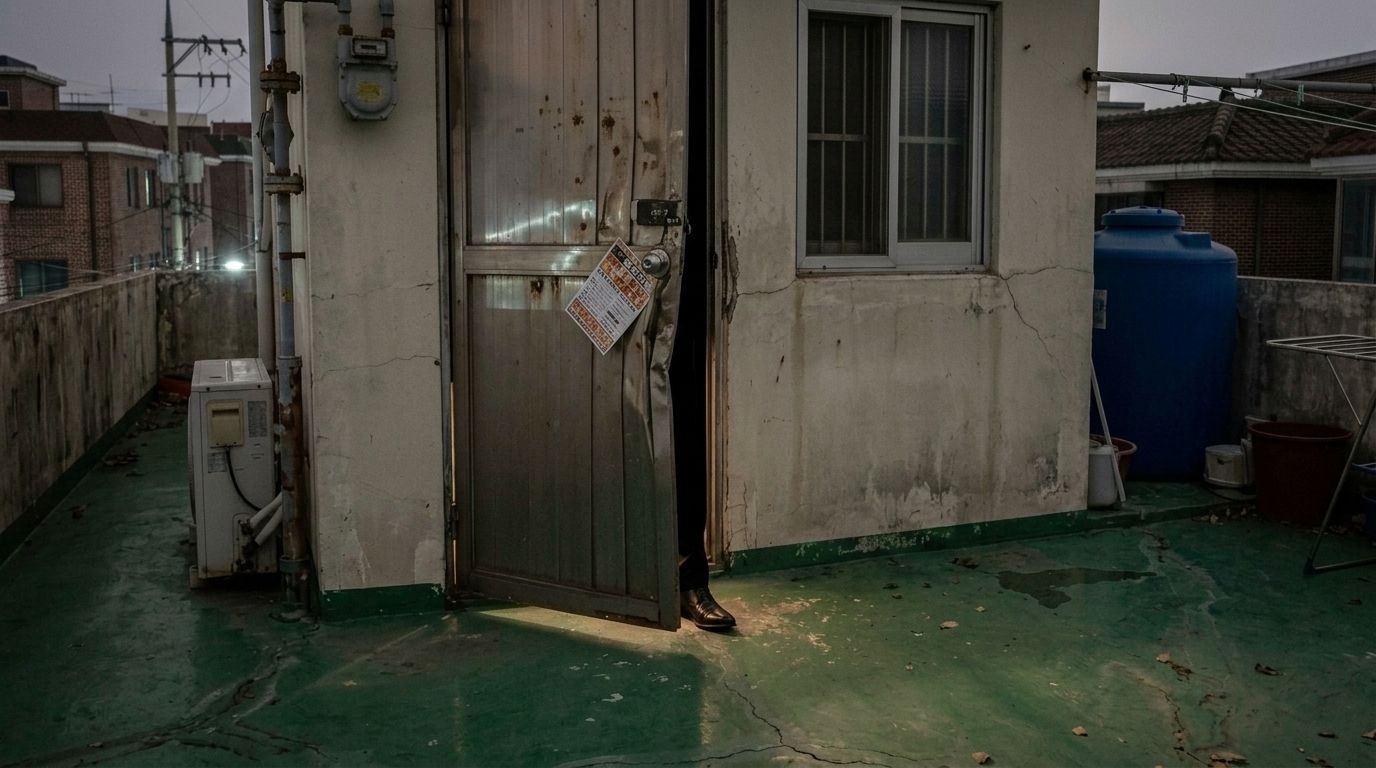
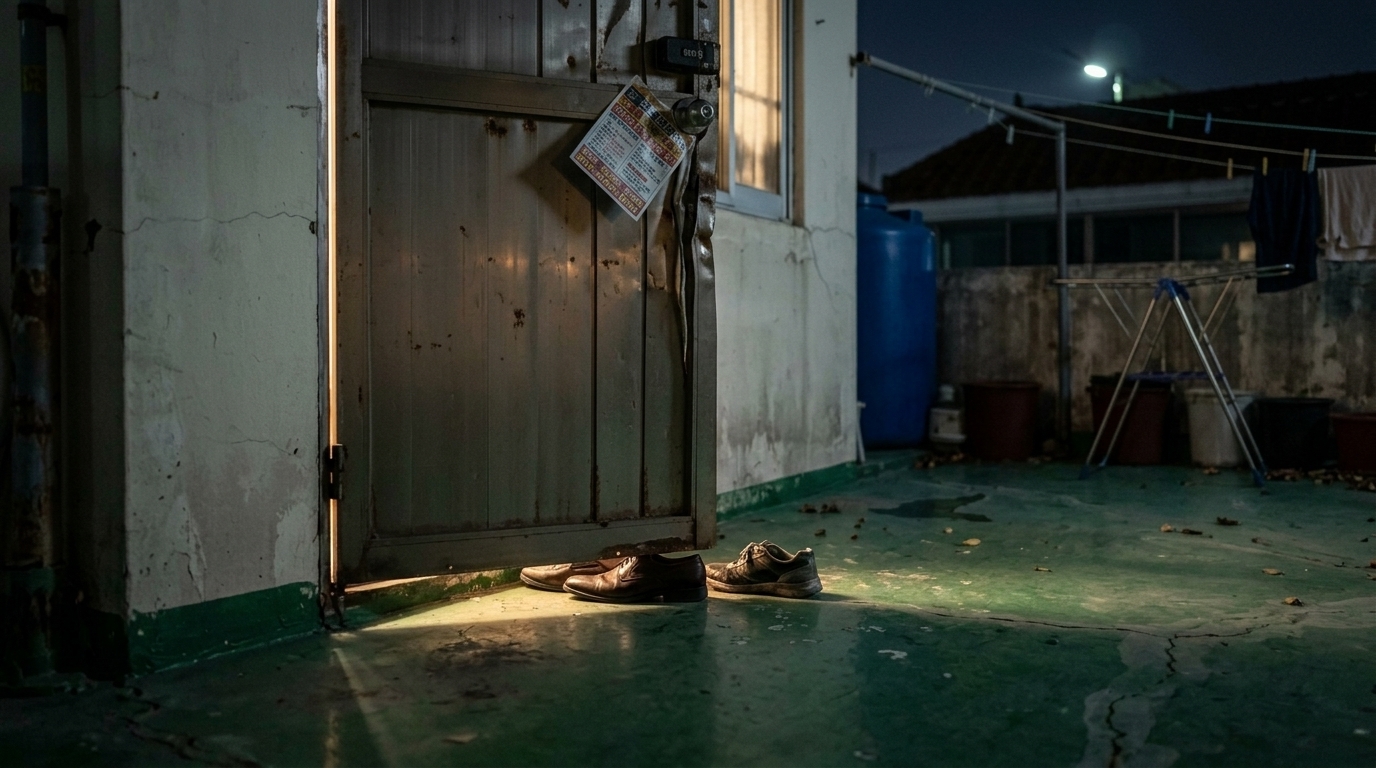
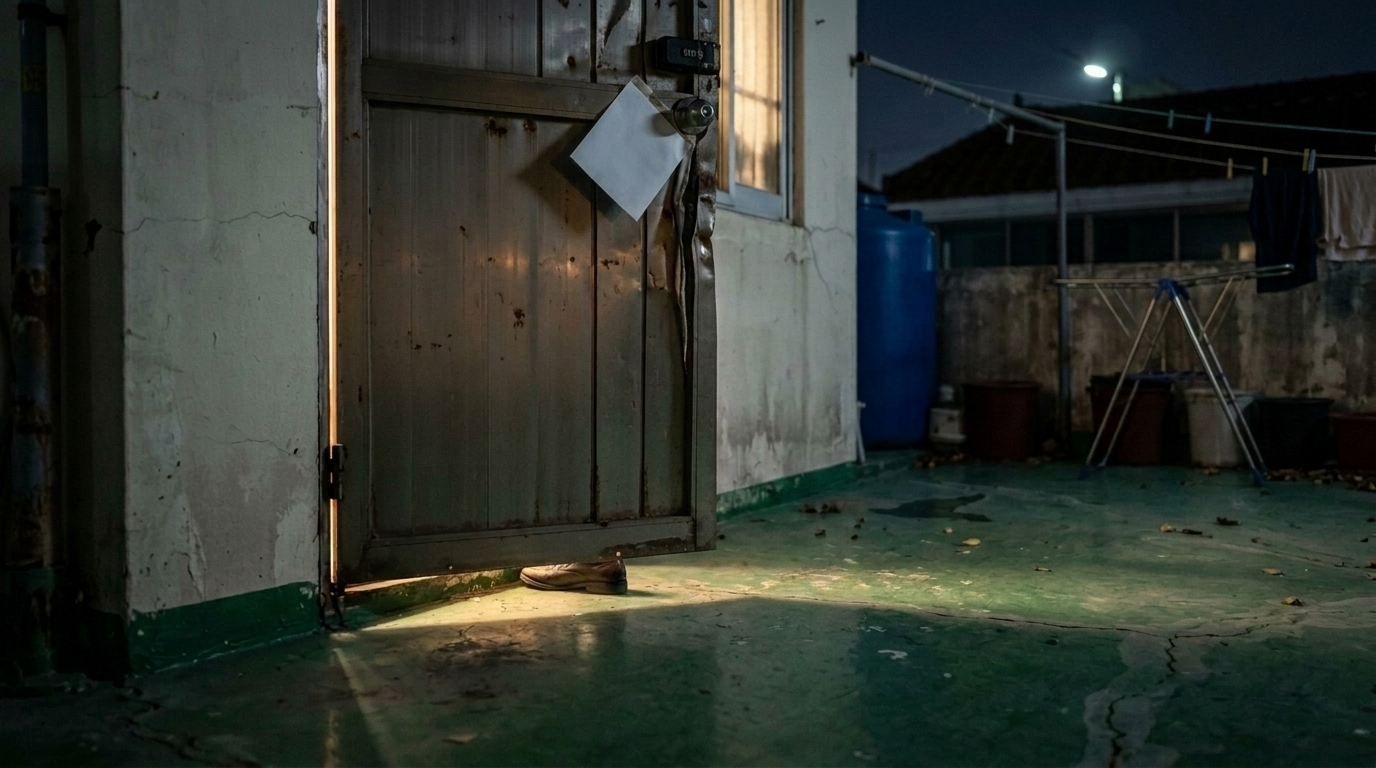
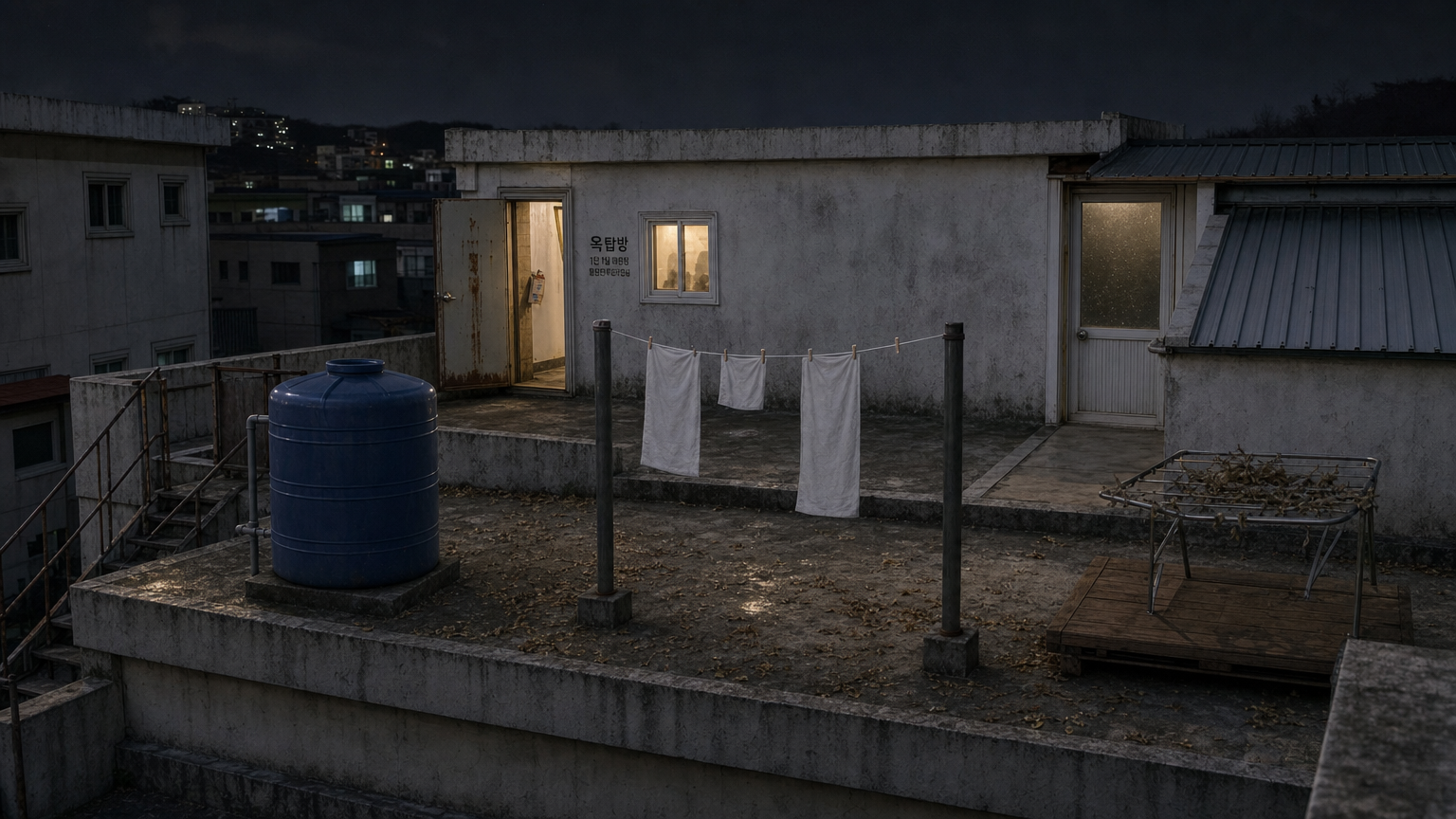
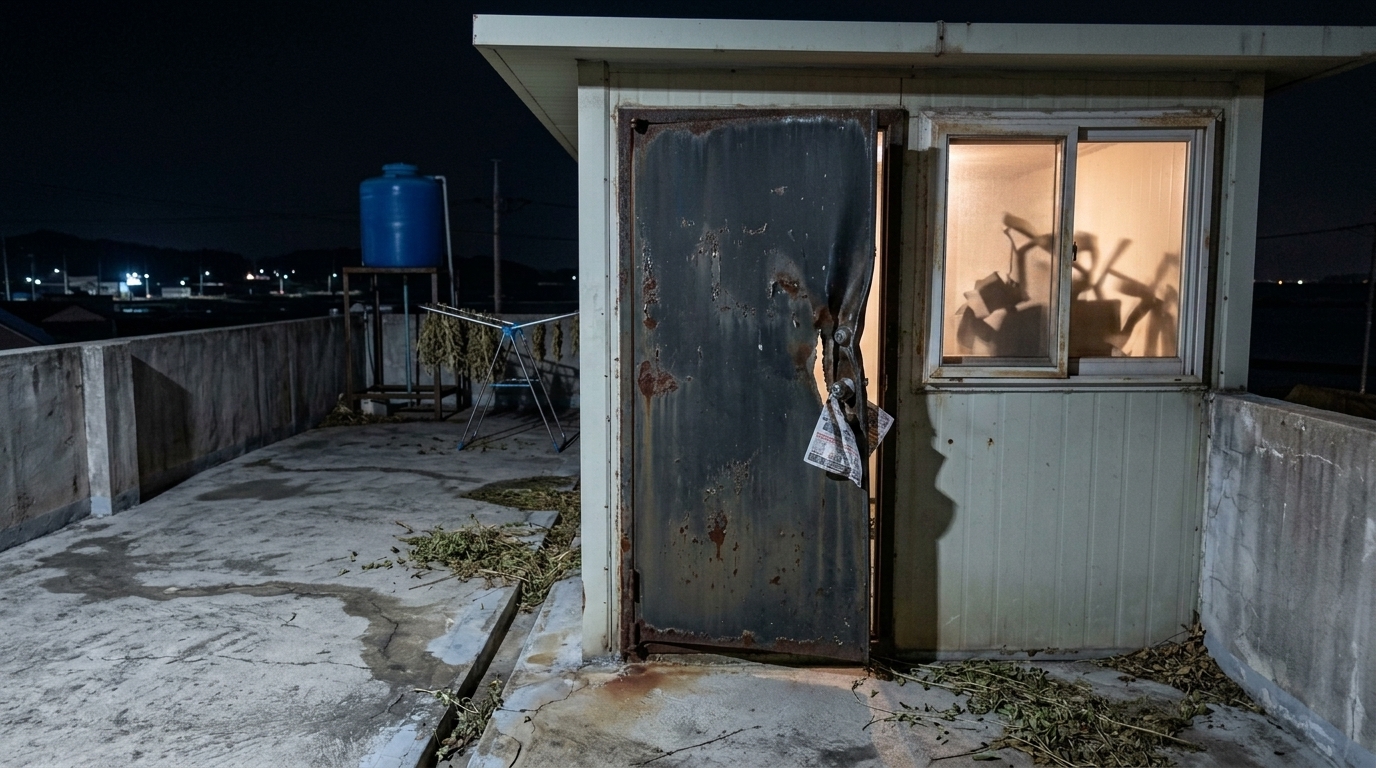
Create ONE FINAL photorealistic live-action film still of the moment below — contemporary South Korea, 2026; all people are Korean unless stated. TIME OF DAY (lock): night.

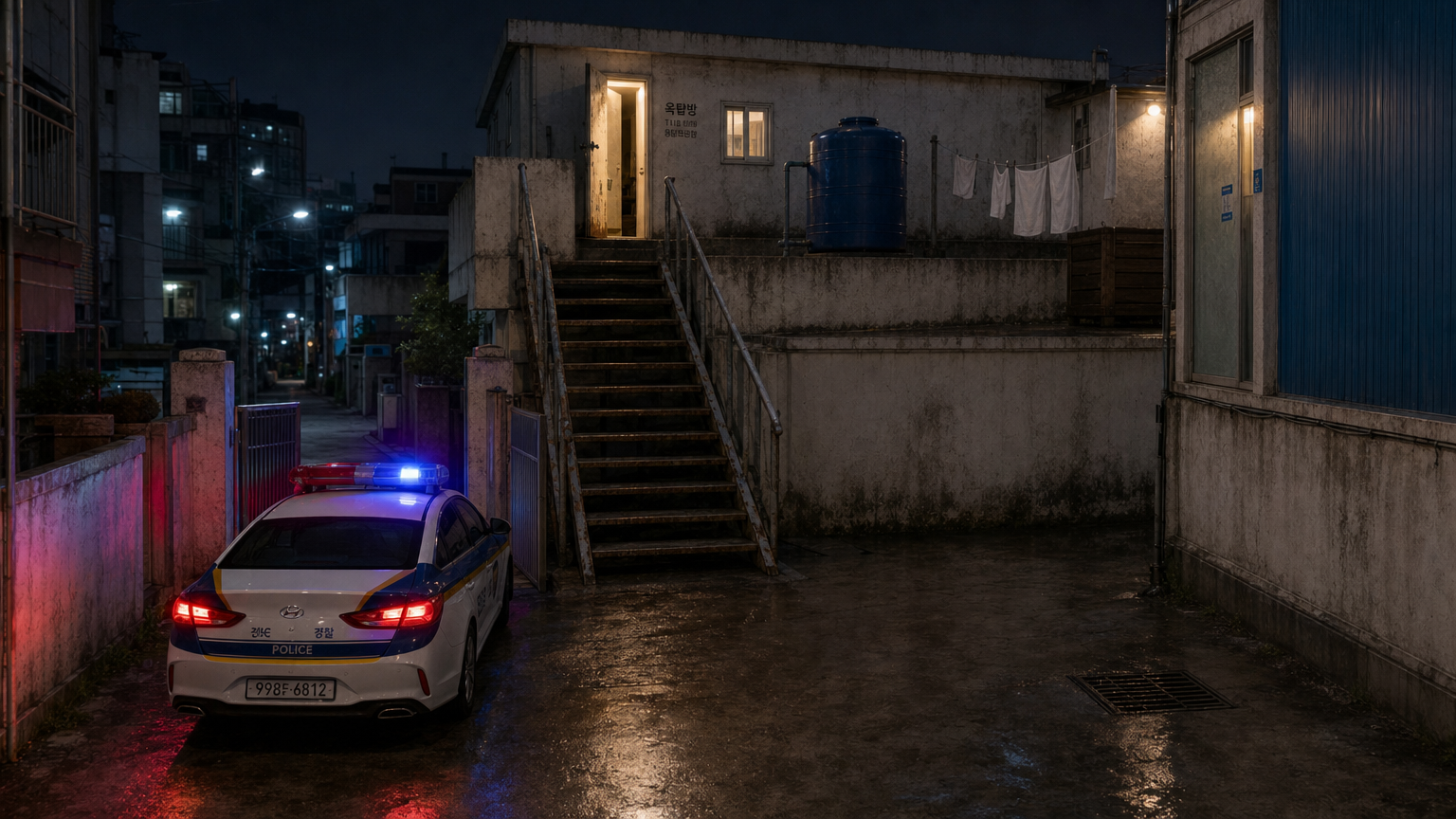
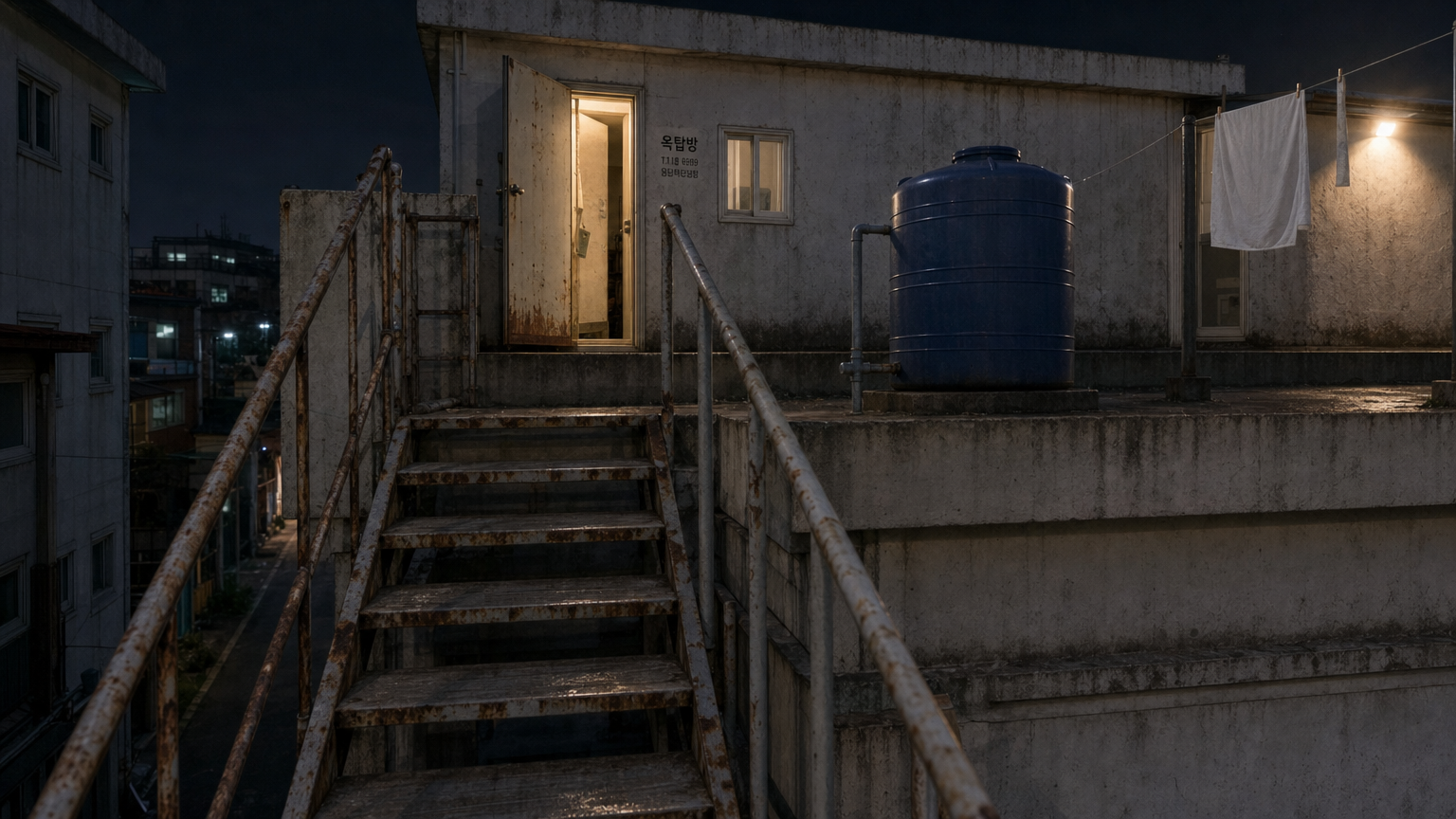
SHOT TEXT (authoritative, Korean): 현관 철문이 아주 살짝 열린 틈새로 보이는 어두운 실내와 신발 앞코

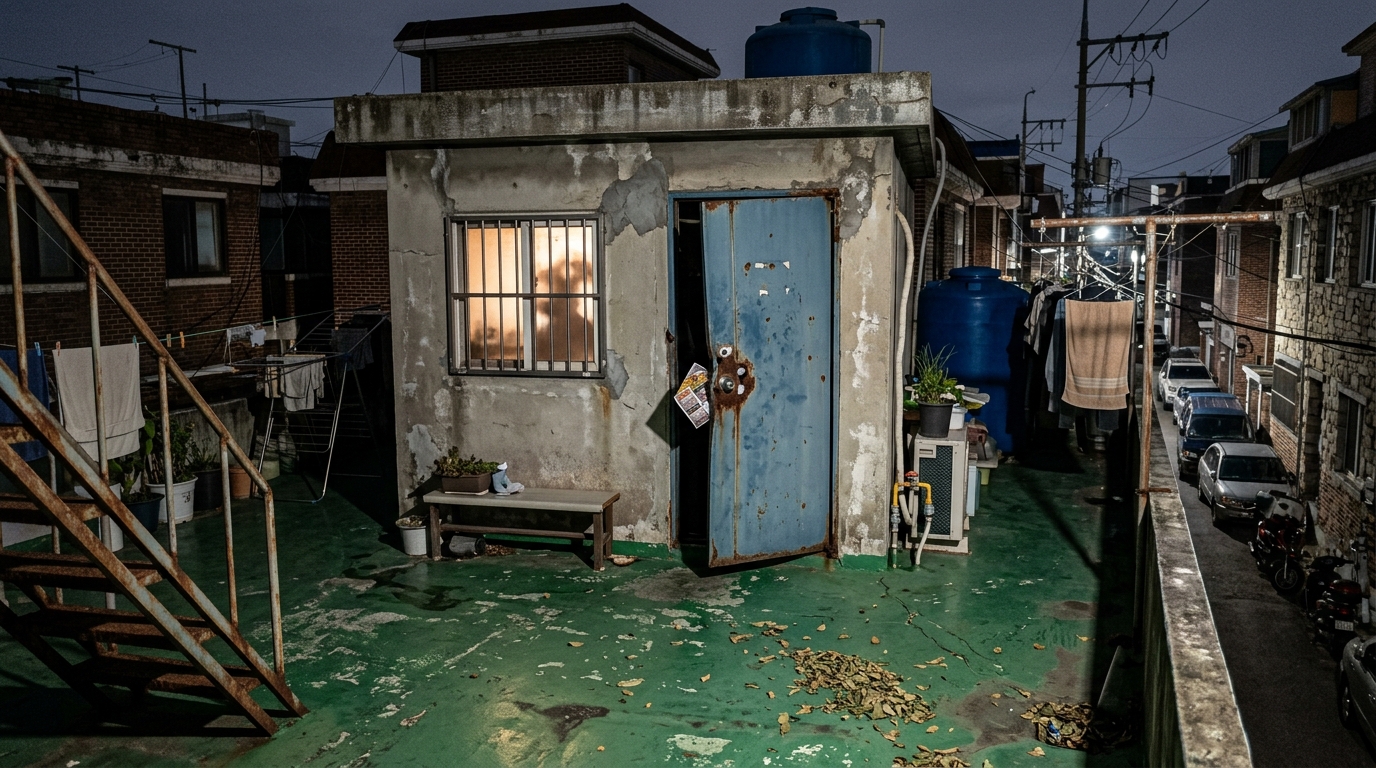
LOCATION (lock): A rooftop terrace around a small rooftop apartment, with a water tank, clothesline, drying platform, scattered dried herbs, and a metal entrance door. The shot takes place here — the attached LOCATION PHOTOGRAPH shows the exact spot.

REALIZE FIGURATIVE LANGUAGE AS A LIVE-ACTION SHOT: the Korean shot
text may describe characters metaphorically, figuratively or with
exaggeration. Photograph what a real movie camera would actually
record on a physical set — exaggerated or figurative impressions
become realistic staging choices (lighting, distance, angle,
wardrobe), not literal fantasy imagery.
EVERY CHARACTER IS A HUMAN BEING: unless the story explicitly
features non-human or virtual beings (as in science fiction or
fantasy), every character — however indirectly, vaguely or
figuratively the text describes them — IS a real human. When the
text gives no direct visual description of a person, IMAGINE one
and still show them as a concrete, fully-formed human being:
always render the human form to the maximum extent — build,
posture, face, hands, clothing — never reduce a person to a shape,
blob, solid silhouette or abstract mass.

EXPRESSIONS ARE ACTED, NEVER ANATOMICAL: when the text describes a
person's eyes, face or presence emotionally or figuratively (vacant,
hollow, dazed, burning, lifeless gaze and the like), it describes an
ACTOR'S PERFORMANCE captured by a real camera — realize it ONLY
through gaze direction, focus, eyelids, facial muscles, stillness
and posture. Every living person's eyes remain anatomically normal
human eyes with a natural iris and pupil, natural sclera and normal
proportions; NEVER whiten, blank out, cloud over, glow, enlarge or
otherwise alter eyeballs, skin or anatomy — unless the story
explicitly declares that being non-human or supernatural in form.

PROPS FACE THE RIGHT WAY: every handheld or used object must be
oriented exactly as its real-world use requires. A person reading,
watching or operating something (a phone, a photograph, a paper,
any device) has its functional side — screen, front, page — facing
THEIR OWN eyes; the camera then sees whatever side the staging
geometry implies (often its back). Show the functional side to the
camera ONLY when the shot text itself stages it toward the viewer.
Never flip, mirror or reverse an object's front and back.

CARRIED STATE (persist exactly — must match the neighbouring shots of this scene): The stranger has forced the lock with the leaflet, leaving the iron entrance door slightly open as he enters.

NO PEOPLE IN THIS SHOT: the shot text shows only the place and its state — no living person or any body part appears in frame, unless the shot text itself explicitly says so.

No text, captions, watermarks or annotations anywhere.
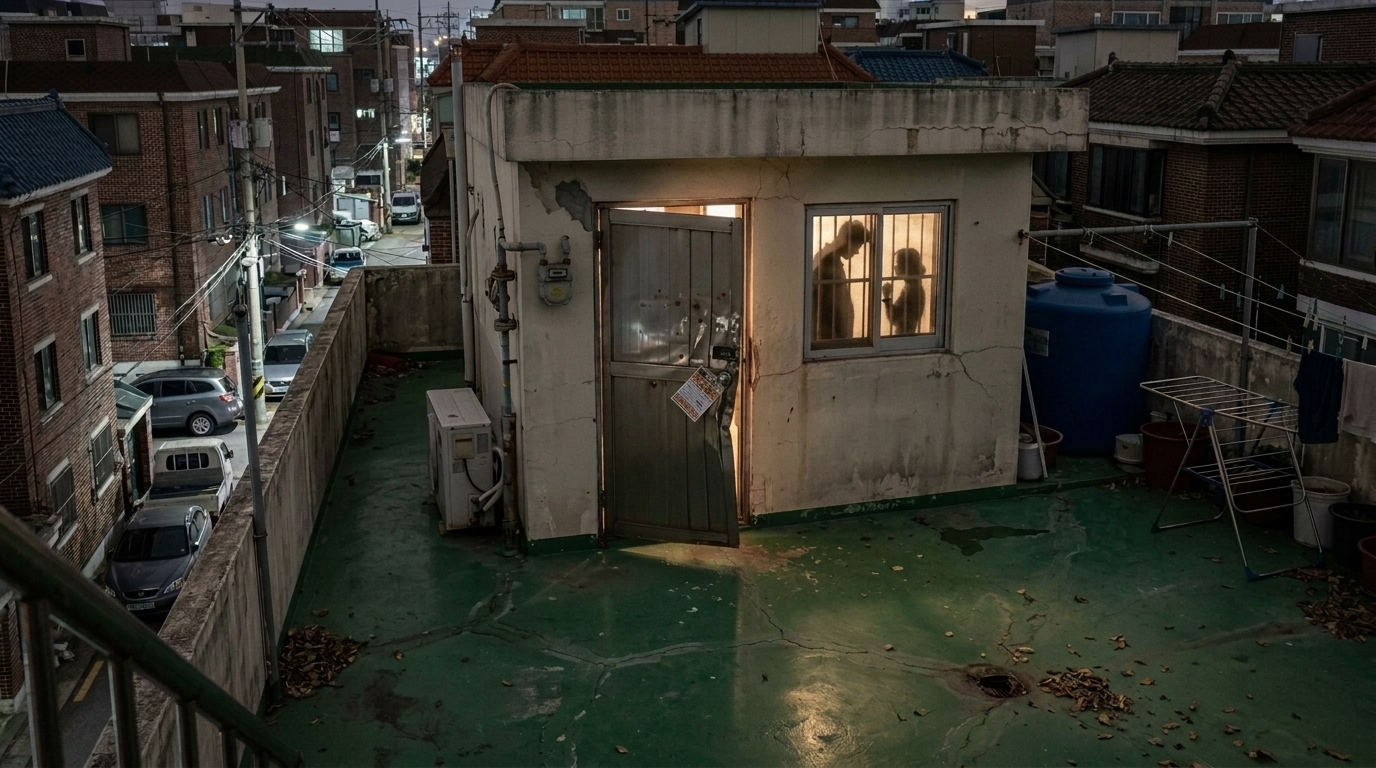
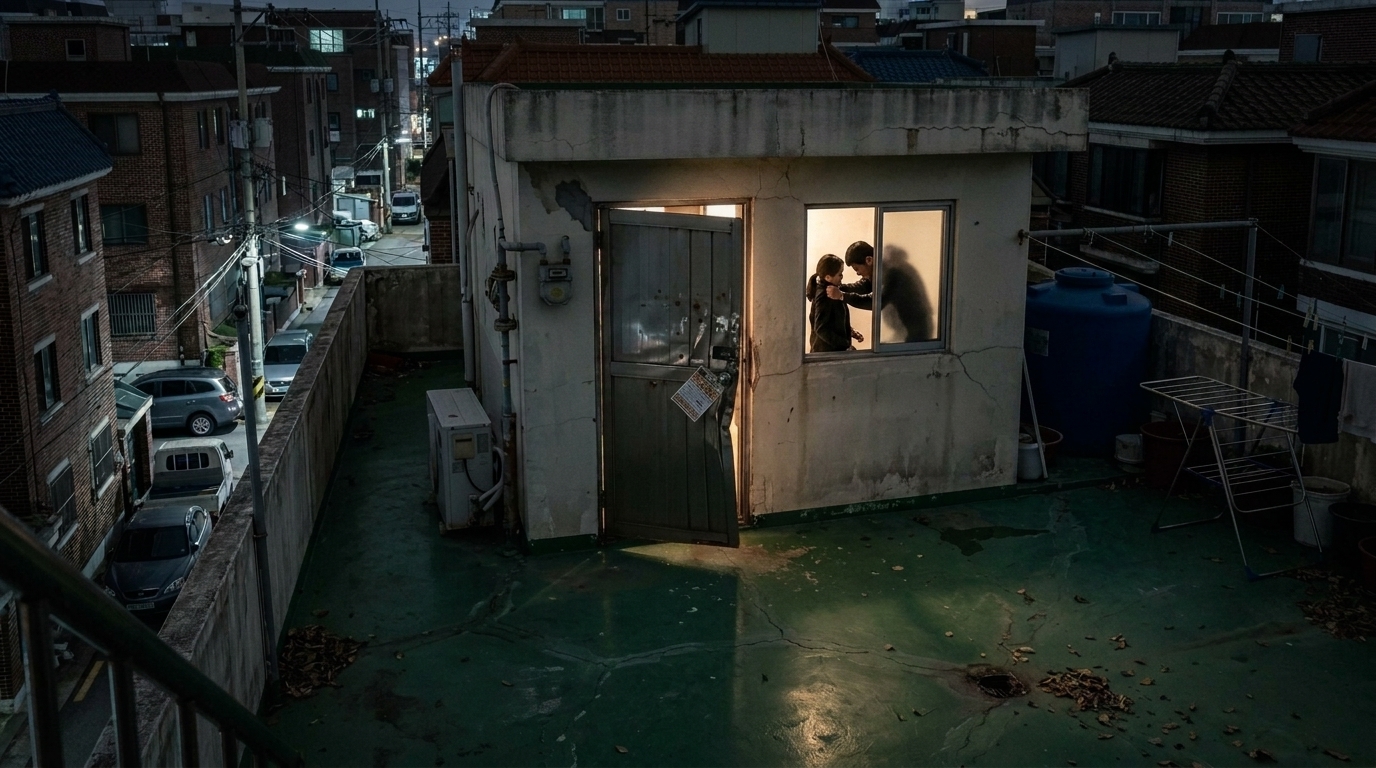
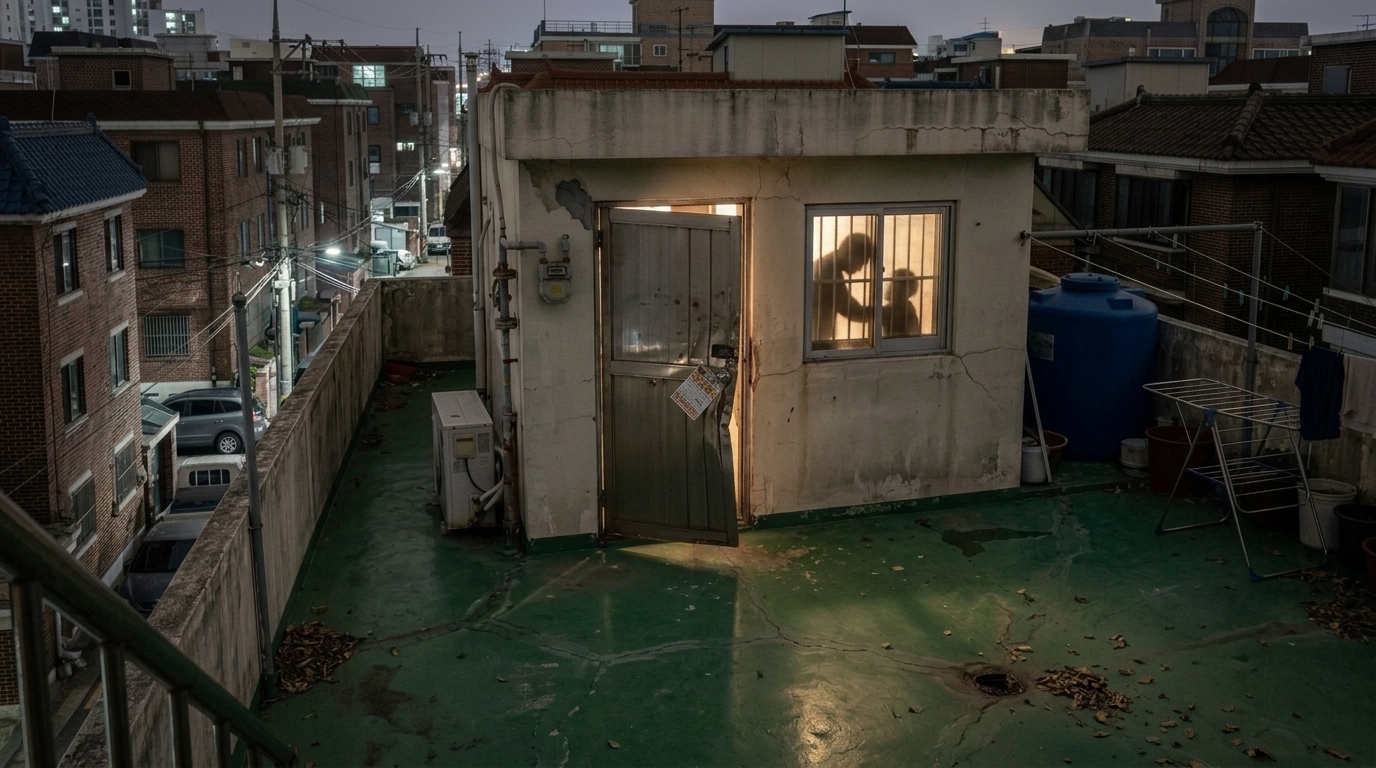
Create ONE FINAL photorealistic live-action film still of the moment below — contemporary South Korea, 2026; all people are Korean unless stated. TIME OF DAY (lock): night.

SHOT TEXT (authoritative, Korean): 불이 켜진 옥탑방 창문에 거대한 그림자가 작은 그림자의 어깨 쪽으로 고개를 꺾은 형태가 맺혀 있는 정지 구도

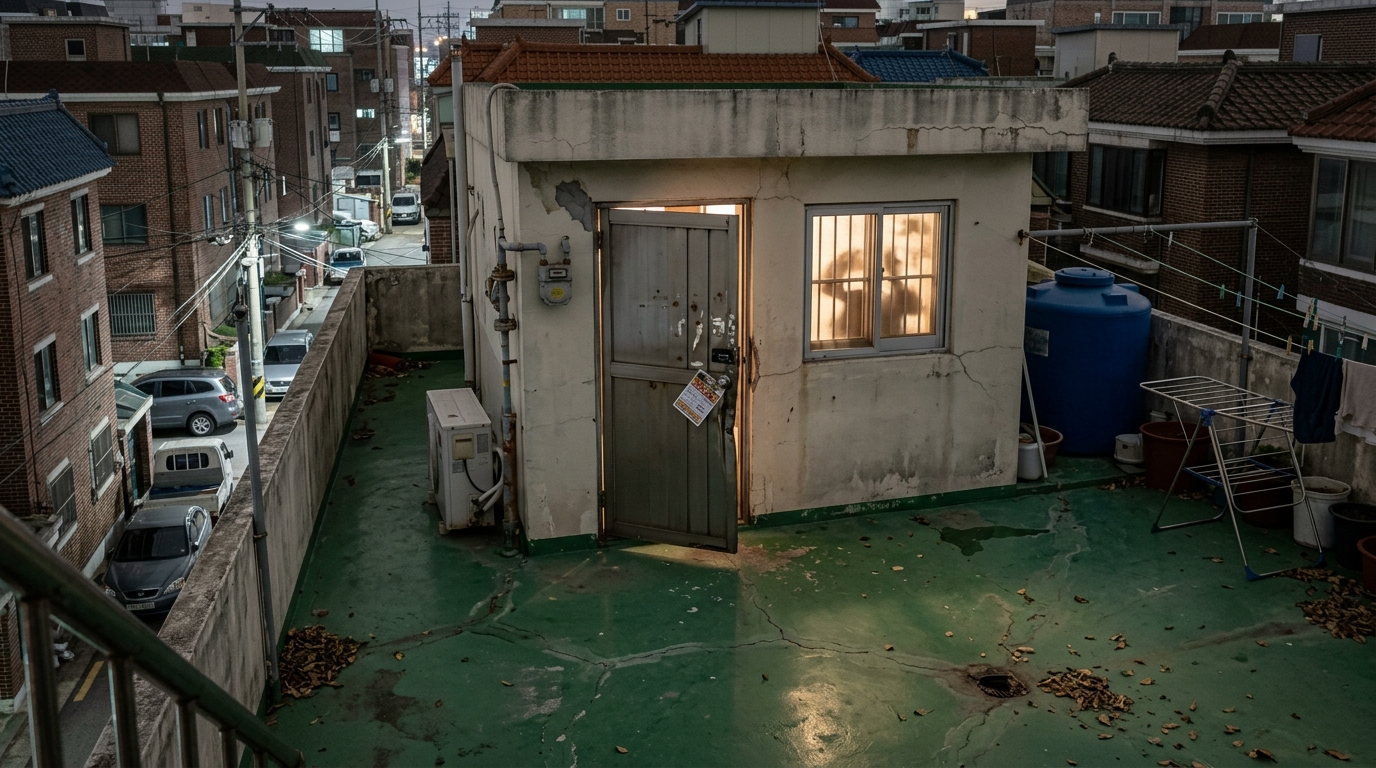
LOCATION (lock): A rooftop terrace around a small rooftop apartment, with a water tank, clothesline, drying platform, scattered dried herbs, and a metal entrance door. The shot takes place here — the attached LOCATION PHOTOGRAPH shows the exact spot.

REALIZE FIGURATIVE LANGUAGE AS A LIVE-ACTION SHOT: the Korean shot
text may describe characters metaphorically, figuratively or with
exaggeration. Photograph what a real movie camera would actually
record on a physical set — exaggerated or figurative impressions
become realistic staging choices (lighting, distance, angle,
wardrobe), not literal fantasy imagery.
EVERY CHARACTER IS A HUMAN BEING: unless the story explicitly
features non-human or virtual beings (as in science fiction or
fantasy), every character — however indirectly, vaguely or
figuratively the text describes them — IS a real human. When the
text gives no direct visual description of a person, IMAGINE one
and still show them as a concrete, fully-formed human being:
always render the human form to the maximum extent — build,
posture, face, hands, clothing — never reduce a person to a shape,
blob, solid silhouette or abstract mass.

EXPRESSIONS ARE ACTED, NEVER ANATOMICAL: when the text describes a
person's eyes, face or presence emotionally or figuratively (vacant,
hollow, dazed, burning, lifeless gaze and the like), it describes an
ACTOR'S PERFORMANCE captured by a real camera — realize it ONLY
through gaze direction, focus, eyelids, facial muscles, stillness
and posture. Every living person's eyes remain anatomically normal
human eyes with a natural iris and pupil, natural sclera and normal
proportions; NEVER whiten, blank out, cloud over, glow, enlarge or
otherwise alter eyeballs, skin or anatomy — unless the story
explicitly declares that being non-human or supernatural in form.

PROPS FACE THE RIGHT WAY: every handheld or used object must be
oriented exactly as its real-world use requires. A person reading,
watching or operating something (a phone, a photograph, a paper,
any device) has its functional side — screen, front, page — facing
THEIR OWN eyes; the camera then sees whatever side the staging
geometry implies (often its back). Show the functional side to the
camera ONLY when the shot text itself stages it toward the viewer.
Never flip, mirror or reverse an object's front and back.

CARRIED STATE (persist exactly — must match the neighbouring shots of this scene): The forced entrance door remains open, and Min-suk still bears the small circular wrist mark as the stranger attacks her shoulder.

NO PEOPLE IN THIS SHOT: the shot text shows only the place and its state — no living person or any body part appears in frame, unless the shot text itself explicitly says so.

No text, captions, watermarks or annotations anywhere.
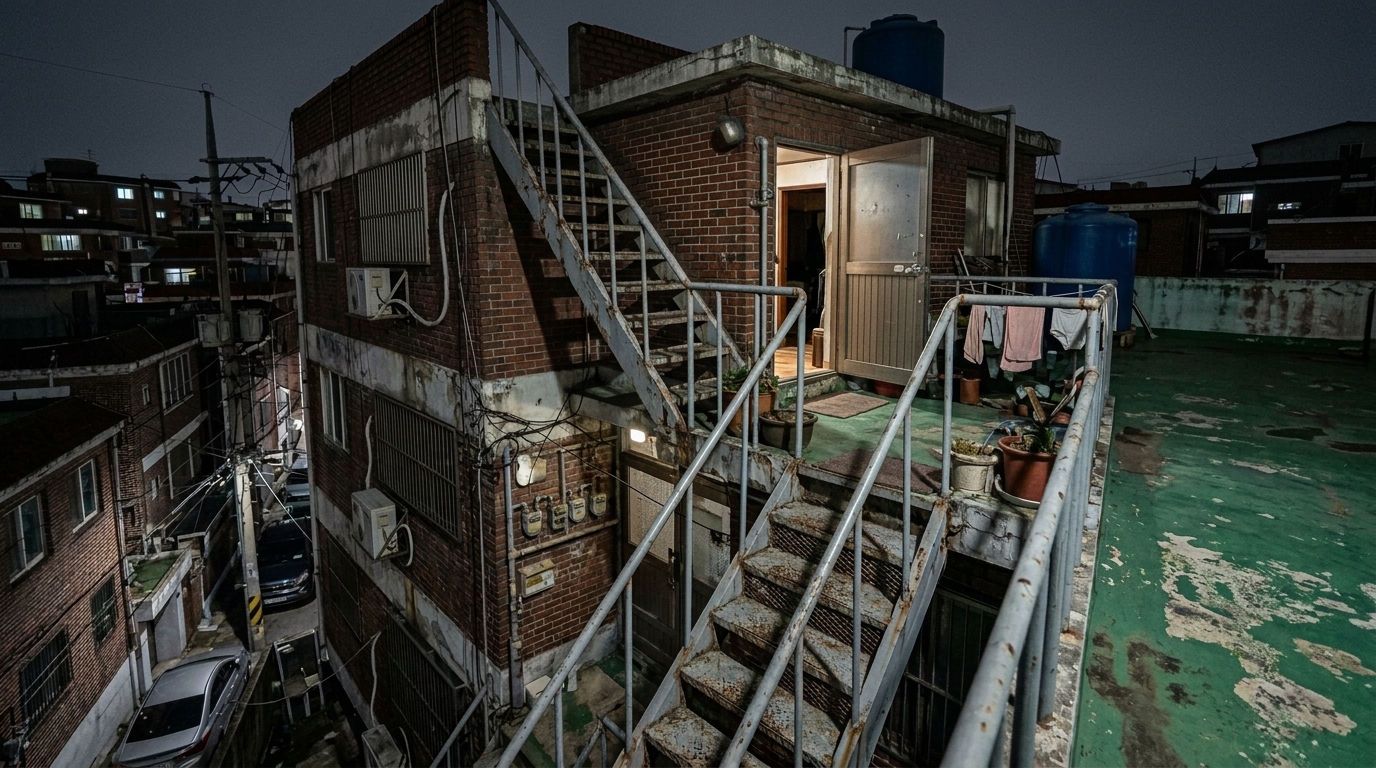
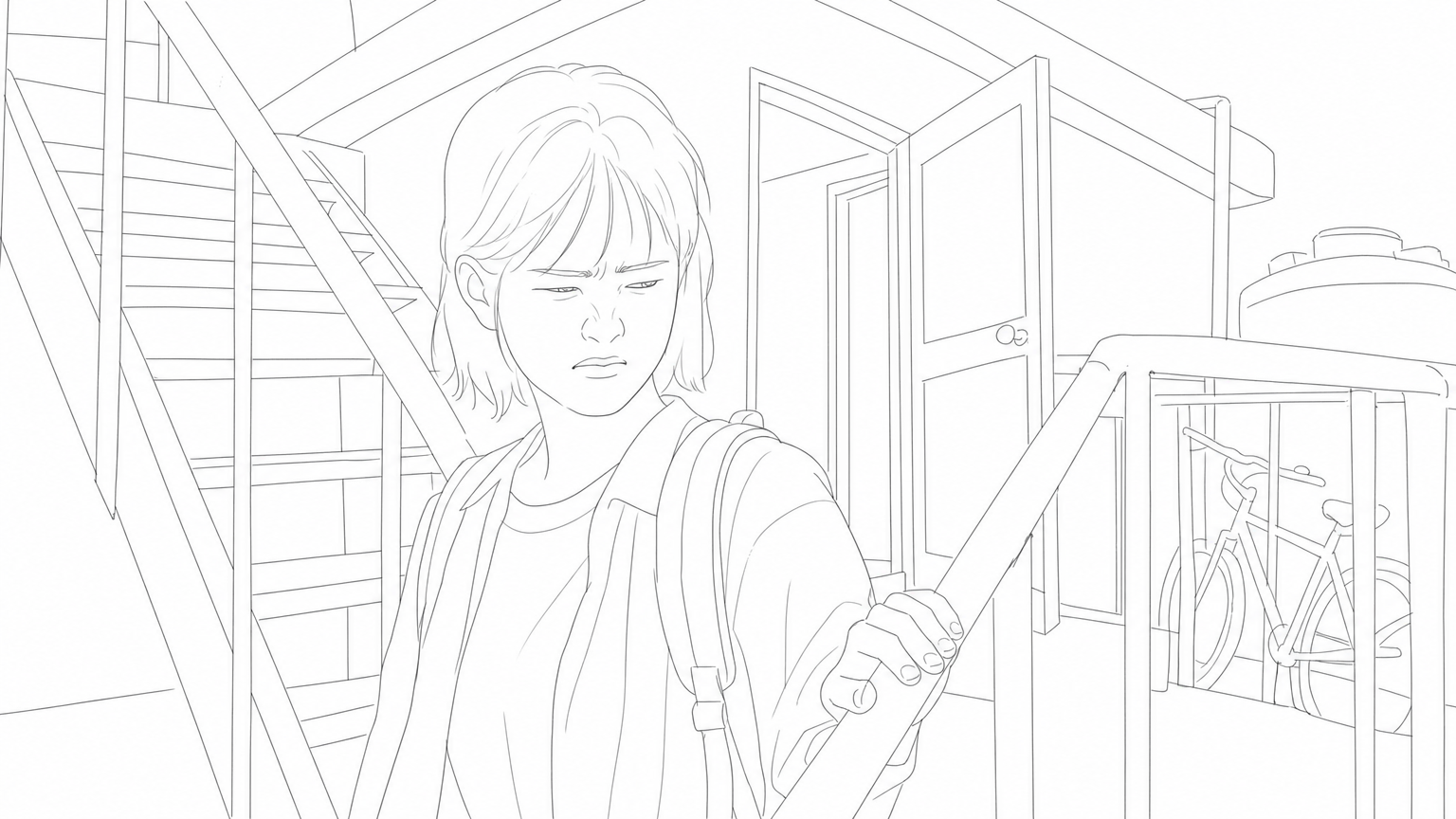
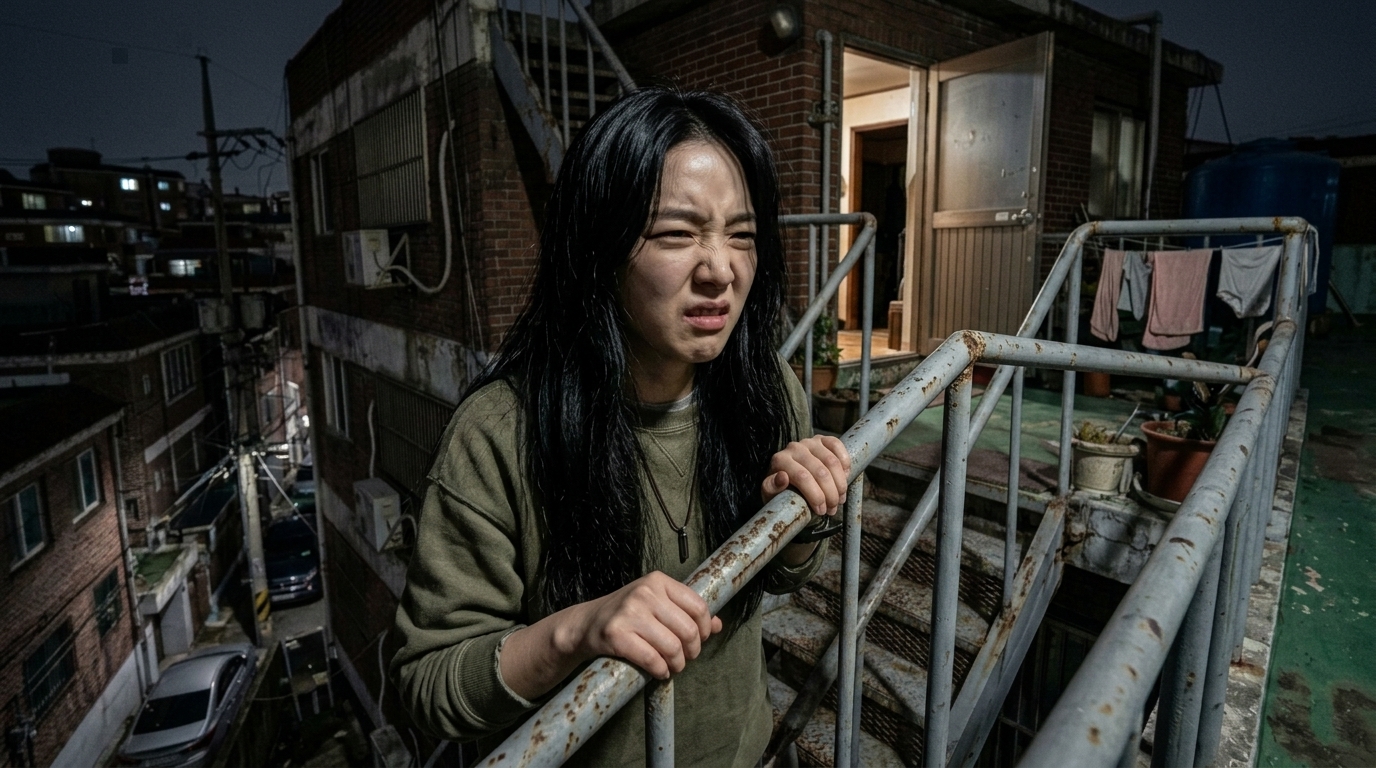
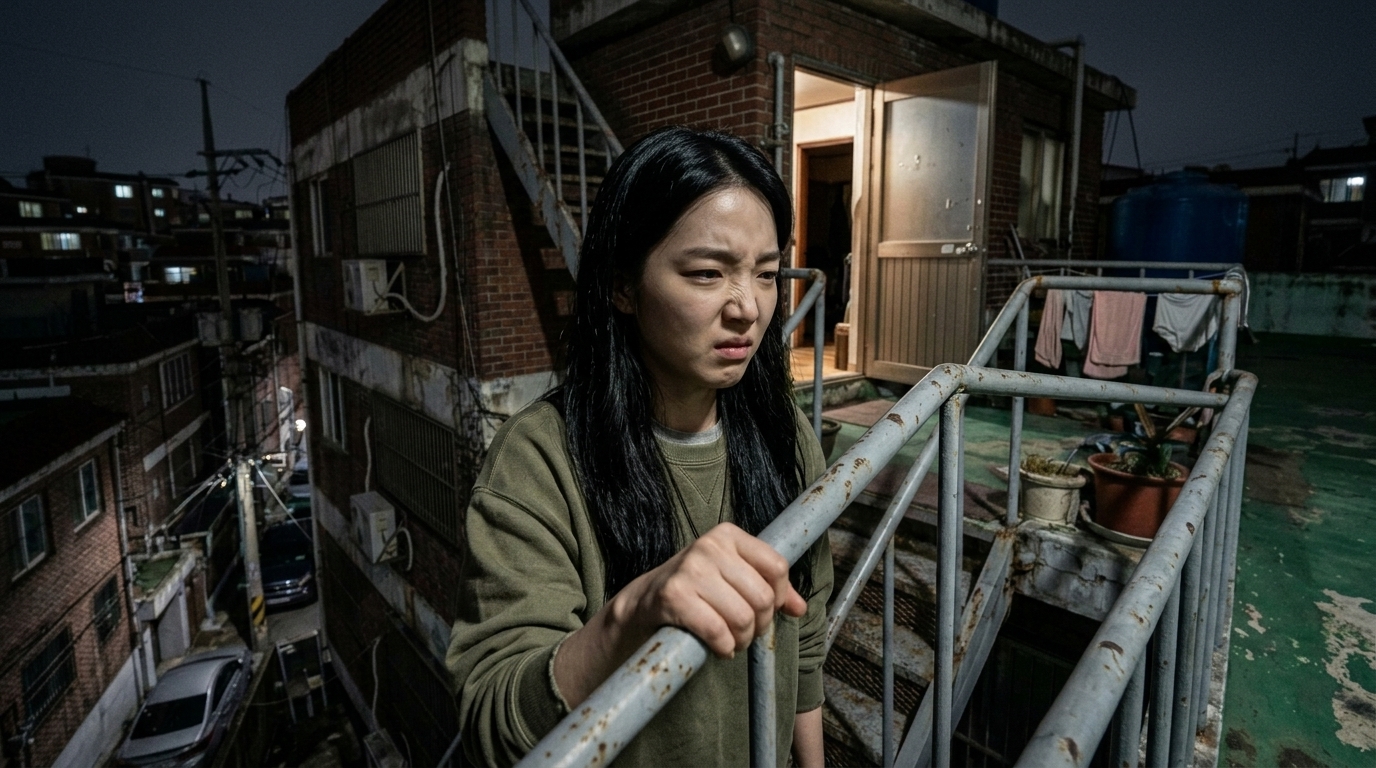
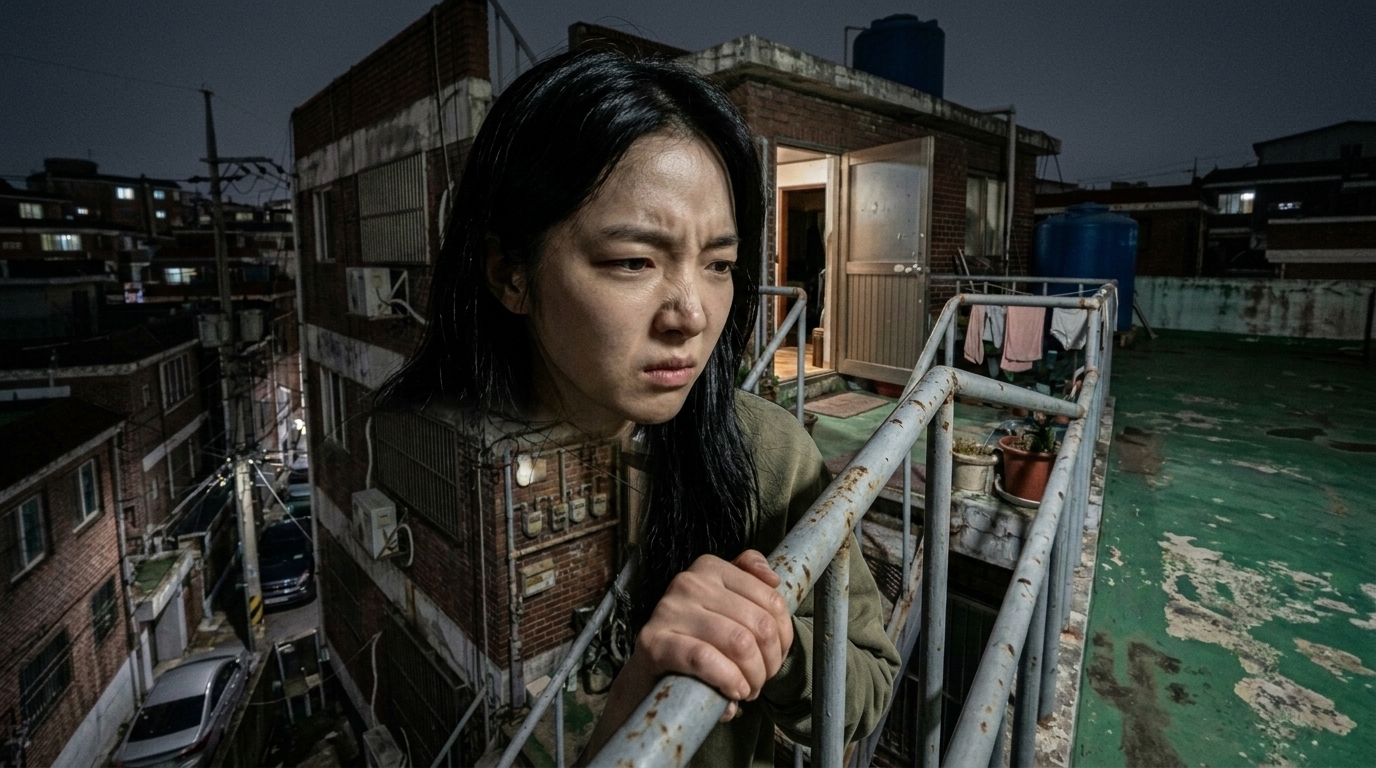
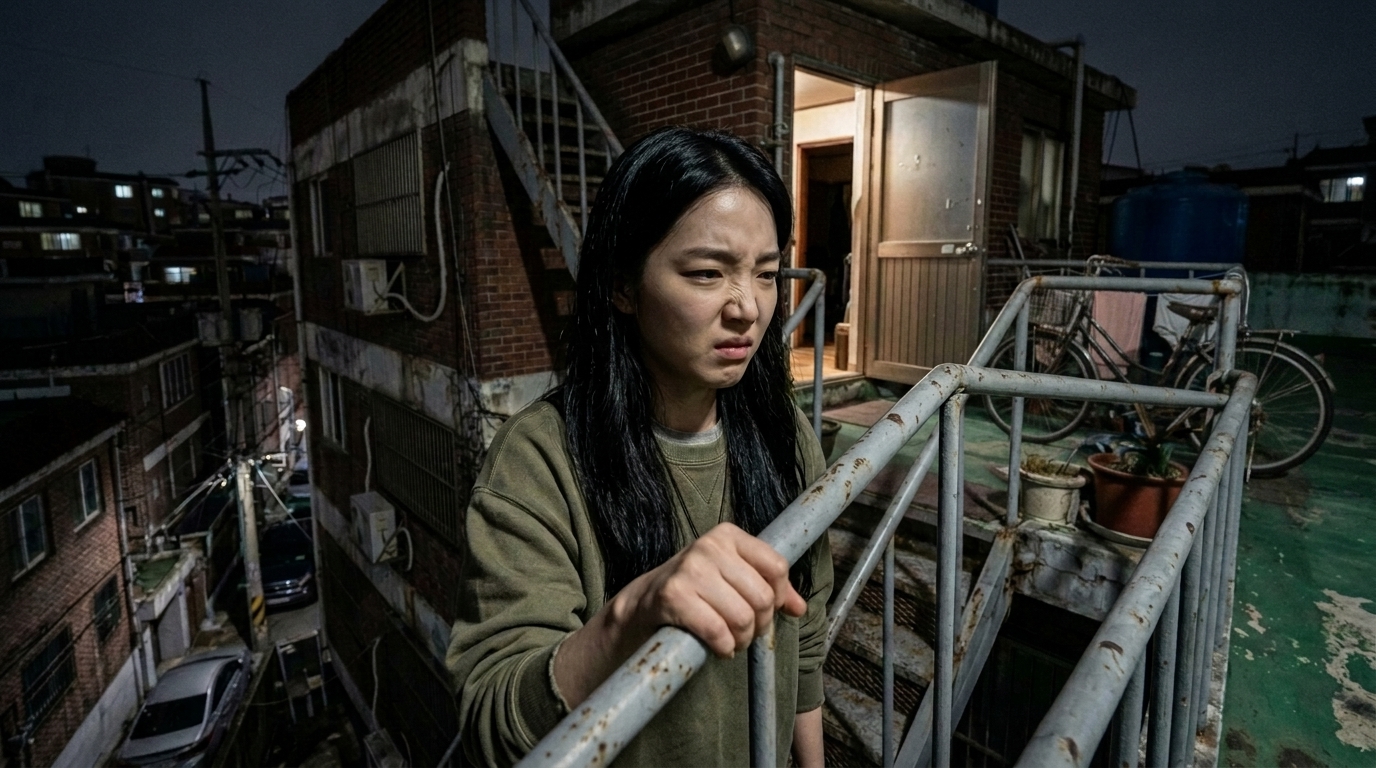
Create ONE FINAL photorealistic live-action film still of the moment below — contemporary South Korea, 2026; all people are Korean unless stated. TIME OF DAY (lock): night.

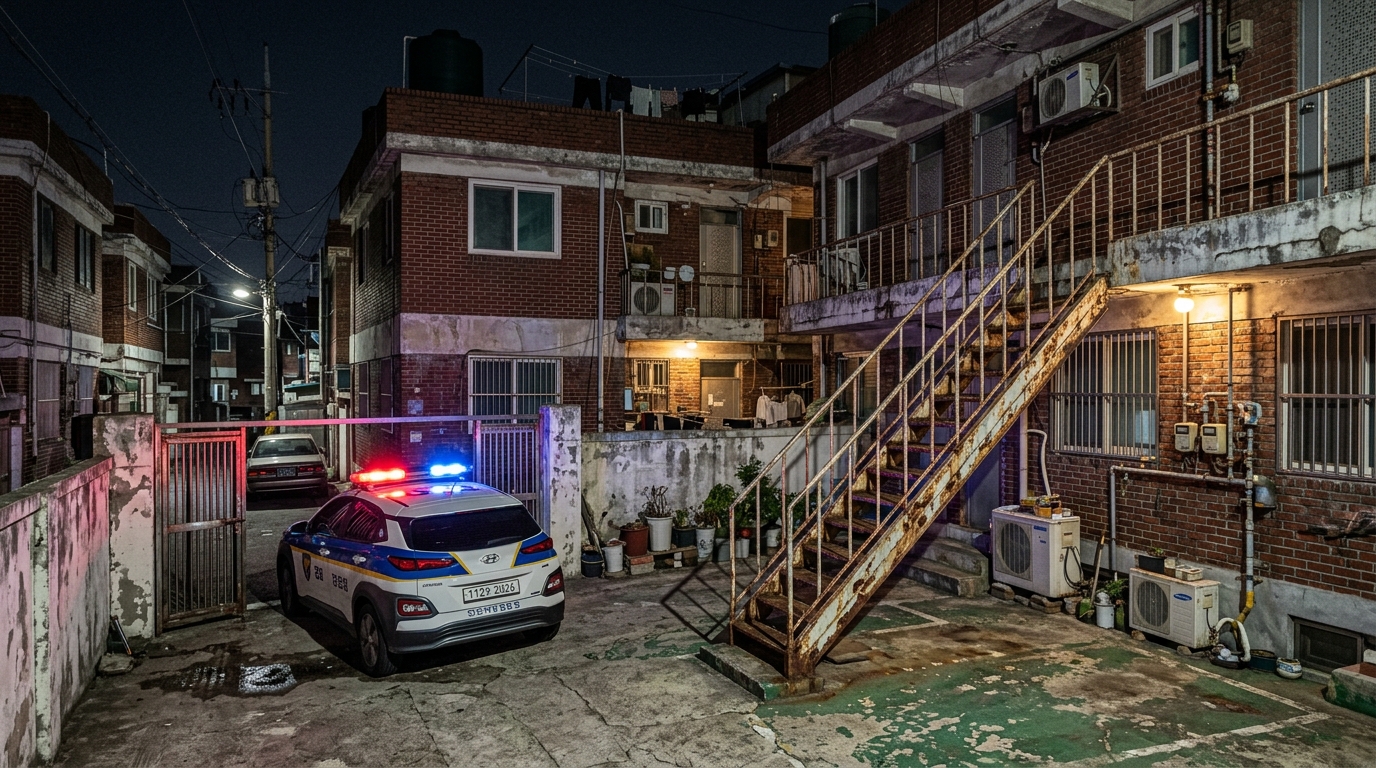
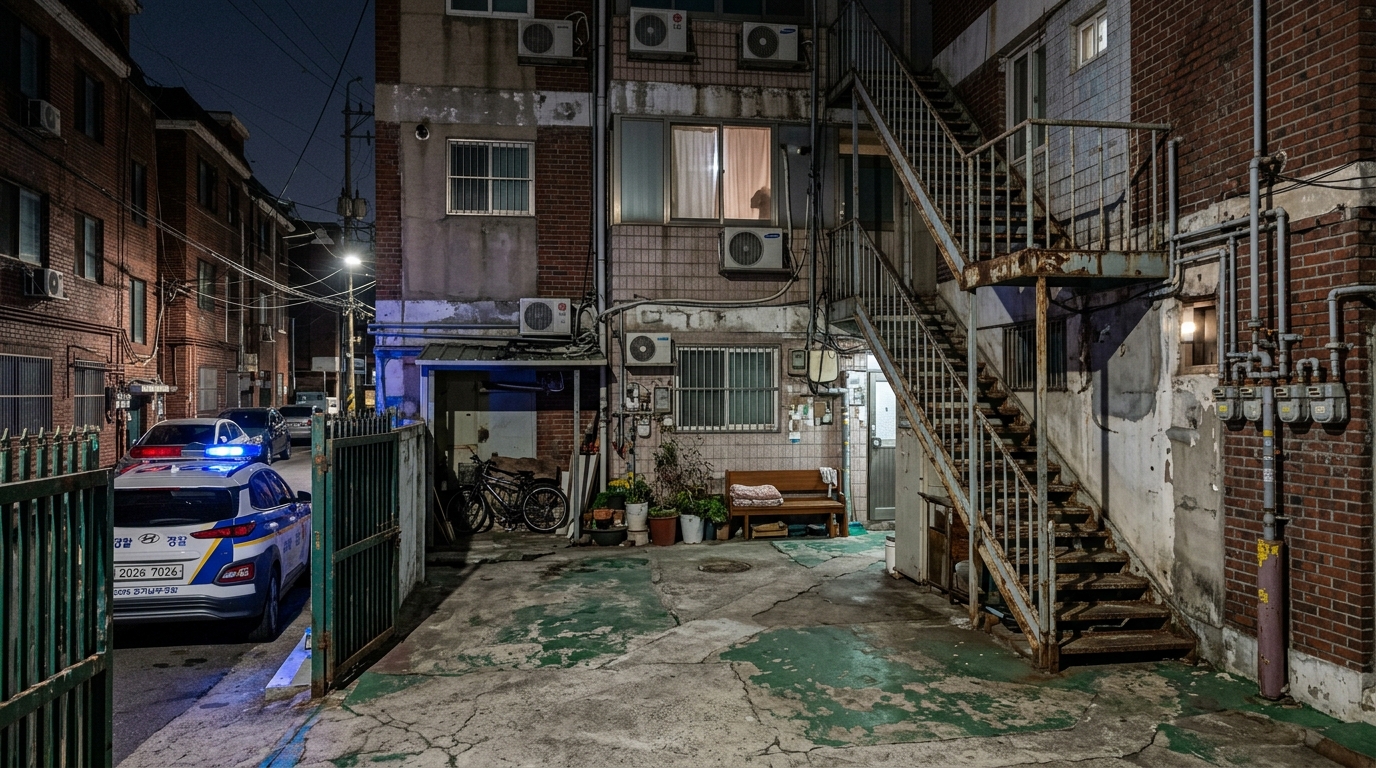
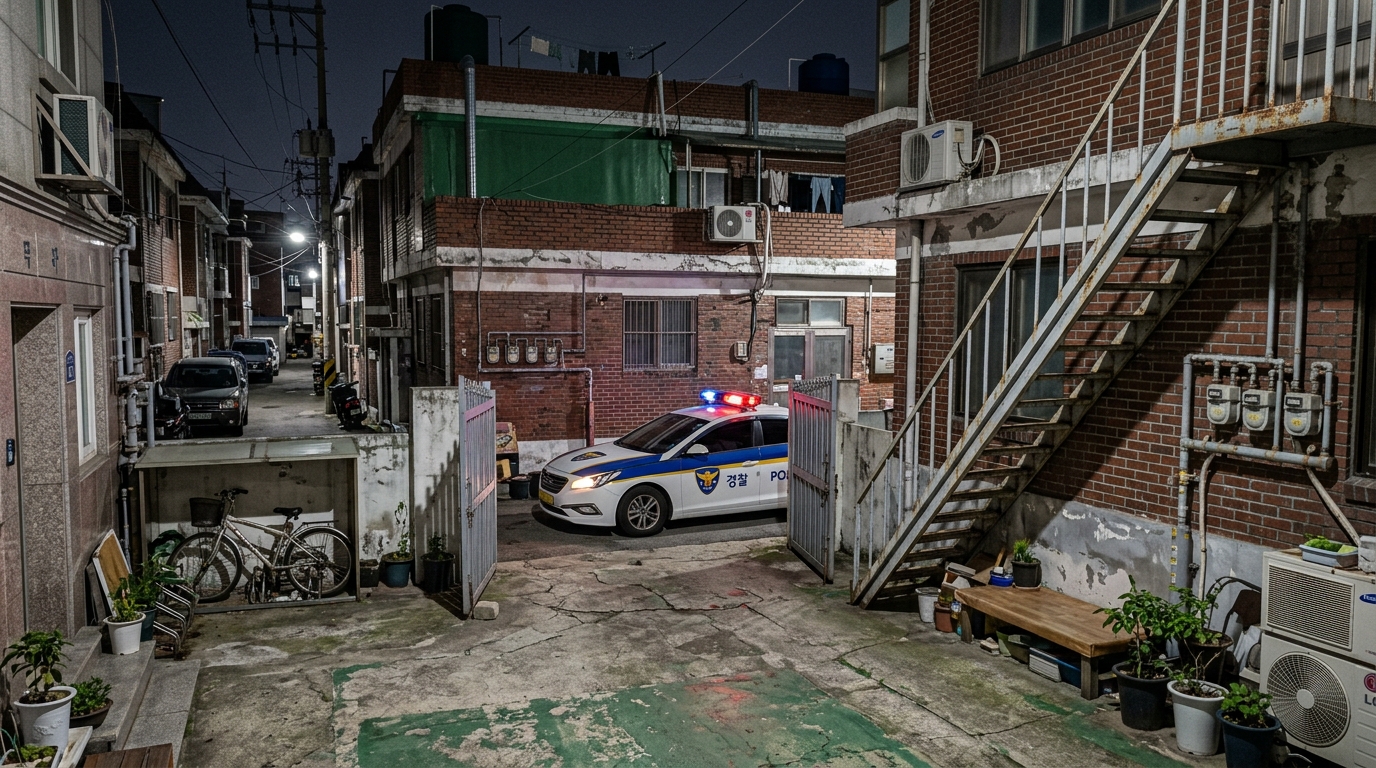
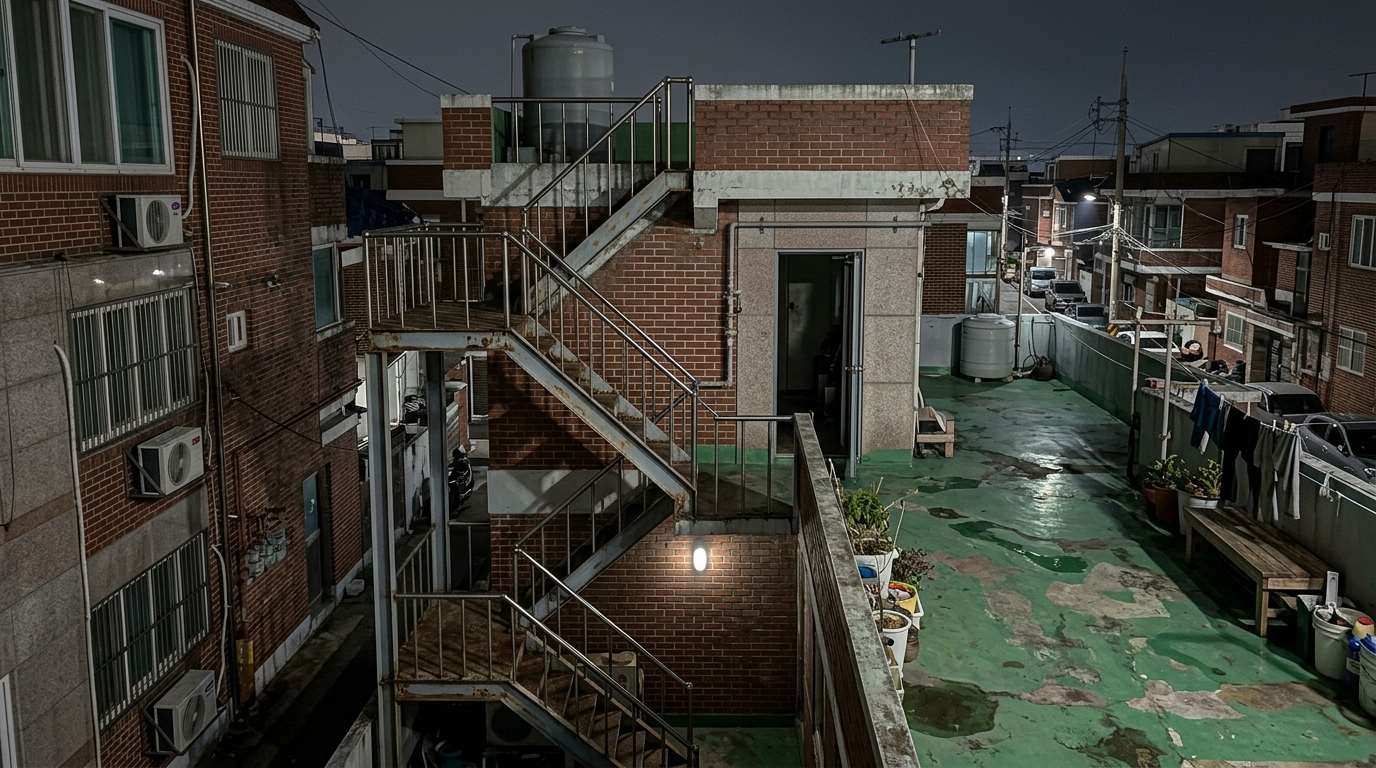
SHOT TEXT (authoritative, Korean): 철제 파이프 난간을 손으로 잡은 수리영이 코끝을 찡그린 채 계단 중간에 서 있는 얼굴 클로즈업

LOCATION (lock): A narrow residential alley leading into the yard of an old multi-unit villa, with a rear bicycle area and an exterior stairway climbing to a rooftop apartment. The shot takes place here — the attached LOCATION PHOTOGRAPH shows the exact spot.

REALIZE FIGURATIVE LANGUAGE AS A LIVE-ACTION SHOT: the Korean shot
text may describe characters metaphorically, figuratively or with
exaggeration. Photograph what a real movie camera would actually
record on a physical set — exaggerated or figurative impressions
become realistic staging choices (lighting, distance, angle,
wardrobe), not literal fantasy imagery.
EVERY CHARACTER IS A HUMAN BEING: unless the story explicitly
features non-human or virtual beings (as in science fiction or
fantasy), every character — however indirectly, vaguely or
figuratively the text describes them — IS a real human. When the
text gives no direct visual description of a person, IMAGINE one
and still show them as a concrete, fully-formed human being:
always render the human form to the maximum extent — build,
posture, face, hands, clothing — never reduce a person to a shape,
blob, solid silhouette or abstract mass.

EXPRESSIONS ARE ACTED, NEVER ANATOMICAL: when the text describes a
person's eyes, face or presence emotionally or figuratively (vacant,
hollow, dazed, burning, lifeless gaze and the like), it describes an
ACTOR'S PERFORMANCE captured by a real camera — realize it ONLY
through gaze direction, focus, eyelids, facial muscles, stillness
and posture. Every living person's eyes remain anatomically normal
human eyes with a natural iris and pupil, natural sclera and normal
proportions; NEVER whiten, blank out, cloud over, glow, enlarge or
otherwise alter eyeballs, skin or anatomy — unless the story
explicitly declares that being non-human or supernatural in form.

PROPS FACE THE RIGHT WAY: every handheld or used object must be
oriented exactly as its real-world use requires. A person reading,
watching or operating something (a phone, a photograph, a paper,
any device) has its functional side — screen, front, page — facing
THEIR OWN eyes; the camera then sees whatever side the staging
geometry implies (often its back). Show the functional side to the
camera ONLY when the shot text itself stages it toward the viewer.
Never flip, mirror or reverse an object's front and back.

CARRIED STATE (persist exactly — must match the neighbouring shots of this scene): Su-ri-young's bicycle has been left in the building's rear yard, while the rooftop entrance door remains half open above her.

PEOPLE: the SHOT TEXT alone decides whether any person is visible in this shot. IF a person appears, they must be one of: 수리영 (Korean 20대 초반 여성, 긴 검은 머리, 타원형의 젊은 얼굴, 부드러운 이목구비와 자연스러운 피부색상태) — never anyone else, and never add a person the shot text does not show. IF only part of a person is in frame (a hand, arm, foot, back, silhouette), that body part belongs to the specific person the shot text names — its sex, age, build, skin and grooming must unmistakably match that person's profile above.

No text, captions, watermarks or annotations anywhere.
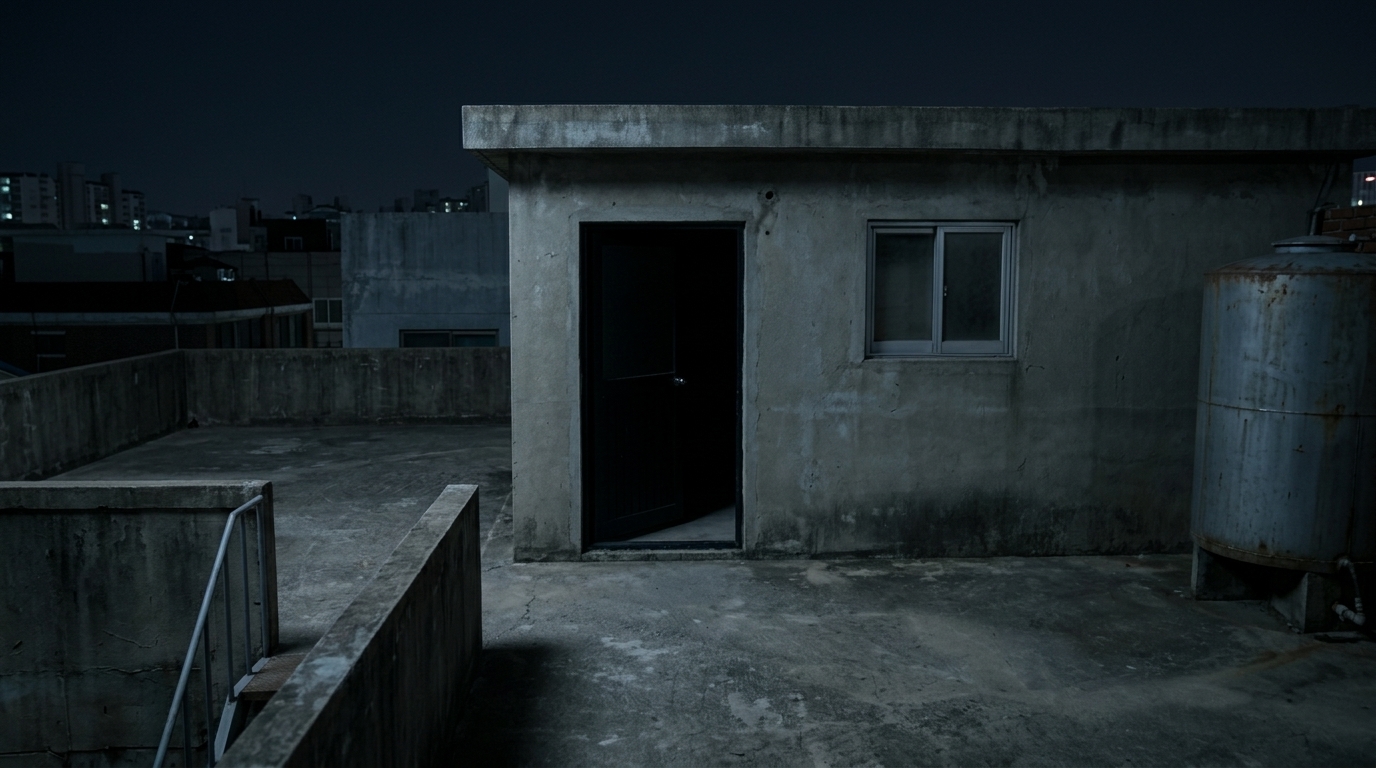
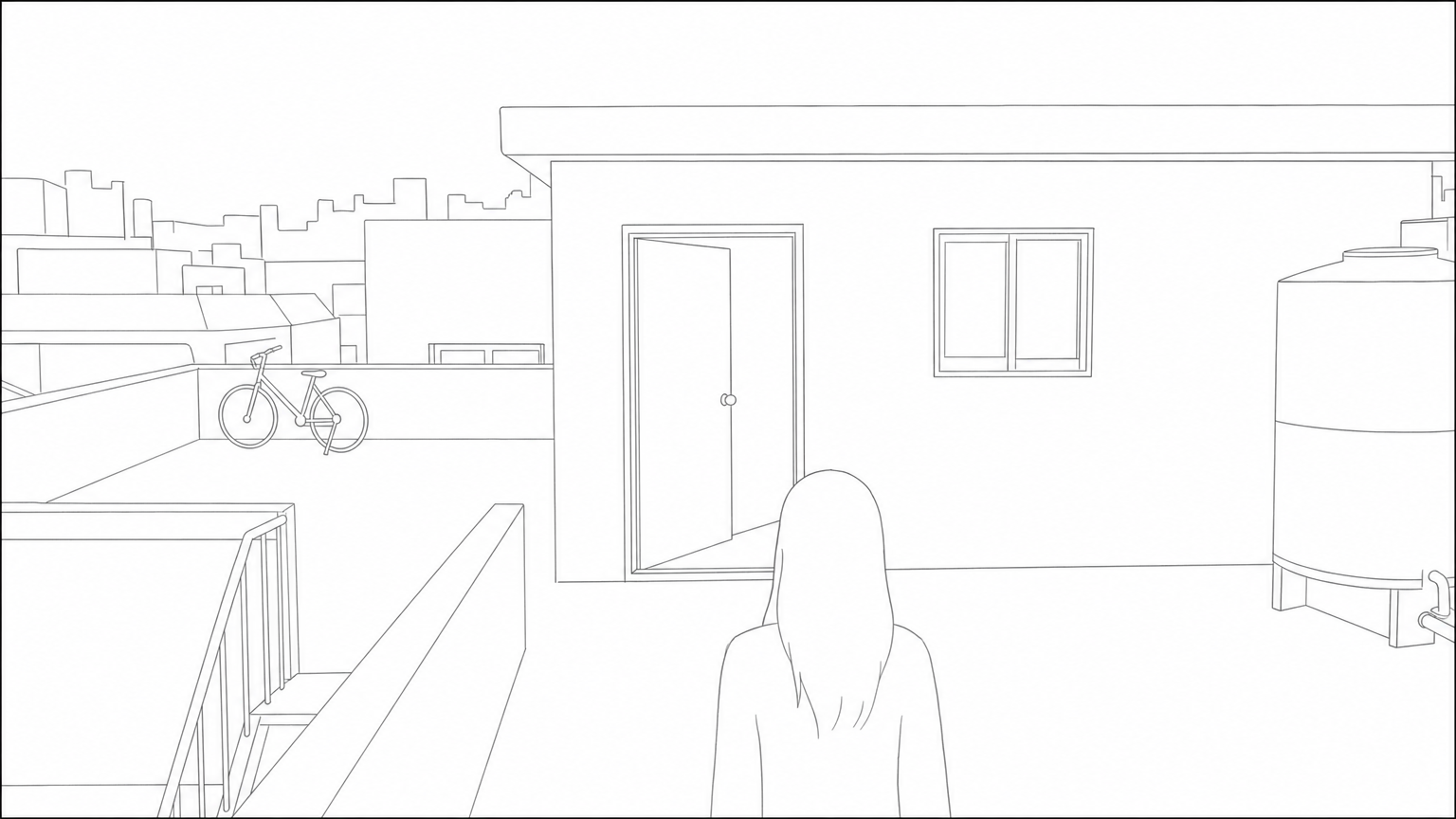
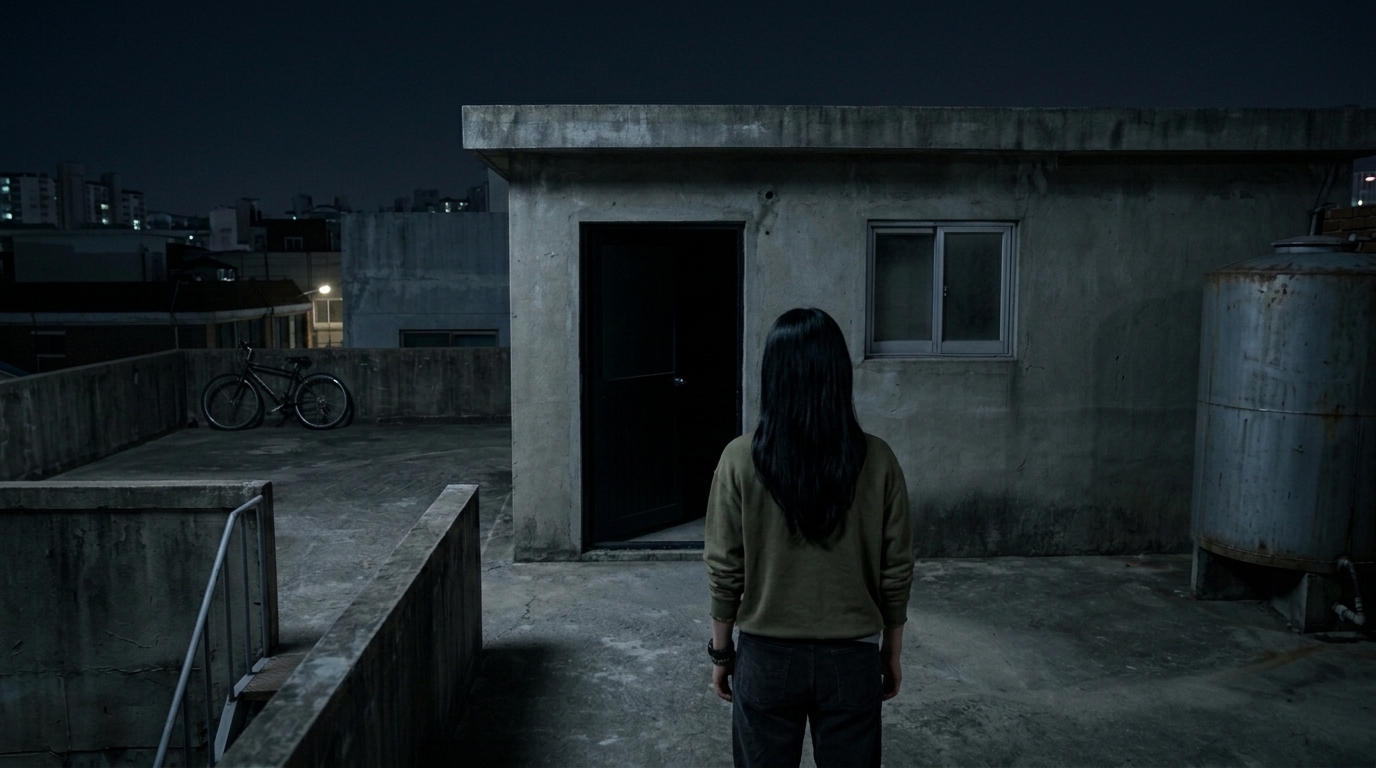
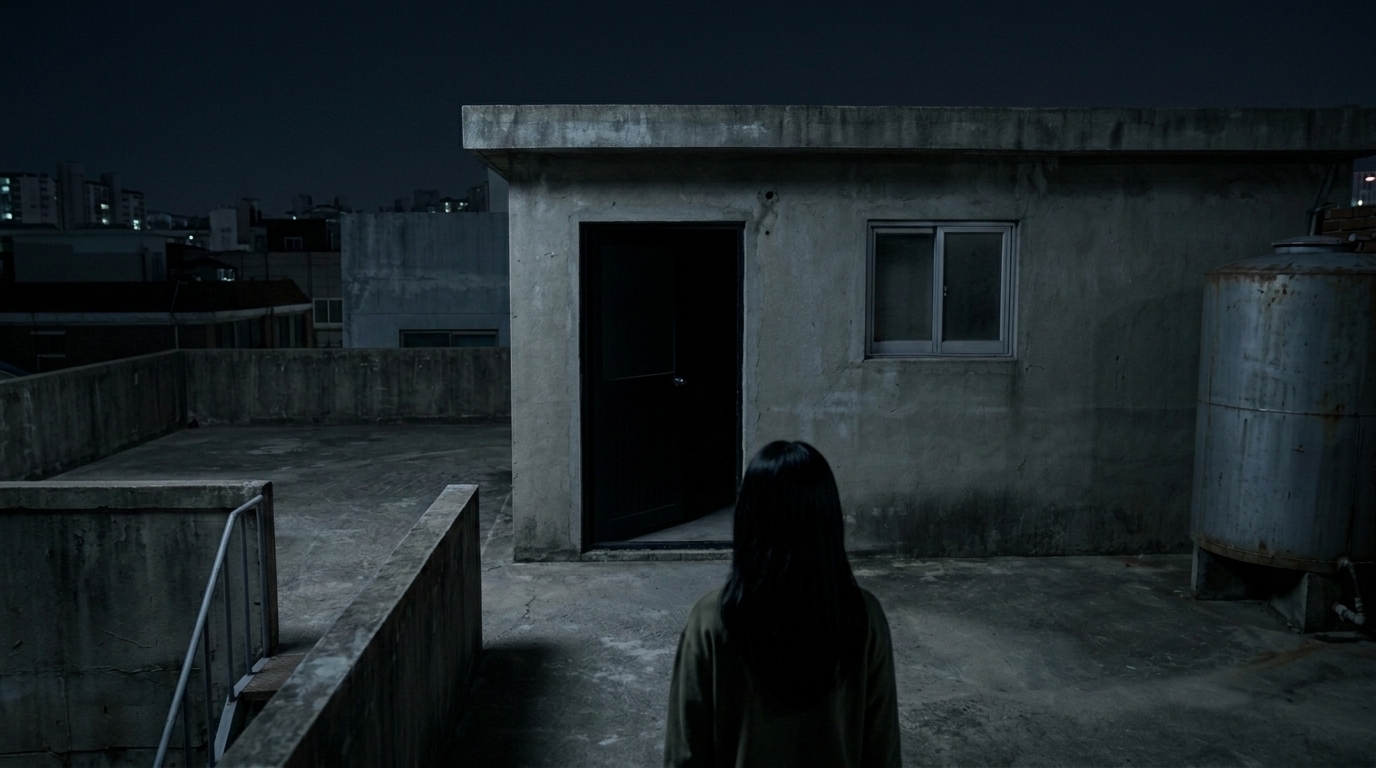
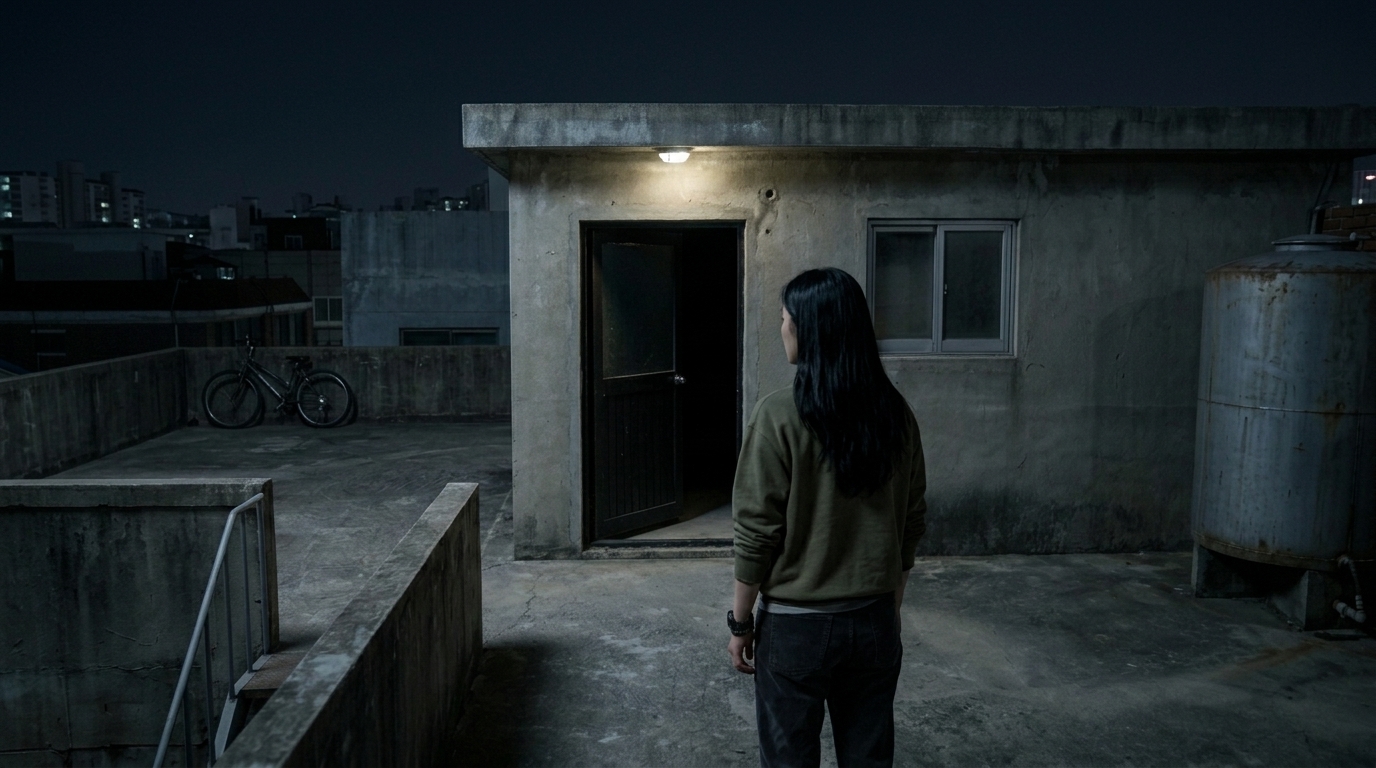
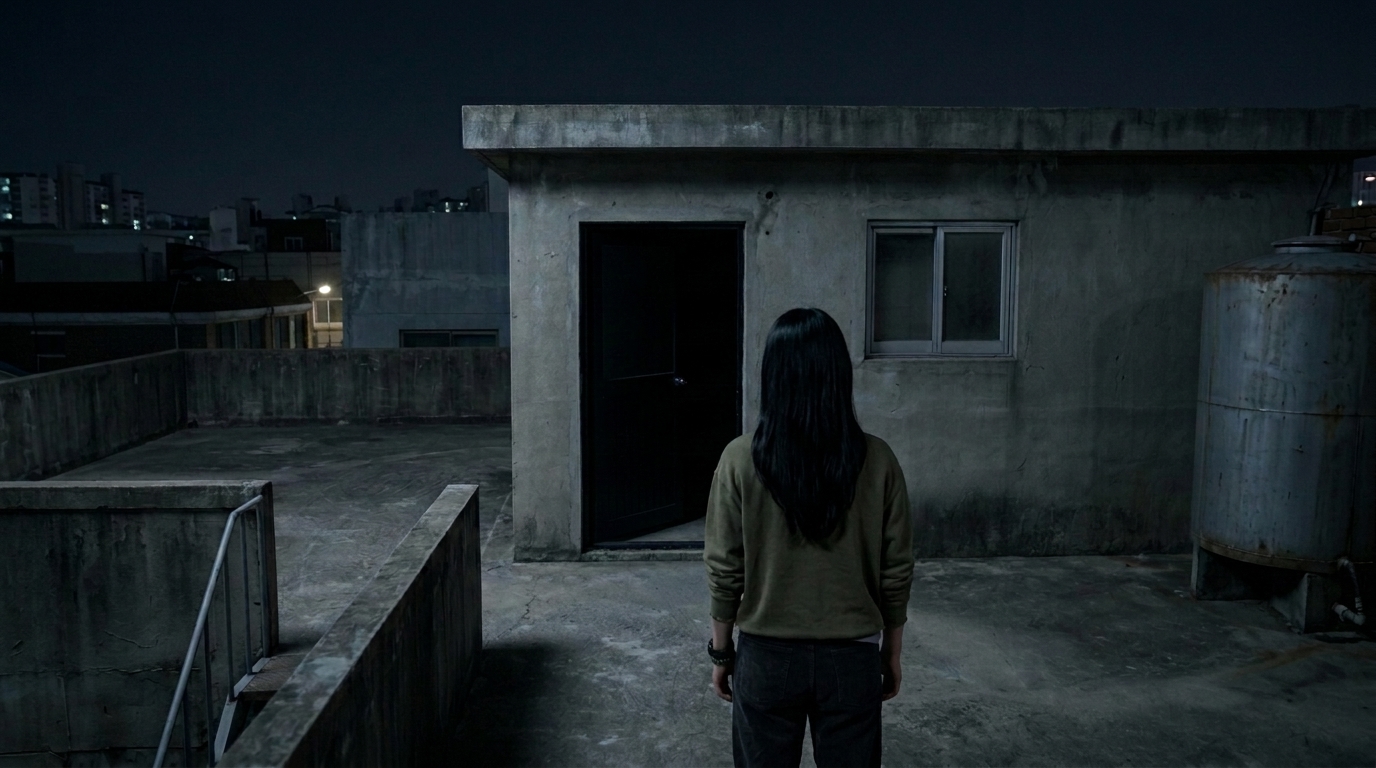
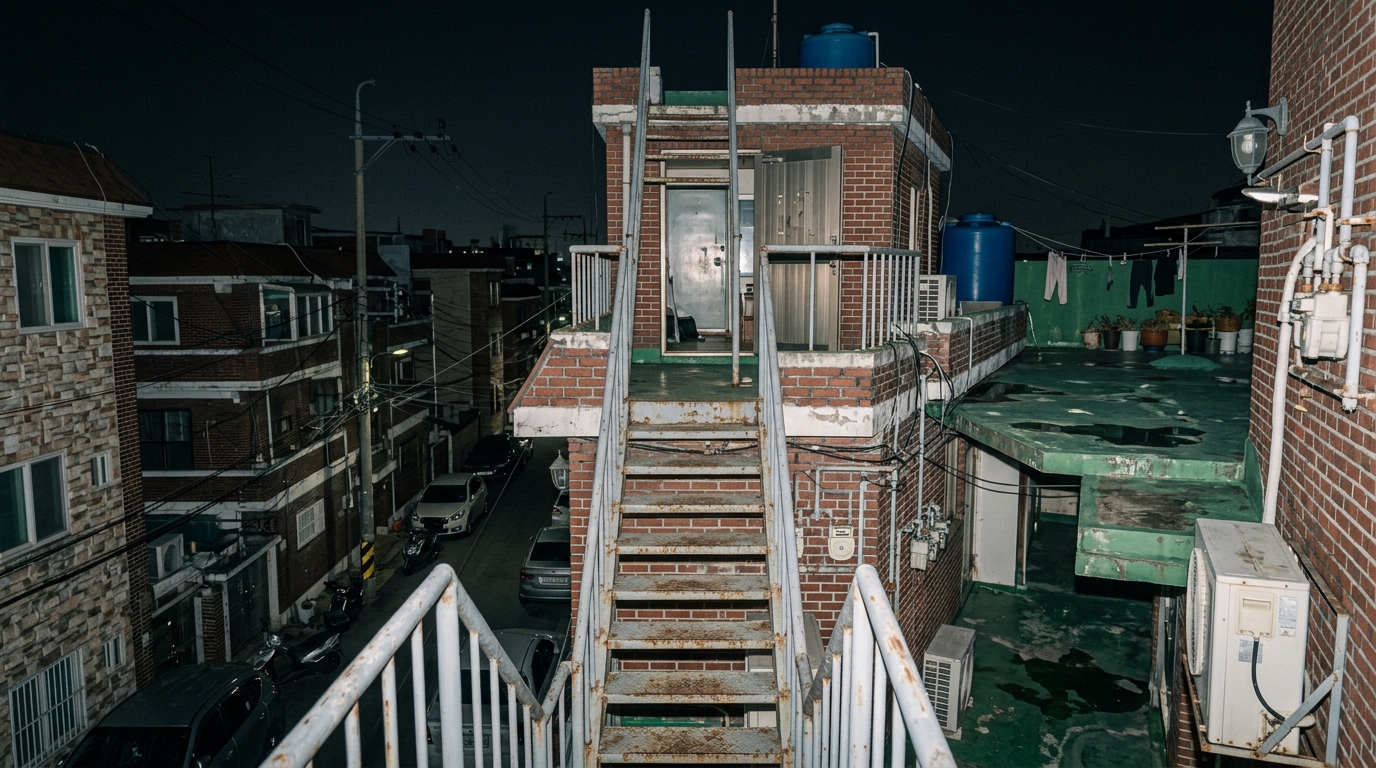
Create ONE FINAL photorealistic live-action film still of the moment below — contemporary South Korea, 2026; all people are Korean unless stated. TIME OF DAY (lock): night.

SHOT TEXT (authoritative, Korean): 옥상에 선 수리영의 시선 끝에 반쯤 열려 있는 어두운 현관 철문이 보이는 정면 구도

LOCATION (lock): A narrow residential alley leading into the yard of an old multi-unit villa, with a rear bicycle area and an exterior stairway climbing to a rooftop apartment. The shot takes place here — the attached LOCATION PHOTOGRAPH shows the exact spot.

REALIZE FIGURATIVE LANGUAGE AS A LIVE-ACTION SHOT: the Korean shot
text may describe characters metaphorically, figuratively or with
exaggeration. Photograph what a real movie camera would actually
record on a physical set — exaggerated or figurative impressions
become realistic staging choices (lighting, distance, angle,
wardrobe), not literal fantasy imagery.
EVERY CHARACTER IS A HUMAN BEING: unless the story explicitly
features non-human or virtual beings (as in science fiction or
fantasy), every character — however indirectly, vaguely or
figuratively the text describes them — IS a real human. When the
text gives no direct visual description of a person, IMAGINE one
and still show them as a concrete, fully-formed human being:
always render the human form to the maximum extent — build,
posture, face, hands, clothing — never reduce a person to a shape,
blob, solid silhouette or abstract mass.

EXPRESSIONS ARE ACTED, NEVER ANATOMICAL: when the text describes a
person's eyes, face or presence emotionally or figuratively (vacant,
hollow, dazed, burning, lifeless gaze and the like), it describes an
ACTOR'S PERFORMANCE captured by a real camera — realize it ONLY
through gaze direction, focus, eyelids, facial muscles, stillness
and posture. Every living person's eyes remain anatomically normal
human eyes with a natural iris and pupil, natural sclera and normal
proportions; NEVER whiten, blank out, cloud over, glow, enlarge or
otherwise alter eyeballs, skin or anatomy — unless the story
explicitly declares that being non-human or supernatural in form.

PROPS FACE THE RIGHT WAY: every handheld or used object must be
oriented exactly as its real-world use requires. A person reading,
watching or operating something (a phone, a photograph, a paper,
any device) has its functional side — screen, front, page — facing
THEIR OWN eyes; the camera then sees whatever side the staging
geometry implies (often its back). Show the functional side to the
camera ONLY when the shot text itself stages it toward the viewer.
Never flip, mirror or reverse an object's front and back.

CARRIED STATE (persist exactly — must match the neighbouring shots of this scene): The bicycle remains roughly parked in the rear yard, and the rooftop iron entrance door is still half open.

PEOPLE: the SHOT TEXT alone decides whether any person is visible in this shot. IF a person appears, they must be one of: 수리영 (Korean 20대 초반 여성, 긴 검은 머리, 타원형의 젊은 얼굴, 부드러운 이목구비와 자연스러운 피부색상태) — never anyone else, and never add a person the shot text does not show. IF only part of a person is in frame (a hand, arm, foot, back, silhouette), that body part belongs to the specific person the shot text names — its sex, age, build, skin and grooming must unmistakably match that person's profile above.

No text, captions, watermarks or annotations anywhere.
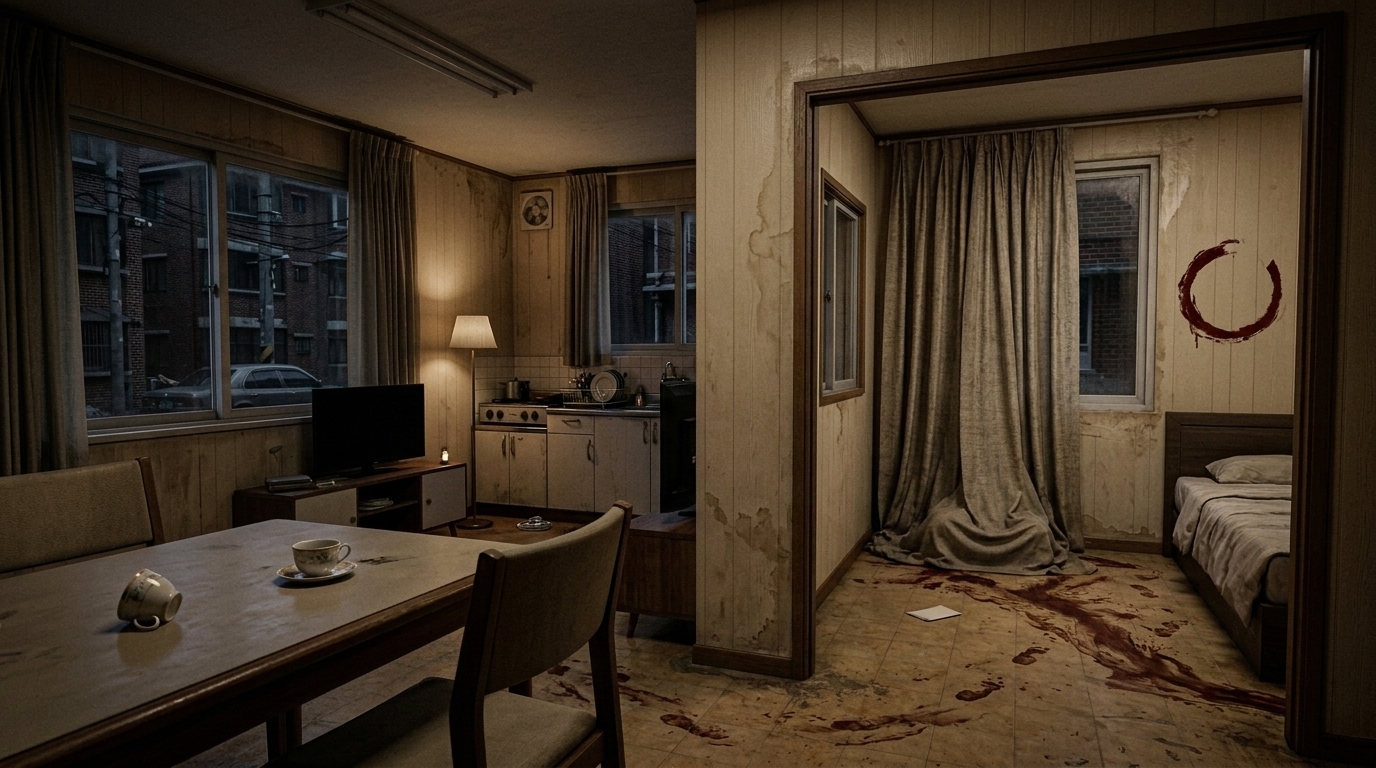
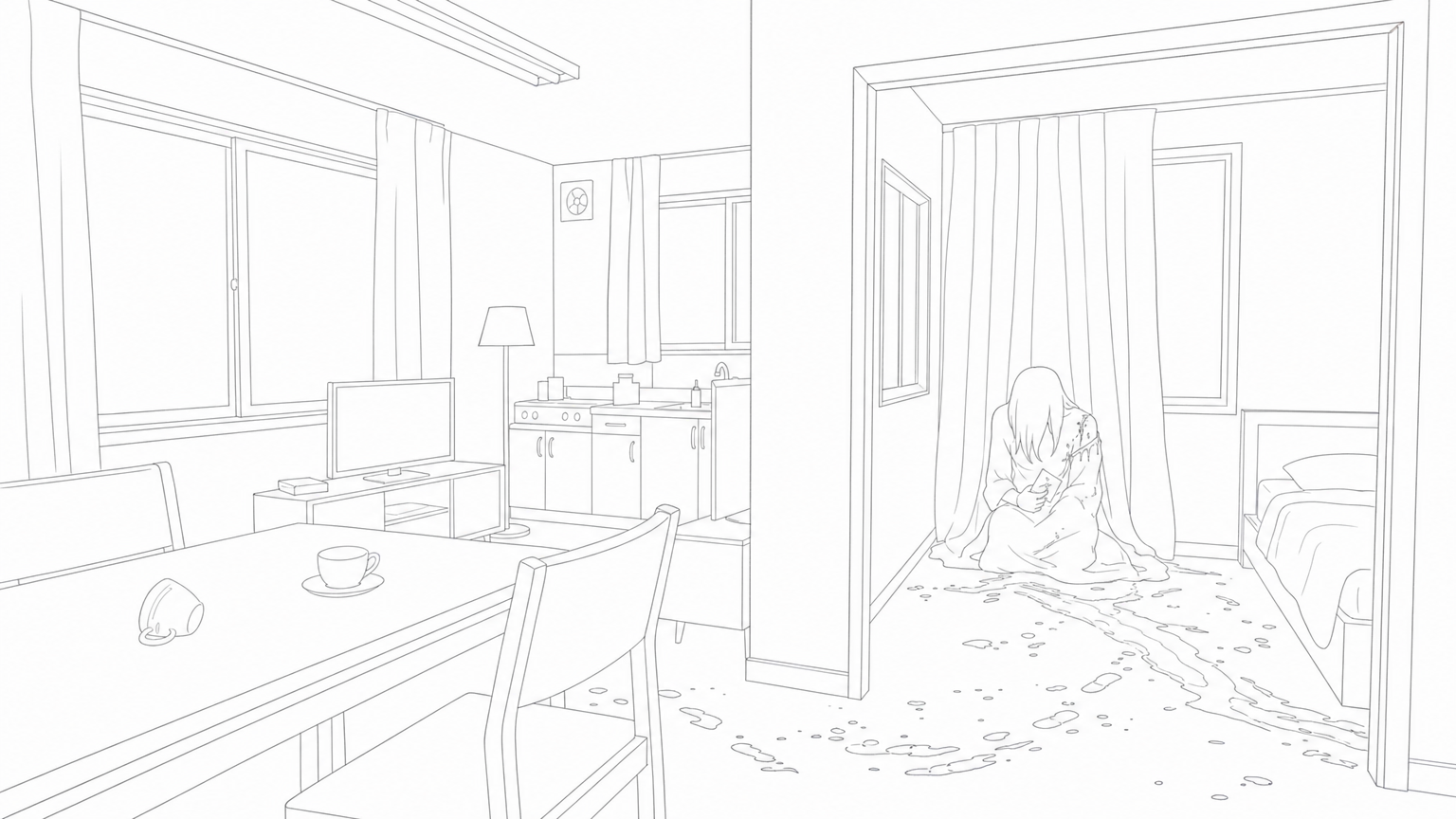
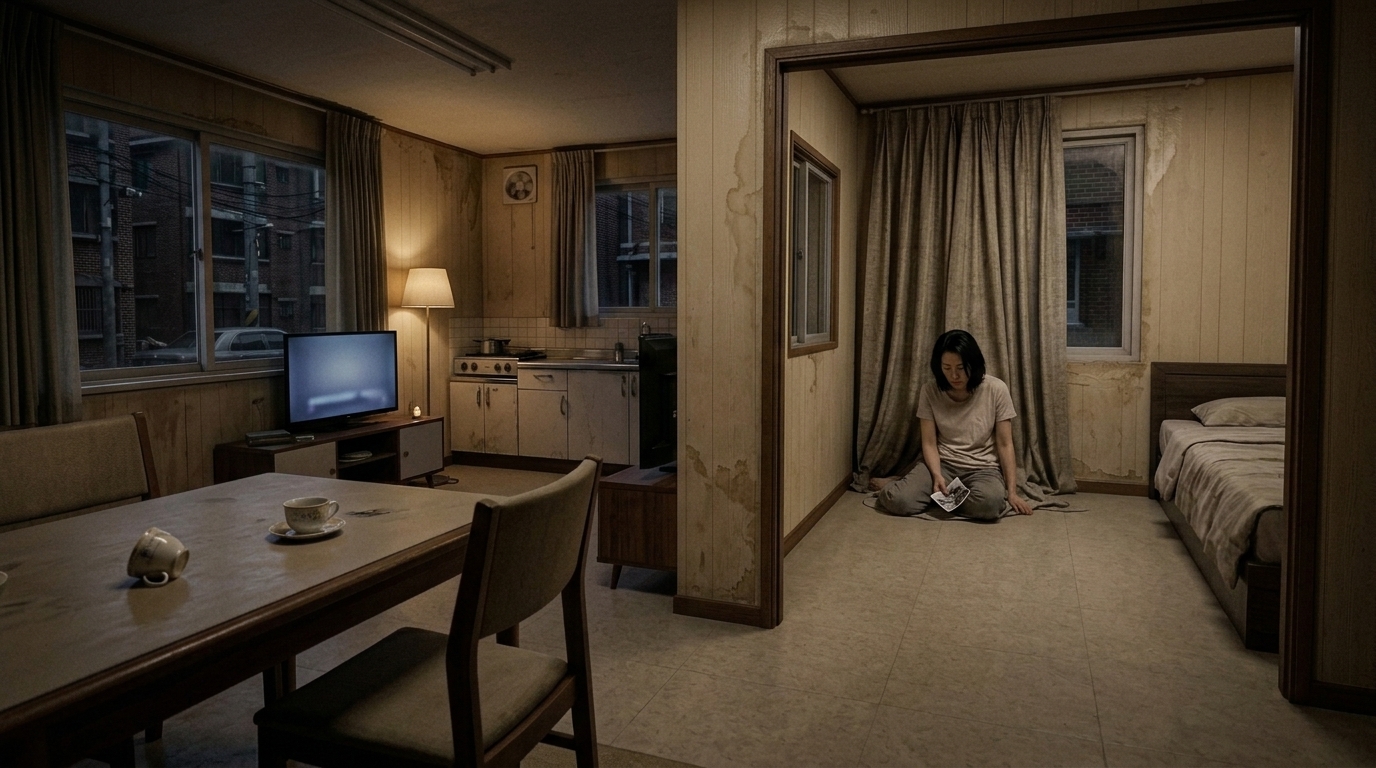
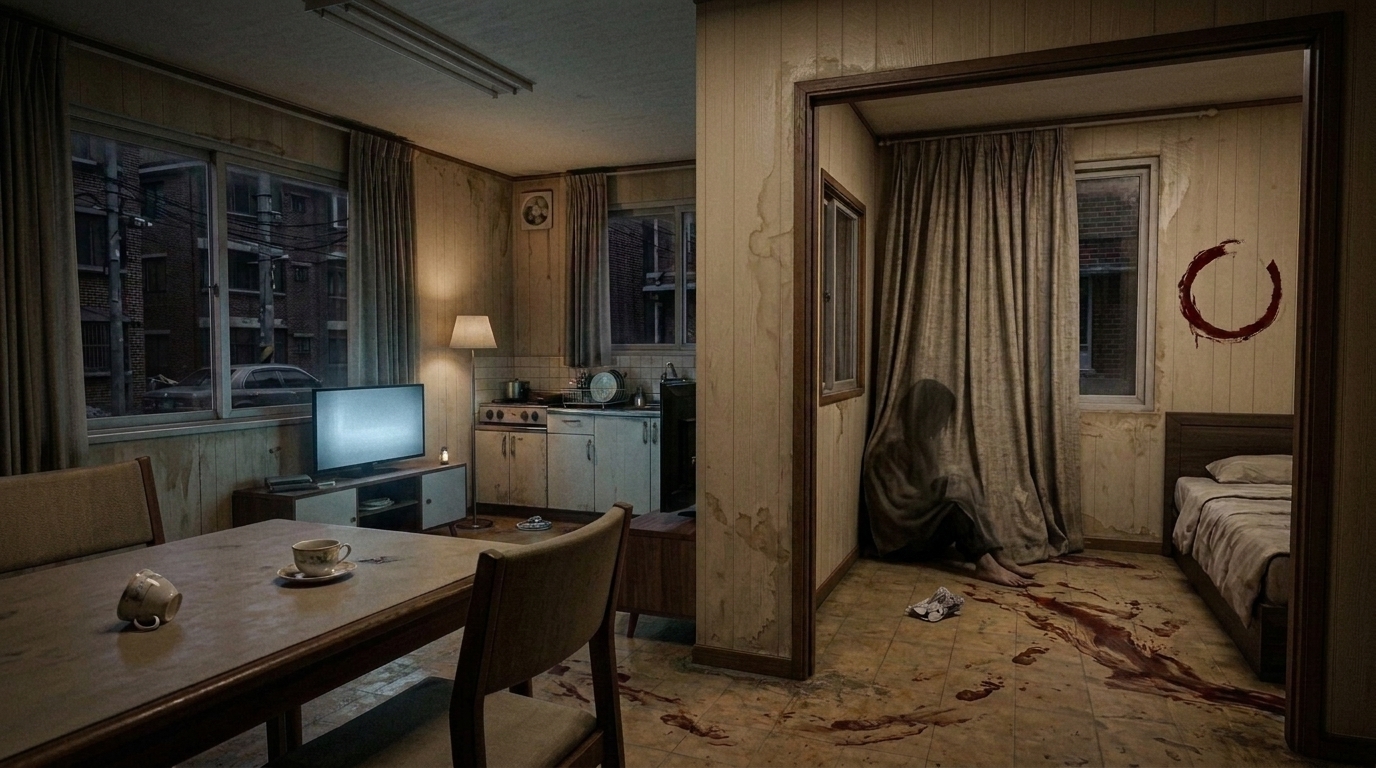
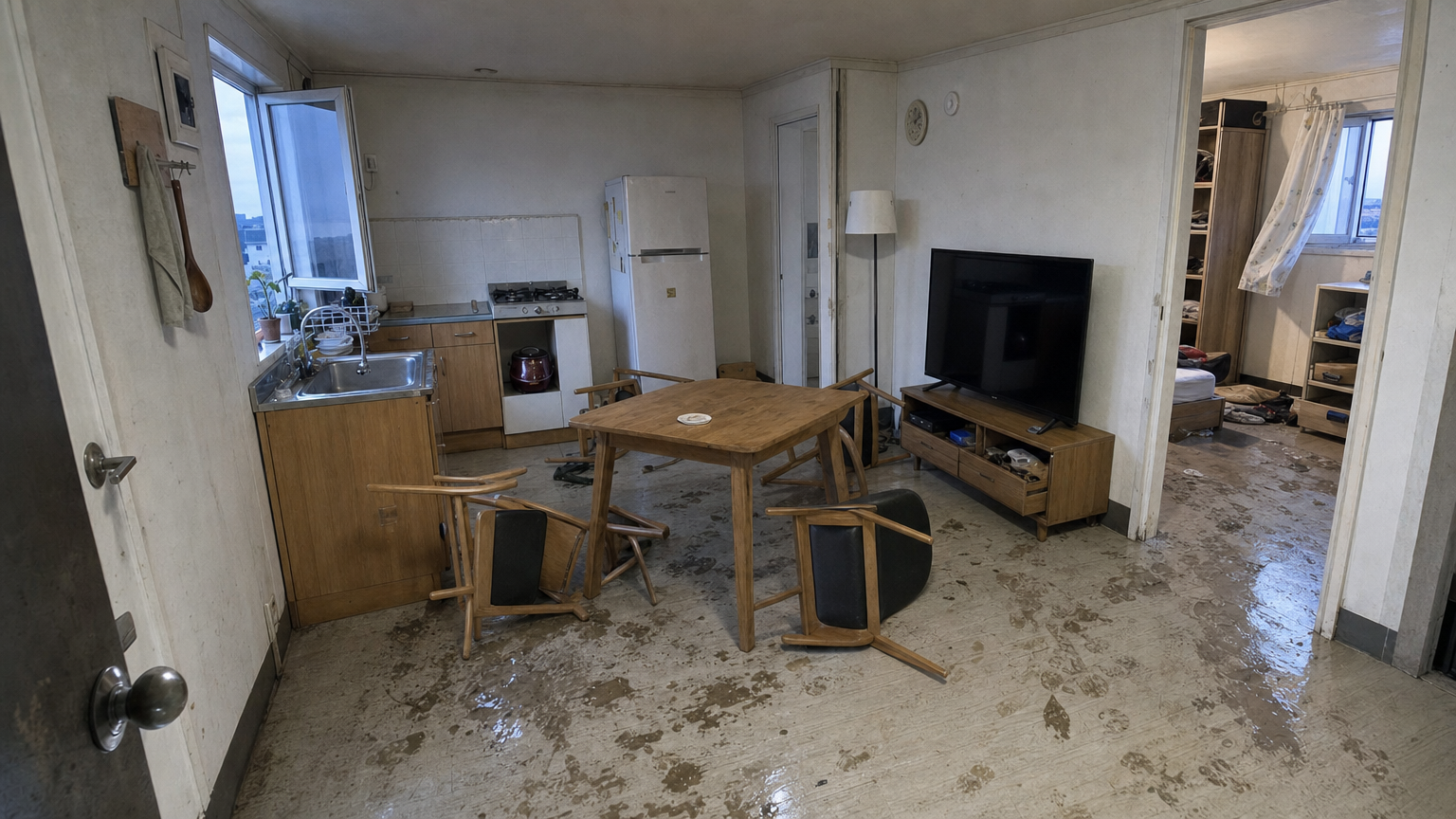
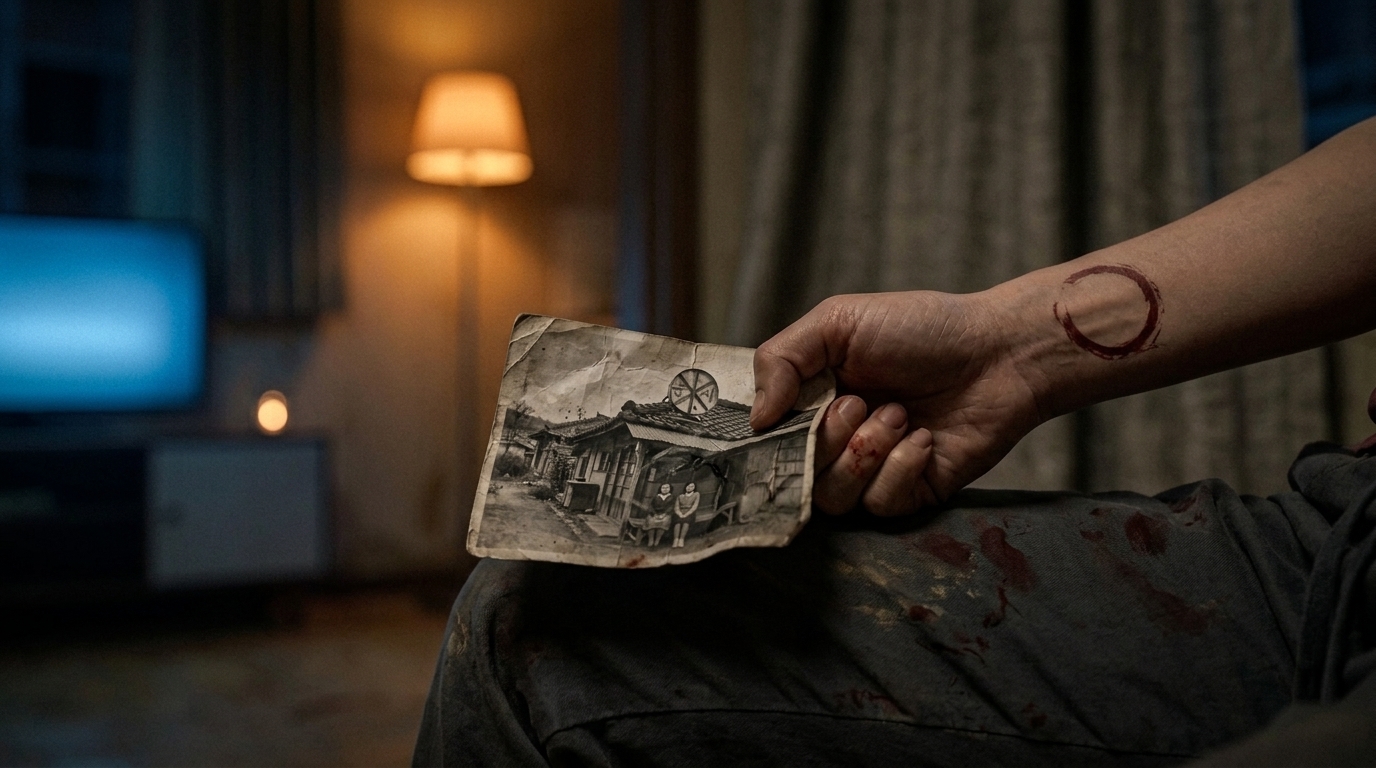
Create ONE FINAL photorealistic live-action film still of the moment below — contemporary South Korea, 2026; all people are Korean unless stated. TIME OF DAY (lock): night, dim floor lamp and television glow.

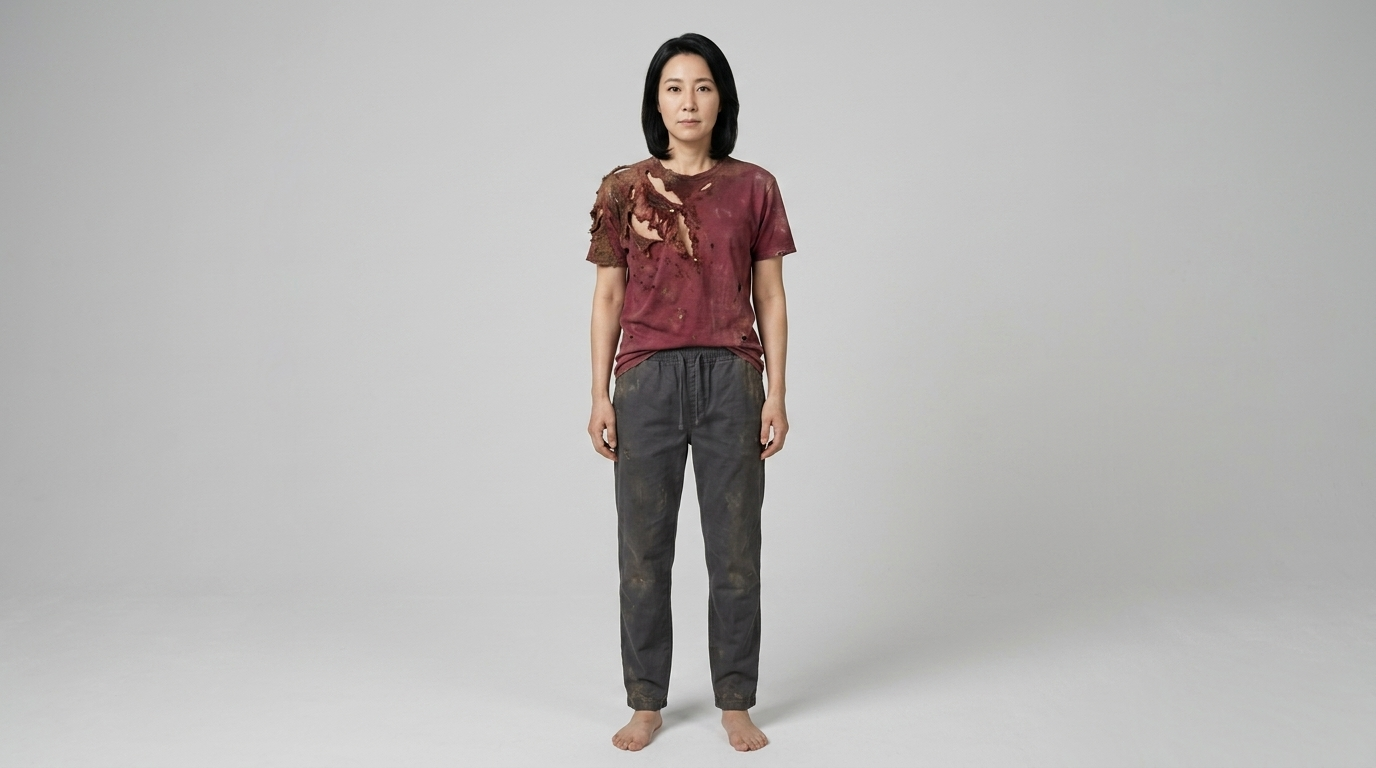
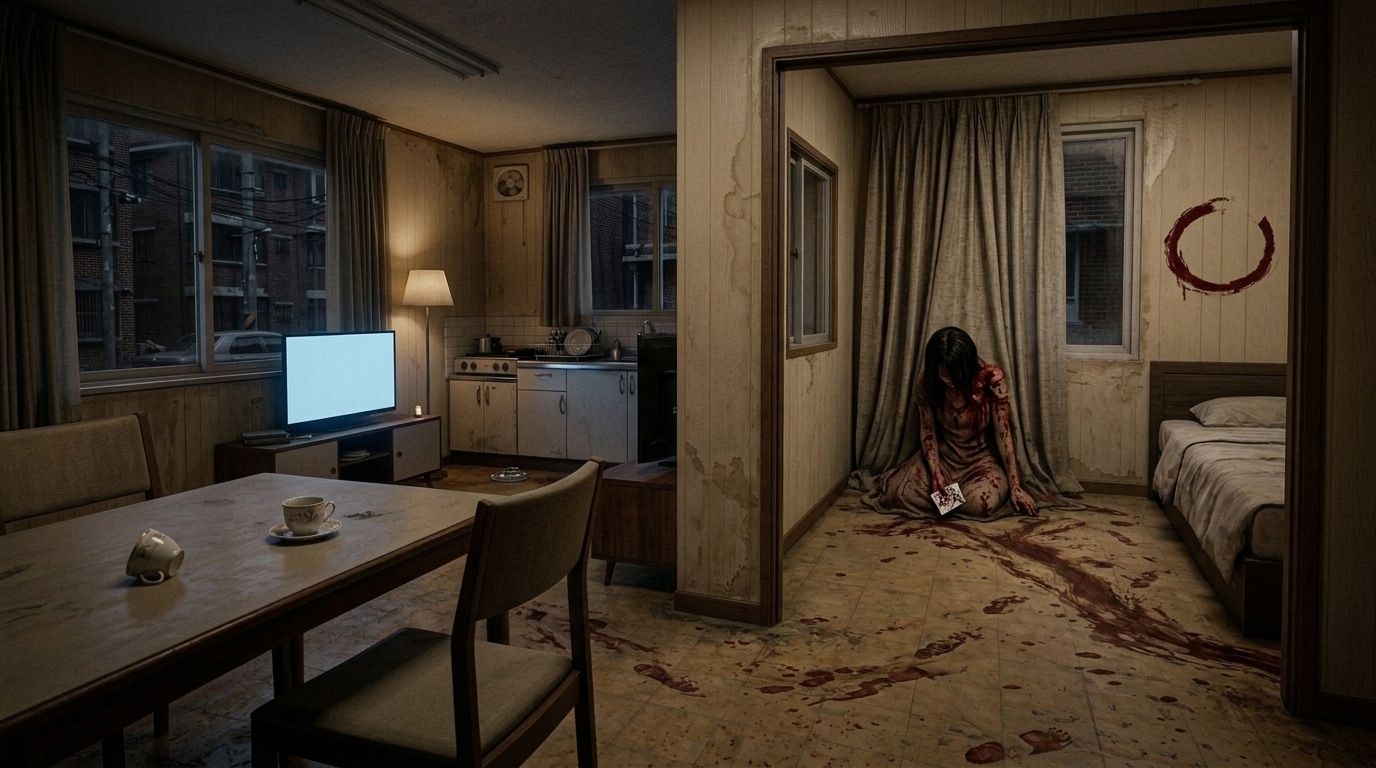
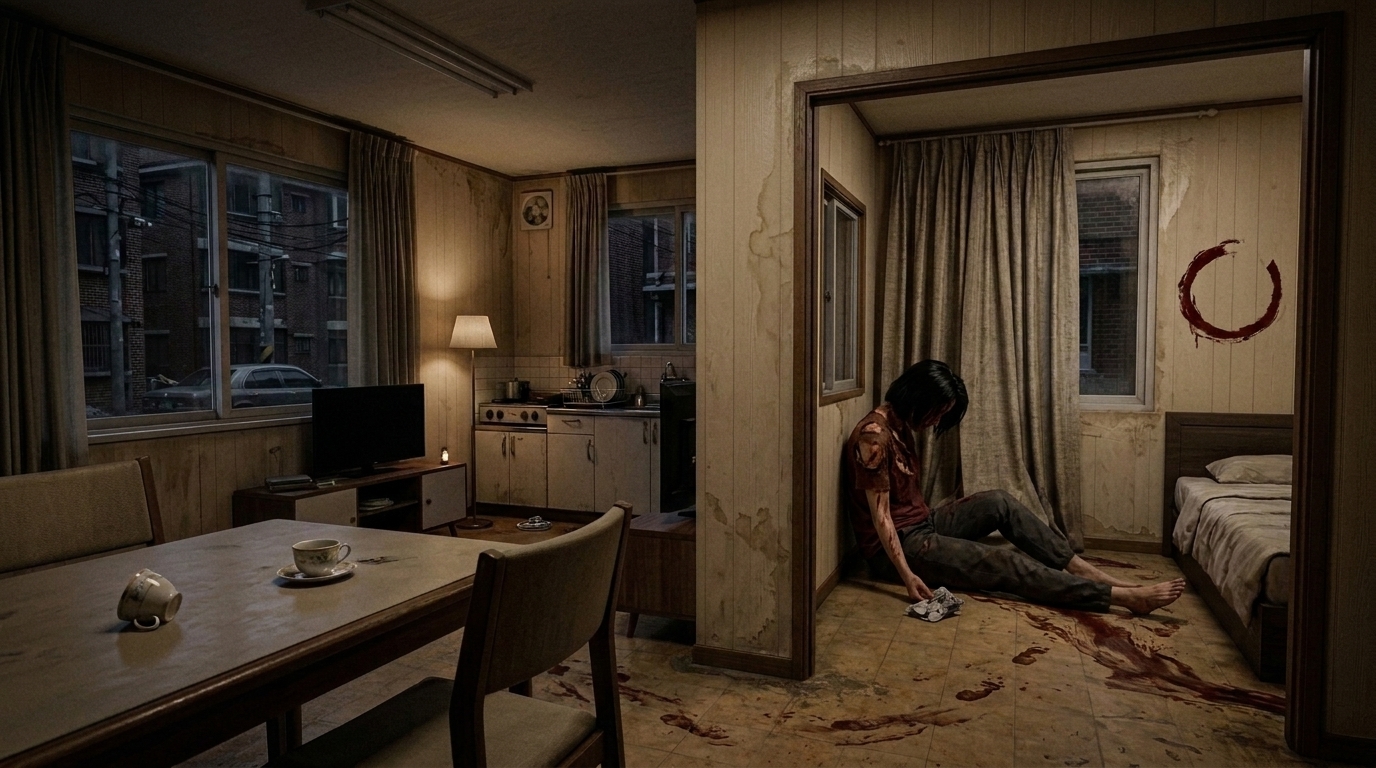
SHOT TEXT (authoritative, Korean): 옷과 피부가 피투성이가 된 민숙이 바닥에 주저앉아 고개를 푹 숙인 정지 상태

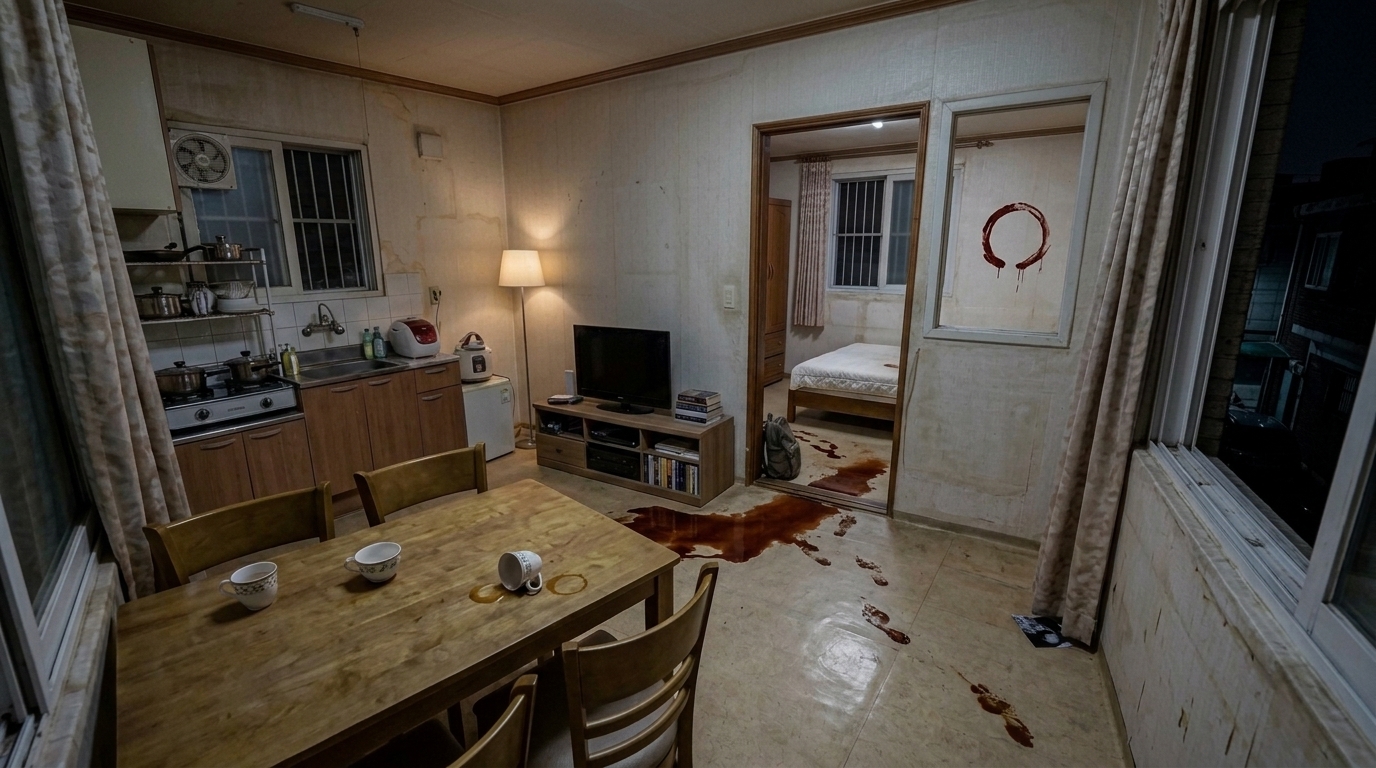
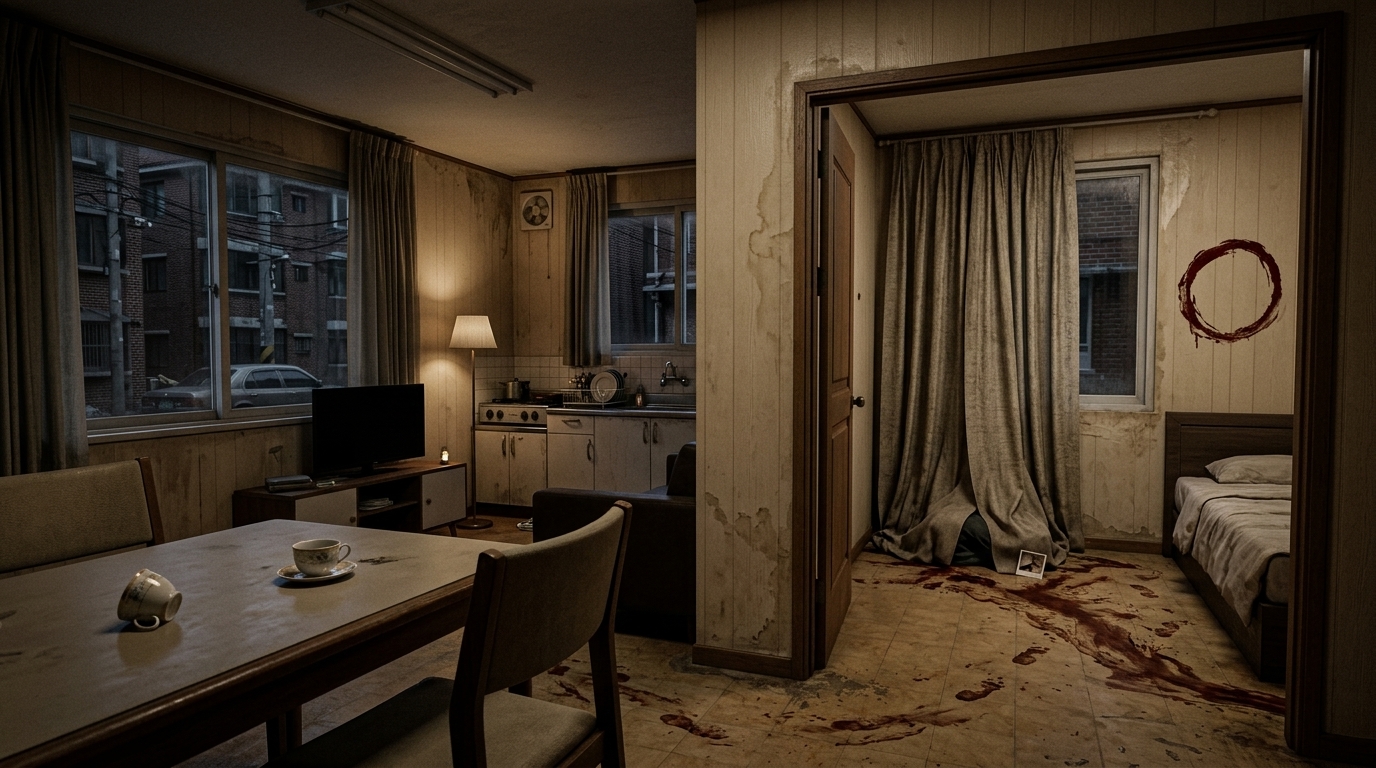
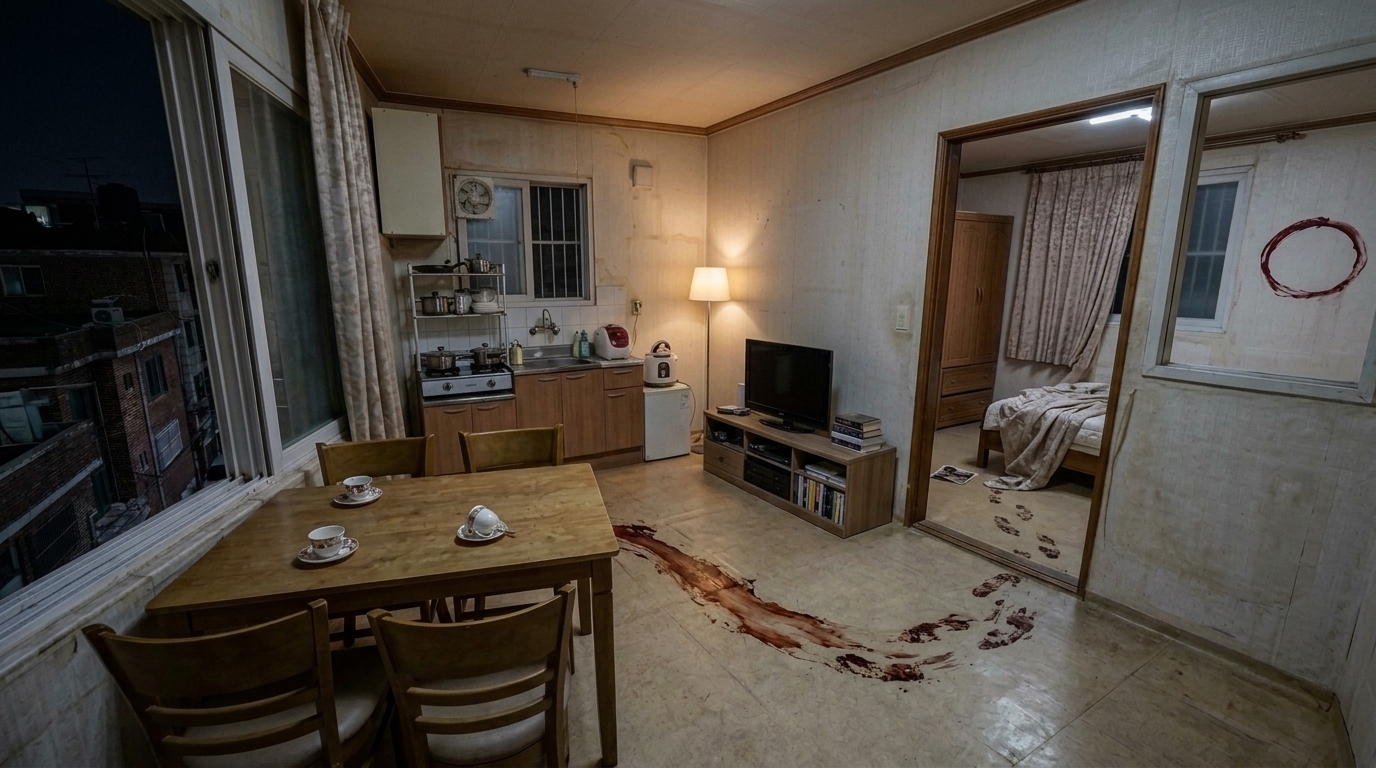
LOCATION (lock): A compact rooftop apartment with a living room, dining table, small kitchen, main bedroom, and a curtained second bedroom. The rooms contain a cooled cooking pot, a television, a floor lamp, and simple domestic furniture. The shot takes place here — the attached LOCATION PHOTOGRAPH shows the exact spot.

IMMOBILE CHARACTER POSE — CANONICAL (identical wherever this character appears in ANY panel; on any conflict THIS POSE WINS): Minsuk is seated motionless behind the curtain, with her head dropped forward and one hand tightly clutching a crumpled photograph. The source does not specify her facing direction, torso angle, leg positions, other arm, or supporting contact.

IMMOBILE BODIES OBEY GRAVITY: a person who is dead or unconscious
exerts NO muscular effort. Every part of their body — head, torso,
arms, hands, fingers, legs — rests fully on whatever supports it
(floor, wall, furniture, their own lap) and hangs or slumps with
gravity. NEVER show any part of an immobile person's body lifted,
raised, held up in the air, or posed as if presenting something:
an object in their grip stays clenched in a hand that itself lies
fallen on a support — the hand does not hold the object up. If the
canonical pose leaves a body part unspecified, resolve it as the
most gravity-compliant, fully-supported position.

REALIZE FIGURATIVE LANGUAGE AS A LIVE-ACTION SHOT: the Korean shot
text may describe characters metaphorically, figuratively or with
exaggeration. Photograph what a real movie camera would actually
record on a physical set — exaggerated or figurative impressions
become realistic staging choices (lighting, distance, angle,
wardrobe), not literal fantasy imagery.
EVERY CHARACTER IS A HUMAN BEING: unless the story explicitly
features non-human or virtual beings (as in science fiction or
fantasy), every character — however indirectly, vaguely or
figuratively the text describes them — IS a real human. When the
text gives no direct visual description of a person, IMAGINE one
and still show them as a concrete, fully-formed human being:
always render the human form to the maximum extent — build,
posture, face, hands, clothing — never reduce a person to a shape,
blob, solid silhouette or abstract mass.

EXPRESSIONS ARE ACTED, NEVER ANATOMICAL: when the text describes a
person's eyes, face or presence emotionally or figuratively (vacant,
hollow, dazed, burning, lifeless gaze and the like), it describes an
ACTOR'S PERFORMANCE captured by a real camera — realize it ONLY
through gaze direction, focus, eyelids, facial muscles, stillness
and posture. Every living person's eyes remain anatomically normal
human eyes with a natural iris and pupil, natural sclera and normal
proportions; NEVER whiten, blank out, cloud over, glow, enlarge or
otherwise alter eyeballs, skin or anatomy — unless the story
explicitly declares that being non-human or supernatural in form.

PROPS FACE THE RIGHT WAY: every handheld or used object must be
oriented exactly as its real-world use requires. A person reading,
watching or operating something (a phone, a photograph, a paper,
any device) has its functional side — screen, front, page — facing
THEIR OWN eyes; the camera then sees whatever side the staging
geometry implies (often its back). Show the functional side to the
camera ONLY when the shot text itself stages it toward the viewer.
Never flip, mirror or reverse an object's front and back.

CARRIED STATE (persist exactly — must match the neighbouring shots of this scene): Min-suk's corpse remains seated motionless behind the curtain, with her head dropped forward and one hand tightly clutching a crumpled photograph, her shoulder and collarbone torn open, and the small wrist mark present. Because she cannot move, the crumpled photograph tightly clutched in one hand must already be there; blood pools, spatters, and bloody footprints remain across the room.

PEOPLE: the SHOT TEXT alone decides whether any person is visible in this shot. IF a person appears, they must be one of: 민숙 (환시) (Korean 40대 초반 여성, 자연스러운 검은 머리, 성숙한 타원형 얼굴, 단정한 이목구비) — never anyone else, and never add a person the shot text does not show. IF only part of a person is in frame (a hand, arm, foot, back, silhouette), that body part belongs to the specific person the shot text names — its sex, age, build, skin and grooming must unmistakably match that person's profile above.

No text, captions, watermarks or annotations anywhere.
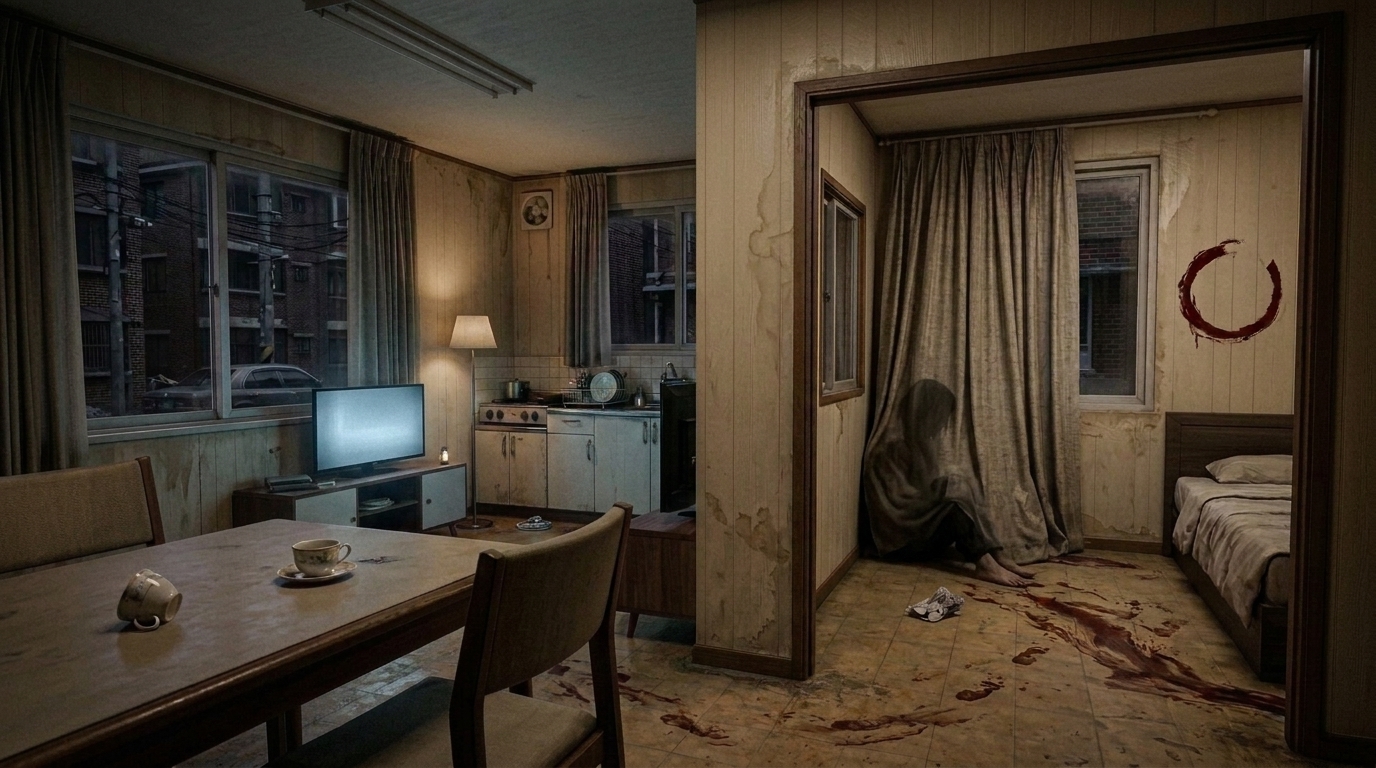
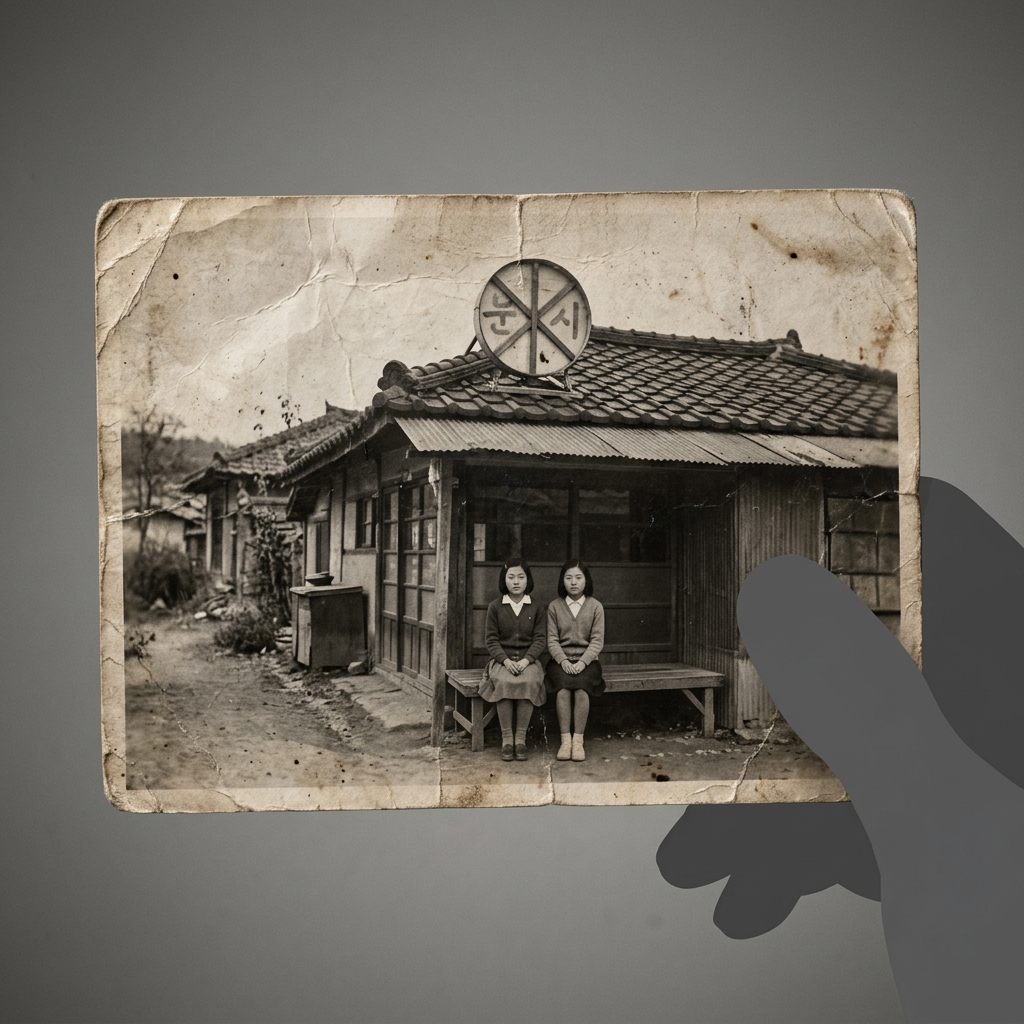
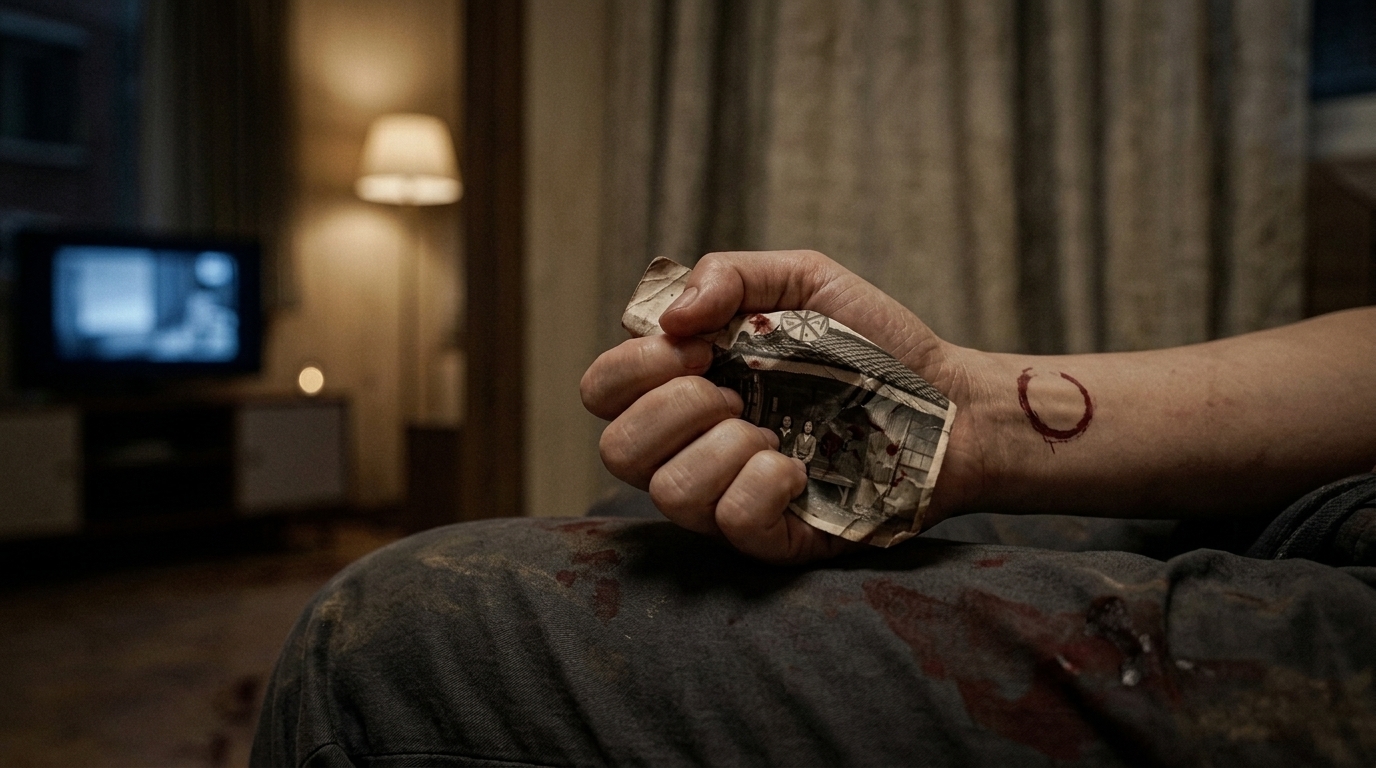
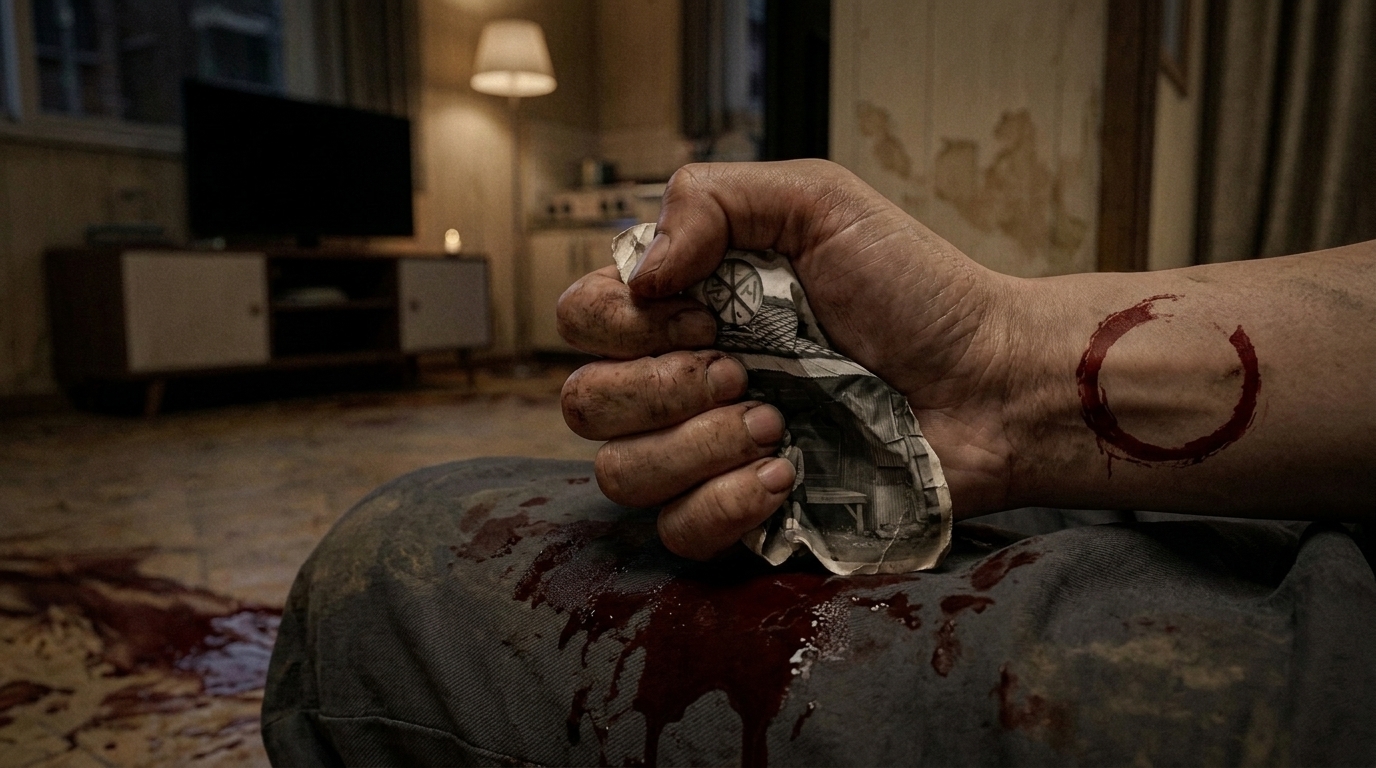
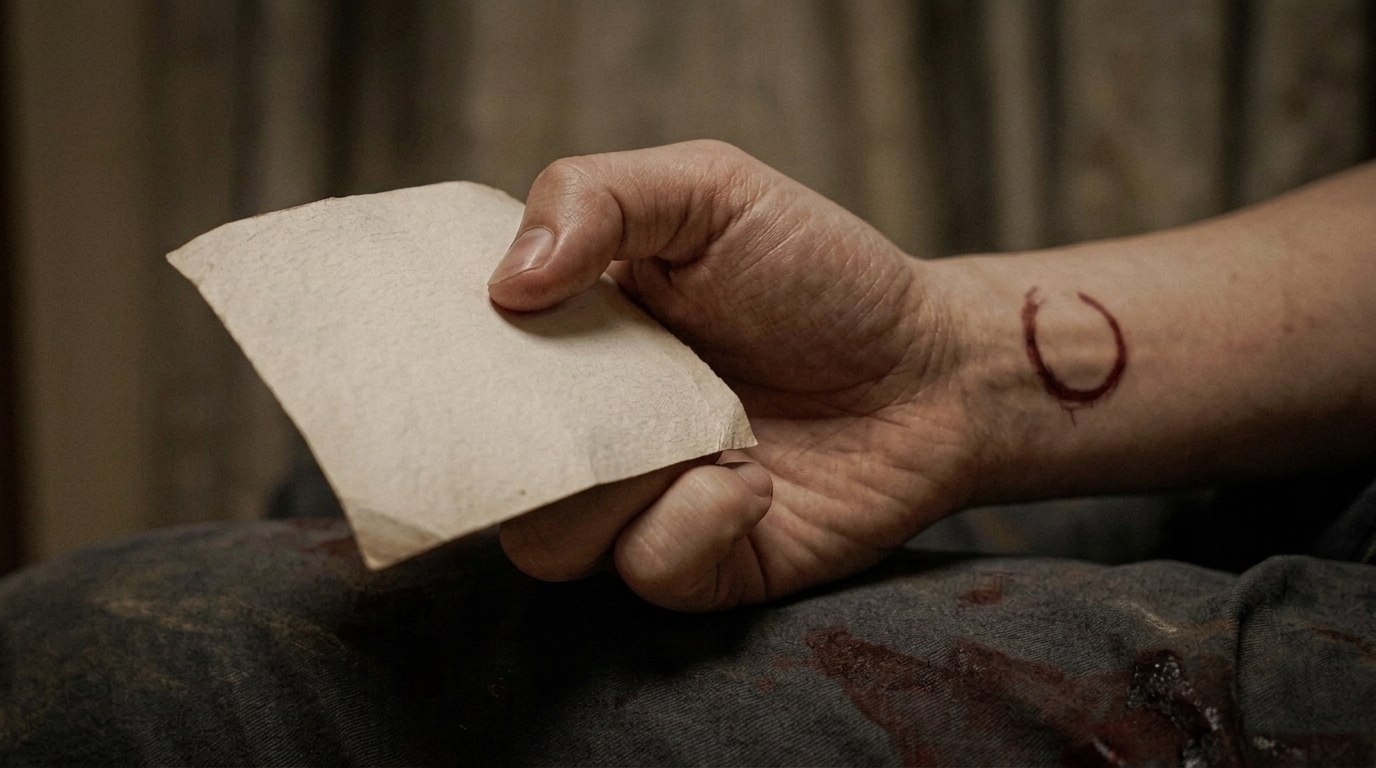
Create ONE FINAL photorealistic live-action film still of the moment below — contemporary South Korea, 2026; all people are Korean unless stated. TIME OF DAY (lock): night, dim floor lamp and television glow.

SHOT TEXT (authoritative, Korean): 민숙의 손에 꽉 쥐어진 구겨진 사진의 타이트 샷

LOCATION (lock): A compact rooftop apartment with a living room, dining table, small kitchen, main bedroom, and a curtained second bedroom. The rooms contain a cooled cooking pot, a television, a floor lamp, and simple domestic furniture. The shot takes place here — the attached PREVIOUS SHOT STILL shows this exact place.

THIS SHOT CONTINUES THE PREVIOUS SHOT: everything the attached still established — the place, its fixed features and wear, each person's clothing and state — persists. Any person in it who cannot move stays PRECISELY as photographed (body, pose, contact points, held objects); only the camera changes.

PREVIOUS STILL USAGE (follow exactly — what to take from the attached still and what to exclude): Take the same dim bedroom lighting, bloodied condition, and the corpse's fixed seated position from the reference. Exclude the full body and surrounding room from the tight frame, retaining only the clenched hand and crumpled photograph.

IMMOBILE CHARACTER POSE — CANONICAL (identical wherever this character appears in ANY panel; on any conflict THIS POSE WINS): Minsuk is seated motionless behind the curtain, with her head dropped forward and one hand tightly clutching a crumpled photograph. The source does not specify her facing direction, torso angle, leg positions, other arm, or supporting contact.

IMMOBILE BODIES OBEY GRAVITY: a person who is dead or unconscious
exerts NO muscular effort. Every part of their body — head, torso,
arms, hands, fingers, legs — rests fully on whatever supports it
(floor, wall, furniture, their own lap) and hangs or slumps with
gravity. NEVER show any part of an immobile person's body lifted,
raised, held up in the air, or posed as if presenting something:
an object in their grip stays clenched in a hand that itself lies
fallen on a support — the hand does not hold the object up. If the
canonical pose leaves a body part unspecified, resolve it as the
most gravity-compliant, fully-supported position.

REALIZE FIGURATIVE LANGUAGE AS A LIVE-ACTION SHOT: the Korean shot
text may describe characters metaphorically, figuratively or with
exaggeration. Photograph what a real movie camera would actually
record on a physical set — exaggerated or figurative impressions
become realistic staging choices (lighting, distance, angle,
wardrobe), not literal fantasy imagery.
EVERY CHARACTER IS A HUMAN BEING: unless the story explicitly
features non-human or virtual beings (as in science fiction or
fantasy), every character — however indirectly, vaguely or
figuratively the text describes them — IS a real human. When the
text gives no direct visual description of a person, IMAGINE one
and still show them as a concrete, fully-formed human being:
always render the human form to the maximum extent — build,
posture, face, hands, clothing — never reduce a person to a shape,
blob, solid silhouette or abstract mass.

EXPRESSIONS ARE ACTED, NEVER ANATOMICAL: when the text describes a
person's eyes, face or presence emotionally or figuratively (vacant,
hollow, dazed, burning, lifeless gaze and the like), it describes an
ACTOR'S PERFORMANCE captured by a real camera — realize it ONLY
through gaze direction, focus, eyelids, facial muscles, stillness
and posture. Every living person's eyes remain anatomically normal
human eyes with a natural iris and pupil, natural sclera and normal
proportions; NEVER whiten, blank out, cloud over, glow, enlarge or
otherwise alter eyeballs, skin or anatomy — unless the story
explicitly declares that being non-human or supernatural in form.

PROPS FACE THE RIGHT WAY: every handheld or used object must be
oriented exactly as its real-world use requires. A person reading,
watching or operating something (a phone, a photograph, a paper,
any device) has its functional side — screen, front, page — facing
THEIR OWN eyes; the camera then sees whatever side the staging
geometry implies (often its back). Show the functional side to the
camera ONLY when the shot text itself stages it toward the viewer.
Never flip, mirror or reverse an object's front and back.

CARRIED STATE (persist exactly — must match the neighbouring shots of this scene): Min-suk remains dead, seated motionless behind the curtain, with her head dropped forward and one hand tightly clutching a crumpled photograph, amid the unchanged bloodstains, with the circular mark on her wrist.

PEOPLE: the SHOT TEXT alone decides whether any person is visible in this shot. IF a person appears, they must be one of: 민숙 (환시) (Korean 40대 초반 여성, 자연스러운 검은 머리, 성숙한 타원형 얼굴, 단정한 이목구비) — never anyone else, and never add a person the shot text does not show. IF only part of a person is in frame (a hand, arm, foot, back, silhouette), that body part belongs to the specific person the shot text names — its sex, age, build, skin and grooming must unmistakably match that person's profile above.

No text, captions, watermarks or annotations anywhere.
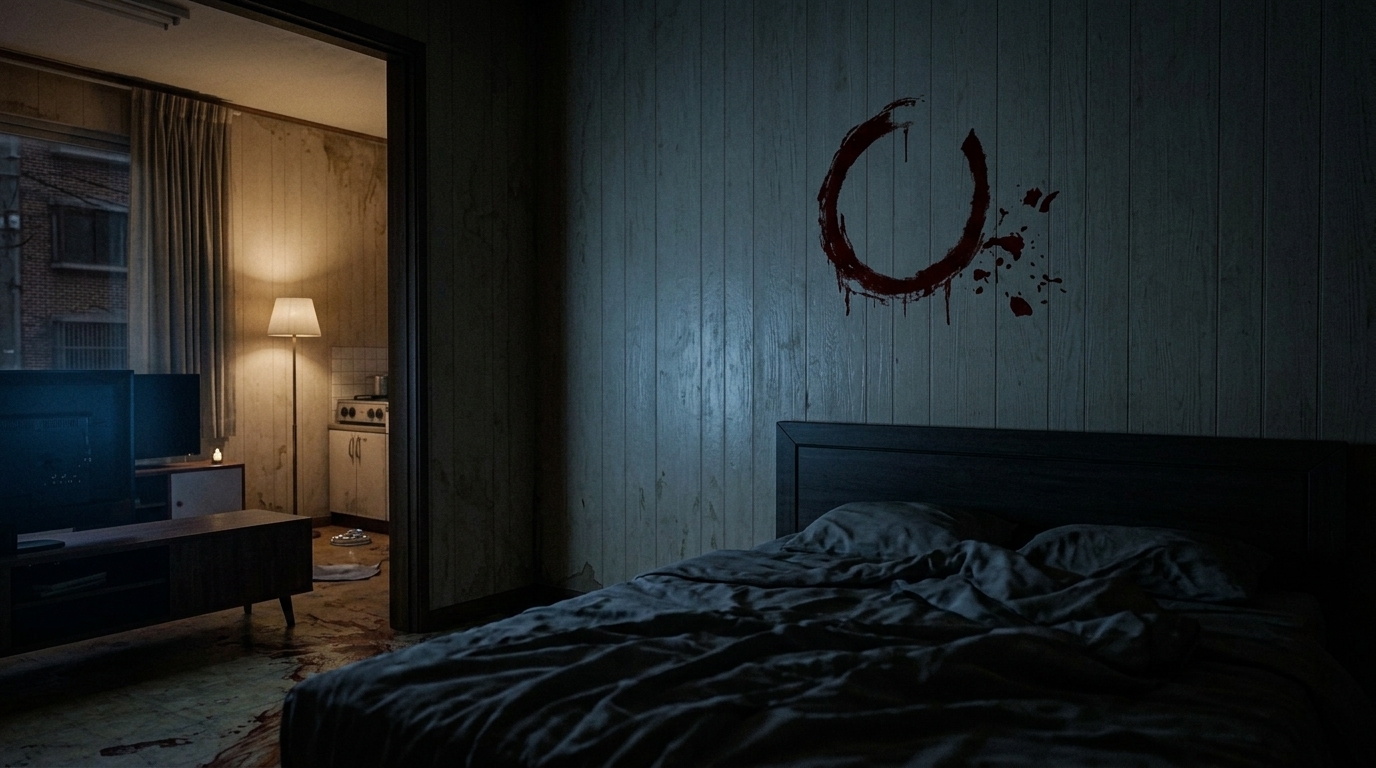
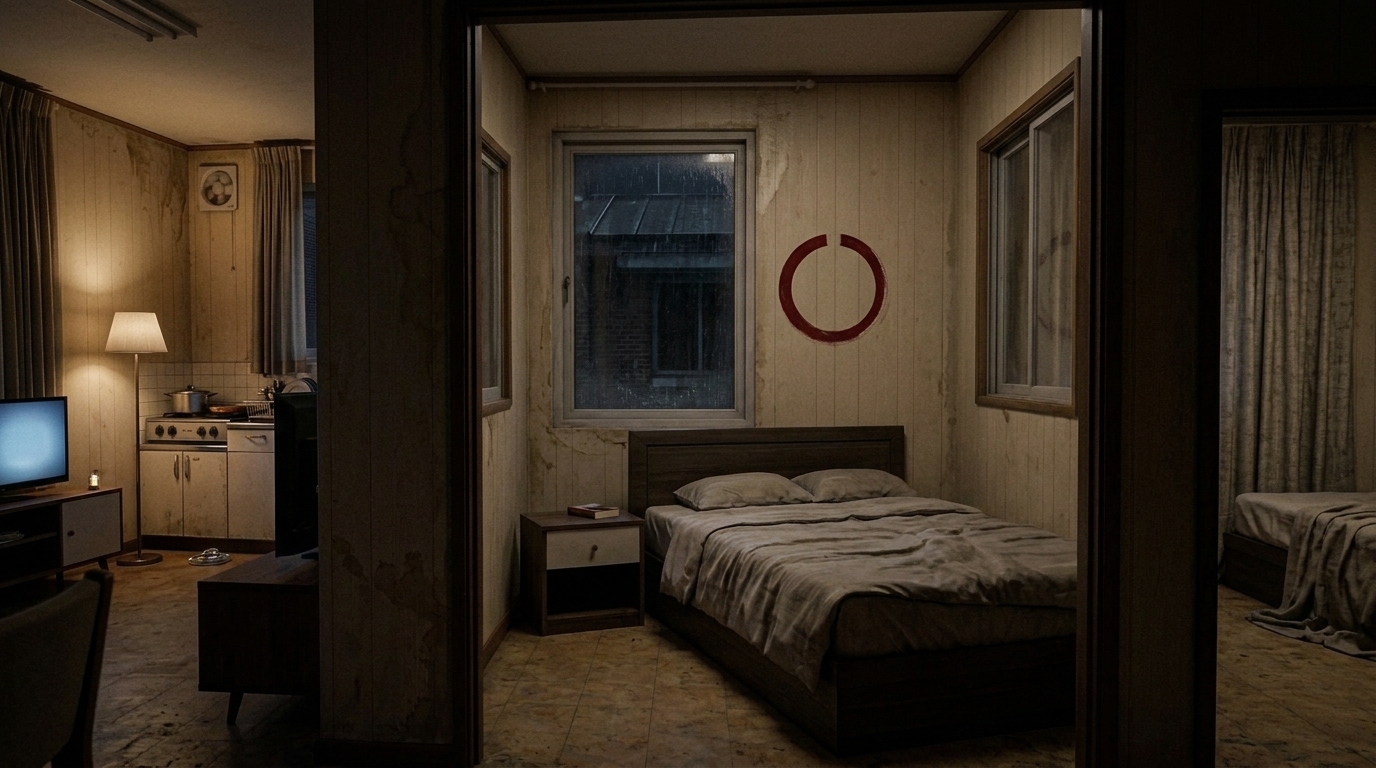
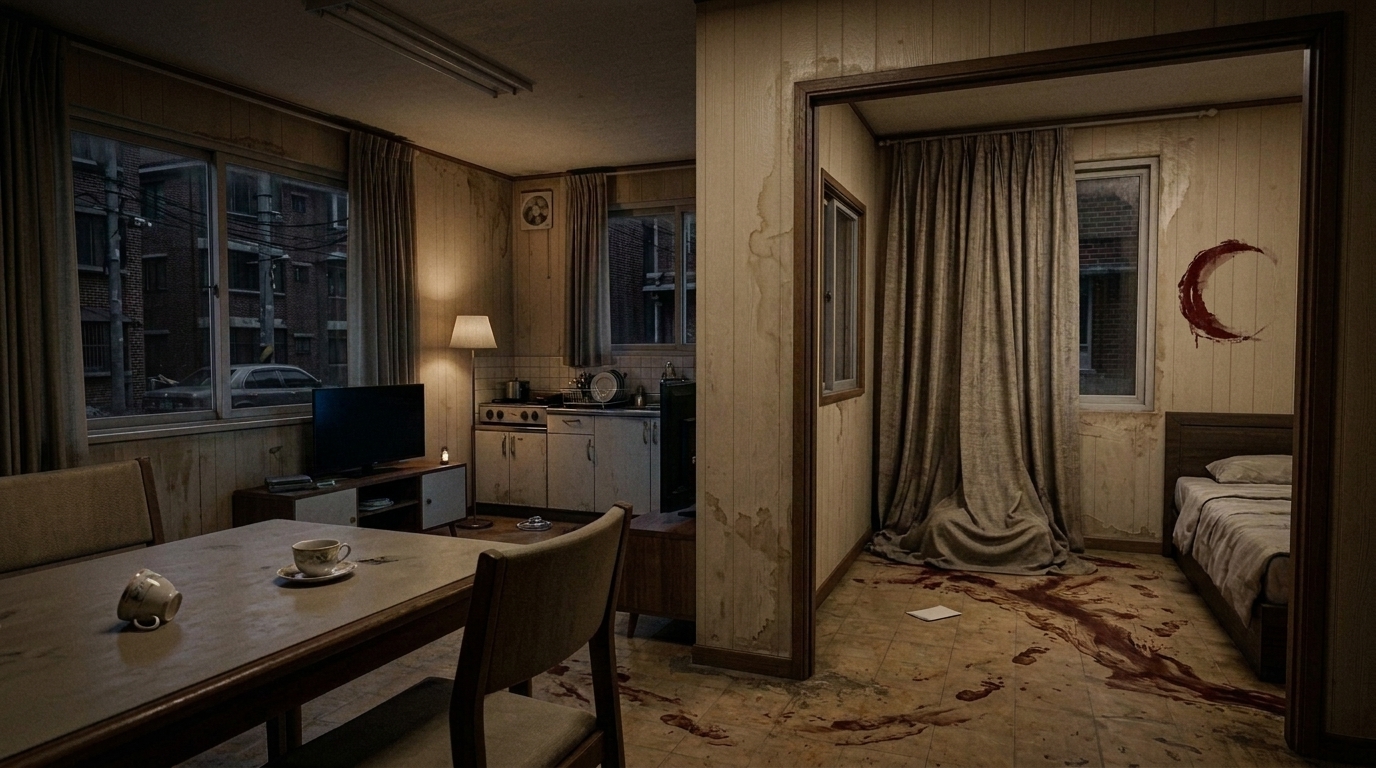
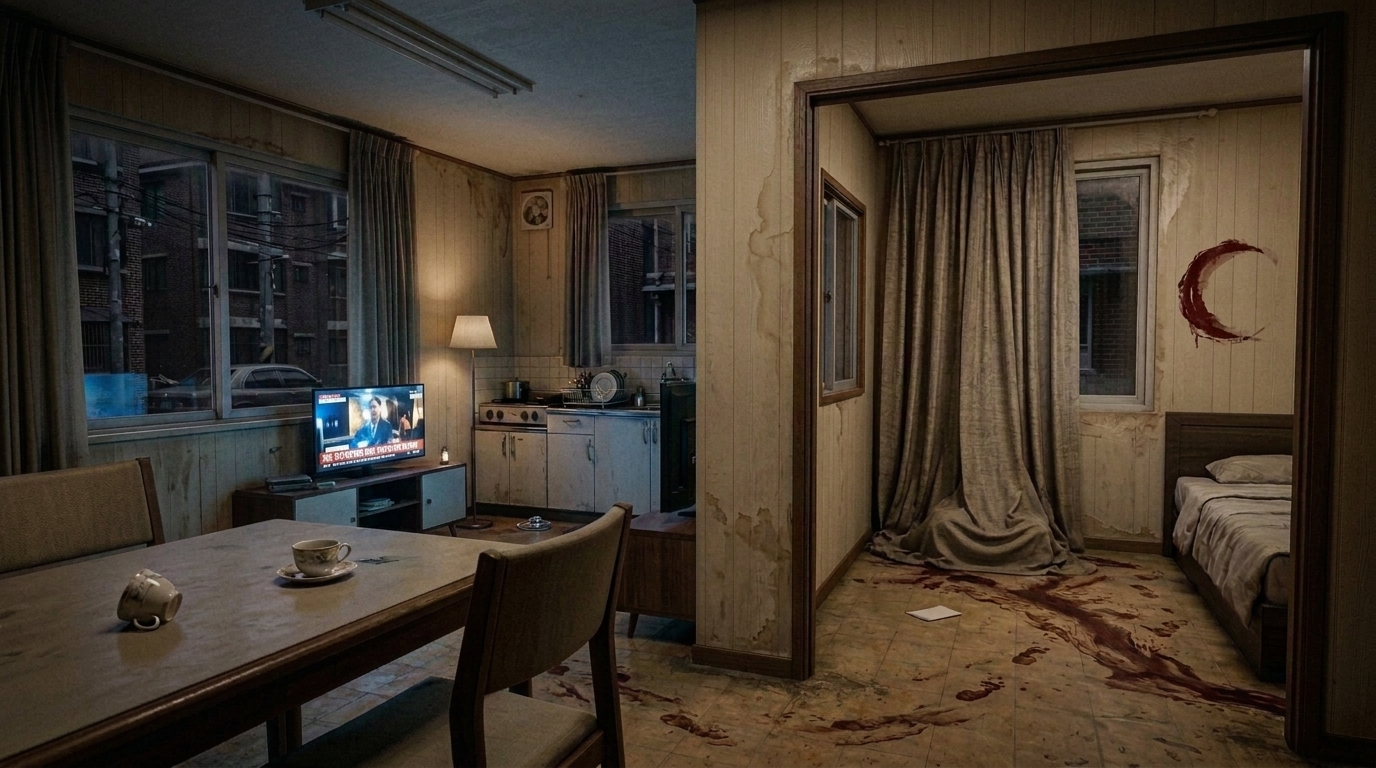
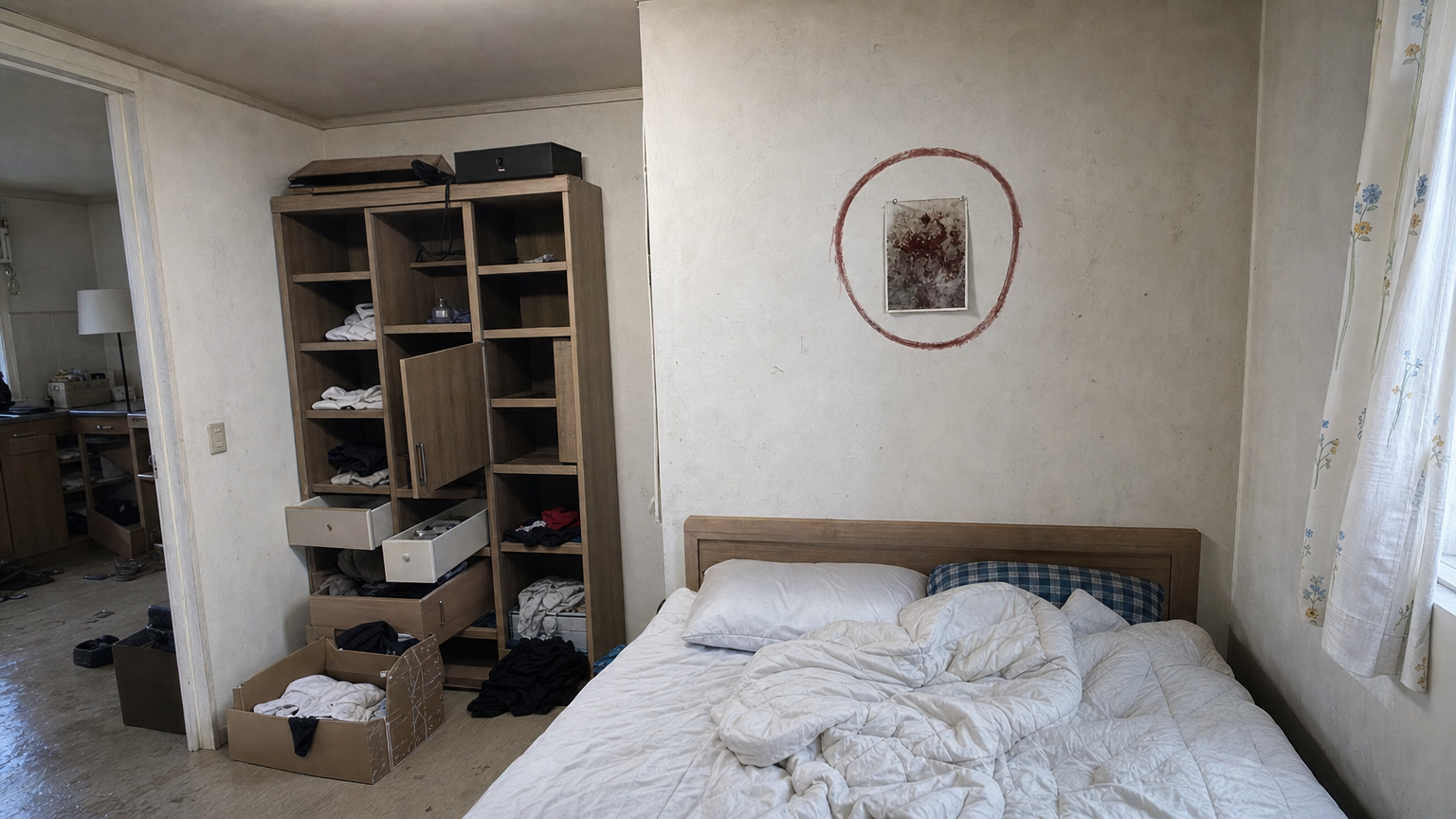
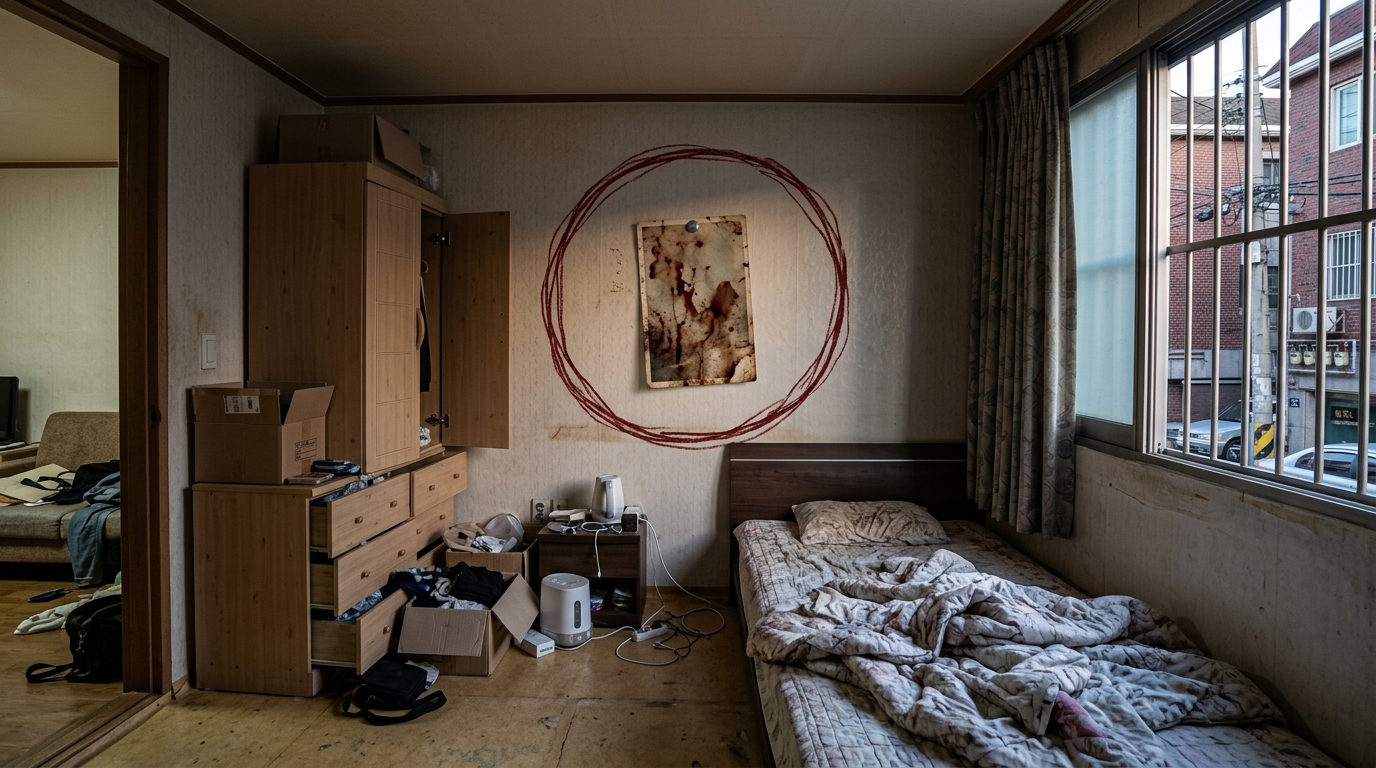
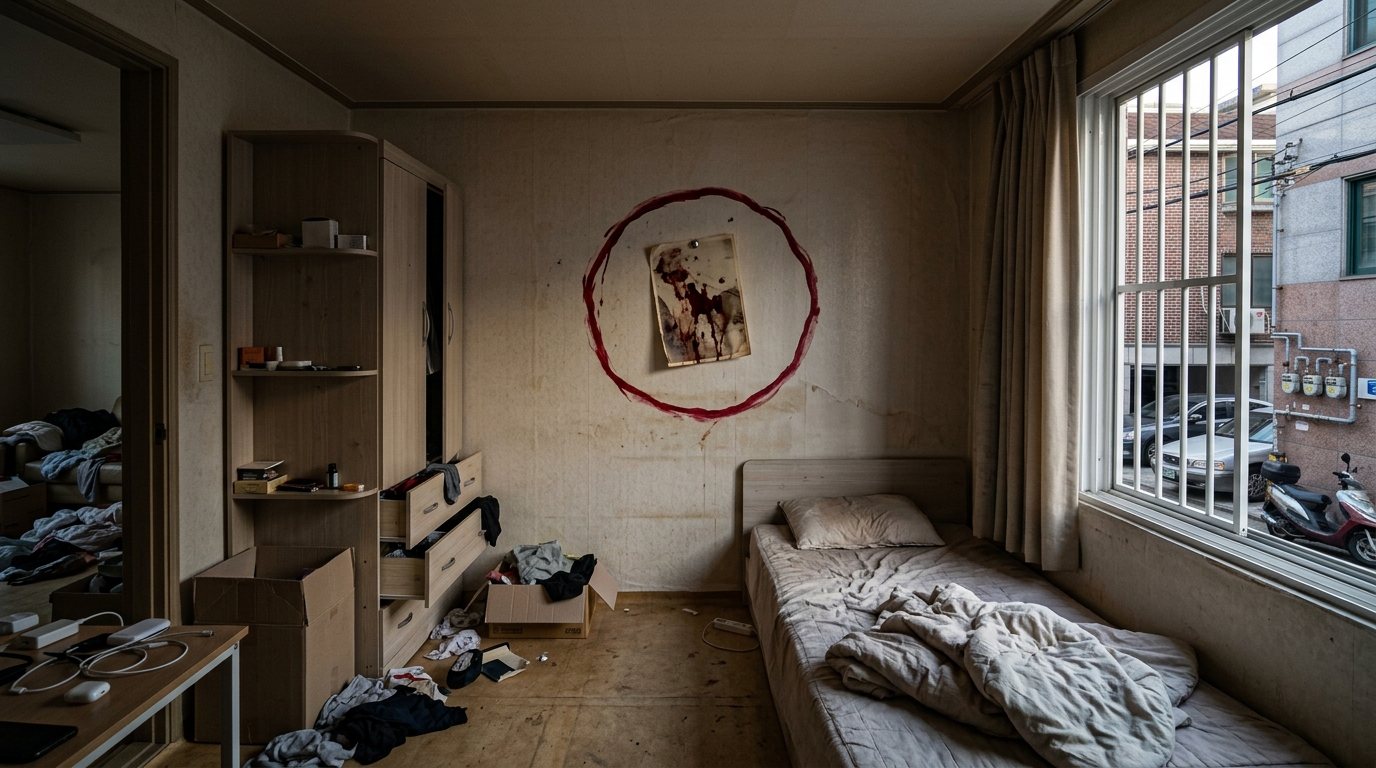
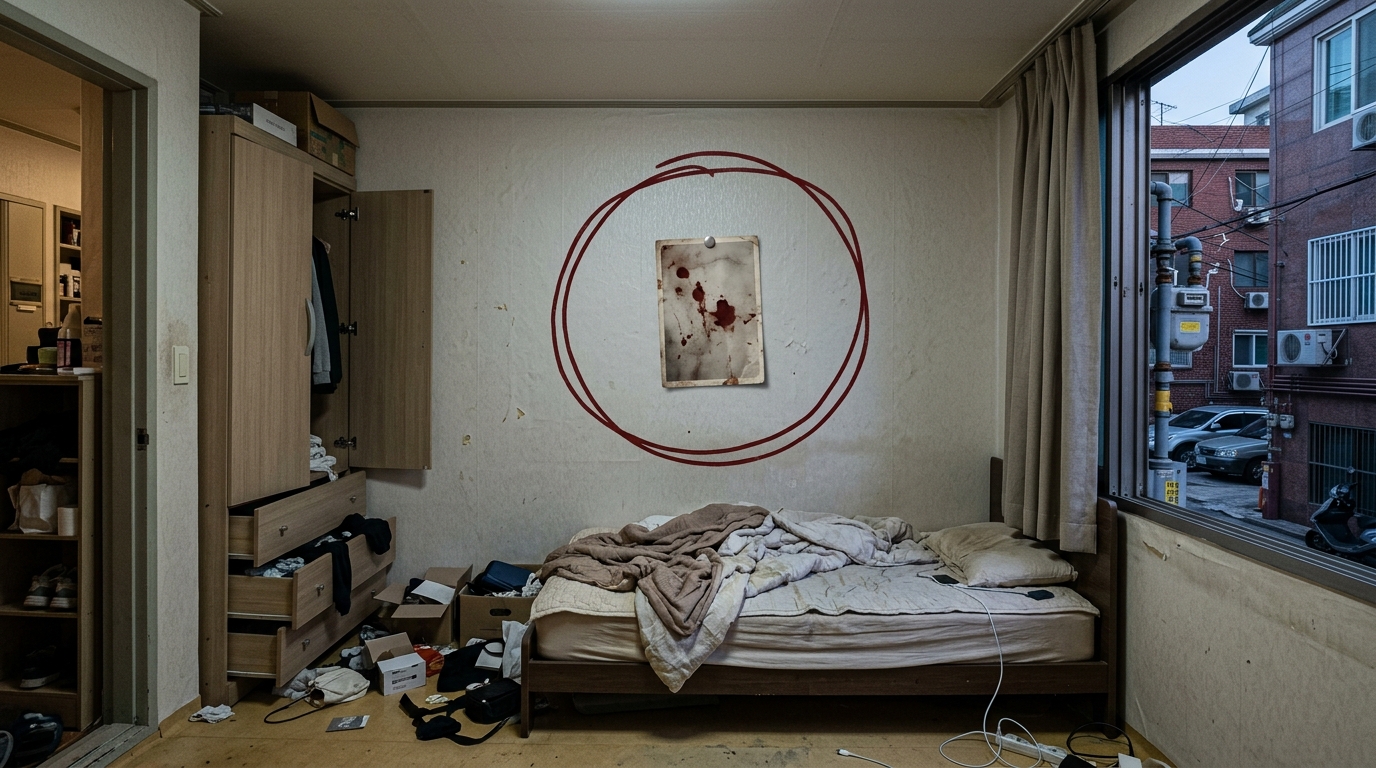
Create ONE FINAL photorealistic live-action film still of the moment below — contemporary South Korea, 2026; all people are Korean unless stated. TIME OF DAY (lock): night, dim floor lamp and television glow.

SHOT TEXT (authoritative, Korean): 침대 위쪽 벽면에 붉은색 원형 표식이 절반쯤 나타난 상태

LOCATION (lock): A compact rooftop apartment with a living room, dining table, small kitchen, main bedroom, and a curtained second bedroom. The rooms contain a cooled cooking pot, a television, a floor lamp, and simple domestic furniture. The shot takes place here — the attached LOCATION PHOTOGRAPH shows the exact spot.

REALIZE FIGURATIVE LANGUAGE AS A LIVE-ACTION SHOT: the Korean shot
text may describe characters metaphorically, figuratively or with
exaggeration. Photograph what a real movie camera would actually
record on a physical set — exaggerated or figurative impressions
become realistic staging choices (lighting, distance, angle,
wardrobe), not literal fantasy imagery.
EVERY CHARACTER IS A HUMAN BEING: unless the story explicitly
features non-human or virtual beings (as in science fiction or
fantasy), every character — however indirectly, vaguely or
figuratively the text describes them — IS a real human. When the
text gives no direct visual description of a person, IMAGINE one
and still show them as a concrete, fully-formed human being:
always render the human form to the maximum extent — build,
posture, face, hands, clothing — never reduce a person to a shape,
blob, solid silhouette or abstract mass.

EXPRESSIONS ARE ACTED, NEVER ANATOMICAL: when the text describes a
person's eyes, face or presence emotionally or figuratively (vacant,
hollow, dazed, burning, lifeless gaze and the like), it describes an
ACTOR'S PERFORMANCE captured by a real camera — realize it ONLY
through gaze direction, focus, eyelids, facial muscles, stillness
and posture. Every living person's eyes remain anatomically normal
human eyes with a natural iris and pupil, natural sclera and normal
proportions; NEVER whiten, blank out, cloud over, glow, enlarge or
otherwise alter eyeballs, skin or anatomy — unless the story
explicitly declares that being non-human or supernatural in form.

PROPS FACE THE RIGHT WAY: every handheld or used object must be
oriented exactly as its real-world use requires. A person reading,
watching or operating something (a phone, a photograph, a paper,
any device) has its functional side — screen, front, page — facing
THEIR OWN eyes; the camera then sees whatever side the staging
geometry implies (often its back). Show the functional side to the
camera ONLY when the shot text itself stages it toward the viewer.
Never flip, mirror or reverse an object's front and back.

CARRIED STATE (persist exactly — must match the neighbouring shots of this scene): Min-suk's corpse and the room's blood evidence remain in place, but the photograph has now been removed from her hand and her wrist mark has turned red. A red circle is forming on the wall above the bed.

NO PEOPLE IN THIS SHOT: the shot text shows only the place and its state — no living person or any body part appears in frame, unless the shot text itself explicitly says so.

No text, captions, watermarks or annotations anywhere.
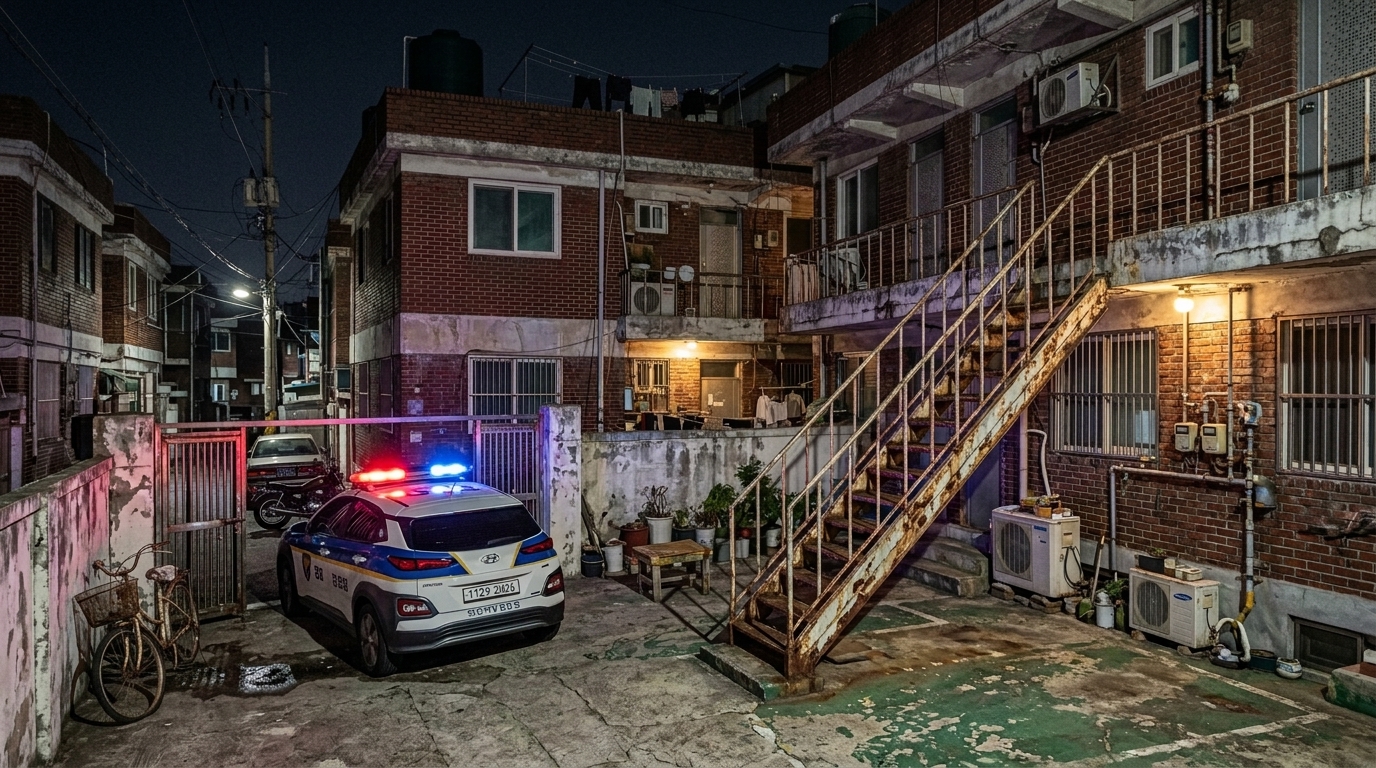
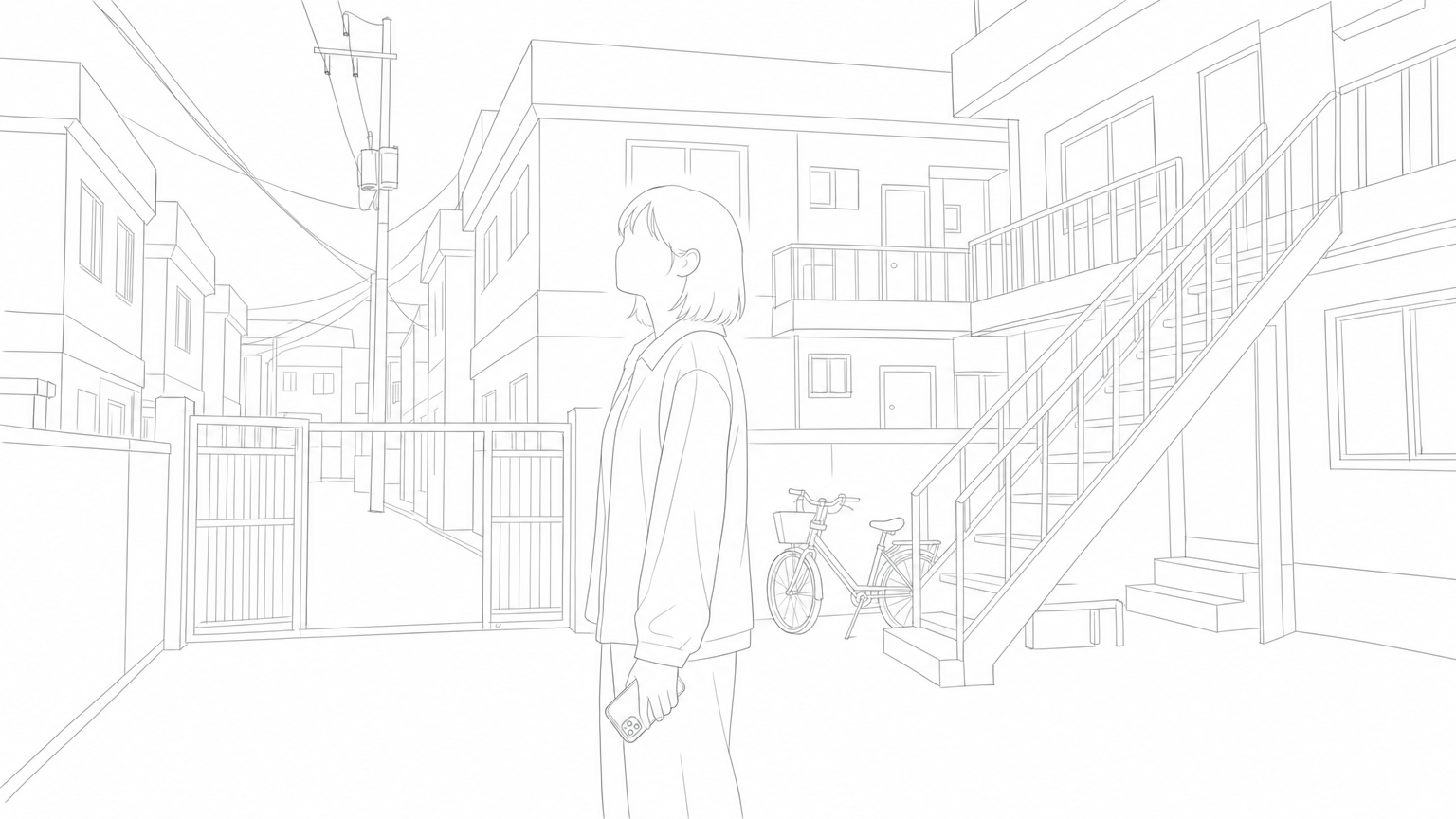
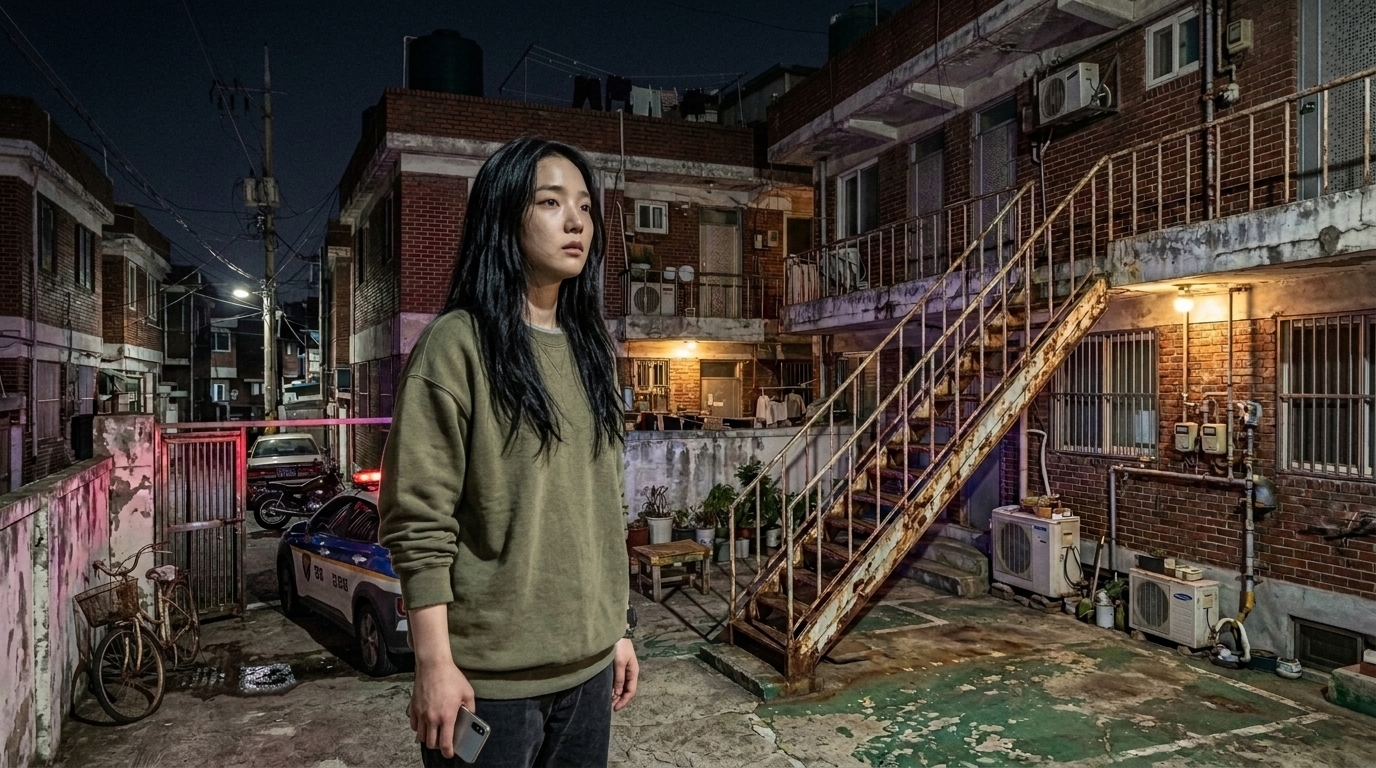
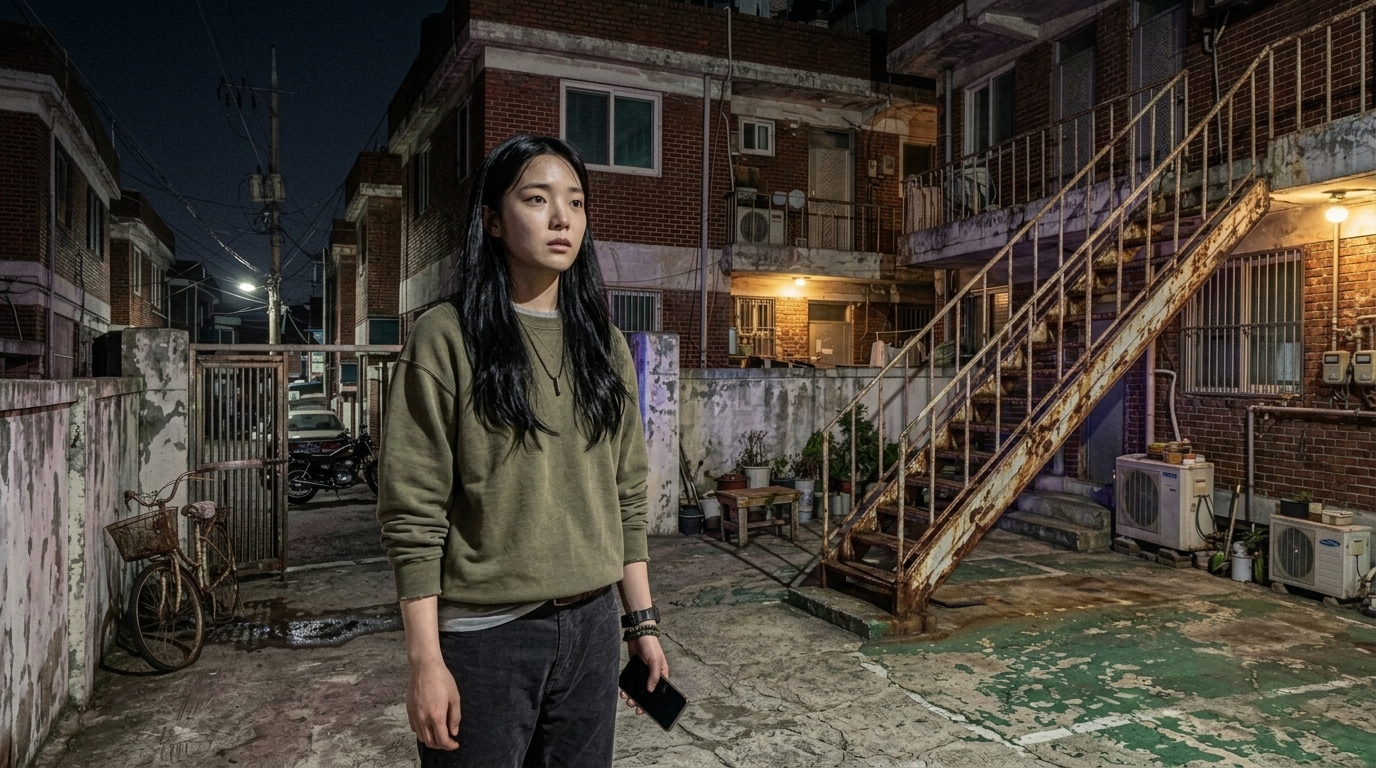
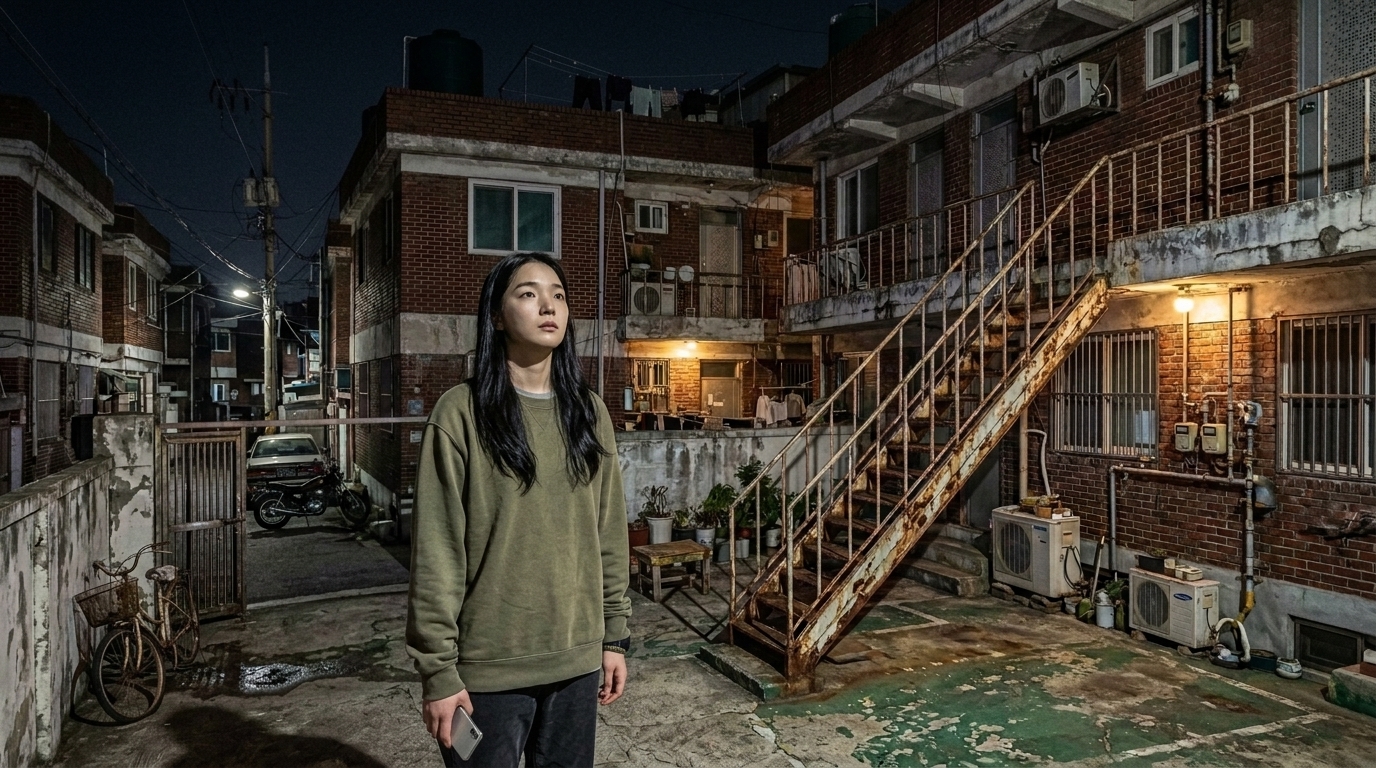
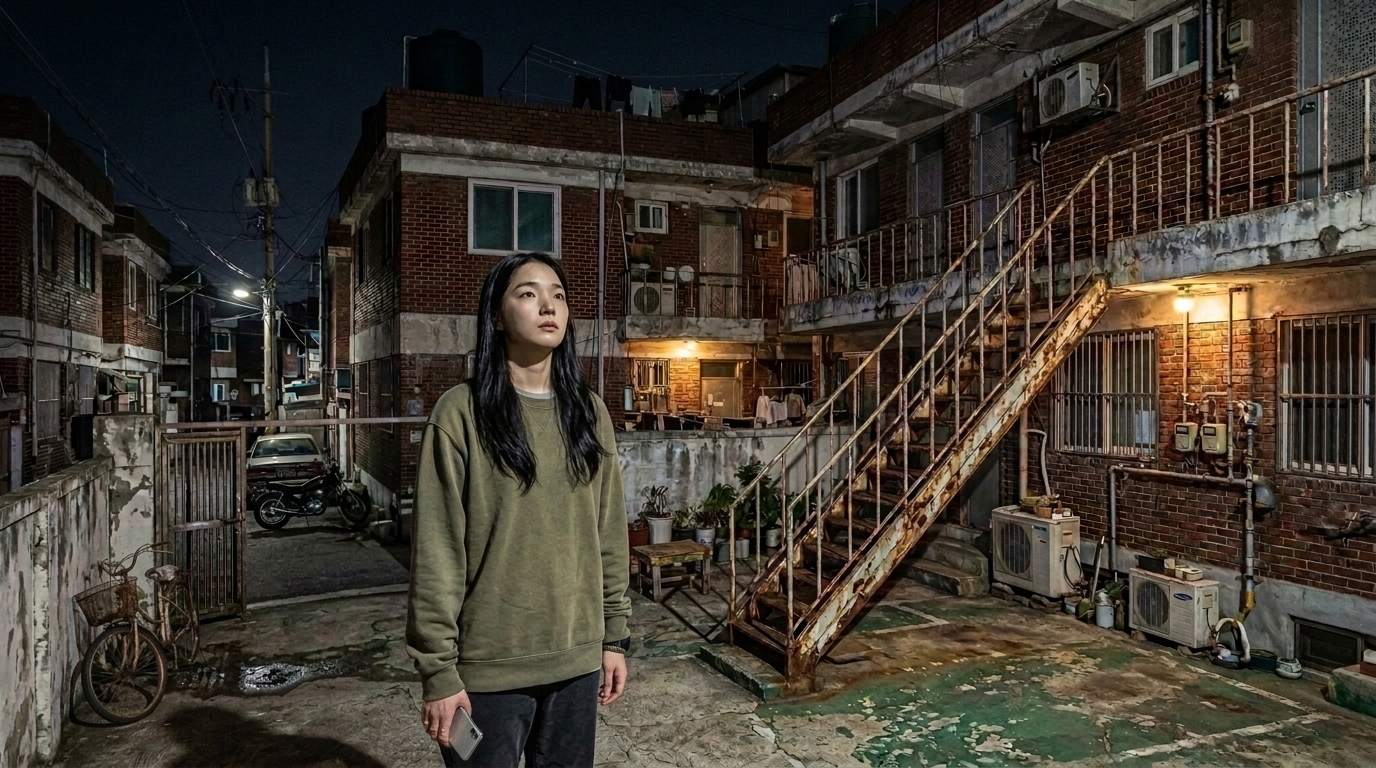
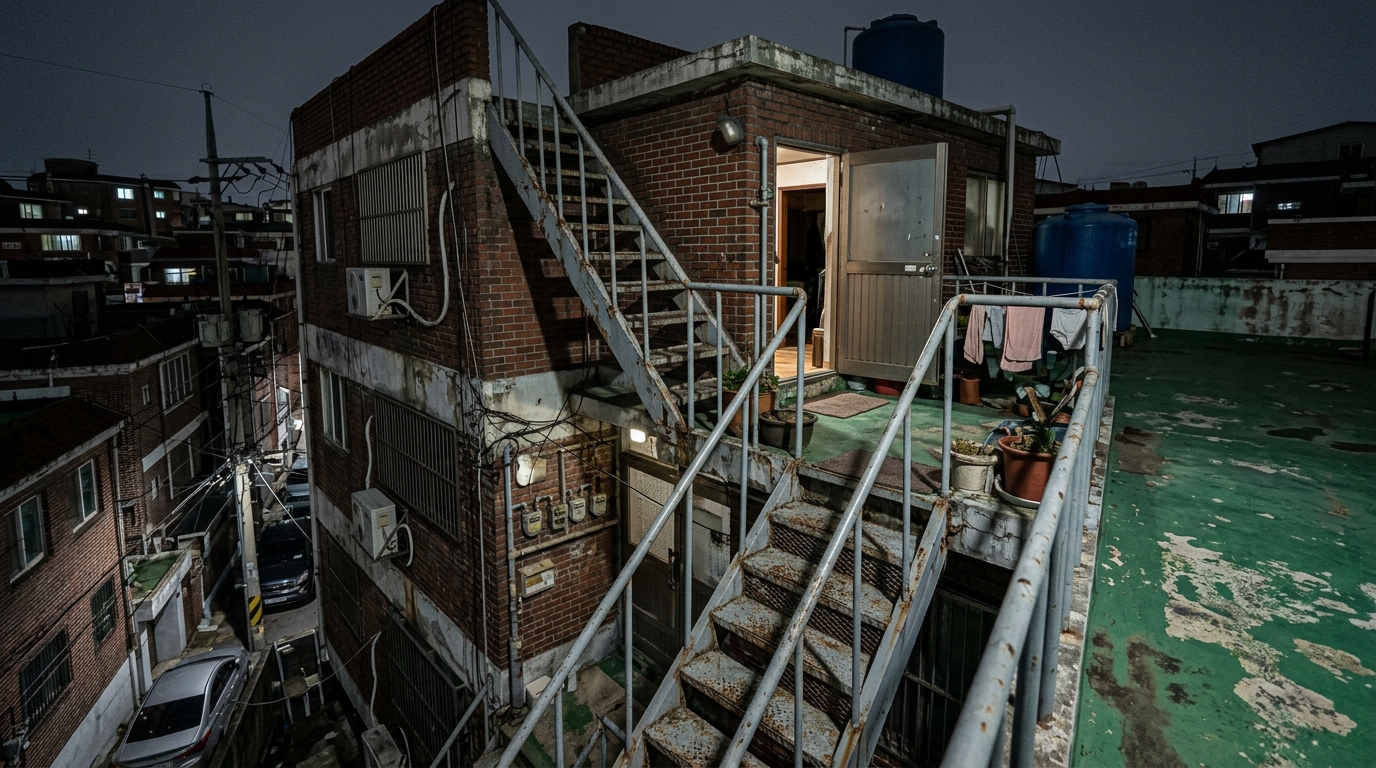
Create ONE FINAL photorealistic live-action film still of the moment below — contemporary South Korea, 2026; all people are Korean unless stated. TIME OF DAY (lock): night.

SHOT TEXT (authoritative, Korean): 수리영이 초점을 잃은 눈으로 허공을 응시하며 서 있는 모습

LOCATION (lock): The exterior of a rooftop apartment atop an old multi-unit villa, reached by a steep outdoor stairway from the yard below. The shot takes place here — the attached LOCATION PHOTOGRAPH shows the exact spot.

REALIZE FIGURATIVE LANGUAGE AS A LIVE-ACTION SHOT: the Korean shot
text may describe characters metaphorically, figuratively or with
exaggeration. Photograph what a real movie camera would actually
record on a physical set — exaggerated or figurative impressions
become realistic staging choices (lighting, distance, angle,
wardrobe), not literal fantasy imagery.
EVERY CHARACTER IS A HUMAN BEING: unless the story explicitly
features non-human or virtual beings (as in science fiction or
fantasy), every character — however indirectly, vaguely or
figuratively the text describes them — IS a real human. When the
text gives no direct visual description of a person, IMAGINE one
and still show them as a concrete, fully-formed human being:
always render the human form to the maximum extent — build,
posture, face, hands, clothing — never reduce a person to a shape,
blob, solid silhouette or abstract mass.

EXPRESSIONS ARE ACTED, NEVER ANATOMICAL: when the text describes a
person's eyes, face or presence emotionally or figuratively (vacant,
hollow, dazed, burning, lifeless gaze and the like), it describes an
ACTOR'S PERFORMANCE captured by a real camera — realize it ONLY
through gaze direction, focus, eyelids, facial muscles, stillness
and posture. Every living person's eyes remain anatomically normal
human eyes with a natural iris and pupil, natural sclera and normal
proportions; NEVER whiten, blank out, cloud over, glow, enlarge or
otherwise alter eyeballs, skin or anatomy — unless the story
explicitly declares that being non-human or supernatural in form.

PROPS FACE THE RIGHT WAY: every handheld or used object must be
oriented exactly as its real-world use requires. A person reading,
watching or operating something (a phone, a photograph, a paper,
any device) has its functional side — screen, front, page — facing
THEIR OWN eyes; the camera then sees whatever side the staging
geometry implies (often its back). Show the functional side to the
camera ONLY when the shot text itself stages it toward the viewer.
Never flip, mirror or reverse an object's front and back.

CARRIED STATE (persist exactly — must match the neighbouring shots of this scene): Su-ri-young still has her smartphone with her after fleeing the apartment, while her bicycle remains in the building's rear yard.

PEOPLE: the SHOT TEXT alone decides whether any person is visible in this shot. IF a person appears, they must be one of: 수리영 (Korean 20대 초반 여성, 긴 검은 머리, 타원형의 젊은 얼굴, 부드러운 이목구비와 자연스러운 피부색상태) — never anyone else, and never add a person the shot text does not show. IF only part of a person is in frame (a hand, arm, foot, back, silhouette), that body part belongs to the specific person the shot text names — its sex, age, build, skin and grooming must unmistakably match that person's profile above.

No text, captions, watermarks or annotations anywhere.
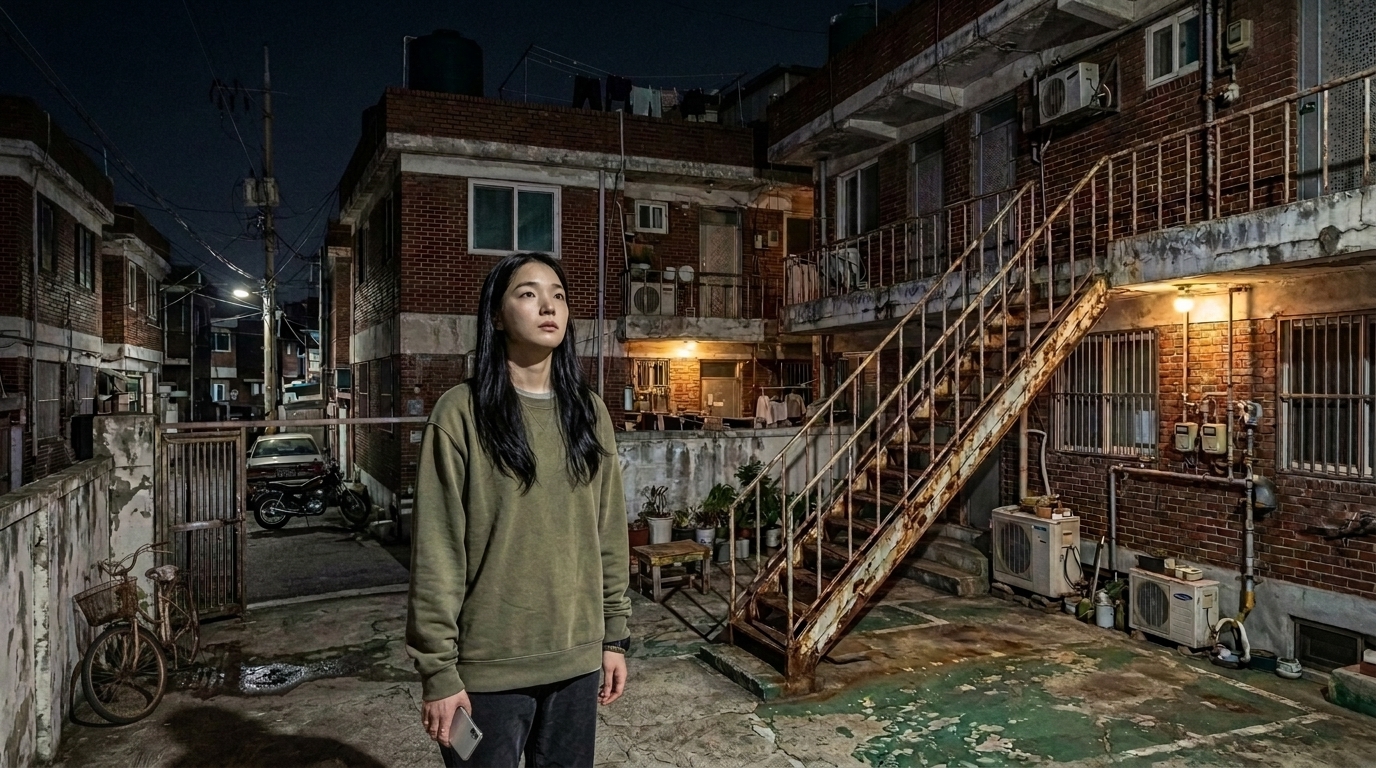
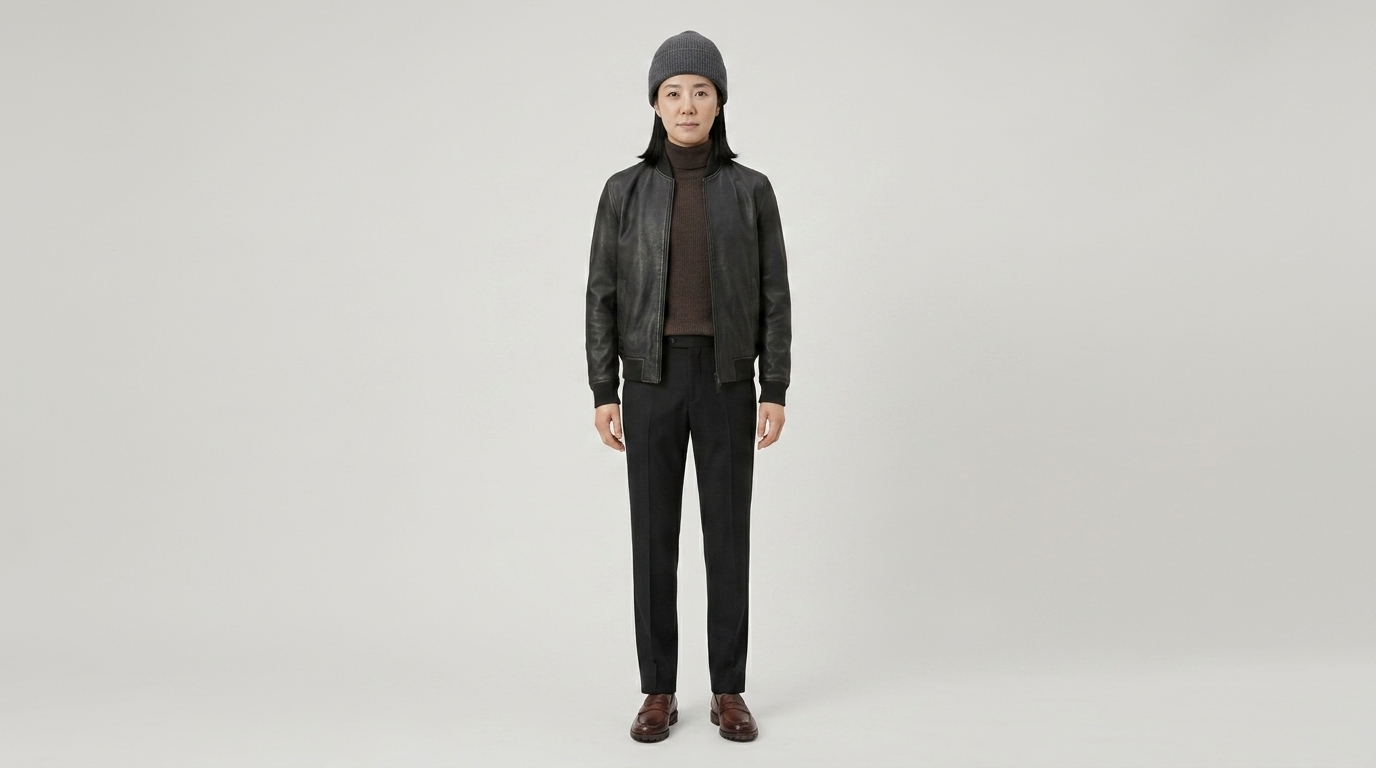
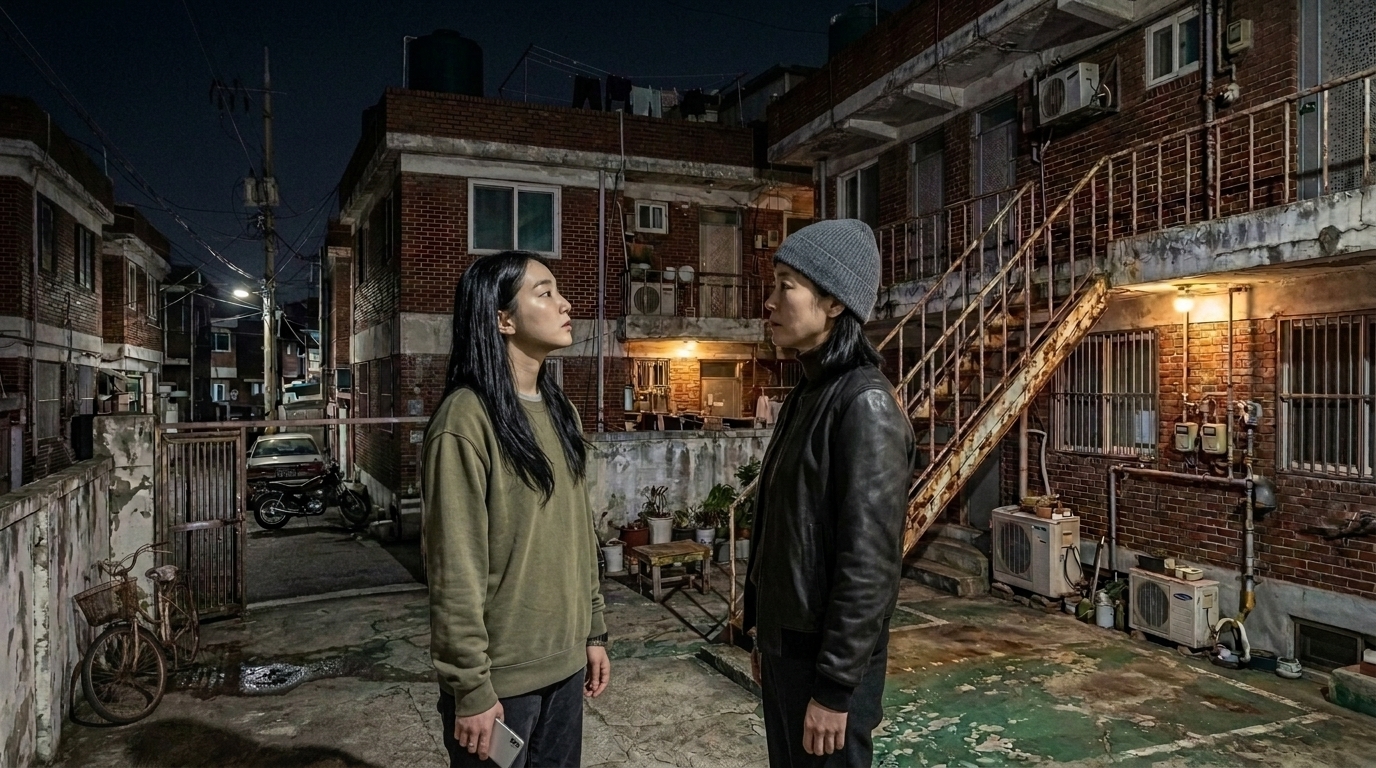
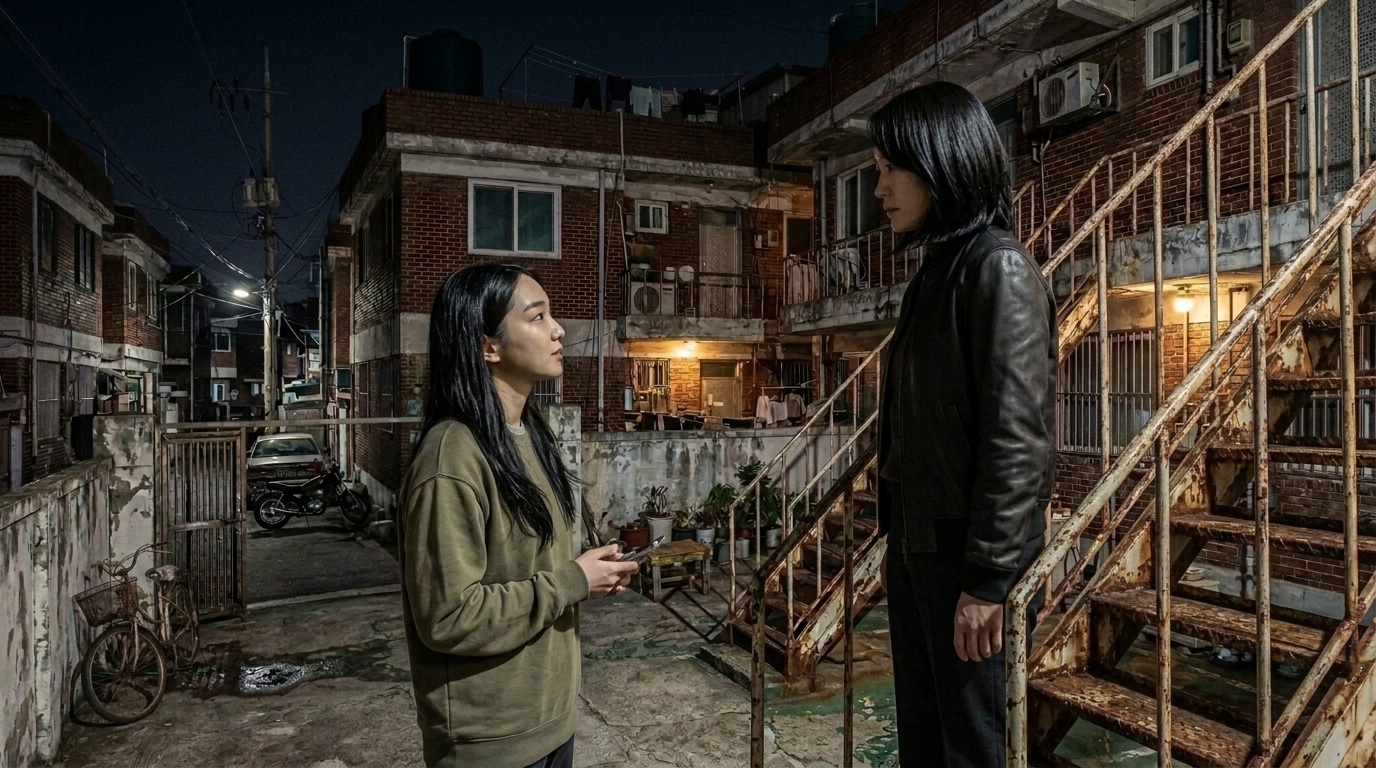
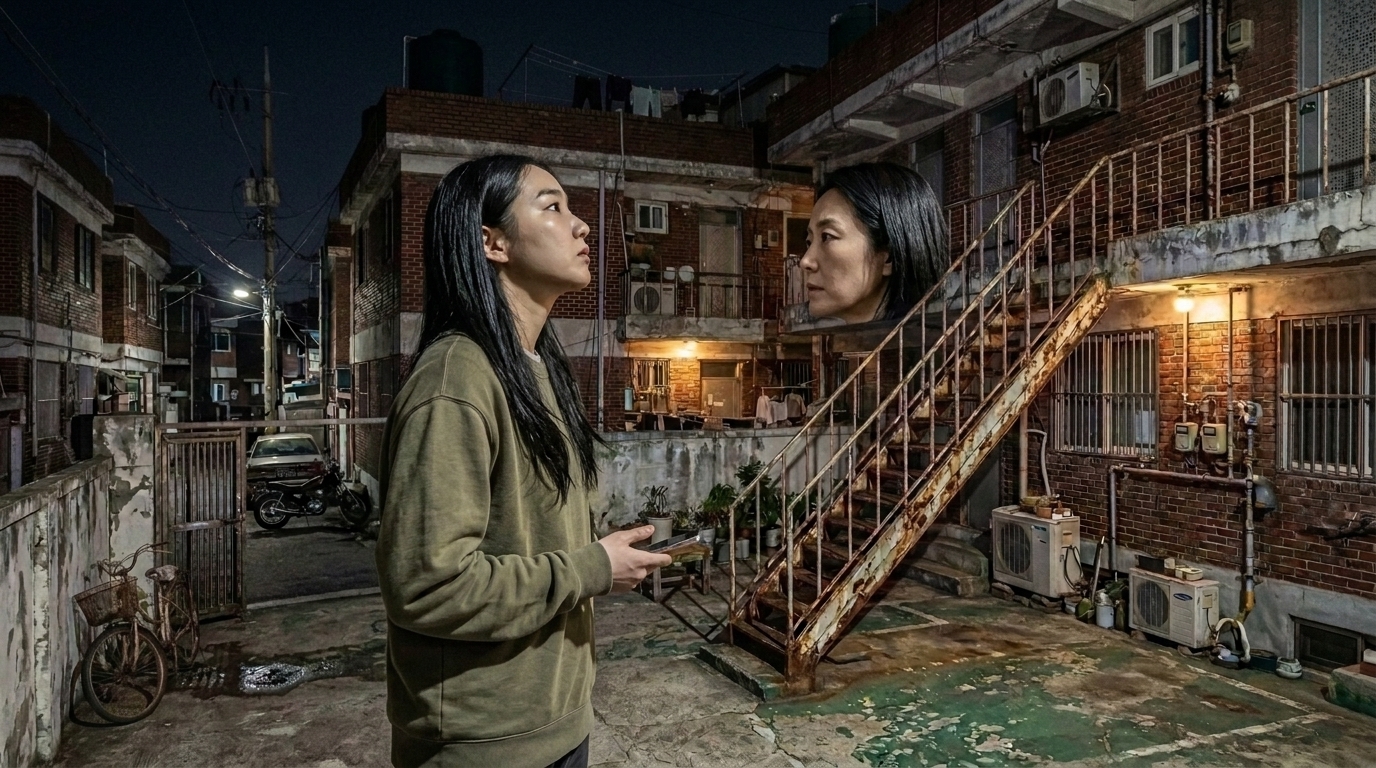
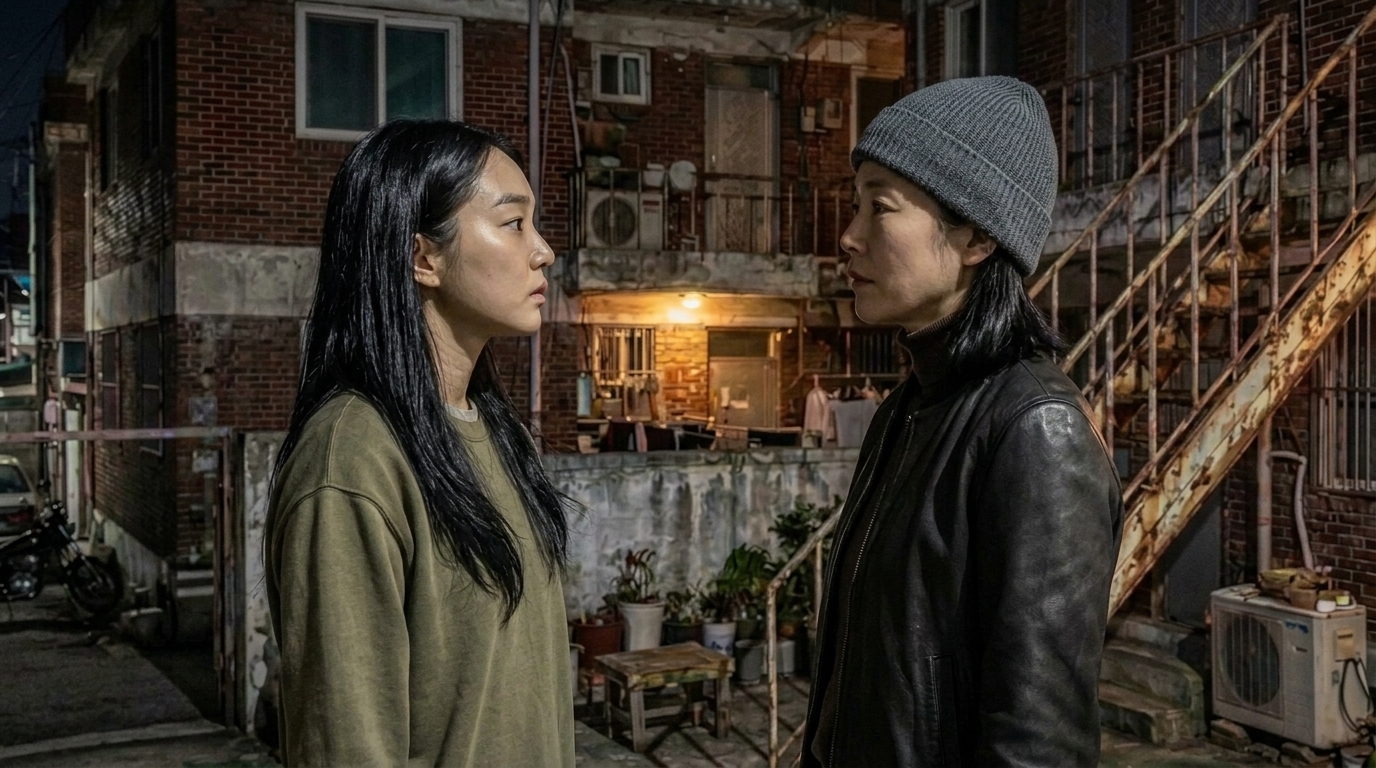
Create ONE FINAL photorealistic live-action film still of the moment below — contemporary South Korea, 2026; all people are Korean unless stated. TIME OF DAY (lock): night.

SHOT TEXT (authoritative, Korean): 고개를 든 채 혜수의 얼굴을 마주보고 있는 수리영의 측면 구도

LOCATION (lock): The exterior of a rooftop apartment atop an old multi-unit villa, reached by a steep outdoor stairway from the yard below. The shot takes place here — the attached PREVIOUS SHOT STILL shows this exact place.

THIS SHOT CONTINUES THE PREVIOUS SHOT: everything the attached still established — the place, its fixed features and wear, each person's clothing and state — persists. Any person in it who cannot move stays PRECISELY as photographed (body, pose, contact points, held objects); only the camera changes.

PREVIOUS STILL USAGE (follow exactly — what to take from the attached still and what to exclude): Take the same dim courtyard, building exterior, and emergency-lit night atmosphere from the reference. Exclude the earlier vacant stare and any vehicles or officers outside this tighter two-person framing.

REALIZE FIGURATIVE LANGUAGE AS A LIVE-ACTION SHOT: the Korean shot
text may describe characters metaphorically, figuratively or with
exaggeration. Photograph what a real movie camera would actually
record on a physical set — exaggerated or figurative impressions
become realistic staging choices (lighting, distance, angle,
wardrobe), not literal fantasy imagery.
EVERY CHARACTER IS A HUMAN BEING: unless the story explicitly
features non-human or virtual beings (as in science fiction or
fantasy), every character — however indirectly, vaguely or
figuratively the text describes them — IS a real human. When the
text gives no direct visual description of a person, IMAGINE one
and still show them as a concrete, fully-formed human being:
always render the human form to the maximum extent — build,
posture, face, hands, clothing — never reduce a person to a shape,
blob, solid silhouette or abstract mass.

EXPRESSIONS ARE ACTED, NEVER ANATOMICAL: when the text describes a
person's eyes, face or presence emotionally or figuratively (vacant,
hollow, dazed, burning, lifeless gaze and the like), it describes an
ACTOR'S PERFORMANCE captured by a real camera — realize it ONLY
through gaze direction, focus, eyelids, facial muscles, stillness
and posture. Every living person's eyes remain anatomically normal
human eyes with a natural iris and pupil, natural sclera and normal
proportions; NEVER whiten, blank out, cloud over, glow, enlarge or
otherwise alter eyeballs, skin or anatomy — unless the story
explicitly declares that being non-human or supernatural in form.

PROPS FACE THE RIGHT WAY: every handheld or used object must be
oriented exactly as its real-world use requires. A person reading,
watching or operating something (a phone, a photograph, a paper,
any device) has its functional side — screen, front, page — facing
THEIR OWN eyes; the camera then sees whatever side the staging
geometry implies (often its back). Show the functional side to the
camera ONLY when the shot text itself stages it toward the viewer.
Never flip, mirror or reverse an object's front and back.

CARRIED STATE (persist exactly — must match the neighbouring shots of this scene): Su-ri-young remains outside with her smartphone, and her bicycle is still parked in the rear yard as Hye-su prepares to go upstairs.

PEOPLE: the SHOT TEXT alone decides whether any person is visible in this shot. IF a person appears, they must be one of: 수리영 (Korean 20대 초반 여성, 긴 검은 머리, 타원형의 젊은 얼굴, 부드러운 이목구비와 자연스러운 피부색상태); 혜수 (Korean 40대 중반 여성, 단정한 검은 머리, 성숙한 타원형 얼굴, 또렷한 이목구비) — never anyone else, and never add a person the shot text does not show. IF only part of a person is in frame (a hand, arm, foot, back, silhouette), that body part belongs to the specific person the shot text names — its sex, age, build, skin and grooming must unmistakably match that person's profile above.

No text, captions, watermarks or annotations anywhere.
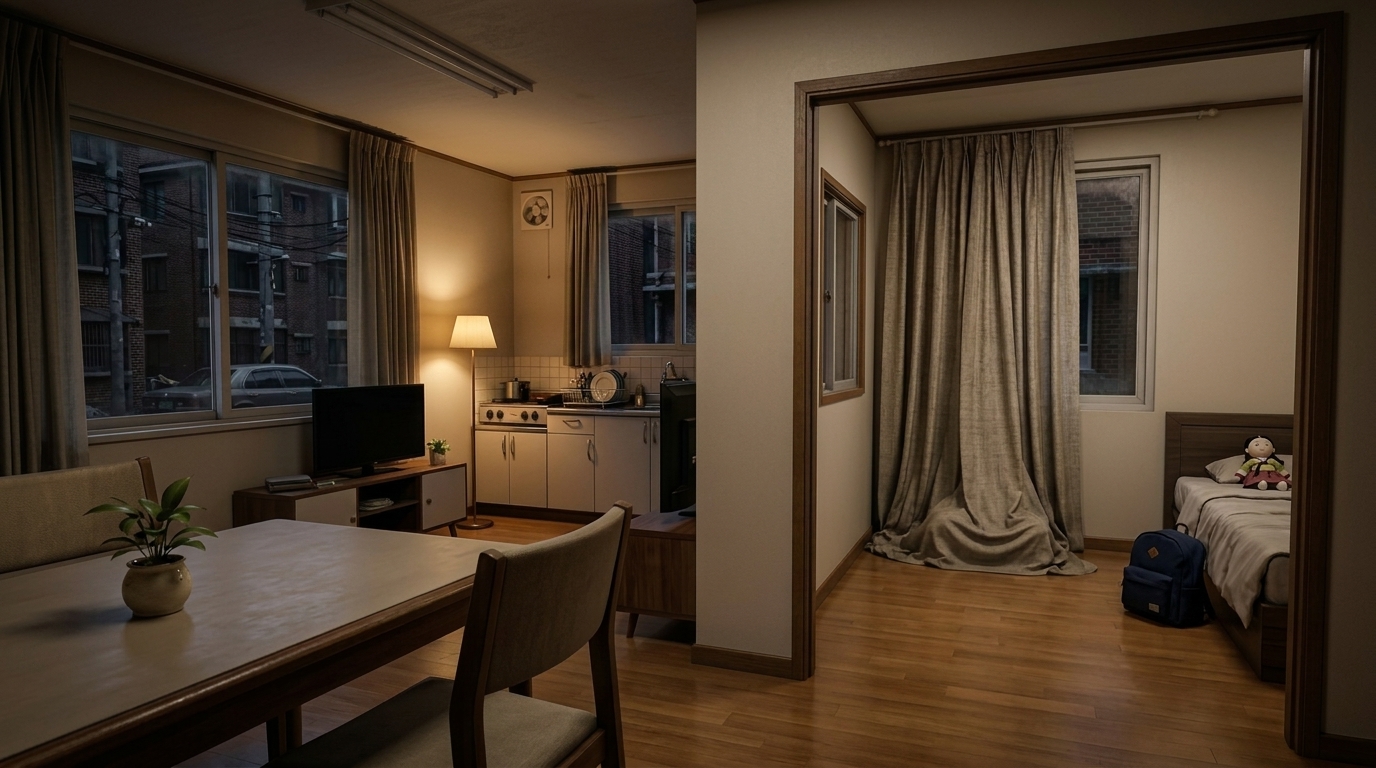
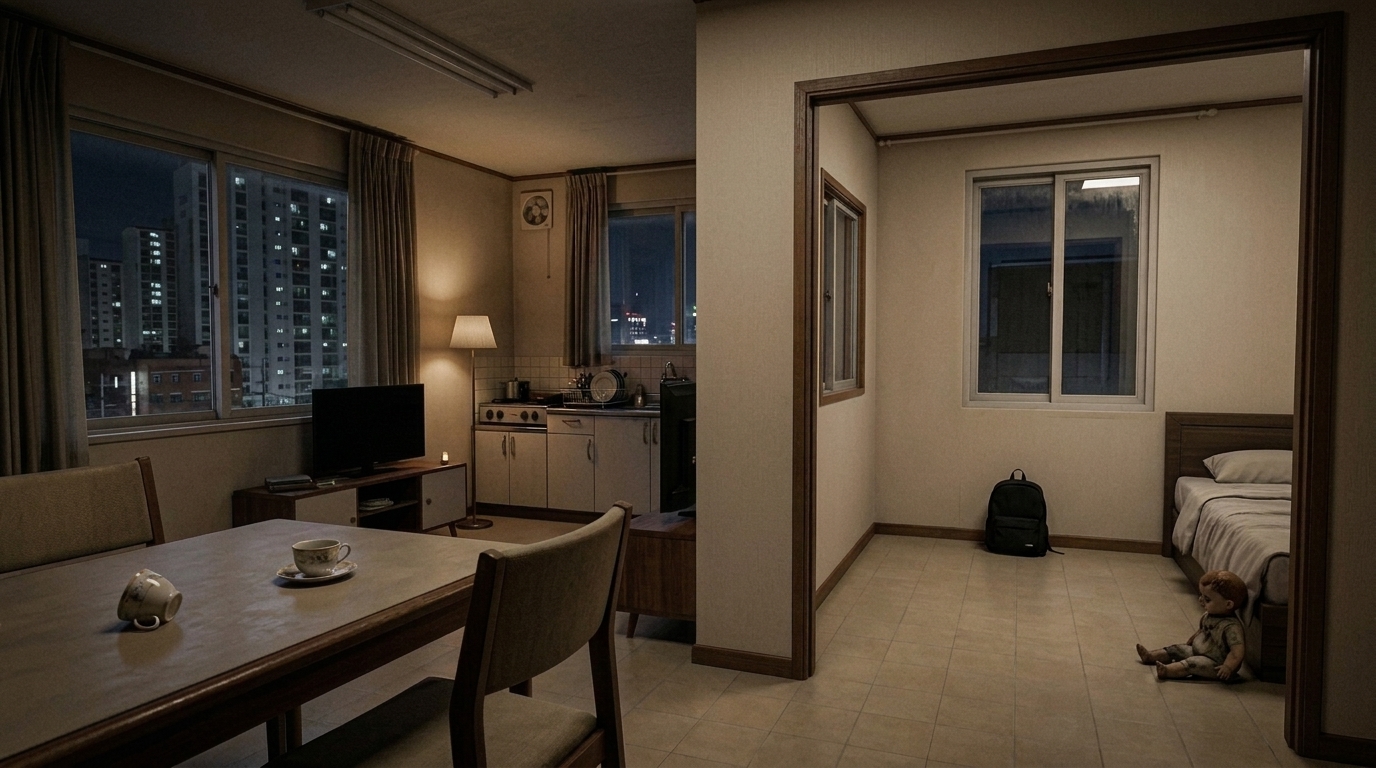
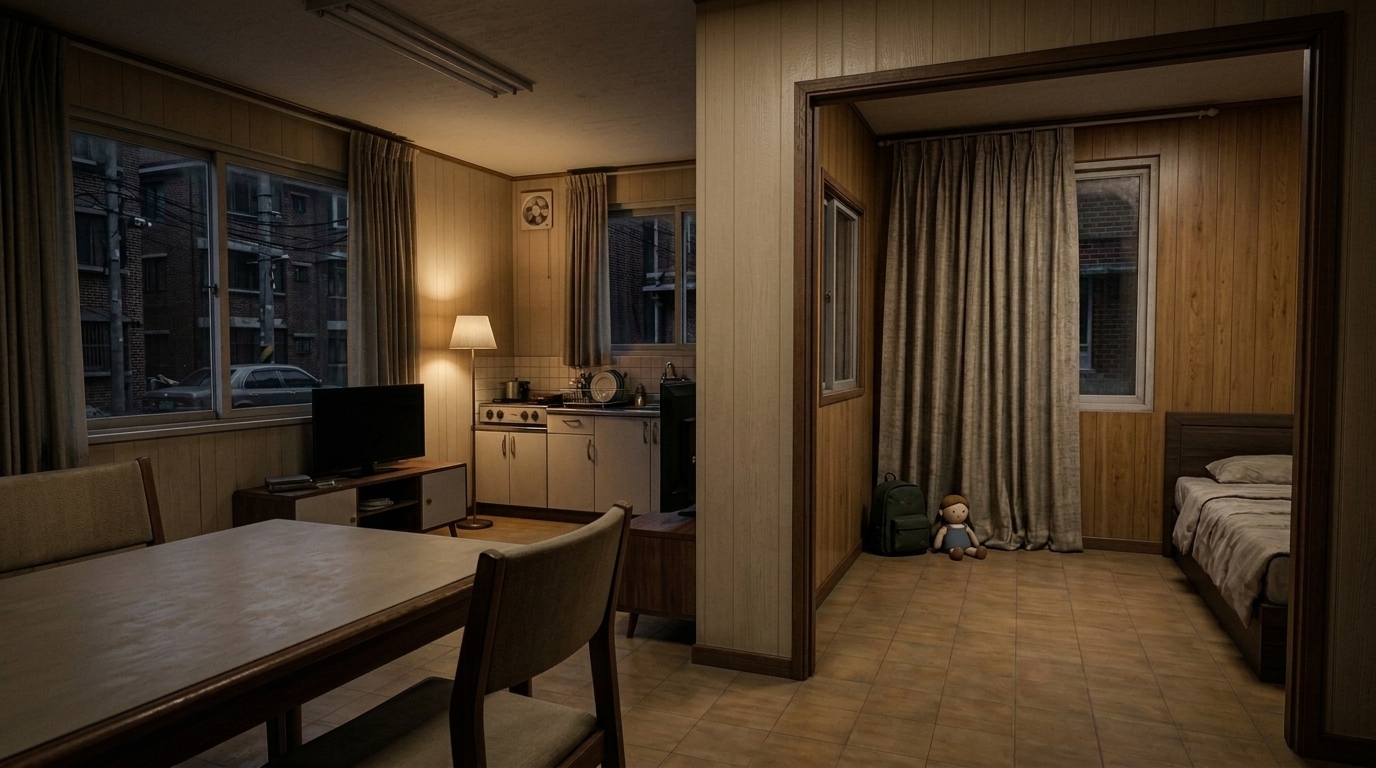
Create ONE FINAL photorealistic live-action film still of the moment below — contemporary South Korea, 2026; all people are Korean unless stated. TIME OF DAY (lock): night, interior lighting unspecified.

SHOT TEXT (authoritative, Korean): 핏자국 없이 깨끗한 방 내부 전경

LOCATION (lock): A compact rooftop apartment whose living area, dining table, and bedroom now appear unnaturally clean and orderly. A backpack and a doll sit in the bedroom in subtly altered positions. The shot takes place here — the attached LOCATION PHOTOGRAPH shows the exact spot.

REALIZE FIGURATIVE LANGUAGE AS A LIVE-ACTION SHOT: the Korean shot
text may describe characters metaphorically, figuratively or with
exaggeration. Photograph what a real movie camera would actually
record on a physical set — exaggerated or figurative impressions
become realistic staging choices (lighting, distance, angle,
wardrobe), not literal fantasy imagery.
EVERY CHARACTER IS A HUMAN BEING: unless the story explicitly
features non-human or virtual beings (as in science fiction or
fantasy), every character — however indirectly, vaguely or
figuratively the text describes them — IS a real human. When the
text gives no direct visual description of a person, IMAGINE one
and still show them as a concrete, fully-formed human being:
always render the human form to the maximum extent — build,
posture, face, hands, clothing — never reduce a person to a shape,
blob, solid silhouette or abstract mass.

EXPRESSIONS ARE ACTED, NEVER ANATOMICAL: when the text describes a
person's eyes, face or presence emotionally or figuratively (vacant,
hollow, dazed, burning, lifeless gaze and the like), it describes an
ACTOR'S PERFORMANCE captured by a real camera — realize it ONLY
through gaze direction, focus, eyelids, facial muscles, stillness
and posture. Every living person's eyes remain anatomically normal
human eyes with a natural iris and pupil, natural sclera and normal
proportions; NEVER whiten, blank out, cloud over, glow, enlarge or
otherwise alter eyeballs, skin or anatomy — unless the story
explicitly declares that being non-human or supernatural in form.

PROPS FACE THE RIGHT WAY: every handheld or used object must be
oriented exactly as its real-world use requires. A person reading,
watching or operating something (a phone, a photograph, a paper,
any device) has its functional side — screen, front, page — facing
THEIR OWN eyes; the camera then sees whatever side the staging
geometry implies (often its back). Show the functional side to the
camera ONLY when the shot text itself stages it toward the viewer.
Never flip, mirror or reverse an object's front and back.

CARRIED STATE (persist exactly — must match the neighbouring shots of this scene): The bedroom has been inexplicably reset: Min-suk's corpse, every bloodstain and footprint, and the red wall circle are gone, leaving the room excessively clean and orderly.

NO PEOPLE IN THIS SHOT: the shot text shows only the place and its state — no living person or any body part appears in frame, unless the shot text itself explicitly says so.

No text, captions, watermarks or annotations anywhere.
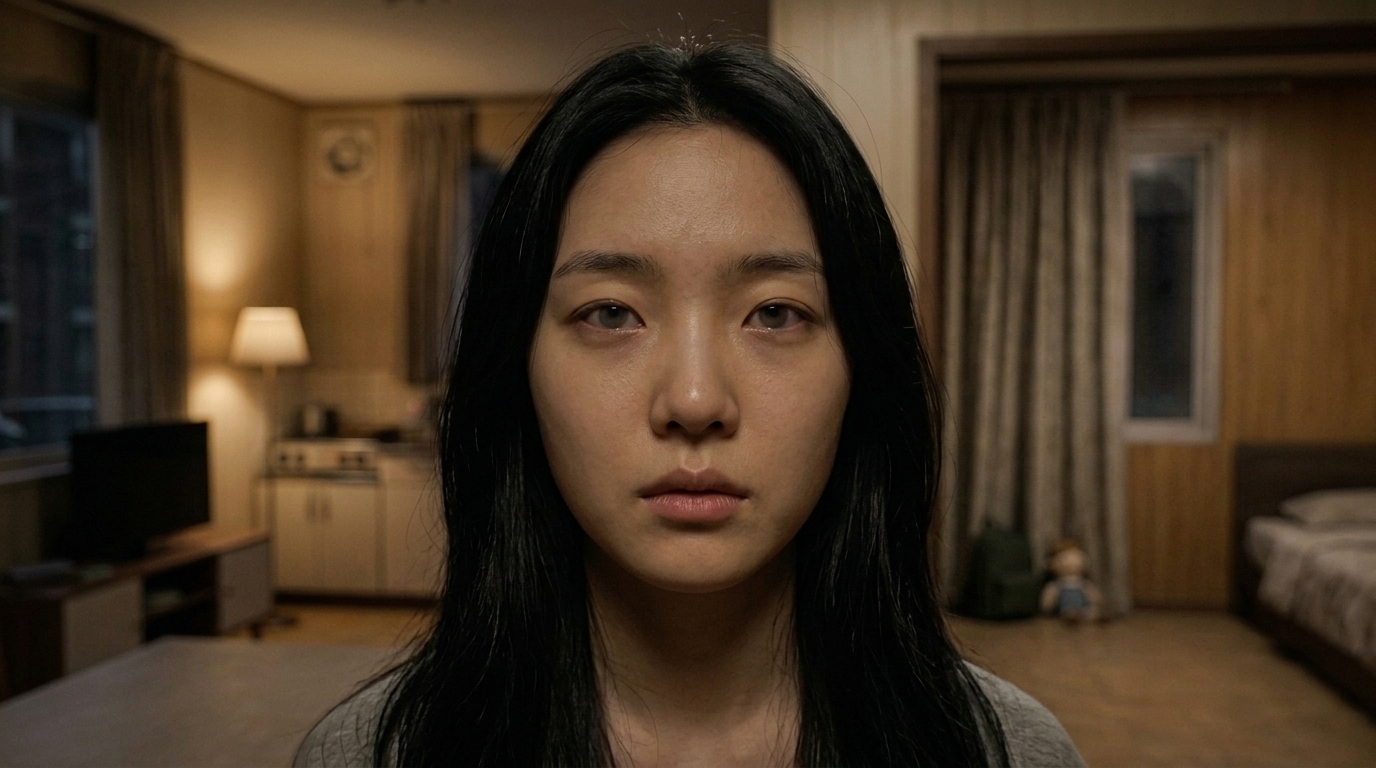
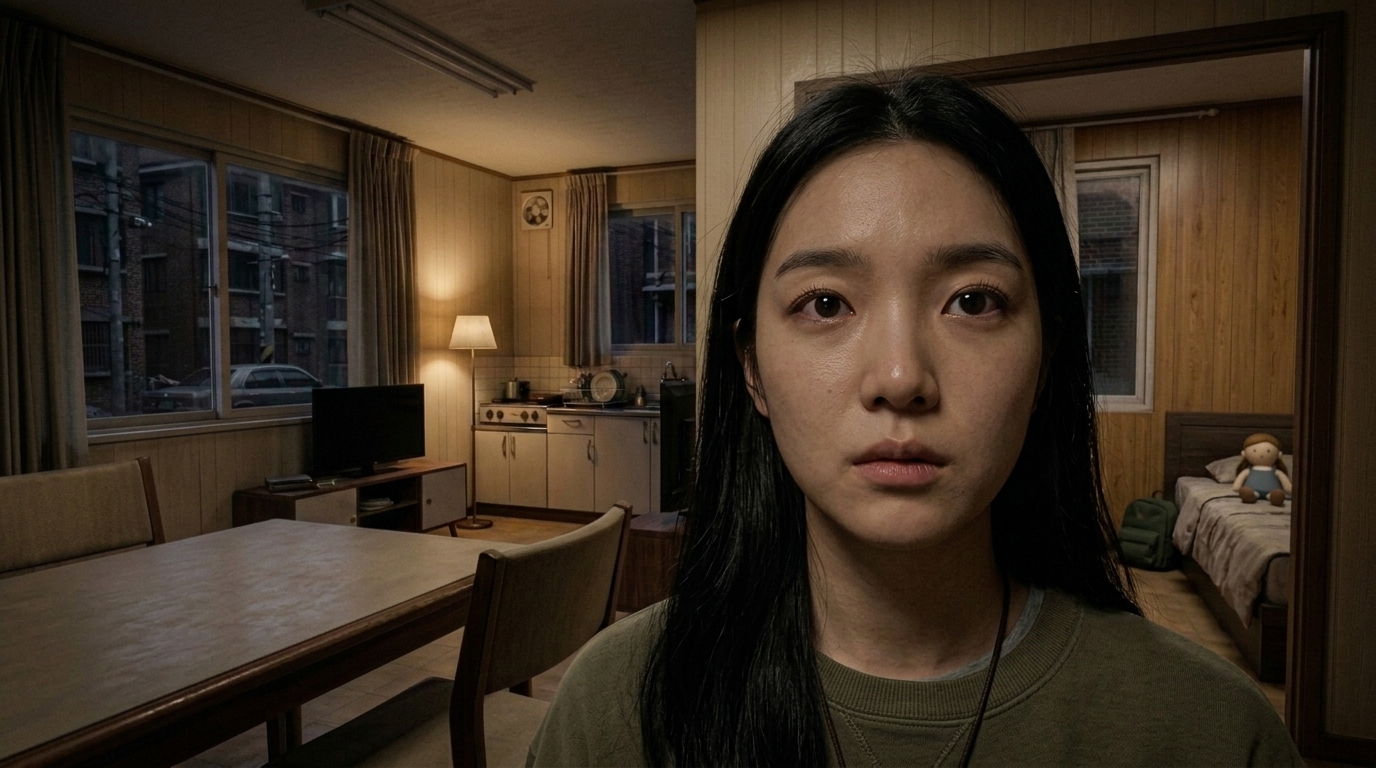
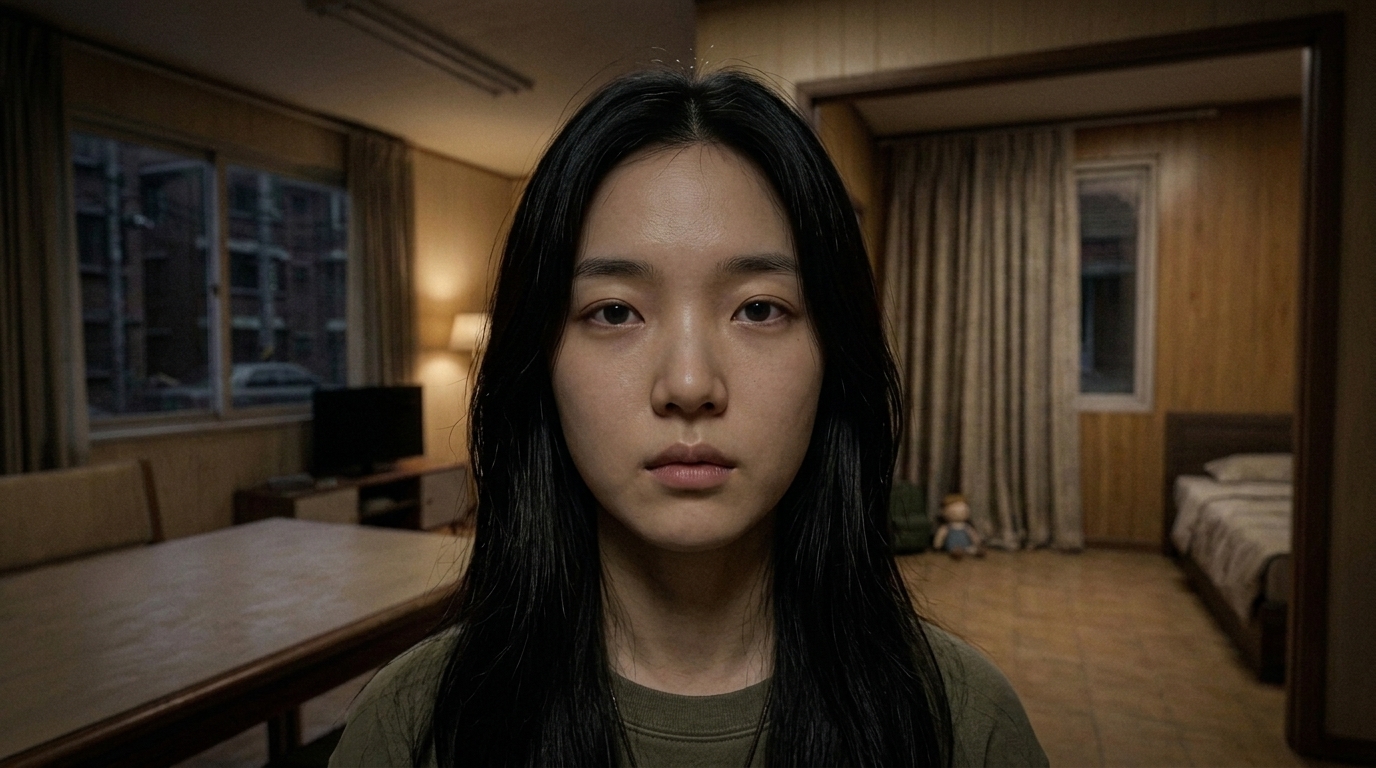
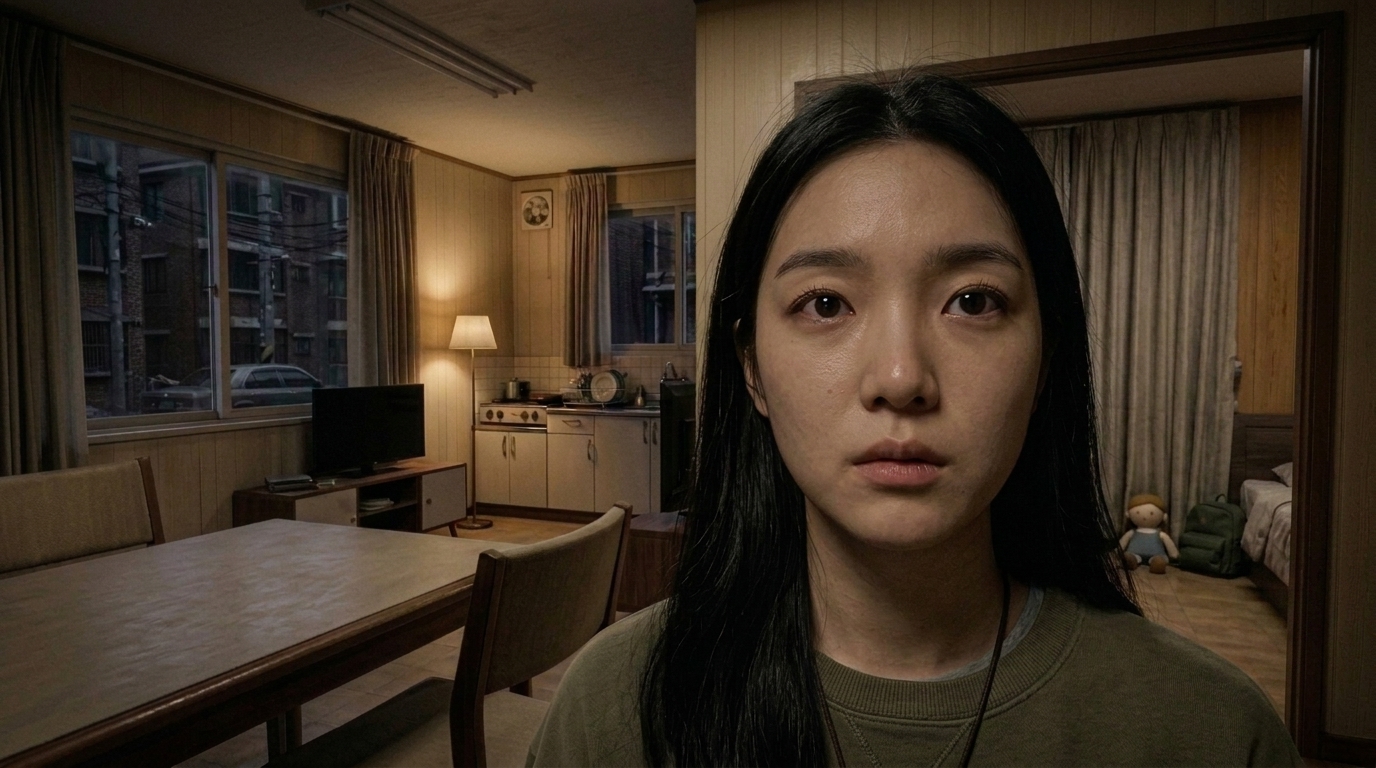
Create ONE FINAL photorealistic live-action film still of the moment below — contemporary South Korea, 2026; all people are Korean unless stated. TIME OF DAY (lock): night, interior lighting unspecified.

SHOT TEXT (authoritative, Korean): 수리영이 멍한 눈으로 텅 빈 방 안을 응시하는 얼굴 클로즈업

LOCATION (lock): A compact rooftop apartment whose living area, dining table, and bedroom now appear unnaturally clean and orderly. A backpack and a doll sit in the bedroom in subtly altered positions. The shot takes place here — the attached PREVIOUS SHOT STILL shows this exact place.

THIS SHOT CONTINUES THE PREVIOUS SHOT: everything the attached still established — the place, its fixed features and wear, each person's clothing and state — persists. Any person in it who cannot move stays PRECISELY as photographed (body, pose, contact points, held objects); only the camera changes.

PREVIOUS STILL USAGE (follow exactly — what to take from the attached still and what to exclude): Take the spotless bedroom, unchanged room geometry, and subdued night lighting from the reference. Exclude any corpse, blood, red wall mark, or attack debris, and keep the background secondary to the close-up.

REALIZE FIGURATIVE LANGUAGE AS A LIVE-ACTION SHOT: the Korean shot
text may describe characters metaphorically, figuratively or with
exaggeration. Photograph what a real movie camera would actually
record on a physical set — exaggerated or figurative impressions
become realistic staging choices (lighting, distance, angle,
wardrobe), not literal fantasy imagery.
EVERY CHARACTER IS A HUMAN BEING: unless the story explicitly
features non-human or virtual beings (as in science fiction or
fantasy), every character — however indirectly, vaguely or
figuratively the text describes them — IS a real human. When the
text gives no direct visual description of a person, IMAGINE one
and still show them as a concrete, fully-formed human being:
always render the human form to the maximum extent — build,
posture, face, hands, clothing — never reduce a person to a shape,
blob, solid silhouette or abstract mass.

EXPRESSIONS ARE ACTED, NEVER ANATOMICAL: when the text describes a
person's eyes, face or presence emotionally or figuratively (vacant,
hollow, dazed, burning, lifeless gaze and the like), it describes an
ACTOR'S PERFORMANCE captured by a real camera — realize it ONLY
through gaze direction, focus, eyelids, facial muscles, stillness
and posture. Every living person's eyes remain anatomically normal
human eyes with a natural iris and pupil, natural sclera and normal
proportions; NEVER whiten, blank out, cloud over, glow, enlarge or
otherwise alter eyeballs, skin or anatomy — unless the story
explicitly declares that being non-human or supernatural in form.

PROPS FACE THE RIGHT WAY: every handheld or used object must be
oriented exactly as its real-world use requires. A person reading,
watching or operating something (a phone, a photograph, a paper,
any device) has its functional side — screen, front, page — facing
THEIR OWN eyes; the camera then sees whatever side the staging
geometry implies (often its back). Show the functional side to the
camera ONLY when the shot text itself stages it toward the viewer.
Never flip, mirror or reverse an object's front and back.

CARRIED STATE (persist exactly — must match the neighbouring shots of this scene): The room remains spotless and empty, with no corpse, blood evidence, or red wall mark anywhere.

PEOPLE: the SHOT TEXT alone decides whether any person is visible in this shot. IF a person appears, they must be one of: 수리영 (Korean 20대 초반 여성, 긴 검은 머리, 타원형의 젊은 얼굴, 부드러운 이목구비와 자연스러운 피부색상태) — never anyone else, and never add a person the shot text does not show. IF only part of a person is in frame (a hand, arm, foot, back, silhouette), that body part belongs to the specific person the shot text names — its sex, age, build, skin and grooming must unmistakably match that person's profile above.

No text, captions, watermarks or annotations anywhere.
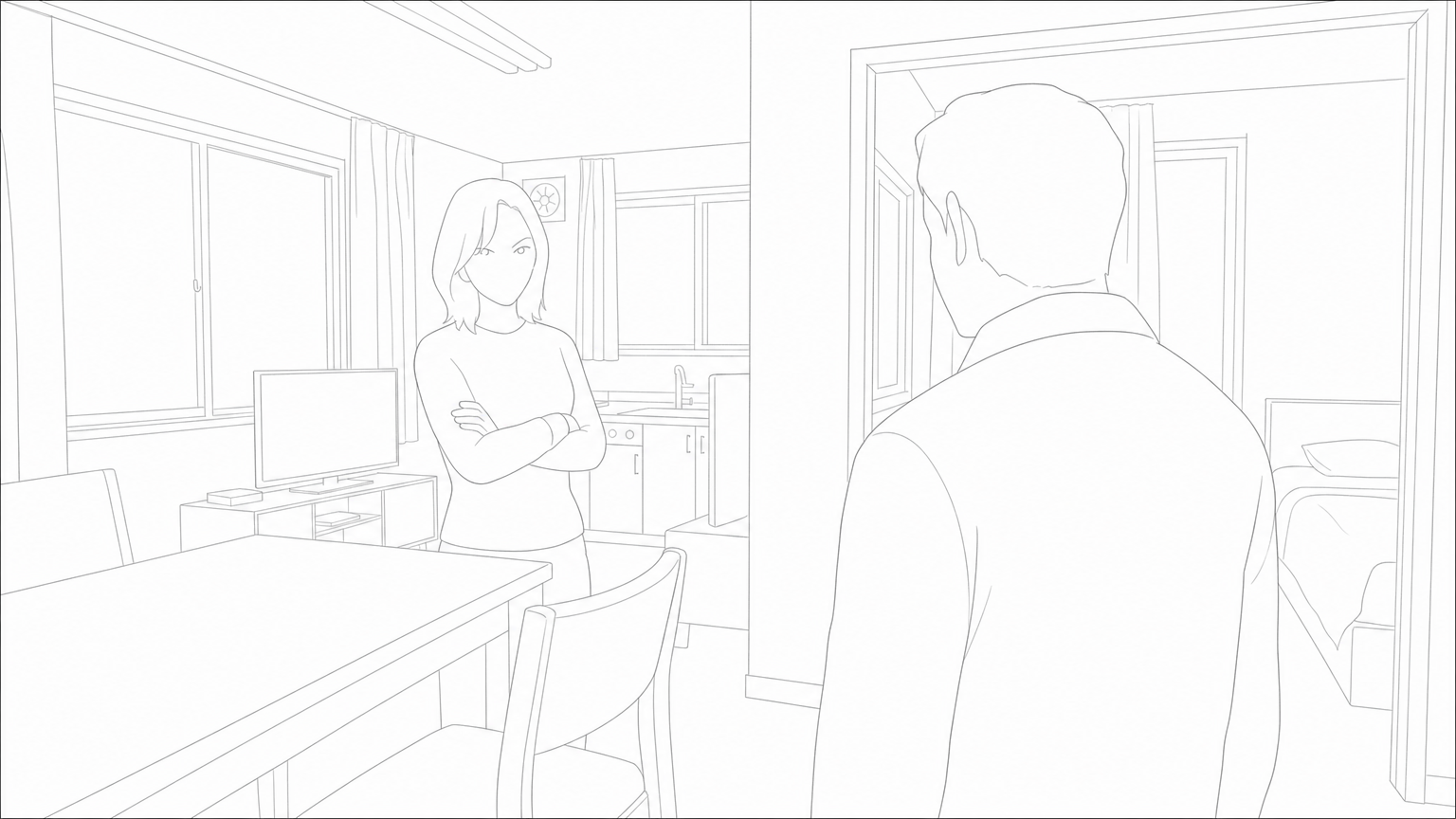
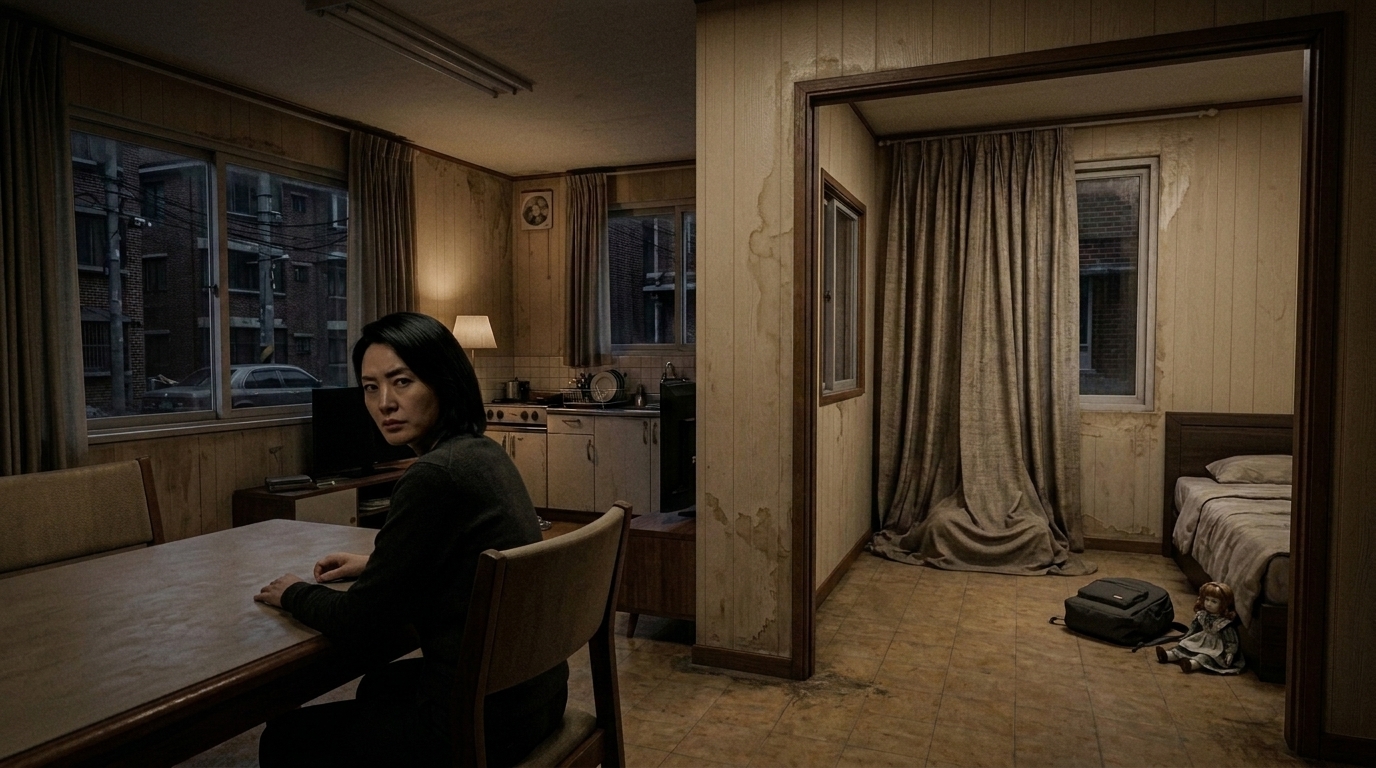
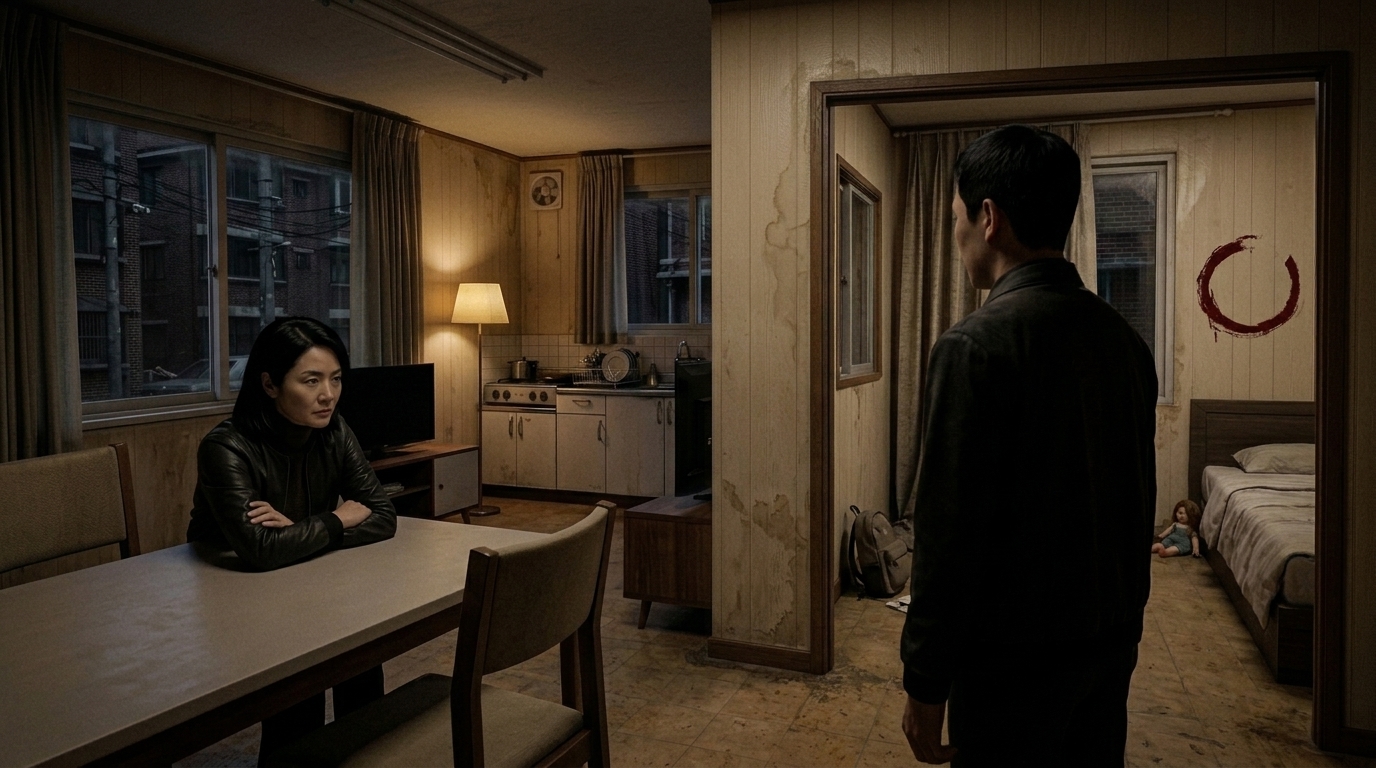
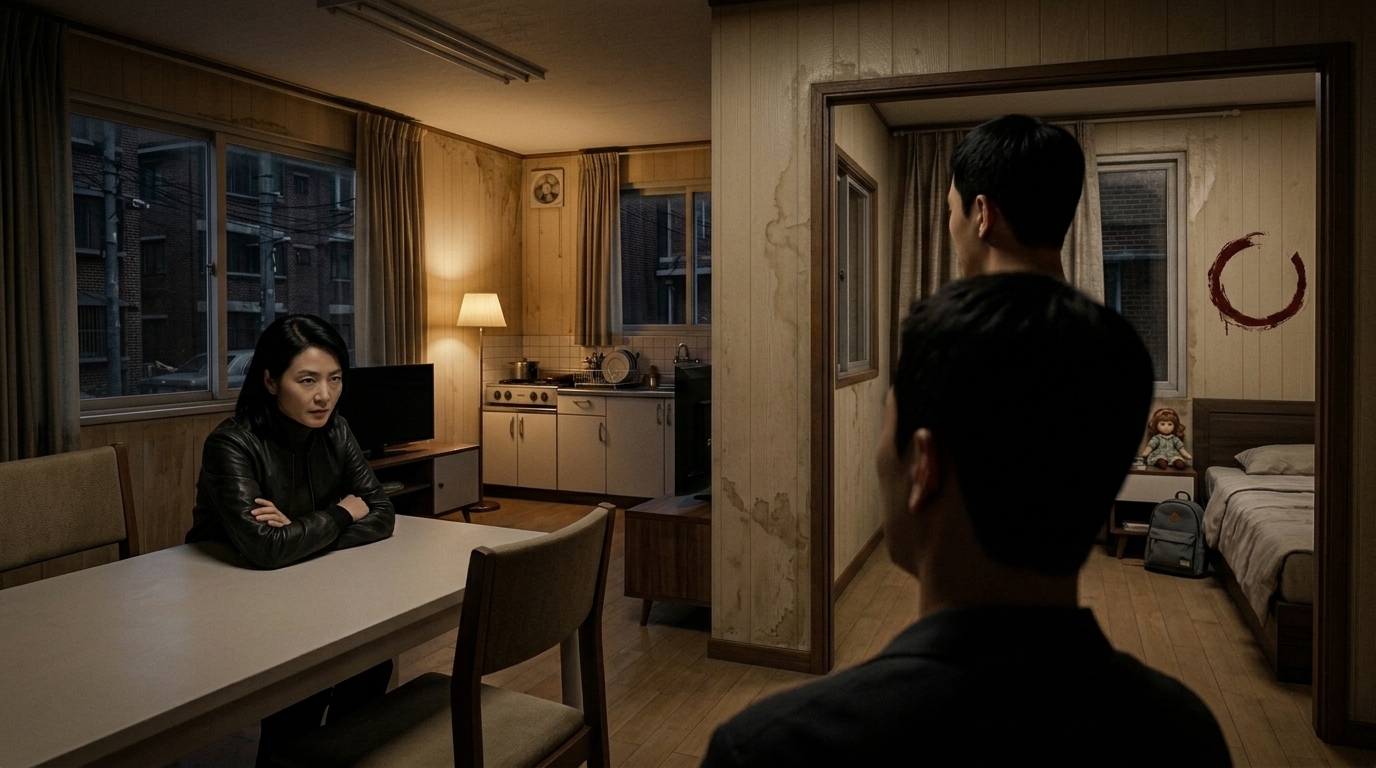
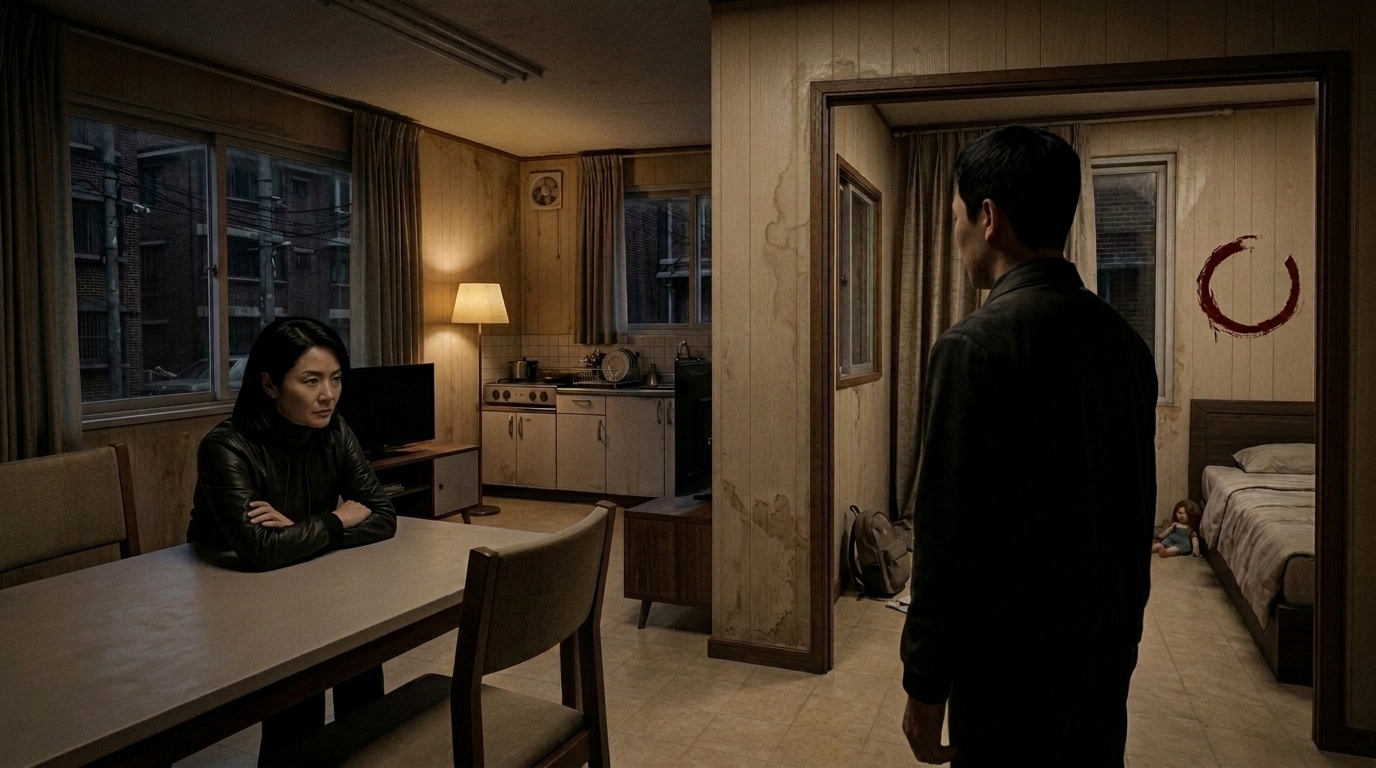
Create ONE FINAL photorealistic live-action film still of the moment below — contemporary South Korea, 2026; all people are Korean unless stated. TIME OF DAY (lock): night, interior lighting unspecified.

SHOT TEXT (authoritative, Korean): 혜수가 날카로운 눈빛으로 김형사를 노려보는 모습

LOCATION (lock): A compact rooftop apartment whose living area, dining table, and bedroom now appear unnaturally clean and orderly. A backpack and a doll sit in the bedroom in subtly altered positions. The shot takes place here — the attached LOCATION PHOTOGRAPH shows the exact spot.

REALIZE FIGURATIVE LANGUAGE AS A LIVE-ACTION SHOT: the Korean shot
text may describe characters metaphorically, figuratively or with
exaggeration. Photograph what a real movie camera would actually
record on a physical set — exaggerated or figurative impressions
become realistic staging choices (lighting, distance, angle,
wardrobe), not literal fantasy imagery.
EVERY CHARACTER IS A HUMAN BEING: unless the story explicitly
features non-human or virtual beings (as in science fiction or
fantasy), every character — however indirectly, vaguely or
figuratively the text describes them — IS a real human. When the
text gives no direct visual description of a person, IMAGINE one
and still show them as a concrete, fully-formed human being:
always render the human form to the maximum extent — build,
posture, face, hands, clothing — never reduce a person to a shape,
blob, solid silhouette or abstract mass.

EXPRESSIONS ARE ACTED, NEVER ANATOMICAL: when the text describes a
person's eyes, face or presence emotionally or figuratively (vacant,
hollow, dazed, burning, lifeless gaze and the like), it describes an
ACTOR'S PERFORMANCE captured by a real camera — realize it ONLY
through gaze direction, focus, eyelids, facial muscles, stillness
and posture. Every living person's eyes remain anatomically normal
human eyes with a natural iris and pupil, natural sclera and normal
proportions; NEVER whiten, blank out, cloud over, glow, enlarge or
otherwise alter eyeballs, skin or anatomy — unless the story
explicitly declares that being non-human or supernatural in form.

PROPS FACE THE RIGHT WAY: every handheld or used object must be
oriented exactly as its real-world use requires. A person reading,
watching or operating something (a phone, a photograph, a paper,
any device) has its functional side — screen, front, page — facing
THEIR OWN eyes; the camera then sees whatever side the staging
geometry implies (often its back). Show the functional side to the
camera ONLY when the shot text itself stages it toward the viewer.
Never flip, mirror or reverse an object's front and back.

CARRIED STATE (persist exactly — must match the neighbouring shots of this scene): The apartment remains unnaturally clean: the corpse and blood are absent, and the two teacups previously on the table are gone.

PEOPLE: the SHOT TEXT alone decides whether any person is visible in this shot. IF a person appears, they must be one of: 혜수 (Korean 40대 중반 여성, 단정한 검은 머리, 성숙한 타원형 얼굴, 또렷한 이목구비) — never anyone else, and never add a person the shot text does not show. IF only part of a person is in frame (a hand, arm, foot, back, silhouette), that body part belongs to the specific person the shot text names — its sex, age, build, skin and grooming must unmistakably match that person's profile above.

No text, captions, watermarks or annotations anywhere.
Create ONE FINAL photorealistic live-action film still of the moment below — contemporary South Korea, 2026; all people are Korean unless stated. TIME OF DAY (lock): night.

SHOT TEXT (authoritative, Korean): 혜수의 손이 음료수 캔을 쥔 채 수리영 앞으로 내밀어진 순간

LOCATION (lock): A bus-stop area beside the coast, with seating oriented toward the open sea. The shot takes place here — the attached LOCATION PHOTOGRAPH shows the exact spot.

REALIZE FIGURATIVE LANGUAGE AS A LIVE-ACTION SHOT: the Korean shot
text may describe characters metaphorically, figuratively or with
exaggeration. Photograph what a real movie camera would actually
record on a physical set — exaggerated or figurative impressions
become realistic staging choices (lighting, distance, angle,
wardrobe), not literal fantasy imagery.
EVERY CHARACTER IS A HUMAN BEING: unless the story explicitly
features non-human or virtual beings (as in science fiction or
fantasy), every character — however indirectly, vaguely or
figuratively the text describes them — IS a real human. When the
text gives no direct visual description of a person, IMAGINE one
and still show them as a concrete, fully-formed human being:
always render the human form to the maximum extent — build,
posture, face, hands, clothing — never reduce a person to a shape,
blob, solid silhouette or abstract mass.

EXPRESSIONS ARE ACTED, NEVER ANATOMICAL: when the text describes a
person's eyes, face or presence emotionally or figuratively (vacant,
hollow, dazed, burning, lifeless gaze and the like), it describes an
ACTOR'S PERFORMANCE captured by a real camera — realize it ONLY
through gaze direction, focus, eyelids, facial muscles, stillness
and posture. Every living person's eyes remain anatomically normal
human eyes with a natural iris and pupil, natural sclera and normal
proportions; NEVER whiten, blank out, cloud over, glow, enlarge or
otherwise alter eyeballs, skin or anatomy — unless the story
explicitly declares that being non-human or supernatural in form.

PROPS FACE THE RIGHT WAY: every handheld or used object must be
oriented exactly as its real-world use requires. A person reading,
watching or operating something (a phone, a photograph, a paper,
any device) has its functional side — screen, front, page — facing
THEIR OWN eyes; the camera then sees whatever side the staging
geometry implies (often its back). Show the functional side to the
camera ONLY when the shot text itself stages it toward the viewer.
Never flip, mirror or reverse an object's front and back.

CARRIED STATE (persist exactly — must match the neighbouring shots of this scene): Su-ri-young still carries her smartphone as Hye-su extends the drink can to her.

PEOPLE: the SHOT TEXT alone decides whether any person is visible in this shot. IF a person appears, they must be one of: 혜수 (Korean 40대 중반 여성, 단정한 검은 머리, 성숙한 타원형 얼굴, 또렷한 이목구비) — never anyone else, and never add a person the shot text does not show. IF only part of a person is in frame (a hand, arm, foot, back, silhouette), that body part belongs to the specific person the shot text names — its sex, age, build, skin and grooming must unmistakably match that person's profile above.

No text, captions, watermarks or annotations anywhere.
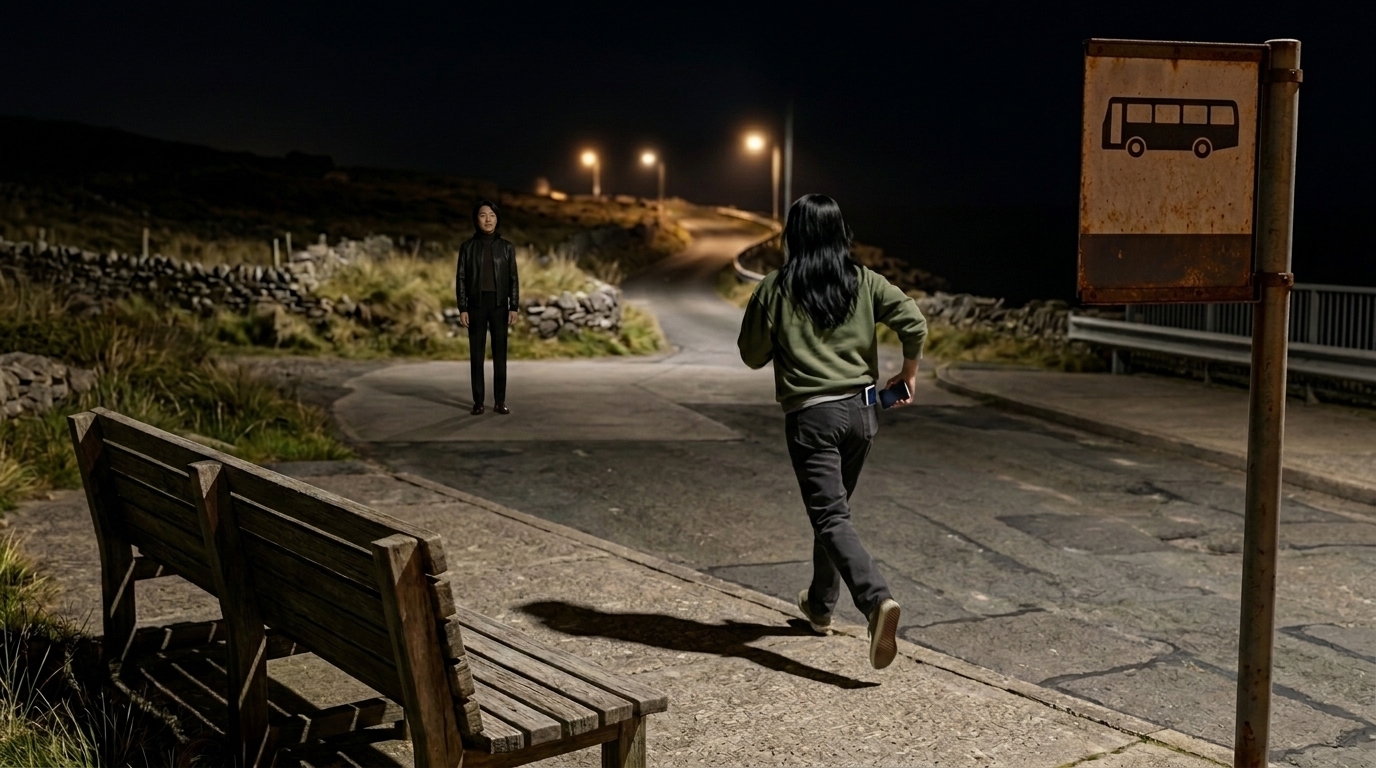
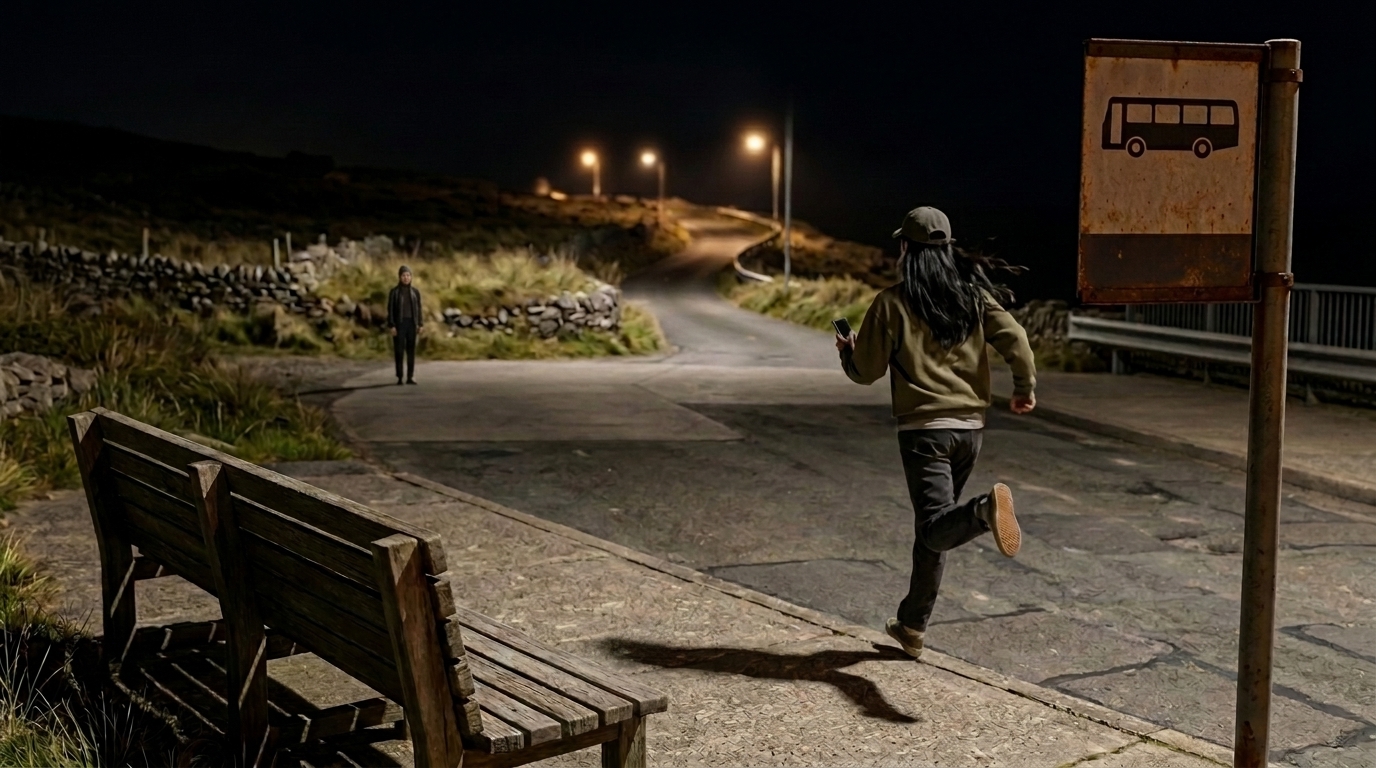
Create ONE FINAL photorealistic live-action film still of the moment below — contemporary South Korea, 2026; all people are Korean unless stated. TIME OF DAY (lock): night.

SHOT TEXT (authoritative, Korean): 멀리서 혜수의 전신과 한 발을 공중에 띄운 mid-stride 자세로 달리는 수리영의 뒷모습을 한 프레임에 담은 넓은 구도

LOCATION (lock): A bus-stop area beside the coast, with seating oriented toward the open sea. The shot takes place here — the attached LOCATION PHOTOGRAPH shows the exact spot.

REALIZE FIGURATIVE LANGUAGE AS A LIVE-ACTION SHOT: the Korean shot
text may describe characters metaphorically, figuratively or with
exaggeration. Photograph what a real movie camera would actually
record on a physical set — exaggerated or figurative impressions
become realistic staging choices (lighting, distance, angle,
wardrobe), not literal fantasy imagery.
EVERY CHARACTER IS A HUMAN BEING: unless the story explicitly
features non-human or virtual beings (as in science fiction or
fantasy), every character — however indirectly, vaguely or
figuratively the text describes them — IS a real human. When the
text gives no direct visual description of a person, IMAGINE one
and still show them as a concrete, fully-formed human being:
always render the human form to the maximum extent — build,
posture, face, hands, clothing — never reduce a person to a shape,
blob, solid silhouette or abstract mass.

EXPRESSIONS ARE ACTED, NEVER ANATOMICAL: when the text describes a
person's eyes, face or presence emotionally or figuratively (vacant,
hollow, dazed, burning, lifeless gaze and the like), it describes an
ACTOR'S PERFORMANCE captured by a real camera — realize it ONLY
through gaze direction, focus, eyelids, facial muscles, stillness
and posture. Every living person's eyes remain anatomically normal
human eyes with a natural iris and pupil, natural sclera and normal
proportions; NEVER whiten, blank out, cloud over, glow, enlarge or
otherwise alter eyeballs, skin or anatomy — unless the story
explicitly declares that being non-human or supernatural in form.

PROPS FACE THE RIGHT WAY: every handheld or used object must be
oriented exactly as its real-world use requires. A person reading,
watching or operating something (a phone, a photograph, a paper,
any device) has its functional side — screen, front, page — facing
THEIR OWN eyes; the camera then sees whatever side the staging
geometry implies (often its back). Show the functional side to the
camera ONLY when the shot text itself stages it toward the viewer.
Never flip, mirror or reverse an object's front and back.

CARRIED STATE (persist exactly — must match the neighbouring shots of this scene): Su-ri-young runs off with her smartphone still on her person.

PEOPLE: the SHOT TEXT alone decides whether any person is visible in this shot. IF a person appears, they must be one of: 수리영 (Korean 20대 초반 여성, 긴 검은 머리, 타원형의 젊은 얼굴, 부드러운 이목구비와 자연스러운 피부색상태); 혜수 (Korean 40대 중반 여성, 단정한 검은 머리, 성숙한 타원형 얼굴, 또렷한 이목구비) — never anyone else, and never add a person the shot text does not show. IF only part of a person is in frame (a hand, arm, foot, back, silhouette), that body part belongs to the specific person the shot text names — its sex, age, build, skin and grooming must unmistakably match that person's profile above.

No text, captions, watermarks or annotations anywhere.
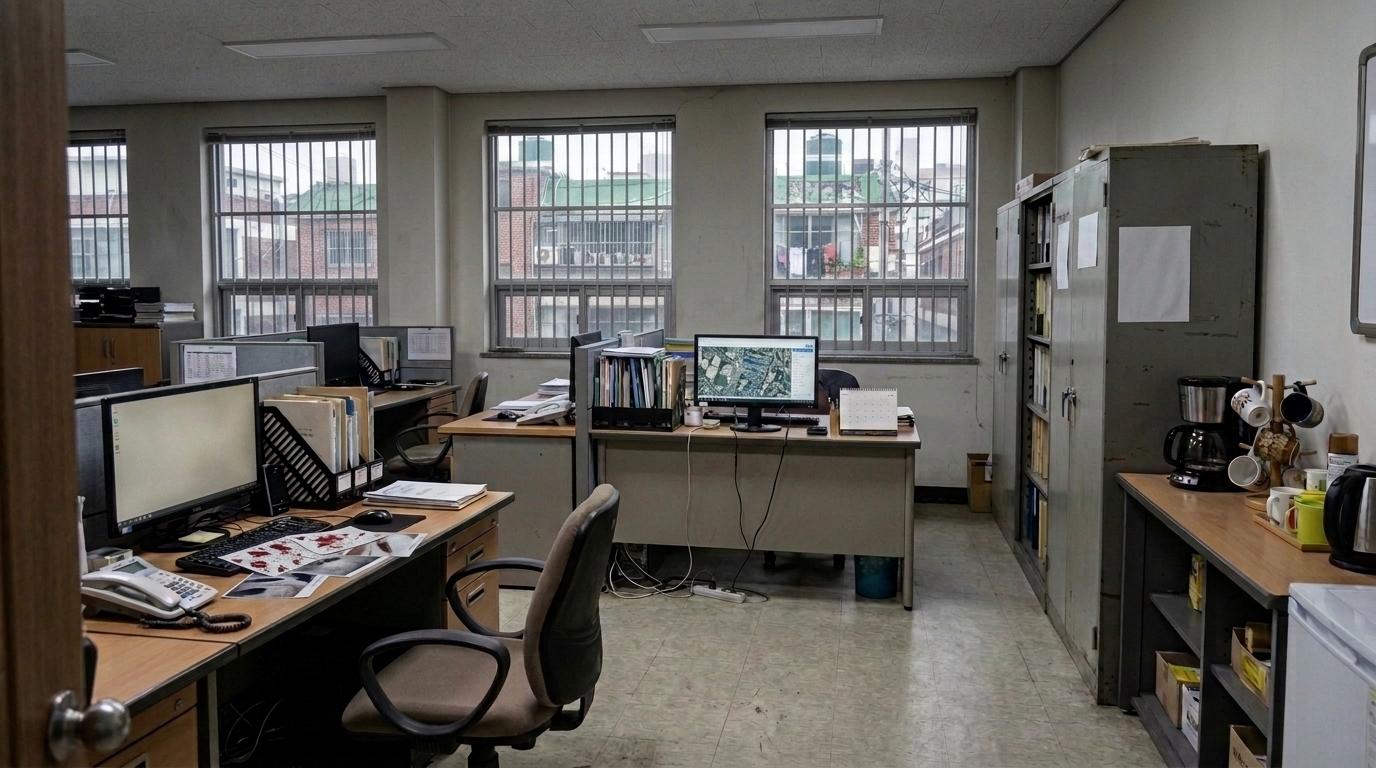
Create ONE FINAL photorealistic live-action film still of the moment below — contemporary South Korea, 2026; all people are Korean unless stated. TIME OF DAY (lock): night, office lighting unspecified.

SHOT TEXT (authoritative, Korean): 혜수가 스마트폰 액정을 김형사 쪽으로 불쑥 내민 순간

LOCATION (lock): A police-station office with duty desks, computers, telephones, and work areas for investigators. The shot takes place here — the attached LOCATION PHOTOGRAPH shows the exact spot.

REALIZE FIGURATIVE LANGUAGE AS A LIVE-ACTION SHOT: the Korean shot
text may describe characters metaphorically, figuratively or with
exaggeration. Photograph what a real movie camera would actually
record on a physical set — exaggerated or figurative impressions
become realistic staging choices (lighting, distance, angle,
wardrobe), not literal fantasy imagery.
EVERY CHARACTER IS A HUMAN BEING: unless the story explicitly
features non-human or virtual beings (as in science fiction or
fantasy), every character — however indirectly, vaguely or
figuratively the text describes them — IS a real human. When the
text gives no direct visual description of a person, IMAGINE one
and still show them as a concrete, fully-formed human being:
always render the human form to the maximum extent — build,
posture, face, hands, clothing — never reduce a person to a shape,
blob, solid silhouette or abstract mass.

EXPRESSIONS ARE ACTED, NEVER ANATOMICAL: when the text describes a
person's eyes, face or presence emotionally or figuratively (vacant,
hollow, dazed, burning, lifeless gaze and the like), it describes an
ACTOR'S PERFORMANCE captured by a real camera — realize it ONLY
through gaze direction, focus, eyelids, facial muscles, stillness
and posture. Every living person's eyes remain anatomically normal
human eyes with a natural iris and pupil, natural sclera and normal
proportions; NEVER whiten, blank out, cloud over, glow, enlarge or
otherwise alter eyeballs, skin or anatomy — unless the story
explicitly declares that being non-human or supernatural in form.

PROPS FACE THE RIGHT WAY: every handheld or used object must be
oriented exactly as its real-world use requires. A person reading,
watching or operating something (a phone, a photograph, a paper,
any device) has its functional side — screen, front, page — facing
THEIR OWN eyes; the camera then sees whatever side the staging
geometry implies (often its back). Show the functional side to the
camera ONLY when the shot text itself stages it toward the viewer.
Never flip, mirror or reverse an object's front and back.

CARRIED STATE (persist exactly — must match the neighbouring shots of this scene): Hye-su is holding her smartphone with Min-suk's saved number displayed on its screen.

PEOPLE: the SHOT TEXT alone decides whether any person is visible in this shot. IF a person appears, they must be one of: 혜수 (Korean 40대 중반 여성, 단정한 검은 머리, 성숙한 타원형 얼굴, 또렷한 이목구비); 김형사 (Korean 30대 남성, 짧은 검은 머리, 성숙한 얼굴, 완만하게 각진 턱선) — never anyone else, and never add a person the shot text does not show. IF only part of a person is in frame (a hand, arm, foot, back, silhouette), that body part belongs to the specific person the shot text names — its sex, age, build, skin and grooming must unmistakably match that person's profile above.

No text, captions, watermarks or annotations anywhere.
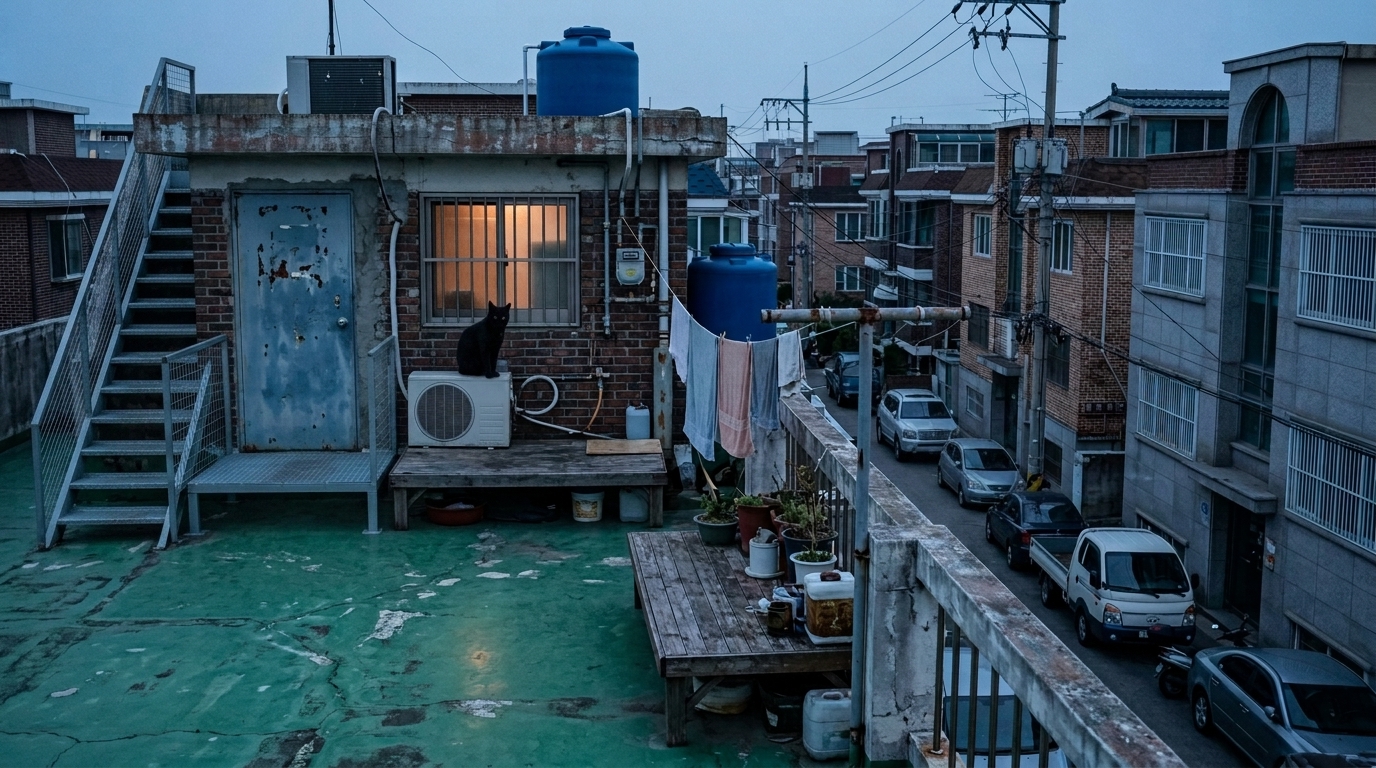
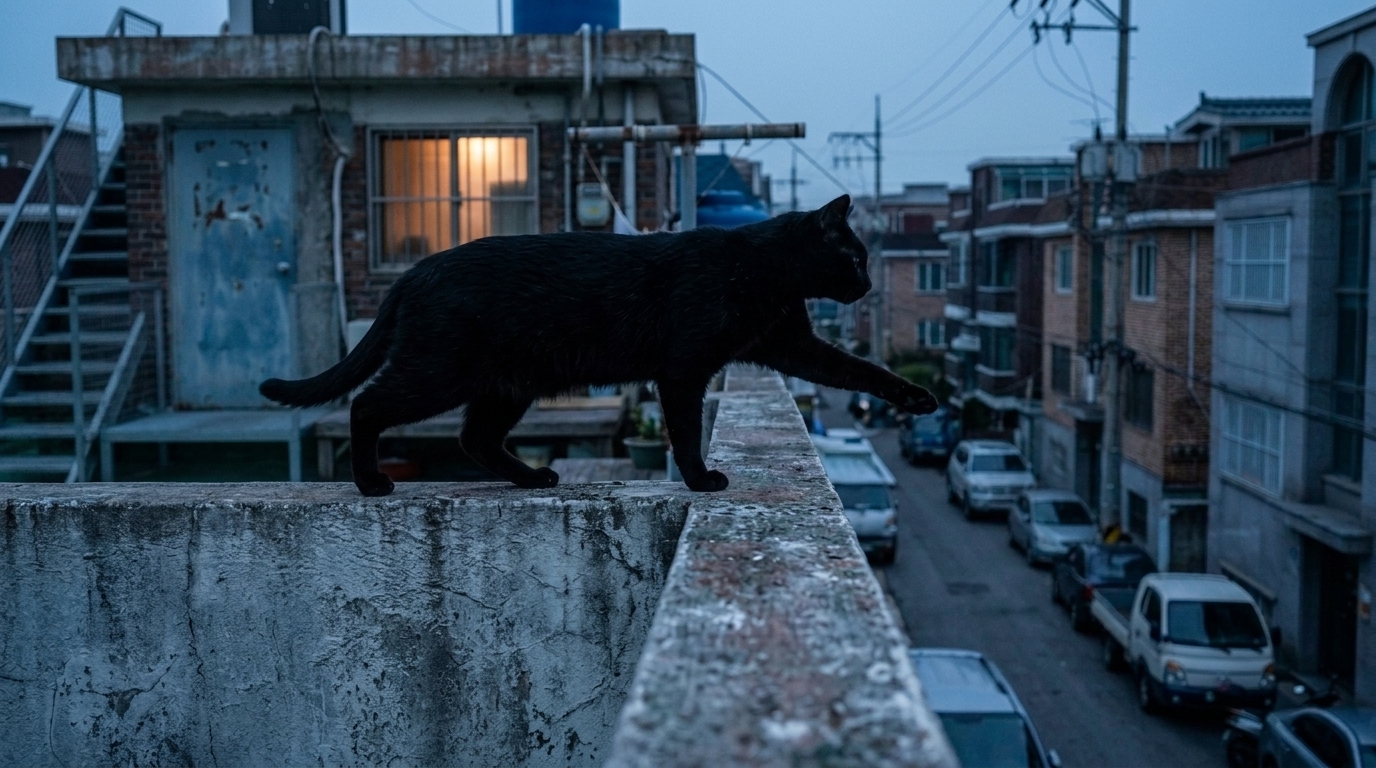
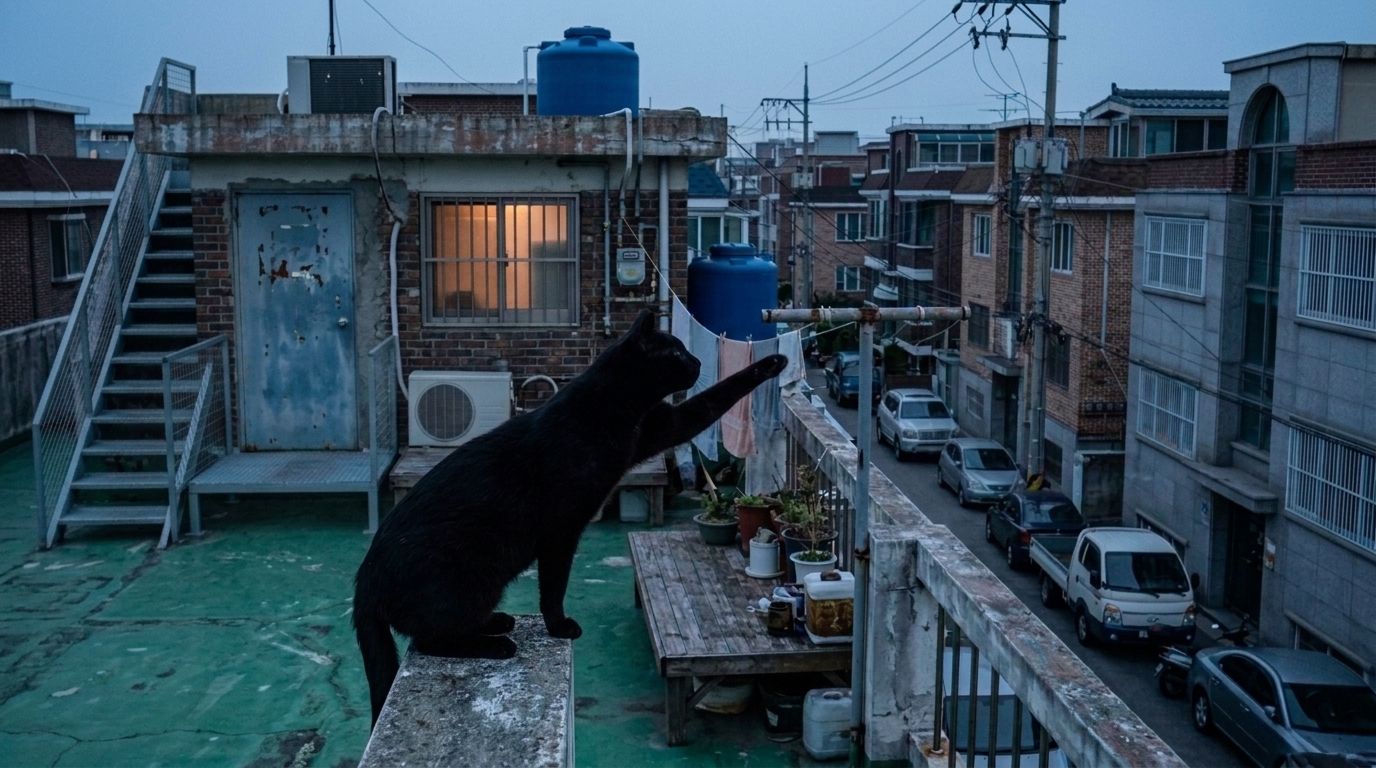
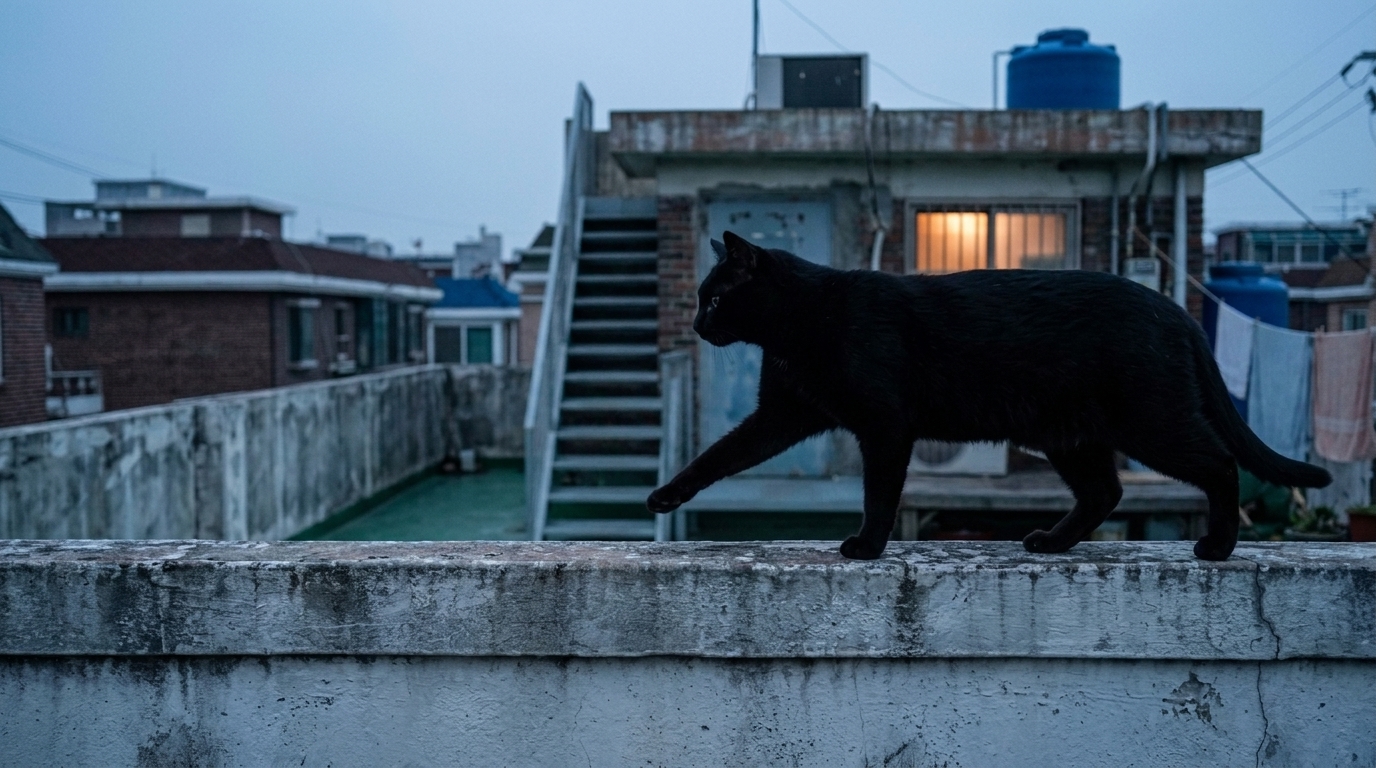
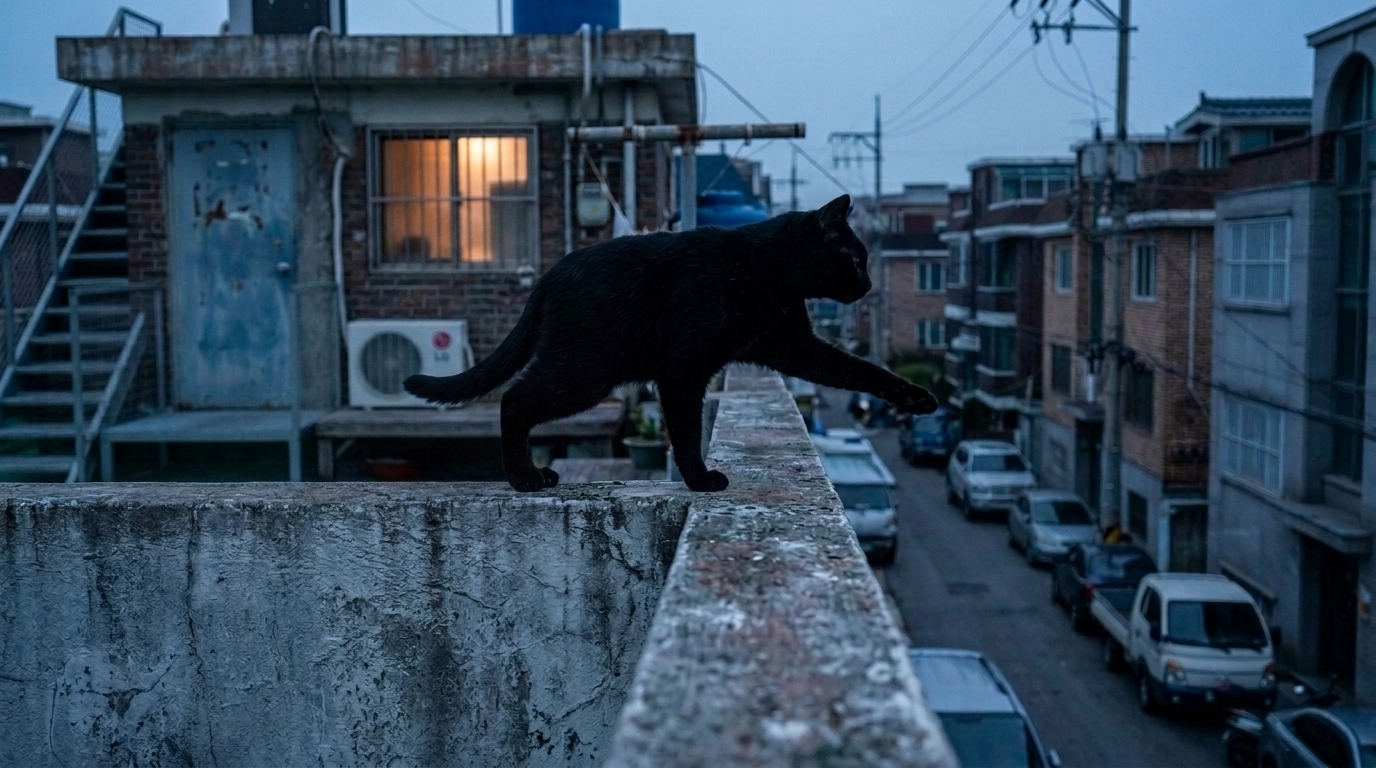
Create ONE FINAL photorealistic live-action film still of the moment below — contemporary South Korea, 2026; all people are Korean unless stated. TIME OF DAY (lock): dawn, rooftop apartment light on.

SHOT TEXT (authoritative, Korean): 옥상 담벼락 위에서 한쪽 앞발을 허공으로 뻗은 검은 고양이의 측면

LOCATION (lock): The rooftop exterior of an old villa, with a small rooftop apartment visible beyond a wall; the apartment light remains on. The shot takes place here — the attached LOCATION PHOTOGRAPH shows the exact spot.

REALIZE FIGURATIVE LANGUAGE AS A LIVE-ACTION SHOT: the Korean shot
text may describe characters metaphorically, figuratively or with
exaggeration. Photograph what a real movie camera would actually
record on a physical set — exaggerated or figurative impressions
become realistic staging choices (lighting, distance, angle,
wardrobe), not literal fantasy imagery.
EVERY CHARACTER IS A HUMAN BEING: unless the story explicitly
features non-human or virtual beings (as in science fiction or
fantasy), every character — however indirectly, vaguely or
figuratively the text describes them — IS a real human. When the
text gives no direct visual description of a person, IMAGINE one
and still show them as a concrete, fully-formed human being:
always render the human form to the maximum extent — build,
posture, face, hands, clothing — never reduce a person to a shape,
blob, solid silhouette or abstract mass.

EXPRESSIONS ARE ACTED, NEVER ANATOMICAL: when the text describes a
person's eyes, face or presence emotionally or figuratively (vacant,
hollow, dazed, burning, lifeless gaze and the like), it describes an
ACTOR'S PERFORMANCE captured by a real camera — realize it ONLY
through gaze direction, focus, eyelids, facial muscles, stillness
and posture. Every living person's eyes remain anatomically normal
human eyes with a natural iris and pupil, natural sclera and normal
proportions; NEVER whiten, blank out, cloud over, glow, enlarge or
otherwise alter eyeballs, skin or anatomy — unless the story
explicitly declares that being non-human or supernatural in form.

PROPS FACE THE RIGHT WAY: every handheld or used object must be
oriented exactly as its real-world use requires. A person reading,
watching or operating something (a phone, a photograph, a paper,
any device) has its functional side — screen, front, page — facing
THEIR OWN eyes; the camera then sees whatever side the staging
geometry implies (often its back). Show the functional side to the
camera ONLY when the shot text itself stages it toward the viewer.
Never flip, mirror or reverse an object's front and back.

CARRIED STATE (persist exactly — must match the neighbouring shots of this scene): The rooftop room remains lit while the black cat crosses the wall.

NO PEOPLE IN THIS SHOT: the shot text shows only the place and its state — no living person or any body part appears in frame, unless the shot text itself explicitly says so.

No text, captions, watermarks or annotations anywhere.
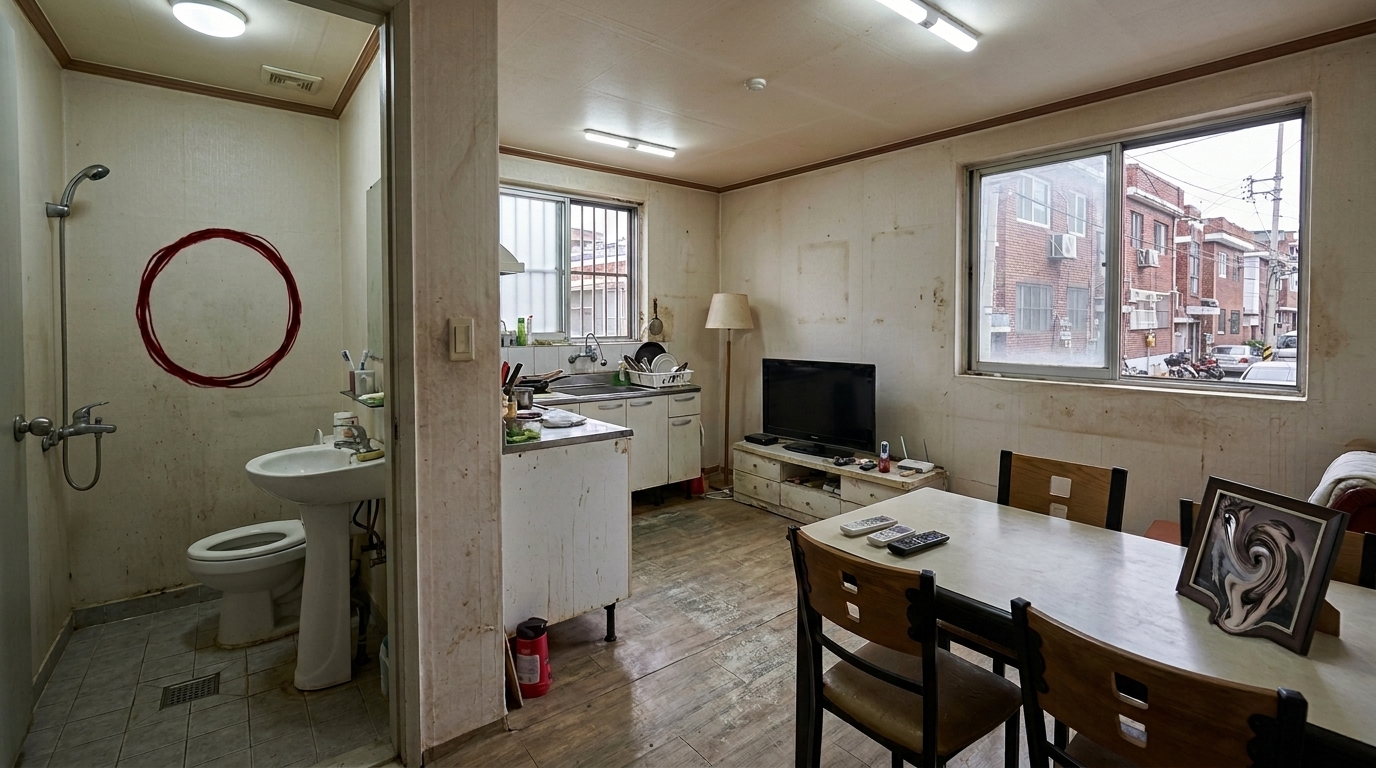
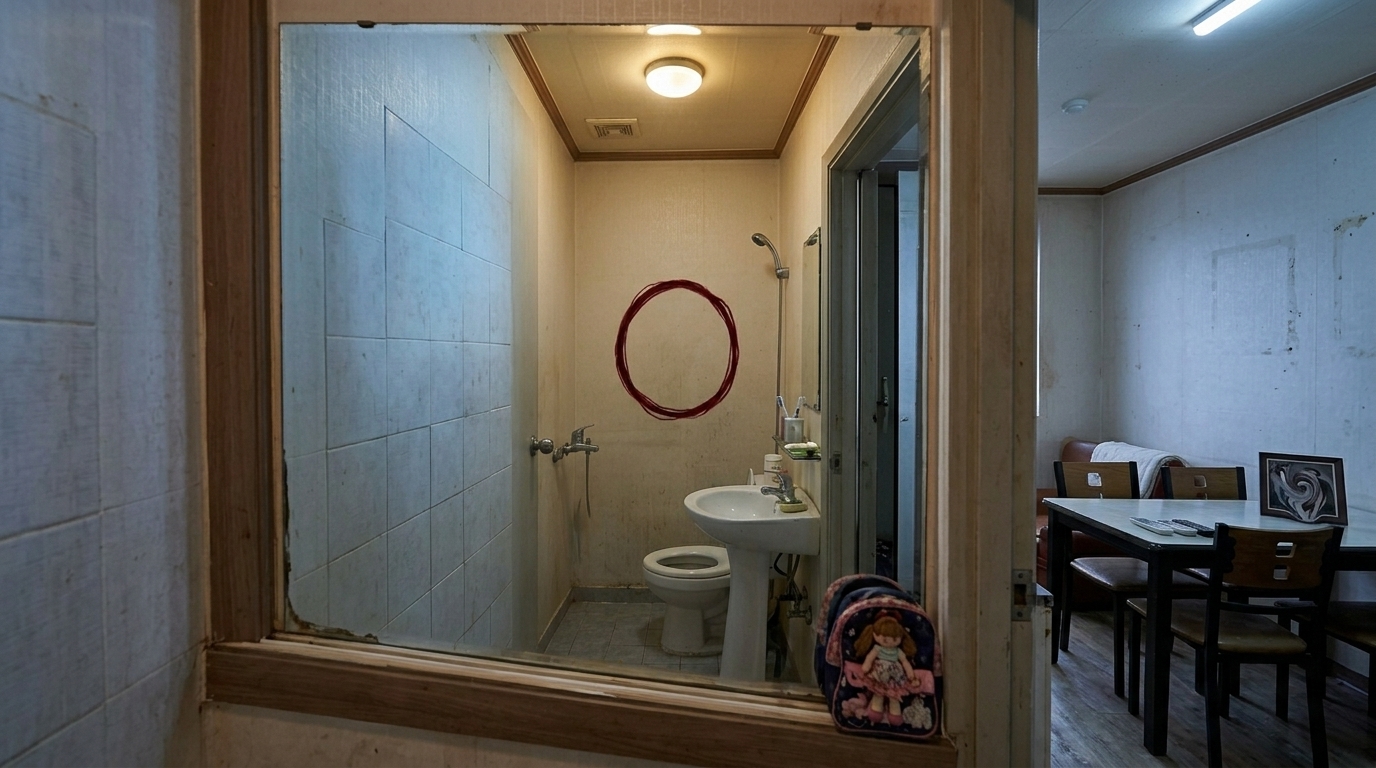
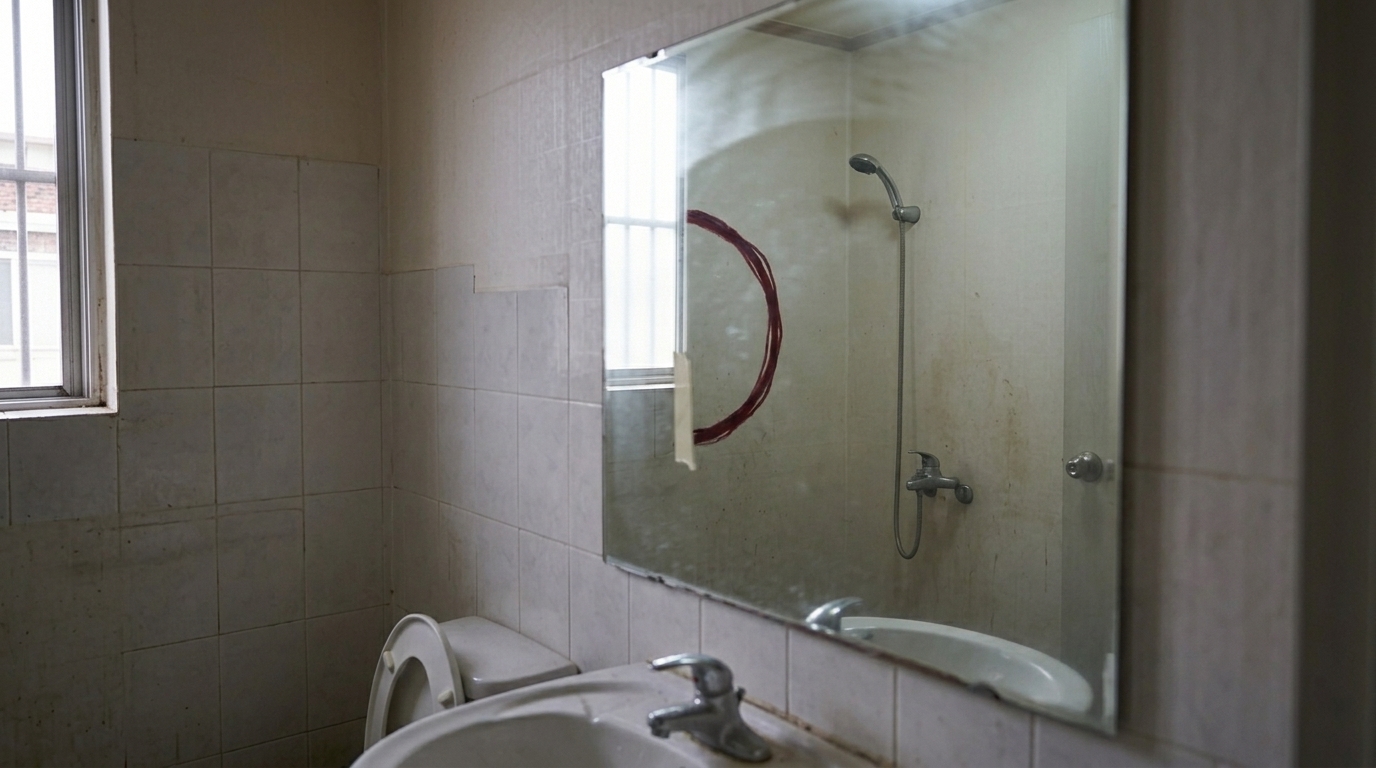
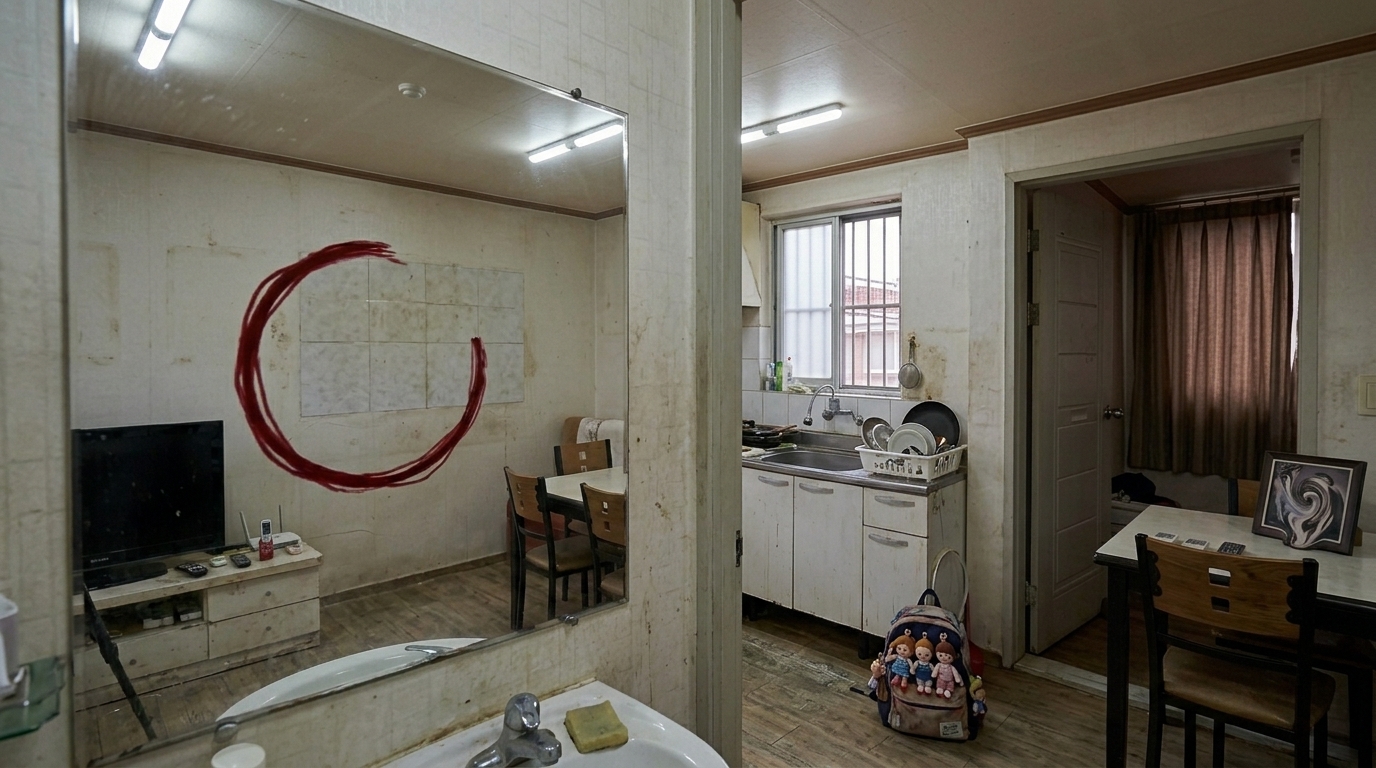
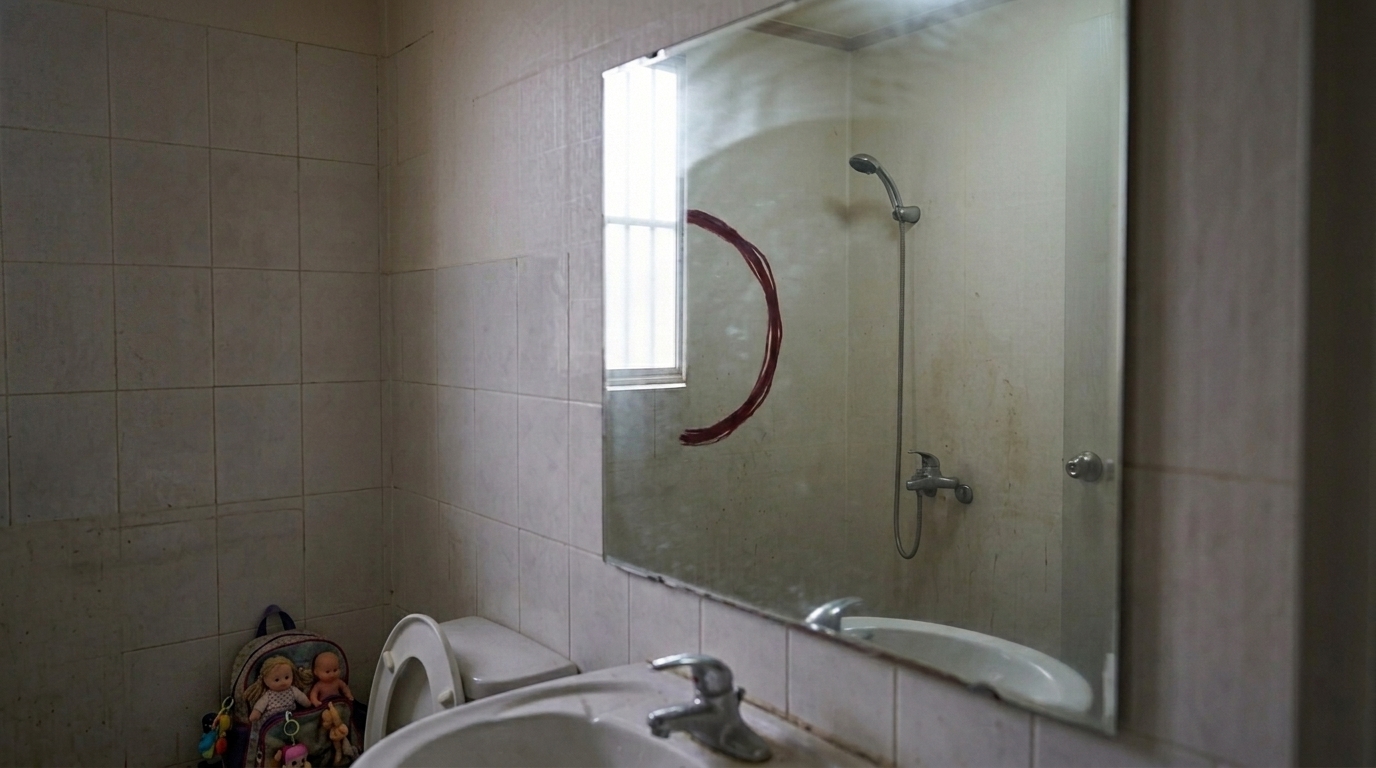
Create ONE FINAL photorealistic live-action film still of the moment below — contemporary South Korea, 2026; all people are Korean unless stated. TIME OF DAY (lock): early morning, interior lighting unspecified.

SHOT TEXT (authoritative, Korean): 거울 속 반사된 욕실 타일 벽면에 붉은색 원형 표식이 절반쯤 나타난 상태

LOCATION (lock): A small rooftop apartment containing a main bedroom, a meticulously ordered second bedroom with curtains, a bathroom with a wall mirror, and a living area with a table and framed family photograph. The shot takes place here — the attached LOCATION PHOTOGRAPH shows the exact spot.

REALIZE FIGURATIVE LANGUAGE AS A LIVE-ACTION SHOT: the Korean shot
text may describe characters metaphorically, figuratively or with
exaggeration. Photograph what a real movie camera would actually
record on a physical set — exaggerated or figurative impressions
become realistic staging choices (lighting, distance, angle,
wardrobe), not literal fantasy imagery.
EVERY CHARACTER IS A HUMAN BEING: unless the story explicitly
features non-human or virtual beings (as in science fiction or
fantasy), every character — however indirectly, vaguely or
figuratively the text describes them — IS a real human. When the
text gives no direct visual description of a person, IMAGINE one
and still show them as a concrete, fully-formed human being:
always render the human form to the maximum extent — build,
posture, face, hands, clothing — never reduce a person to a shape,
blob, solid silhouette or abstract mass.

EXPRESSIONS ARE ACTED, NEVER ANATOMICAL: when the text describes a
person's eyes, face or presence emotionally or figuratively (vacant,
hollow, dazed, burning, lifeless gaze and the like), it describes an
ACTOR'S PERFORMANCE captured by a real camera — realize it ONLY
through gaze direction, focus, eyelids, facial muscles, stillness
and posture. Every living person's eyes remain anatomically normal
human eyes with a natural iris and pupil, natural sclera and normal
proportions; NEVER whiten, blank out, cloud over, glow, enlarge or
otherwise alter eyeballs, skin or anatomy — unless the story
explicitly declares that being non-human or supernatural in form.

PROPS FACE THE RIGHT WAY: every handheld or used object must be
oriented exactly as its real-world use requires. A person reading,
watching or operating something (a phone, a photograph, a paper,
any device) has its functional side — screen, front, page — facing
THEIR OWN eyes; the camera then sees whatever side the staging
geometry implies (often its back). Show the functional side to the
camera ONLY when the shot text itself stages it toward the viewer.
Never flip, mirror or reverse an object's front and back.

CARRIED STATE (persist exactly — must match the neighbouring shots of this scene): The previously reset bedroom remains excessively clean and corpse-free. Su-ri-young has taken out her doll-adorned backpack, and a red circle is temporarily forming on the reflected bathroom wall.

NO PEOPLE IN THIS SHOT: the shot text shows only the place and its state — no living person or any body part appears in frame, unless the shot text itself explicitly says so.

No text, captions, watermarks or annotations anywhere.

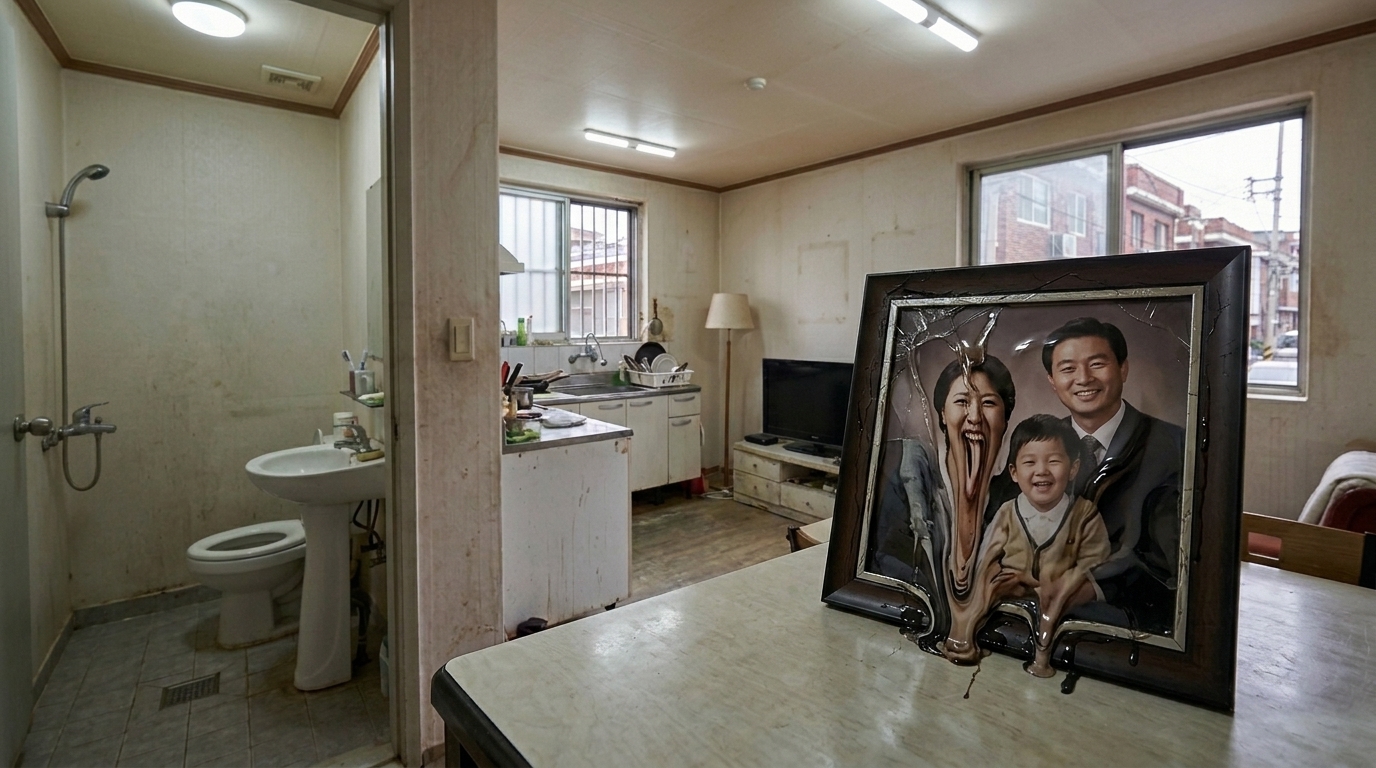
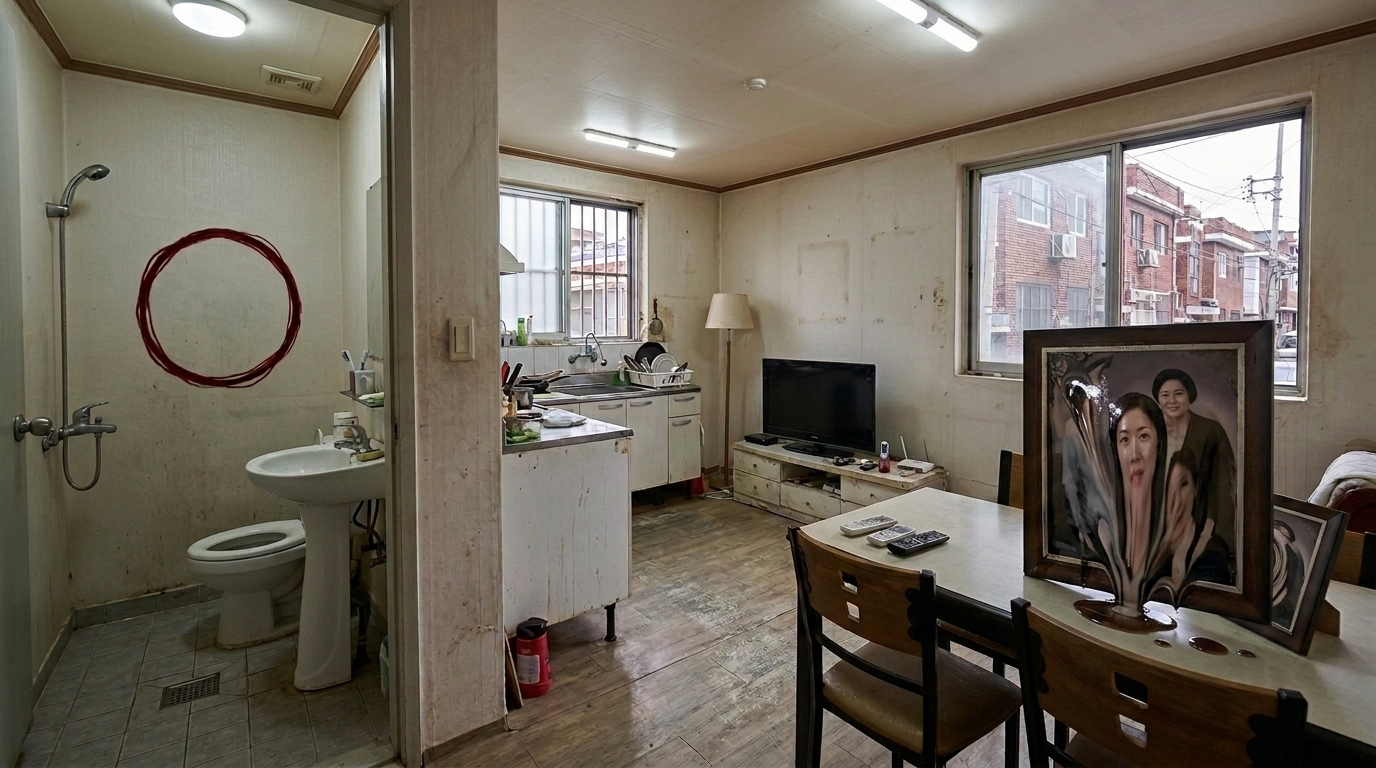
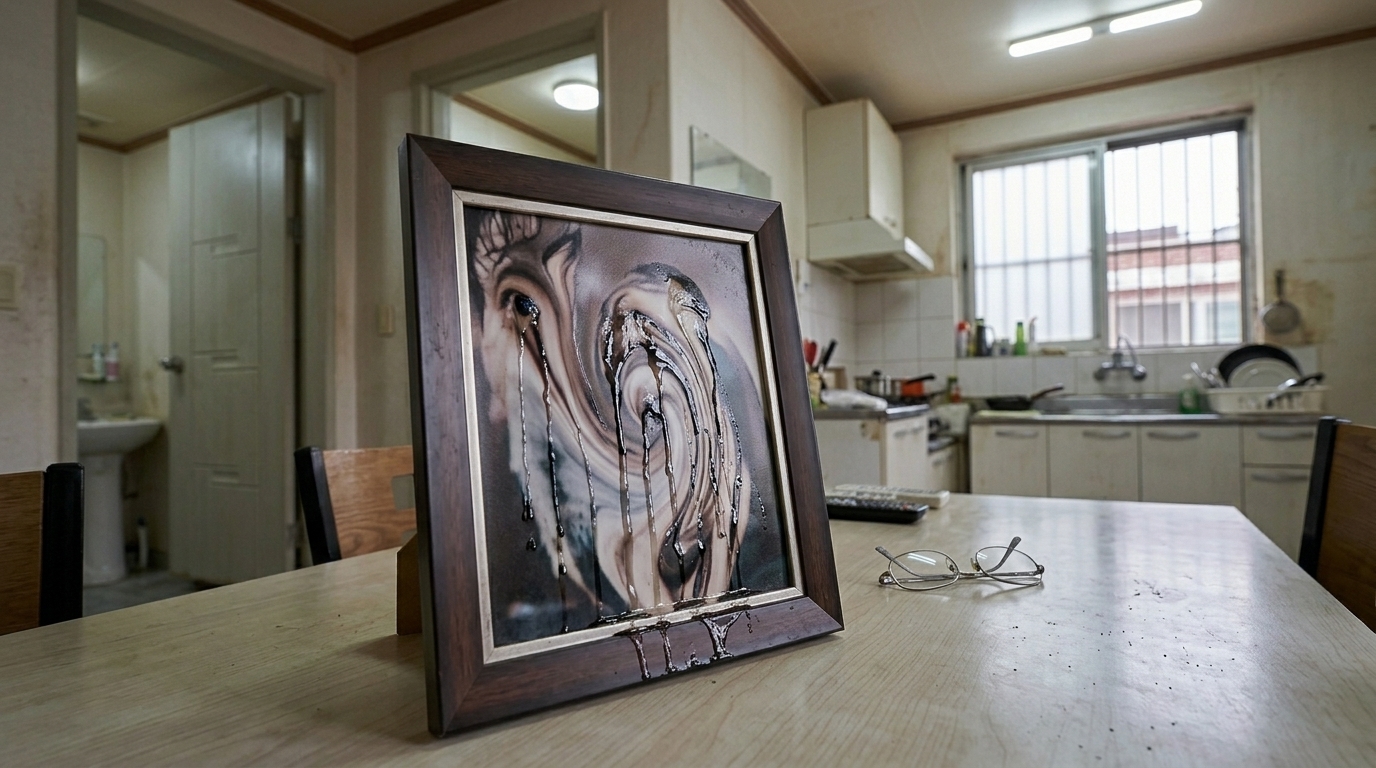
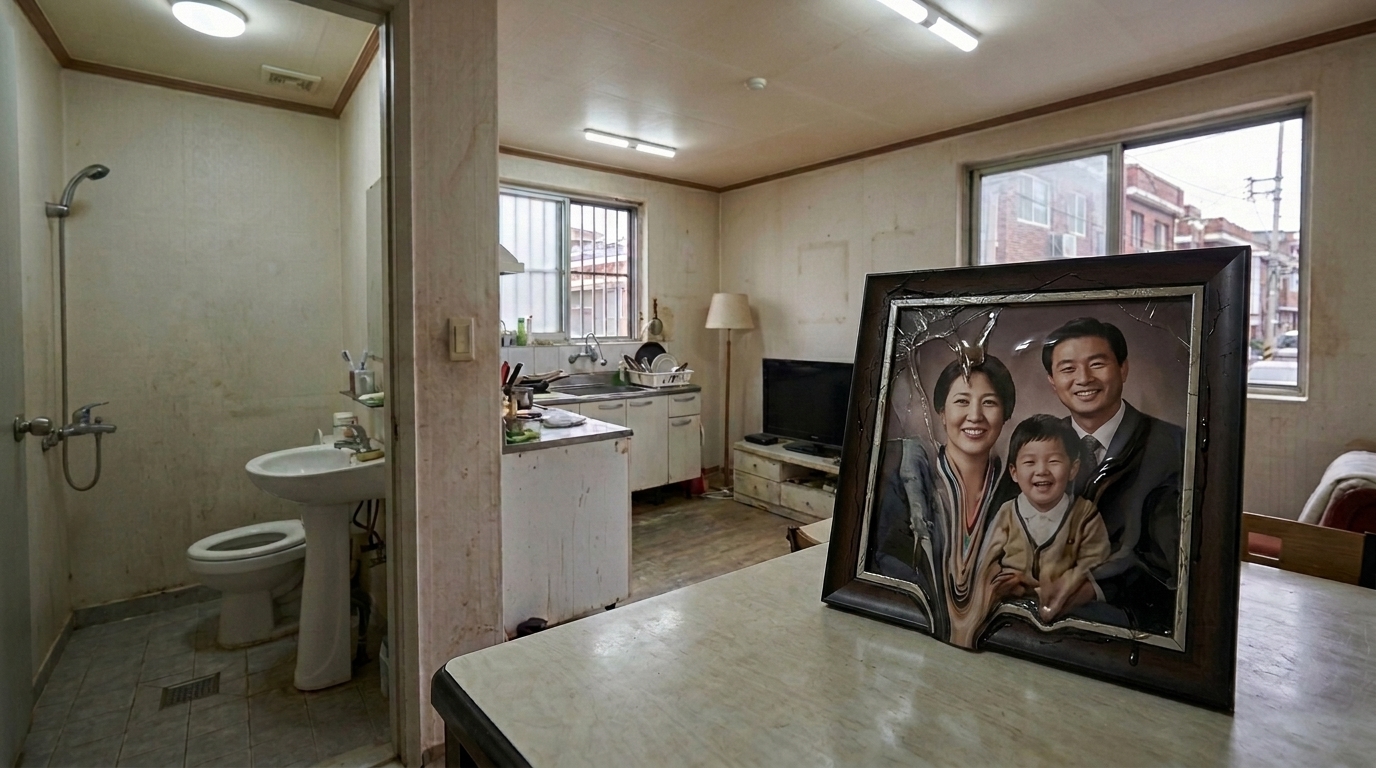
Create ONE FINAL photorealistic live-action film still of the moment below — contemporary South Korea, 2026; all people are Korean unless stated. TIME OF DAY (lock): early morning, interior lighting unspecified.

SHOT TEXT (authoritative, Korean): 액자 속 민숙의 얼굴 부분 이미지가 아래로 일그러지며 흘러내리는 찰나

LOCATION (lock): A small rooftop apartment containing a main bedroom, a meticulously ordered second bedroom with curtains, a bathroom with a wall mirror, and a living area with a table and framed family photograph. The shot takes place here — the attached LOCATION PHOTOGRAPH shows the exact spot.

REALIZE FIGURATIVE LANGUAGE AS A LIVE-ACTION SHOT: the Korean shot
text may describe characters metaphorically, figuratively or with
exaggeration. Photograph what a real movie camera would actually
record on a physical set — exaggerated or figurative impressions
become realistic staging choices (lighting, distance, angle,
wardrobe), not literal fantasy imagery.
EVERY CHARACTER IS A HUMAN BEING: unless the story explicitly
features non-human or virtual beings (as in science fiction or
fantasy), every character — however indirectly, vaguely or
figuratively the text describes them — IS a real human. When the
text gives no direct visual description of a person, IMAGINE one
and still show them as a concrete, fully-formed human being:
always render the human form to the maximum extent — build,
posture, face, hands, clothing — never reduce a person to a shape,
blob, solid silhouette or abstract mass.

EXPRESSIONS ARE ACTED, NEVER ANATOMICAL: when the text describes a
person's eyes, face or presence emotionally or figuratively (vacant,
hollow, dazed, burning, lifeless gaze and the like), it describes an
ACTOR'S PERFORMANCE captured by a real camera — realize it ONLY
through gaze direction, focus, eyelids, facial muscles, stillness
and posture. Every living person's eyes remain anatomically normal
human eyes with a natural iris and pupil, natural sclera and normal
proportions; NEVER whiten, blank out, cloud over, glow, enlarge or
otherwise alter eyeballs, skin or anatomy — unless the story
explicitly declares that being non-human or supernatural in form.

PROPS FACE THE RIGHT WAY: every handheld or used object must be
oriented exactly as its real-world use requires. A person reading,
watching or operating something (a phone, a photograph, a paper,
any device) has its functional side — screen, front, page — facing
THEIR OWN eyes; the camera then sees whatever side the staging
geometry implies (often its back). Show the functional side to the
camera ONLY when the shot text itself stages it toward the viewer.
Never flip, mirror or reverse an object's front and back.

CARRIED STATE (persist exactly — must match the neighbouring shots of this scene): Su-ri-young's doll-adorned backpack and smartphone remain with her as Min-suk's face in the framed photograph temporarily distorts and runs downward.

NO PEOPLE IN THIS SHOT: the shot text shows only the place and its state — no living person or any body part appears in frame, unless the shot text itself explicitly says so.

No text, captions, watermarks or annotations anywhere.
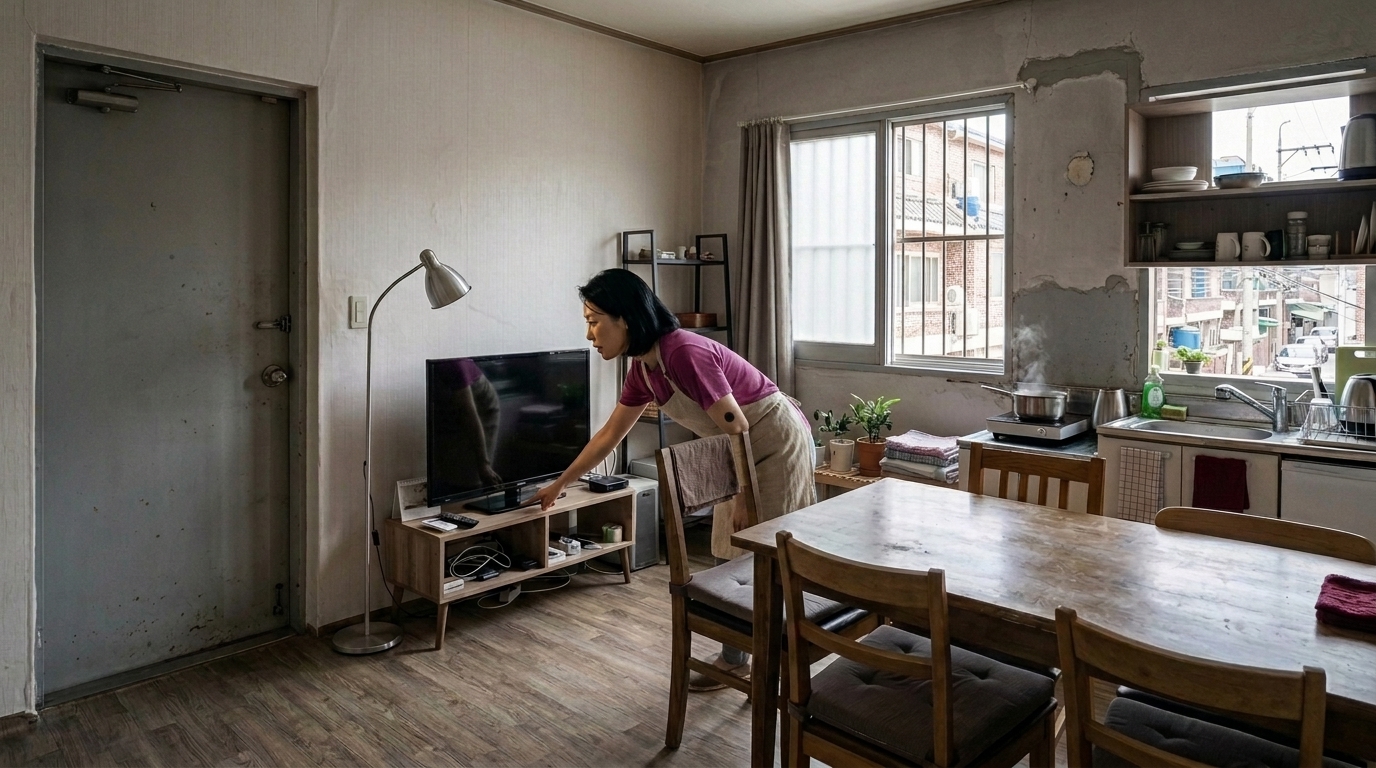
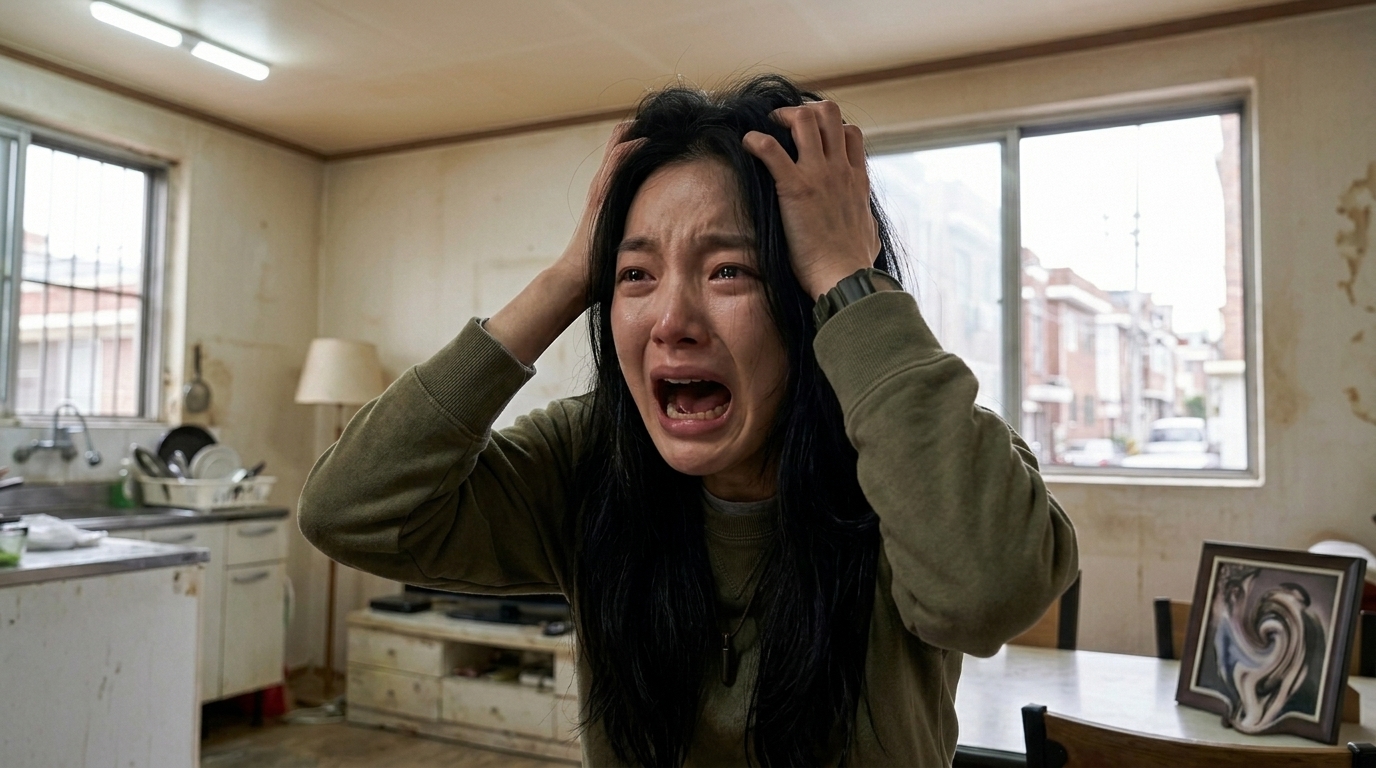
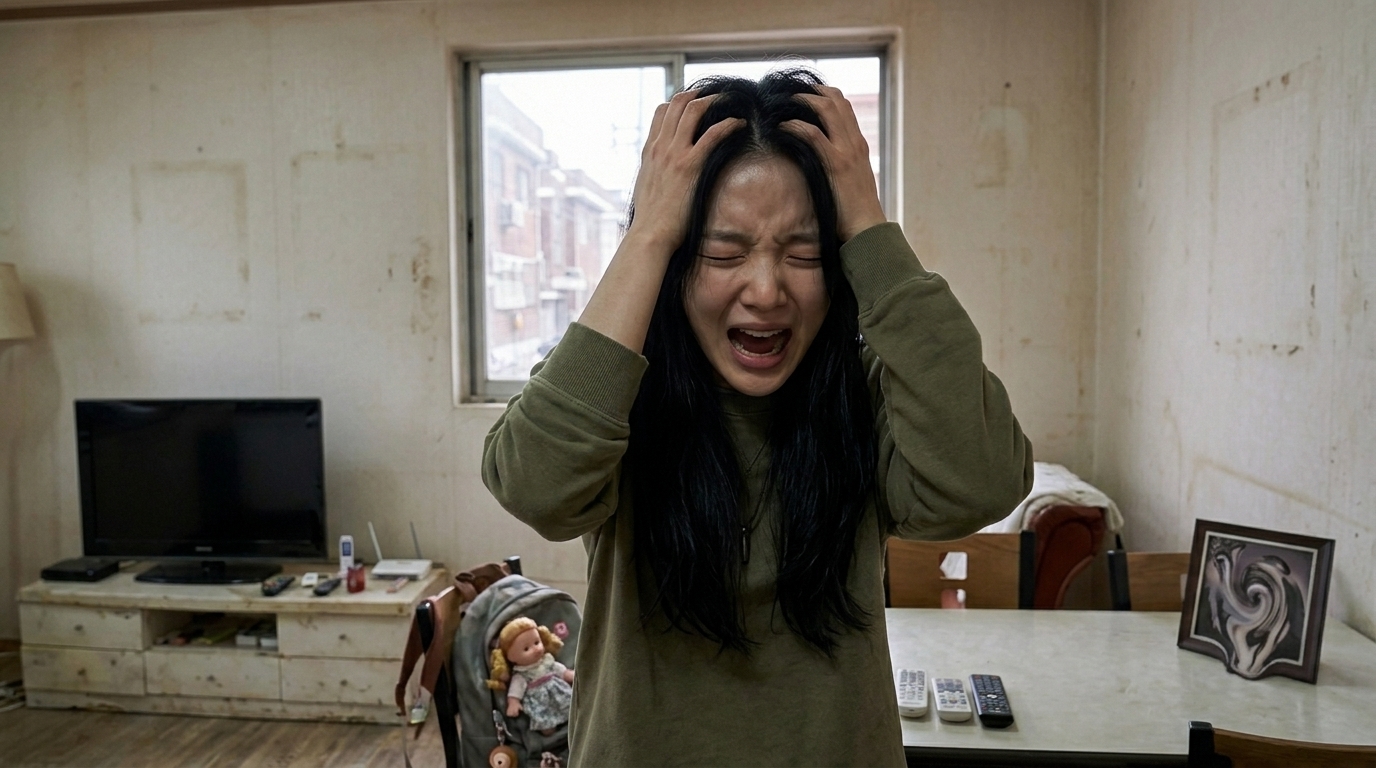
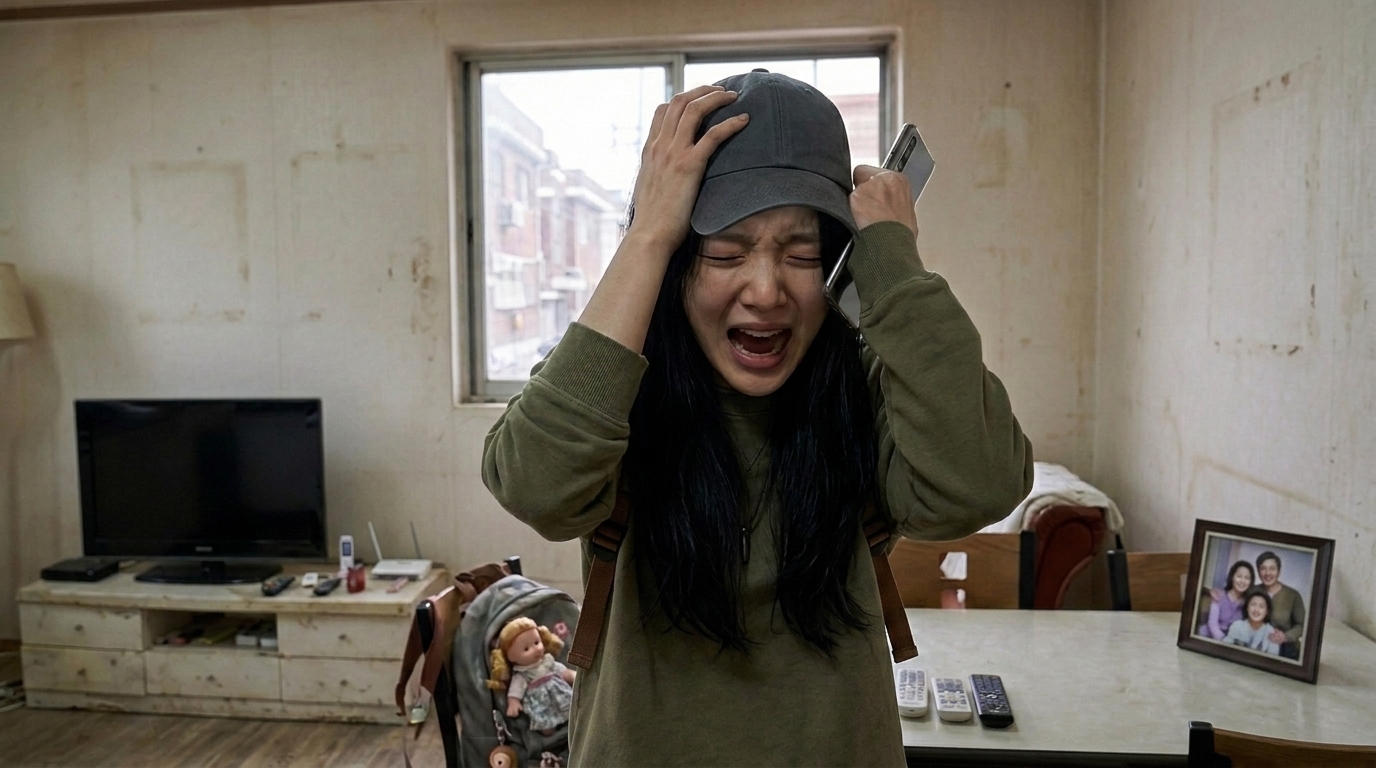
Create ONE FINAL photorealistic live-action film still of the moment below — contemporary South Korea, 2026; all people are Korean unless stated. TIME OF DAY (lock): early morning, interior lighting unspecified.

SHOT TEXT (authoritative, Korean): 수리영이 두 손으로 머리를 감싸 쥐고 입을 크게 벌린 얼굴

LOCATION (lock): A small rooftop apartment containing a main bedroom, a meticulously ordered second bedroom with curtains, a bathroom with a wall mirror, and a living area with a table and framed family photograph. The shot takes place here — the attached PREVIOUS SHOT STILL shows this exact place.

THIS SHOT CONTINUES THE PREVIOUS SHOT: everything the attached still established — the place, its fixed features and wear, each person's clothing and state — persists. Any person in it who cannot move stays PRECISELY as photographed (body, pose, contact points, held objects); only the camera changes.

PREVIOUS STILL USAGE (follow exactly — what to take from the attached still and what to exclude): Take the same modest living-room look, daylight, and interior materials from the reference. Exclude the earlier television action, apron-clad woman, cookware, and any bathroom elements from this distressed close-up.

REALIZE FIGURATIVE LANGUAGE AS A LIVE-ACTION SHOT: the Korean shot
text may describe characters metaphorically, figuratively or with
exaggeration. Photograph what a real movie camera would actually
record on a physical set — exaggerated or figurative impressions
become realistic staging choices (lighting, distance, angle,
wardrobe), not literal fantasy imagery.
EVERY CHARACTER IS A HUMAN BEING: unless the story explicitly
features non-human or virtual beings (as in science fiction or
fantasy), every character — however indirectly, vaguely or
figuratively the text describes them — IS a real human. When the
text gives no direct visual description of a person, IMAGINE one
and still show them as a concrete, fully-formed human being:
always render the human form to the maximum extent — build,
posture, face, hands, clothing — never reduce a person to a shape,
blob, solid silhouette or abstract mass.

EXPRESSIONS ARE ACTED, NEVER ANATOMICAL: when the text describes a
person's eyes, face or presence emotionally or figuratively (vacant,
hollow, dazed, burning, lifeless gaze and the like), it describes an
ACTOR'S PERFORMANCE captured by a real camera — realize it ONLY
through gaze direction, focus, eyelids, facial muscles, stillness
and posture. Every living person's eyes remain anatomically normal
human eyes with a natural iris and pupil, natural sclera and normal
proportions; NEVER whiten, blank out, cloud over, glow, enlarge or
otherwise alter eyeballs, skin or anatomy — unless the story
explicitly declares that being non-human or supernatural in form.

PROPS FACE THE RIGHT WAY: every handheld or used object must be
oriented exactly as its real-world use requires. A person reading,
watching or operating something (a phone, a photograph, a paper,
any device) has its functional side — screen, front, page — facing
THEIR OWN eyes; the camera then sees whatever side the staging
geometry implies (often its back). Show the functional side to the
camera ONLY when the shot text itself stages it toward the viewer.
Never flip, mirror or reverse an object's front and back.

CARRIED STATE (persist exactly — must match the neighbouring shots of this scene): The framed photograph has returned to normal, and the bathroom's red circle has vanished; Su-ri-young still has her doll-adorned backpack and smartphone.

PEOPLE: the SHOT TEXT alone decides whether any person is visible in this shot. IF a person appears, they must be one of: 수리영 (Korean 20대 초반 여성, 긴 검은 머리, 타원형의 젊은 얼굴, 부드러운 이목구비와 자연스러운 피부색상태) — never anyone else, and never add a person the shot text does not show. IF only part of a person is in frame (a hand, arm, foot, back, silhouette), that body part belongs to the specific person the shot text names — its sex, age, build, skin and grooming must unmistakably match that person's profile above.

No text, captions, watermarks or annotations anywhere.
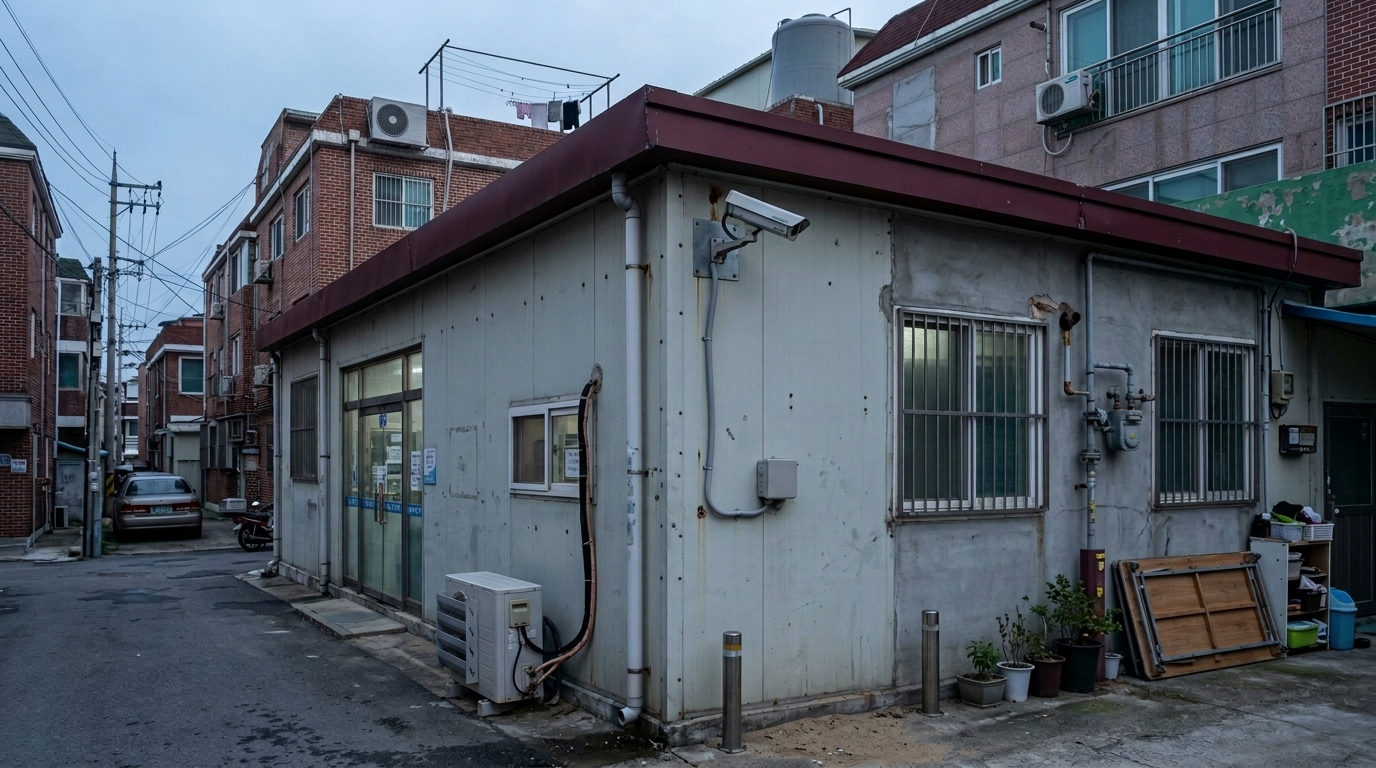
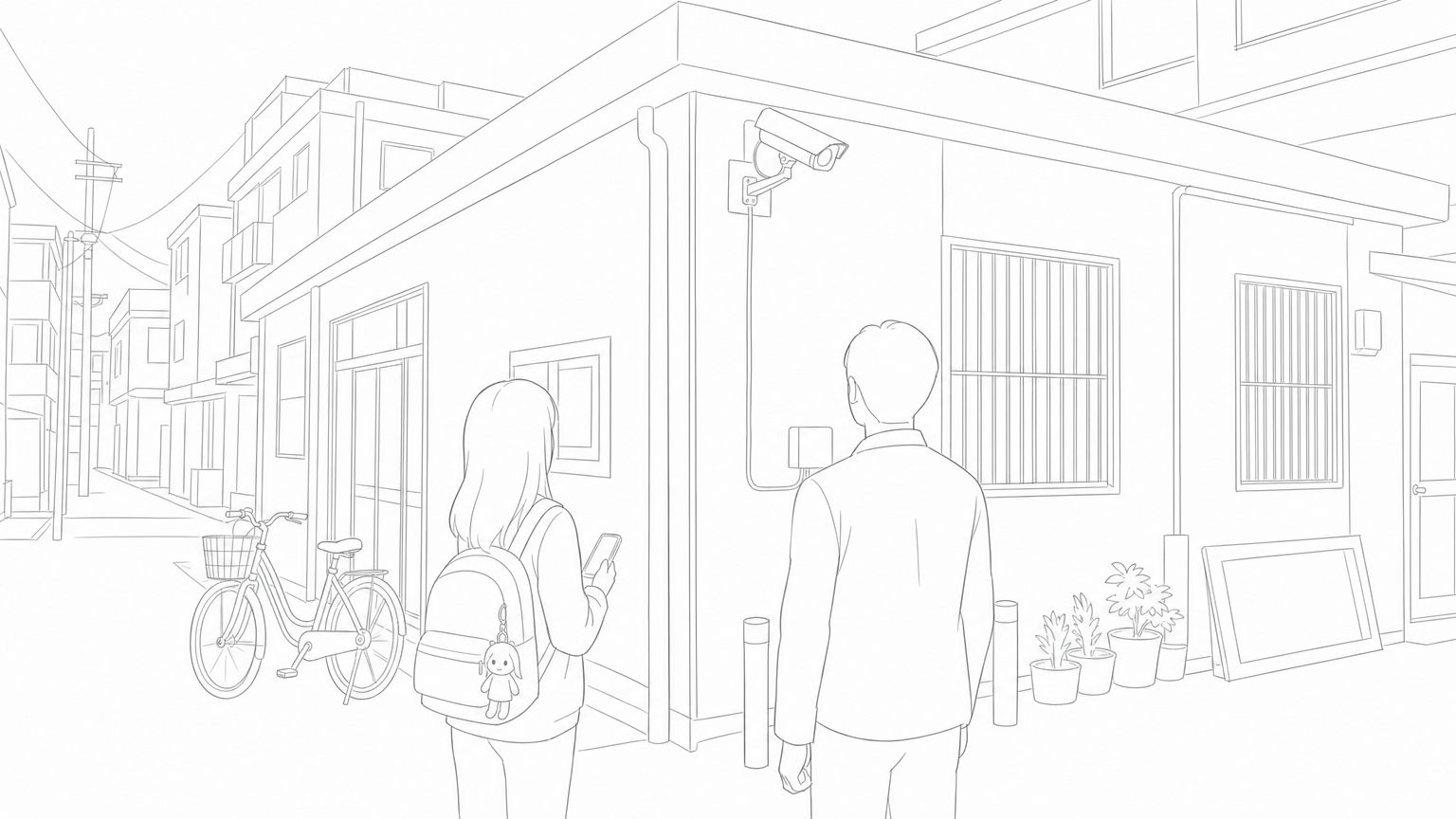
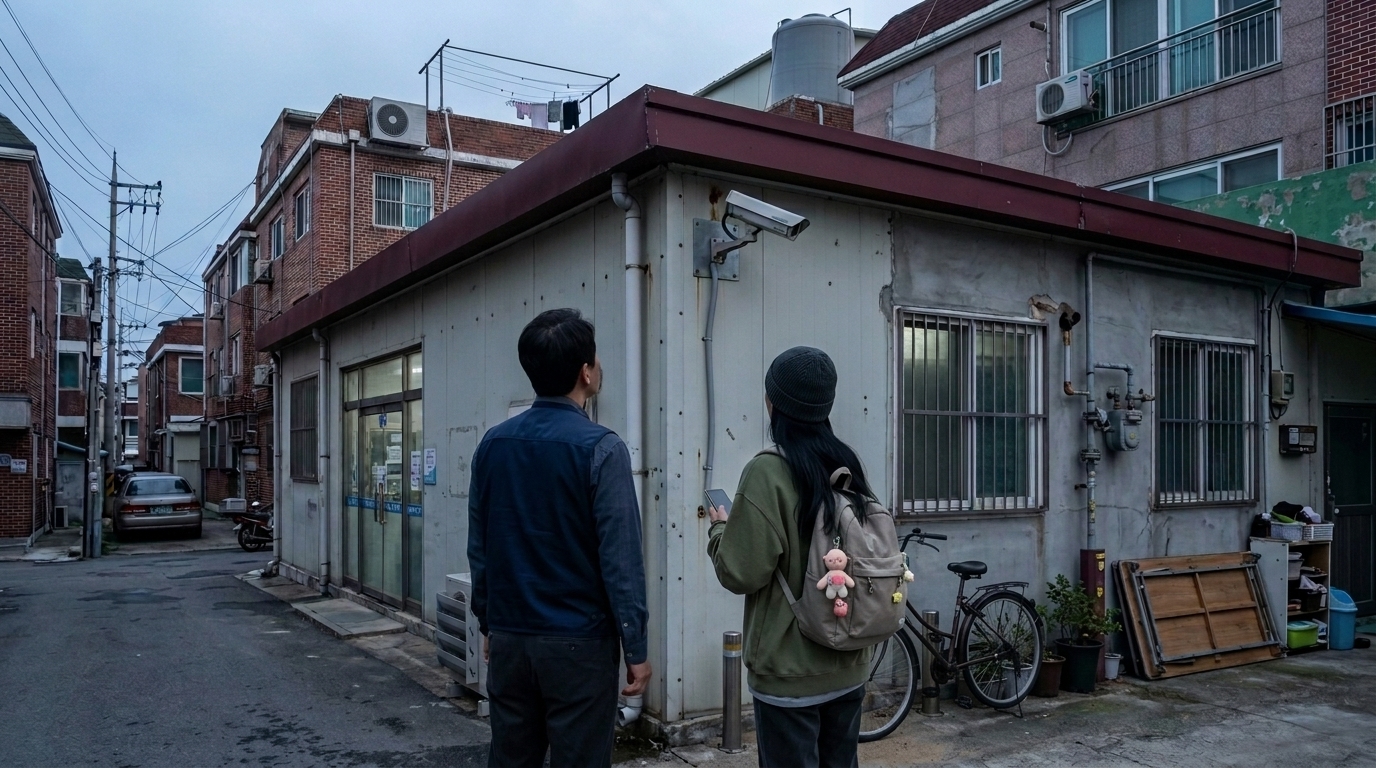
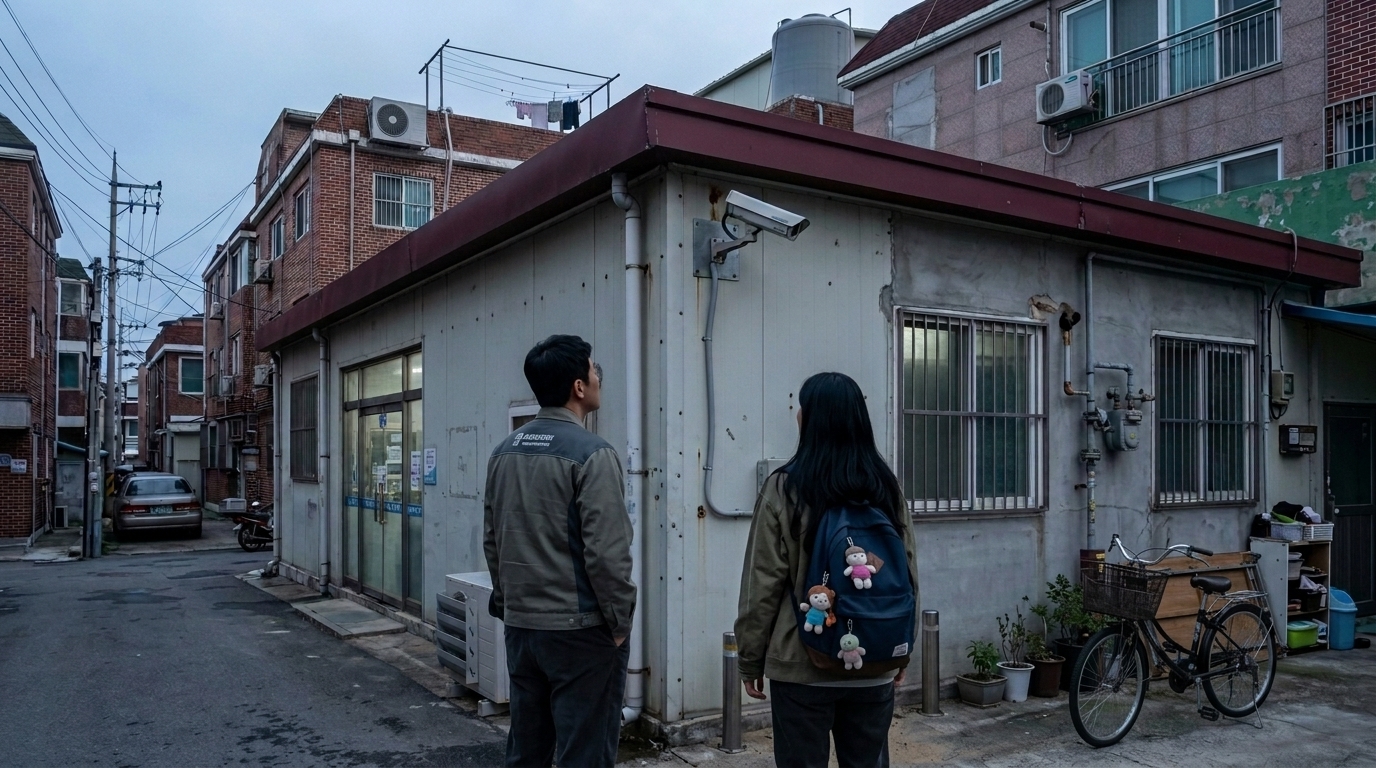
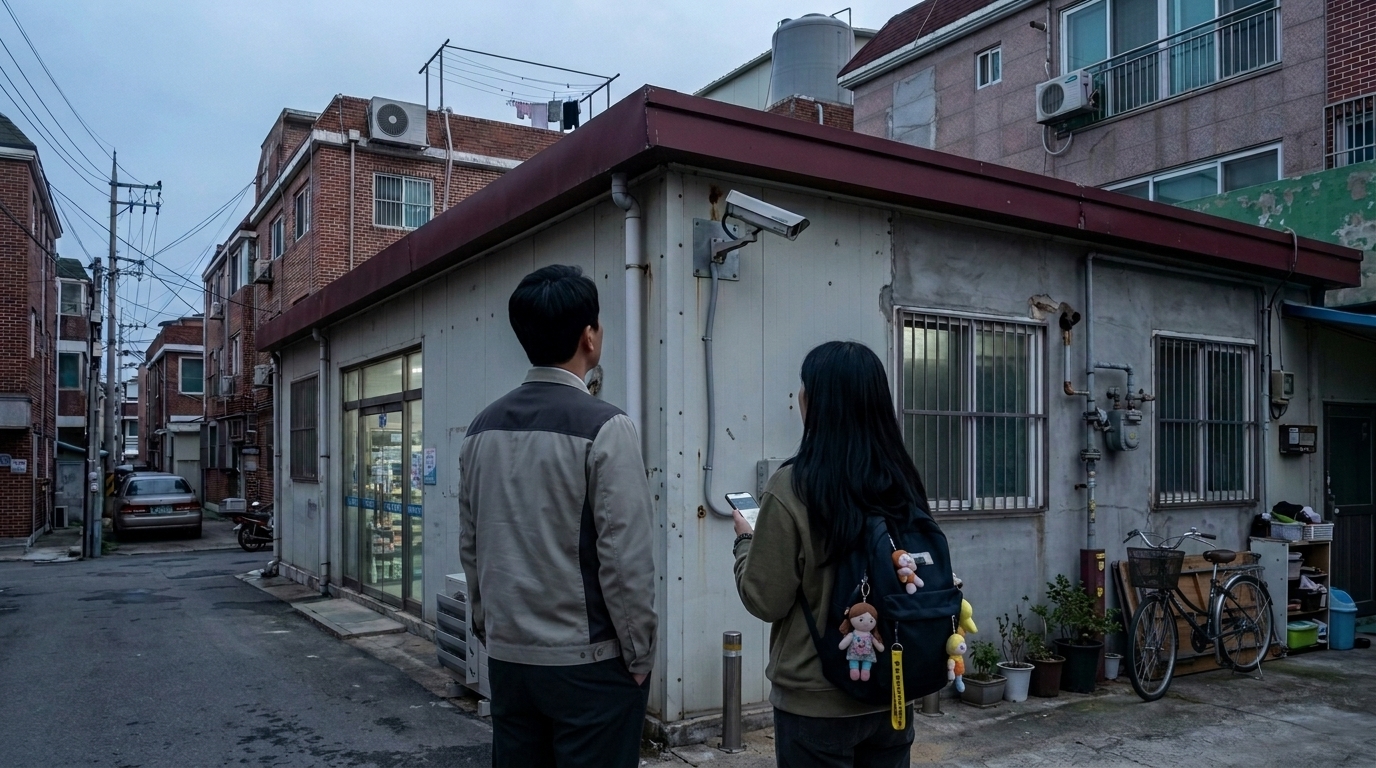
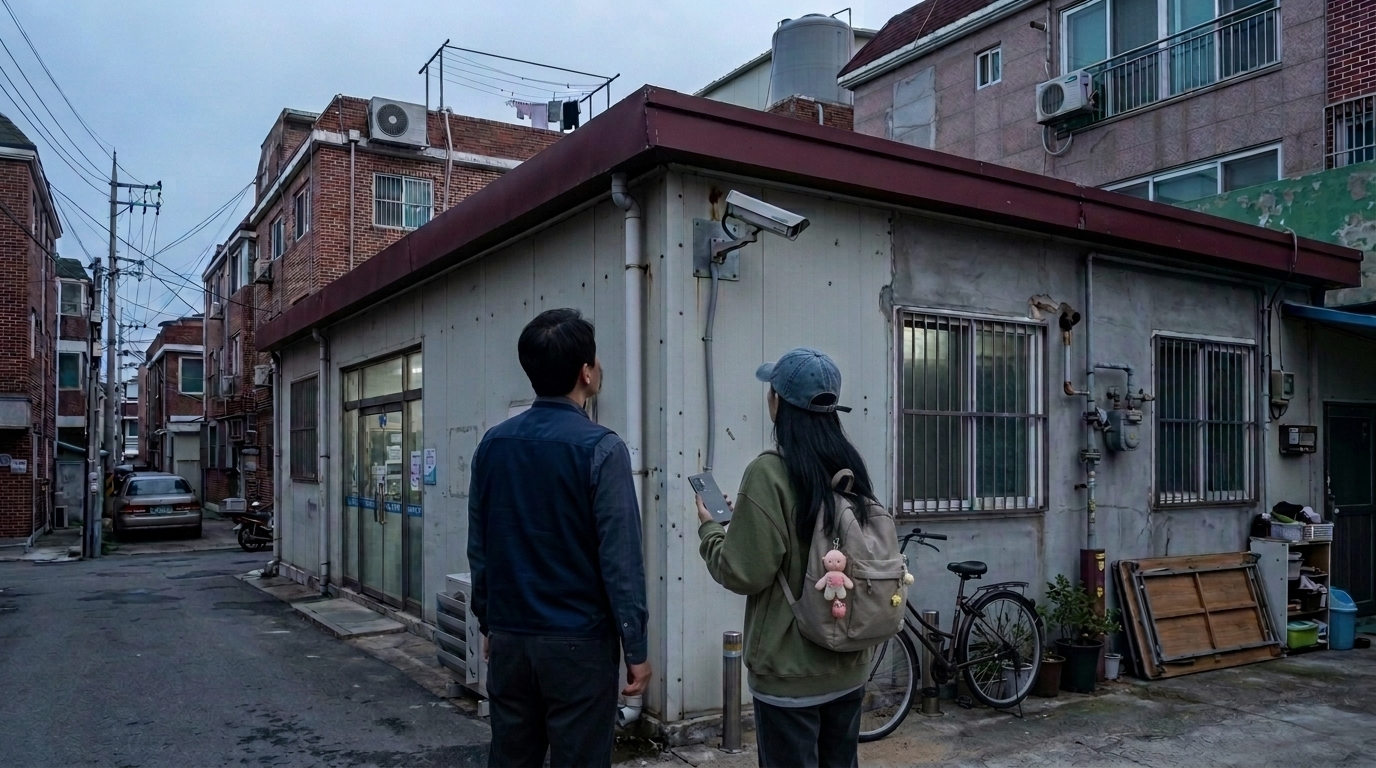
Create ONE FINAL photorealistic live-action film still of the moment below — contemporary South Korea, 2026; all people are Korean unless stated. TIME OF DAY (lock): early morning, interior lighting unspecified.

SHOT TEXT (authoritative, Korean): 수리영과 남자직원이 마트 밖에서 벽면의 CCTV를 올려다보는 뒷모습

LOCATION (lock): A large supermarket in the quiet early hours, with broad merchandise aisles, an exterior bicycle area, and outdoor walls covered by surveillance cameras. The shot takes place here — the attached LOCATION PHOTOGRAPH shows the exact spot.

REALIZE FIGURATIVE LANGUAGE AS A LIVE-ACTION SHOT: the Korean shot
text may describe characters metaphorically, figuratively or with
exaggeration. Photograph what a real movie camera would actually
record on a physical set — exaggerated or figurative impressions
become realistic staging choices (lighting, distance, angle,
wardrobe), not literal fantasy imagery.
EVERY CHARACTER IS A HUMAN BEING: unless the story explicitly
features non-human or virtual beings (as in science fiction or
fantasy), every character — however indirectly, vaguely or
figuratively the text describes them — IS a real human. When the
text gives no direct visual description of a person, IMAGINE one
and still show them as a concrete, fully-formed human being:
always render the human form to the maximum extent — build,
posture, face, hands, clothing — never reduce a person to a shape,
blob, solid silhouette or abstract mass.

EXPRESSIONS ARE ACTED, NEVER ANATOMICAL: when the text describes a
person's eyes, face or presence emotionally or figuratively (vacant,
hollow, dazed, burning, lifeless gaze and the like), it describes an
ACTOR'S PERFORMANCE captured by a real camera — realize it ONLY
through gaze direction, focus, eyelids, facial muscles, stillness
and posture. Every living person's eyes remain anatomically normal
human eyes with a natural iris and pupil, natural sclera and normal
proportions; NEVER whiten, blank out, cloud over, glow, enlarge or
otherwise alter eyeballs, skin or anatomy — unless the story
explicitly declares that being non-human or supernatural in form.

PROPS FACE THE RIGHT WAY: every handheld or used object must be
oriented exactly as its real-world use requires. A person reading,
watching or operating something (a phone, a photograph, a paper,
any device) has its functional side — screen, front, page — facing
THEIR OWN eyes; the camera then sees whatever side the staging
geometry implies (often its back). Show the functional side to the
camera ONLY when the shot text itself stages it toward the viewer.
Never flip, mirror or reverse an object's front and back.

CARRIED STATE (persist exactly — must match the neighbouring shots of this scene): Su-ri-young's bicycle remains parked outside the mart, and she continues to carry her doll-adorned backpack and smartphone.

PEOPLE: the SHOT TEXT alone decides whether any person is visible in this shot. IF a person appears, they must be one of: 수리영 (Korean 20대 초반 여성, 긴 검은 머리, 타원형의 젊은 얼굴, 부드러운 이목구비와 자연스러운 피부색상태); 남자직원 (Korean 중년 남성, 짧고 단정한 검은 머리, 평범한 얼굴형, 중년의 자연스러운 이목구비) — never anyone else, and never add a person the shot text does not show. IF only part of a person is in frame (a hand, arm, foot, back, silhouette), that body part belongs to the specific person the shot text names — its sex, age, build, skin and grooming must unmistakably match that person's profile above.

No text, captions, watermarks or annotations anywhere.
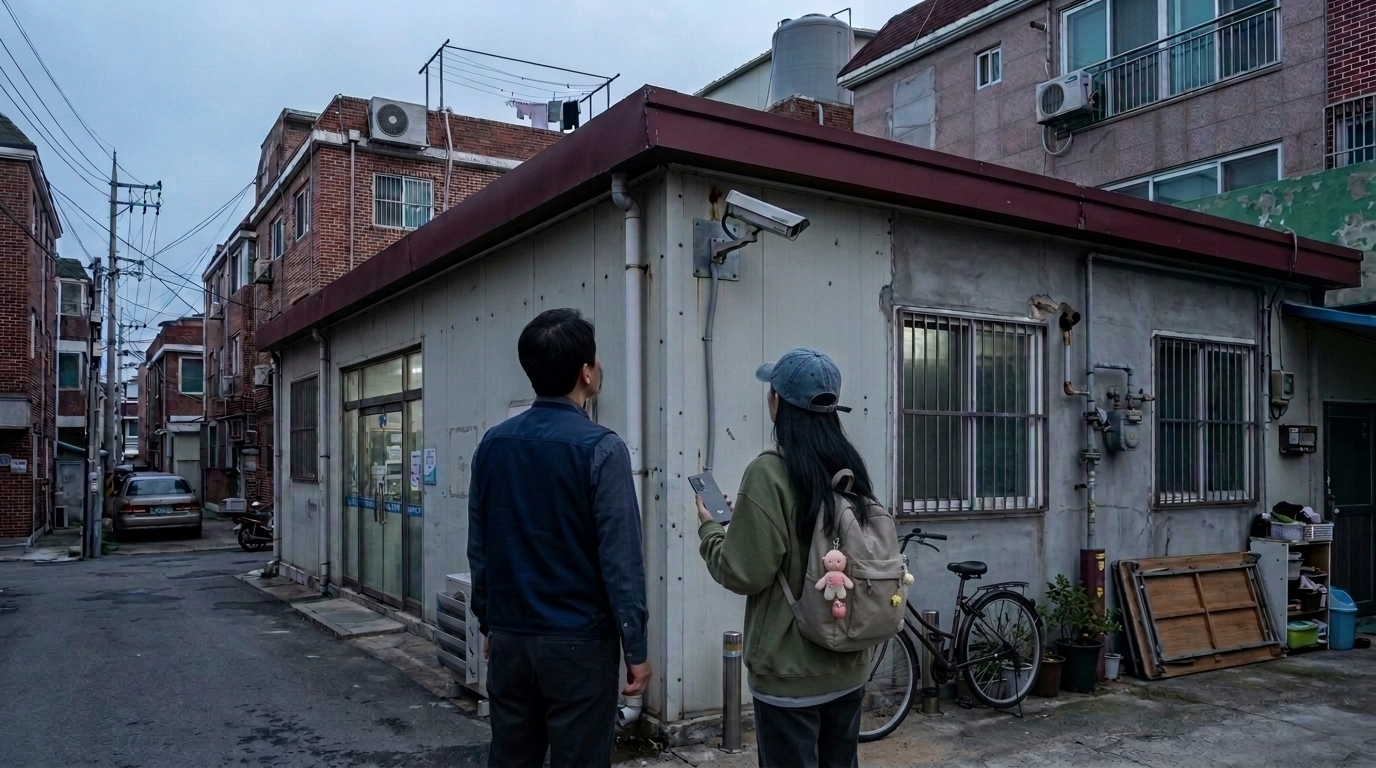
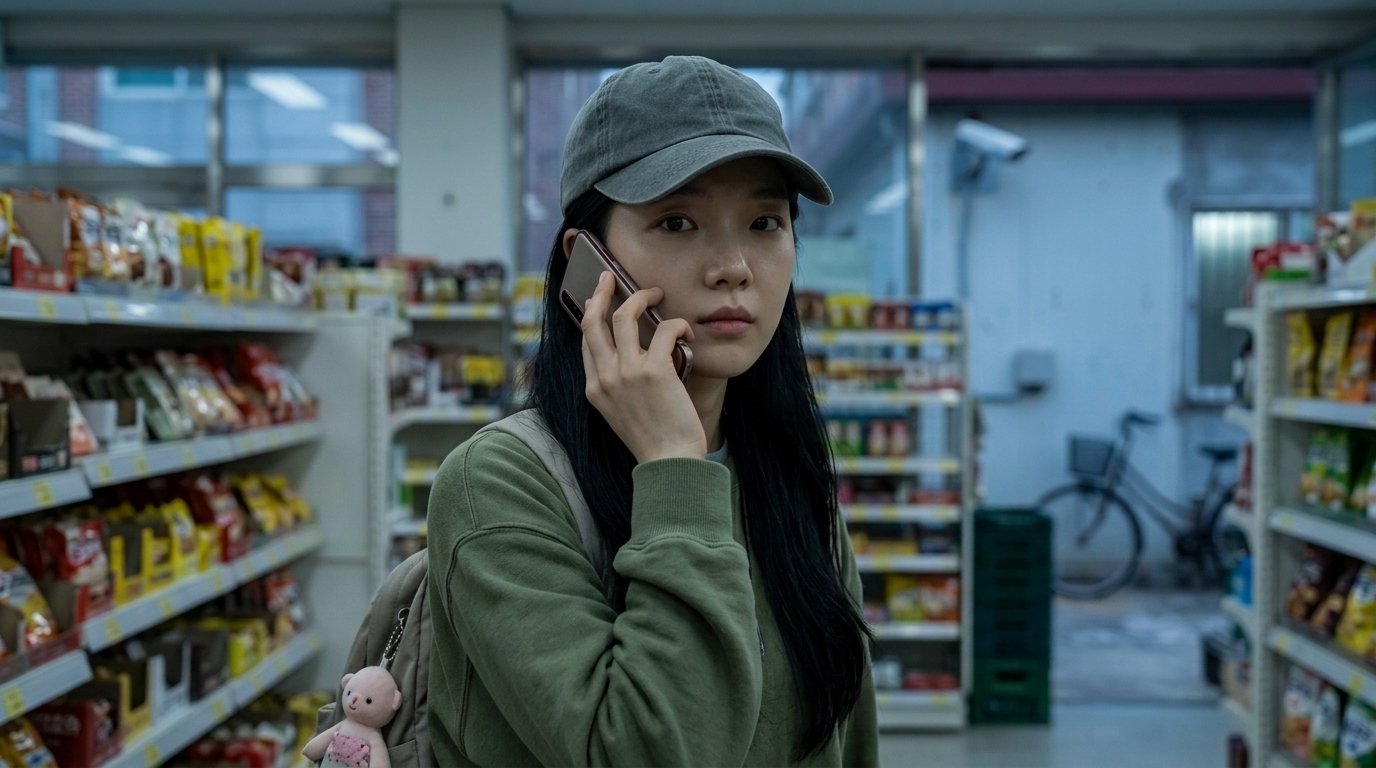
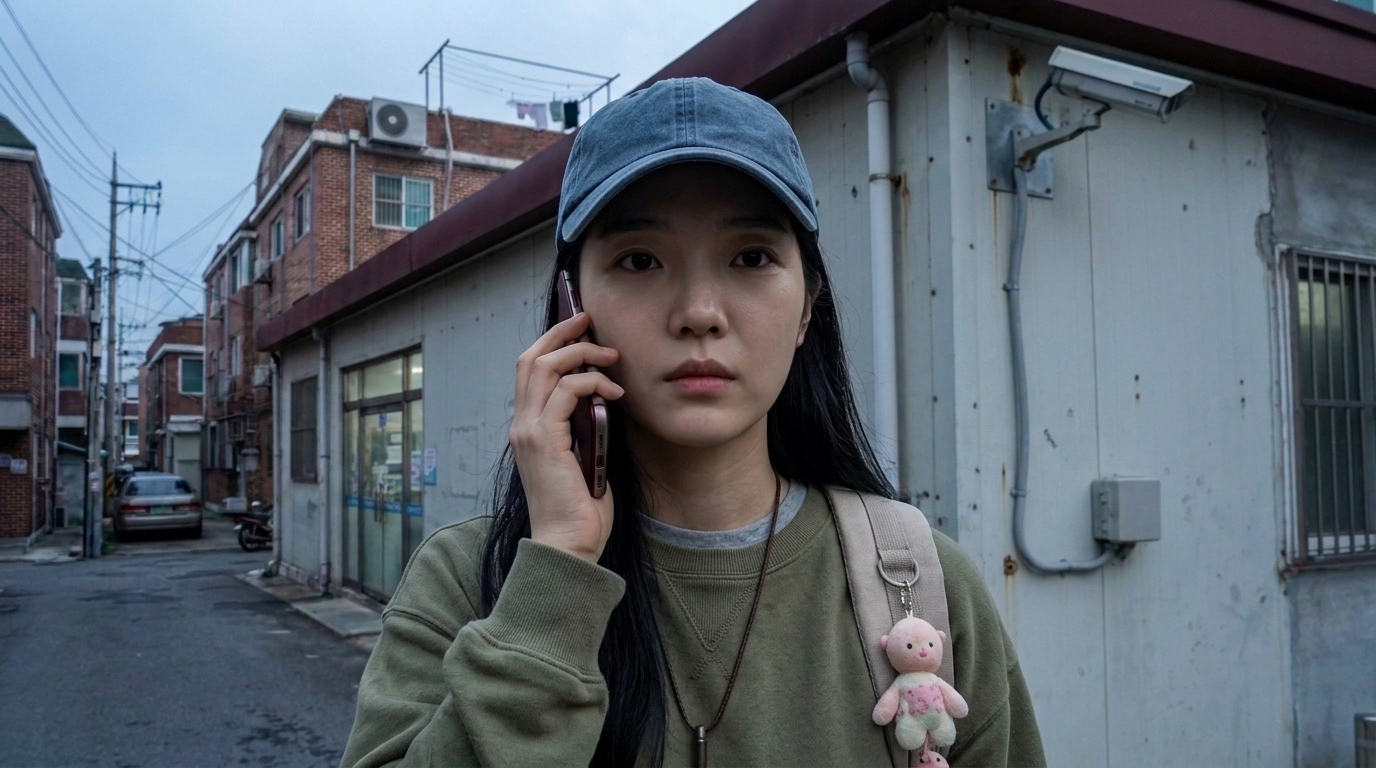
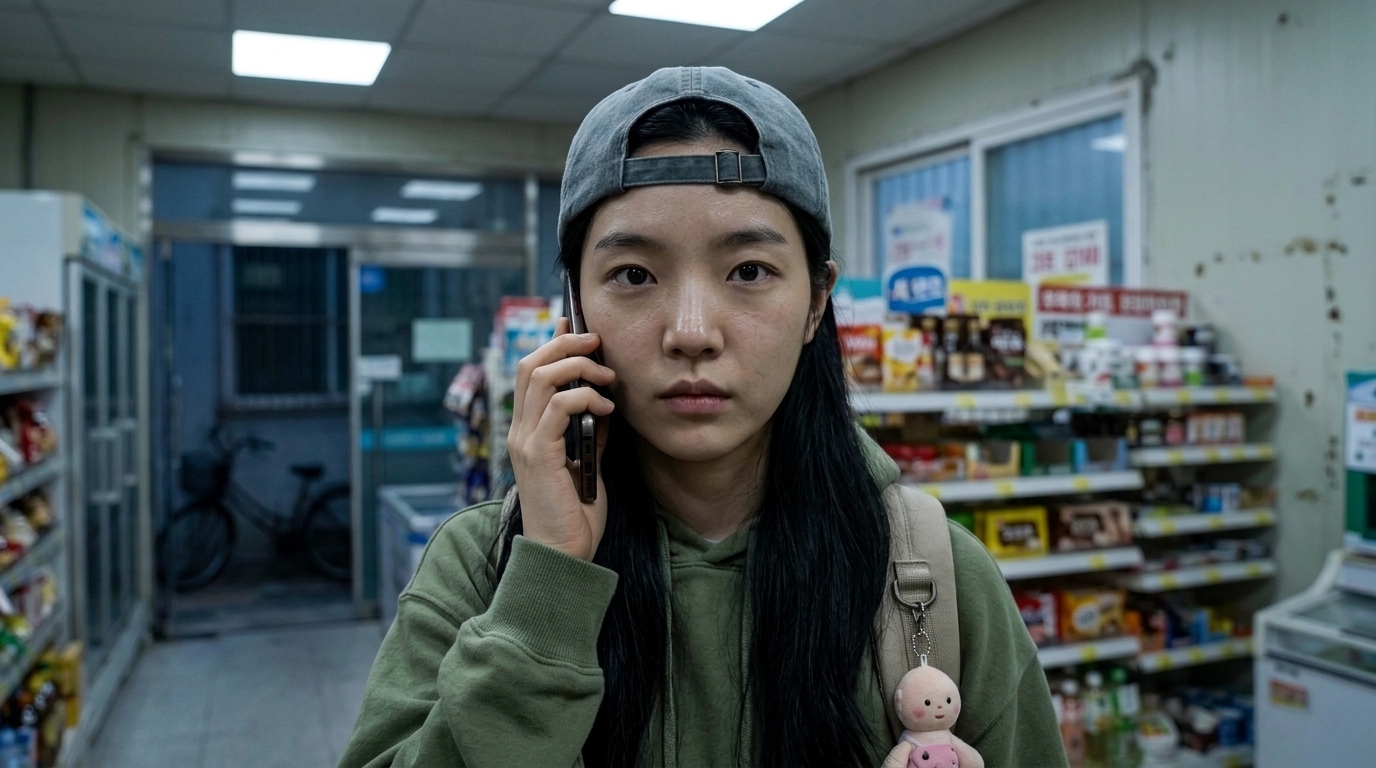
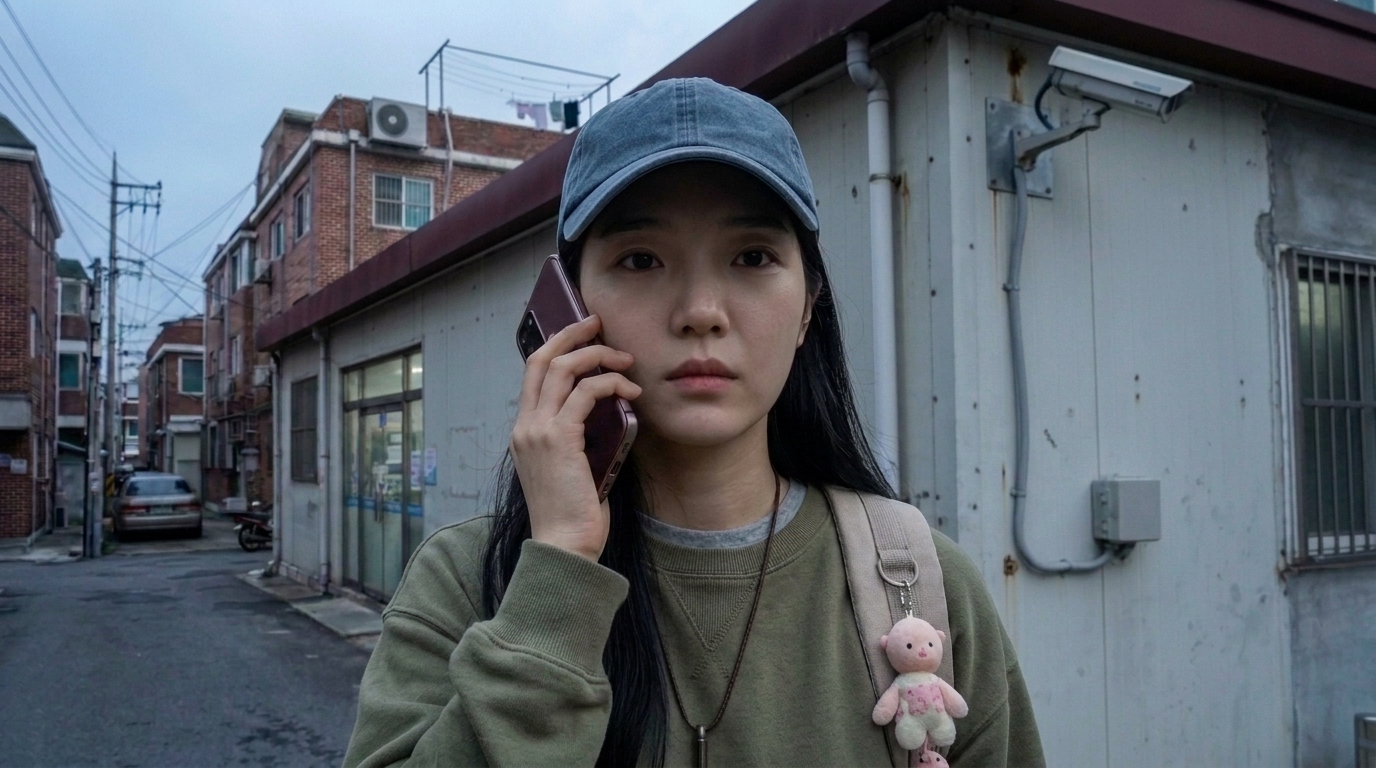
Create ONE FINAL photorealistic live-action film still of the moment below — contemporary South Korea, 2026; all people are Korean unless stated. TIME OF DAY (lock): early morning, interior lighting unspecified.

SHOT TEXT (authoritative, Korean): 수리영이 귀에 스마트폰을 댄 채 정면을 응시하는 상체 클로즈업

LOCATION (lock): A large supermarket in the quiet early hours, with broad merchandise aisles, an exterior bicycle area, and outdoor walls covered by surveillance cameras. The shot takes place here — the attached PREVIOUS SHOT STILL shows this exact place.

THIS SHOT CONTINUES THE PREVIOUS SHOT: everything the attached still established — the place, its fixed features and wear, each person's clothing and state — persists. Any person in it who cannot move stays PRECISELY as photographed (body, pose, contact points, held objects); only the camera changes.

PREVIOUS STILL USAGE (follow exactly — what to take from the attached still and what to exclude): Take the same exterior wall, mounted surveillance camera, and daylight from the reference. Exclude the male employee and the earlier upward-looking pose from this phone-call close-up.

REALIZE FIGURATIVE LANGUAGE AS A LIVE-ACTION SHOT: the Korean shot
text may describe characters metaphorically, figuratively or with
exaggeration. Photograph what a real movie camera would actually
record on a physical set — exaggerated or figurative impressions
become realistic staging choices (lighting, distance, angle,
wardrobe), not literal fantasy imagery.
EVERY CHARACTER IS A HUMAN BEING: unless the story explicitly
features non-human or virtual beings (as in science fiction or
fantasy), every character — however indirectly, vaguely or
figuratively the text describes them — IS a real human. When the
text gives no direct visual description of a person, IMAGINE one
and still show them as a concrete, fully-formed human being:
always render the human form to the maximum extent — build,
posture, face, hands, clothing — never reduce a person to a shape,
blob, solid silhouette or abstract mass.

EXPRESSIONS ARE ACTED, NEVER ANATOMICAL: when the text describes a
person's eyes, face or presence emotionally or figuratively (vacant,
hollow, dazed, burning, lifeless gaze and the like), it describes an
ACTOR'S PERFORMANCE captured by a real camera — realize it ONLY
through gaze direction, focus, eyelids, facial muscles, stillness
and posture. Every living person's eyes remain anatomically normal
human eyes with a natural iris and pupil, natural sclera and normal
proportions; NEVER whiten, blank out, cloud over, glow, enlarge or
otherwise alter eyeballs, skin or anatomy — unless the story
explicitly declares that being non-human or supernatural in form.

PROPS FACE THE RIGHT WAY: every handheld or used object must be
oriented exactly as its real-world use requires. A person reading,
watching or operating something (a phone, a photograph, a paper,
any device) has its functional side — screen, front, page — facing
THEIR OWN eyes; the camera then sees whatever side the staging
geometry implies (often its back). Show the functional side to the
camera ONLY when the shot text itself stages it toward the viewer.
Never flip, mirror or reverse an object's front and back.

CARRIED STATE (persist exactly — must match the neighbouring shots of this scene): The bicycle remains parked outside while Su-ri-young uses her smartphone to call Hye-su; her doll-adorned backpack stays with her.

PEOPLE: the SHOT TEXT alone decides whether any person is visible in this shot. IF a person appears, they must be one of: 수리영 (Korean 20대 초반 여성, 긴 검은 머리, 타원형의 젊은 얼굴, 부드러운 이목구비와 자연스러운 피부색상태) — never anyone else, and never add a person the shot text does not show. IF only part of a person is in frame (a hand, arm, foot, back, silhouette), that body part belongs to the specific person the shot text names — its sex, age, build, skin and grooming must unmistakably match that person's profile above.

No text, captions, watermarks or annotations anywhere.
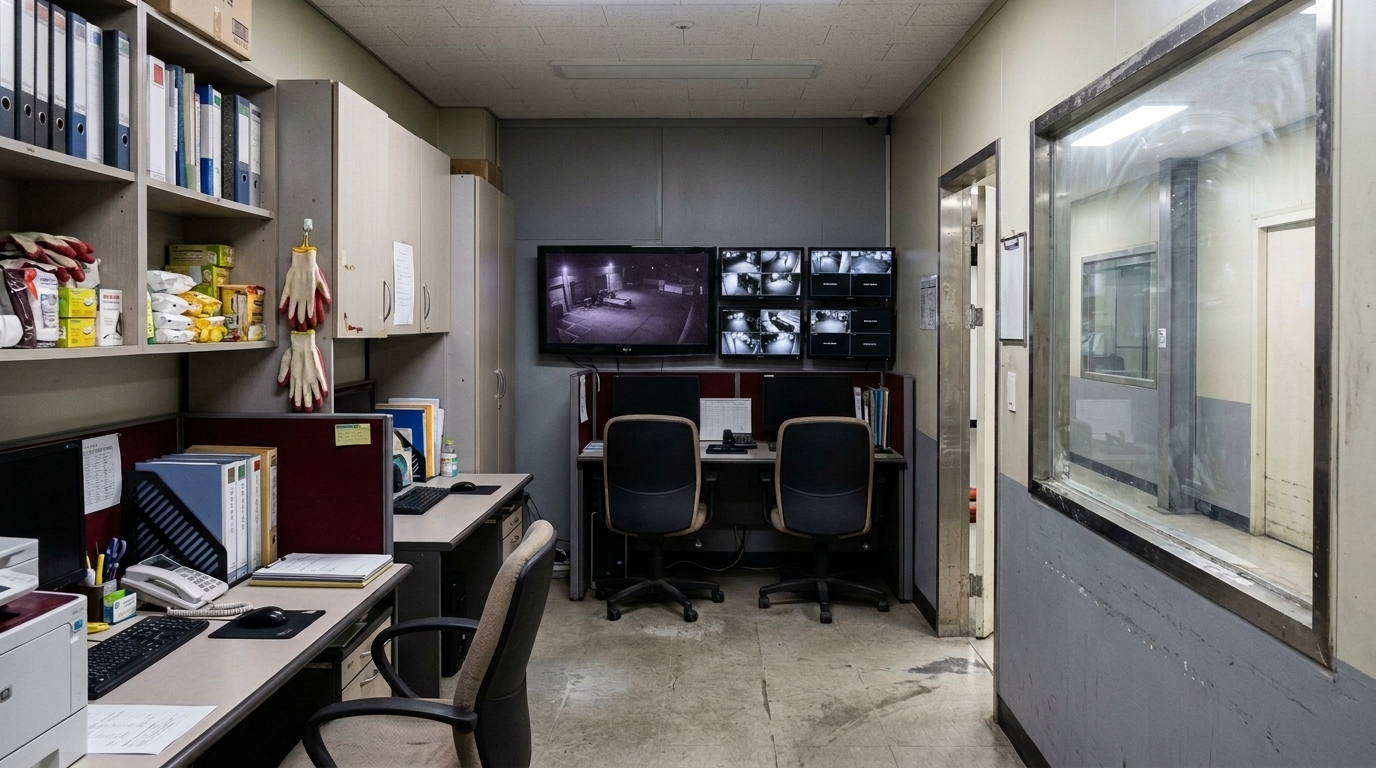
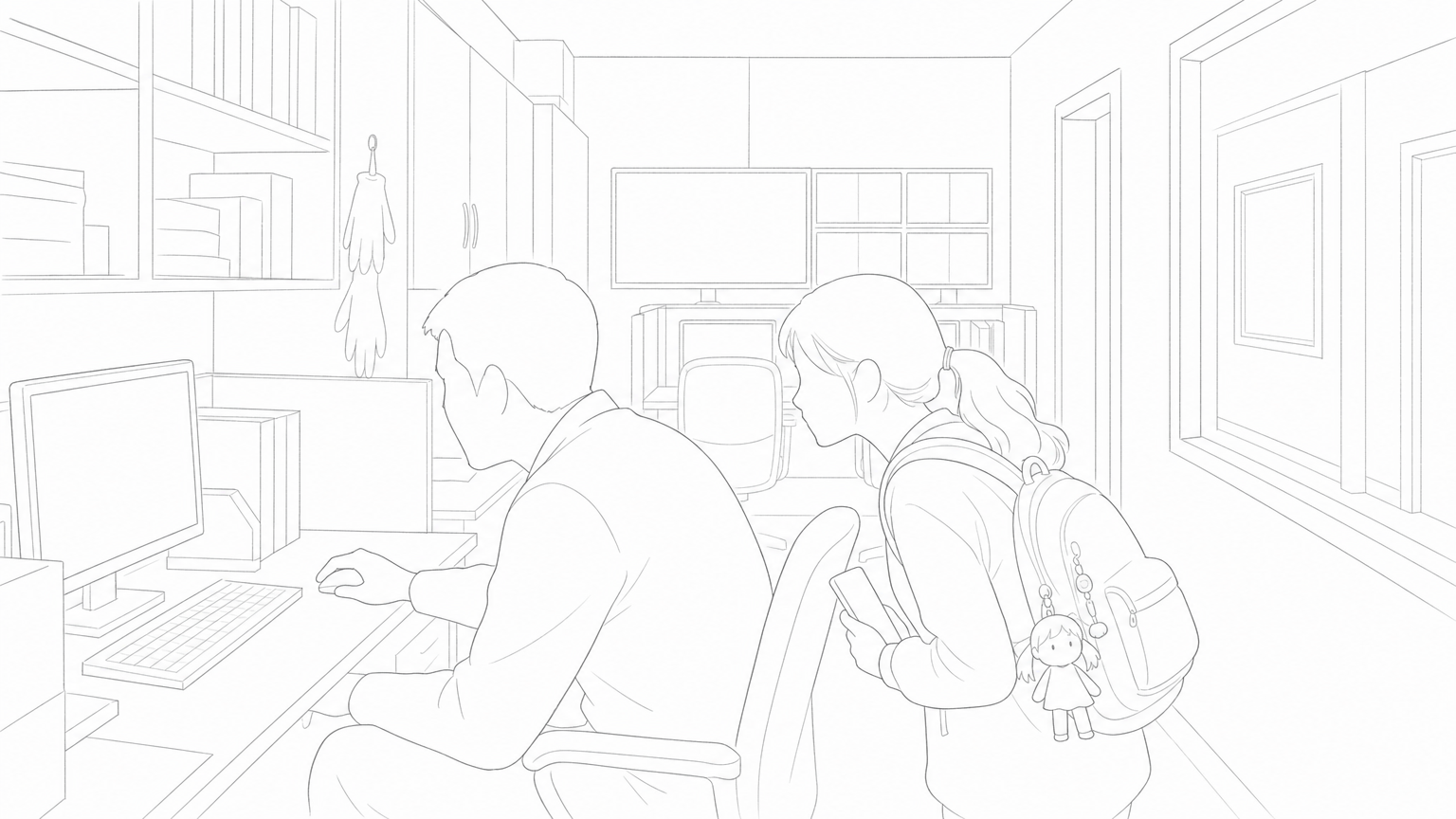
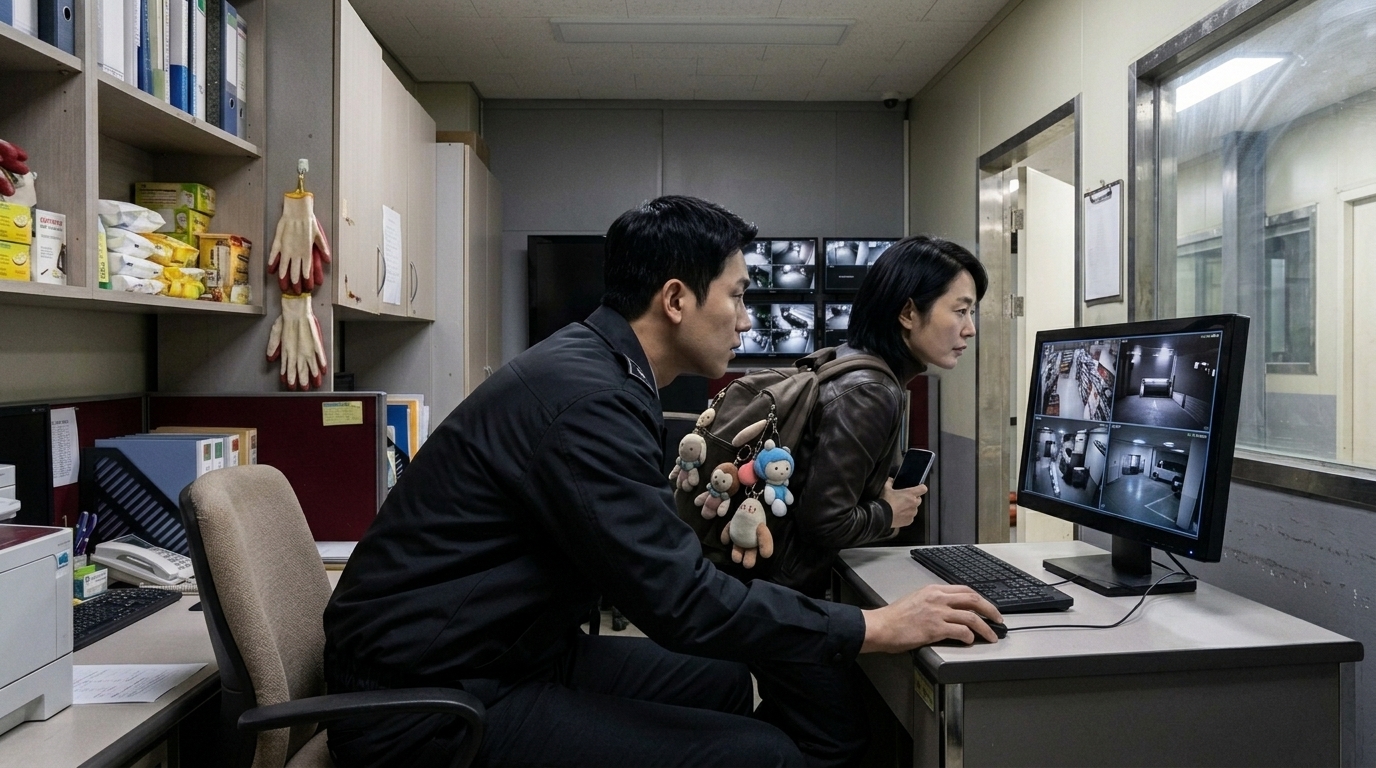
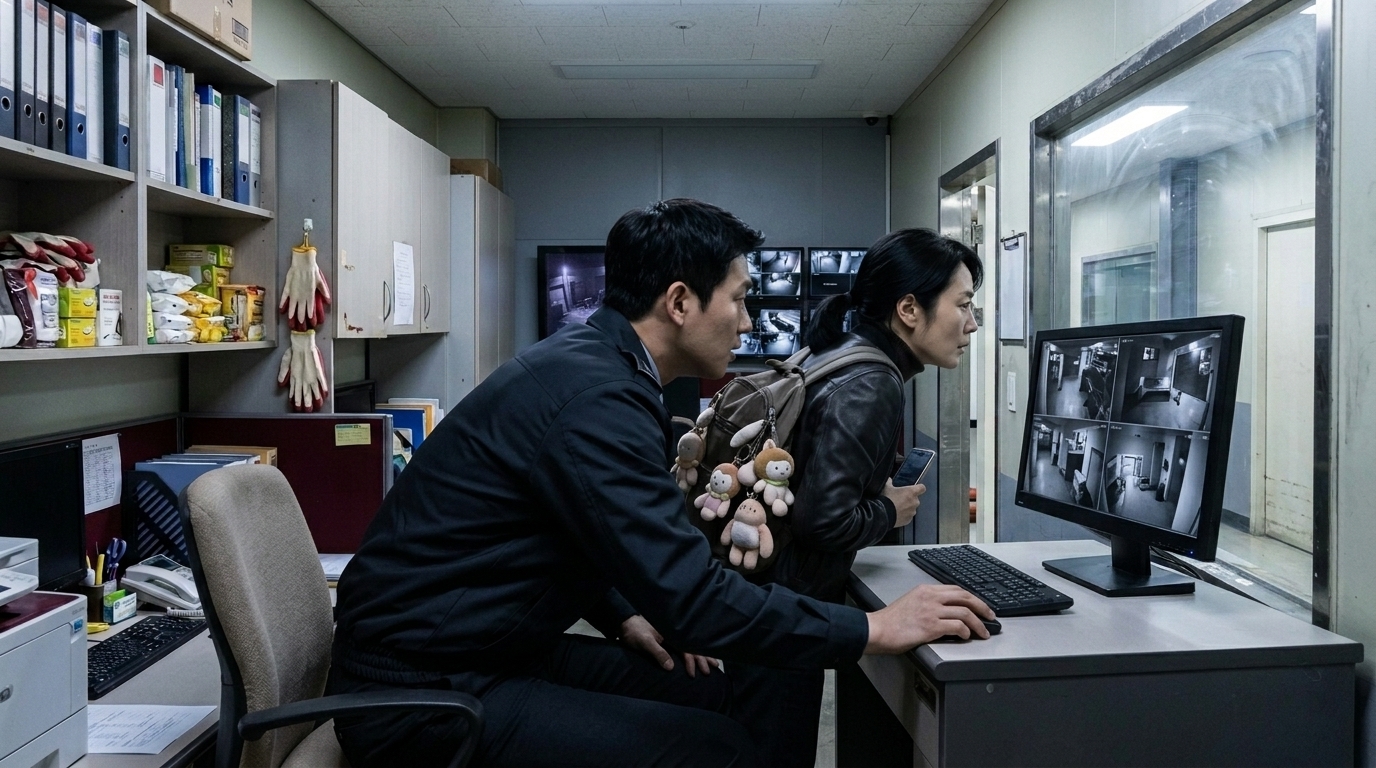
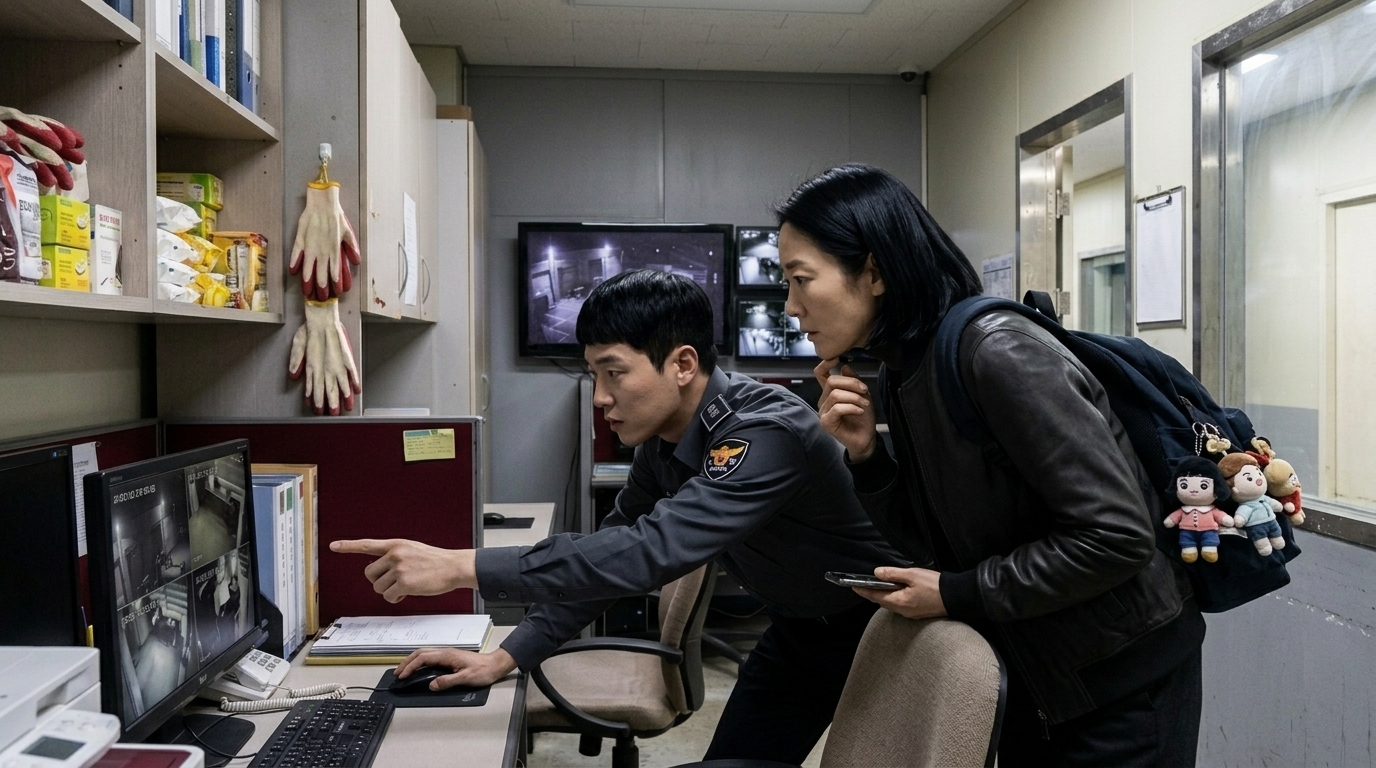
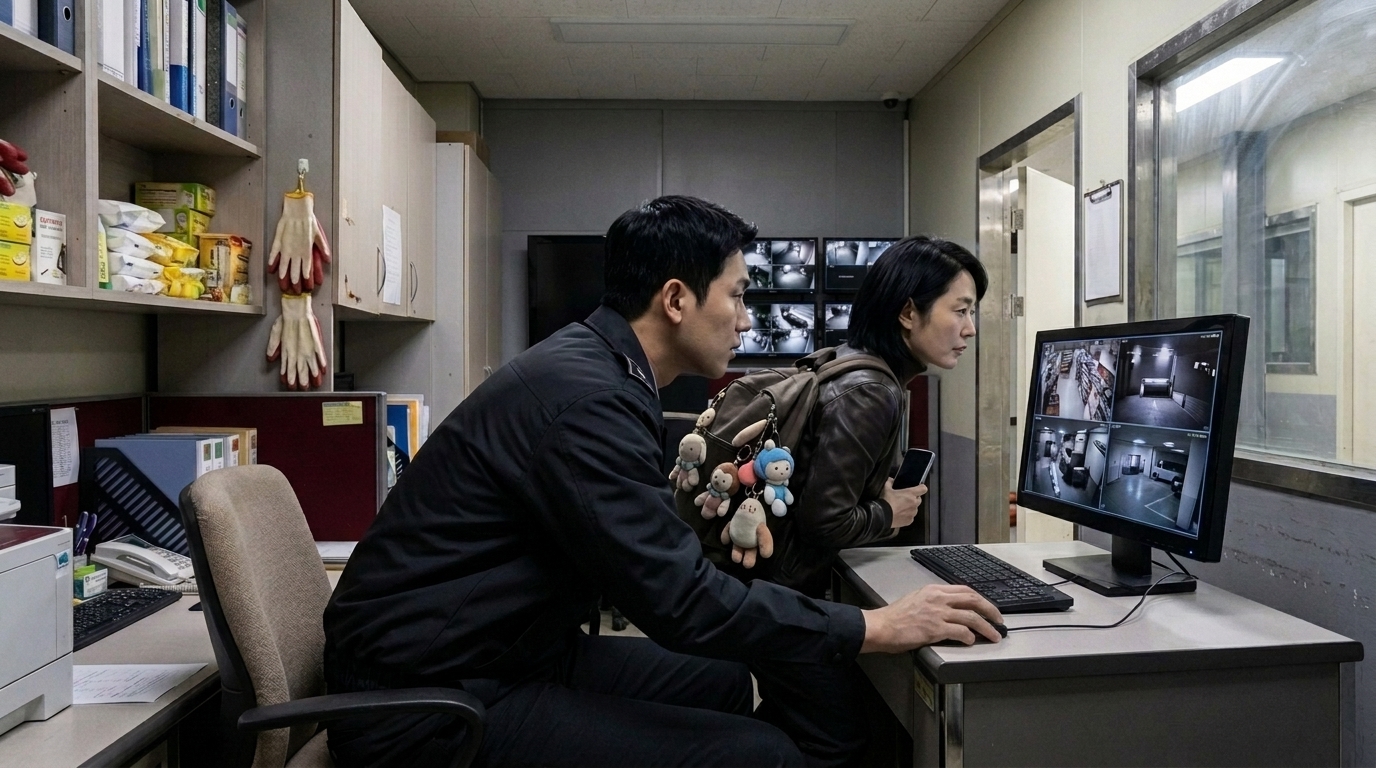
Create ONE FINAL photorealistic live-action film still of the moment below — contemporary South Korea, 2026; all people are Korean unless stated. TIME OF DAY (lock): early morning, interior lighting unspecified.

SHOT TEXT (authoritative, Korean): 마트 총무과 책상 앞, 한국인 남성 보안직원과 혜수가 컴퓨터 모니터를 향해 몸을 기울인 측면

LOCATION (lock): A supermarket administrative and security office with a CCTV review station, monitors, and space for staff and investigators to watch recorded footage. The shot takes place here — the attached LOCATION PHOTOGRAPH shows the exact spot.

REALIZE FIGURATIVE LANGUAGE AS A LIVE-ACTION SHOT: the Korean shot
text may describe characters metaphorically, figuratively or with
exaggeration. Photograph what a real movie camera would actually
record on a physical set — exaggerated or figurative impressions
become realistic staging choices (lighting, distance, angle,
wardrobe), not literal fantasy imagery.
EVERY CHARACTER IS A HUMAN BEING: unless the story explicitly
features non-human or virtual beings (as in science fiction or
fantasy), every character — however indirectly, vaguely or
figuratively the text describes them — IS a real human. When the
text gives no direct visual description of a person, IMAGINE one
and still show them as a concrete, fully-formed human being:
always render the human form to the maximum extent — build,
posture, face, hands, clothing — never reduce a person to a shape,
blob, solid silhouette or abstract mass.

EXPRESSIONS ARE ACTED, NEVER ANATOMICAL: when the text describes a
person's eyes, face or presence emotionally or figuratively (vacant,
hollow, dazed, burning, lifeless gaze and the like), it describes an
ACTOR'S PERFORMANCE captured by a real camera — realize it ONLY
through gaze direction, focus, eyelids, facial muscles, stillness
and posture. Every living person's eyes remain anatomically normal
human eyes with a natural iris and pupil, natural sclera and normal
proportions; NEVER whiten, blank out, cloud over, glow, enlarge or
otherwise alter eyeballs, skin or anatomy — unless the story
explicitly declares that being non-human or supernatural in form.

PROPS FACE THE RIGHT WAY: every handheld or used object must be
oriented exactly as its real-world use requires. A person reading,
watching or operating something (a phone, a photograph, a paper,
any device) has its functional side — screen, front, page — facing
THEIR OWN eyes; the camera then sees whatever side the staging
geometry implies (often its back). Show the functional side to the
camera ONLY when the shot text itself stages it toward the viewer.
Never flip, mirror or reverse an object's front and back.

CARRIED STATE (persist exactly — must match the neighbouring shots of this scene): Su-ri-young still has her doll-adorned backpack and smartphone while watching the CCTV review.

PEOPLE: the SHOT TEXT alone decides whether any person is visible in this shot. IF a person appears, they must be one of: 혜수 (Korean 40대 중반 여성, 단정한 검은 머리, 성숙한 타원형 얼굴, 또렷한 이목구비); 한국인 남성 보안직원 (Korean 성인 남성, 짧고 단정한 검은 머리, 평범한 얼굴형, 깔끔한 이목구비) — never anyone else, and never add a person the shot text does not show. IF only part of a person is in frame (a hand, arm, foot, back, silhouette), that body part belongs to the specific person the shot text names — its sex, age, build, skin and grooming must unmistakably match that person's profile above.

No text, captions, watermarks or annotations anywhere.
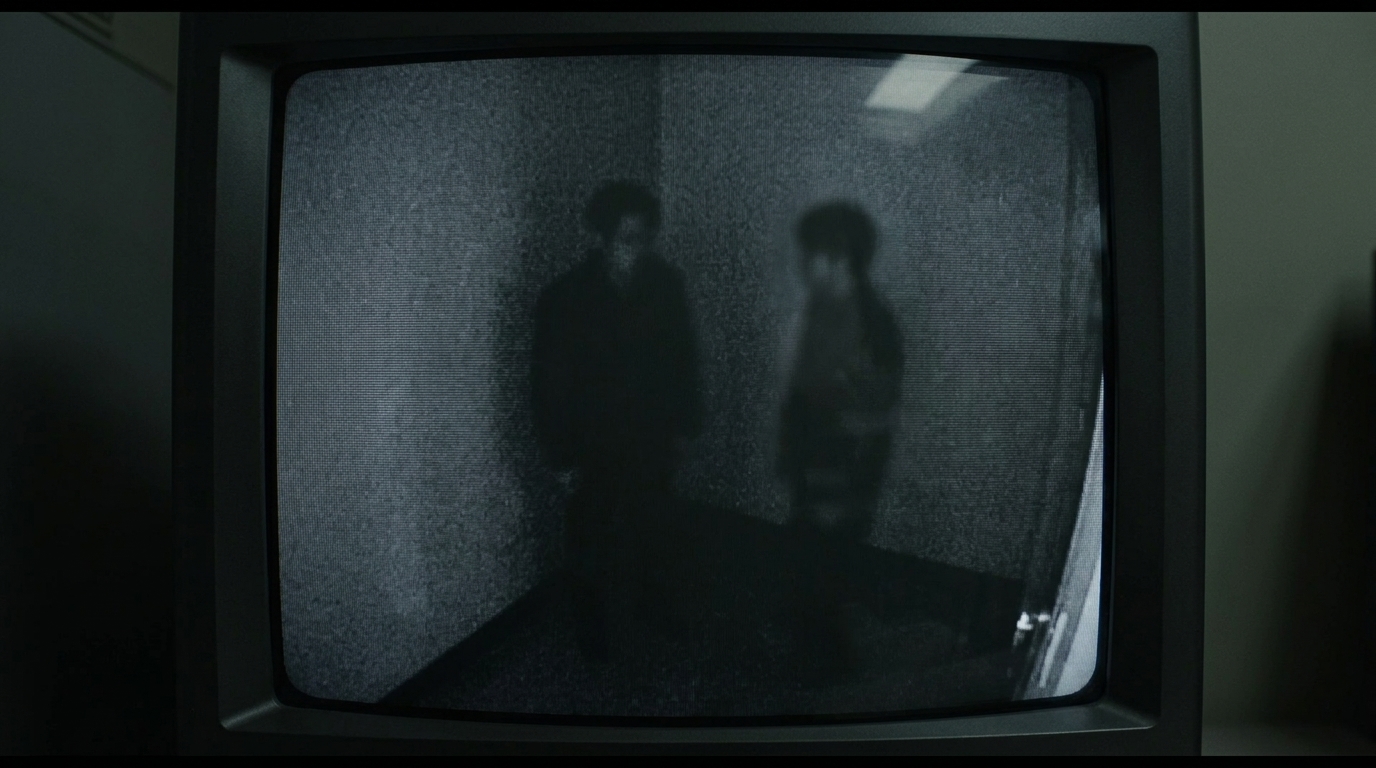
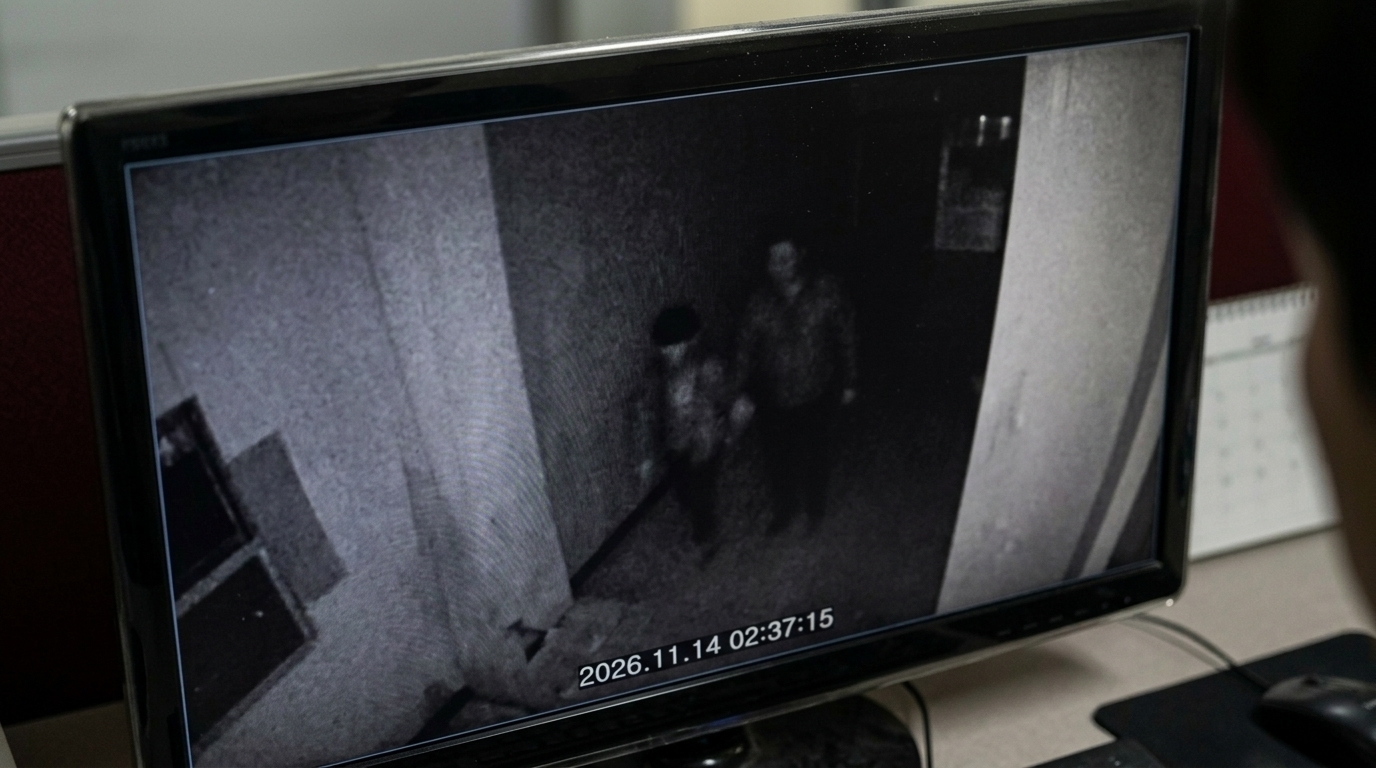
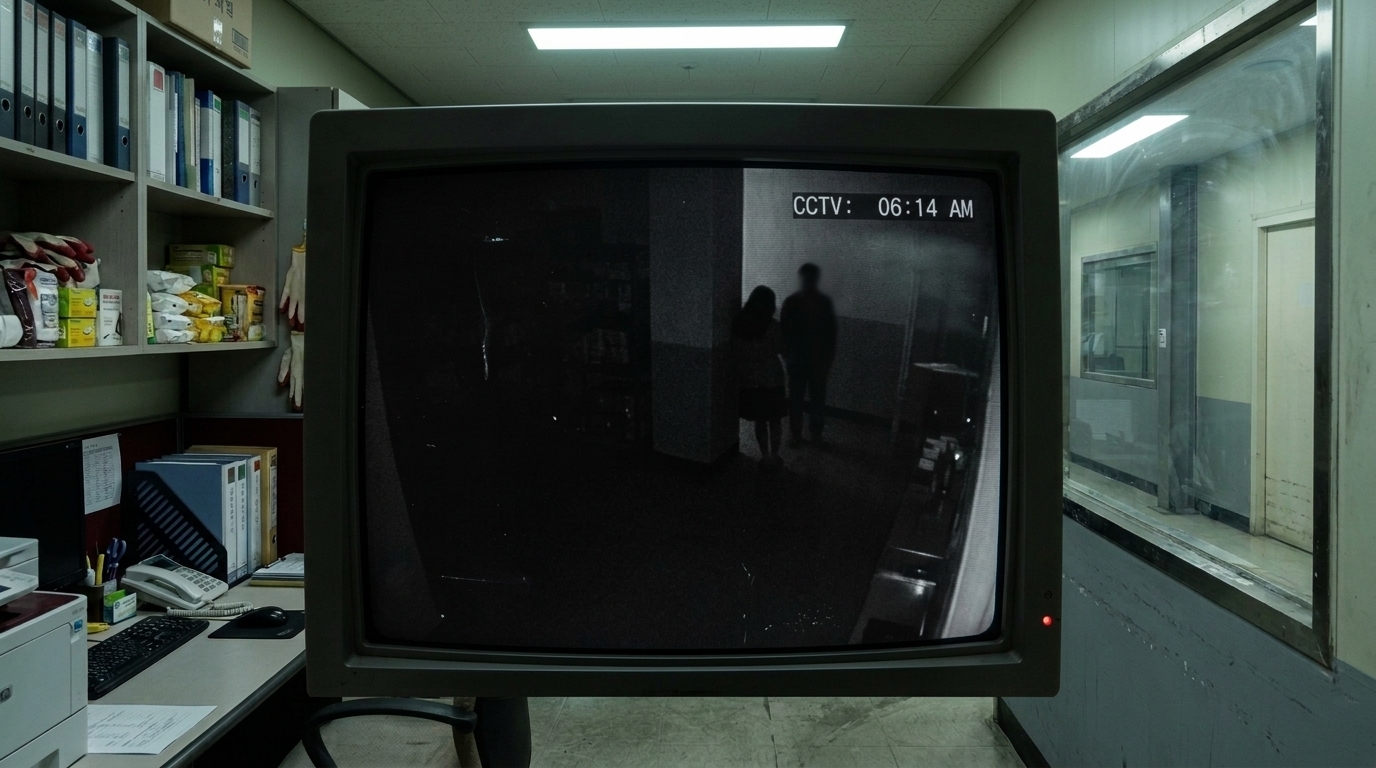
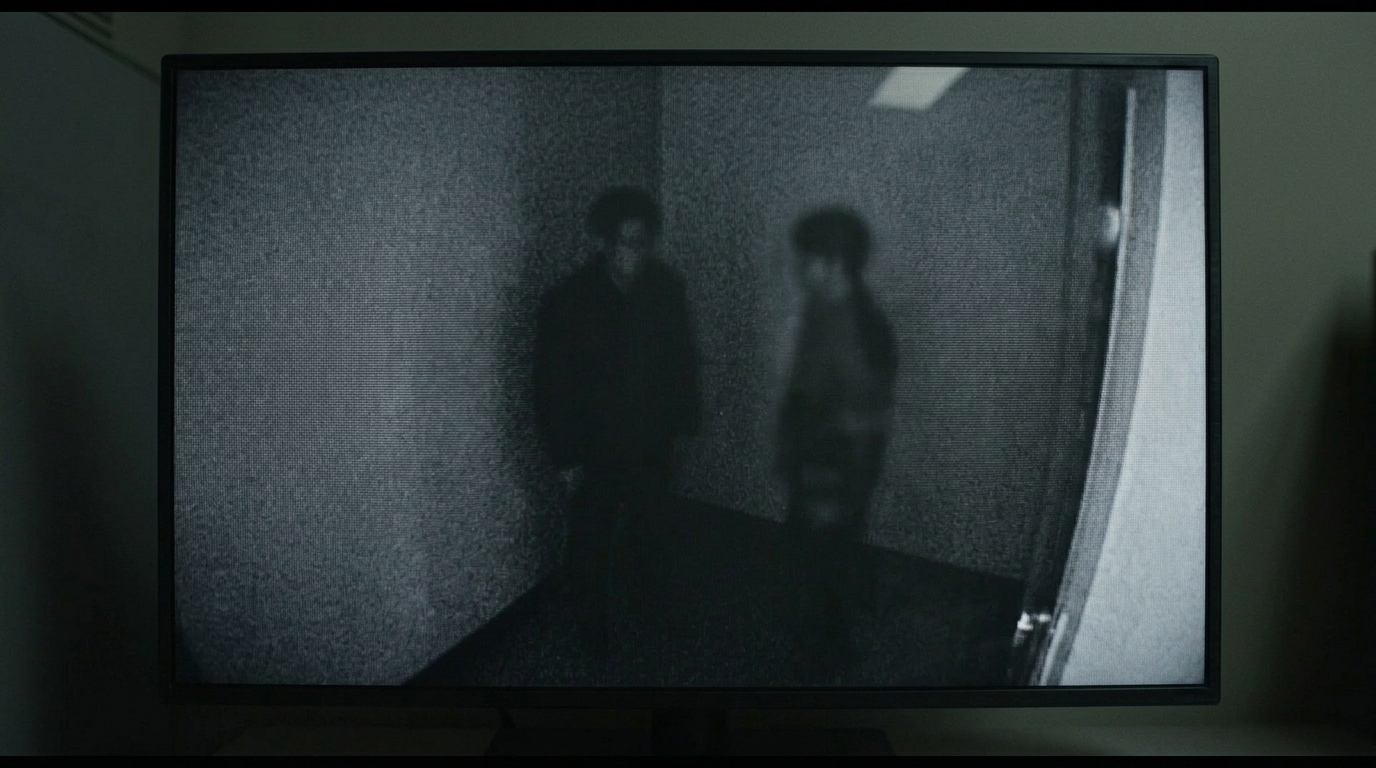
Create ONE FINAL photorealistic live-action film still of the moment below — contemporary South Korea, 2026; all people are Korean unless stated. TIME OF DAY (lock): early morning, interior lighting unspecified.

SHOT TEXT (authoritative, Korean): 흑백 CCTV 화면 속 어두운 구석에 사람 형상이 희미하게 찍힌 모니터 클로즈업

LOCATION (lock): A supermarket administrative and security office with a CCTV review station, monitors, and space for staff and investigators to watch recorded footage. The shot takes place here — the attached LOCATION PHOTOGRAPH shows the exact spot.

REALIZE FIGURATIVE LANGUAGE AS A LIVE-ACTION SHOT: the Korean shot
text may describe characters metaphorically, figuratively or with
exaggeration. Photograph what a real movie camera would actually
record on a physical set — exaggerated or figurative impressions
become realistic staging choices (lighting, distance, angle,
wardrobe), not literal fantasy imagery.
EVERY CHARACTER IS A HUMAN BEING: unless the story explicitly
features non-human or virtual beings (as in science fiction or
fantasy), every character — however indirectly, vaguely or
figuratively the text describes them — IS a real human. When the
text gives no direct visual description of a person, IMAGINE one
and still show them as a concrete, fully-formed human being:
always render the human form to the maximum extent — build,
posture, face, hands, clothing — never reduce a person to a shape,
blob, solid silhouette or abstract mass.

EXPRESSIONS ARE ACTED, NEVER ANATOMICAL: when the text describes a
person's eyes, face or presence emotionally or figuratively (vacant,
hollow, dazed, burning, lifeless gaze and the like), it describes an
ACTOR'S PERFORMANCE captured by a real camera — realize it ONLY
through gaze direction, focus, eyelids, facial muscles, stillness
and posture. Every living person's eyes remain anatomically normal
human eyes with a natural iris and pupil, natural sclera and normal
proportions; NEVER whiten, blank out, cloud over, glow, enlarge or
otherwise alter eyeballs, skin or anatomy — unless the story
explicitly declares that being non-human or supernatural in form.

PROPS FACE THE RIGHT WAY: every handheld or used object must be
oriented exactly as its real-world use requires. A person reading,
watching or operating something (a phone, a photograph, a paper,
any device) has its functional side — screen, front, page — facing
THEIR OWN eyes; the camera then sees whatever side the staging
geometry implies (often its back). Show the functional side to the
camera ONLY when the shot text itself stages it toward the viewer.
Never flip, mirror or reverse an object's front and back.

CARRIED STATE (persist exactly — must match the neighbouring shots of this scene): The relevant section of the CCTV image remains anomalously dark, leaving the man and Min-suk only as indistinct human forms.

NO PEOPLE IN THIS SHOT: the shot text shows only the place and its state — no living person or any body part appears in frame, unless the shot text itself explicitly says so.

No text, captions, watermarks or annotations anywhere.
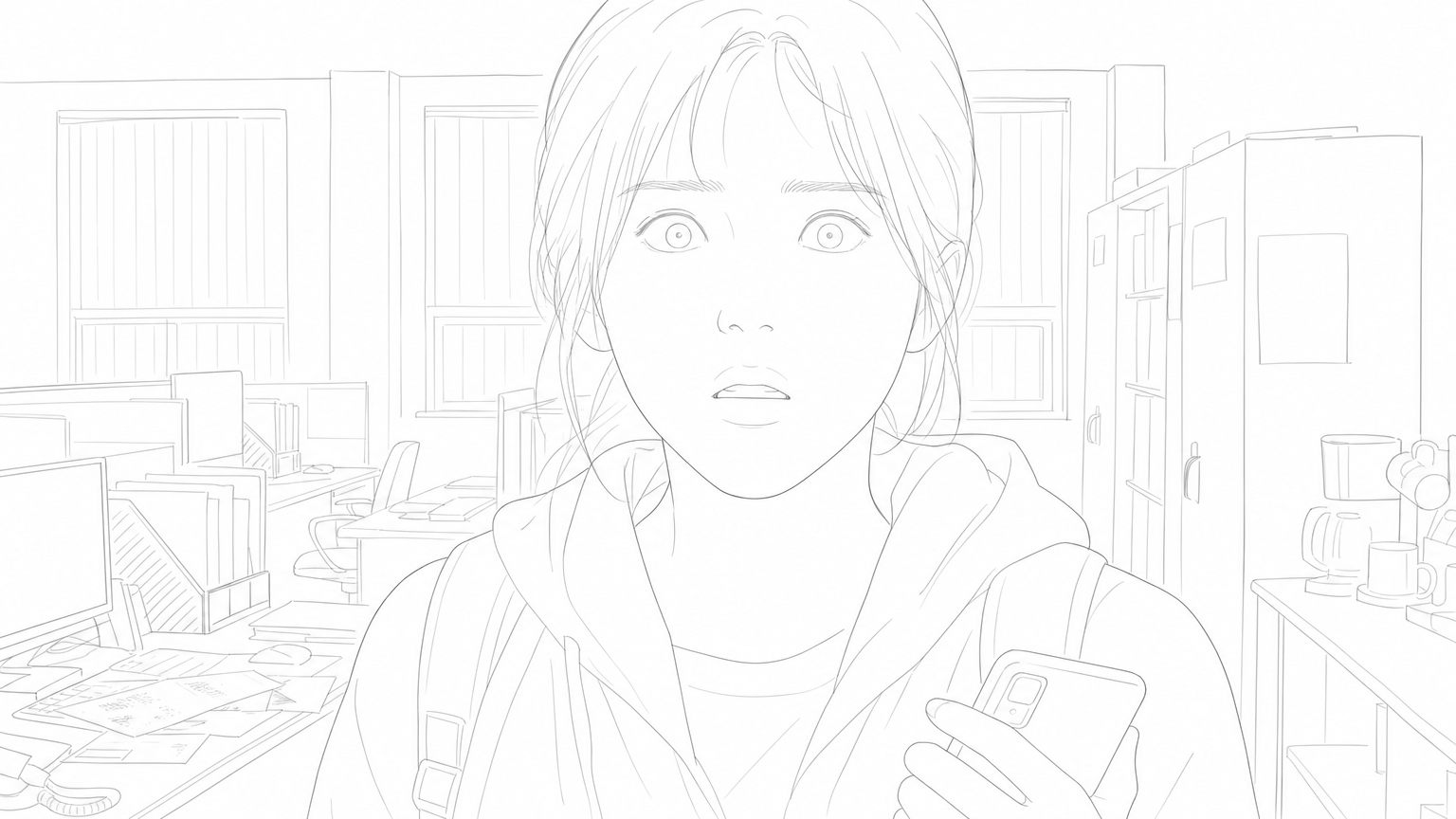
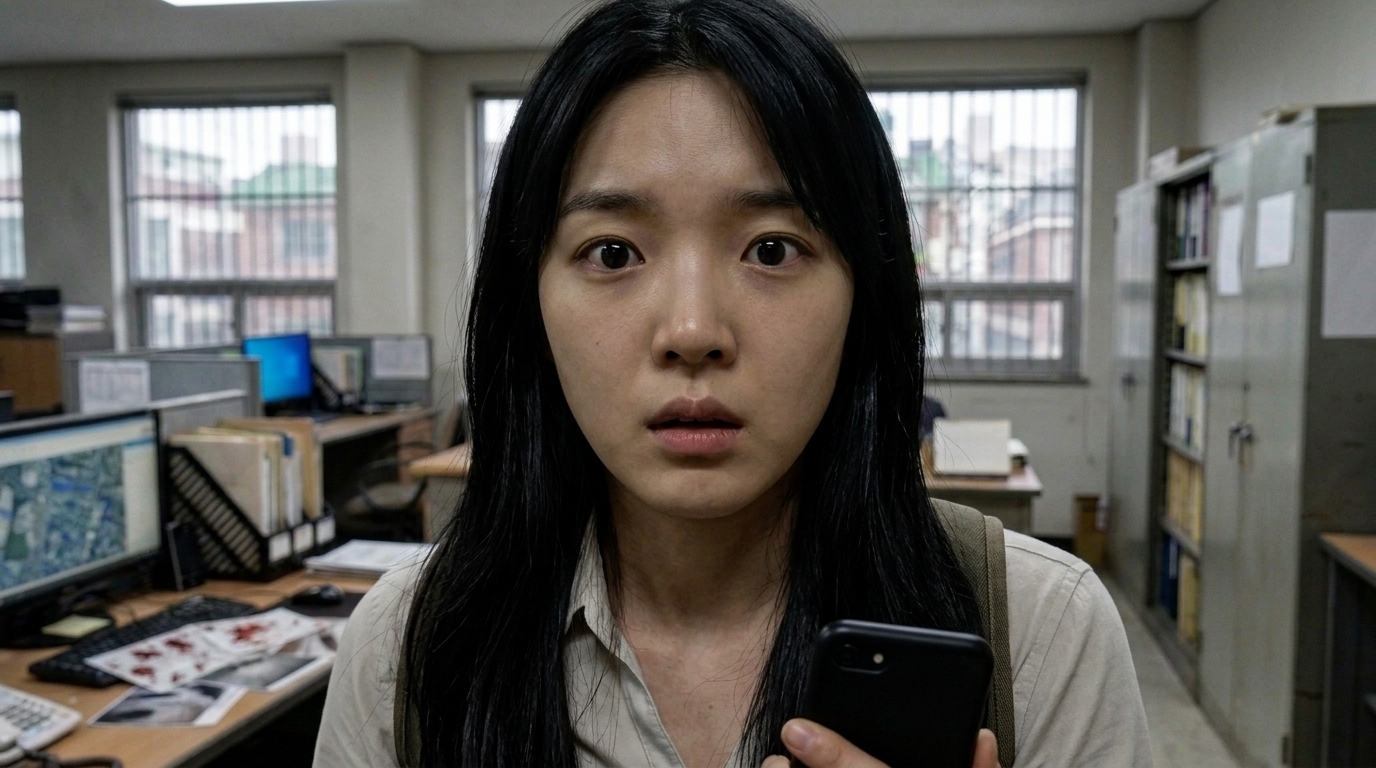
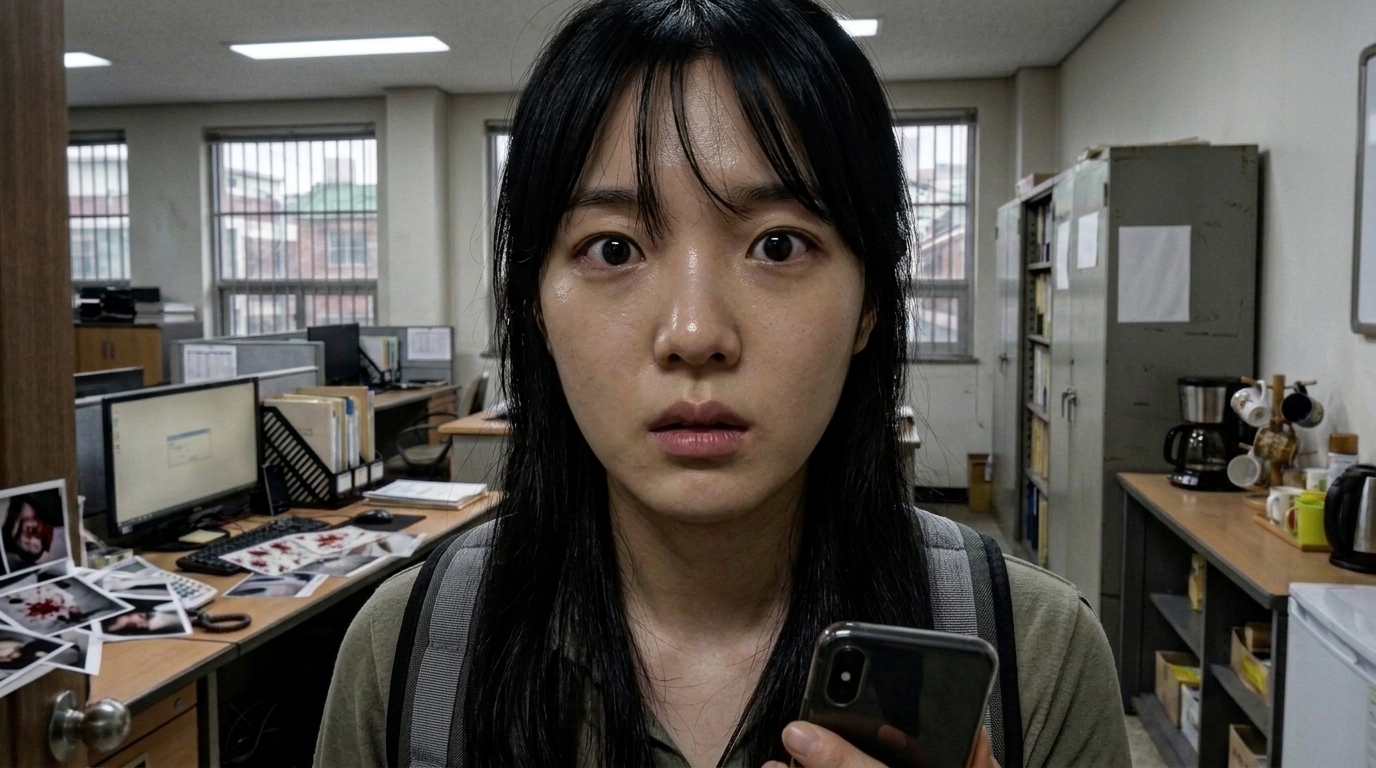
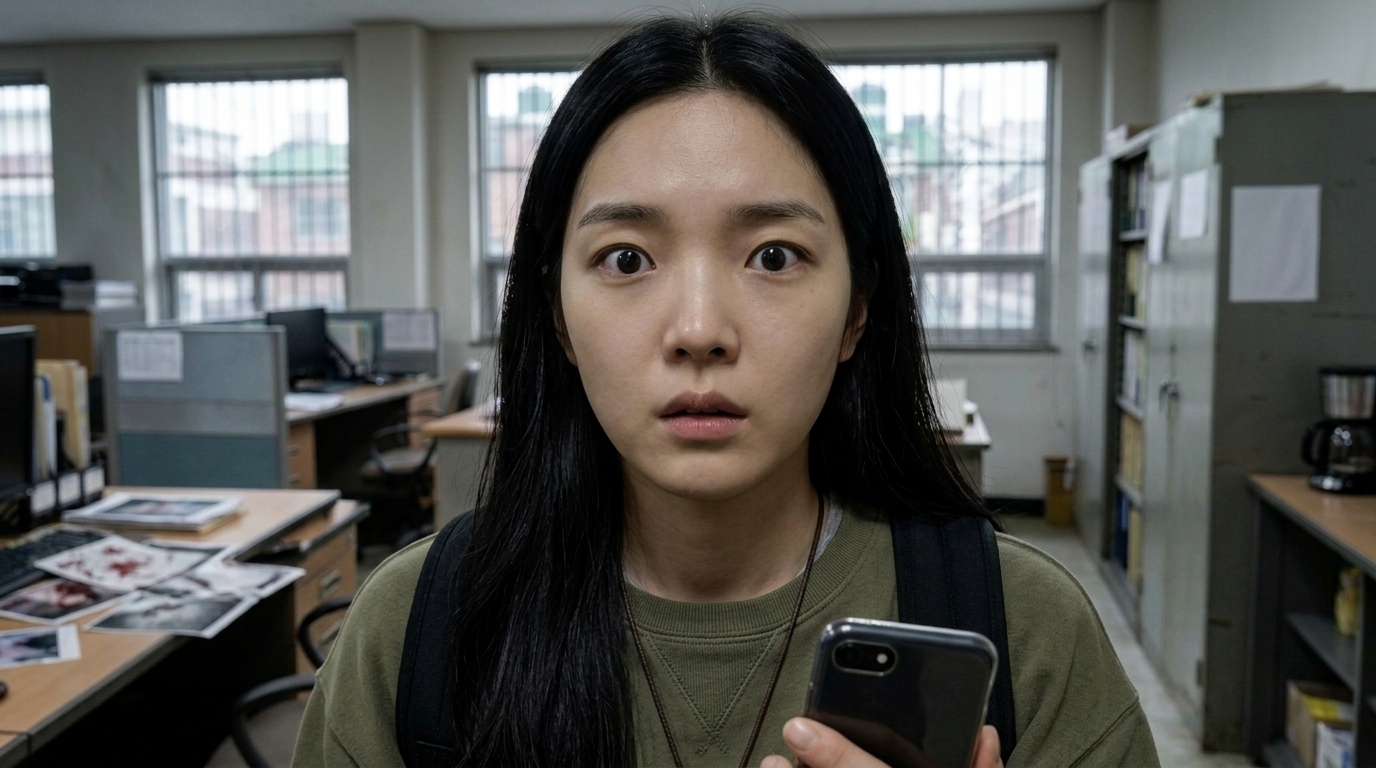
Create ONE FINAL photorealistic live-action film still of the moment below — contemporary South Korea, 2026; all people are Korean unless stated. TIME OF DAY (lock): day, interior lighting unspecified.

SHOT TEXT (authoritative, Korean): 수리영이 두 눈을 크게 뜨고 입을 살짝 벌린 굳은 얼굴 클로즈업

LOCATION (lock): A police station with a shared investigators’ office, clustered desks, computer monitors, paperwork, and crime-scene photographs spread across a desk. An adjacent meeting area draws the officers away. The shot takes place here — the attached LOCATION PHOTOGRAPH shows the exact spot.

REALIZE FIGURATIVE LANGUAGE AS A LIVE-ACTION SHOT: the Korean shot
text may describe characters metaphorically, figuratively or with
exaggeration. Photograph what a real movie camera would actually
record on a physical set — exaggerated or figurative impressions
become realistic staging choices (lighting, distance, angle,
wardrobe), not literal fantasy imagery.
EVERY CHARACTER IS A HUMAN BEING: unless the story explicitly
features non-human or virtual beings (as in science fiction or
fantasy), every character — however indirectly, vaguely or
figuratively the text describes them — IS a real human. When the
text gives no direct visual description of a person, IMAGINE one
and still show them as a concrete, fully-formed human being:
always render the human form to the maximum extent — build,
posture, face, hands, clothing — never reduce a person to a shape,
blob, solid silhouette or abstract mass.

EXPRESSIONS ARE ACTED, NEVER ANATOMICAL: when the text describes a
person's eyes, face or presence emotionally or figuratively (vacant,
hollow, dazed, burning, lifeless gaze and the like), it describes an
ACTOR'S PERFORMANCE captured by a real camera — realize it ONLY
through gaze direction, focus, eyelids, facial muscles, stillness
and posture. Every living person's eyes remain anatomically normal
human eyes with a natural iris and pupil, natural sclera and normal
proportions; NEVER whiten, blank out, cloud over, glow, enlarge or
otherwise alter eyeballs, skin or anatomy — unless the story
explicitly declares that being non-human or supernatural in form.

PROPS FACE THE RIGHT WAY: every handheld or used object must be
oriented exactly as its real-world use requires. A person reading,
watching or operating something (a phone, a photograph, a paper,
any device) has its functional side — screen, front, page — facing
THEIR OWN eyes; the camera then sees whatever side the staging
geometry implies (often its back). Show the functional side to the
camera ONLY when the shot text itself stages it toward the viewer.
Never flip, mirror or reverse an object's front and back.

CARRIED STATE (persist exactly — must match the neighbouring shots of this scene): The enlarged murder-scene photographs remain scattered across Hye-su's desk, and Su-ri-young still has her backpack and smartphone with her.

PEOPLE: the SHOT TEXT alone decides whether any person is visible in this shot. IF a person appears, they must be one of: 수리영 (Korean 20대 초반 여성, 긴 검은 머리, 타원형의 젊은 얼굴, 부드러운 이목구비와 자연스러운 피부색상태) — never anyone else, and never add a person the shot text does not show. IF only part of a person is in frame (a hand, arm, foot, back, silhouette), that body part belongs to the specific person the shot text names — its sex, age, build, skin and grooming must unmistakably match that person's profile above.

No text, captions, watermarks or annotations anywhere.

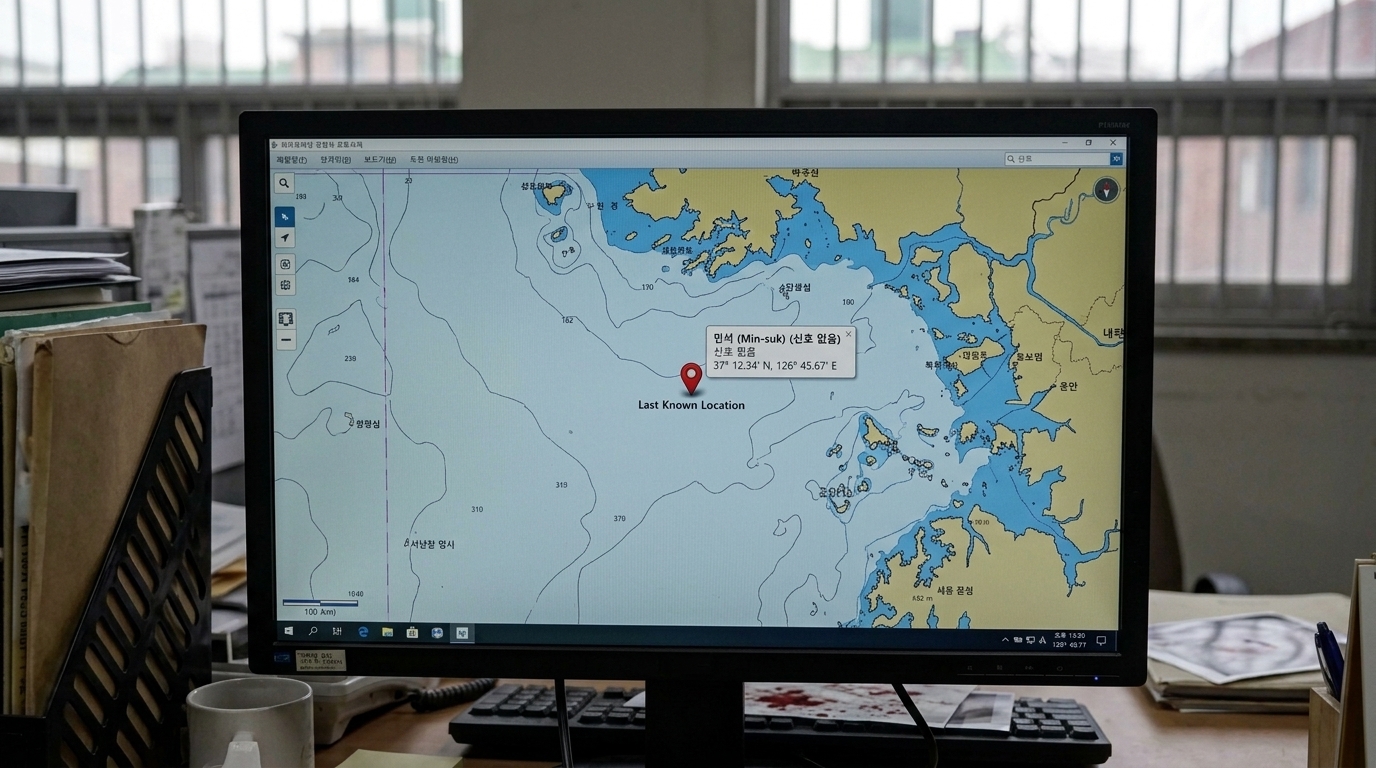
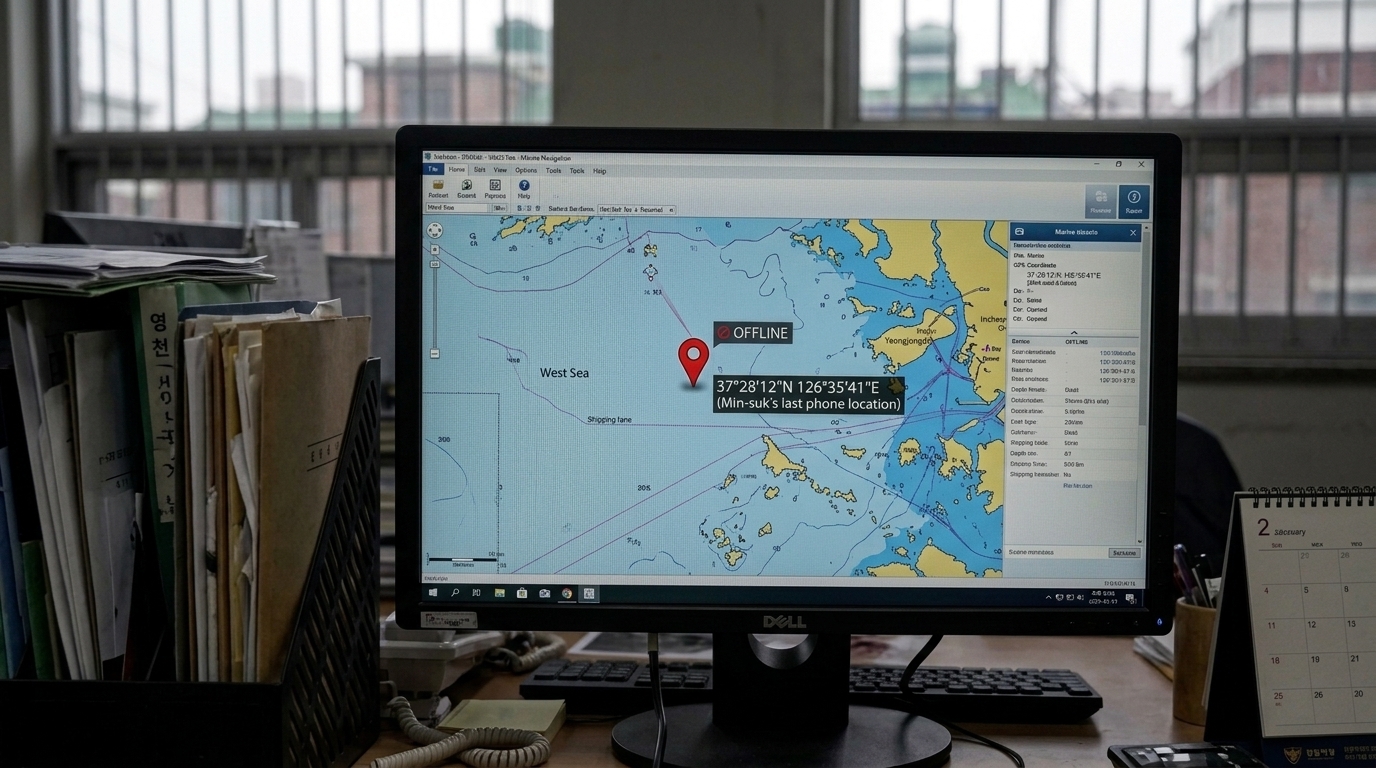

Create ONE FINAL photorealistic live-action film still of the moment below — contemporary South Korea, 2026; all people are Korean unless stated. TIME OF DAY (lock): day, interior lighting unspecified.

SHOT TEXT (authoritative, Korean): 모니터 화면에 바다 지도가 펼쳐져 있고 붉은색 핀과 좌표 숫자가 떠 있는 클로즈업

LOCATION (lock): A police station with a shared investigators’ office, clustered desks, computer monitors, paperwork, and crime-scene photographs spread across a desk. An adjacent meeting area draws the officers away. The shot takes place here — the attached LOCATION PHOTOGRAPH shows the exact spot.

REALIZE FIGURATIVE LANGUAGE AS A LIVE-ACTION SHOT: the Korean shot
text may describe characters metaphorically, figuratively or with
exaggeration. Photograph what a real movie camera would actually
record on a physical set — exaggerated or figurative impressions
become realistic staging choices (lighting, distance, angle,
wardrobe), not literal fantasy imagery.
EVERY CHARACTER IS A HUMAN BEING: unless the story explicitly
features non-human or virtual beings (as in science fiction or
fantasy), every character — however indirectly, vaguely or
figuratively the text describes them — IS a real human. When the
text gives no direct visual description of a person, IMAGINE one
and still show them as a concrete, fully-formed human being:
always render the human form to the maximum extent — build,
posture, face, hands, clothing — never reduce a person to a shape,
blob, solid silhouette or abstract mass.

EXPRESSIONS ARE ACTED, NEVER ANATOMICAL: when the text describes a
person's eyes, face or presence emotionally or figuratively (vacant,
hollow, dazed, burning, lifeless gaze and the like), it describes an
ACTOR'S PERFORMANCE captured by a real camera — realize it ONLY
through gaze direction, focus, eyelids, facial muscles, stillness
and posture. Every living person's eyes remain anatomically normal
human eyes with a natural iris and pupil, natural sclera and normal
proportions; NEVER whiten, blank out, cloud over, glow, enlarge or
otherwise alter eyeballs, skin or anatomy — unless the story
explicitly declares that being non-human or supernatural in form.

PROPS FACE THE RIGHT WAY: every handheld or used object must be
oriented exactly as its real-world use requires. A person reading,
watching or operating something (a phone, a photograph, a paper,
any device) has its functional side — screen, front, page — facing
THEIR OWN eyes; the camera then sees whatever side the staging
geometry implies (often its back). Show the functional side to the
camera ONLY when the shot text itself stages it toward the viewer.
Never flip, mirror or reverse an object's front and back.

CARRIED STATE (persist exactly — must match the neighbouring shots of this scene): The monitor displays Min-suk's last phone location as offshore coordinates, with the device marked offline. Su-ri-young's backpack and smartphone remain with her.

NO PEOPLE IN THIS SHOT: the shot text shows only the place and its state — no living person or any body part appears in frame, unless the shot text itself explicitly says so.

No text, captions, watermarks or annotations anywhere.
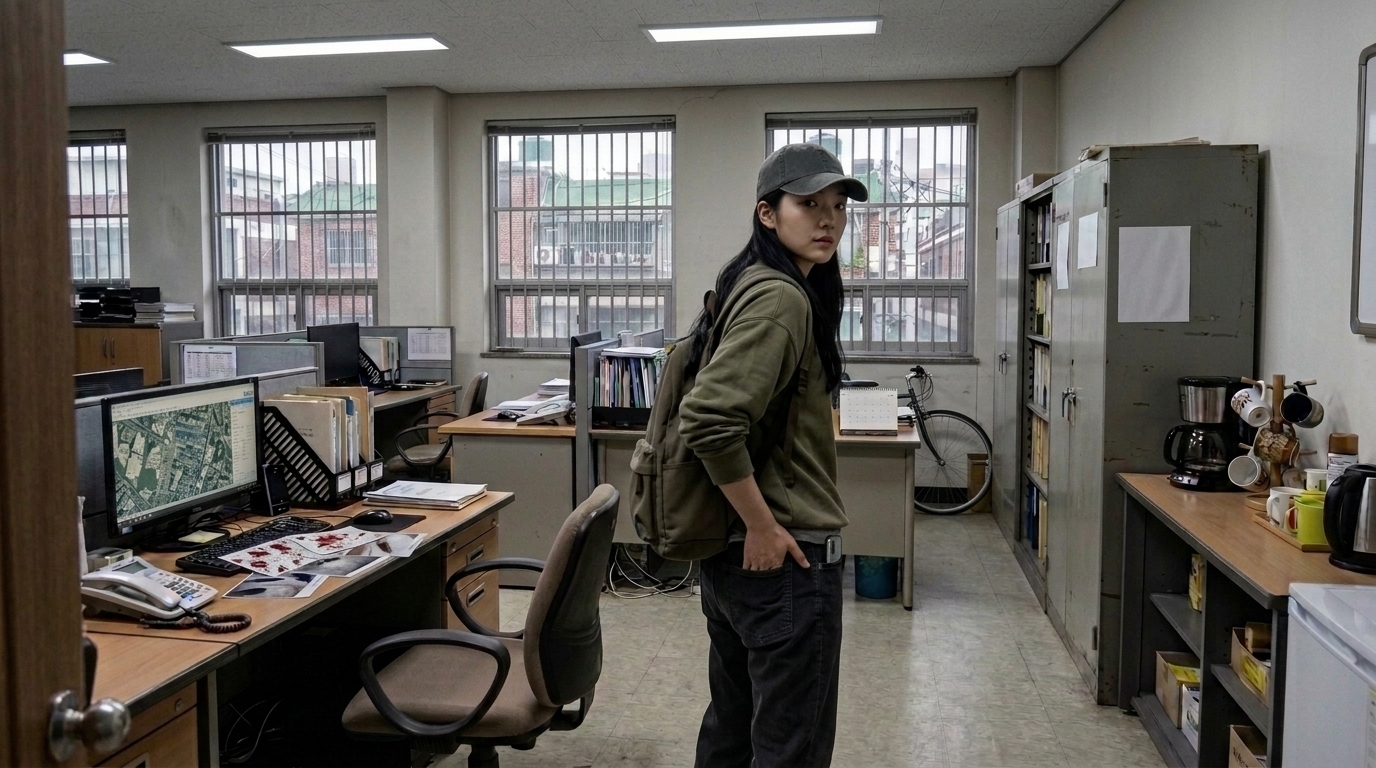
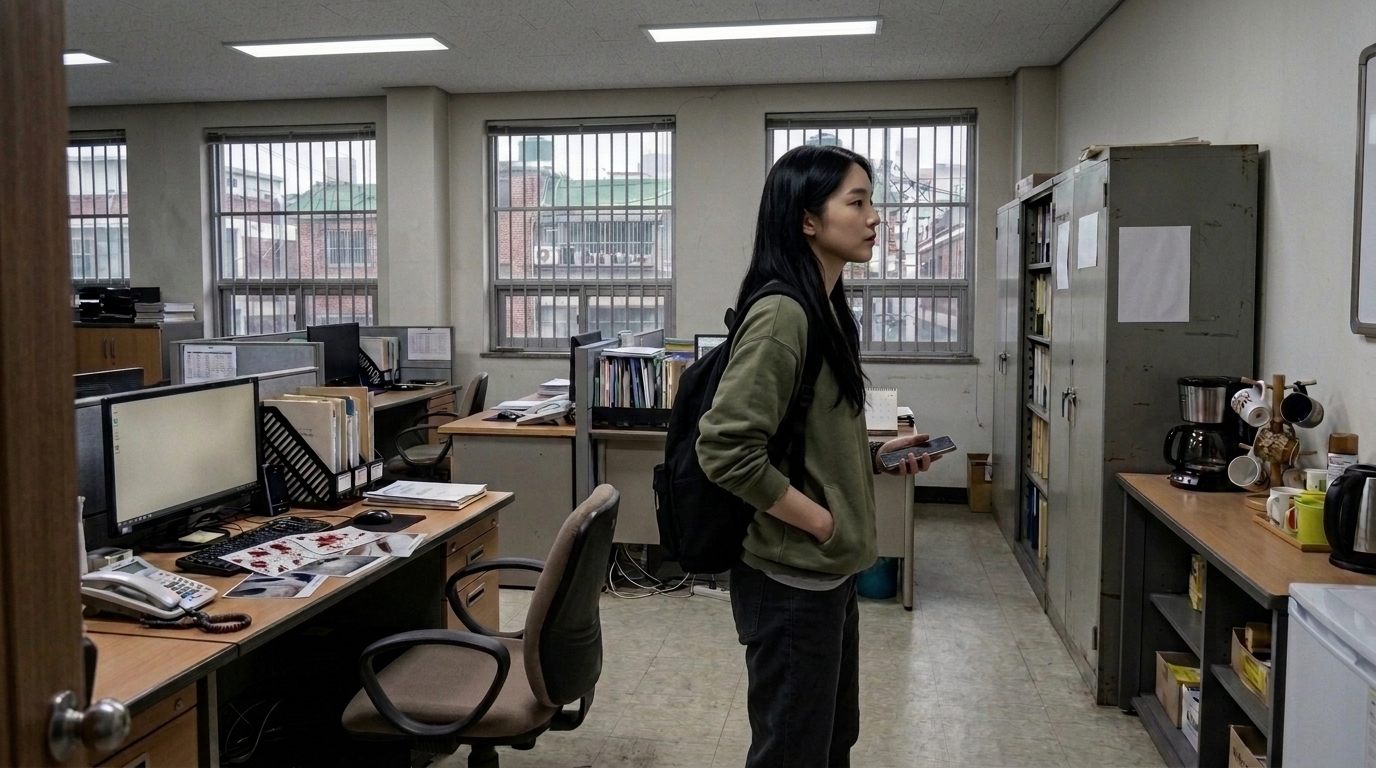
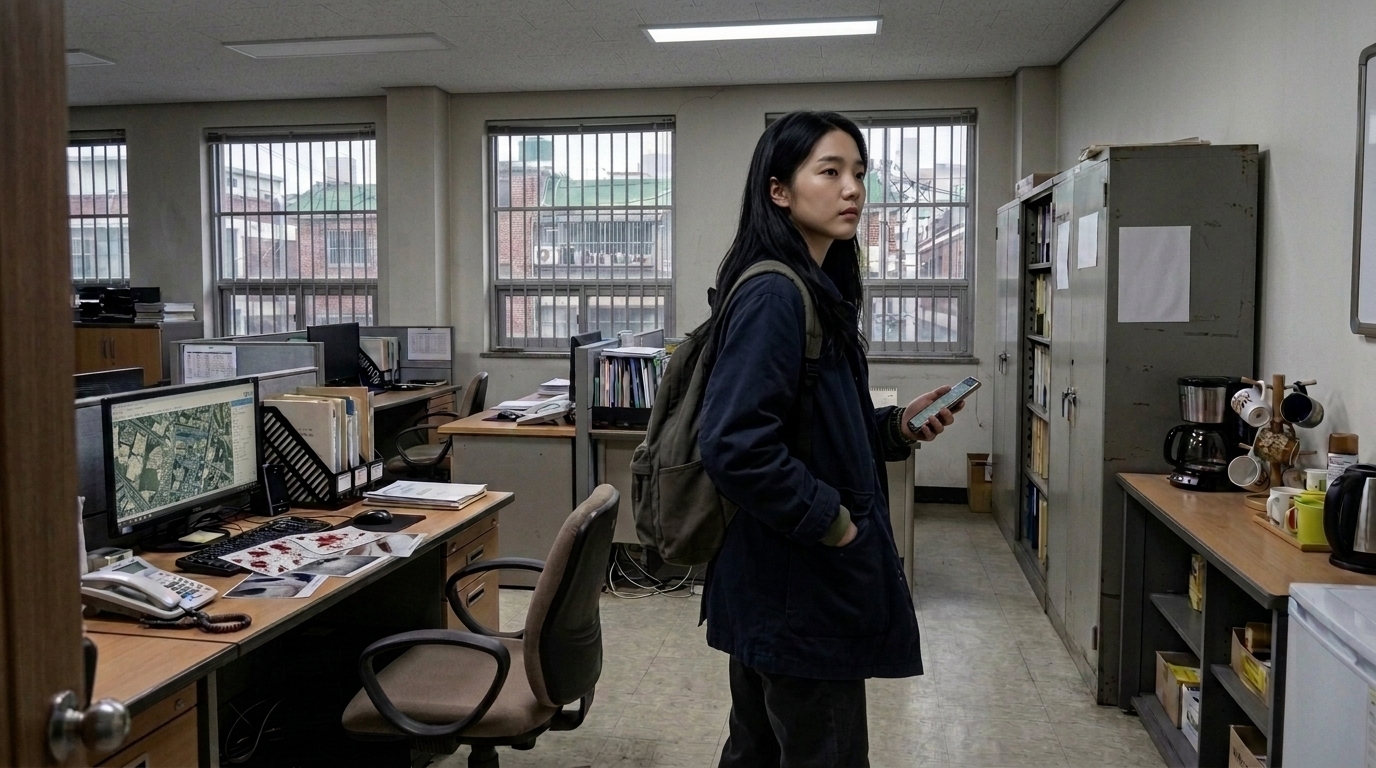
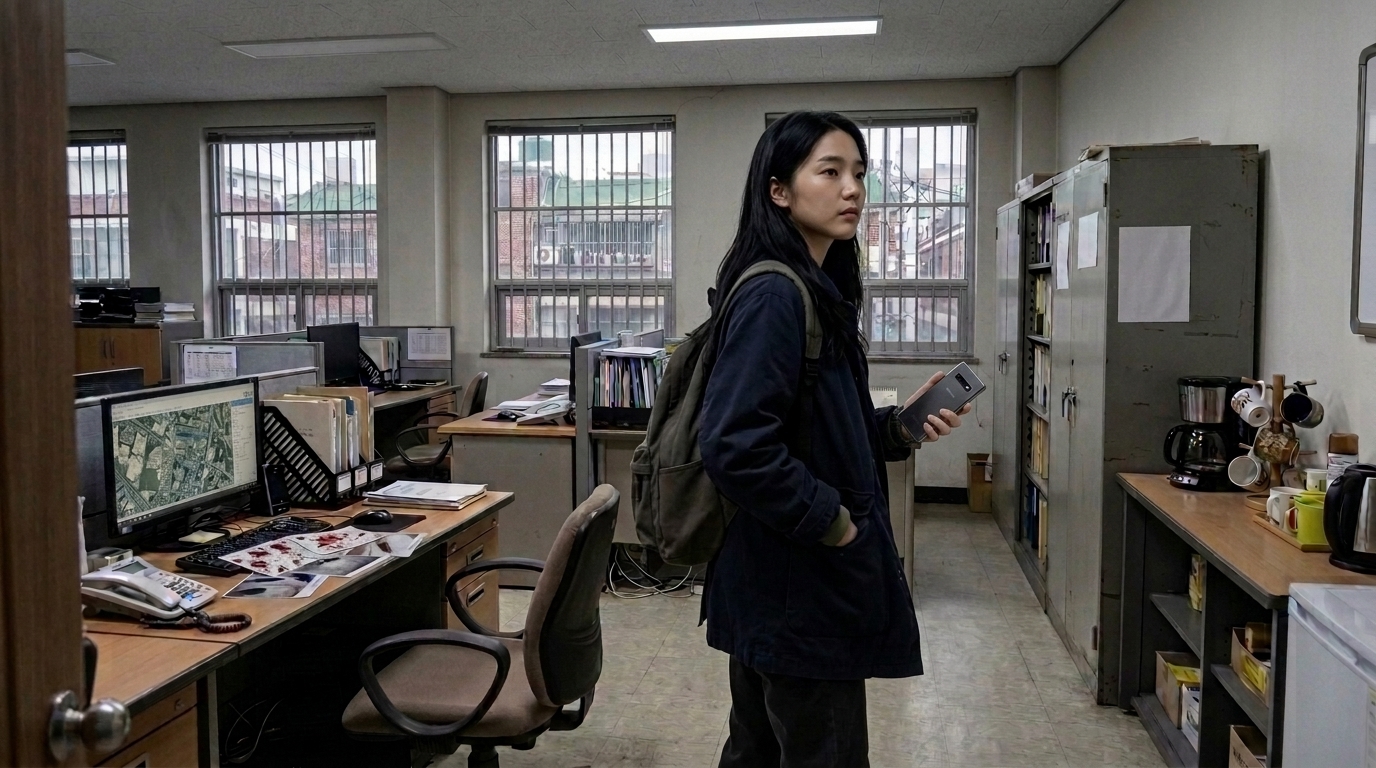
Create ONE FINAL photorealistic live-action film still of the moment below — contemporary South Korea, 2026; all people are Korean unless stated. TIME OF DAY (lock): day, interior lighting unspecified.

SHOT TEXT (authoritative, Korean): 수리영이 메모지가 들어간 겉옷 주머니에 손을 넣은 채 사무실 출입문을 향해 몸을 돌린 정지 순간

LOCATION (lock): A police station with a shared investigators’ office, clustered desks, computer monitors, paperwork, and crime-scene photographs spread across a desk. An adjacent meeting area draws the officers away. The shot takes place here — the attached LOCATION PHOTOGRAPH shows the exact spot.

REALIZE FIGURATIVE LANGUAGE AS A LIVE-ACTION SHOT: the Korean shot
text may describe characters metaphorically, figuratively or with
exaggeration. Photograph what a real movie camera would actually
record on a physical set — exaggerated or figurative impressions
become realistic staging choices (lighting, distance, angle,
wardrobe), not literal fantasy imagery.
EVERY CHARACTER IS A HUMAN BEING: unless the story explicitly
features non-human or virtual beings (as in science fiction or
fantasy), every character — however indirectly, vaguely or
figuratively the text describes them — IS a real human. When the
text gives no direct visual description of a person, IMAGINE one
and still show them as a concrete, fully-formed human being:
always render the human form to the maximum extent — build,
posture, face, hands, clothing — never reduce a person to a shape,
blob, solid silhouette or abstract mass.

EXPRESSIONS ARE ACTED, NEVER ANATOMICAL: when the text describes a
person's eyes, face or presence emotionally or figuratively (vacant,
hollow, dazed, burning, lifeless gaze and the like), it describes an
ACTOR'S PERFORMANCE captured by a real camera — realize it ONLY
through gaze direction, focus, eyelids, facial muscles, stillness
and posture. Every living person's eyes remain anatomically normal
human eyes with a natural iris and pupil, natural sclera and normal
proportions; NEVER whiten, blank out, cloud over, glow, enlarge or
otherwise alter eyeballs, skin or anatomy — unless the story
explicitly declares that being non-human or supernatural in form.

PROPS FACE THE RIGHT WAY: every handheld or used object must be
oriented exactly as its real-world use requires. A person reading,
watching or operating something (a phone, a photograph, a paper,
any device) has its functional side — screen, front, page — facing
THEIR OWN eyes; the camera then sees whatever side the staging
geometry implies (often its back). Show the functional side to the
camera ONLY when the shot text itself stages it toward the viewer.
Never flip, mirror or reverse an object's front and back.

CARRIED STATE (persist exactly — must match the neighbouring shots of this scene): Su-ri-young carries the folded coordinate note in her pocket, with her backpack and smartphone still on her, and her bicycle waiting outside the police station.

PEOPLE: the SHOT TEXT alone decides whether any person is visible in this shot. IF a person appears, they must be one of: 수리영 (Korean 20대 초반 여성, 긴 검은 머리, 타원형의 젊은 얼굴, 부드러운 이목구비와 자연스러운 피부색상태) — never anyone else, and never add a person the shot text does not show. IF only part of a person is in frame (a hand, arm, foot, back, silhouette), that body part belongs to the specific person the shot text names — its sex, age, build, skin and grooming must unmistakably match that person's profile above.

No text, captions, watermarks or annotations anywhere.
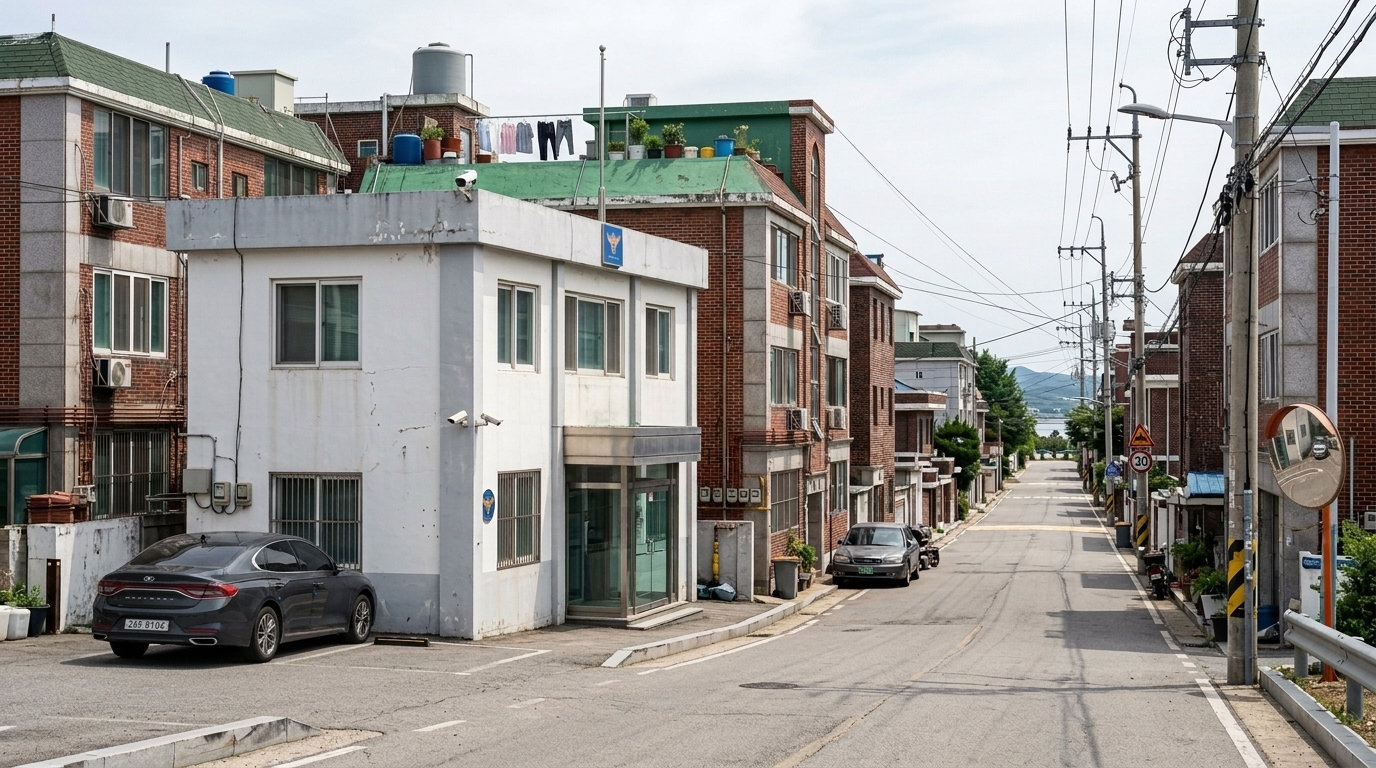
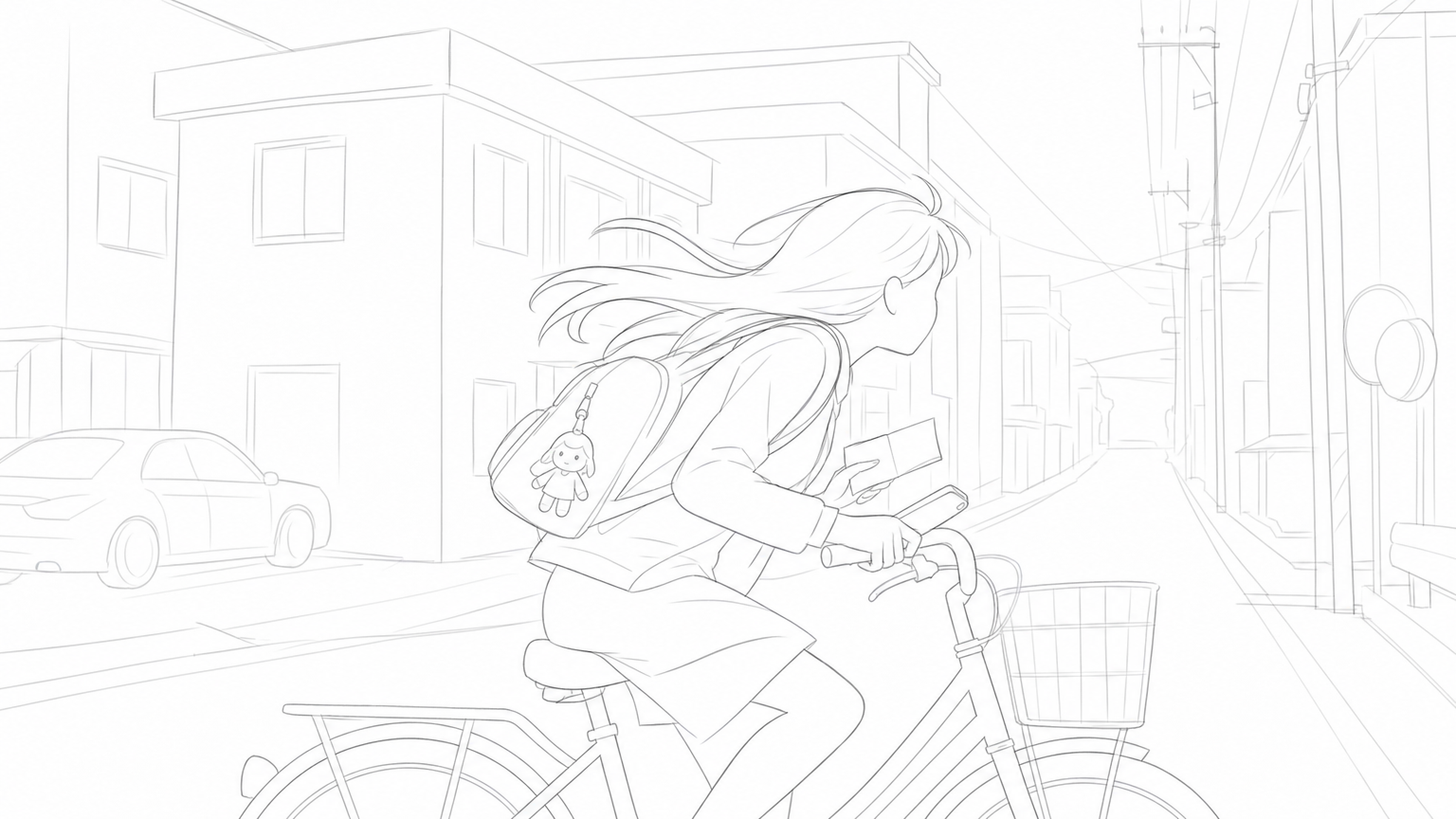
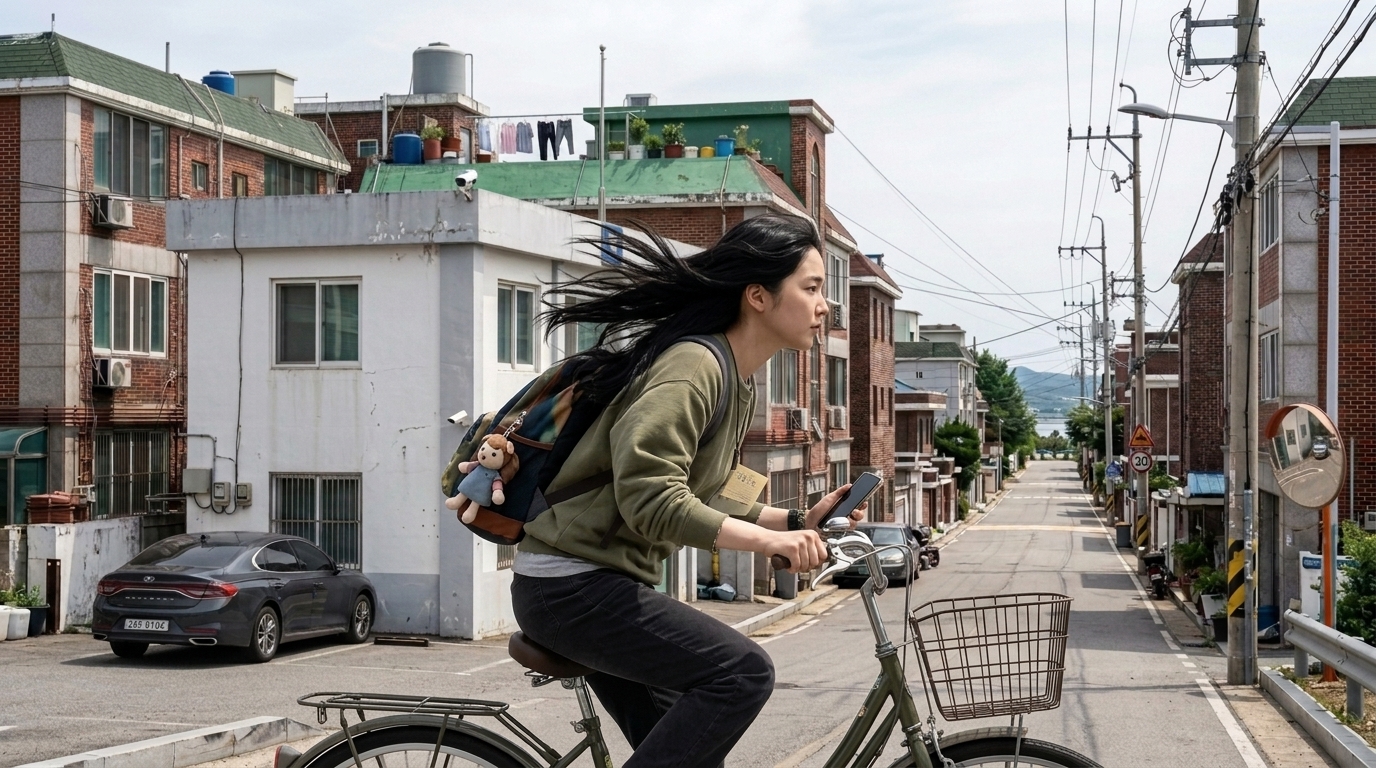
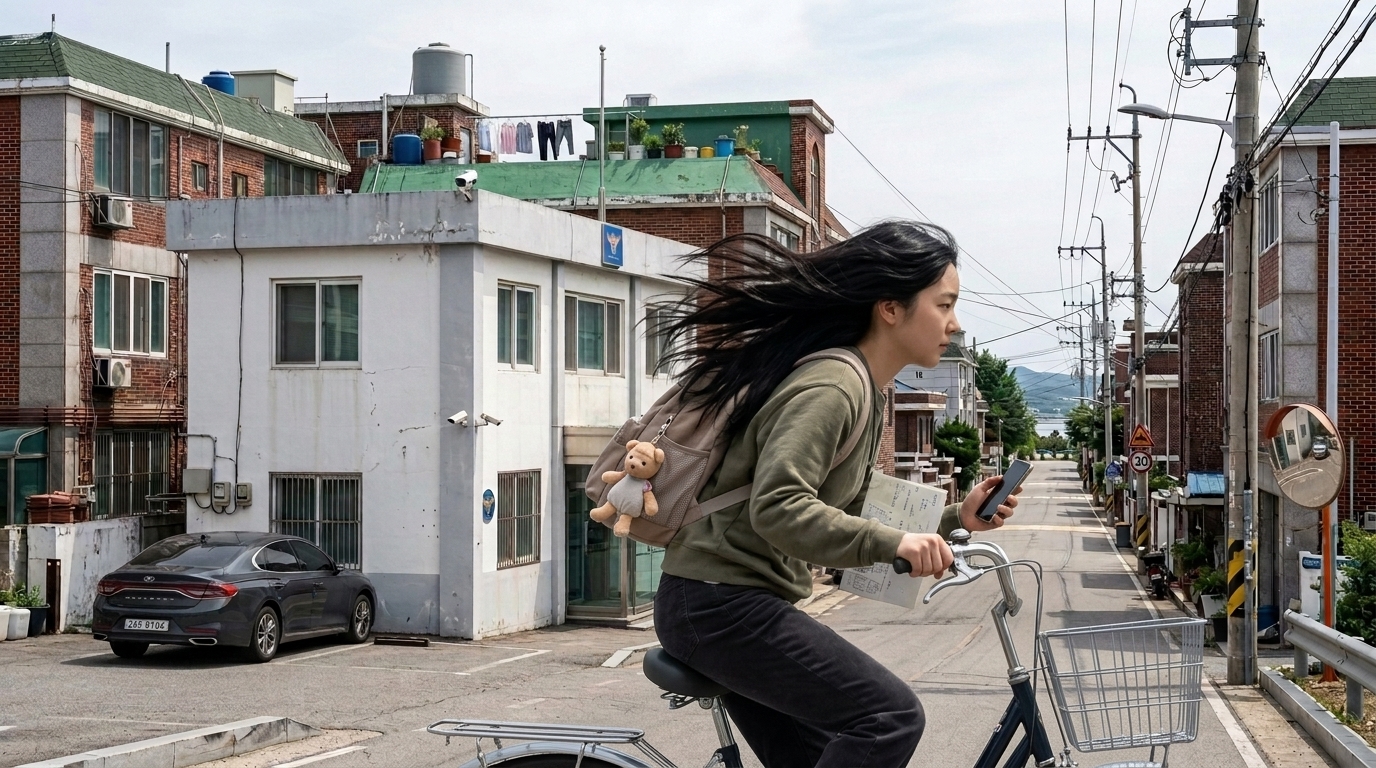
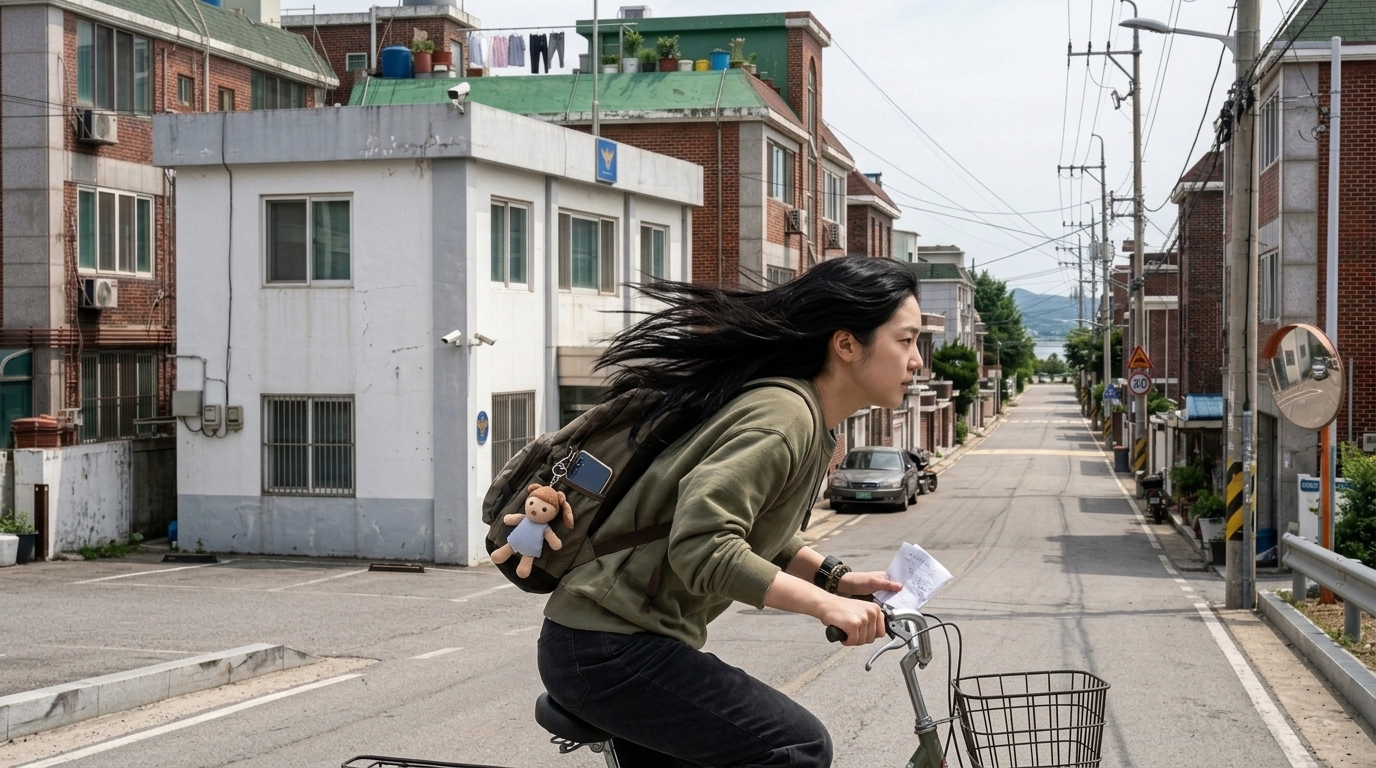
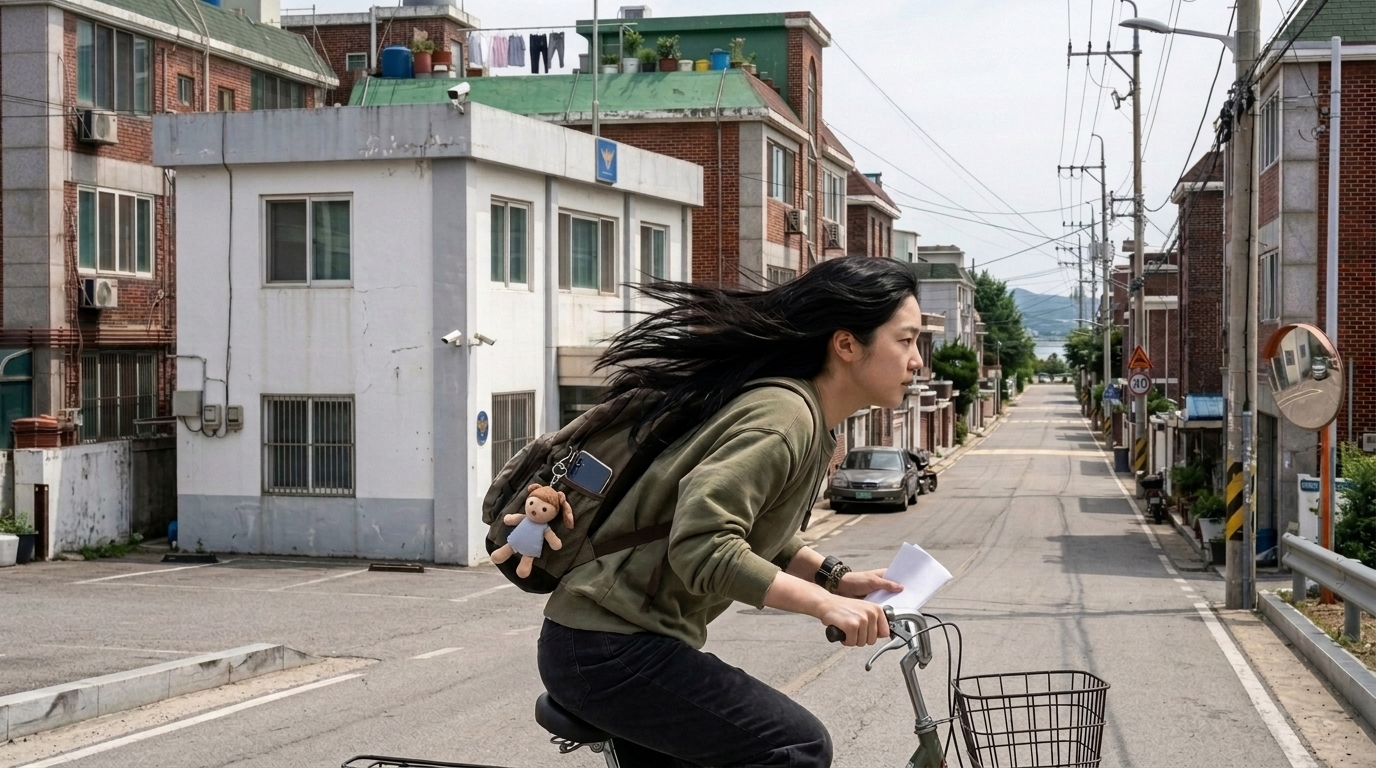
Create ONE FINAL photorealistic live-action film still of the moment below — contemporary South Korea, 2026; all people are Korean unless stated. TIME OF DAY (lock): day.

SHOT TEXT (authoritative, Korean): 경찰서 건물 밖 도로 위에서 수리영이 자전거 안장에 앉아 상체를 앞으로 숙인 채 머리카락이 뒤로 흩날리는 측면

LOCATION (lock): The exterior of a police station with a bicycle parked nearby and direct access to the street. The shot takes place here — the attached LOCATION PHOTOGRAPH shows the exact spot.

REALIZE FIGURATIVE LANGUAGE AS A LIVE-ACTION SHOT: the Korean shot
text may describe characters metaphorically, figuratively or with
exaggeration. Photograph what a real movie camera would actually
record on a physical set — exaggerated or figurative impressions
become realistic staging choices (lighting, distance, angle,
wardrobe), not literal fantasy imagery.
EVERY CHARACTER IS A HUMAN BEING: unless the story explicitly
features non-human or virtual beings (as in science fiction or
fantasy), every character — however indirectly, vaguely or
figuratively the text describes them — IS a real human. When the
text gives no direct visual description of a person, IMAGINE one
and still show them as a concrete, fully-formed human being:
always render the human form to the maximum extent — build,
posture, face, hands, clothing — never reduce a person to a shape,
blob, solid silhouette or abstract mass.

EXPRESSIONS ARE ACTED, NEVER ANATOMICAL: when the text describes a
person's eyes, face or presence emotionally or figuratively (vacant,
hollow, dazed, burning, lifeless gaze and the like), it describes an
ACTOR'S PERFORMANCE captured by a real camera — realize it ONLY
through gaze direction, focus, eyelids, facial muscles, stillness
and posture. Every living person's eyes remain anatomically normal
human eyes with a natural iris and pupil, natural sclera and normal
proportions; NEVER whiten, blank out, cloud over, glow, enlarge or
otherwise alter eyeballs, skin or anatomy — unless the story
explicitly declares that being non-human or supernatural in form.

PROPS FACE THE RIGHT WAY: every handheld or used object must be
oriented exactly as its real-world use requires. A person reading,
watching or operating something (a phone, a photograph, a paper,
any device) has its functional side — screen, front, page — facing
THEIR OWN eyes; the camera then sees whatever side the staging
geometry implies (often its back). Show the functional side to the
camera ONLY when the shot text itself stages it toward the viewer.
Never flip, mirror or reverse an object's front and back.

CARRIED STATE (persist exactly — must match the neighbouring shots of this scene): Su-ri-young rides away on the bicycle while retaining the folded coordinate note, her doll-adorned backpack, and her smartphone.

PEOPLE: the SHOT TEXT alone decides whether any person is visible in this shot. IF a person appears, they must be one of: 수리영 (Korean 20대 초반 여성, 긴 검은 머리, 타원형의 젊은 얼굴, 부드러운 이목구비와 자연스러운 피부색상태) — never anyone else, and never add a person the shot text does not show. IF only part of a person is in frame (a hand, arm, foot, back, silhouette), that body part belongs to the specific person the shot text names — its sex, age, build, skin and grooming must unmistakably match that person's profile above.

No text, captions, watermarks or annotations anywhere.
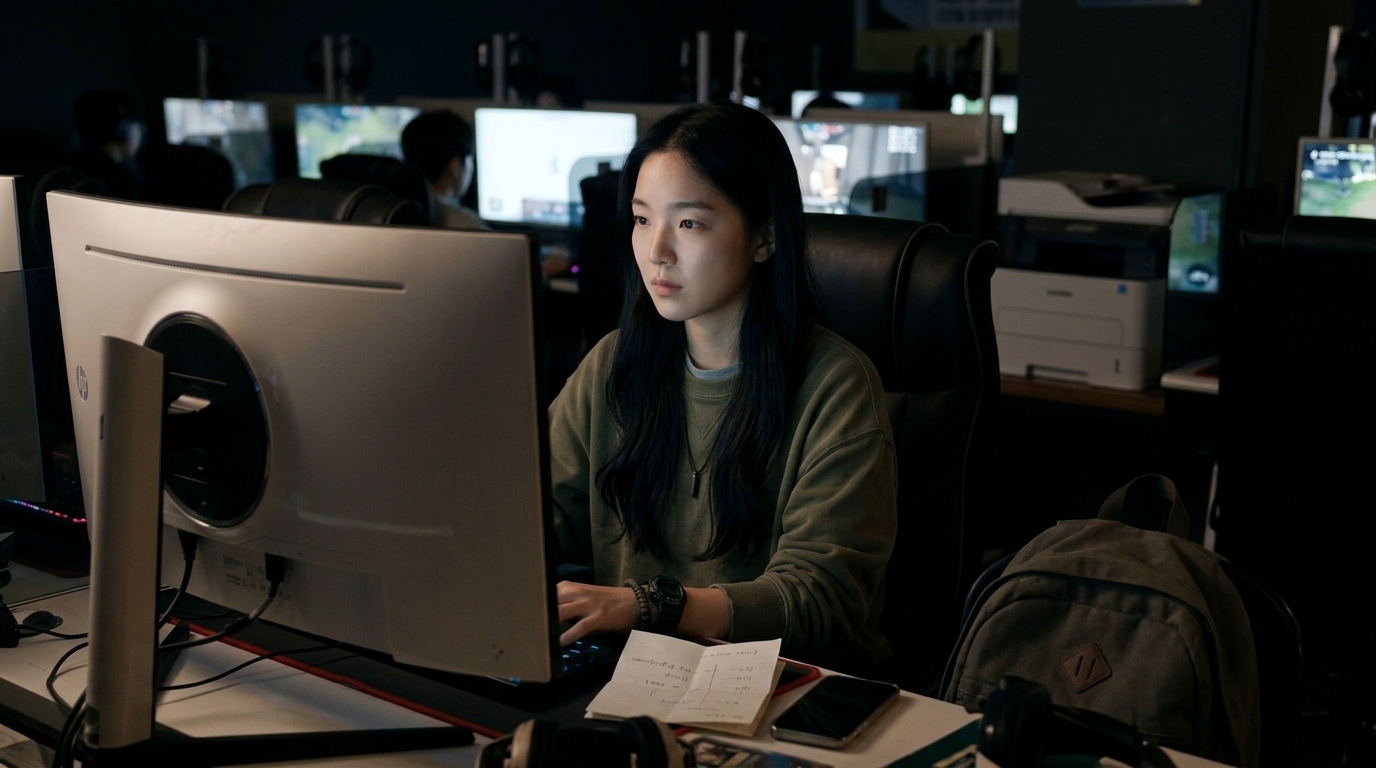
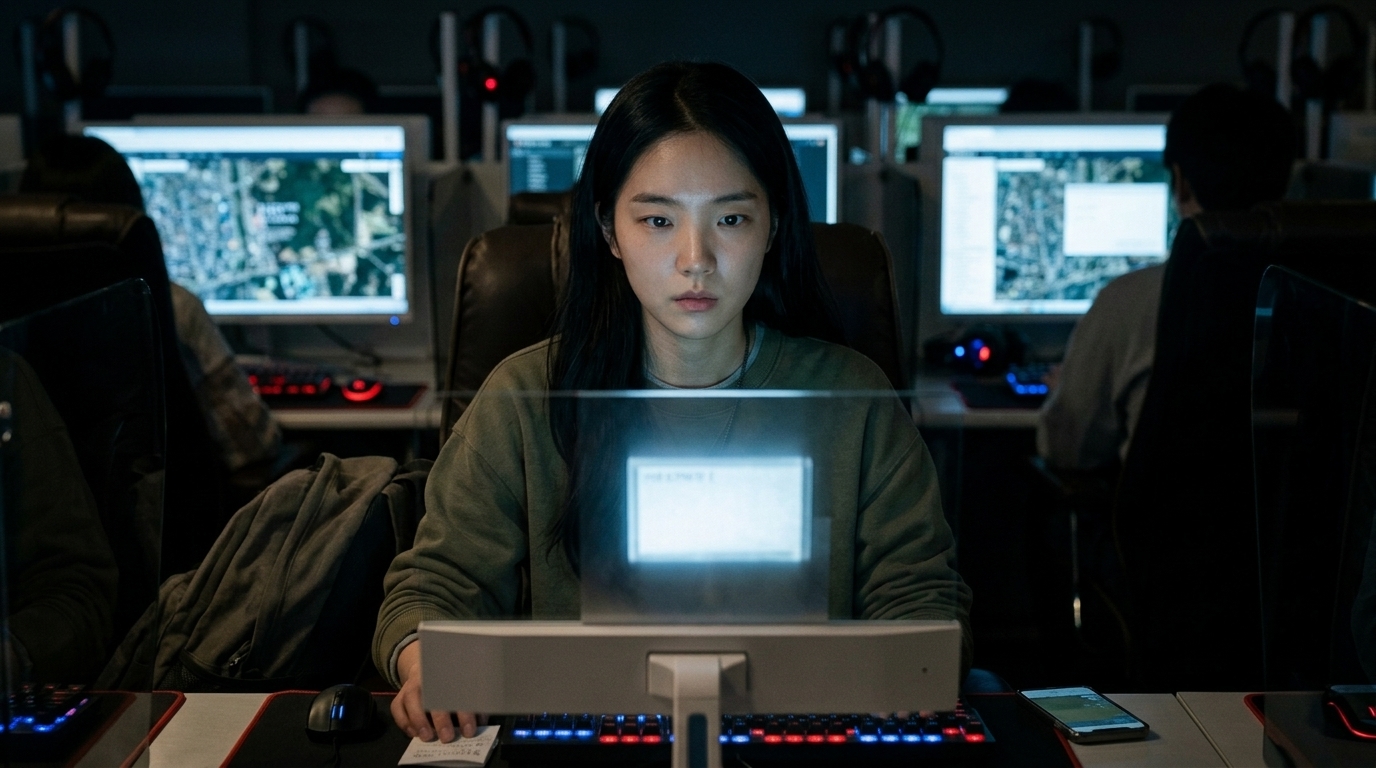
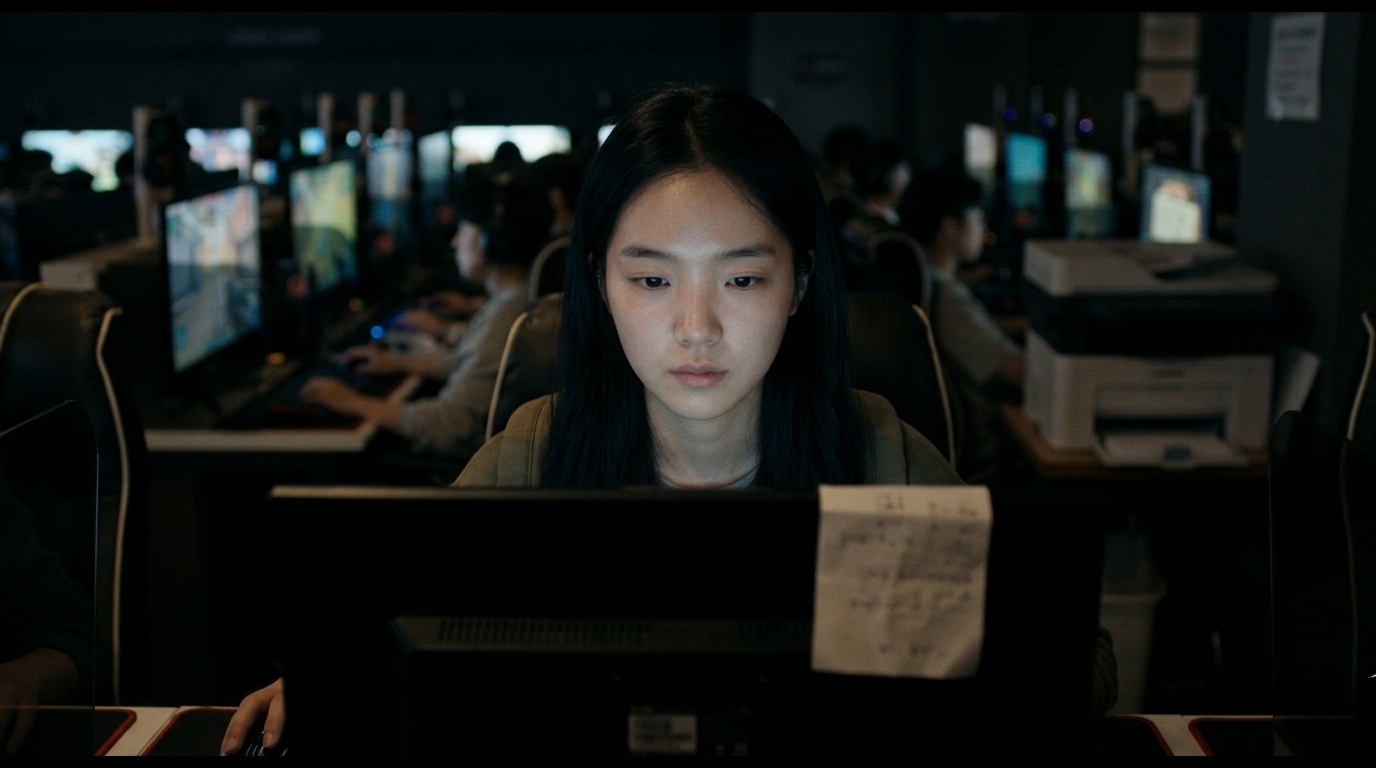
Create ONE FINAL photorealistic live-action film still of the moment below — contemporary South Korea, 2026; all people are Korean unless stated. TIME OF DAY (lock): day, interior lighting unspecified.

SHOT TEXT (authoritative, Korean): 어두운 PC방 안, 모니터 불빛이 비치는 수리영의 정면 상체

LOCATION (lock): A computer café with rows of monitor stations and access to a printer for producing multiple map sheets. The shot takes place here — the attached LOCATION PHOTOGRAPH shows the exact spot.

REALIZE FIGURATIVE LANGUAGE AS A LIVE-ACTION SHOT: the Korean shot
text may describe characters metaphorically, figuratively or with
exaggeration. Photograph what a real movie camera would actually
record on a physical set — exaggerated or figurative impressions
become realistic staging choices (lighting, distance, angle,
wardrobe), not literal fantasy imagery.
EVERY CHARACTER IS A HUMAN BEING: unless the story explicitly
features non-human or virtual beings (as in science fiction or
fantasy), every character — however indirectly, vaguely or
figuratively the text describes them — IS a real human. When the
text gives no direct visual description of a person, IMAGINE one
and still show them as a concrete, fully-formed human being:
always render the human form to the maximum extent — build,
posture, face, hands, clothing — never reduce a person to a shape,
blob, solid silhouette or abstract mass.

EXPRESSIONS ARE ACTED, NEVER ANATOMICAL: when the text describes a
person's eyes, face or presence emotionally or figuratively (vacant,
hollow, dazed, burning, lifeless gaze and the like), it describes an
ACTOR'S PERFORMANCE captured by a real camera — realize it ONLY
through gaze direction, focus, eyelids, facial muscles, stillness
and posture. Every living person's eyes remain anatomically normal
human eyes with a natural iris and pupil, natural sclera and normal
proportions; NEVER whiten, blank out, cloud over, glow, enlarge or
otherwise alter eyeballs, skin or anatomy — unless the story
explicitly declares that being non-human or supernatural in form.

PROPS FACE THE RIGHT WAY: every handheld or used object must be
oriented exactly as its real-world use requires. A person reading,
watching or operating something (a phone, a photograph, a paper,
any device) has its functional side — screen, front, page — facing
THEIR OWN eyes; the camera then sees whatever side the staging
geometry implies (often its back). Show the functional side to the
camera ONLY when the shot text itself stages it toward the viewer.
Never flip, mirror or reverse an object's front and back.

CARRIED STATE (persist exactly — must match the neighbouring shots of this scene): Su-ri-young has the folded coordinate note available while looking up the location, and her backpack and smartphone remain with her.

PEOPLE: the SHOT TEXT alone decides whether any person is visible in this shot. IF a person appears, they must be one of: 수리영 (Korean 20대 초반 여성, 긴 검은 머리, 타원형의 젊은 얼굴, 부드러운 이목구비와 자연스러운 피부색상태) — never anyone else, and never add a person the shot text does not show. IF only part of a person is in frame (a hand, arm, foot, back, silhouette), that body part belongs to the specific person the shot text names — its sex, age, build, skin and grooming must unmistakably match that person's profile above.

No text, captions, watermarks or annotations anywhere.
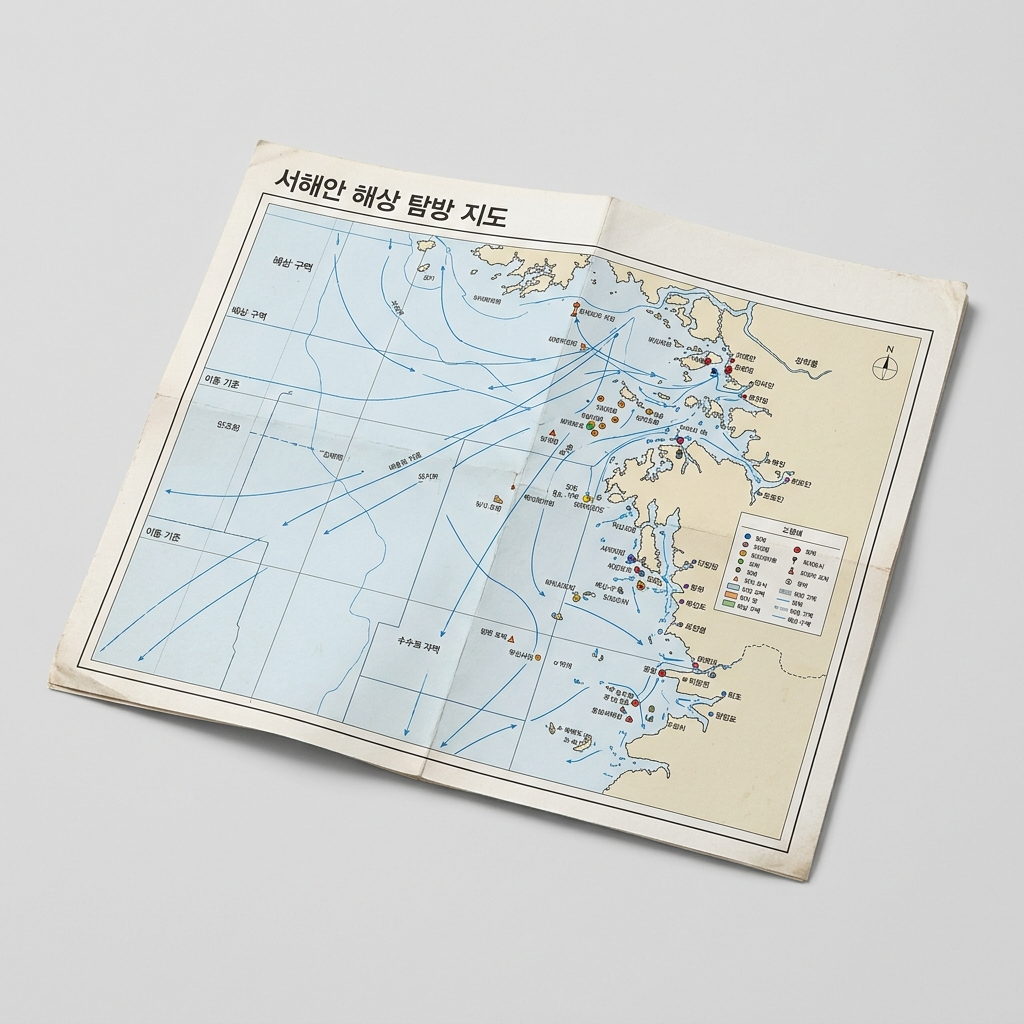
Create ONE FINAL photorealistic live-action film still of the moment below — contemporary South Korea, 2026; all people are Korean unless stated. TIME OF DAY (lock): day, interior lighting unspecified.

SHOT TEXT (authoritative, Korean): 수리영의 두 손이 접힌 지도 종이들을 열려 있는 백팩 안으로 밀어넣은 정지 순간

LOCATION (lock): A computer café with rows of monitor stations and access to a printer for producing multiple map sheets. The shot takes place here — the attached PREVIOUS SHOT STILL shows this exact place.

THIS SHOT CONTINUES THE PREVIOUS SHOT: everything the attached still established — the place, its fixed features and wear, each person's clothing and state — persists. Any person in it who cannot move stays PRECISELY as photographed (body, pose, contact points, held objects); only the camera changes.

PREVIOUS STILL USAGE (follow exactly — what to take from the attached still and what to exclude): Take the same dark computer-booth lighting, monitor glow, and workstation materials from the reference. Exclude the seated upper body and screen content, focusing only on the hands, folded maps, and open backpack.

REALIZE FIGURATIVE LANGUAGE AS A LIVE-ACTION SHOT: the Korean shot
text may describe characters metaphorically, figuratively or with
exaggeration. Photograph what a real movie camera would actually
record on a physical set — exaggerated or figurative impressions
become realistic staging choices (lighting, distance, angle,
wardrobe), not literal fantasy imagery.
EVERY CHARACTER IS A HUMAN BEING: unless the story explicitly
features non-human or virtual beings (as in science fiction or
fantasy), every character — however indirectly, vaguely or
figuratively the text describes them — IS a real human. When the
text gives no direct visual description of a person, IMAGINE one
and still show them as a concrete, fully-formed human being:
always render the human form to the maximum extent — build,
posture, face, hands, clothing — never reduce a person to a shape,
blob, solid silhouette or abstract mass.

EXPRESSIONS ARE ACTED, NEVER ANATOMICAL: when the text describes a
person's eyes, face or presence emotionally or figuratively (vacant,
hollow, dazed, burning, lifeless gaze and the like), it describes an
ACTOR'S PERFORMANCE captured by a real camera — realize it ONLY
through gaze direction, focus, eyelids, facial muscles, stillness
and posture. Every living person's eyes remain anatomically normal
human eyes with a natural iris and pupil, natural sclera and normal
proportions; NEVER whiten, blank out, cloud over, glow, enlarge or
otherwise alter eyeballs, skin or anatomy — unless the story
explicitly declares that being non-human or supernatural in form.

PROPS FACE THE RIGHT WAY: every handheld or used object must be
oriented exactly as its real-world use requires. A person reading,
watching or operating something (a phone, a photograph, a paper,
any device) has its functional side — screen, front, page — facing
THEIR OWN eyes; the camera then sees whatever side the staging
geometry implies (often its back). Show the functional side to the
camera ONLY when the shot text itself stages it toward the viewer.
Never flip, mirror or reverse an object's front and back.

CARRIED STATE (persist exactly — must match the neighbouring shots of this scene): Several folded printed maps are now stored inside Su-ri-young's doll-adorned backpack; she also retains the coordinate note and smartphone.

PEOPLE: the SHOT TEXT alone decides whether any person is visible in this shot. IF a person appears, they must be one of: 수리영 (Korean 20대 초반 여성, 긴 검은 머리, 타원형의 젊은 얼굴, 부드러운 이목구비와 자연스러운 피부색상태) — never anyone else, and never add a person the shot text does not show. IF only part of a person is in frame (a hand, arm, foot, back, silhouette), that body part belongs to the specific person the shot text names — its sex, age, build, skin and grooming must unmistakably match that person's profile above.

No text, captions, watermarks or annotations anywhere.
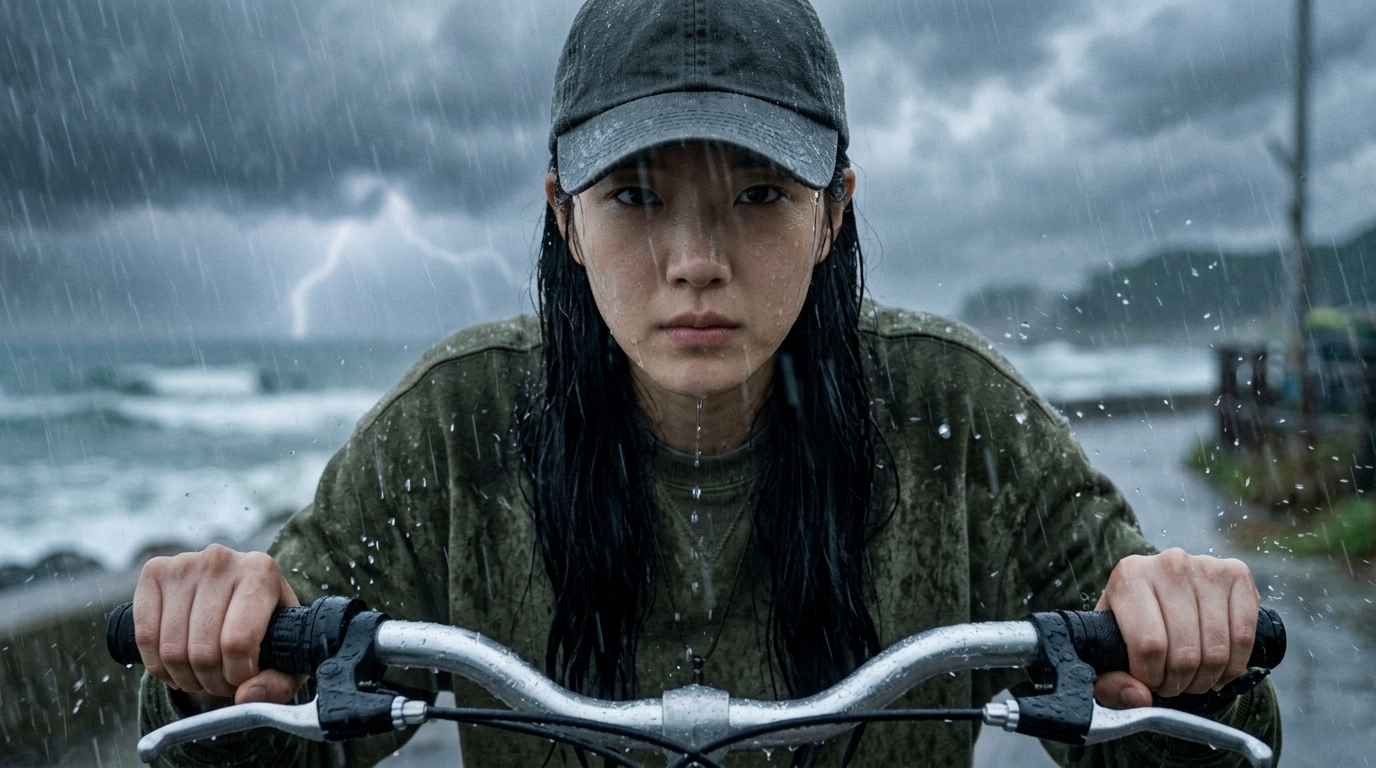
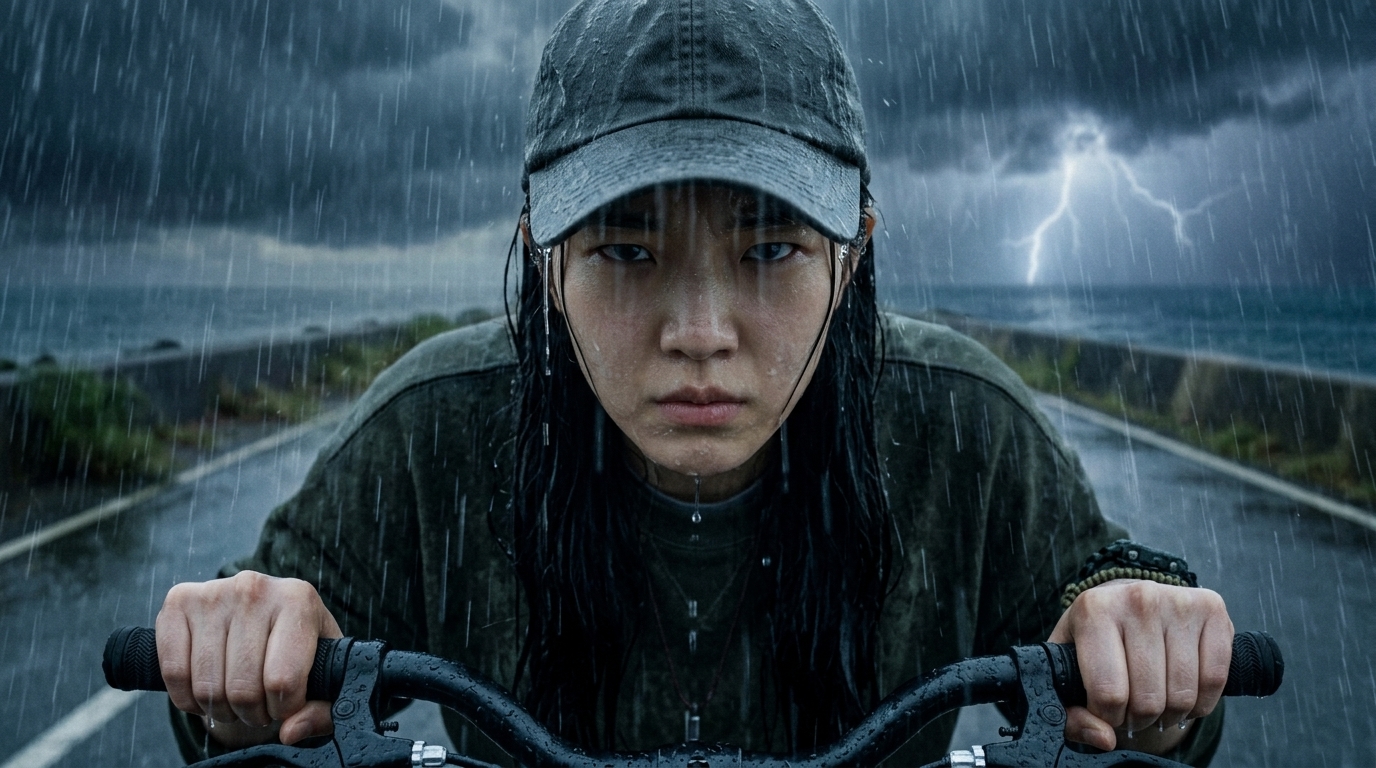
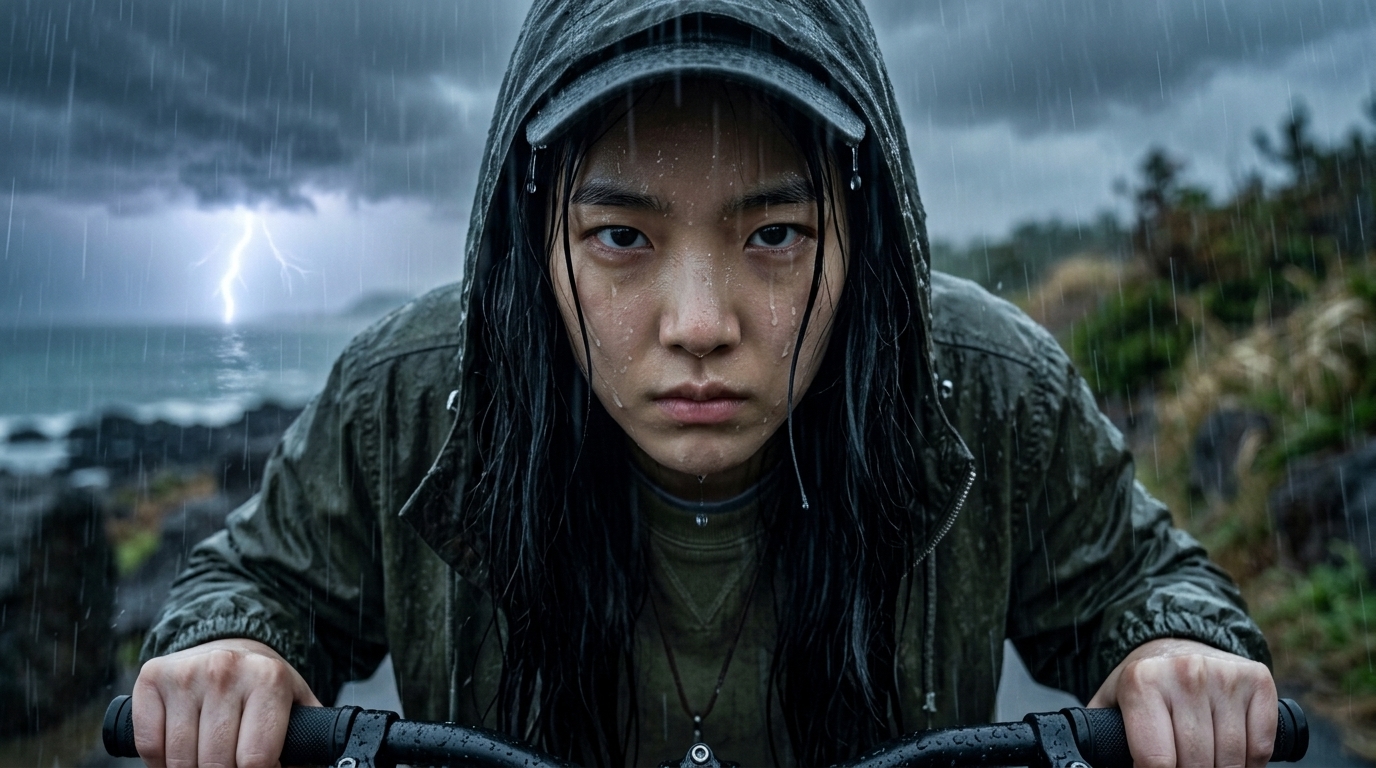
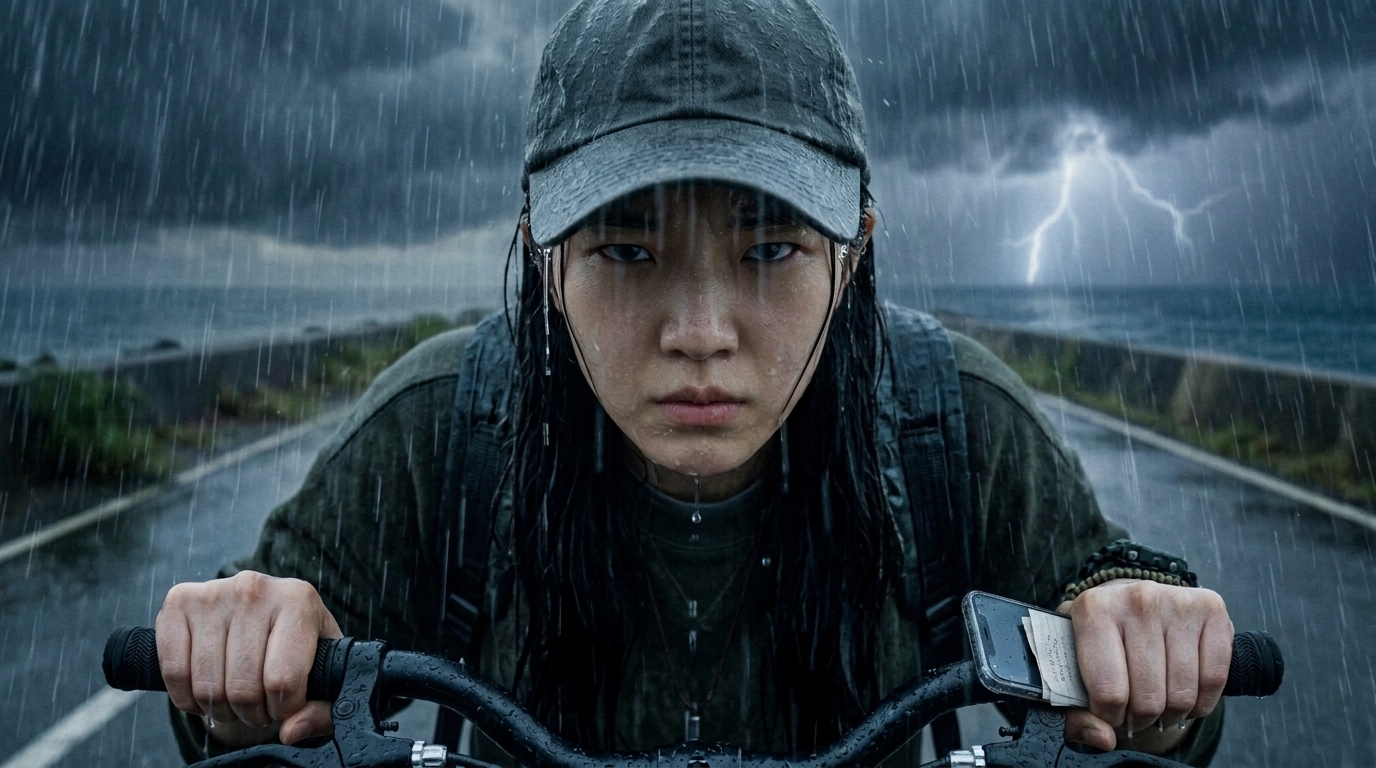
Create ONE FINAL photorealistic live-action film still of the moment below — contemporary South Korea, 2026; all people are Korean unless stated. TIME OF DAY (lock): day, heavy thunderstorm.

SHOT TEXT (authoritative, Korean): 비에 흠뻑 젖은 수리영이 자전거 핸들을 꽉 쥔 채 앞을 노려보는 얼굴 클로즈업

LOCATION (lock): A coastal route exposed to a sudden downpour, with dark storm clouds, thunder, lightning, and heavy rain over the bicycle path. The shot takes place here — the attached LOCATION PHOTOGRAPH shows the exact spot.

REALIZE FIGURATIVE LANGUAGE AS A LIVE-ACTION SHOT: the Korean shot
text may describe characters metaphorically, figuratively or with
exaggeration. Photograph what a real movie camera would actually
record on a physical set — exaggerated or figurative impressions
become realistic staging choices (lighting, distance, angle,
wardrobe), not literal fantasy imagery.
EVERY CHARACTER IS A HUMAN BEING: unless the story explicitly
features non-human or virtual beings (as in science fiction or
fantasy), every character — however indirectly, vaguely or
figuratively the text describes them — IS a real human. When the
text gives no direct visual description of a person, IMAGINE one
and still show them as a concrete, fully-formed human being:
always render the human form to the maximum extent — build,
posture, face, hands, clothing — never reduce a person to a shape,
blob, solid silhouette or abstract mass.

EXPRESSIONS ARE ACTED, NEVER ANATOMICAL: when the text describes a
person's eyes, face or presence emotionally or figuratively (vacant,
hollow, dazed, burning, lifeless gaze and the like), it describes an
ACTOR'S PERFORMANCE captured by a real camera — realize it ONLY
through gaze direction, focus, eyelids, facial muscles, stillness
and posture. Every living person's eyes remain anatomically normal
human eyes with a natural iris and pupil, natural sclera and normal
proportions; NEVER whiten, blank out, cloud over, glow, enlarge or
otherwise alter eyeballs, skin or anatomy — unless the story
explicitly declares that being non-human or supernatural in form.

PROPS FACE THE RIGHT WAY: every handheld or used object must be
oriented exactly as its real-world use requires. A person reading,
watching or operating something (a phone, a photograph, a paper,
any device) has its functional side — screen, front, page — facing
THEIR OWN eyes; the camera then sees whatever side the staging
geometry implies (often its back). Show the functional side to the
camera ONLY when the shot text itself stages it toward the viewer.
Never flip, mirror or reverse an object's front and back.

CARRIED STATE (persist exactly — must match the neighbouring shots of this scene): Su-ri-young rides through the rain with the printed maps secured in her backpack, while retaining the coordinate note and smartphone.

PEOPLE: the SHOT TEXT alone decides whether any person is visible in this shot. IF a person appears, they must be one of: 수리영 (Korean 20대 초반 여성, 긴 검은 머리, 타원형의 젊은 얼굴, 부드러운 이목구비와 자연스러운 피부색상태) — never anyone else, and never add a person the shot text does not show. IF only part of a person is in frame (a hand, arm, foot, back, silhouette), that body part belongs to the specific person the shot text names — its sex, age, build, skin and grooming must unmistakably match that person's profile above.

No text, captions, watermarks or annotations anywhere.
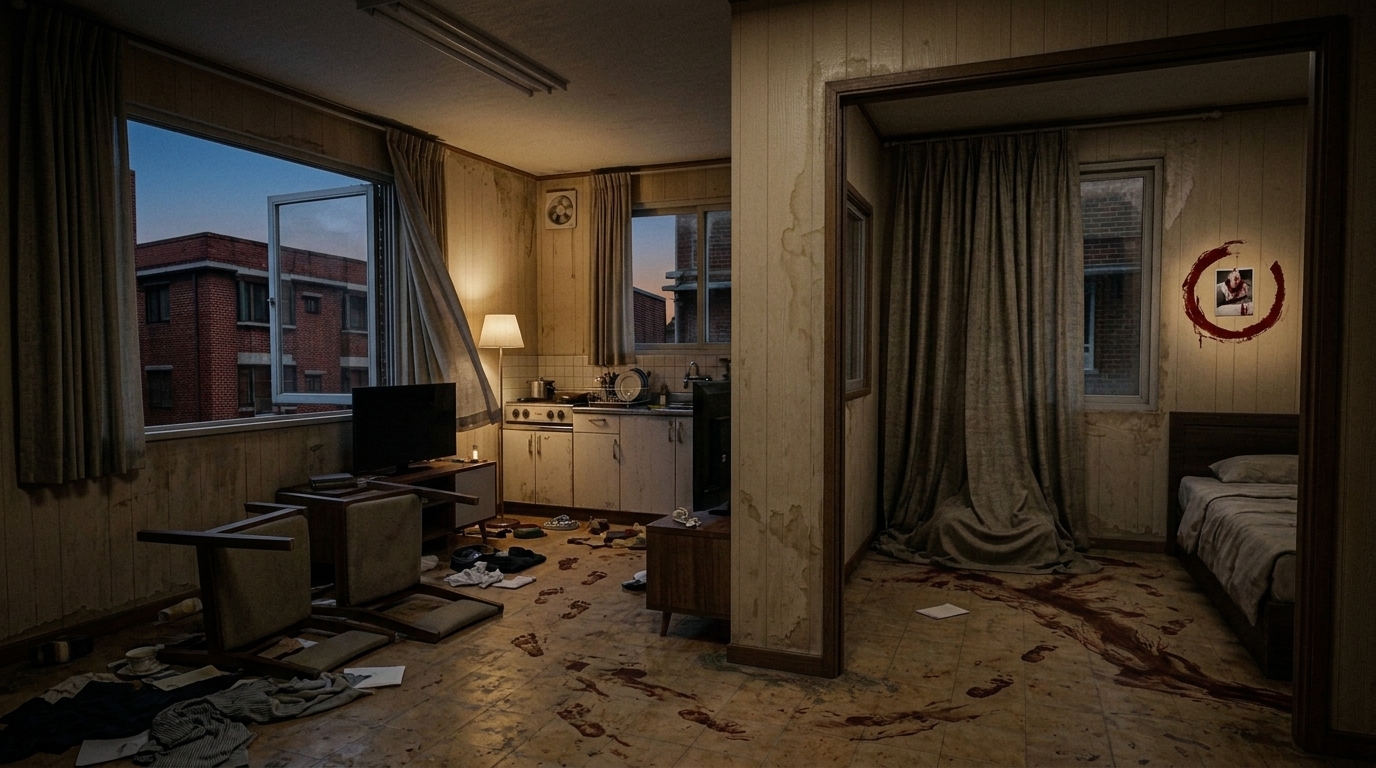
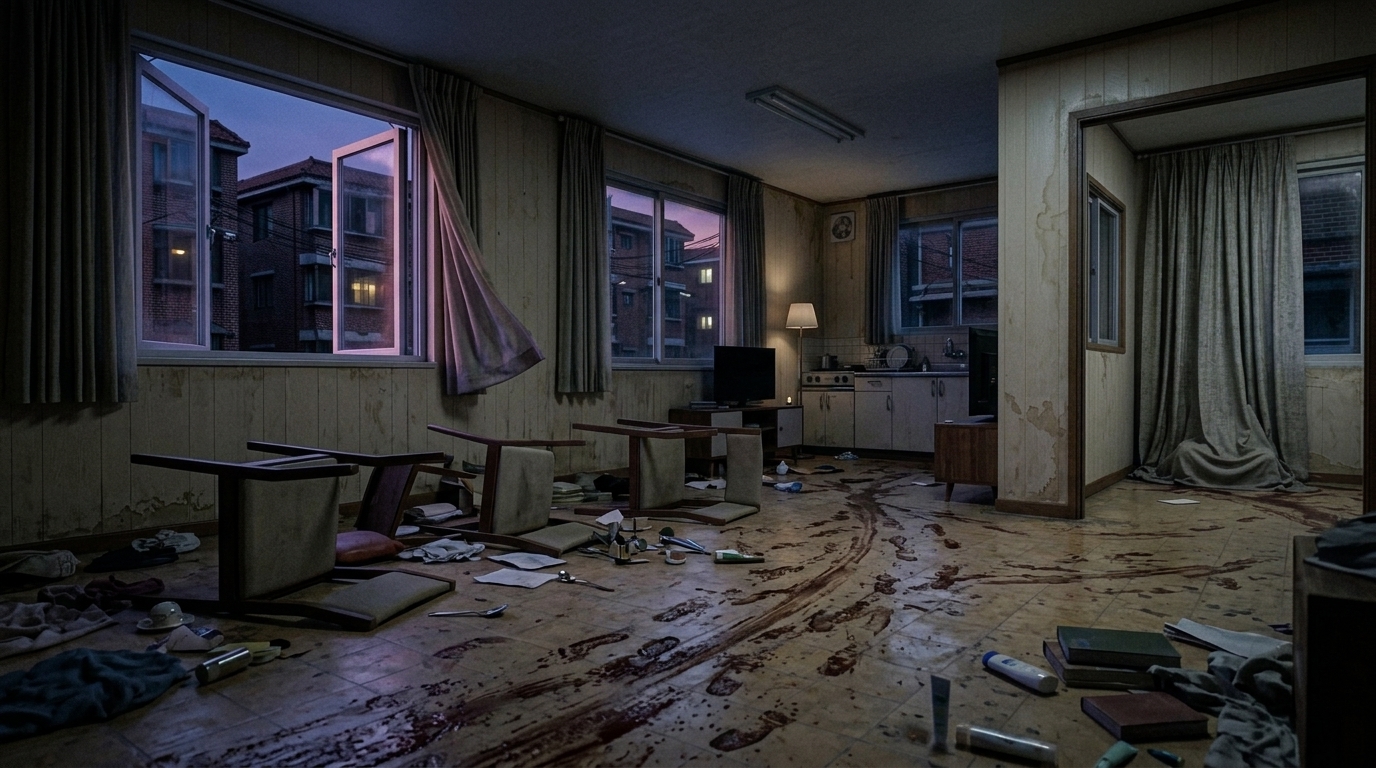
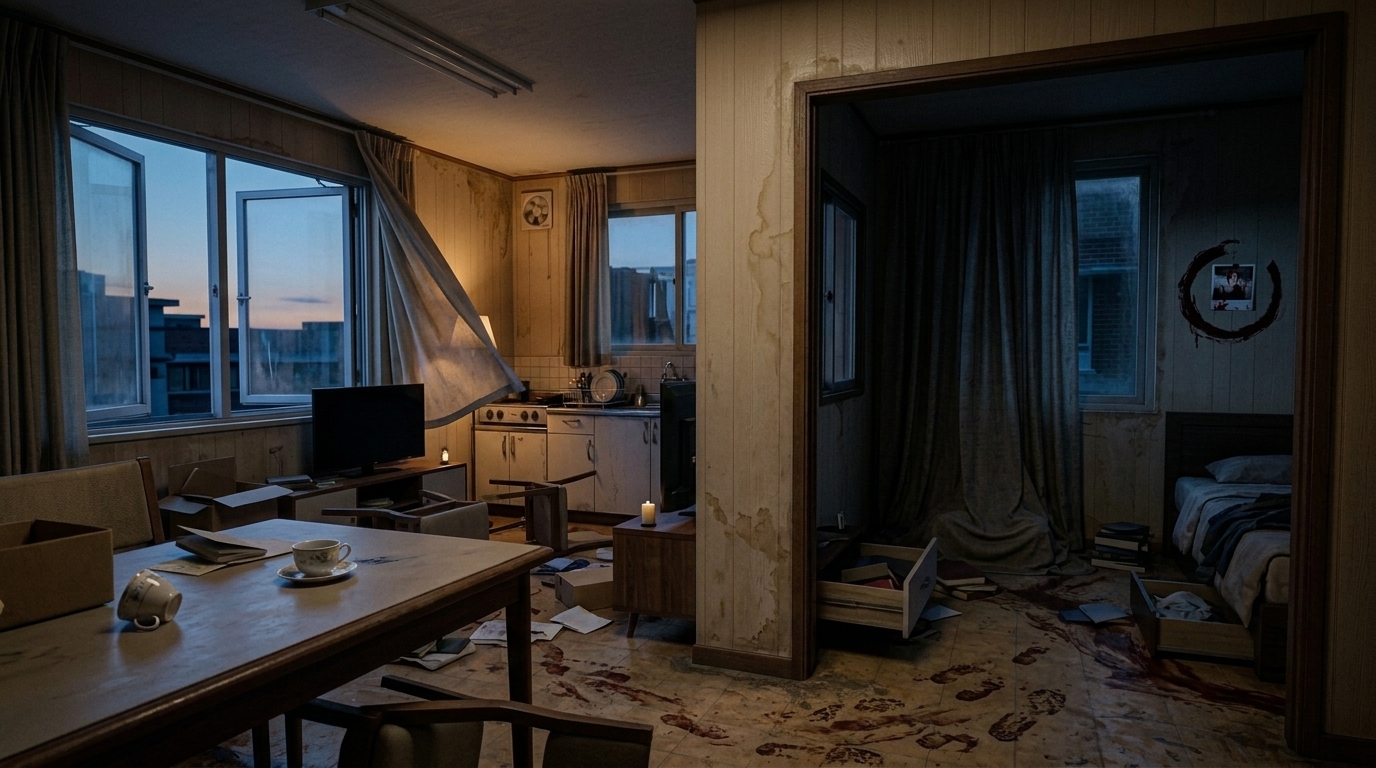
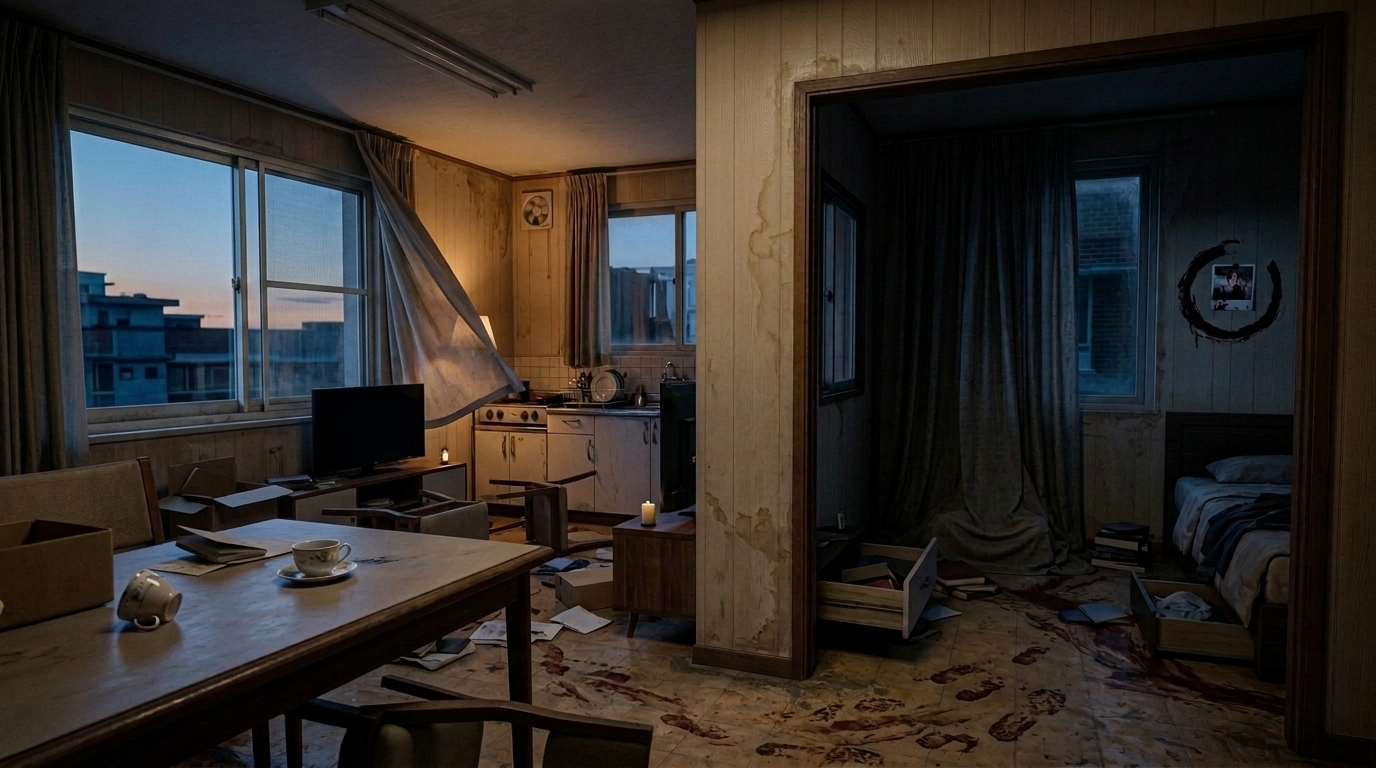
Create ONE FINAL photorealistic live-action film still of the moment below — contemporary South Korea, 2026; all people are Korean unless stated. TIME OF DAY (lock): dusk, open window.

SHOT TEXT (authoritative, Korean): 해질 무렵 옥탑방 거실, 흙 묻은 발자국들이 찍힌 바닥과 쓰러진 식탁 의자들이 보이는 전경

LOCATION (lock): A ransacked rooftop apartment with muddy or dusty footprints, an open living-room window, overturned dining chairs, and household items pulled apart. The bedroom contains a red circle on the wall with a bloodstained photograph pinned at its center. The shot takes place here — the attached LOCATION PHOTOGRAPH shows the exact spot.

REALIZE FIGURATIVE LANGUAGE AS A LIVE-ACTION SHOT: the Korean shot
text may describe characters metaphorically, figuratively or with
exaggeration. Photograph what a real movie camera would actually
record on a physical set — exaggerated or figurative impressions
become realistic staging choices (lighting, distance, angle,
wardrobe), not literal fantasy imagery.
EVERY CHARACTER IS A HUMAN BEING: unless the story explicitly
features non-human or virtual beings (as in science fiction or
fantasy), every character — however indirectly, vaguely or
figuratively the text describes them — IS a real human. When the
text gives no direct visual description of a person, IMAGINE one
and still show them as a concrete, fully-formed human being:
always render the human form to the maximum extent — build,
posture, face, hands, clothing — never reduce a person to a shape,
blob, solid silhouette or abstract mass.

EXPRESSIONS ARE ACTED, NEVER ANATOMICAL: when the text describes a
person's eyes, face or presence emotionally or figuratively (vacant,
hollow, dazed, burning, lifeless gaze and the like), it describes an
ACTOR'S PERFORMANCE captured by a real camera — realize it ONLY
through gaze direction, focus, eyelids, facial muscles, stillness
and posture. Every living person's eyes remain anatomically normal
human eyes with a natural iris and pupil, natural sclera and normal
proportions; NEVER whiten, blank out, cloud over, glow, enlarge or
otherwise alter eyeballs, skin or anatomy — unless the story
explicitly declares that being non-human or supernatural in form.

PROPS FACE THE RIGHT WAY: every handheld or used object must be
oriented exactly as its real-world use requires. A person reading,
watching or operating something (a phone, a photograph, a paper,
any device) has its functional side — screen, front, page — facing
THEIR OWN eyes; the camera then sees whatever side the staging
geometry implies (often its back). Show the functional side to the
camera ONLY when the shot text itself stages it toward the viewer.
Never flip, mirror or reverse an object's front and back.

CARRIED STATE (persist exactly — must match the neighbouring shots of this scene): The apartment has been ransacked, with muddy footprints, displaced household items, toppled chairs, and an open window. The bedroom already contains a red wall circle with the bloodied old photograph pinned at its center; Su-ri-young still has the maps in her backpack.

NO PEOPLE IN THIS SHOT: the shot text shows only the place and its state — no living person or any body part appears in frame, unless the shot text itself explicitly says so.

No text, captions, watermarks or annotations anywhere.
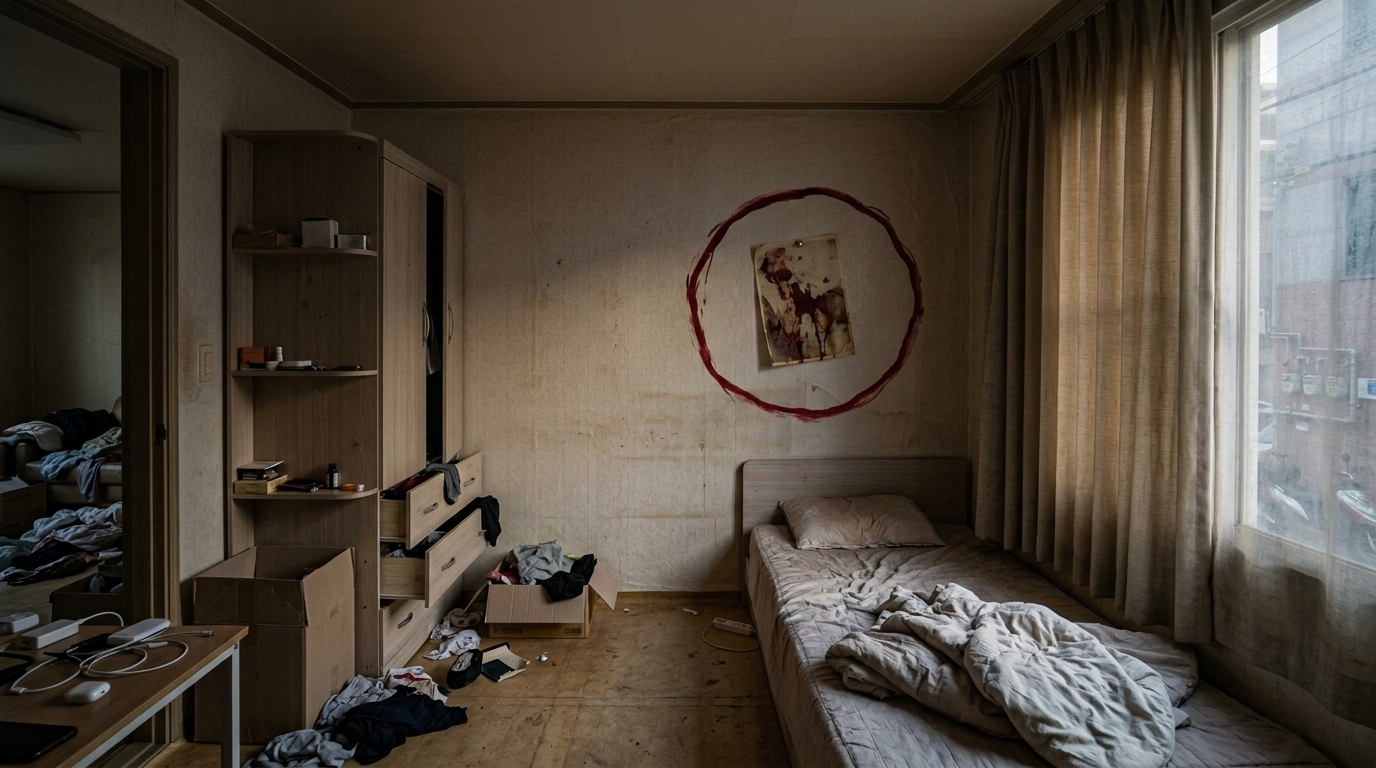
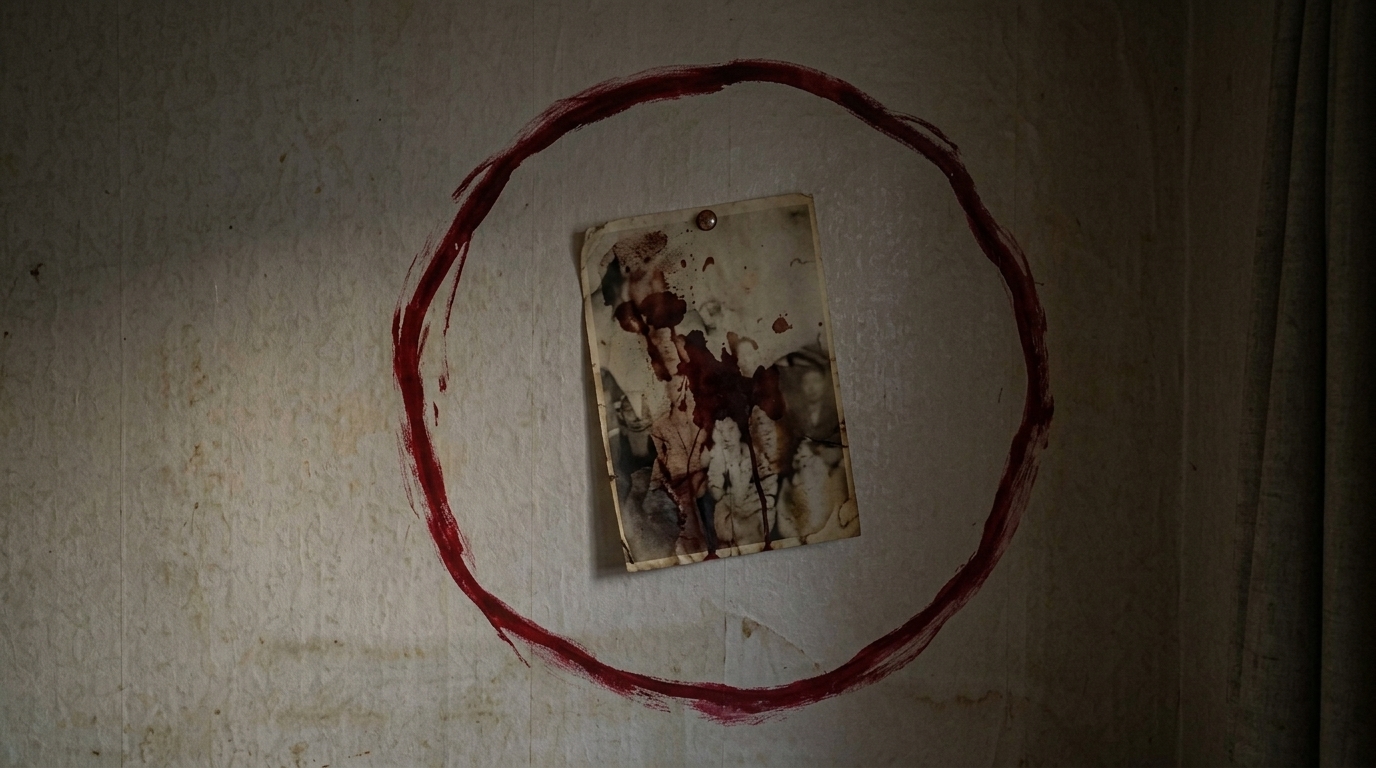
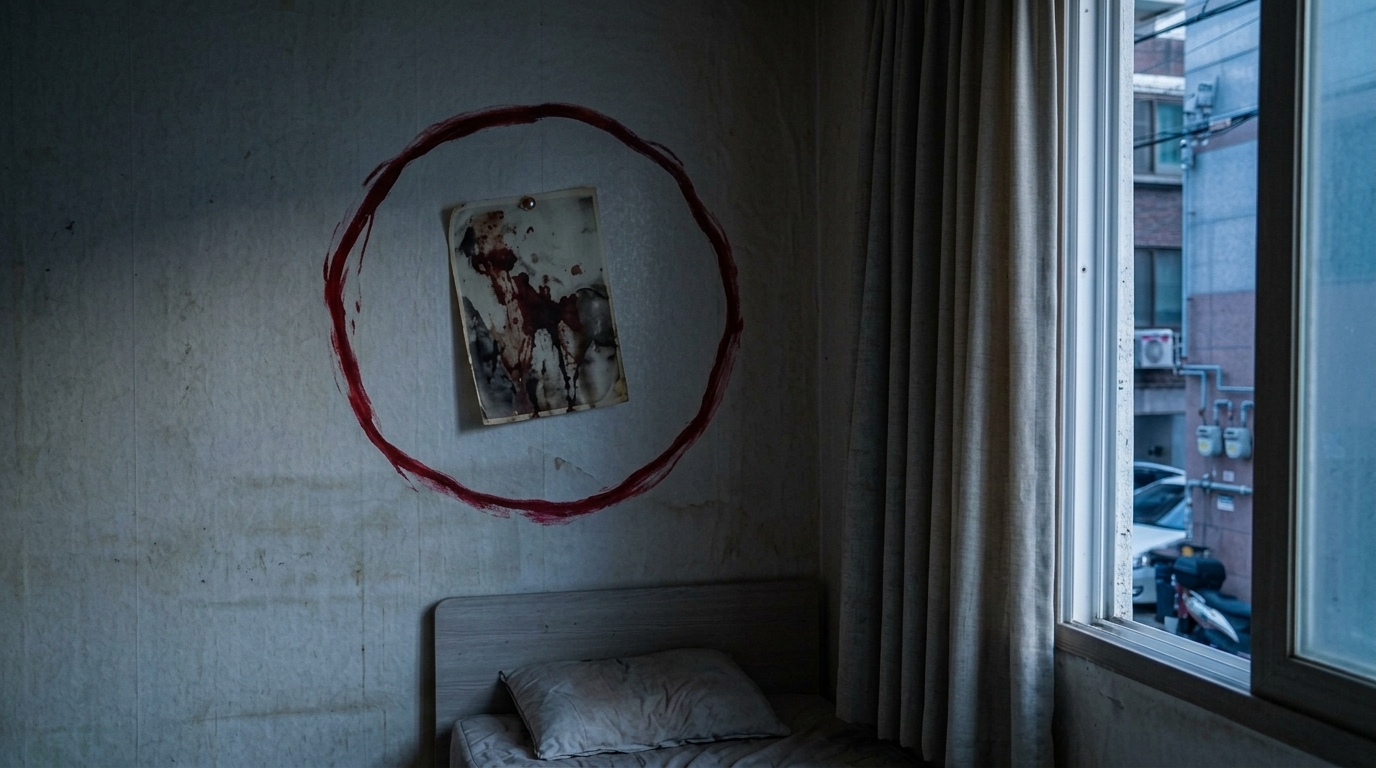
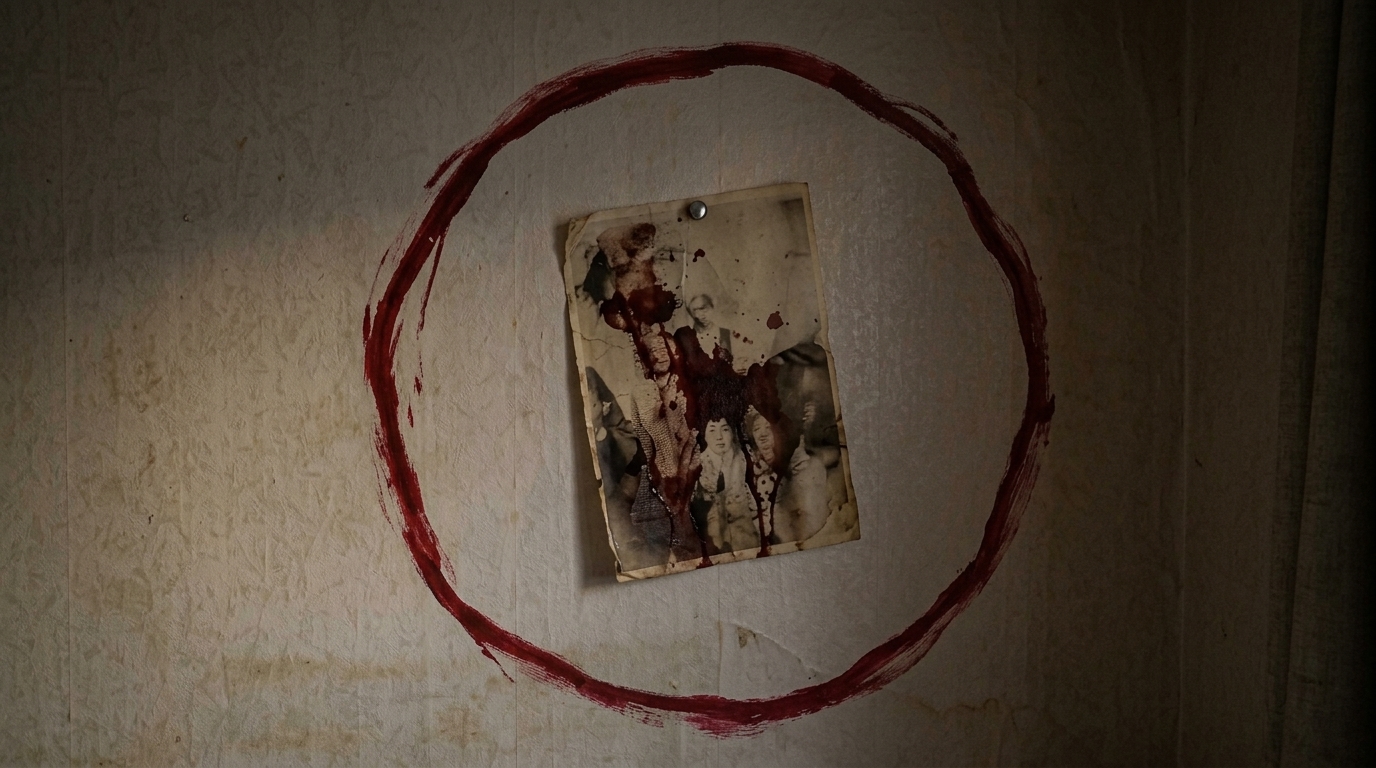
Create ONE FINAL photorealistic live-action film still of the moment below — contemporary South Korea, 2026; all people are Korean unless stated. TIME OF DAY (lock): dusk, open window.

SHOT TEXT (authoritative, Korean): 붉은 원 한가운데 피 묻은 낡은 흑백 사진이 벽에 꽂혀 있는 타이트 샷

LOCATION (lock): A ransacked rooftop apartment with muddy or dusty footprints, an open living-room window, overturned dining chairs, and household items pulled apart. The bedroom contains a red circle on the wall with a bloodstained photograph pinned at its center. The shot takes place here — the attached LOCATION PHOTOGRAPH shows the exact spot.

REALIZE FIGURATIVE LANGUAGE AS A LIVE-ACTION SHOT: the Korean shot
text may describe characters metaphorically, figuratively or with
exaggeration. Photograph what a real movie camera would actually
record on a physical set — exaggerated or figurative impressions
become realistic staging choices (lighting, distance, angle,
wardrobe), not literal fantasy imagery.
EVERY CHARACTER IS A HUMAN BEING: unless the story explicitly
features non-human or virtual beings (as in science fiction or
fantasy), every character — however indirectly, vaguely or
figuratively the text describes them — IS a real human. When the
text gives no direct visual description of a person, IMAGINE one
and still show them as a concrete, fully-formed human being:
always render the human form to the maximum extent — build,
posture, face, hands, clothing — never reduce a person to a shape,
blob, solid silhouette or abstract mass.

EXPRESSIONS ARE ACTED, NEVER ANATOMICAL: when the text describes a
person's eyes, face or presence emotionally or figuratively (vacant,
hollow, dazed, burning, lifeless gaze and the like), it describes an
ACTOR'S PERFORMANCE captured by a real camera — realize it ONLY
through gaze direction, focus, eyelids, facial muscles, stillness
and posture. Every living person's eyes remain anatomically normal
human eyes with a natural iris and pupil, natural sclera and normal
proportions; NEVER whiten, blank out, cloud over, glow, enlarge or
otherwise alter eyeballs, skin or anatomy — unless the story
explicitly declares that being non-human or supernatural in form.

PROPS FACE THE RIGHT WAY: every handheld or used object must be
oriented exactly as its real-world use requires. A person reading,
watching or operating something (a phone, a photograph, a paper,
any device) has its functional side — screen, front, page — facing
THEIR OWN eyes; the camera then sees whatever side the staging
geometry implies (often its back). Show the functional side to the
camera ONLY when the shot text itself stages it toward the viewer.
Never flip, mirror or reverse an object's front and back.

CARRIED STATE (persist exactly — must match the neighbouring shots of this scene): The ransacked apartment and muddy footprints remain undisturbed, and the bloodied old photograph is still pinned at the center of the red circle.

NO PEOPLE IN THIS SHOT: the shot text shows only the place and its state — no living person or any body part appears in frame, unless the shot text itself explicitly says so.

No text, captions, watermarks or annotations anywhere.
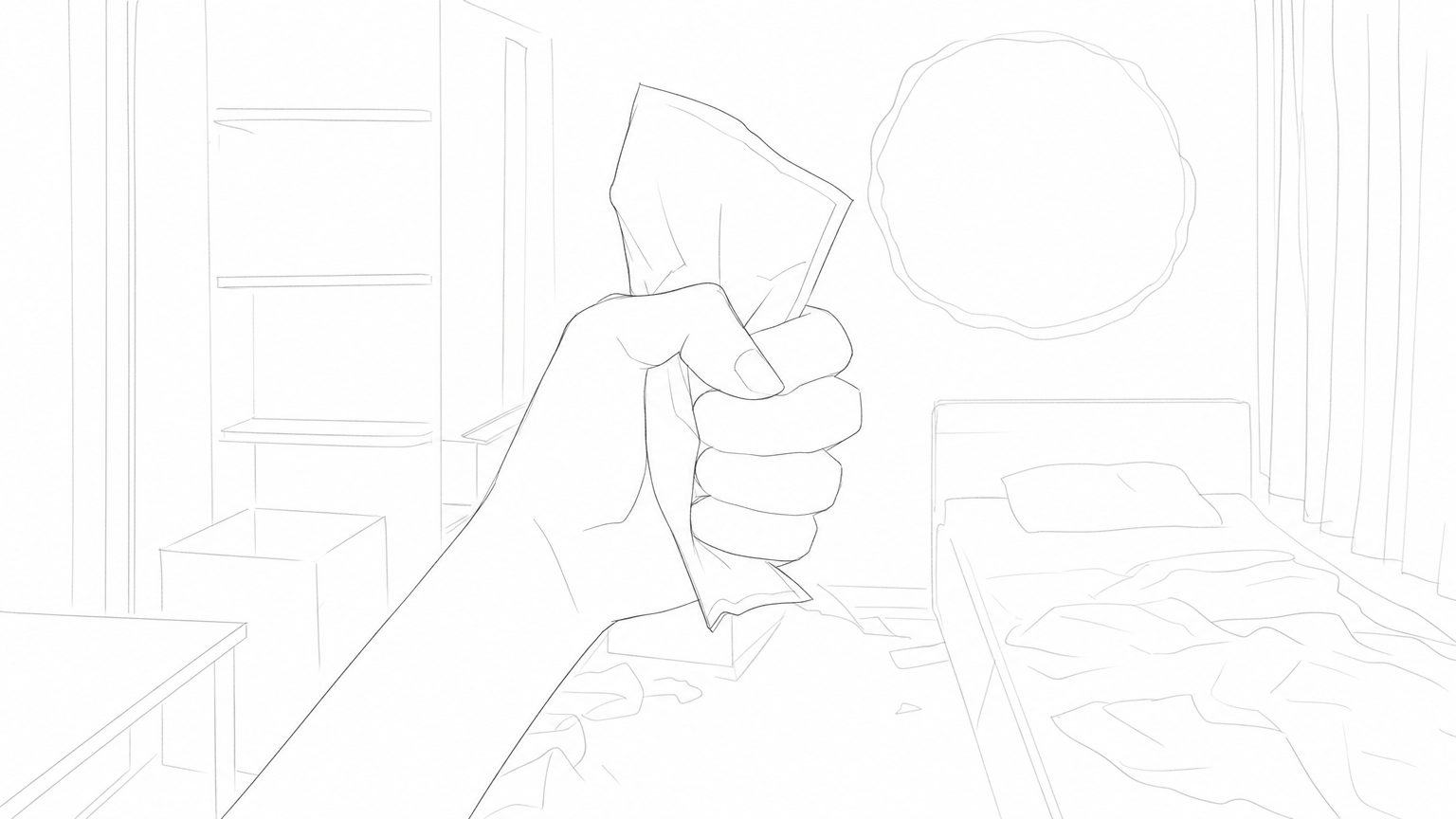
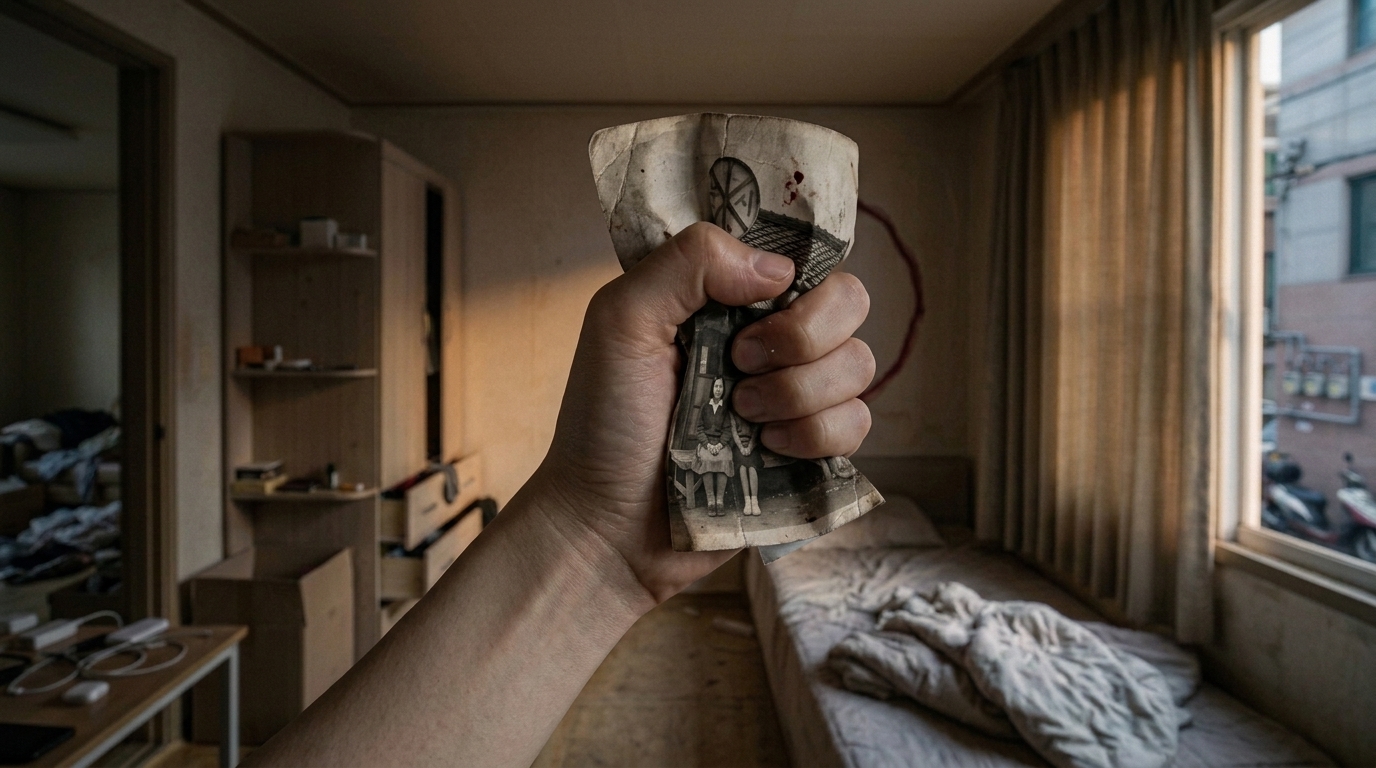
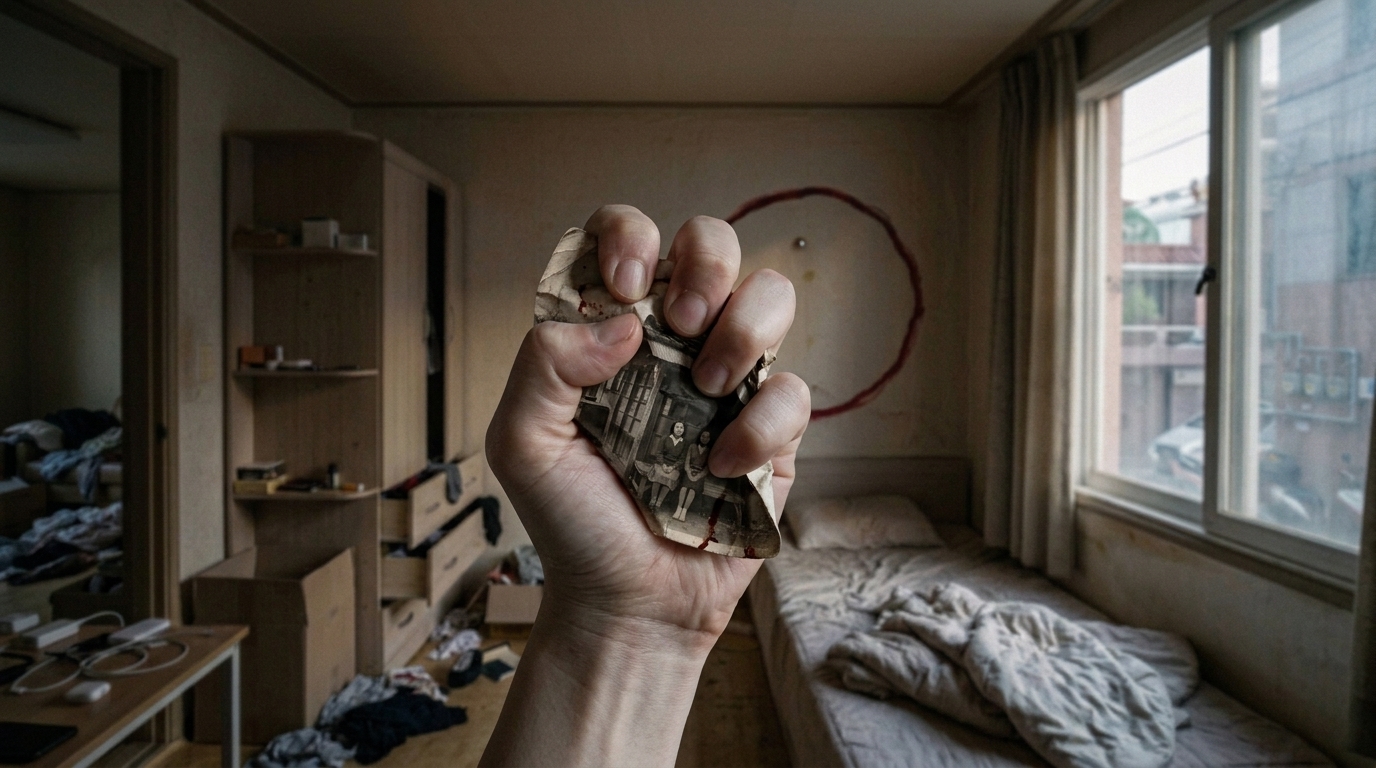
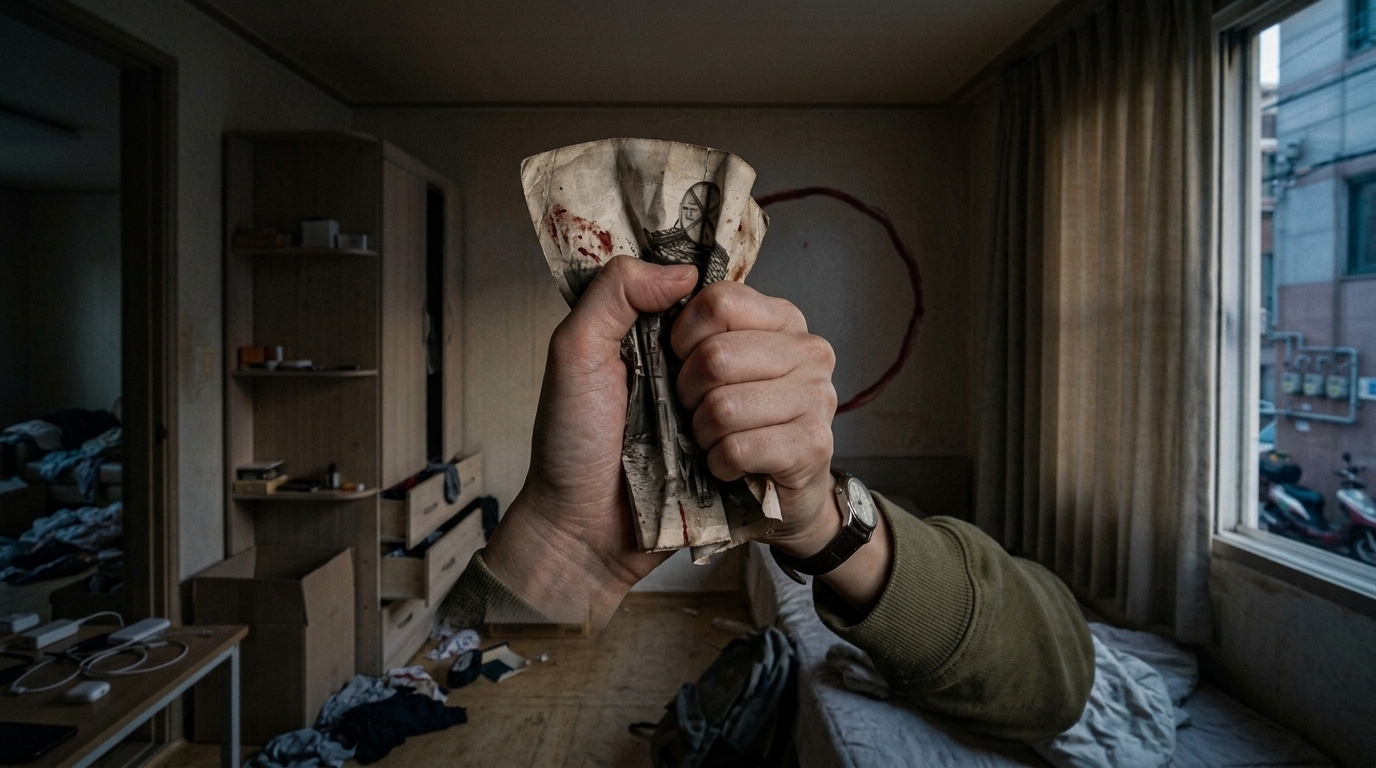
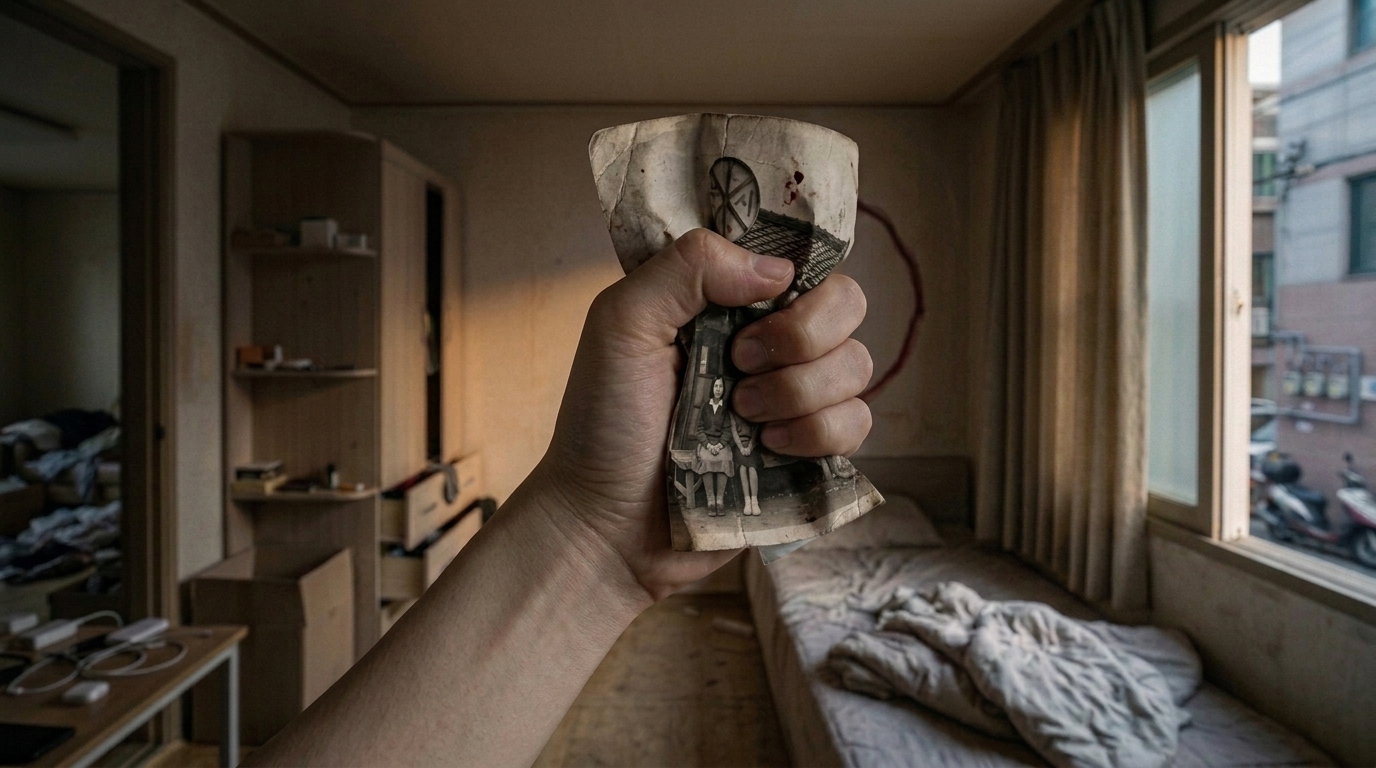
Create ONE FINAL photorealistic live-action film still of the moment below — contemporary South Korea, 2026; all people are Korean unless stated. TIME OF DAY (lock): dusk, open window.

SHOT TEXT (authoritative, Korean): 수리영의 손이 구겨진 사진을 꽉 움켜쥔 타이트 샷

LOCATION (lock): A ransacked rooftop apartment with muddy or dusty footprints, an open living-room window, overturned dining chairs, and household items pulled apart. The bedroom contains a red circle on the wall with a bloodstained photograph pinned at its center. The shot takes place here — the attached LOCATION PHOTOGRAPH shows the exact spot.

REALIZE FIGURATIVE LANGUAGE AS A LIVE-ACTION SHOT: the Korean shot
text may describe characters metaphorically, figuratively or with
exaggeration. Photograph what a real movie camera would actually
record on a physical set — exaggerated or figurative impressions
become realistic staging choices (lighting, distance, angle,
wardrobe), not literal fantasy imagery.
EVERY CHARACTER IS A HUMAN BEING: unless the story explicitly
features non-human or virtual beings (as in science fiction or
fantasy), every character — however indirectly, vaguely or
figuratively the text describes them — IS a real human. When the
text gives no direct visual description of a person, IMAGINE one
and still show them as a concrete, fully-formed human being:
always render the human form to the maximum extent — build,
posture, face, hands, clothing — never reduce a person to a shape,
blob, solid silhouette or abstract mass.

EXPRESSIONS ARE ACTED, NEVER ANATOMICAL: when the text describes a
person's eyes, face or presence emotionally or figuratively (vacant,
hollow, dazed, burning, lifeless gaze and the like), it describes an
ACTOR'S PERFORMANCE captured by a real camera — realize it ONLY
through gaze direction, focus, eyelids, facial muscles, stillness
and posture. Every living person's eyes remain anatomically normal
human eyes with a natural iris and pupil, natural sclera and normal
proportions; NEVER whiten, blank out, cloud over, glow, enlarge or
otherwise alter eyeballs, skin or anatomy — unless the story
explicitly declares that being non-human or supernatural in form.

PROPS FACE THE RIGHT WAY: every handheld or used object must be
oriented exactly as its real-world use requires. A person reading,
watching or operating something (a phone, a photograph, a paper,
any device) has its functional side — screen, front, page — facing
THEIR OWN eyes; the camera then sees whatever side the staging
geometry implies (often its back). Show the functional side to the
camera ONLY when the shot text itself stages it toward the viewer.
Never flip, mirror or reverse an object's front and back.

CARRIED STATE (persist exactly — must match the neighbouring shots of this scene): The photograph has been removed from the wall and is now tightly clenched in Su-ri-young's hand, while the red circle and the ransacked state of the apartment remain behind. Her backpack still contains the printed maps.

PEOPLE: the SHOT TEXT alone decides whether any person is visible in this shot. IF a person appears, they must be one of: 수리영 (Korean 20대 초반 여성, 긴 검은 머리, 타원형의 젊은 얼굴, 부드러운 이목구비와 자연스러운 피부색상태) — never anyone else, and never add a person the shot text does not show. IF only part of a person is in frame (a hand, arm, foot, back, silhouette), that body part belongs to the specific person the shot text names — its sex, age, build, skin and grooming must unmistakably match that person's profile above.

No text, captions, watermarks or annotations anywhere.
Create ONE FINAL photorealistic live-action film still of the moment below — contemporary South Korea, 2026; all people are Korean unless stated. TIME OF DAY (lock): dusk, dense fog after rain.

SHOT TEXT (authoritative, Korean): 수리영이 갯바위 위에 무릎을 모으고 앉아 바다를 응시하는 측면

LOCATION (lock): An empty harbor after a downpour, bordered by tidal rocks and filled with dense fog that hides the boats offshore. A single small fishing boat approaches through the mist. The shot takes place here — the attached LOCATION PHOTOGRAPH shows the exact spot.

REALIZE FIGURATIVE LANGUAGE AS A LIVE-ACTION SHOT: the Korean shot
text may describe characters metaphorically, figuratively or with
exaggeration. Photograph what a real movie camera would actually
record on a physical set — exaggerated or figurative impressions
become realistic staging choices (lighting, distance, angle,
wardrobe), not literal fantasy imagery.
EVERY CHARACTER IS A HUMAN BEING: unless the story explicitly
features non-human or virtual beings (as in science fiction or
fantasy), every character — however indirectly, vaguely or
figuratively the text describes them — IS a real human. When the
text gives no direct visual description of a person, IMAGINE one
and still show them as a concrete, fully-formed human being:
always render the human form to the maximum extent — build,
posture, face, hands, clothing — never reduce a person to a shape,
blob, solid silhouette or abstract mass.

EXPRESSIONS ARE ACTED, NEVER ANATOMICAL: when the text describes a
person's eyes, face or presence emotionally or figuratively (vacant,
hollow, dazed, burning, lifeless gaze and the like), it describes an
ACTOR'S PERFORMANCE captured by a real camera — realize it ONLY
through gaze direction, focus, eyelids, facial muscles, stillness
and posture. Every living person's eyes remain anatomically normal
human eyes with a natural iris and pupil, natural sclera and normal
proportions; NEVER whiten, blank out, cloud over, glow, enlarge or
otherwise alter eyeballs, skin or anatomy — unless the story
explicitly declares that being non-human or supernatural in form.

PROPS FACE THE RIGHT WAY: every handheld or used object must be
oriented exactly as its real-world use requires. A person reading,
watching or operating something (a phone, a photograph, a paper,
any device) has its functional side — screen, front, page — facing
THEIR OWN eyes; the camera then sees whatever side the staging
geometry implies (often its back). Show the functional side to the
camera ONLY when the shot text itself stages it toward the viewer.
Never flip, mirror or reverse an object's front and back.

CARRIED STATE (persist exactly — must match the neighbouring shots of this scene): Su-ri-young continues to possess the bloodied old photograph and carries the printed maps in her backpack, along with her smartphone.

PEOPLE: the SHOT TEXT alone decides whether any person is visible in this shot. IF a person appears, they must be one of: 수리영 (Korean 20대 초반 여성, 긴 검은 머리, 타원형의 젊은 얼굴, 부드러운 이목구비와 자연스러운 피부색상태) — never anyone else, and never add a person the shot text does not show. IF only part of a person is in frame (a hand, arm, foot, back, silhouette), that body part belongs to the specific person the shot text names — its sex, age, build, skin and grooming must unmistakably match that person's profile above.

No text, captions, watermarks or annotations anywhere.
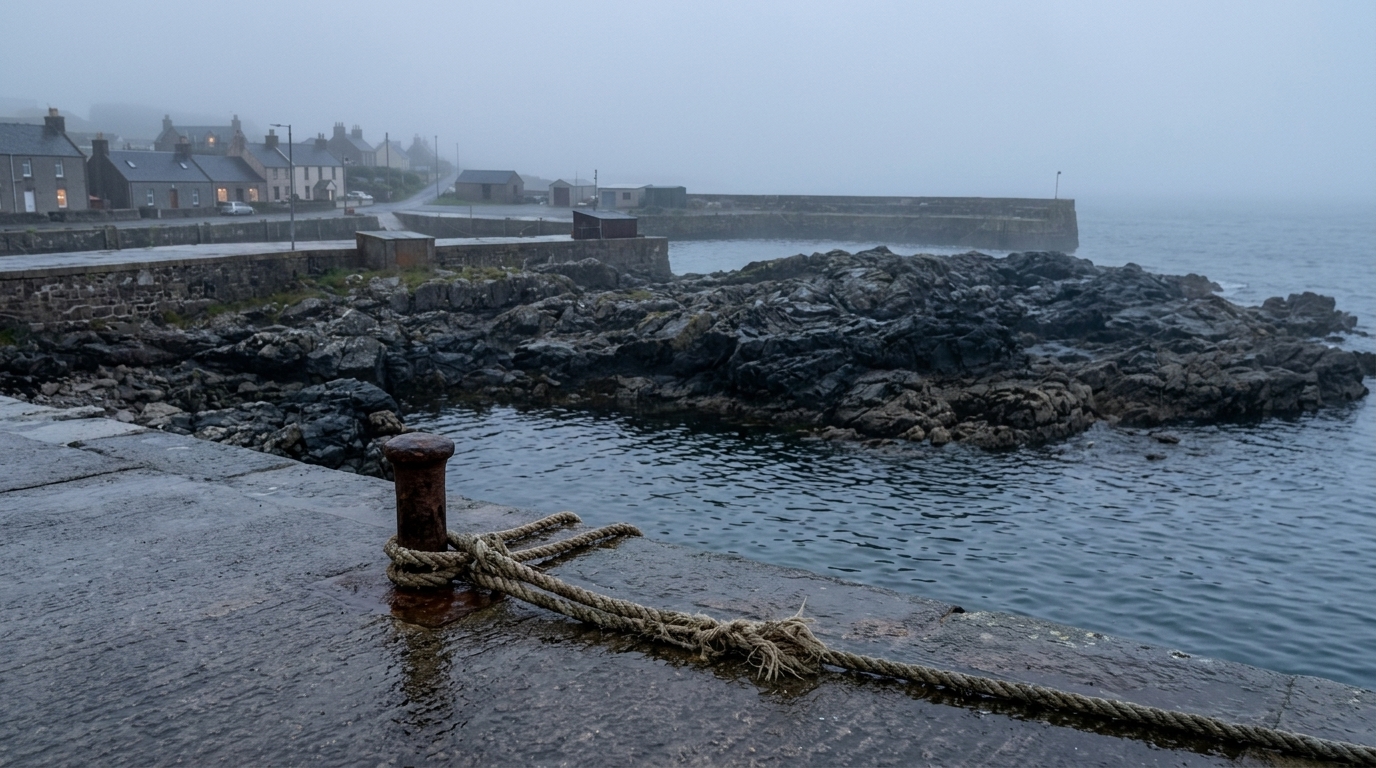
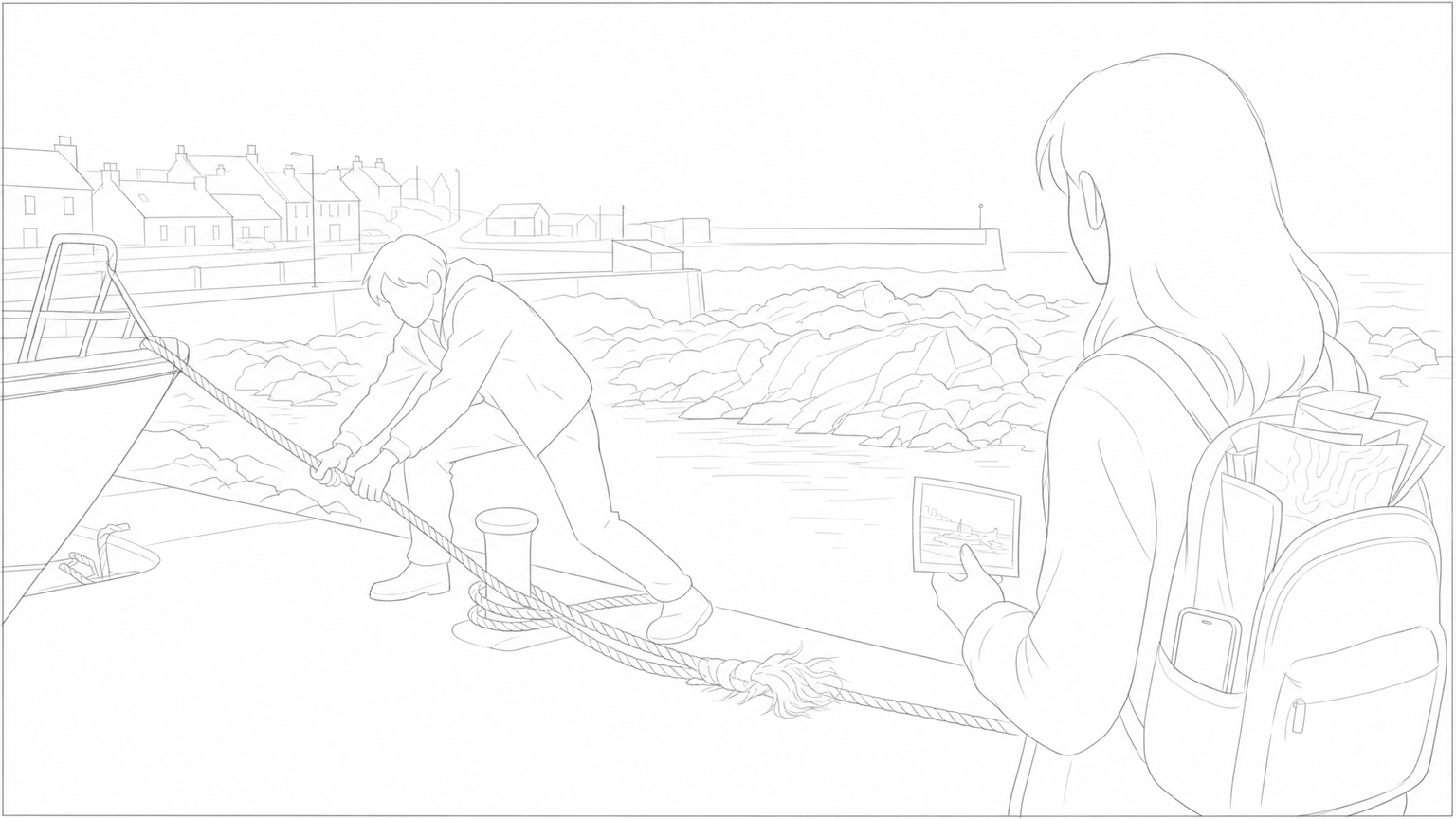
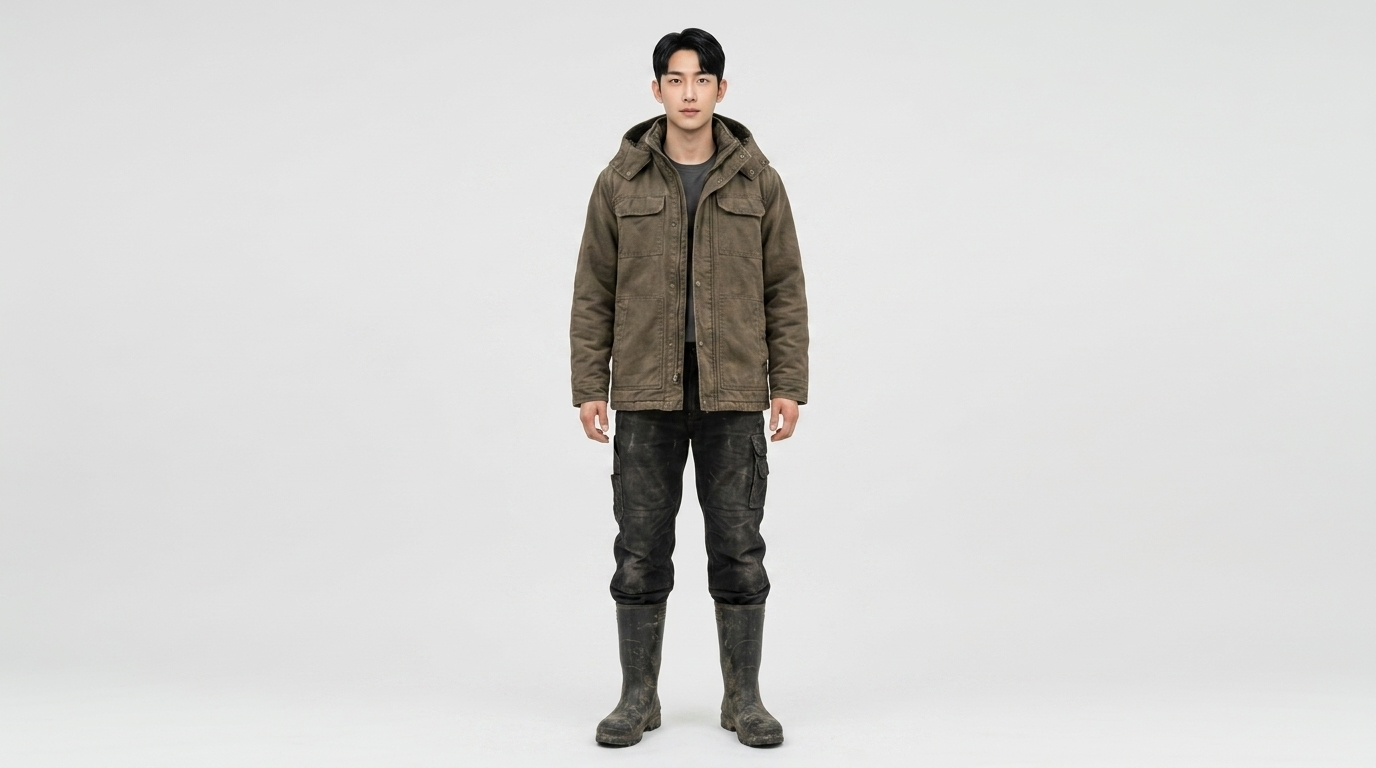
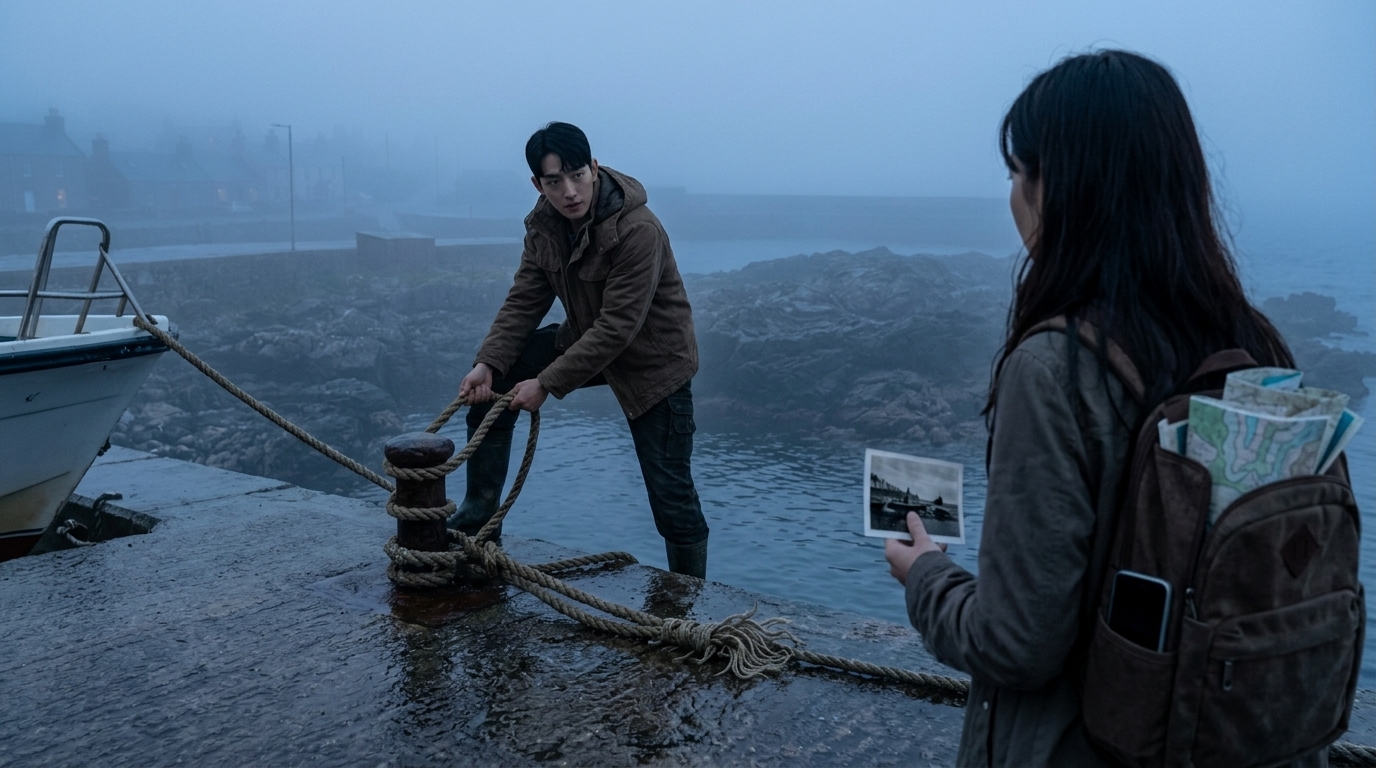
Create ONE FINAL photorealistic live-action film still of the moment below — contemporary South Korea, 2026; all people are Korean unless stated. TIME OF DAY (lock): dusk, dense fog after rain.

SHOT TEXT (authoritative, Korean): 뱃머리에서 내린 인우가 굵은 닻줄을 쥔 채 바닥의 말뚝에 걸친 정지 순간

LOCATION (lock): An empty harbor after a downpour, bordered by tidal rocks and filled with dense fog that hides the boats offshore. A single small fishing boat approaches through the mist. The shot takes place here — the attached LOCATION PHOTOGRAPH shows the exact spot.

REALIZE FIGURATIVE LANGUAGE AS A LIVE-ACTION SHOT: the Korean shot
text may describe characters metaphorically, figuratively or with
exaggeration. Photograph what a real movie camera would actually
record on a physical set — exaggerated or figurative impressions
become realistic staging choices (lighting, distance, angle,
wardrobe), not literal fantasy imagery.
EVERY CHARACTER IS A HUMAN BEING: unless the story explicitly
features non-human or virtual beings (as in science fiction or
fantasy), every character — however indirectly, vaguely or
figuratively the text describes them — IS a real human. When the
text gives no direct visual description of a person, IMAGINE one
and still show them as a concrete, fully-formed human being:
always render the human form to the maximum extent — build,
posture, face, hands, clothing — never reduce a person to a shape,
blob, solid silhouette or abstract mass.

EXPRESSIONS ARE ACTED, NEVER ANATOMICAL: when the text describes a
person's eyes, face or presence emotionally or figuratively (vacant,
hollow, dazed, burning, lifeless gaze and the like), it describes an
ACTOR'S PERFORMANCE captured by a real camera — realize it ONLY
through gaze direction, focus, eyelids, facial muscles, stillness
and posture. Every living person's eyes remain anatomically normal
human eyes with a natural iris and pupil, natural sclera and normal
proportions; NEVER whiten, blank out, cloud over, glow, enlarge or
otherwise alter eyeballs, skin or anatomy — unless the story
explicitly declares that being non-human or supernatural in form.

PROPS FACE THE RIGHT WAY: every handheld or used object must be
oriented exactly as its real-world use requires. A person reading,
watching or operating something (a phone, a photograph, a paper,
any device) has its functional side — screen, front, page — facing
THEIR OWN eyes; the camera then sees whatever side the staging
geometry implies (often its back). Show the functional side to the
camera ONLY when the shot text itself stages it toward the viewer.
Never flip, mirror or reverse an object's front and back.

CARRIED STATE (persist exactly — must match the neighbouring shots of this scene): In-woo is securing the boat with the mooring line while Su-ri-young retains the old photograph, her map-filled backpack, and her smartphone nearby.

PEOPLE: the SHOT TEXT alone decides whether any person is visible in this shot. IF a person appears, they must be one of: 인우 (Korean 20대 중반 남성, 자연스러운 검은 머리, 균형 잡힌 젊은 얼굴, 선이 고운 이목구비) — never anyone else, and never add a person the shot text does not show. IF only part of a person is in frame (a hand, arm, foot, back, silhouette), that body part belongs to the specific person the shot text names — its sex, age, build, skin and grooming must unmistakably match that person's profile above.

No text, captions, watermarks or annotations anywhere.
Create ONE FINAL photorealistic live-action film still of the moment below — contemporary South Korea, 2026; all people are Korean unless stated. TIME OF DAY (lock): dusk, dense fog after rain.

SHOT TEXT (authoritative, Korean): 수리영이 바다를 향해 선 채 스마트폰을 입가에 댄 측면 상체

LOCATION (lock): An empty harbor after a downpour, bordered by tidal rocks and filled with dense fog that hides the boats offshore. A single small fishing boat approaches through the mist. The shot takes place here — the attached PREVIOUS SHOT STILL shows this exact place.

THIS SHOT CONTINUES THE PREVIOUS SHOT: everything the attached still established — the place, its fixed features and wear, each person's clothing and state — persists. Any person in it who cannot move stays PRECISELY as photographed (body, pose, contact points, held objects); only the camera changes.

PREVIOUS STILL USAGE (follow exactly — what to take from the attached still and what to exclude): Take the foggy harbor, mooring area, wet coastal textures, and dusk light from the reference. Exclude the man, the rope-handling action, and the boat's disembarkation moment from this phone-message framing.

REALIZE FIGURATIVE LANGUAGE AS A LIVE-ACTION SHOT: the Korean shot
text may describe characters metaphorically, figuratively or with
exaggeration. Photograph what a real movie camera would actually
record on a physical set — exaggerated or figurative impressions
become realistic staging choices (lighting, distance, angle,
wardrobe), not literal fantasy imagery.
EVERY CHARACTER IS A HUMAN BEING: unless the story explicitly
features non-human or virtual beings (as in science fiction or
fantasy), every character — however indirectly, vaguely or
figuratively the text describes them — IS a real human. When the
text gives no direct visual description of a person, IMAGINE one
and still show them as a concrete, fully-formed human being:
always render the human form to the maximum extent — build,
posture, face, hands, clothing — never reduce a person to a shape,
blob, solid silhouette or abstract mass.

EXPRESSIONS ARE ACTED, NEVER ANATOMICAL: when the text describes a
person's eyes, face or presence emotionally or figuratively (vacant,
hollow, dazed, burning, lifeless gaze and the like), it describes an
ACTOR'S PERFORMANCE captured by a real camera — realize it ONLY
through gaze direction, focus, eyelids, facial muscles, stillness
and posture. Every living person's eyes remain anatomically normal
human eyes with a natural iris and pupil, natural sclera and normal
proportions; NEVER whiten, blank out, cloud over, glow, enlarge or
otherwise alter eyeballs, skin or anatomy — unless the story
explicitly declares that being non-human or supernatural in form.

PROPS FACE THE RIGHT WAY: every handheld or used object must be
oriented exactly as its real-world use requires. A person reading,
watching or operating something (a phone, a photograph, a paper,
any device) has its functional side — screen, front, page — facing
THEIR OWN eyes; the camera then sees whatever side the staging
geometry implies (often its back). Show the functional side to the
camera ONLY when the shot text itself stages it toward the viewer.
Never flip, mirror or reverse an object's front and back.

CARRIED STATE (persist exactly — must match the neighbouring shots of this scene): Su-ri-young records the message on her smartphone while still carrying the old photograph and the backpack containing her printed maps.

PEOPLE: the SHOT TEXT alone decides whether any person is visible in this shot. IF a person appears, they must be one of: 수리영 (Korean 20대 초반 여성, 긴 검은 머리, 타원형의 젊은 얼굴, 부드러운 이목구비와 자연스러운 피부색상태) — never anyone else, and never add a person the shot text does not show. IF only part of a person is in frame (a hand, arm, foot, back, silhouette), that body part belongs to the specific person the shot text names — its sex, age, build, skin and grooming must unmistakably match that person's profile above.

No text, captions, watermarks or annotations anywhere.
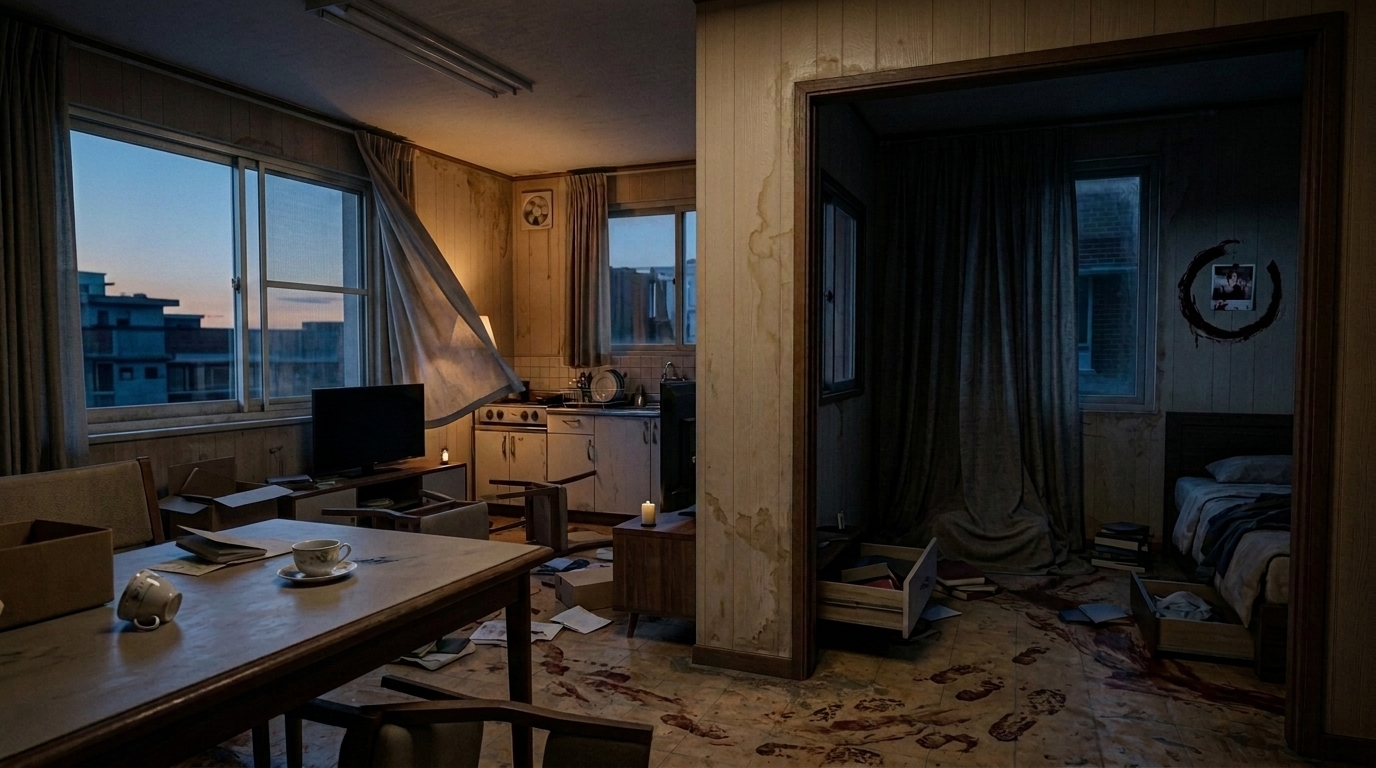
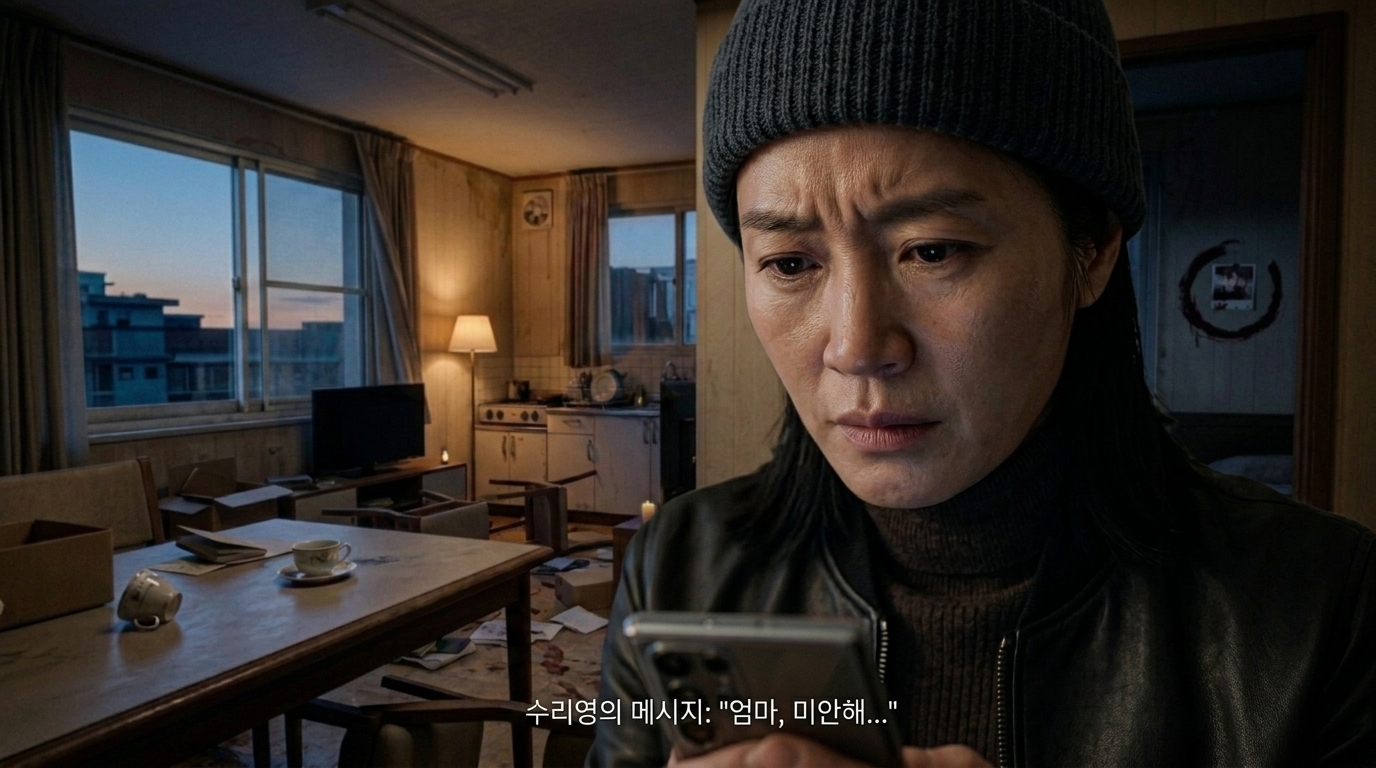
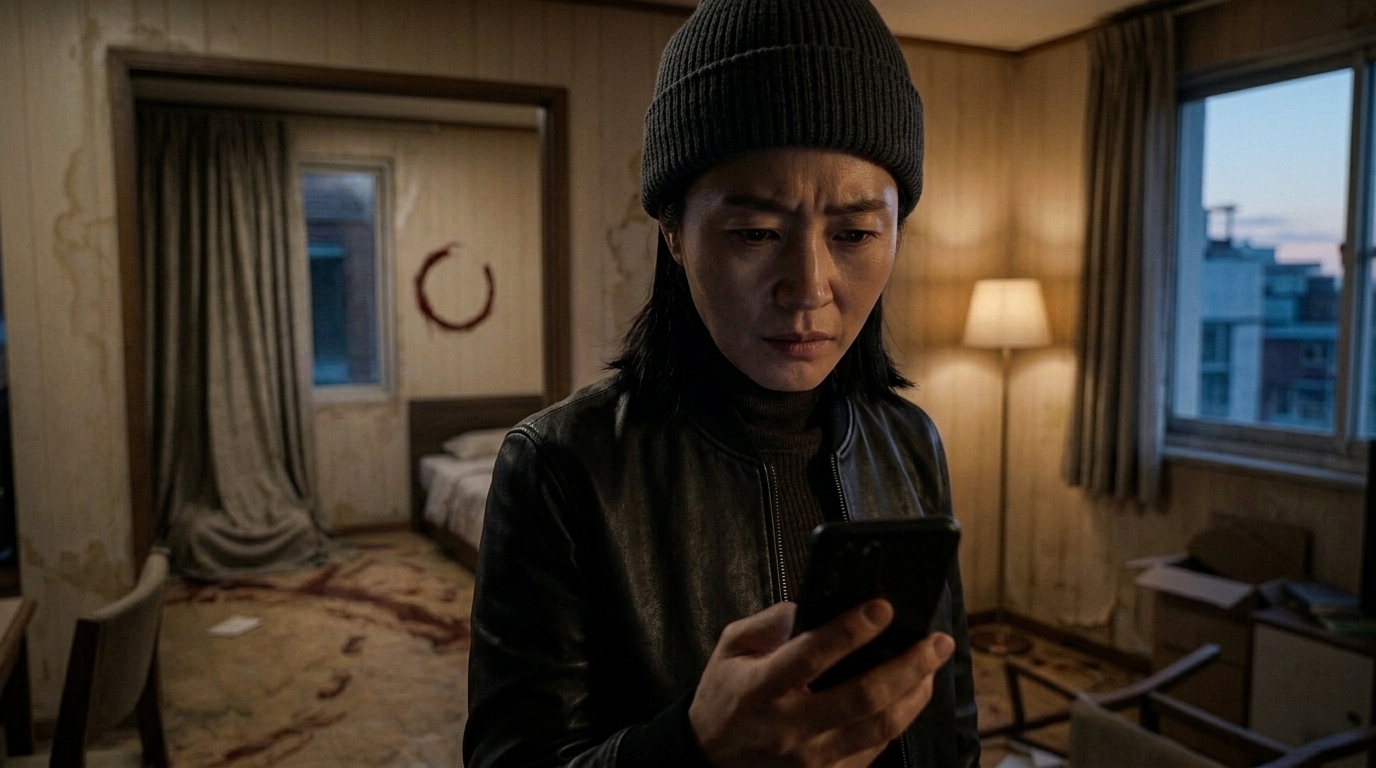
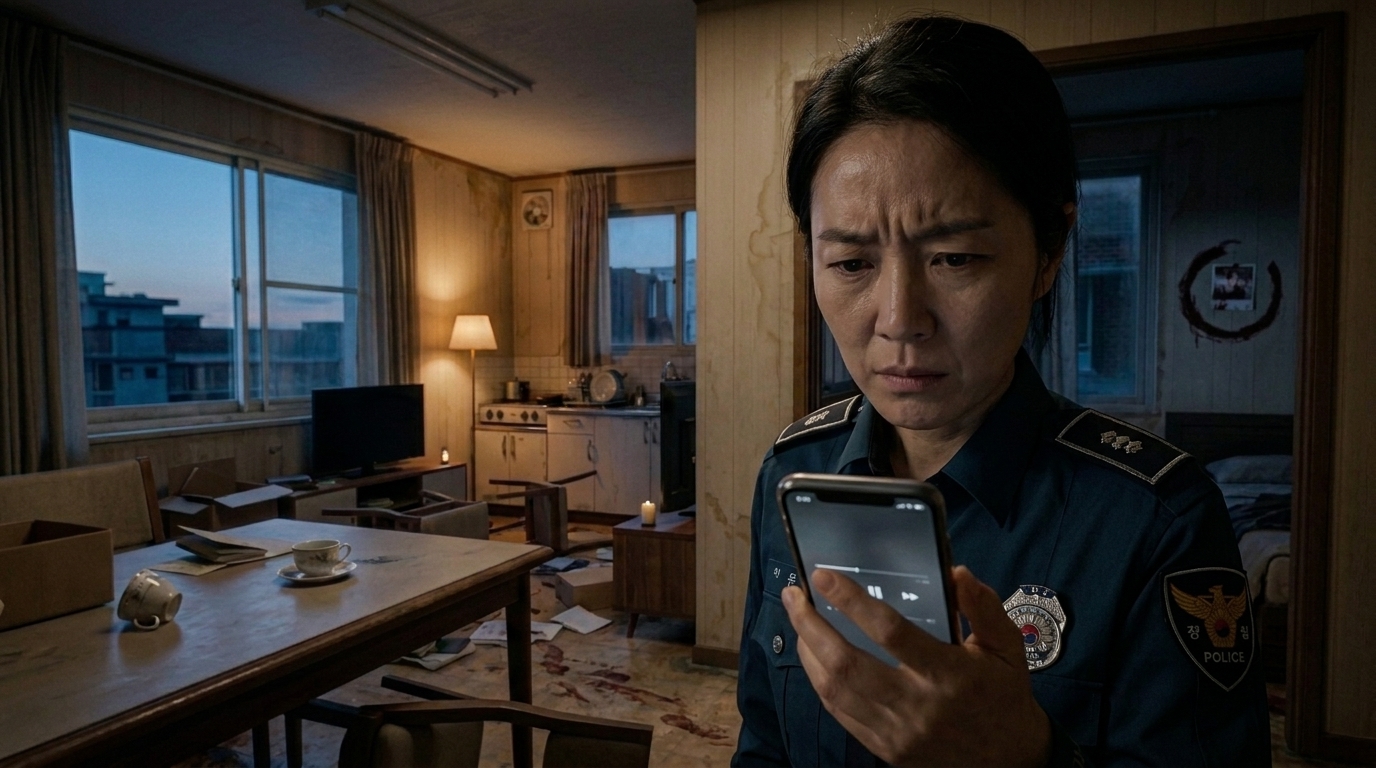
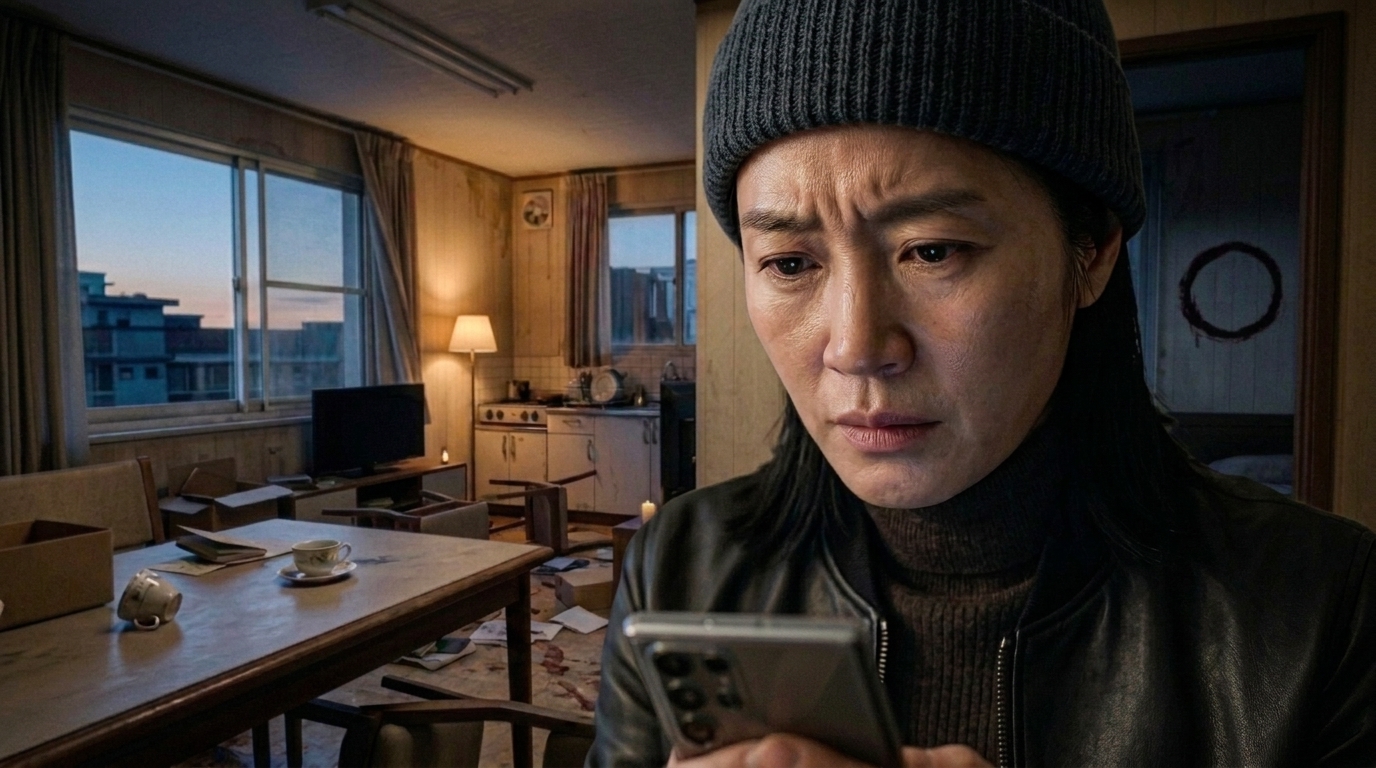
Create ONE FINAL photorealistic live-action film still of the moment below — contemporary South Korea, 2026; all people are Korean unless stated. TIME OF DAY (lock): dusk, interior lighting unspecified.

SHOT TEXT (authoritative, Korean): 혜수가 미간을 깊게 찌푸린 채 스마트폰을 내려다보는 얼굴 클로즈업

LOCATION (lock): The interior of a small rooftop apartment, where a recorded phone message is being checked. The shot takes place here — the attached PREVIOUS SHOT STILL shows this exact place.

THIS SHOT CONTINUES THE PREVIOUS SHOT: everything the attached still established — the place, its fixed features and wear, each person's clothing and state — persists. Any person in it who cannot move stays PRECISELY as photographed (body, pose, contact points, held objects); only the camera changes.

PREVIOUS STILL USAGE (follow exactly — what to take from the attached still and what to exclude): Take the disturbed living room, muddy footprints, overturned dining chairs, open window, and dusk lighting from the reference. Exclude the younger woman and her search action, showing only the officer checking the phone while the disorder remains.

REALIZE FIGURATIVE LANGUAGE AS A LIVE-ACTION SHOT: the Korean shot
text may describe characters metaphorically, figuratively or with
exaggeration. Photograph what a real movie camera would actually
record on a physical set — exaggerated or figurative impressions
become realistic staging choices (lighting, distance, angle,
wardrobe), not literal fantasy imagery.
EVERY CHARACTER IS A HUMAN BEING: unless the story explicitly
features non-human or virtual beings (as in science fiction or
fantasy), every character — however indirectly, vaguely or
figuratively the text describes them — IS a real human. When the
text gives no direct visual description of a person, IMAGINE one
and still show them as a concrete, fully-formed human being:
always render the human form to the maximum extent — build,
posture, face, hands, clothing — never reduce a person to a shape,
blob, solid silhouette or abstract mass.

EXPRESSIONS ARE ACTED, NEVER ANATOMICAL: when the text describes a
person's eyes, face or presence emotionally or figuratively (vacant,
hollow, dazed, burning, lifeless gaze and the like), it describes an
ACTOR'S PERFORMANCE captured by a real camera — realize it ONLY
through gaze direction, focus, eyelids, facial muscles, stillness
and posture. Every living person's eyes remain anatomically normal
human eyes with a natural iris and pupil, natural sclera and normal
proportions; NEVER whiten, blank out, cloud over, glow, enlarge or
otherwise alter eyeballs, skin or anatomy — unless the story
explicitly declares that being non-human or supernatural in form.

PROPS FACE THE RIGHT WAY: every handheld or used object must be
oriented exactly as its real-world use requires. A person reading,
watching or operating something (a phone, a photograph, a paper,
any device) has its functional side — screen, front, page — facing
THEIR OWN eyes; the camera then sees whatever side the staging
geometry implies (often its back). Show the functional side to the
camera ONLY when the shot text itself stages it toward the viewer.
Never flip, mirror or reverse an object's front and back.

CARRIED STATE (persist exactly — must match the neighbouring shots of this scene): The apartment remains ransacked, with muddy footprints, toppled chairs, an open window, and the red wall circle still present; the pinned photograph is gone because Su-ri-young took it. Hye-su is holding the smartphone on which she is checking Su-ri-young's message.

PEOPLE: the SHOT TEXT alone decides whether any person is visible in this shot. IF a person appears, they must be one of: 혜수 (Korean 40대 중반 여성, 단정한 검은 머리, 성숙한 타원형 얼굴, 또렷한 이목구비) — never anyone else, and never add a person the shot text does not show. IF only part of a person is in frame (a hand, arm, foot, back, silhouette), that body part belongs to the specific person the shot text names — its sex, age, build, skin and grooming must unmistakably match that person's profile above.

No text, captions, watermarks or annotations anywhere.
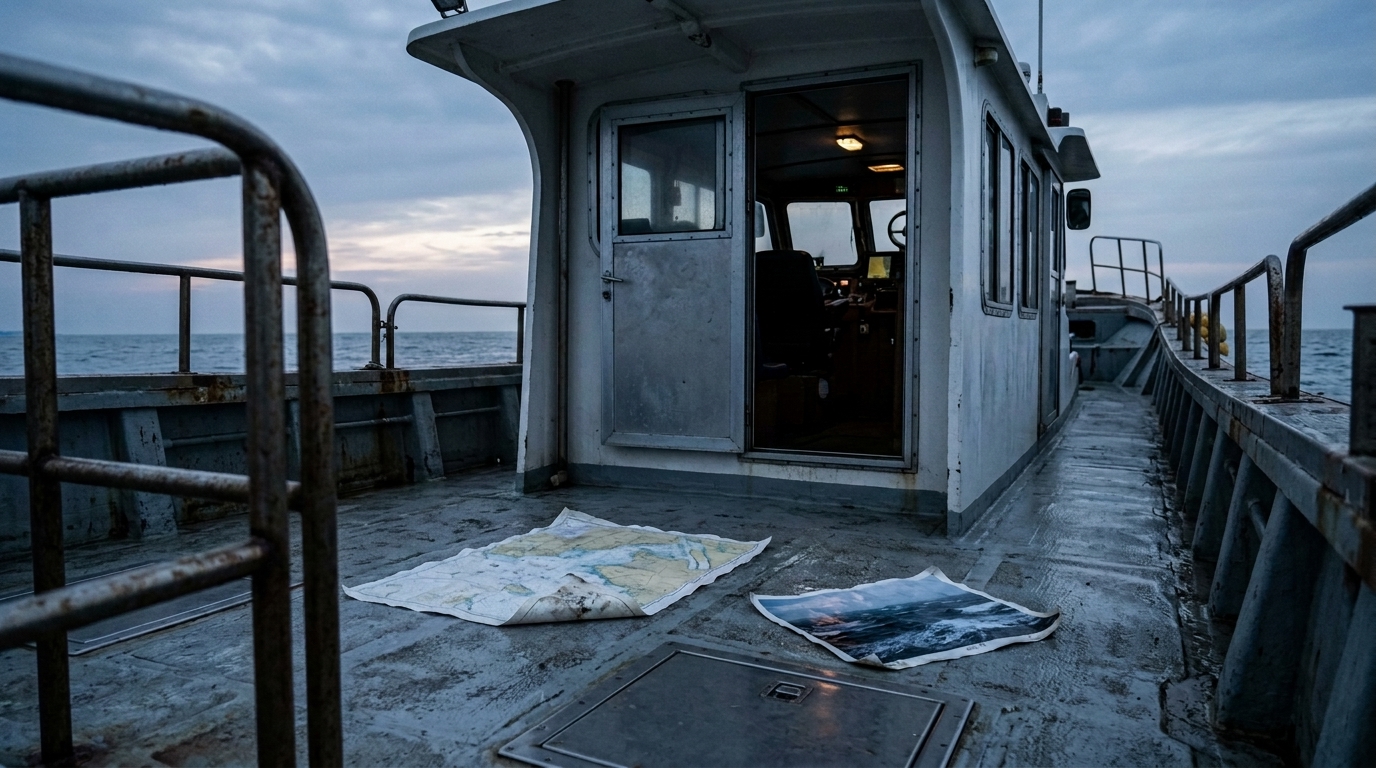
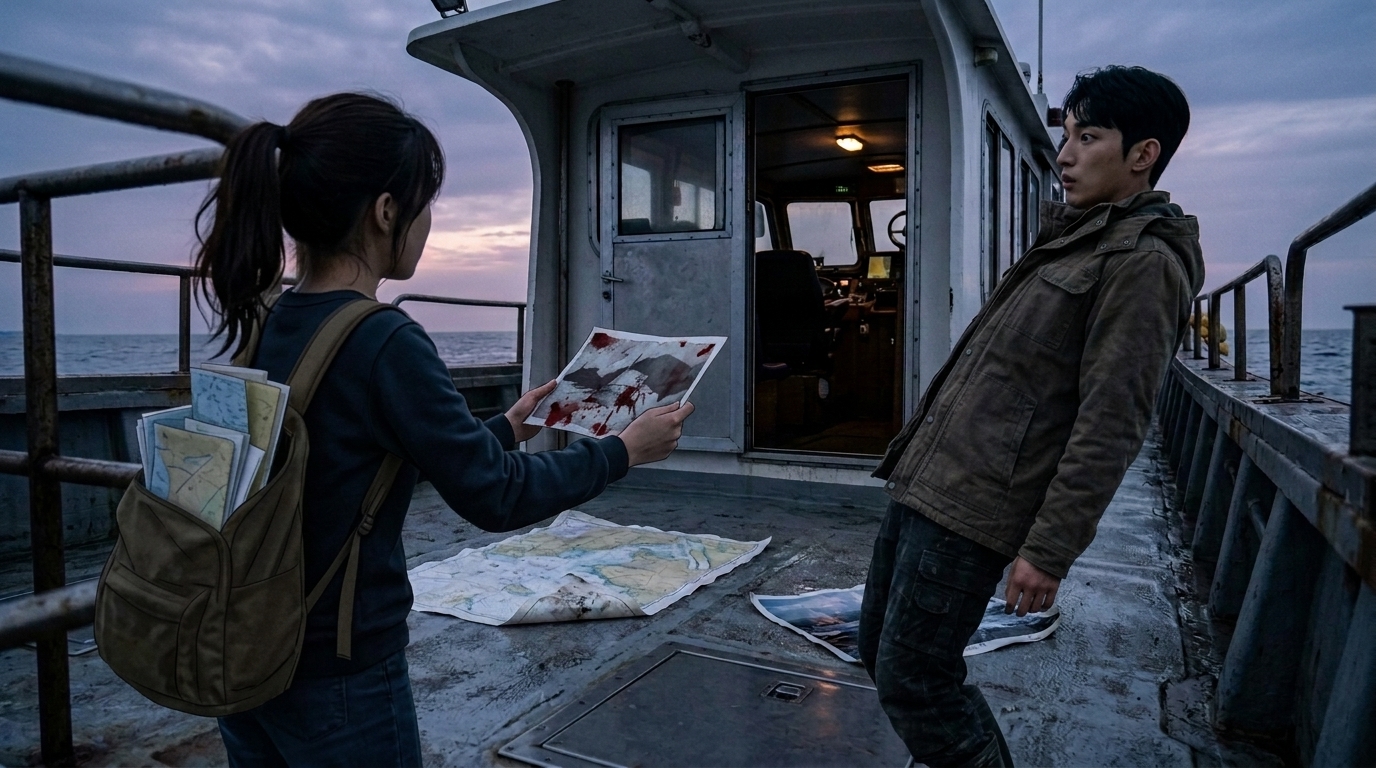
Create ONE FINAL photorealistic live-action film still of the moment below — contemporary South Korea, 2026; all people are Korean unless stated. TIME OF DAY (lock): dusk.

SHOT TEXT (authoritative, Korean): 인우가 사진에 시선을 고정한 채 두 눈을 크게 뜨고 상체를 뒤로 뺀 측면 구도

LOCATION (lock): A small fishing boat far out at sea, with an open working deck and an enclosed wheelhouse. The surrounding water stretches away from the harbor. The shot takes place here — the attached LOCATION PHOTOGRAPH shows the exact spot.

REALIZE FIGURATIVE LANGUAGE AS A LIVE-ACTION SHOT: the Korean shot
text may describe characters metaphorically, figuratively or with
exaggeration. Photograph what a real movie camera would actually
record on a physical set — exaggerated or figurative impressions
become realistic staging choices (lighting, distance, angle,
wardrobe), not literal fantasy imagery.
EVERY CHARACTER IS A HUMAN BEING: unless the story explicitly
features non-human or virtual beings (as in science fiction or
fantasy), every character — however indirectly, vaguely or
figuratively the text describes them — IS a real human. When the
text gives no direct visual description of a person, IMAGINE one
and still show them as a concrete, fully-formed human being:
always render the human form to the maximum extent — build,
posture, face, hands, clothing — never reduce a person to a shape,
blob, solid silhouette or abstract mass.

EXPRESSIONS ARE ACTED, NEVER ANATOMICAL: when the text describes a
person's eyes, face or presence emotionally or figuratively (vacant,
hollow, dazed, burning, lifeless gaze and the like), it describes an
ACTOR'S PERFORMANCE captured by a real camera — realize it ONLY
through gaze direction, focus, eyelids, facial muscles, stillness
and posture. Every living person's eyes remain anatomically normal
human eyes with a natural iris and pupil, natural sclera and normal
proportions; NEVER whiten, blank out, cloud over, glow, enlarge or
otherwise alter eyeballs, skin or anatomy — unless the story
explicitly declares that being non-human or supernatural in form.

PROPS FACE THE RIGHT WAY: every handheld or used object must be
oriented exactly as its real-world use requires. A person reading,
watching or operating something (a phone, a photograph, a paper,
any device) has its functional side — screen, front, page — facing
THEIR OWN eyes; the camera then sees whatever side the staging
geometry implies (often its back). Show the functional side to the
camera ONLY when the shot text itself stages it toward the viewer.
Never flip, mirror or reverse an object's front and back.

CARRIED STATE (persist exactly — must match the neighbouring shots of this scene): Su-ri-young has brought the bloodied old photograph aboard and is showing it to In-woo; her backpack still holds the remaining printed maps, while one map has been taken out for navigation.

PEOPLE: the SHOT TEXT alone decides whether any person is visible in this shot. IF a person appears, they must be one of: 인우 (Korean 20대 중반 남성, 자연스러운 검은 머리, 균형 잡힌 젊은 얼굴, 선이 고운 이목구비) — never anyone else, and never add a person the shot text does not show. IF only part of a person is in frame (a hand, arm, foot, back, silhouette), that body part belongs to the specific person the shot text names — its sex, age, build, skin and grooming must unmistakably match that person's profile above.

No text, captions, watermarks or annotations anywhere.
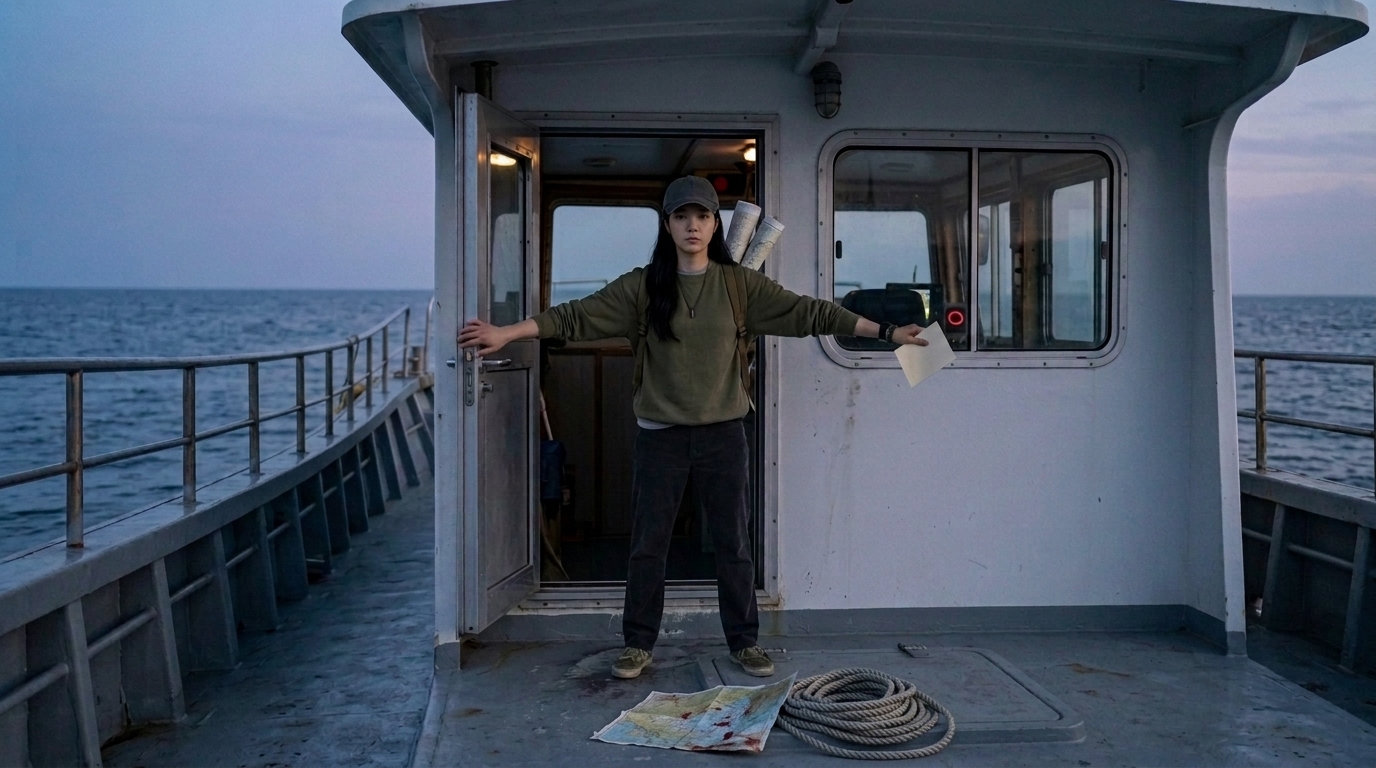
Create ONE FINAL photorealistic live-action film still of the moment below — contemporary South Korea, 2026; all people are Korean unless stated. TIME OF DAY (lock): dusk.

SHOT TEXT (authoritative, Korean): 수리영이 조타실 입구에 서서 두 팔을 벌린 채 멈춘 전신

LOCATION (lock): A small fishing boat far out at sea, with an open working deck and an enclosed wheelhouse. The surrounding water stretches away from the harbor. The shot takes place here — the attached PREVIOUS SHOT STILL shows this exact place.

THIS SHOT CONTINUES THE PREVIOUS SHOT: everything the attached still established — the place, its fixed features and wear, each person's clothing and state — persists. Any person in it who cannot move stays PRECISELY as photographed (body, pose, contact points, held objects); only the camera changes.

PREVIOUS STILL USAGE (follow exactly — what to take from the attached still and what to exclude): Take the small fishing boat's deck materials, dusk light, surrounding sea, and wheelhouse exterior from the reference. Exclude the man's startled seated reaction and the close presentation of the photograph, framing the woman alone at the wheelhouse entrance.

REALIZE FIGURATIVE LANGUAGE AS A LIVE-ACTION SHOT: the Korean shot
text may describe characters metaphorically, figuratively or with
exaggeration. Photograph what a real movie camera would actually
record on a physical set — exaggerated or figurative impressions
become realistic staging choices (lighting, distance, angle,
wardrobe), not literal fantasy imagery.
EVERY CHARACTER IS A HUMAN BEING: unless the story explicitly
features non-human or virtual beings (as in science fiction or
fantasy), every character — however indirectly, vaguely or
figuratively the text describes them — IS a real human. When the
text gives no direct visual description of a person, IMAGINE one
and still show them as a concrete, fully-formed human being:
always render the human form to the maximum extent — build,
posture, face, hands, clothing — never reduce a person to a shape,
blob, solid silhouette or abstract mass.

EXPRESSIONS ARE ACTED, NEVER ANATOMICAL: when the text describes a
person's eyes, face or presence emotionally or figuratively (vacant,
hollow, dazed, burning, lifeless gaze and the like), it describes an
ACTOR'S PERFORMANCE captured by a real camera — realize it ONLY
through gaze direction, focus, eyelids, facial muscles, stillness
and posture. Every living person's eyes remain anatomically normal
human eyes with a natural iris and pupil, natural sclera and normal
proportions; NEVER whiten, blank out, cloud over, glow, enlarge or
otherwise alter eyeballs, skin or anatomy — unless the story
explicitly declares that being non-human or supernatural in form.

PROPS FACE THE RIGHT WAY: every handheld or used object must be
oriented exactly as its real-world use requires. A person reading,
watching or operating something (a phone, a photograph, a paper,
any device) has its functional side — screen, front, page — facing
THEIR OWN eyes; the camera then sees whatever side the staging
geometry implies (often its back). Show the functional side to the
camera ONLY when the shot text itself stages it toward the viewer.
Never flip, mirror or reverse an object's front and back.

CARRIED STATE (persist exactly — must match the neighbouring shots of this scene): Su-ri-young retains the old photograph and her map-filled backpack as she blocks the wheelhouse entrance. The many circles inside the wheelhouse, including the red one revealed next, must already be physically present.

PEOPLE: the SHOT TEXT alone decides whether any person is visible in this shot. IF a person appears, they must be one of: 수리영 (Korean 20대 초반 여성, 긴 검은 머리, 타원형의 젊은 얼굴, 부드러운 이목구비와 자연스러운 피부색상태) — never anyone else, and never add a person the shot text does not show. IF only part of a person is in frame (a hand, arm, foot, back, silhouette), that body part belongs to the specific person the shot text names — its sex, age, build, skin and grooming must unmistakably match that person's profile above.

No text, captions, watermarks or annotations anywhere.
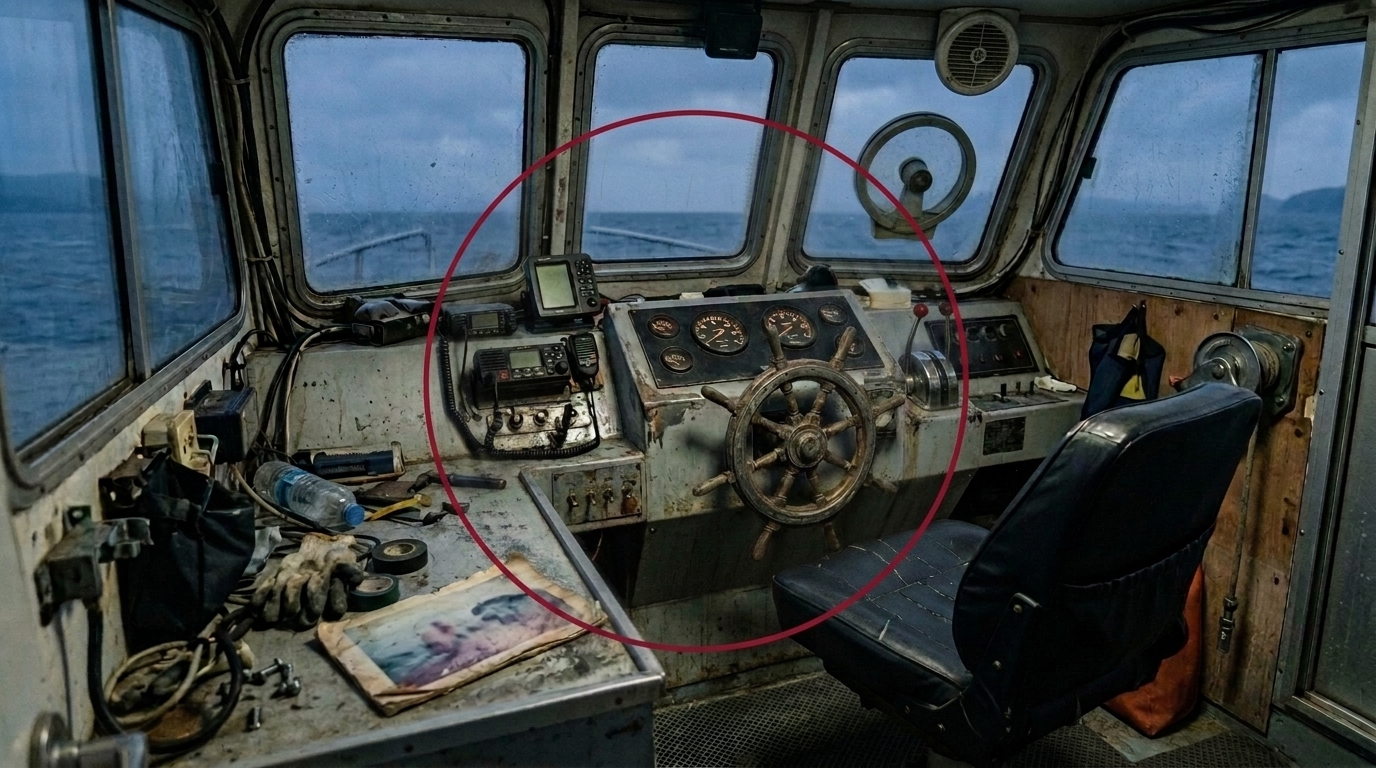
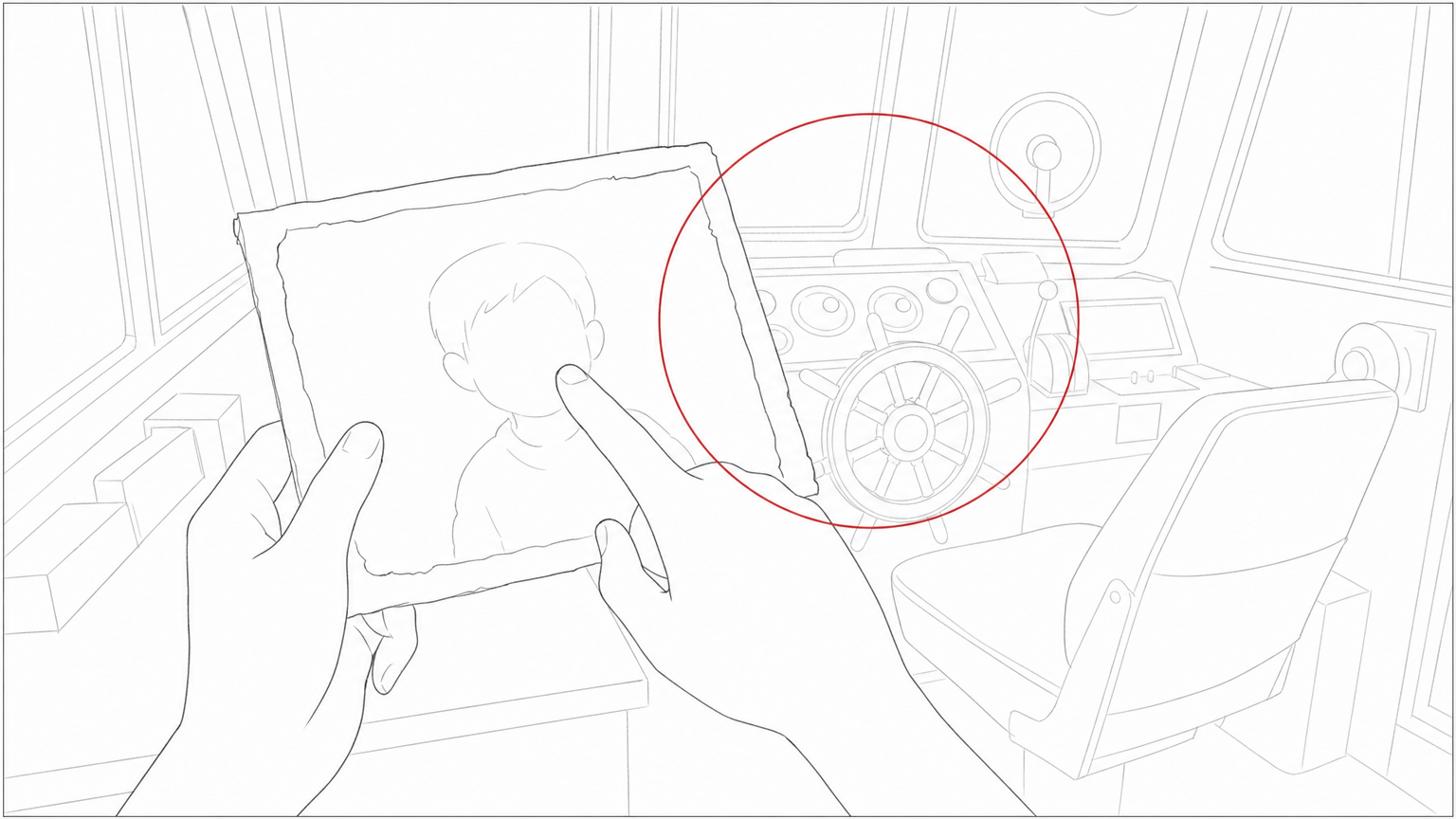
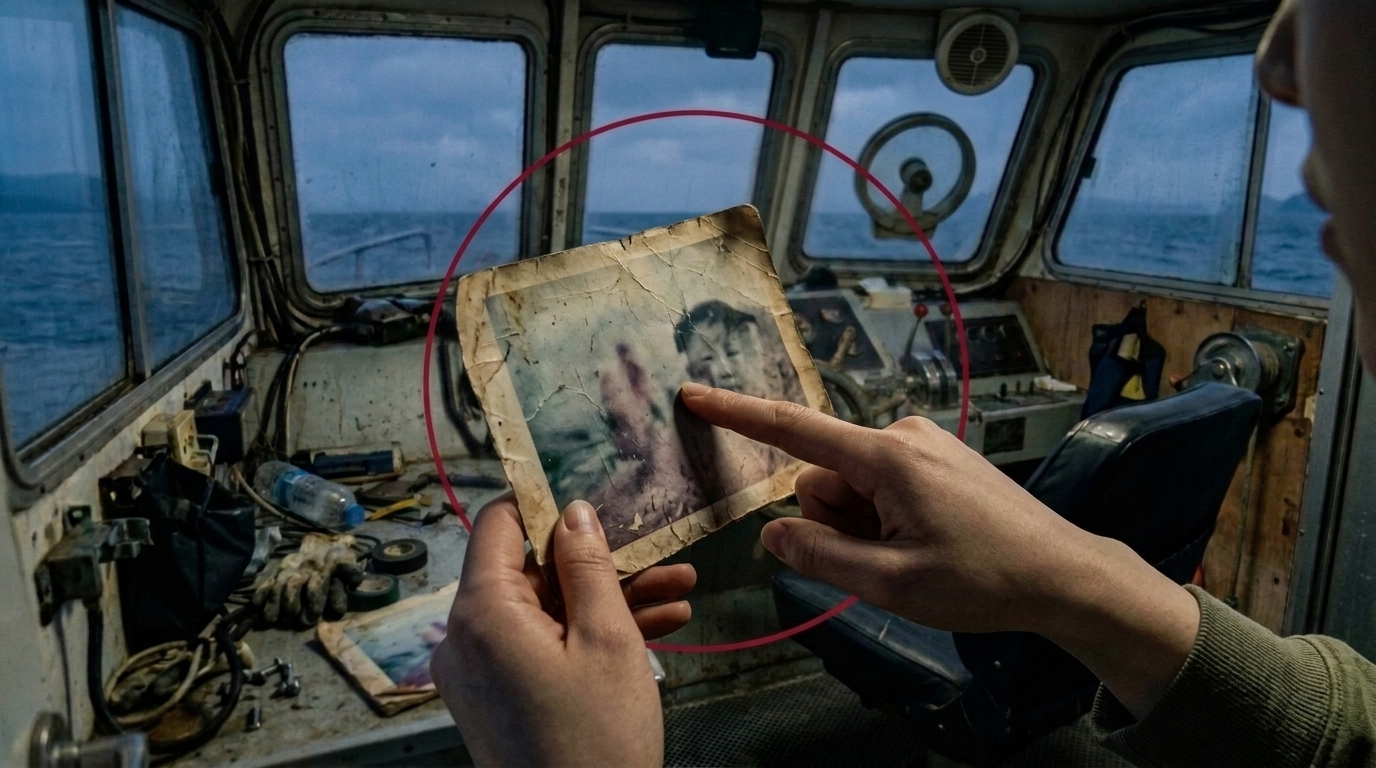
Create ONE FINAL photorealistic live-action film still of the moment below — contemporary South Korea, 2026; all people are Korean unless stated. TIME OF DAY (lock): dusk, wheelhouse lighting unspecified.

SHOT TEXT (authoritative, Korean): 수리영의 검지손가락이 낡은 사진 속 아이의 얼굴 부분에 닿아 있는 클로즈업

LOCATION (lock): A compact fishing-boat wheelhouse with steering controls and interior surfaces marked by numerous circular forms, including a distinct red circle. The shot takes place here — the attached LOCATION PHOTOGRAPH shows the exact spot.

REALIZE FIGURATIVE LANGUAGE AS A LIVE-ACTION SHOT: the Korean shot
text may describe characters metaphorically, figuratively or with
exaggeration. Photograph what a real movie camera would actually
record on a physical set — exaggerated or figurative impressions
become realistic staging choices (lighting, distance, angle,
wardrobe), not literal fantasy imagery.
EVERY CHARACTER IS A HUMAN BEING: unless the story explicitly
features non-human or virtual beings (as in science fiction or
fantasy), every character — however indirectly, vaguely or
figuratively the text describes them — IS a real human. When the
text gives no direct visual description of a person, IMAGINE one
and still show them as a concrete, fully-formed human being:
always render the human form to the maximum extent — build,
posture, face, hands, clothing — never reduce a person to a shape,
blob, solid silhouette or abstract mass.

EXPRESSIONS ARE ACTED, NEVER ANATOMICAL: when the text describes a
person's eyes, face or presence emotionally or figuratively (vacant,
hollow, dazed, burning, lifeless gaze and the like), it describes an
ACTOR'S PERFORMANCE captured by a real camera — realize it ONLY
through gaze direction, focus, eyelids, facial muscles, stillness
and posture. Every living person's eyes remain anatomically normal
human eyes with a natural iris and pupil, natural sclera and normal
proportions; NEVER whiten, blank out, cloud over, glow, enlarge or
otherwise alter eyeballs, skin or anatomy — unless the story
explicitly declares that being non-human or supernatural in form.

PROPS FACE THE RIGHT WAY: every handheld or used object must be
oriented exactly as its real-world use requires. A person reading,
watching or operating something (a phone, a photograph, a paper,
any device) has its functional side — screen, front, page — facing
THEIR OWN eyes; the camera then sees whatever side the staging
geometry implies (often its back). Show the functional side to the
camera ONLY when the shot text itself stages it toward the viewer.
Never flip, mirror or reverse an object's front and back.

CARRIED STATE (persist exactly — must match the neighbouring shots of this scene): The old photograph remains in Su-ri-young's possession as her finger indicates the child. Numerous circles, including a red circle, remain marked throughout the wheelhouse behind In-woo.

PEOPLE: the SHOT TEXT alone decides whether any person is visible in this shot. IF a person appears, they must be one of: 수리영 (Korean 20대 초반 여성, 긴 검은 머리, 타원형의 젊은 얼굴, 부드러운 이목구비와 자연스러운 피부색상태) — never anyone else, and never add a person the shot text does not show. IF only part of a person is in frame (a hand, arm, foot, back, silhouette), that body part belongs to the specific person the shot text names — its sex, age, build, skin and grooming must unmistakably match that person's profile above.

No text, captions, watermarks or annotations anywhere.
Create ONE FINAL photorealistic live-action film still of the moment below — contemporary South Korea, 2026; all people are Korean unless stated. TIME OF DAY (lock): dusk, wheelhouse lighting unspecified.

SHOT TEXT (authoritative, Korean): 인우가 입술을 살짝 벌린 채 하얗게 질린 얼굴 타이트 샷

LOCATION (lock): A compact fishing-boat wheelhouse with steering controls and interior surfaces marked by numerous circular forms, including a distinct red circle. The shot takes place here — the attached LOCATION PHOTOGRAPH shows the exact spot.

REALIZE FIGURATIVE LANGUAGE AS A LIVE-ACTION SHOT: the Korean shot
text may describe characters metaphorically, figuratively or with
exaggeration. Photograph what a real movie camera would actually
record on a physical set — exaggerated or figurative impressions
become realistic staging choices (lighting, distance, angle,
wardrobe), not literal fantasy imagery.
EVERY CHARACTER IS A HUMAN BEING: unless the story explicitly
features non-human or virtual beings (as in science fiction or
fantasy), every character — however indirectly, vaguely or
figuratively the text describes them — IS a real human. When the
text gives no direct visual description of a person, IMAGINE one
and still show them as a concrete, fully-formed human being:
always render the human form to the maximum extent — build,
posture, face, hands, clothing — never reduce a person to a shape,
blob, solid silhouette or abstract mass.

EXPRESSIONS ARE ACTED, NEVER ANATOMICAL: when the text describes a
person's eyes, face or presence emotionally or figuratively (vacant,
hollow, dazed, burning, lifeless gaze and the like), it describes an
ACTOR'S PERFORMANCE captured by a real camera — realize it ONLY
through gaze direction, focus, eyelids, facial muscles, stillness
and posture. Every living person's eyes remain anatomically normal
human eyes with a natural iris and pupil, natural sclera and normal
proportions; NEVER whiten, blank out, cloud over, glow, enlarge or
otherwise alter eyeballs, skin or anatomy — unless the story
explicitly declares that being non-human or supernatural in form.

PROPS FACE THE RIGHT WAY: every handheld or used object must be
oriented exactly as its real-world use requires. A person reading,
watching or operating something (a phone, a photograph, a paper,
any device) has its functional side — screen, front, page — facing
THEIR OWN eyes; the camera then sees whatever side the staging
geometry implies (often its back). Show the functional side to the
camera ONLY when the shot text itself stages it toward the viewer.
Never flip, mirror or reverse an object's front and back.

CARRIED STATE (persist exactly — must match the neighbouring shots of this scene): The wheelhouse remains covered with numerous circles, including the red circle, while Su-ri-young retains the old photograph and her backpack of maps.

PEOPLE: the SHOT TEXT alone decides whether any person is visible in this shot. IF a person appears, they must be one of: 인우 (Korean 20대 중반 남성, 자연스러운 검은 머리, 균형 잡힌 젊은 얼굴, 선이 고운 이목구비) — never anyone else, and never add a person the shot text does not show. IF only part of a person is in frame (a hand, arm, foot, back, silhouette), that body part belongs to the specific person the shot text names — its sex, age, build, skin and grooming must unmistakably match that person's profile above.

No text, captions, watermarks or annotations anywhere.
Create ONE FINAL photorealistic live-action film still of the moment below — contemporary South Korea, 2026; all people are Korean unless stated. TIME OF DAY (lock): dusk, wheelhouse lighting unspecified.

SHOT TEXT (authoritative, Korean): 눈이 반쯤 감긴 수리영의 이마가 인우의 어깨에 맞닿아 있는 찰나

LOCATION (lock): A compact fishing-boat wheelhouse with steering controls and interior surfaces marked by numerous circular forms, including a distinct red circle. The shot takes place here — the attached LOCATION PHOTOGRAPH shows the exact spot.

IMMOBILE CHARACTER POSE — CANONICAL (identical wherever this character appears in ANY panel; on any conflict THIS POSE WINS): Suriyoung is collapsed motionless against Inwoo’s shoulder as her consciousness fades. The source does not specify her facing direction, exact head and torso angles, arm positions, leg positions, or other supporting contact.

IMMOBILE BODIES OBEY GRAVITY: a person who is dead or unconscious
exerts NO muscular effort. Every part of their body — head, torso,
arms, hands, fingers, legs — rests fully on whatever supports it
(floor, wall, furniture, their own lap) and hangs or slumps with
gravity. NEVER show any part of an immobile person's body lifted,
raised, held up in the air, or posed as if presenting something:
an object in their grip stays clenched in a hand that itself lies
fallen on a support — the hand does not hold the object up. If the
canonical pose leaves a body part unspecified, resolve it as the
most gravity-compliant, fully-supported position.

REALIZE FIGURATIVE LANGUAGE AS A LIVE-ACTION SHOT: the Korean shot
text may describe characters metaphorically, figuratively or with
exaggeration. Photograph what a real movie camera would actually
record on a physical set — exaggerated or figurative impressions
become realistic staging choices (lighting, distance, angle,
wardrobe), not literal fantasy imagery.
EVERY CHARACTER IS A HUMAN BEING: unless the story explicitly
features non-human or virtual beings (as in science fiction or
fantasy), every character — however indirectly, vaguely or
figuratively the text describes them — IS a real human. When the
text gives no direct visual description of a person, IMAGINE one
and still show them as a concrete, fully-formed human being:
always render the human form to the maximum extent — build,
posture, face, hands, clothing — never reduce a person to a shape,
blob, solid silhouette or abstract mass.

EXPRESSIONS ARE ACTED, NEVER ANATOMICAL: when the text describes a
person's eyes, face or presence emotionally or figuratively (vacant,
hollow, dazed, burning, lifeless gaze and the like), it describes an
ACTOR'S PERFORMANCE captured by a real camera — realize it ONLY
through gaze direction, focus, eyelids, facial muscles, stillness
and posture. Every living person's eyes remain anatomically normal
human eyes with a natural iris and pupil, natural sclera and normal
proportions; NEVER whiten, blank out, cloud over, glow, enlarge or
otherwise alter eyeballs, skin or anatomy — unless the story
explicitly declares that being non-human or supernatural in form.

PROPS FACE THE RIGHT WAY: every handheld or used object must be
oriented exactly as its real-world use requires. A person reading,
watching or operating something (a phone, a photograph, a paper,
any device) has its functional side — screen, front, page — facing
THEIR OWN eyes; the camera then sees whatever side the staging
geometry implies (often its back). Show the functional side to the
camera ONLY when the shot text itself stages it toward the viewer.
Never flip, mirror or reverse an object's front and back.

CARRIED STATE (persist exactly — must match the neighbouring shots of this scene): The wheelhouse circles remain in place as Suriyoung is collapsed motionless against Inwoo’s shoulder as her consciousness fades. Her old photograph, backpack, maps, and smartphone remain aboard with her, though the photograph's exact grip after collapse is unspecified.

PEOPLE: the SHOT TEXT alone decides whether any person is visible in this shot. IF a person appears, they must be one of: 수리영 (Korean 20대 초반 여성, 긴 검은 머리, 타원형의 젊은 얼굴, 부드러운 이목구비와 자연스러운 피부색상태); 인우 (Korean 20대 중반 남성, 자연스러운 검은 머리, 균형 잡힌 젊은 얼굴, 선이 고운 이목구비) — never anyone else, and never add a person the shot text does not show. IF only part of a person is in frame (a hand, arm, foot, back, silhouette), that body part belongs to the specific person the shot text names — its sex, age, build, skin and grooming must unmistakably match that person's profile above.

No text, captions, watermarks or annotations anywhere.





Create ONE FINAL photorealistic live-action film still of the moment below — contemporary South Korea, 2026; all people are Korean unless stated. TIME OF DAY (lock): sunset, dense fog bank.

SHOT TEXT (authoritative, Korean): 해질 무렵 황금빛 노을이 바다 표면에 길게 비친 전경

LOCATION (lock): Open sea around a small fishing boat, with a dense offshore fog bank forming a visual boundary across the water. The shot takes place here — the attached LOCATION PHOTOGRAPH shows the exact spot.

REALIZE FIGURATIVE LANGUAGE AS A LIVE-ACTION SHOT: the Korean shot
text may describe characters metaphorically, figuratively or with
exaggeration. Photograph what a real movie camera would actually
record on a physical set — exaggerated or figurative impressions
become realistic staging choices (lighting, distance, angle,
wardrobe), not literal fantasy imagery.
EVERY CHARACTER IS A HUMAN BEING: unless the story explicitly
features non-human or virtual beings (as in science fiction or
fantasy), every character — however indirectly, vaguely or
figuratively the text describes them — IS a real human. When the
text gives no direct visual description of a person, IMAGINE one
and still show them as a concrete, fully-formed human being:
always render the human form to the maximum extent — build,
posture, face, hands, clothing — never reduce a person to a shape,
blob, solid silhouette or abstract mass.

EXPRESSIONS ARE ACTED, NEVER ANATOMICAL: when the text describes a
person's eyes, face or presence emotionally or figuratively (vacant,
hollow, dazed, burning, lifeless gaze and the like), it describes an
ACTOR'S PERFORMANCE captured by a real camera — realize it ONLY
through gaze direction, focus, eyelids, facial muscles, stillness
and posture. Every living person's eyes remain anatomically normal
human eyes with a natural iris and pupil, natural sclera and normal
proportions; NEVER whiten, blank out, cloud over, glow, enlarge or
otherwise alter eyeballs, skin or anatomy — unless the story
explicitly declares that being non-human or supernatural in form.

PROPS FACE THE RIGHT WAY: every handheld or used object must be
oriented exactly as its real-world use requires. A person reading,
watching or operating something (a phone, a photograph, a paper,
any device) has its functional side — screen, front, page — facing
THEIR OWN eyes; the camera then sees whatever side the staging
geometry implies (often its back). Show the functional side to the
camera ONLY when the shot text itself stages it toward the viewer.
Never flip, mirror or reverse an object's front and back.

CARRIED STATE (persist exactly — must match the neighbouring shots of this scene): The boat continues onward with the unconscious Su-ri-young aboard, along with her backpack, maps, old photograph, and smartphone.

NO PEOPLE IN THIS SHOT: the shot text shows only the place and its state — no living person or any body part appears in frame, unless the shot text itself explicitly says so.

No text, captions, watermarks or annotations anywhere.

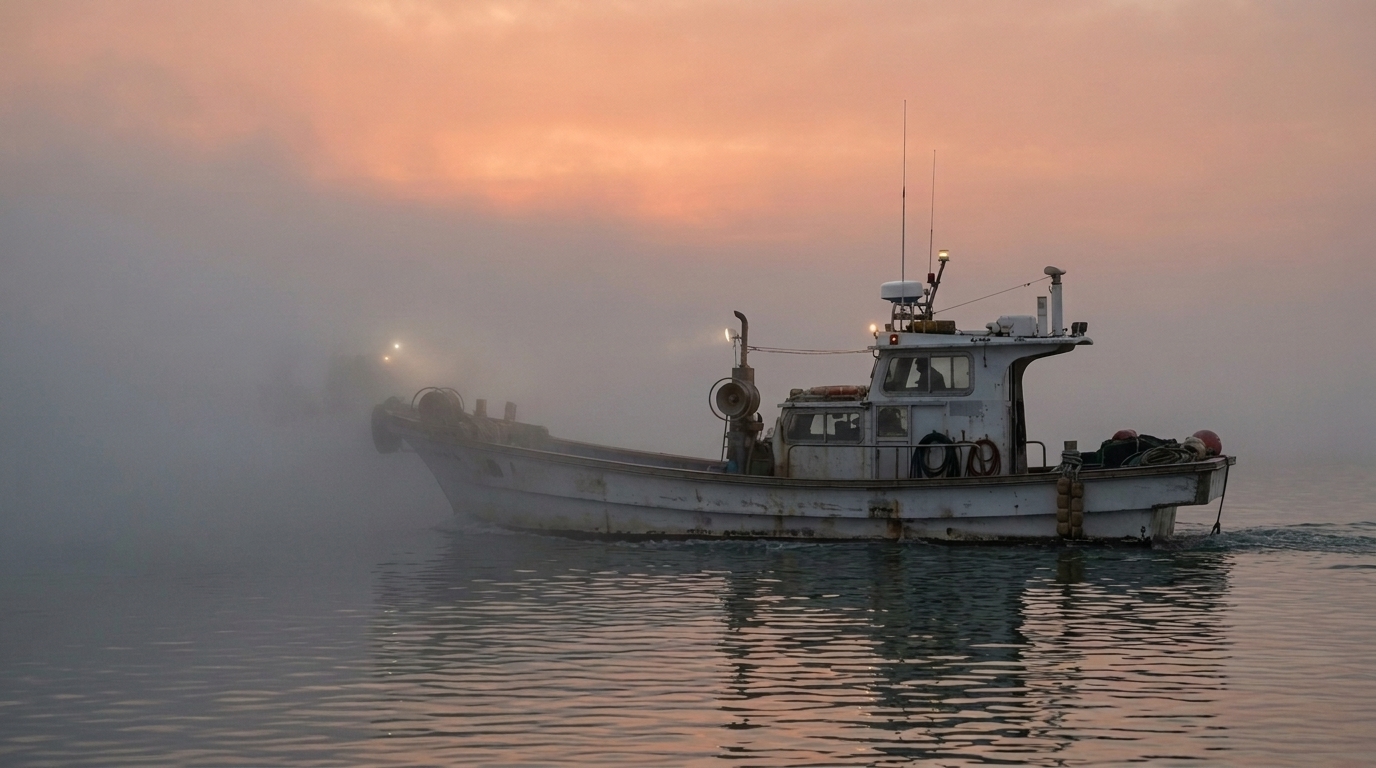
Create ONE FINAL photorealistic live-action film still of the moment below — contemporary South Korea, 2026; all people are Korean unless stated. TIME OF DAY (lock): sunset, dense fog bank.

SHOT TEXT (authoritative, Korean): 어선의 뱃머리가 짙은 안개벽에 절반쯤 가려진 측면 구도

LOCATION (lock): Open sea around a small fishing boat, with a dense offshore fog bank forming a visual boundary across the water. The shot takes place here — the attached LOCATION PHOTOGRAPH shows the exact spot.

REALIZE FIGURATIVE LANGUAGE AS A LIVE-ACTION SHOT: the Korean shot
text may describe characters metaphorically, figuratively or with
exaggeration. Photograph what a real movie camera would actually
record on a physical set — exaggerated or figurative impressions
become realistic staging choices (lighting, distance, angle,
wardrobe), not literal fantasy imagery.
EVERY CHARACTER IS A HUMAN BEING: unless the story explicitly
features non-human or virtual beings (as in science fiction or
fantasy), every character — however indirectly, vaguely or
figuratively the text describes them — IS a real human. When the
text gives no direct visual description of a person, IMAGINE one
and still show them as a concrete, fully-formed human being:
always render the human form to the maximum extent — build,
posture, face, hands, clothing — never reduce a person to a shape,
blob, solid silhouette or abstract mass.

EXPRESSIONS ARE ACTED, NEVER ANATOMICAL: when the text describes a
person's eyes, face or presence emotionally or figuratively (vacant,
hollow, dazed, burning, lifeless gaze and the like), it describes an
ACTOR'S PERFORMANCE captured by a real camera — realize it ONLY
through gaze direction, focus, eyelids, facial muscles, stillness
and posture. Every living person's eyes remain anatomically normal
human eyes with a natural iris and pupil, natural sclera and normal
proportions; NEVER whiten, blank out, cloud over, glow, enlarge or
otherwise alter eyeballs, skin or anatomy — unless the story
explicitly declares that being non-human or supernatural in form.

PROPS FACE THE RIGHT WAY: every handheld or used object must be
oriented exactly as its real-world use requires. A person reading,
watching or operating something (a phone, a photograph, a paper,
any device) has its functional side — screen, front, page — facing
THEIR OWN eyes; the camera then sees whatever side the staging
geometry implies (often its back). Show the functional side to the
camera ONLY when the shot text itself stages it toward the viewer.
Never flip, mirror or reverse an object's front and back.

CARRIED STATE (persist exactly — must match the neighbouring shots of this scene): In-woo's boat continues into the fog carrying the unconscious Su-ri-young and her belongings; the wheelhouse's numerous circles remain unchanged.

NO PEOPLE IN THIS SHOT: the shot text shows only the place and its state — no living person or any body part appears in frame, unless the shot text itself explicitly says so.

No text, captions, watermarks or annotations anywhere.
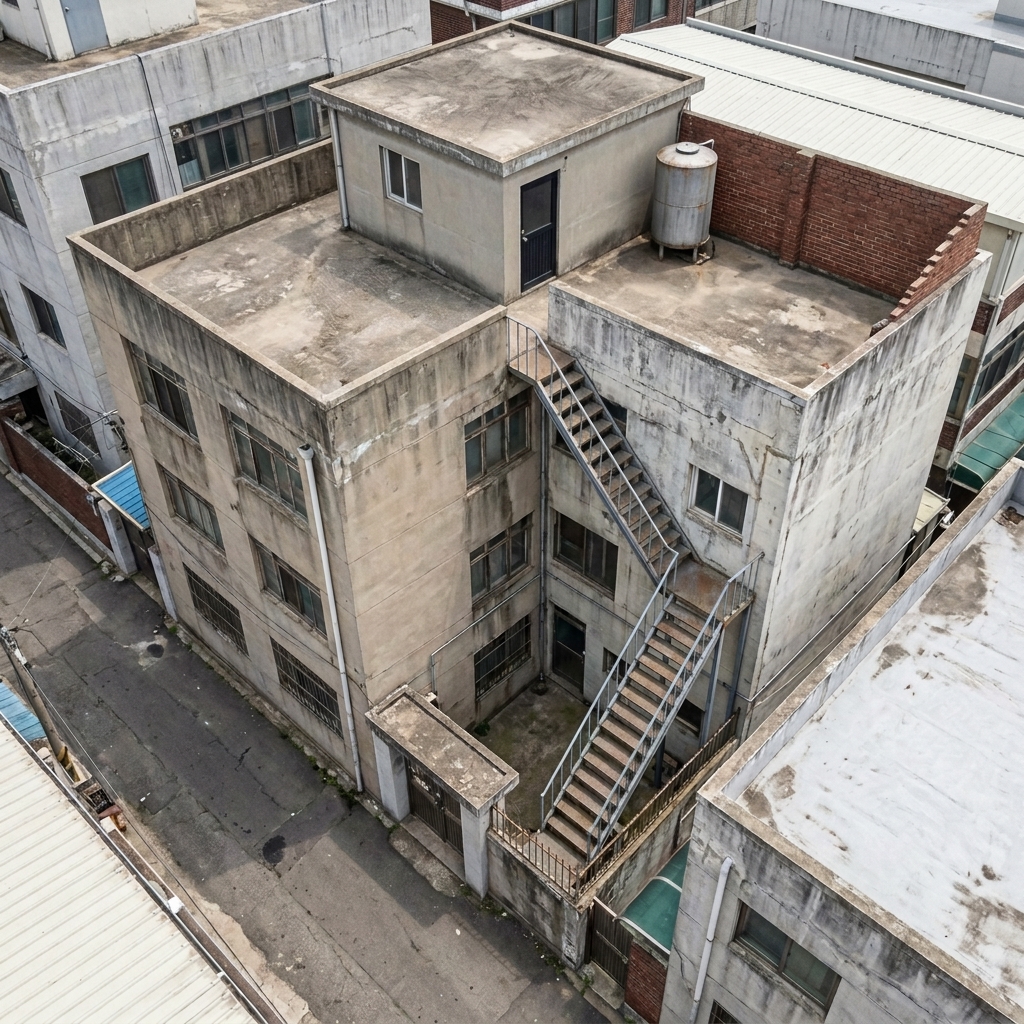
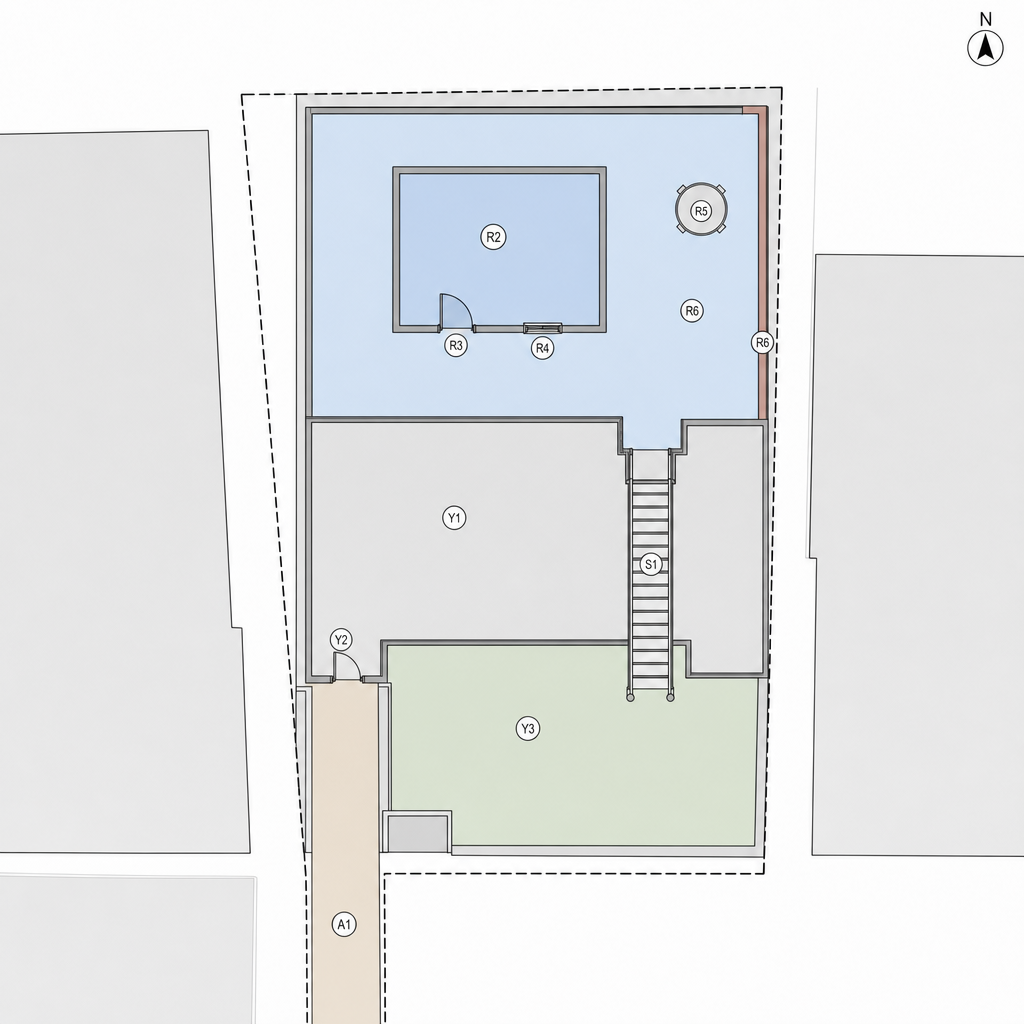
{
 "anchor_markers": [
  "R3",
  "R1"
 ],
 "camera_position_en": "On the rooftop plane surrounding the rooftop room, directly in front of the rooftop room exterior.",
 "in_frame_en": "The half-open iron entrance door of the rooftop room, its doorway, and the surrounding exterior wall of the rooftop room.",
 "look_direction_en": "Straight toward the iron entrance door set into the rooftop room's exterior wall.",
 "map_zone": "Rooftop Terrace and Rooftop Room Exterior",
 "moment_context_en": "Suriyoung has just hurried up the exterior stair after leaving her bicycle in the rear yard. She has suddenly noticed a disgusting smell before seeing the half-open door.",
 "rationale_ko": "샷은 옥상에 선 수리영의 시선 끝에 옥탑방의 반쯤 열린 현관 철문이 정면으로 보이는 구도다. 따라서 카메라는 옥탑방을 둘러싼 옥상 평면에서 철문과 정면으로 마주보는 위치에 두고, 철문을 화면의 주 피사체로 삼는 것이 사이트플랜과 장면 원문에 부합한다."
}Create ONE photorealistic BACKGROUND PLATE for a live-action film still. No people, no animals, an empty set. CAMERA: On the rooftop plane surrounding the rooftop room, directly in front of the rooftop room exterior. Looking: Straight toward the iron entrance door set into the rooftop room's exterior wall. MAP POINT: this plate is taken in the "Rooftop Terrace and Rooftop Room Exterior" area of the property on the attached site plan, anchored to these mapped elements: - iron entrance door of the rooftop room: The iron entrance door is set into the rooftop room's exterior wall and opens directly onto the surrounding rooftop plane. - rooftop plane surrounding the rooftop room: The rooftop plane sits atop the multi-unit villa, receives the exterior stair, and extends around the rooftop room. IN FRAME (near to far): The half-open iron entrance door of the rooftop room, its doorway, and the surrounding exterior wall of the rooftop room. MOMENT CONTEXT: Suriyoung has just hurried up the exterior stair after leaving her bicycle in the rear yard. She has suddenly noticed a disgusting smell before seeing the half-open door. TIME & LIGHT: night Do not add weather, atmosphere or colour moods beyond this. INVENTION BOUNDARY: state world facts (weather, atmosphere, surface wetness, materials, light-source colour, numeric distances, time of day) ONLY when the shot text or its corrections state them; where they are silent, stay silent too — do not invent moods or weather. LOOK REFERENCE: the attached PHOTOGRAPH shows this same property. Match its look exactly — the building, its materials and aging, the roof-deck contents, colours, and the surrounding town. It is the single source of truth for how everything LOOKS. SITE PLAN REFERENCE: the attached flat drawing is the site plan of this same property. Use it ONLY as the source of truth for WHERE things are (spatial arrangement, adjacency, routes). NEVER draw the plan itself — none of its flat colours, circles, codes or labels may appear in the output. The output image must contain ZERO annotations — no circles, no codes, no letters, no numbers, no text, no signage lettering, no arrows, no dashed lines.
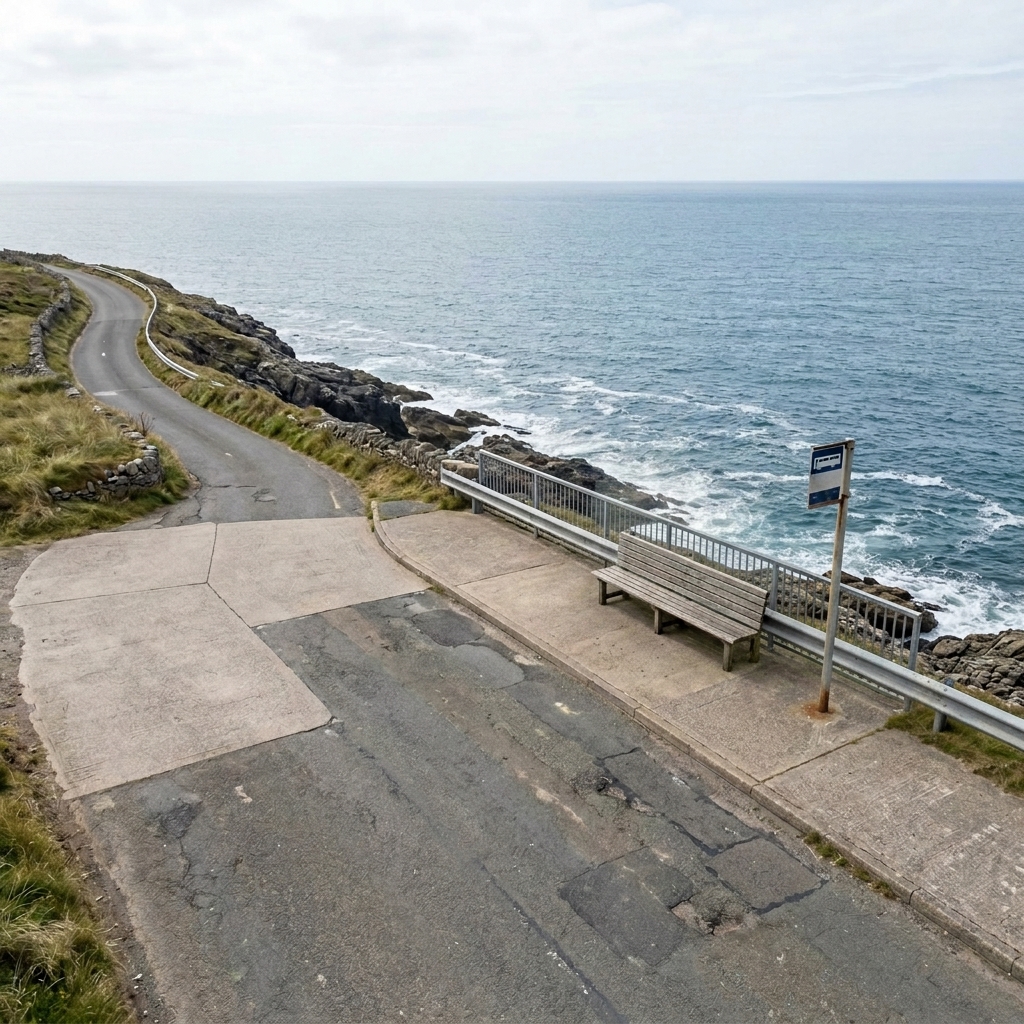
{
 "anchor_markers": [
  "B1",
  "B2",
  "A1"
 ],
 "camera_position_en": "Place the camera within the Bus Stop Waiting Zone, on the seaward side of the coastal bus-stop identification sign and offset from the sea-facing bus-stop waiting seat so that neither element blocks the two performers.",
 "in_frame_en": "Hyesu in full figure beside the sea-facing bus-stop waiting seat, Suriyoung farther away in rear view with one foot lifted mid-stride, and the bus-stop approach area extending ahead of her.",
 "look_direction_en": "Look from the seaward side of the Bus Stop Waiting Zone across the sea-facing bus-stop waiting seat and toward the bus-stop approach area on the side away from the sea.",
 "map_zone": "Bus Stop Approach Zone",
 "moment_context_en": "Suriyoung has decided to go home after concluding that she may have misseen what happened. Hyesu calls after her to have her mother telephone if Suriyoung sees her.",
 "rationale_ko": "수리영은 바다를 향한 대기 좌석에서 일어난 뒤 정류장을 떠나 달려가므로, 주된 동작은 바다 반대편으로 이어지는 버스정류장 접근 구역에 배치하는 것이 자연스럽다. 카메라를 대기 구역의 바다 쪽에 두고 육지 방향으로 보면 달아나는 수리영의 뒷모습과 좌석 부근에 남은 혜수의 전신을 한 넓은 프레임에 함께 담을 수 있다. 표지와 좌석에서 옆으로 비켜 촬영하면 두 인물이 겹치거나 가려지는 것을 피할 수 있다."
}Create ONE photorealistic BACKGROUND PLATE for a live-action film still. No people, no animals, an empty set. CAMERA: Place the camera within the Bus Stop Waiting Zone, on the seaward side of the coastal bus-stop identification sign and offset from the sea-facing bus-stop waiting seat so that neither element blocks the two performers. Looking: Look from the seaward side of the Bus Stop Waiting Zone across the sea-facing bus-stop waiting seat and toward the bus-stop approach area on the side away from the sea. MAP POINT: this plate is taken in the "Bus Stop Approach Zone" area of the property on the attached site plan, anchored to these mapped elements: - sea-facing bus-stop waiting seat: Located within the Bus Stop Waiting Zone and oriented toward the sea. - coastal bus-stop identification sign: Fixed beside the sea-facing waiting seat within the Bus Stop Waiting Zone. - bus-stop approach area: Directly adjoins the Bus Stop Waiting Zone on the side away from the sea and continues outward from the stop. IN FRAME (near to far): Hyesu in full figure beside the sea-facing bus-stop waiting seat, Suriyoung farther away in rear view with one foot lifted mid-stride, and the bus-stop approach area extending ahead of her. MOMENT CONTEXT: Suriyoung has decided to go home after concluding that she may have misseen what happened. Hyesu calls after her to have her mother telephone if Suriyoung sees her. TIME & LIGHT: night Do not add weather, atmosphere or colour moods beyond this. INVENTION BOUNDARY: state world facts (weather, atmosphere, surface wetness, materials, light-source colour, numeric distances, time of day) ONLY when the shot text or its corrections state them; where they are silent, stay silent too — do not invent moods or weather. LOOK REFERENCE: the attached PHOTOGRAPH shows this same property. Match its look exactly — the building, its materials and aging, the roof-deck contents, colours, and the surrounding town. It is the single source of truth for how everything LOOKS. SITE PLAN REFERENCE: the attached flat drawing is the site plan of this same property. Use it ONLY as the source of truth for WHERE things are (spatial arrangement, adjacency, routes). NEVER draw the plan itself — none of its flat colours, circles, codes or labels may appear in the output. The output image must contain ZERO annotations — no circles, no codes, no letters, no numbers, no text, no signage lettering, no arrows, no dashed lines.
{
 "anchor_markers": [
  "H1",
  "R1"
 ],
 "camera_position_en": "At the landward edge of the coastal harbor water area, beside the mooring point and across the water from the harbor-side tidal rock outcrop.",
 "in_frame_en": "The ground-level mooring stake and thick anchor line in the foreground; Inwoo holding the line after stepping down from the boat's bow; the boat and coastal harbor water area behind him; and the harbor-side tidal rock outcrop farther across the water.",
 "look_direction_en": "Toward the boat's bow at the edge of the coastal harbor water area, with the harbor-side tidal rock outcrop beyond.",
 "map_zone": "Harbor Waterfront",
 "moment_context_en": "The harbor is otherwise empty, and the boat has just emerged through the fog. Suriyoung has approached it after waiting at the tidal rocks.",
 "rationale_ko": "인우가 배에서 내려 닻줄을 육상의 말뚝에 거는 순간이므로, 배가 접안할 수 있는 포구 수면의 육지측 가장자리에 배치하는 것이 자연스럽다. 카메라를 계류 지점 가까이 낮게 두면 말뚝과 굵은 닻줄, 인우의 손과 정지 동작을 전경에서 명확히 잡으면서 배와 포구 수면을 함께 제시할 수 있다. 갯바위는 수리영이 직전에 머물던 장소이자 포구의 해안 지형이므로 수면 너머 원경 기준으로 삼는다."
}Create ONE photorealistic BACKGROUND PLATE for a live-action film still. No people, no animals, an empty set. CAMERA: At the landward edge of the coastal harbor water area, beside the mooring point and across the water from the harbor-side tidal rock outcrop. Looking: Toward the boat's bow at the edge of the coastal harbor water area, with the harbor-side tidal rock outcrop beyond. MAP POINT: this plate is taken in the "Harbor Waterfront" area of the property on the attached site plan, anchored to these mapped elements: - coastal harbor water area: The harbor water area adjoins the tidal rock outcrop and opens outward toward the sea. - harbor-side tidal rock outcrop: The tidal rock outcrop occupies the shore beside the harbor waters and faces outward toward the sea. IN FRAME (near to far): The ground-level mooring stake and thick anchor line in the foreground; Inwoo holding the line after stepping down from the boat's bow; the boat and coastal harbor water area behind him; and the harbor-side tidal rock outcrop farther across the water. MOMENT CONTEXT: The harbor is otherwise empty, and the boat has just emerged through the fog. Suriyoung has approached it after waiting at the tidal rocks. TIME & LIGHT: dusk, dense fog after rain Do not add weather, atmosphere or colour moods beyond this. INVENTION BOUNDARY: state world facts (weather, atmosphere, surface wetness, materials, light-source colour, numeric distances, time of day) ONLY when the shot text or its corrections state them; where they are silent, stay silent too — do not invent moods or weather. LOOK REFERENCE: the attached PHOTOGRAPH shows this same property. Match its look exactly — the building, its materials and aging, the roof-deck contents, colours, and the surrounding town. It is the single source of truth for how everything LOOKS. SITE PLAN REFERENCE: the attached flat drawing is the site plan of this same property. Use it ONLY as the source of truth for WHERE things are (spatial arrangement, adjacency, routes). NEVER draw the plan itself — none of its flat colours, circles, codes or labels may appear in the output. The output image must contain ZERO annotations — no circles, no codes, no letters, no numbers, no text, no signage lettering, no arrows, no dashed lines.