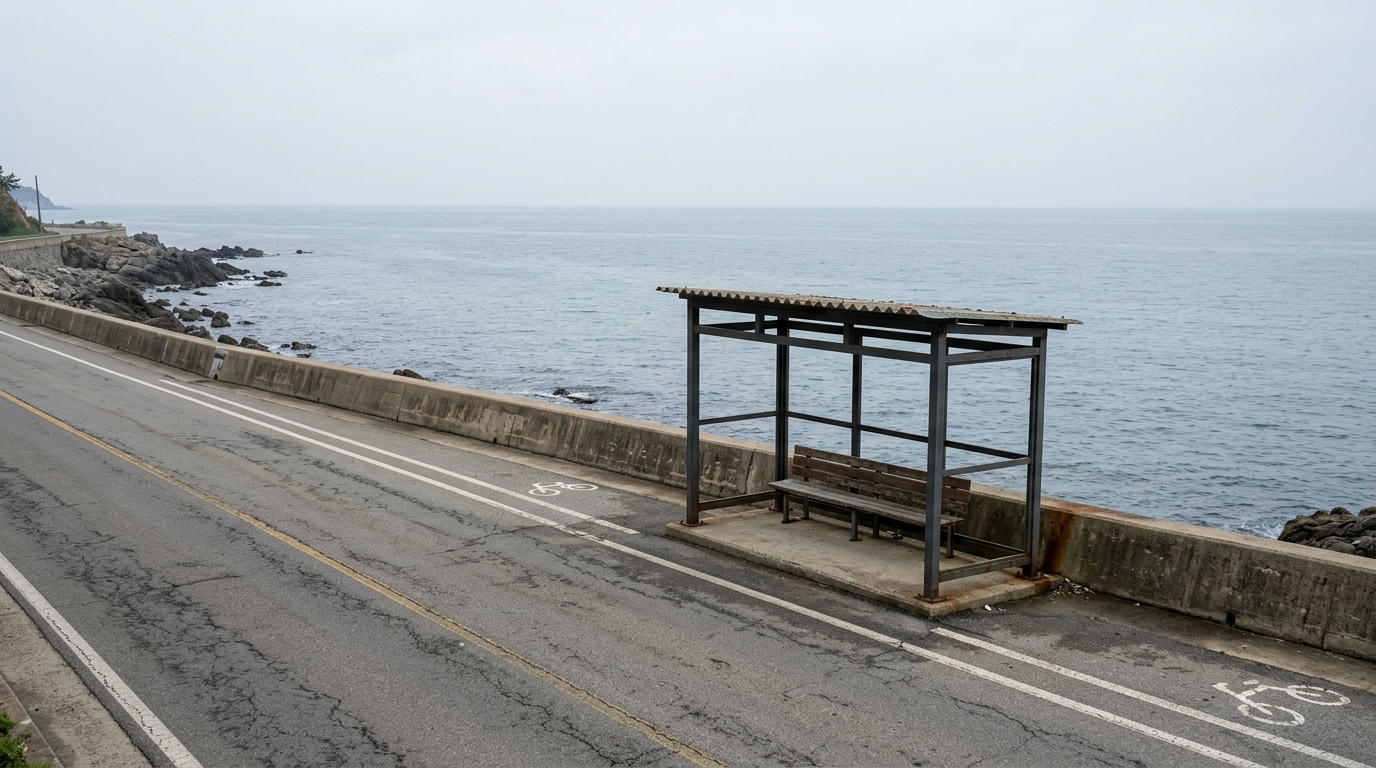
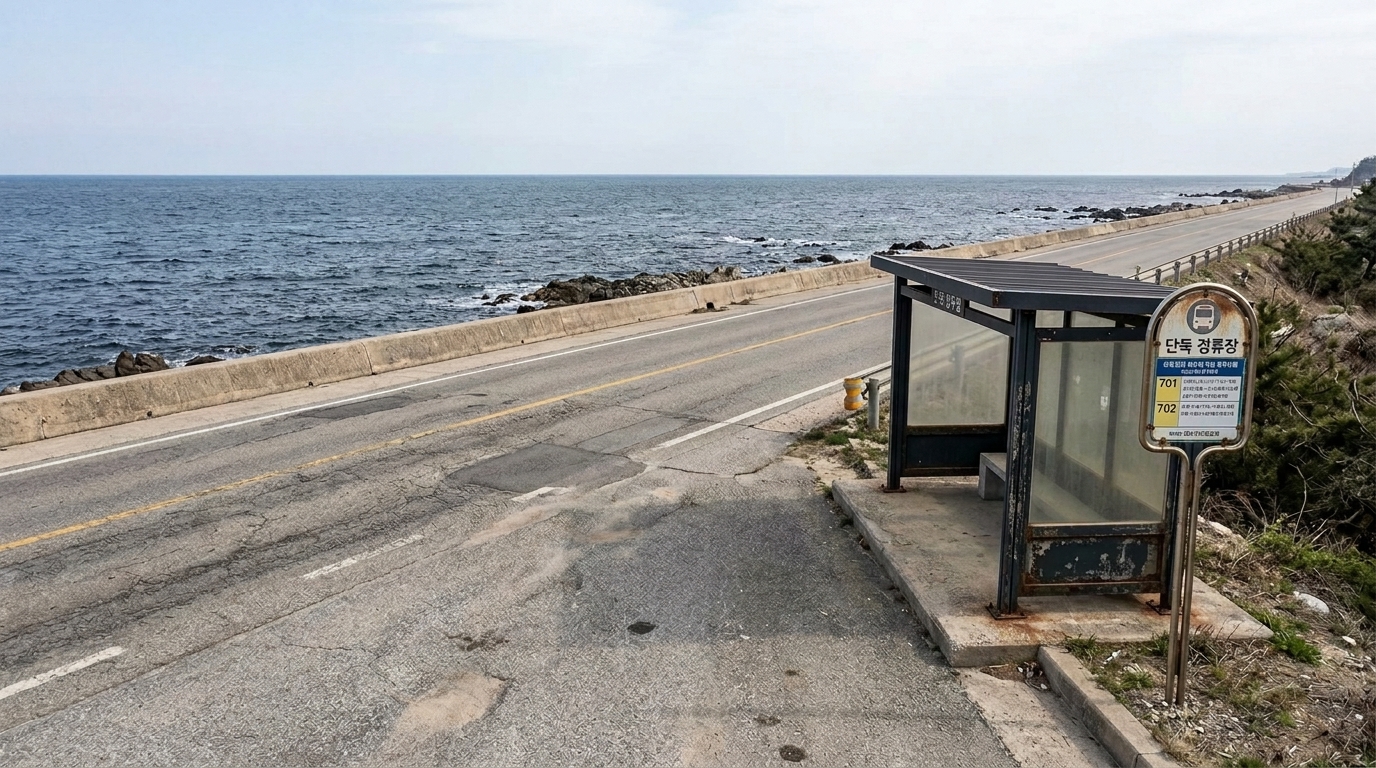
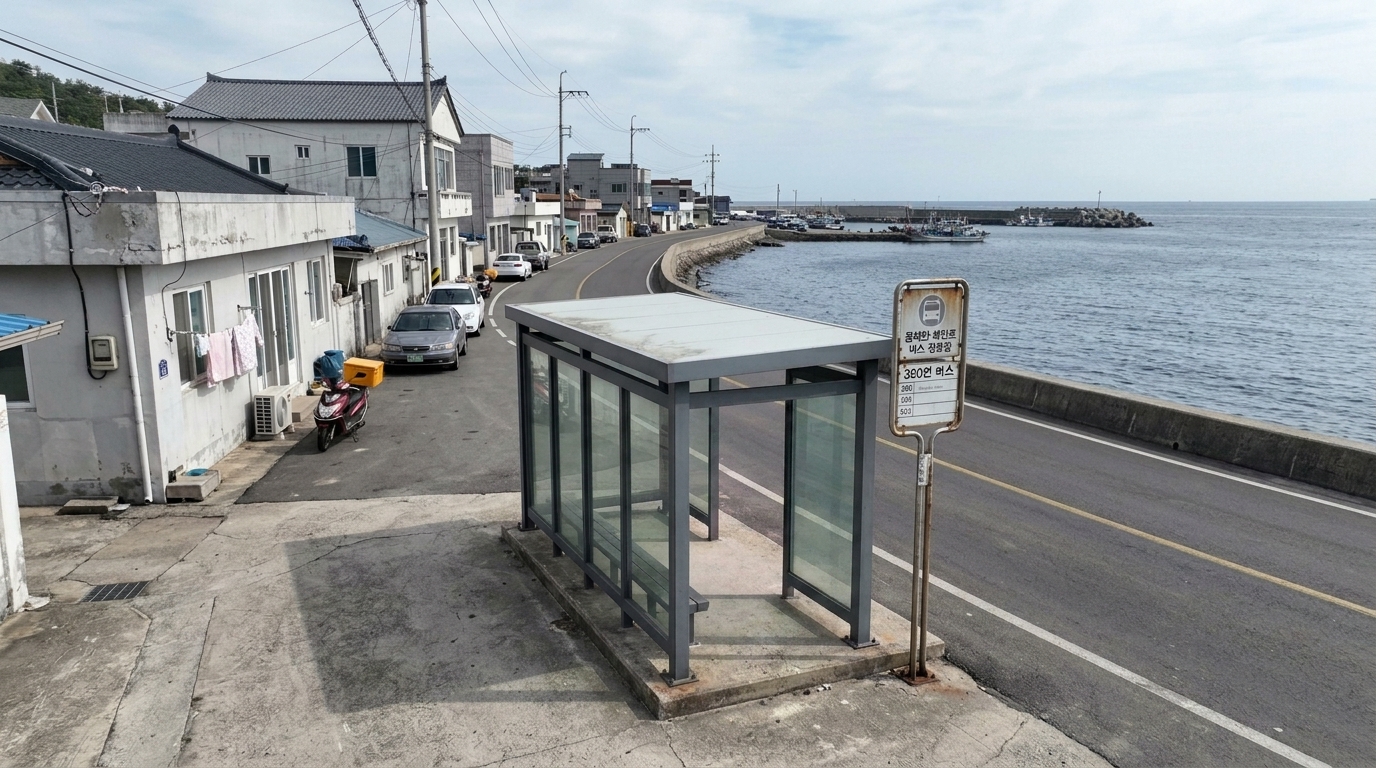
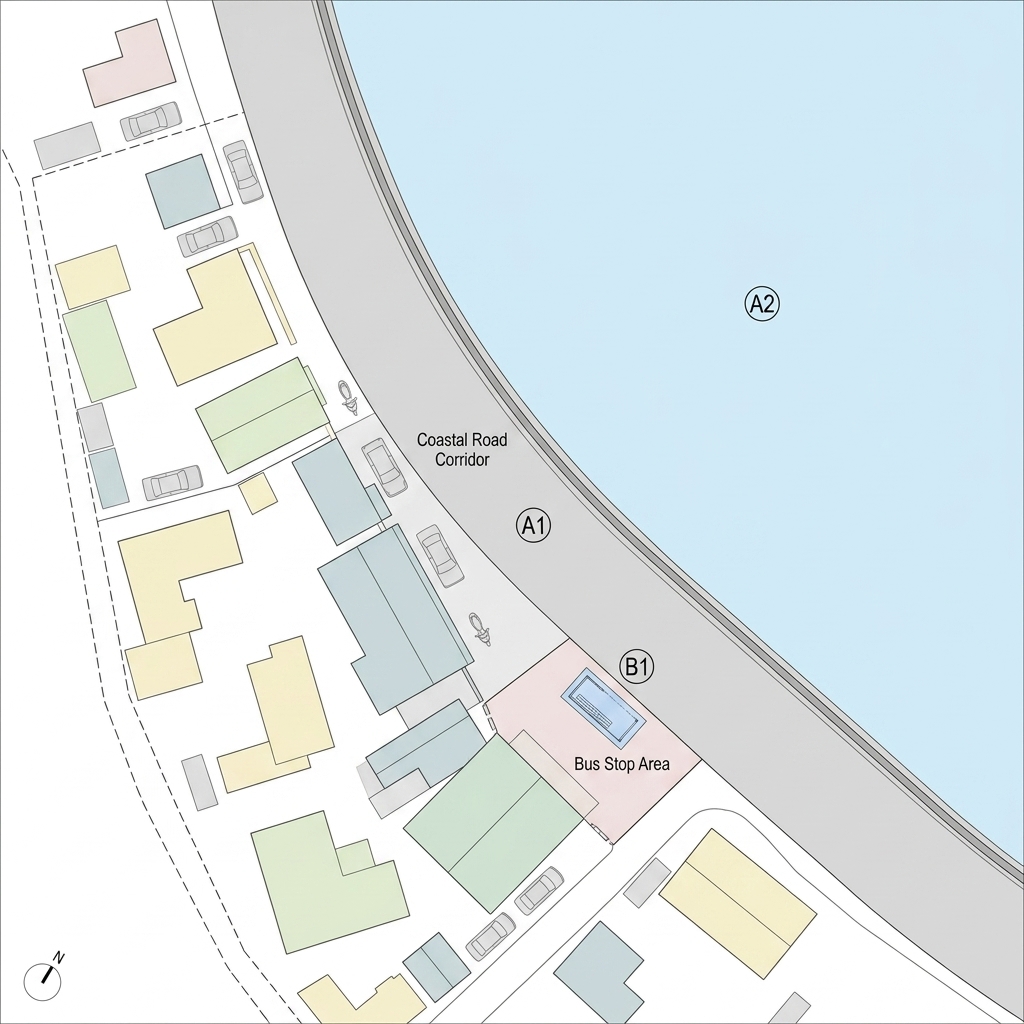
구본(1R, 동일 프롬프트 3롤) vs 신규(2R, 변형 3종 각 1롤). 판정=Gemini 블라인드(브리프 conformance 선행). 구본은 .bak_seed_2r 백업본.
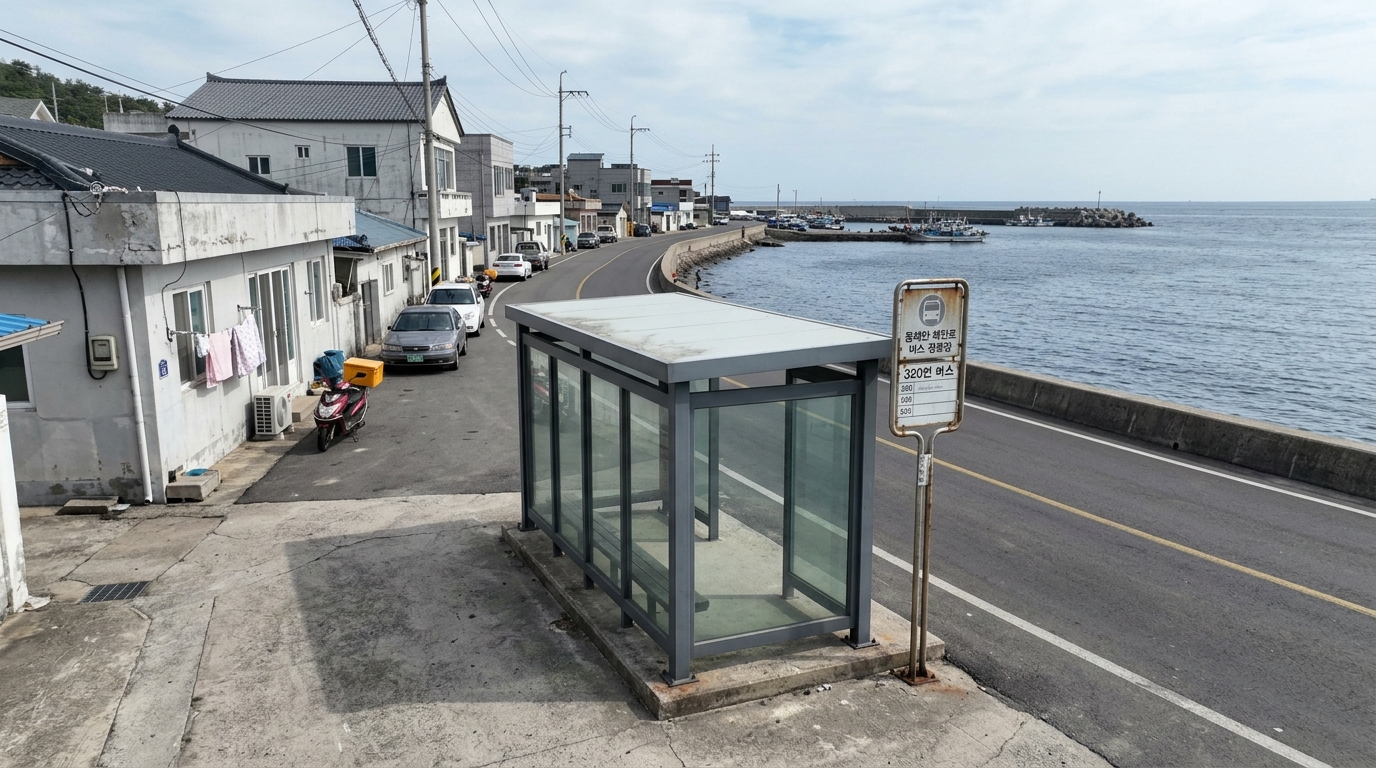
선정 = A location_line_en: A coastal roadside bus stop at the inhabited edge of a South Korean seaside village, 2026.
SHARED CONFORMANCE BRIEF (invariant visual facts every candidate must satisfy):

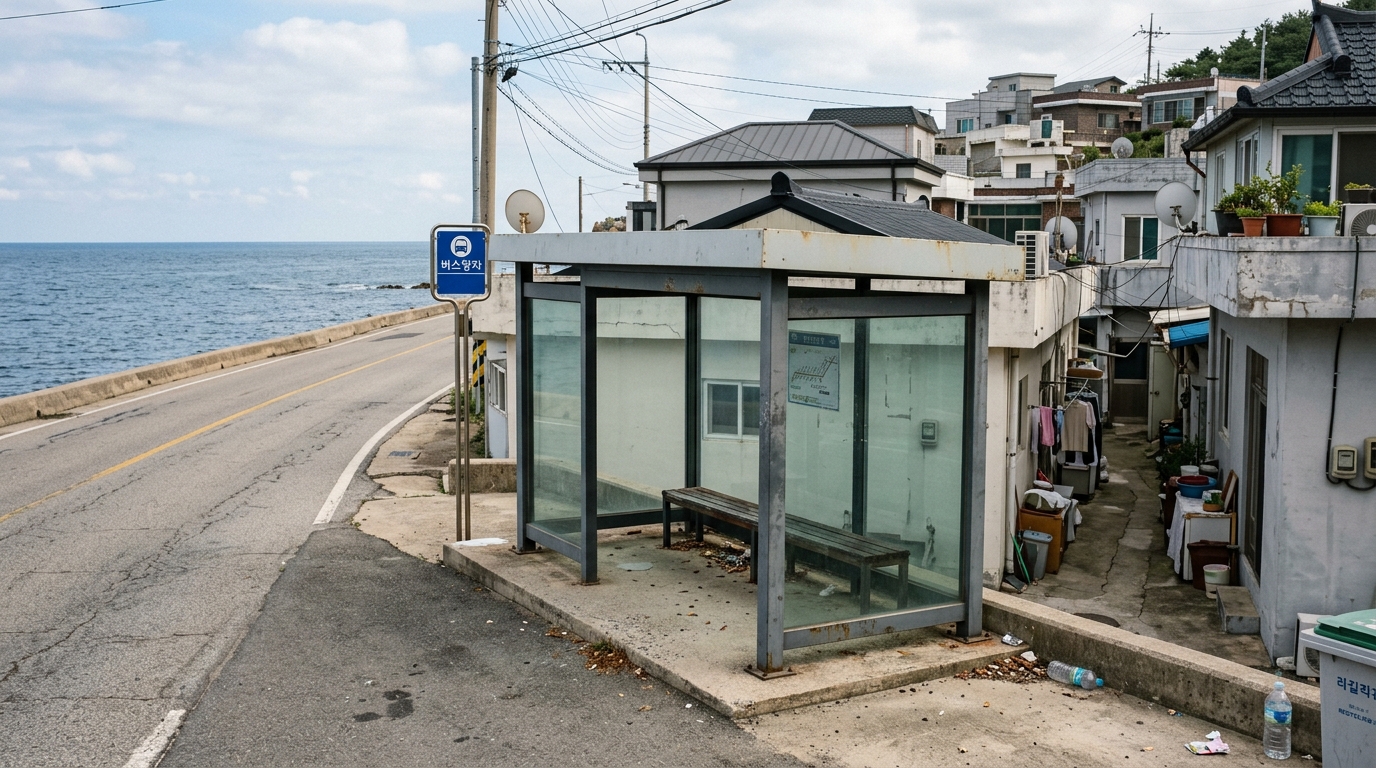
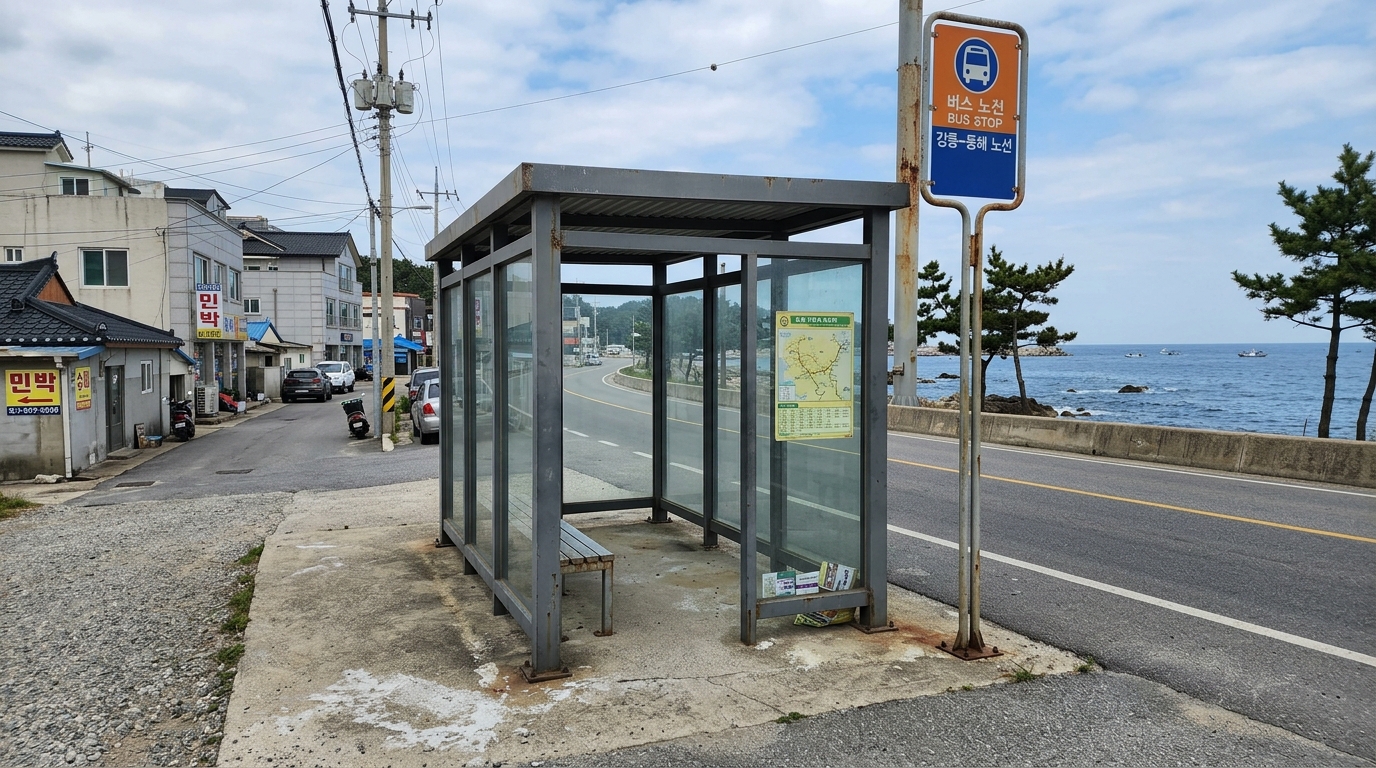
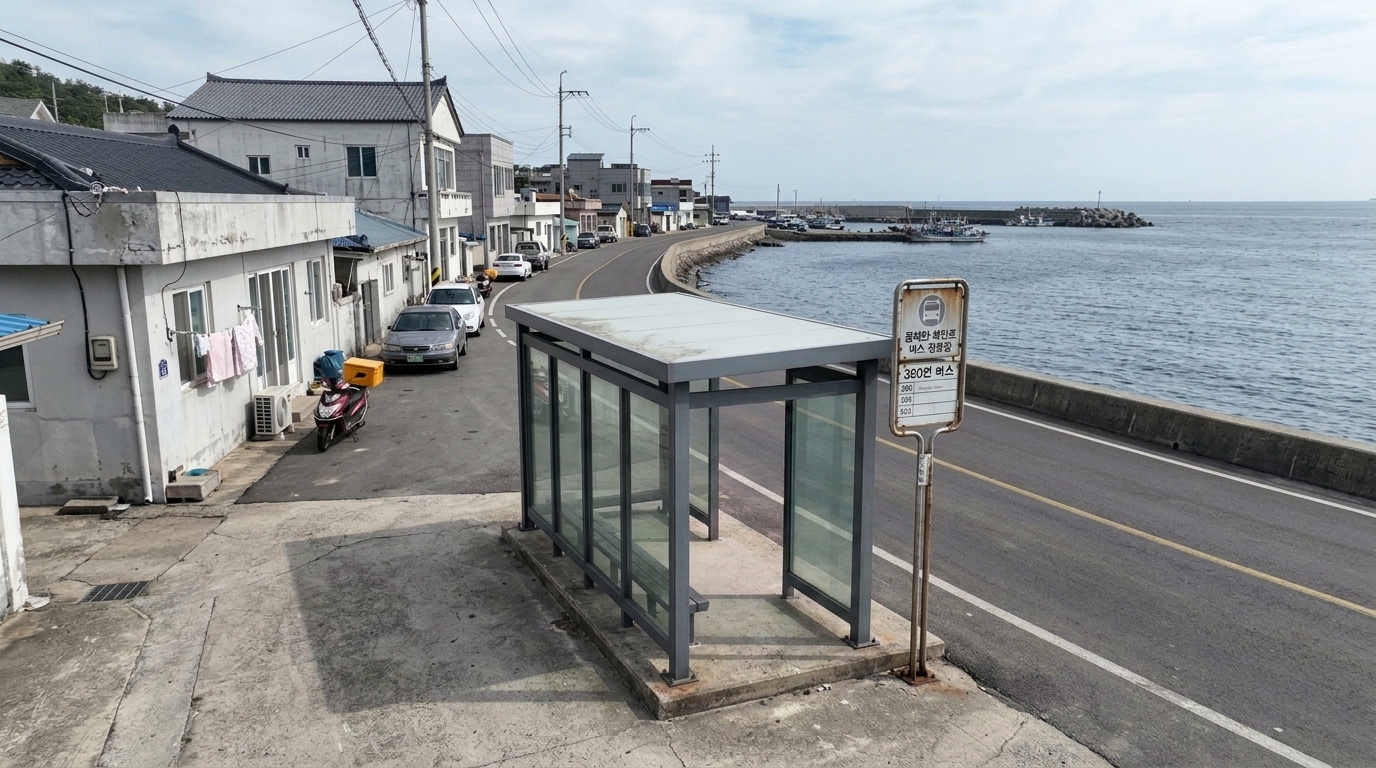
Every image must show the same compact one-storey rectangular coastal bus shelter beside a continuous worn dark-gray asphalt road in contemporary South Korea. The shelter has a flat pale-gray coated-metal roof, a dark-gray powder-coated steel frame, clear tempered-glass wind screens, one road-facing open entrance, and a gray concrete waiting pad, with mild salt fading and rain staining. An asphalt shoulder runs beside the road. The road continues past the stop, and the sea remains directly visible from the stop across the open seaward side of the road. The inland side belongs to an inhabited coastal village edge with ordinary low-rise off-white and pale-gray rendered concrete and masonry buildings under dark-gray roofs.

THE LOCATION: A coastal roadside bus stop at the inhabited edge of a South Korean seaside village, 2026.

SCENE TRANSIENTS — the items below belong to specific scripted
moments, not to the permanent place. Do not reproduce these particular
staged items or momentary states. This does not forbid the ordinary,
generic equivalents such a neighborhood would naturally show:
Bicycle presence on the coastal road; Purchased beverage; Thunderstorm and heavy rain; Earphones
| 롤 | 점수 | verdict |
|---|---|---|
| A | 7 | Misses the road-facing entrance constraint by placing the opening on the short side, but flawlessly realizes the coastal village setting, shelter materials, and excludes all requested transients. |
| B | 3 | Disqualified for Rule 1 hard violations (the right frame completely merges into the building wall behind it) and Rule 3 violations by including explicitly excluded purchased beverages (water bottles on the wall and ground). |
| C | 5 | Fails the road-facing entrance requirement similarly to A, but features excessive rust instead of mild fading and contains minor geometric errors with the bench protruding through the frame. |
ranking: ['A', 'C', 'B']
결함 검사(critique) → i2i 수정:
- 버스 정류장의 열린 입구가 도로 쪽이 아닌 내륙 건물 쪽을 향하고 있습니다. → Open the road-facing side of the bus shelter to create the entrance.
- 멀리 방파제 위에 사람의 형상이 작게 보입니다. → Remove the distant figures standing on the seawall.
원어 근거 인용:
“해안가 도로”
“해안도로를 자전거를 타고 바삐 집으로 달려가는”
“해안가. 버스정류장 부근”
“바다를 바라보며”
“해안가 / 소나기”
전체 롤 프롬프트(불변절 포함):
A location-scouting photograph for a live-action film — a real place,
found and chosen for shooting. The TARGET STRUCTURE described below is
the main subject, photographed from a slightly elevated three-quarter
view that shows its overall shape, faces and openings, and it stands
inside its real, lived-in neighborhood: the adjacent buildings, the
alley or street it belongs to, and the everyday surroundings such a
place naturally has. Never an isolated building on empty ground. This
image becomes the look authority (seed) for every later view of the
SAME structure, so render the exterior complete and real: no cutaway,
no floor-plan or room labels, no transparent enclosed surfaces, never
a drawing or diagram. Real materials, real weathering, and the
ordinary visual texture of a place where people actually live.

An inhabited South Korean coastal village edge extends along the inland side of a continuous waterfront road. Ordinary low-rise off-white and pale-gray rendered concrete and masonry buildings with dark-gray roofs establish a working neighborhood. The sea is directly beside the open seaward side of the worn dark-gray asphalt road and remains visible from the roadside stop. A compact one-storey rectangular bus shelter stands on a gray concrete waiting pad directly beside the asphalt shoulder. It has a flat pale-gray coated-metal roof, a dark-gray powder-coated steel frame, clear tempered-glass wind screens, and one road-facing open entrance. Mild salt fading and rain staining mark the metal and concrete. The road passes continuously beyond the distinct stop area.

THE LOCATION: A coastal roadside bus stop at the inhabited edge of a South Korean seaside village, 2026.

SCENE TRANSIENTS — the items below belong to specific scripted
moments, not to the permanent place. Do not reproduce these particular
staged items or momentary states. This does not forbid the ordinary,
generic equivalents such a neighborhood would naturally show:
Bicycle presence on the coastal road; Purchased beverage; Thunderstorm and heavy rain; Earphones

CLEAN PLATE RULES: no people and no animals anywhere in frame. Do not
stage any scripted moment — no doors held open for a scene, no
interior lights implying someone mid-scene, no picture vehicles or
props arranged for action. Generic, everyday signs of habitation that
any such neighborhood would naturally show are welcome — leave their
selection to the image itself, exactly as a scout would find the
place on an ordinary day.
원어 근거 인용:
“해안가 도로 / D”
“해안가 / N”
“해안가. 버스정류장 부근 / N”
“바다를 바라보며”
전체 롤 프롬프트(불변절 포함):
A location-scouting photograph for a live-action film — a real place,
found and chosen for shooting. The TARGET STRUCTURE described below is
the main subject, photographed from a slightly elevated three-quarter
view that shows its overall shape, faces and openings, and it stands
inside its real, lived-in neighborhood: the adjacent buildings, the
alley or street it belongs to, and the everyday surroundings such a
place naturally has. Never an isolated building on empty ground. This
image becomes the look authority (seed) for every later view of the
SAME structure, so render the exterior complete and real: no cutaway,
no floor-plan or room labels, no transparent enclosed surfaces, never
a drawing or diagram. Real materials, real weathering, and the
ordinary visual texture of a place where people actually live.

A lived-in coastal village neighborhood occupies the inland edge of this South Korean waterfront route. Its ordinary low-rise buildings are off-white and pale-gray rendered concrete and masonry with dark-gray roofs. A worn dark-gray asphalt road continues through the site, with an asphalt shoulder and an unobstructed open side facing the adjacent sea. The bus stop forms a separate gray concrete waiting area directly connected to the roadside. Its target shelter is a compact rectangular one-storey structure with a flat pale-gray coated-metal roof, dark-gray powder-coated steel framing, clear tempered-glass wind screens, and exactly one open entrance facing the road. The finish shows restrained salt fading and rain staining. The sea is plainly visible from the shelter, and the road continues past it in both directions.

THE LOCATION: A coastal roadside bus stop at the inhabited edge of a South Korean seaside village, 2026.

SCENE TRANSIENTS — the items below belong to specific scripted
moments, not to the permanent place. Do not reproduce these particular
staged items or momentary states. This does not forbid the ordinary,
generic equivalents such a neighborhood would naturally show:
Bicycle presence on the coastal road; Purchased beverage; Thunderstorm and heavy rain; Earphones

CLEAN PLATE RULES: no people and no animals anywhere in frame. Do not
stage any scripted moment — no doors held open for a scene, no
interior lights implying someone mid-scene, no picture vehicles or
props arranged for action. Generic, everyday signs of habitation that
any such neighborhood would naturally show are welcome — leave their
selection to the image itself, exactly as a scout would find the
place on an ordinary day.
원어 근거 인용:
“해안도로”
“버스정류장 부근”
“바다를 바라보며”
“잔뜩 낀 먹구름이 세찬 비를 뿌린다”
전체 롤 프롬프트(불변절 포함):
A location-scouting photograph for a live-action film — a real place,
found and chosen for shooting. The TARGET STRUCTURE described below is
the main subject, photographed from a slightly elevated three-quarter
view that shows its overall shape, faces and openings, and it stands
inside its real, lived-in neighborhood: the adjacent buildings, the
alley or street it belongs to, and the everyday surroundings such a
place naturally has. Never an isolated building on empty ground. This
image becomes the look authority (seed) for every later view of the
SAME structure, so render the exterior complete and real: no cutaway,
no floor-plan or room labels, no transparent enclosed surfaces, never
a drawing or diagram. Real materials, real weathering, and the
ordinary visual texture of a place where people actually live.

The site is part of an inhabited contemporary South Korean coastal settlement, with ordinary low-rise off-white and pale-gray rendered concrete and masonry buildings under dark-gray roofs on the inland side. Beside them, a continuous worn dark-gray asphalt coastal road and asphalt shoulder follow the adjacent sea. The target is one compact one-storey rectangular roadside bus shelter set on a gray concrete pad. A dark-gray powder-coated steel frame supports a flat pale-gray coated-metal roof and clear tempered-glass wind screens; one road-facing entrance is open. Coastal salt has lightly faded the coating, and normal rain runoff has stained the concrete without making the stop look abandoned. The waiting pad connects directly to the road, the route continues beyond the shelter, and the sea remains visible across the road's open seaward side.

THE LOCATION: A coastal roadside bus stop at the inhabited edge of a South Korean seaside village, 2026.

SCENE TRANSIENTS — the items below belong to specific scripted
moments, not to the permanent place. Do not reproduce these particular
staged items or momentary states. This does not forbid the ordinary,
generic equivalents such a neighborhood would naturally show:
Bicycle presence on the coastal road; Purchased beverage; Thunderstorm and heavy rain; Earphones

CLEAN PLATE RULES: no people and no animals anywhere in frame. Do not
stage any scripted moment — no doors held open for a scene, no
interior lights implying someone mid-scene, no picture vehicles or
props arranged for action. Generic, everyday signs of habitation that
any such neighborhood would naturally show are welcome — leave their
selection to the image itself, exactly as a scout would find the
place on an ordinary day.
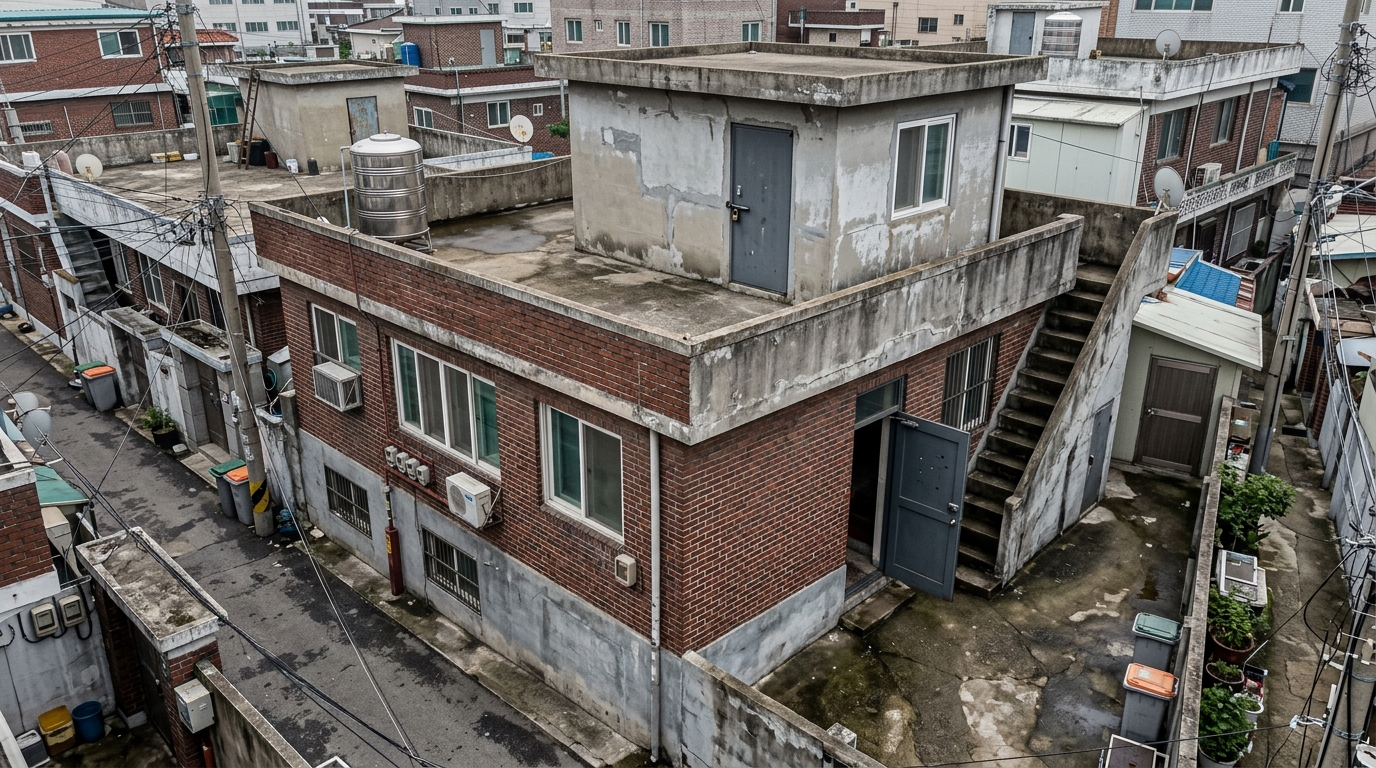
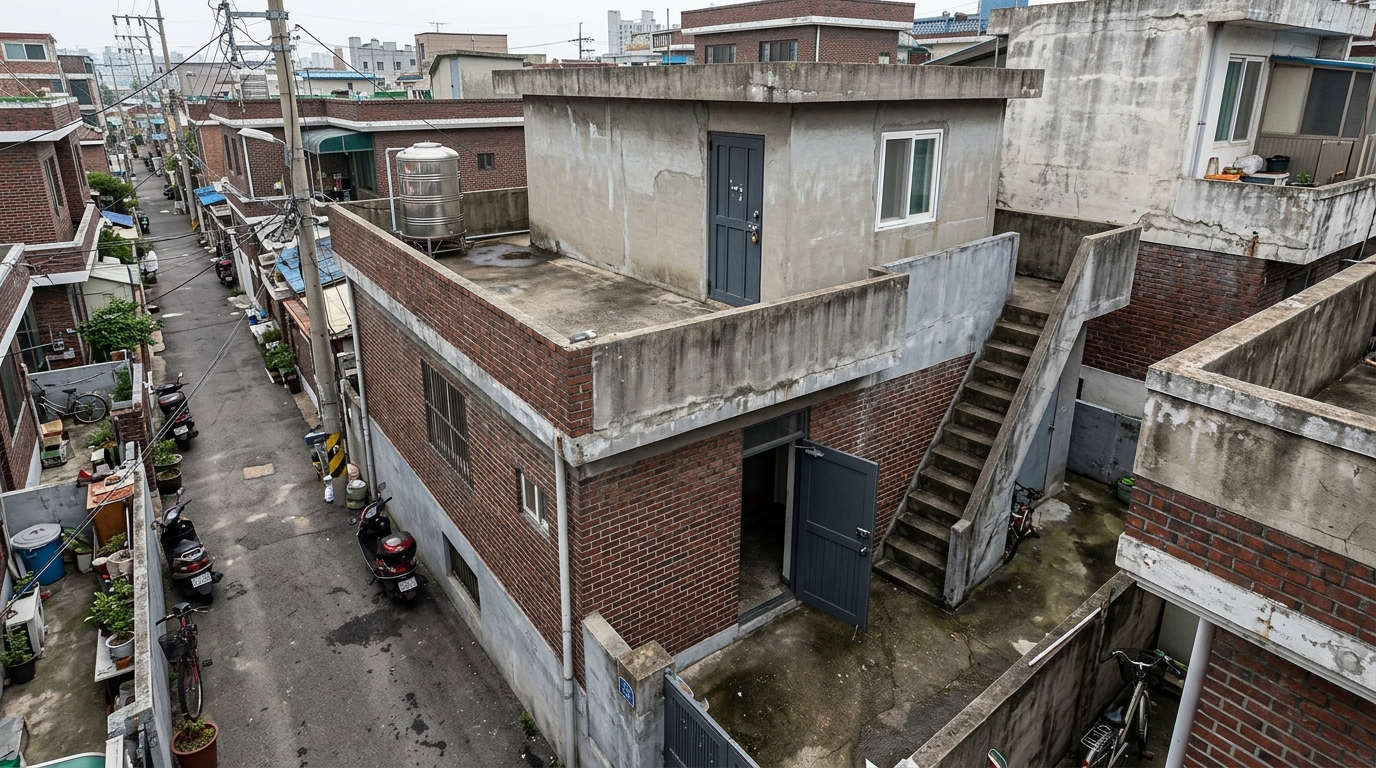
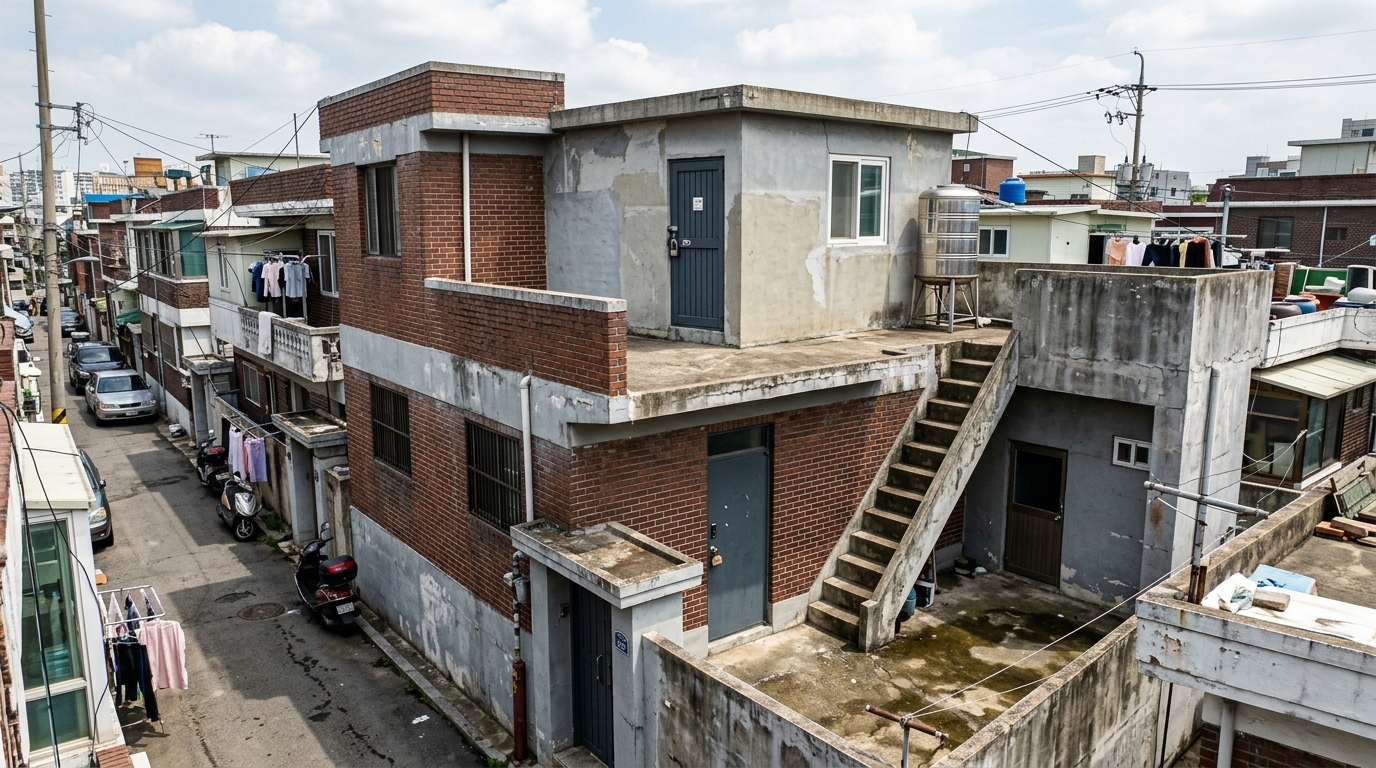
선정 = A location_line_en: An old multi-unit villa with a rooftop dwelling in an inhabited outer residential alley of Incheon, South Korea, in 2026.
SHARED CONFORMANCE BRIEF (invariant visual facts every candidate must satisfy):

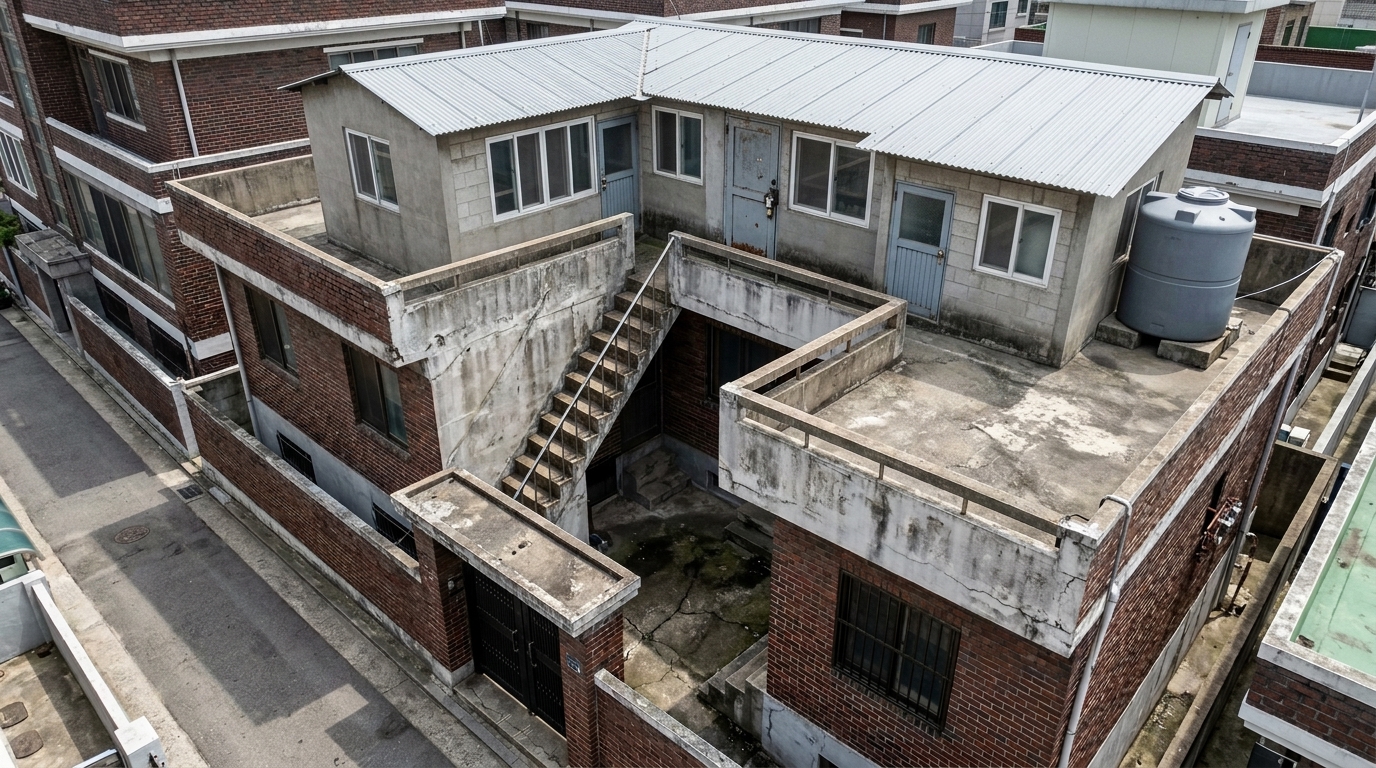
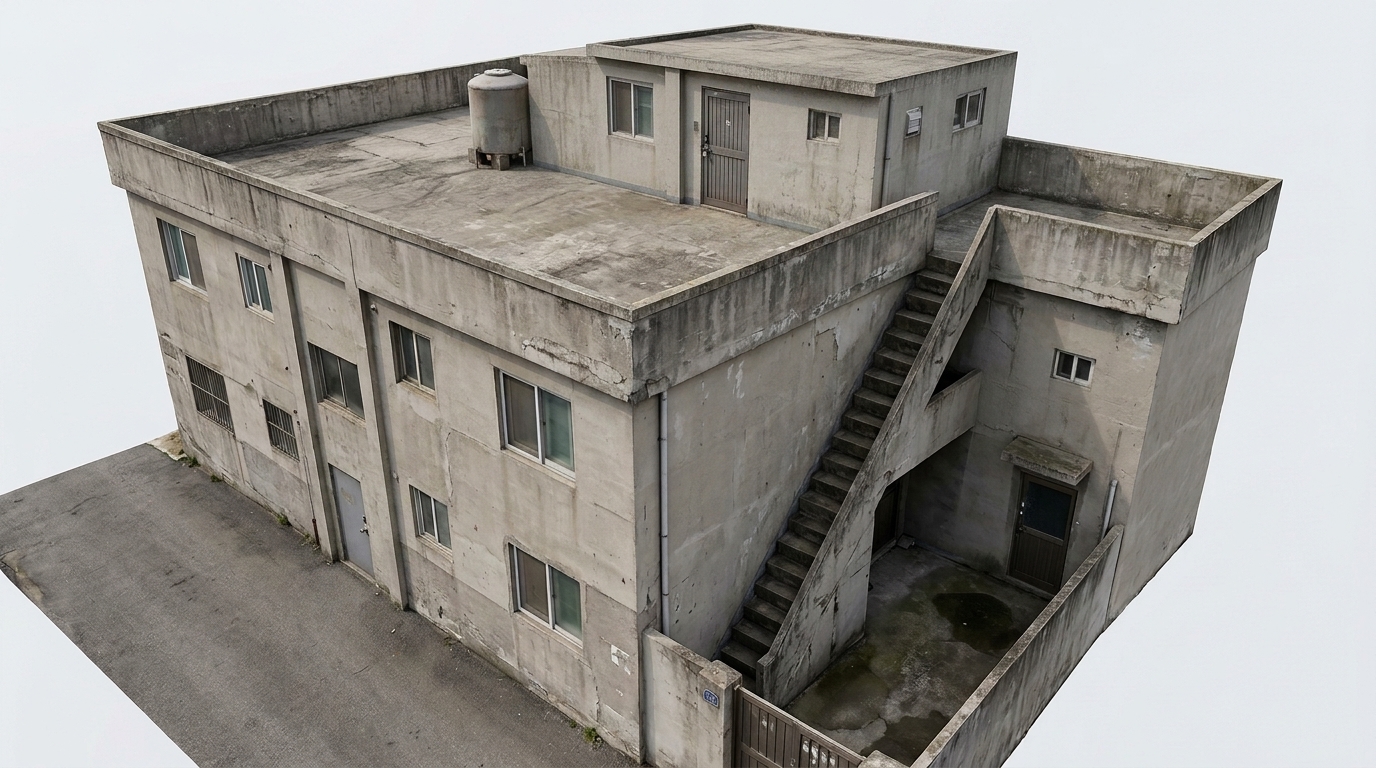
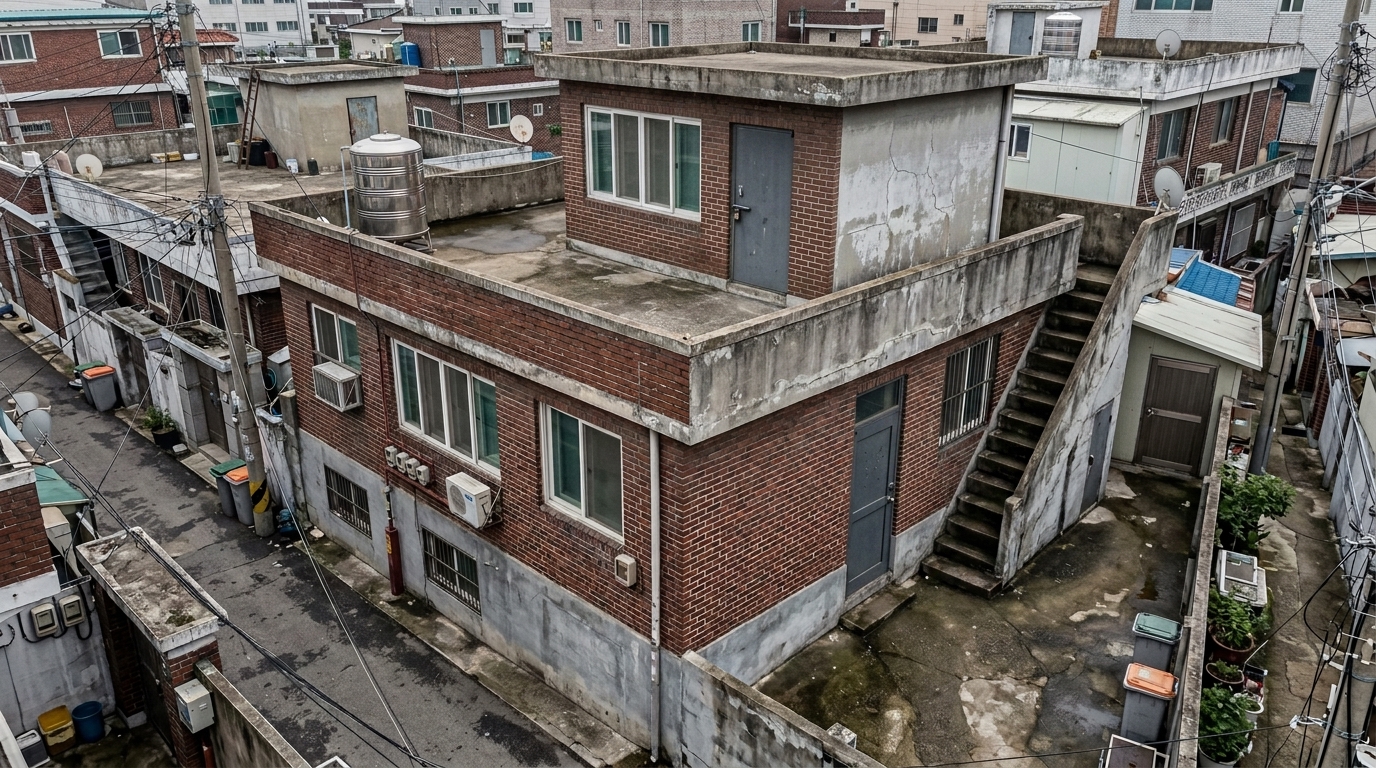
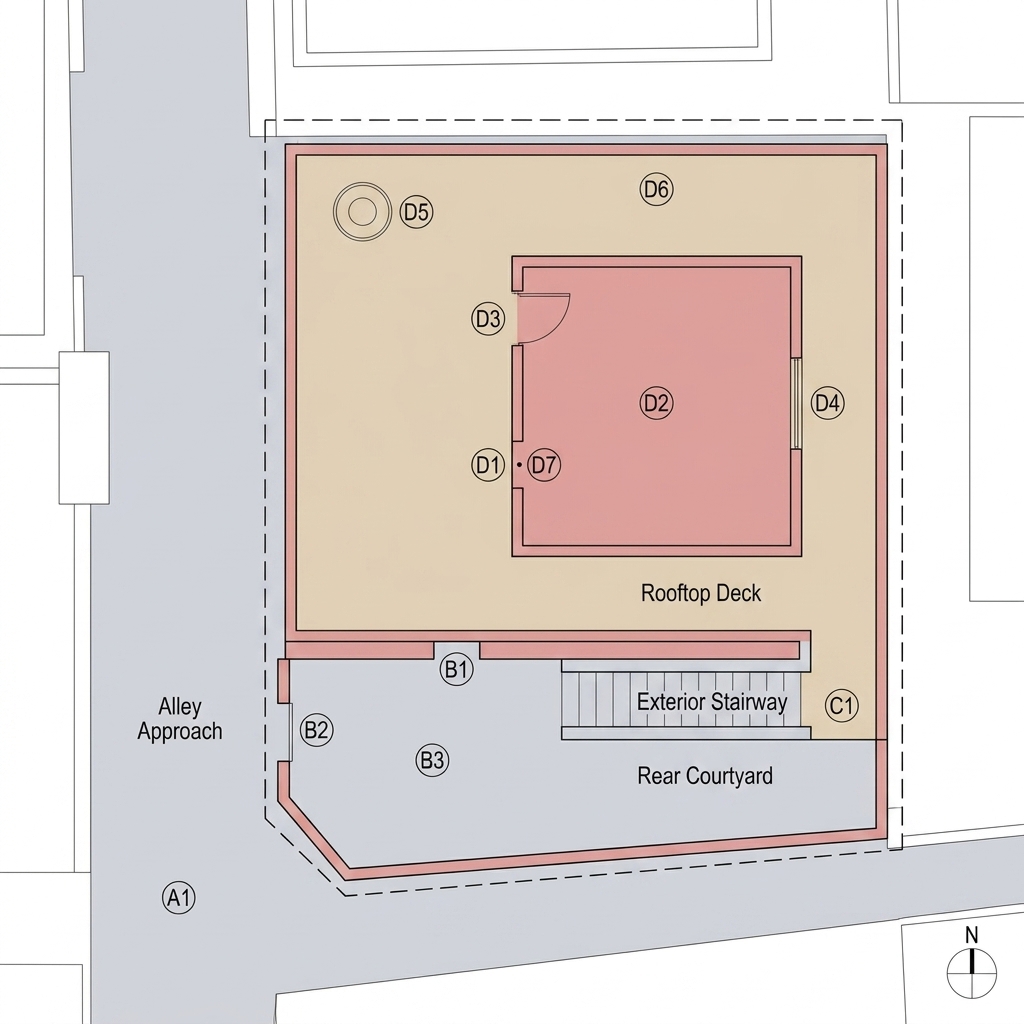
Every image must show the same old three-storey, box-shaped multi-unit villa in an inhabited outer-Incheon residential alley in 2026. The villa has faded reddish-brown brick veneer, a gray concrete base, and a flat reinforced-concrete rooftop deck. One dark gray painted-steel entrance door connects the alley directly to a damp rear concrete courtyard. A narrow, steep exterior concrete stairway rises from that courtyard to the rooftop deck. A compact one-storey rooftop room has weathered light gray cement-rendered masonry walls and a flat concrete roof, exactly one dark gray iron entrance door with a mounted metal lock, and exactly one white aluminum-framed exterior window on another wall. A stainless-steel water tank stands on the deck. A weathered gray concrete boundary wall follows an outer deck edge within the window's sightline. The target must remain surrounded by a believable, currently inhabited low-rise working neighborhood.

THE LOCATION: An old multi-unit villa with a rooftop dwelling in an inhabited outer residential alley of Incheon, South Korea, in 2026.

SCENE TRANSIENTS — the items below belong to specific scripted
moments, not to the permanent place. Do not reproduce these particular
staged items or momentary states. This does not forbid the ordinary,
generic equivalents such a neighborhood would naturally show:
bicycle in the rear courtyard; car outside the stair area; clothesline on the rooftop; wooden platform on the rooftop; dried sweet flag on the platform; advertising flyer in the entrance-door gap; half-open state of the rooftop-room entrance door; illuminated state of the rooftop room; black cat at the boundary wall
| 롤 | 점수 | verdict |
|---|---|---|
| A | 7 | 모든 제외 요소를 성공적으로 배제하고 옥탑방 창문을 다른 벽면에 정확히 배치하여 지시문을 가장 잘 준수함. |
| B | 5 | 마당 계단 아래에 명시적으로 제외 대상인 자전거가 묘사되어 지시문(제외 요소)을 위반함. |
| C | 4 | 옥탑방의 출입문과 창문이 같은 벽면에 배치되었고 콘크리트 경계벽 대신 벽돌을 사용하여 구조 지시를 위반함. |
ranking: ['A', 'B', 'C']
결함 검사(critique) → i2i 수정:
- 건물 본체가 3층이 아닌 2층(콘크리트 기단 1층, 벽돌 1층)으로 묘사되어 있습니다. → Add one more brick storey to the main building to make it a three-storey villa.
- 옥탑방의 창문이 출입문과 다른 벽면이 아닌 동일한 벽면에 배치되어 있습니다. → Move the white aluminum-framed window to a different exterior wall of the rooftop room.
- 1층 안마당 쪽 짙은 회색 출입문이 활짝 열려 있어, 연출된 상황을 배제하는 클린 플레이트 규칙을 위반했습니다. → Close the open dark gray door on the ground floor.
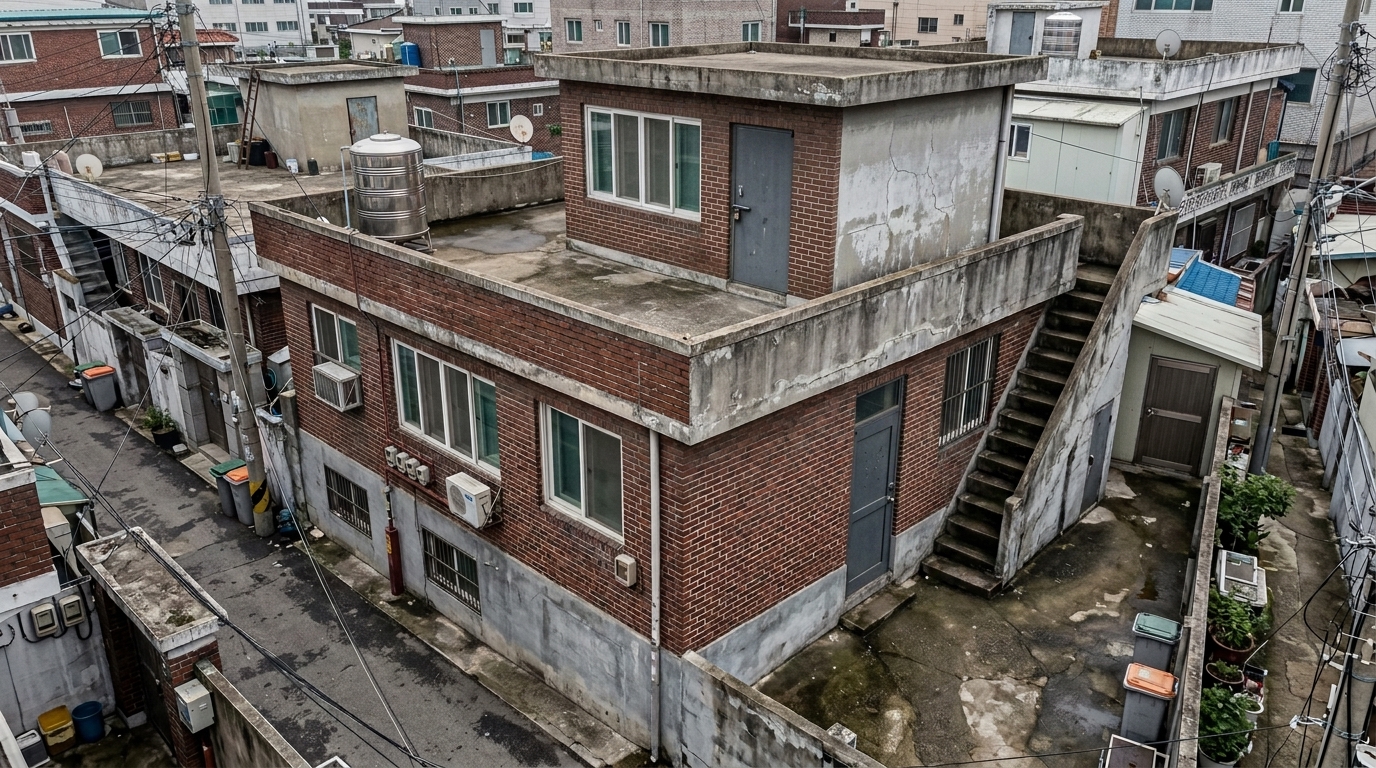
원어 근거 인용:
“인천 변두리 부감, 오래된 빌라 옥탑방 전경.”
“옥탑방 옥상. 물탱크.”
“옥탑방 철문 현관”
“창문”
“골목길”
“다세대 빌라 문”
“마당 후미진 곳”
“옥탑방과 연결되는 계단”
“담”
전체 롤 프롬프트(불변절 포함):
A location-scouting photograph for a live-action film — a real place,
found and chosen for shooting. The TARGET STRUCTURE described below is
the main subject, photographed from a slightly elevated three-quarter
view that shows its overall shape, faces and openings, and it stands
inside its real, lived-in neighborhood: the adjacent buildings, the
alley or street it belongs to, and the everyday surroundings such a
place naturally has. Never an isolated building on empty ground. This
image becomes the look authority (seed) for every later view of the
SAME structure, so render the exterior complete and real: no cutaway,
no floor-plan or room labels, no transparent enclosed surfaces, never
a drawing or diagram. Real materials, real weathering, and the
ordinary visual texture of a place where people actually live.

An inhabited working residential alley in outer Incheon surrounds the property, with ordinary closely spaced low-rise neighborhood buildings typical of South Korea in 2026. The narrow worn-asphalt alley leads to an old three-storey, box-shaped multi-unit villa faced in faded reddish-brown brick over a gray concrete base. A single dark gray painted-steel villa entrance door opens from the alley into a damp rear courtyard paved in worn gray concrete. A narrow, steep exterior concrete stairway begins beside the rear courtyard and rises to the flat reinforced-concrete rooftop deck. A compact one-storey rooftop room stands on the deck, with weathered light gray cement-rendered masonry walls and a flat concrete roof. Its deck-facing entrance is exactly one dark gray iron door with a mounted metal lock; exactly one white aluminum-framed window occupies another exterior wall. A stainless-steel water tank stands on the surrounding deck. A weathered gray concrete boundary wall follows one outer deck edge and remains directly visible from the rooftop-room window. Patched cement, water staining, faded paint, and minor rust show long use without abandonment.

THE LOCATION: An old multi-unit villa with a rooftop dwelling in an inhabited outer residential alley of Incheon, South Korea, in 2026.

SCENE TRANSIENTS — the items below belong to specific scripted
moments, not to the permanent place. Do not reproduce these particular
staged items or momentary states. This does not forbid the ordinary,
generic equivalents such a neighborhood would naturally show:
bicycle in the rear courtyard; car outside the stair area; clothesline on the rooftop; wooden platform on the rooftop; dried sweet flag on the platform; advertising flyer in the entrance-door gap; half-open state of the rooftop-room entrance door; illuminated state of the rooftop room; black cat at the boundary wall

CLEAN PLATE RULES: no people and no animals anywhere in frame. Do not
stage any scripted moment — no doors held open for a scene, no
interior lights implying someone mid-scene, no picture vehicles or
props arranged for action. Generic, everyday signs of habitation that
any such neighborhood would naturally show are welcome — leave their
selection to the image itself, exactly as a scout would find the
place on an ordinary day.
원어 근거 인용:
“인천 변두리”
“오래된 빌라 옥탑방 전경”
“골목길”
“다세대 빌라 문”
“마당 후미진 곳”
“옥상에 올라와 보니”
“현관 철문”
전체 롤 프롬프트(불변절 포함):
A location-scouting photograph for a live-action film — a real place,
found and chosen for shooting. The TARGET STRUCTURE described below is
the main subject, photographed from a slightly elevated three-quarter
view that shows its overall shape, faces and openings, and it stands
inside its real, lived-in neighborhood: the adjacent buildings, the
alley or street it belongs to, and the everyday surroundings such a
place naturally has. Never an isolated building on empty ground. This
image becomes the look authority (seed) for every later view of the
SAME structure, so render the exterior complete and real: no cutaway,
no floor-plan or room labels, no transparent enclosed surfaces, never
a drawing or diagram. Real materials, real weathering, and the
ordinary visual texture of a place where people actually live.

This is a currently inhabited outer-Incheon neighborhood of older low-rise villas and modest residential buildings, arranged along a narrow worn-asphalt alley with the ordinary density and upkeep of South Korea in 2026. The main property is a definite three-storey rectangular multi-unit villa with faded reddish-brown brick veneer, a gray concrete base, and a flat reinforced-concrete roof deck. One dark gray painted-steel entrance door connects the alley to a worn, damp gray-concrete rear courtyard. From the courtyard, one narrow and steep exterior concrete stairway climbs directly to the rooftop deck. The deck surrounds a compact single-storey rooftop dwelling built of weathered light gray cement-rendered masonry beneath a flat concrete roof. The dwelling has exactly one dark gray iron entrance door facing the deck, with a metal lock mounted on it, and exactly one white aluminum-framed window on a different exterior wall. A stainless-steel water tank occupies the open deck area. A gray concrete boundary wall runs along an outer edge of the deck within a direct sightline from the window. Subdued repairs, moisture marks, worn cement, and localized rust make the property old but actively maintained.

THE LOCATION: An old multi-unit villa with a rooftop dwelling in an inhabited outer residential alley of Incheon, South Korea, in 2026.

SCENE TRANSIENTS — the items below belong to specific scripted
moments, not to the permanent place. Do not reproduce these particular
staged items or momentary states. This does not forbid the ordinary,
generic equivalents such a neighborhood would naturally show:
bicycle in the rear courtyard; car outside the stair area; clothesline on the rooftop; wooden platform on the rooftop; dried sweet flag on the platform; advertising flyer in the entrance-door gap; half-open state of the rooftop-room entrance door; illuminated state of the rooftop room; black cat at the boundary wall

CLEAN PLATE RULES: no people and no animals anywhere in frame. Do not
stage any scripted moment — no doors held open for a scene, no
interior lights implying someone mid-scene, no picture vehicles or
props arranged for action. Generic, everyday signs of habitation that
any such neighborhood would naturally show are welcome — leave their
selection to the image itself, exactly as a scout would find the
place on an ordinary day.
원어 근거 인용:
“변두리의 오래된 다세대 주택 꼭대기 공간”
“낡은 시멘트 바닥”
“철문이 달린 작은 가건물(옥탑방) 외관”
“오래된 빌라 1층의 어둡고 습한 마당”
“옥상으로 이어지는 좁고 가파른 시멘트 외부 계단”
“물탱크”
전체 롤 프롬프트(불변절 포함):
A location-scouting photograph for a live-action film — a real place,
found and chosen for shooting. The TARGET STRUCTURE described below is
the main subject, photographed from a slightly elevated three-quarter
view that shows its overall shape, faces and openings, and it stands
inside its real, lived-in neighborhood: the adjacent buildings, the
alley or street it belongs to, and the everyday surroundings such a
place naturally has. Never an isolated building on empty ground. This
image becomes the look authority (seed) for every later view of the
SAME structure, so render the exterior complete and real: no cutaway,
no floor-plan or room labels, no transparent enclosed surfaces, never
a drawing or diagram. Real materials, real weathering, and the
ordinary visual texture of a place where people actually live.

Faded reddish-brown brick, weathered gray concrete, light gray cement render, dark gray painted steel, white aluminum, and stainless steel define this old but inhabited 2026 Incheon property. It stands within a dense, ordinary working neighborhood of older low-rise housing along a narrow worn-asphalt alley. The target is a box-shaped three-storey multi-unit villa with brick-veneered elevations, a gray concrete base, and a flat reinforced-concrete rooftop deck. Its single alley entrance is a dark gray painted-steel door leading into a damp rear courtyard of worn gray concrete. A narrow, steep exterior concrete stairway rises from the courtyard to the rooftop deck. On the deck is one compact single-storey rooftop room with patched light gray cement-rendered masonry walls and a flat concrete roof. Exactly one dark gray iron entrance door opens toward the deck and carries a mounted metal lock. Exactly one white aluminum-framed window is set into another exterior wall. A stainless-steel water tank stands beside the rooftop exterior area. A weathered gray concrete boundary wall occupies one outer edge of the deck and stays visible from the rooftop-room window. Water streaks, faded coatings, patched render, and slight iron rust record sustained residential use rather than abandonment.

THE LOCATION: An old multi-unit villa with a rooftop dwelling in an inhabited outer residential alley of Incheon, South Korea, in 2026.

SCENE TRANSIENTS — the items below belong to specific scripted
moments, not to the permanent place. Do not reproduce these particular
staged items or momentary states. This does not forbid the ordinary,
generic equivalents such a neighborhood would naturally show:
bicycle in the rear courtyard; car outside the stair area; clothesline on the rooftop; wooden platform on the rooftop; dried sweet flag on the platform; advertising flyer in the entrance-door gap; half-open state of the rooftop-room entrance door; illuminated state of the rooftop room; black cat at the boundary wall

CLEAN PLATE RULES: no people and no animals anywhere in frame. Do not
stage any scripted moment — no doors held open for a scene, no
interior lights implying someone mid-scene, no picture vehicles or
props arranged for action. Generic, everyday signs of habitation that
any such neighborhood would naturally show are welcome — leave their
selection to the image itself, exactly as a scout would find the
place on an ordinary day.