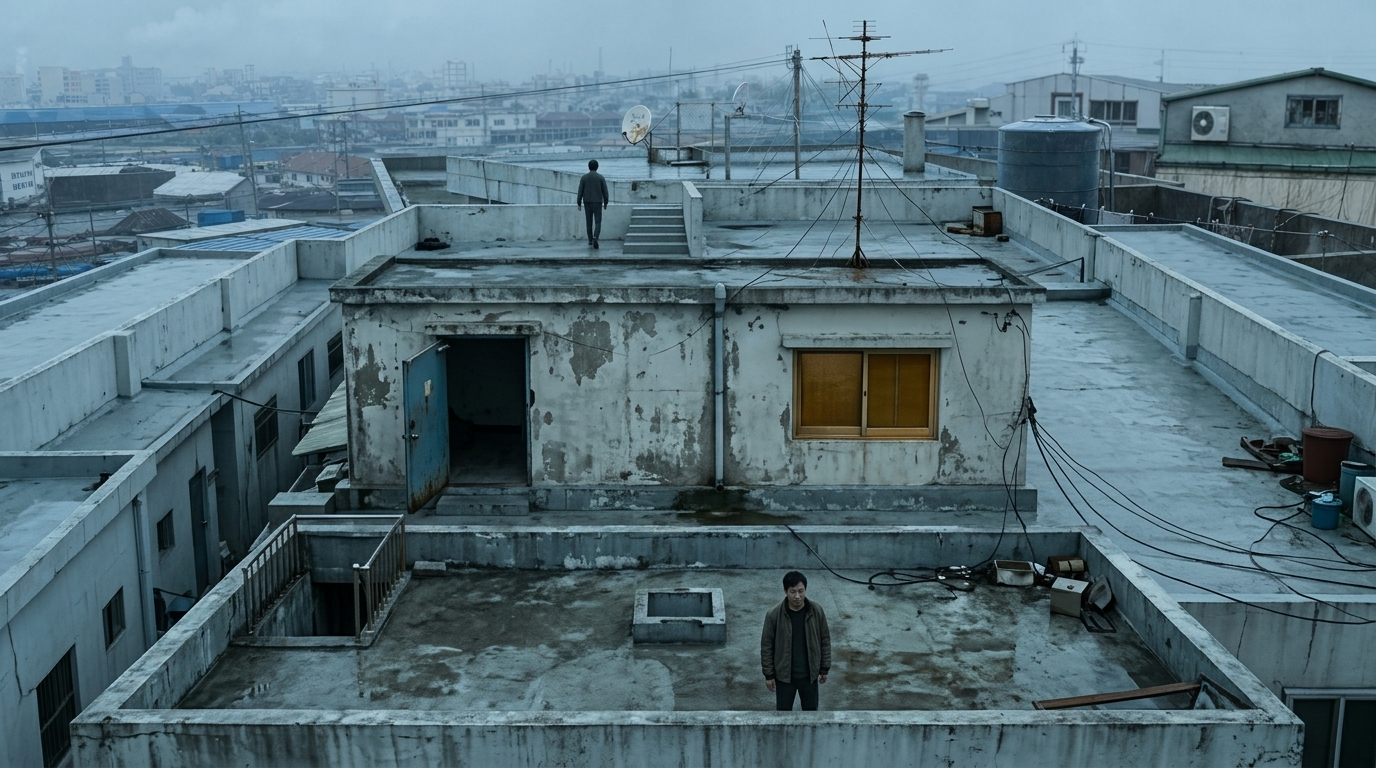
원본 최신 스틸 (기존 배경)
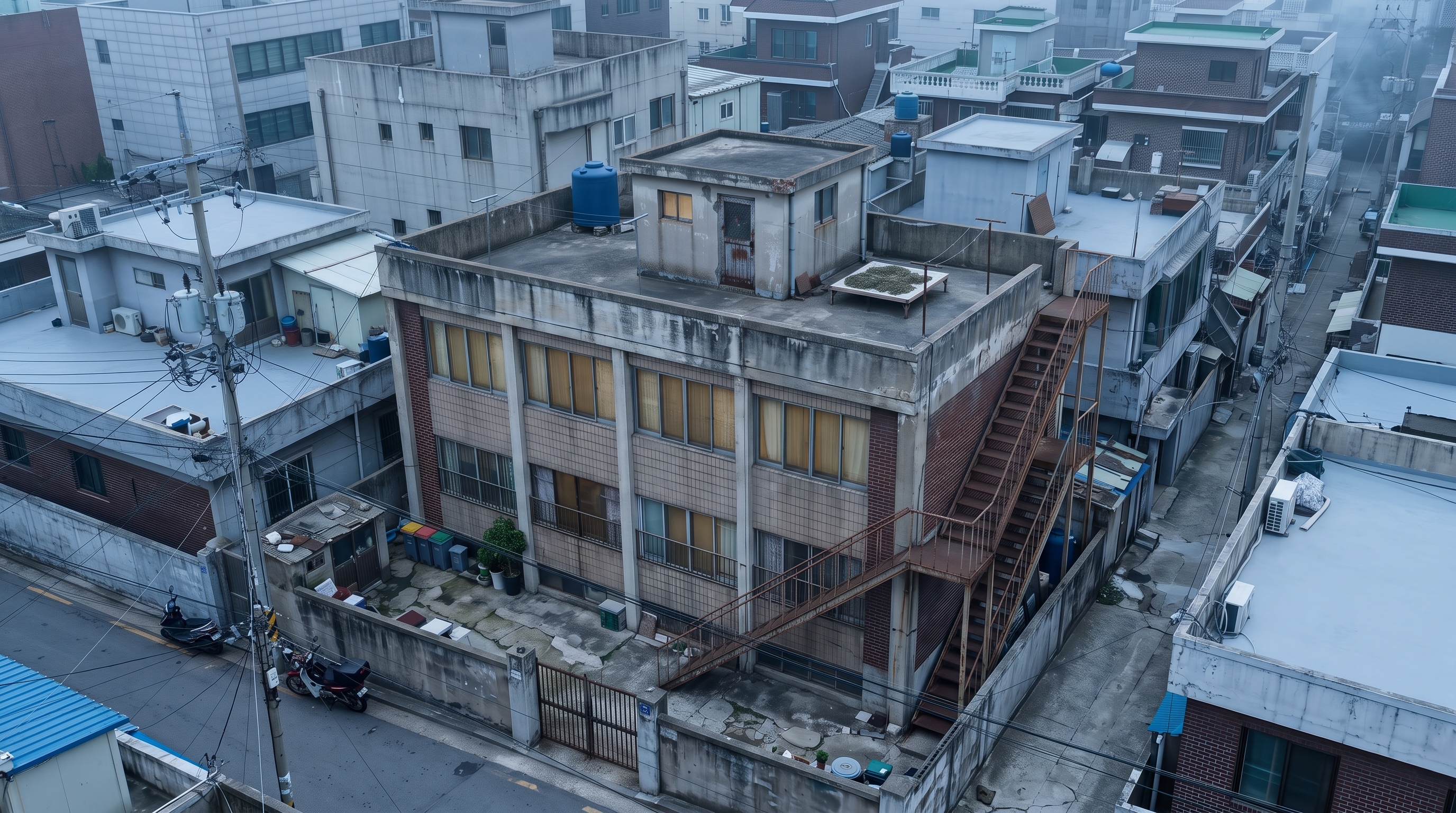
1차 remake (배경만 교체)
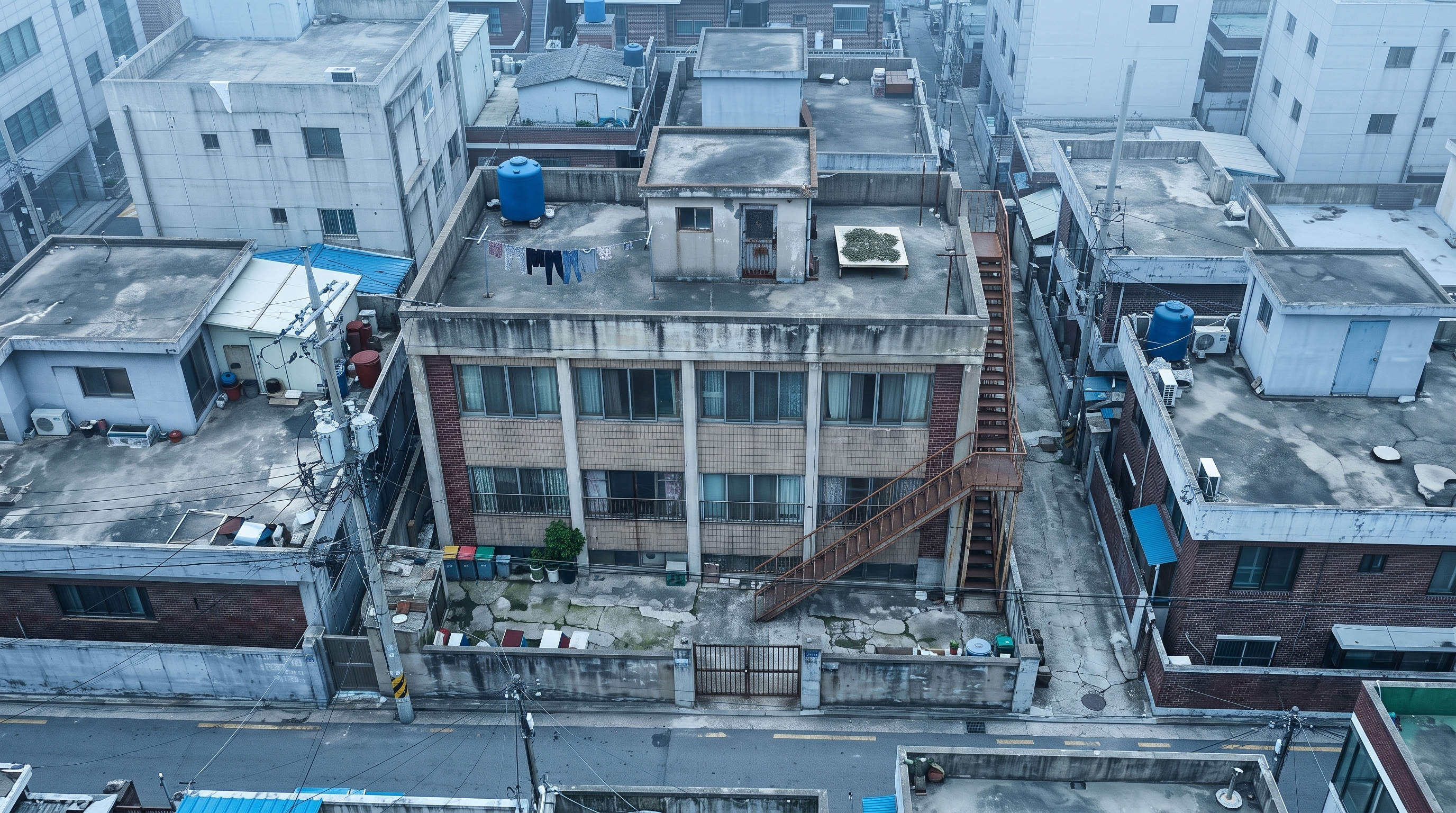
신규 (배경 교체 + blocking fp 참조)
3열: 좌=원본 최신 스틸 / 중=1차 remake(배경만 교체) / 우=신규(배경 교체+blocking fp 참조 추가, 프롬프트 불변 — 새 참조 의미는 라벨 텍스트 전달). staging 판단=LLM(gpt), 마커 부여·조립=코드. 매핑=plans/outdoor_blocking_fp.json
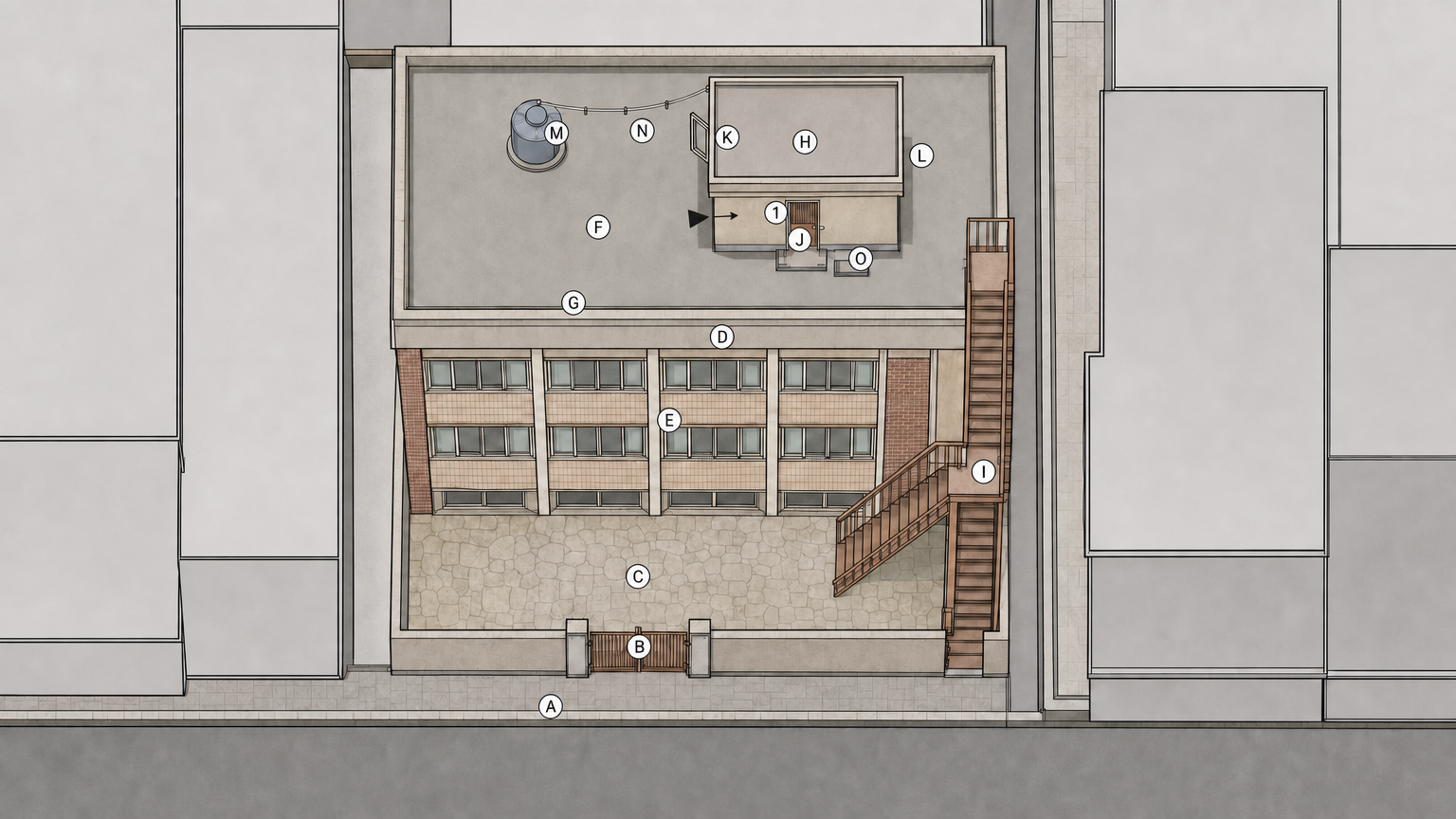
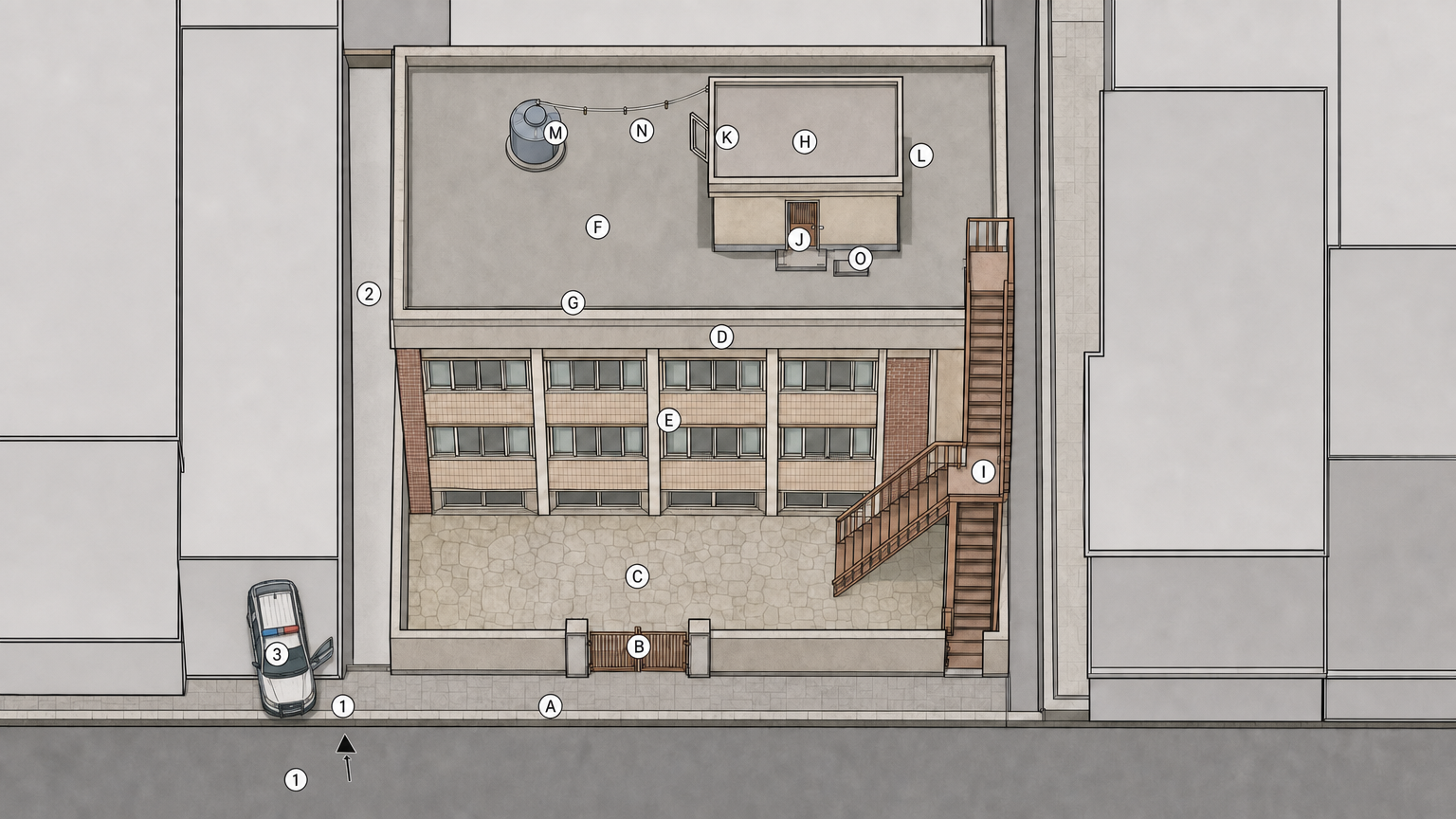
| 글자 | 요소 | 서술 |
|---|---|---|
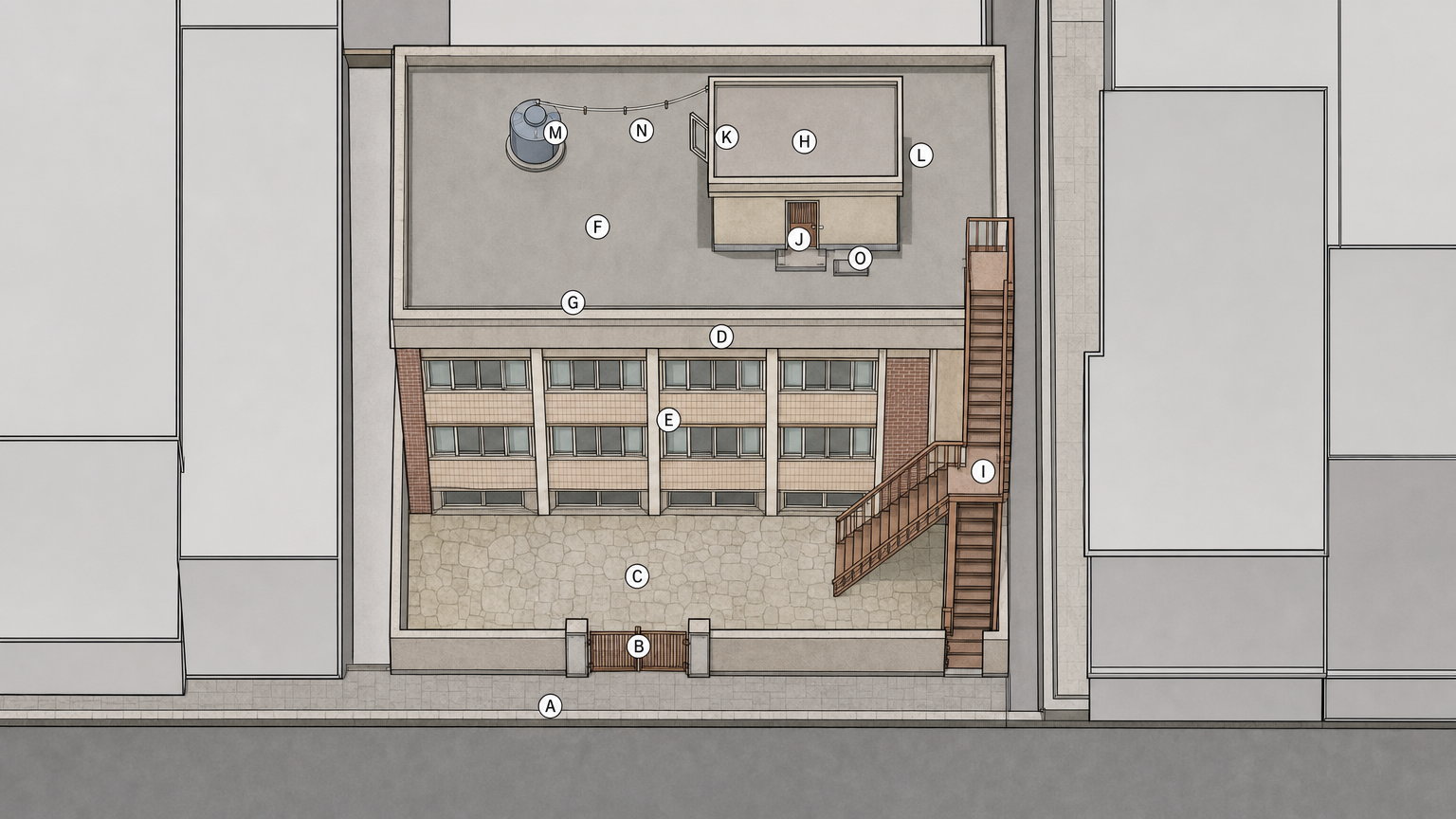
| A | narrow alley | 왼쪽에는 도로에서 빌라 입구까지 이어지는 좁은 세로 골목이 있다. |
| B | entry gate | 골목과 앞마당 사이에는 단일 빌라 입구 게이트가 있다. |
| C | entry yard | 빌라 앞에는 골목과 계단 사이에 작은 마당이 있다. |
| D | villa mass | 중앙에는 옥탑방을 올린 낡은 다세대 빌라 매스가 있다. |
| E | facade windows | 본관 앞마당 쪽 벽에는 전면 창 네 칸이 반복되어 있다. |
| F | roof terrace | 본관 지붕 위에는 옥탑방과 물탱크가 놓인 시멘트 바닥의 옥상 테라스가 있다. |
| G | low wall | 옥상 테라스 가장자리에는 낮은 콘크리트 담이 둘러져 있다. |
| H | rooftop room | 옥상 중앙에는 작은 옥탑 주거 공간의 외곽 매스가 놓여 있다. |
| I | added-on exterior stair | (LLM 최소 보완 요소) |
| J | iron door | 옥탑방 아래쪽 가장자리에는 계단 상부 랜딩을 향한 철문 현관이 있다. |
| K | living window | 옥탑방 오른쪽 외벽에는 작은 거실 창이 있다. |
| L | bedroom window | 옥탑방 위쪽 외벽에는 커튼이 달린 침실 창이 있다. |
| M | water tank | 옥상 왼쪽 뒤편에는 원형 물탱크가 놓여 있다. |
| N | laundry line | 물탱크와 옥탑방 사이에는 얇은 빨랫줄이 가로질러 걸려 있다. |
| O | low platform | 옥상 앞쪽에는 낮은 직사각형 평상이 놓여 있다. |
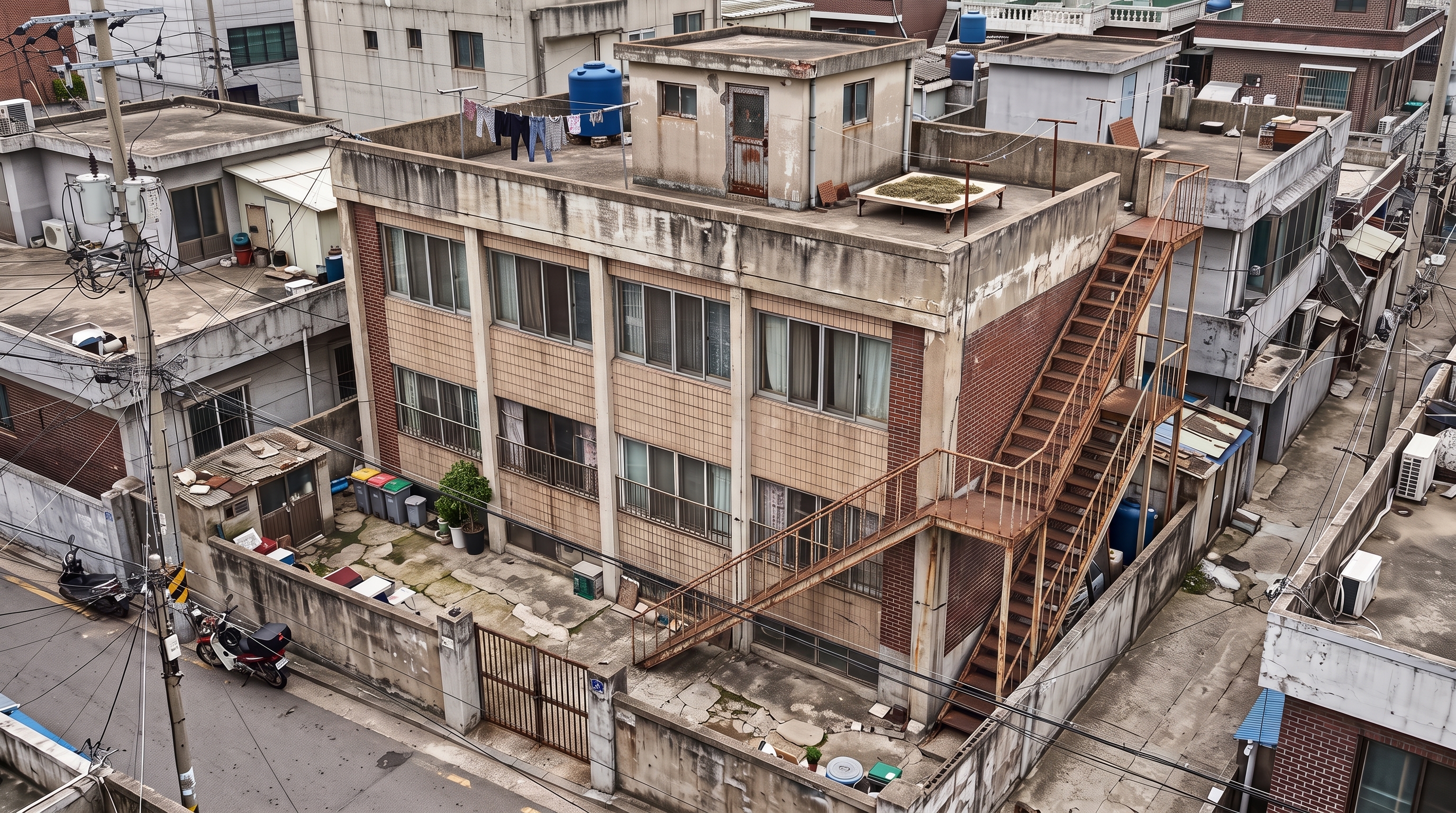
등장 인물·차량은 없고, 카메라는 빌라 옥상 D/F 위 높은 부감에서 옥탑방 H와 주변 옥상 전체를 내려다본다.
원본 최신 스틸 (기존 배경)
1차 remake (배경만 교체)
신규 (배경 교체 + blocking fp 참조)
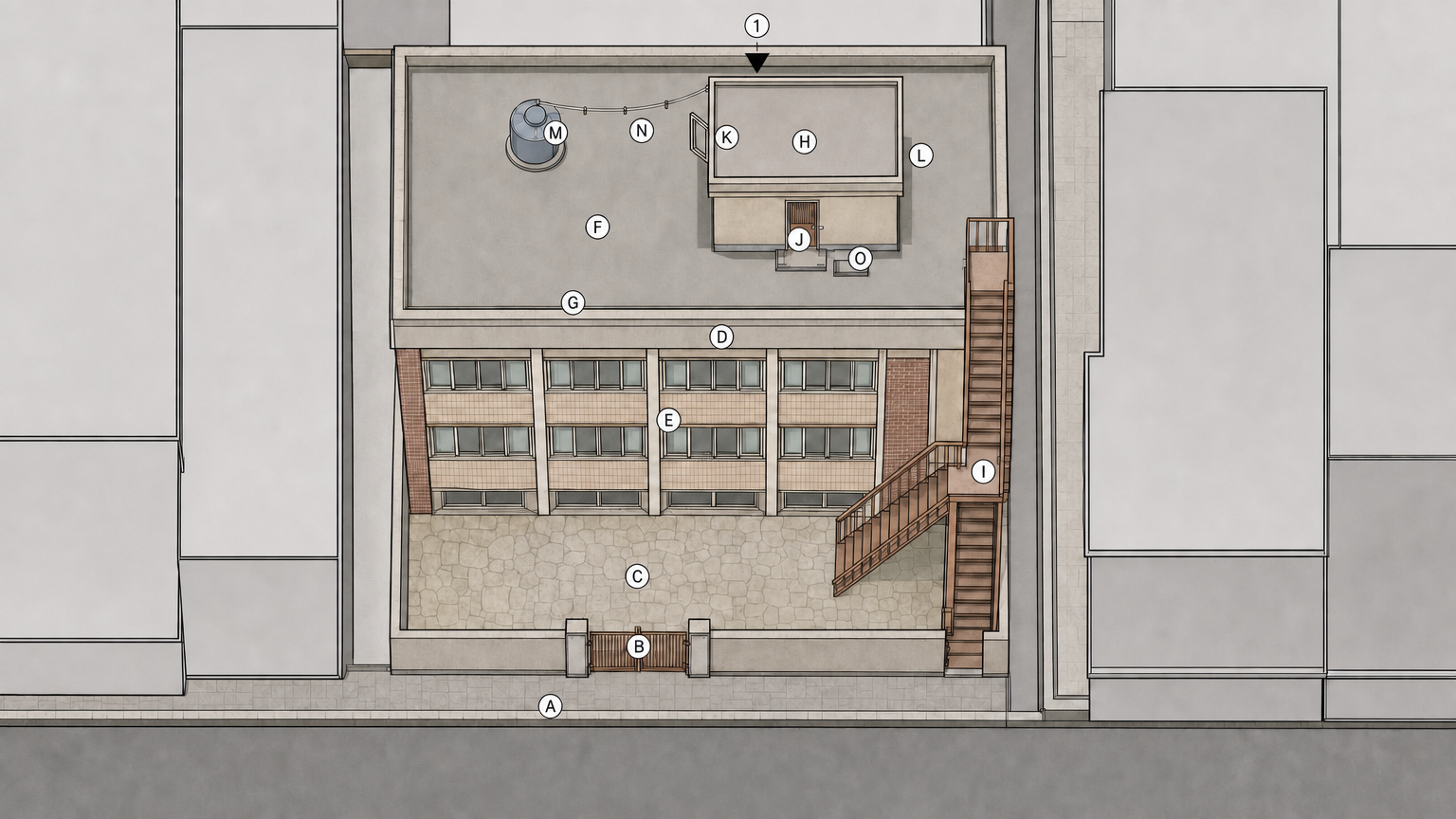
blocking fp — 엔티티(원형 숫자)+카메라(쐐기·화살표)
배경 참조 stairfix_nb2
⑯-2 원본 marked fp
| 마커 | 엔티티 | 배치(top-down) | 근거 인용 |
|---|---|---|---|
| 무인 샷 — 엔티티 없음 | |||
| ▲ | 카메라 (overhead, high above) | 위치: high above the villa mass D and roof terrace F, centered so rooftop room H sits middle-center 방향: straight down toward D/F, centered on H and surrounding rooftop fixtures |
“한눈에 내려다보이는 부감 구도”, “viewed from an omniscient overhead camera high above” |
The attached image is a strict top-down exterior SITE PLAN whose
elements are identified by small plain CIRCLED LETTER markers.
REPRODUCE the attached plan EXACTLY — same geometry, same colours,
same circled letters, nothing moved, nothing redrawn — and ADD ONLY
the shot-staging marks listed below.

CAMERA MARK:
- position: high above the villa mass D and roof terrace F, centered so rooftop room H sits middle-center
- facing: straight down toward D/F, centered on H and surrounding rooftop fixtures

Marker style: each added entity mark is a small plain CIRCLED DIGIT
(same graphic style as the existing circled letters), drawn once at
its stated position. The camera is ONE small solid dark wedge
(triangle) at its stated position with a short straight arrow showing
its facing direction. Apart from the existing circled letters, these
circled digits and the single camera wedge+arrow, add nothing: no
text, no words, no other markers, no legend, no compass, no people,
no objects.
Photorealistic cinematic still.

Reference image 1: pre-rendered BACKGROUND environment reference — layout/material/lighting identity

An old rooftop room sits in the middle-center midground, viewed from an omniscient overhead camera high above. The dilapidated building is centered in the wide frame, boxed in by a cramped grid of neighboring pale gray rooftops and narrow alleys. Daylight is overcast and desaturated, casting blue-gray concrete shadows across the worn roof tile and faded parapet. An aged water tank, a rusted antenna, and sagging cable lines dot the flat surface next to the stairwell. A thin, bluish damp urban haze softens the outskirts, while faint sickly amber stains on the window break the neighborhood's cold isolation.

Generate one image:
- use image 1 for this location's wall/floor/ceiling materials, furniture identity, and lighting mood
- follow the camera position, framing, and action requested in the prompt text — do NOT copy the camera position or composition of image 1 unless the prompt explicitly asks for it
- do NOT copy any people from image 1
- architectural openings (doors, windows, thresholds) must match image 1 — same position, type, and material; do NOT invent additional doors or windows unless the prompt text explicitly asks for them
- if the prompt text places the camera inside or at one of these openings, camera-side walls and door/window frames may appear only as local foreground edges — do NOT show the same opening again in the scene, and do NOT show the exterior facade of the structure that contains the camera out in front of it
- do not copy poses or compositions from reference images
- do not alter character identities where their face is visible in the scene
- each character's clothing/outfit must match that character's appearance reference image EXACTLY; if any clothing wording in the text conflicts with the reference image, follow the reference image and ignore that wording
- only render what the scene description asks for — if only a hand or wrist is described, do NOT add the character's face
- CRITICAL: Only render what the scene description explicitly describes. If a character's face is visible in the scene, match it to the reference. If only a body part is shown, do NOT add the face.
- CRITICAL: Output exactly ONE single continuous photograph of ONE moment — never a panel grid, collage, contact sheet, split-screen, storyboard sheet, or multiple sub-frames inside one image.
- CRITICAL: Every person must be physically grounded and weight-bearing — in real contact with a supporting surface, with body weight visibly carried by that contact. For a figure caught mid-action (falling, stumbling, collapsing, jumping off something), render a physically plausible instant: joints bent, weight clearly transferring, at least one believable point of contact or support — never a rigid body hovering, tilted or suspended in mid-air without support.

--- ref labels ---
[
 "background chain ref (L03B02 for L03) — match wall/floor/ceiling/lighting",
 "shot STAGING PLAN (top-down diagram of this same location — annotation only: NEVER draw or copy this diagram, its flat colours, markers or top-down view into the photograph): circled letters = structure identifiers; each circled digit = where that on-screen character/entity stands; the single dark wedge with arrow = the camera's position and facing direction for THIS shot. Use it only to place subjects and the camera consistently with the prompt text."
]
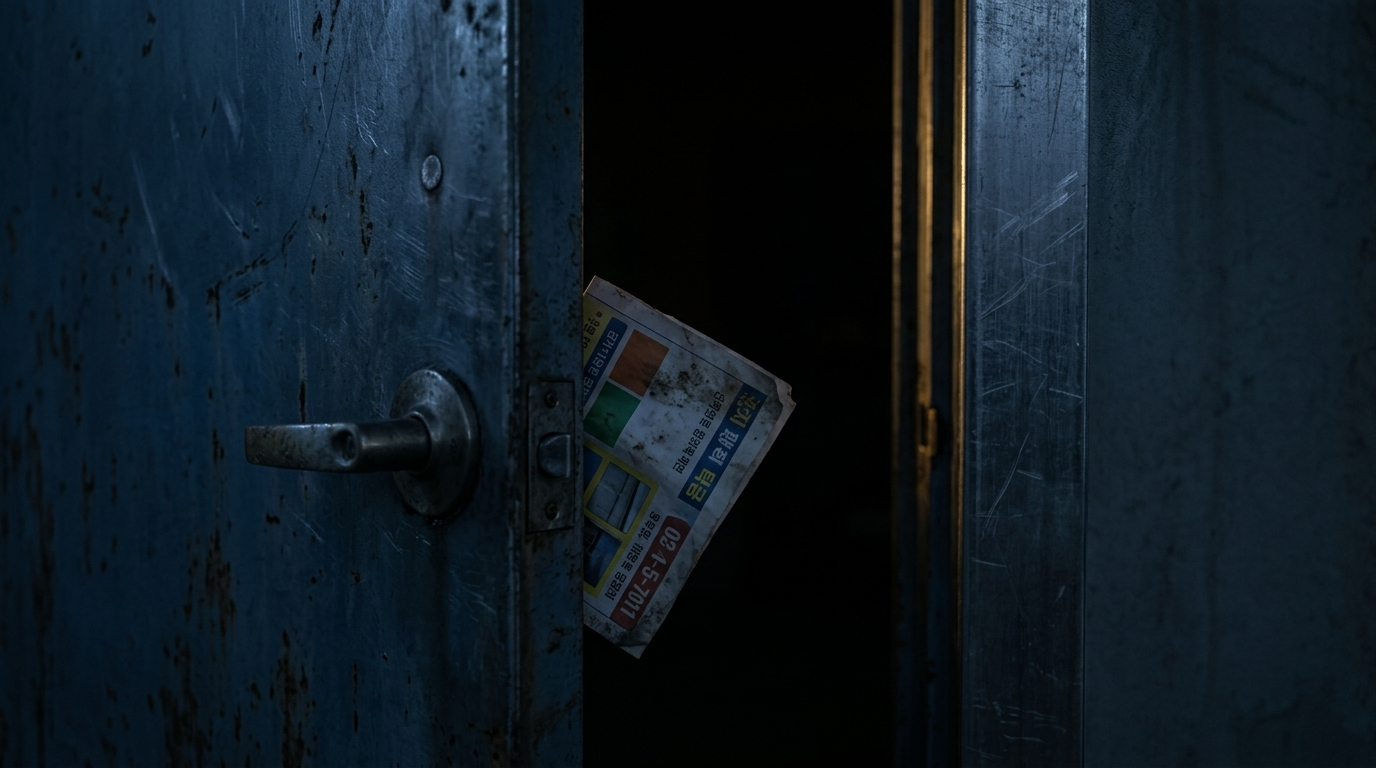
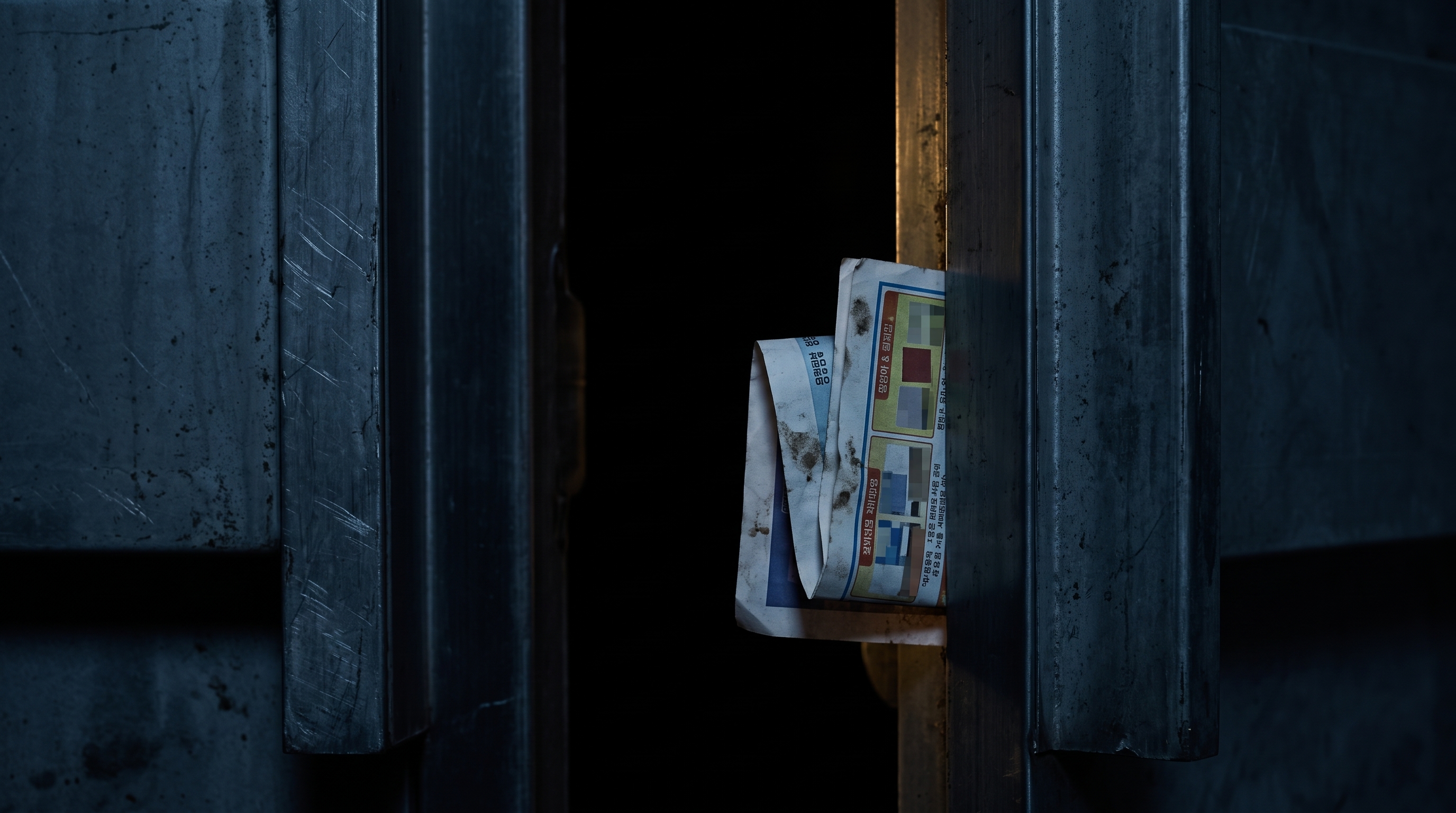
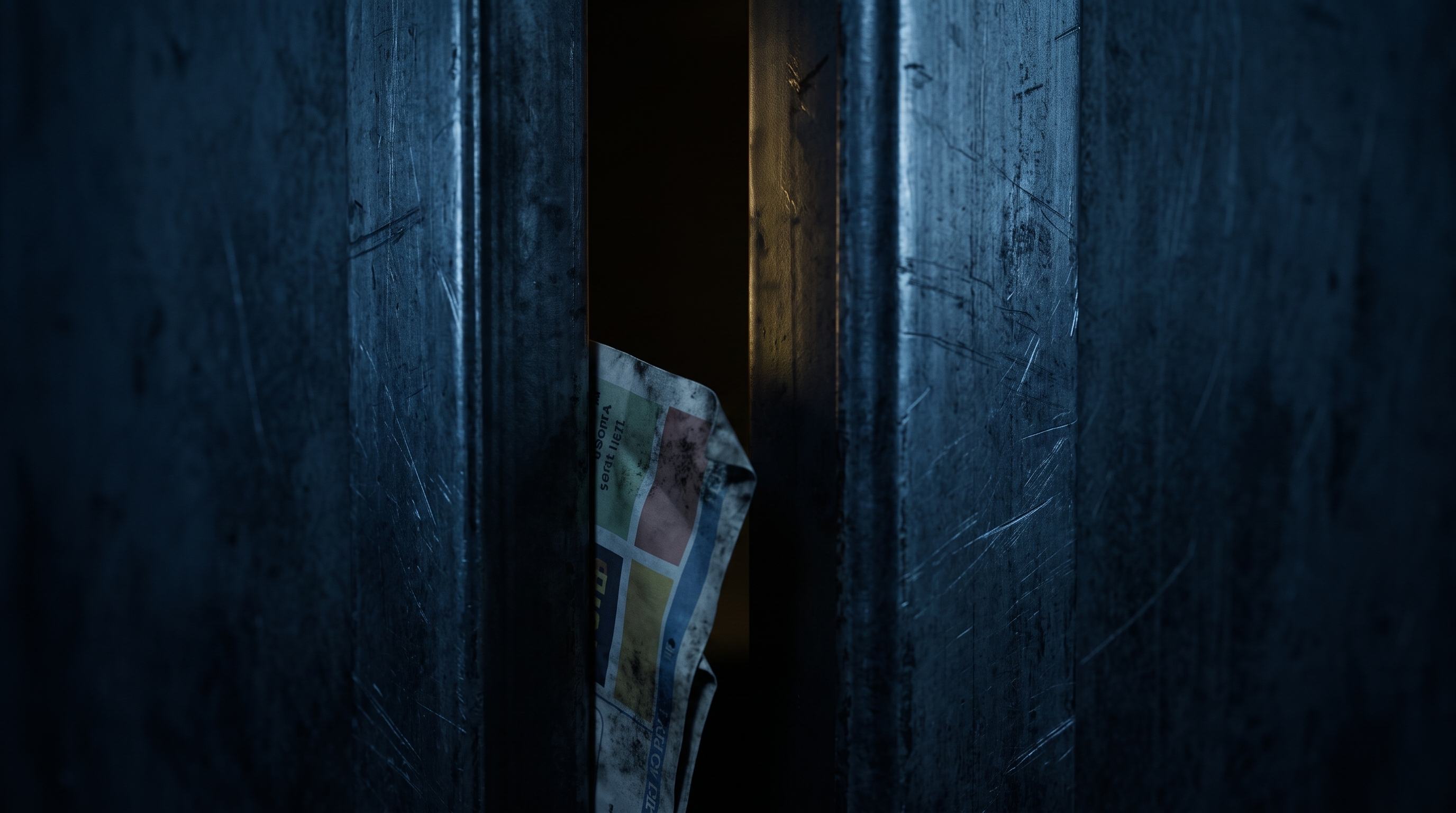
구겨진 광고 전단지 가장자리가 옥탑방 철문 J 틈에 끼어 있고, 카메라는 F의 J 바로 앞에서 철문 틈 너머 H 내부를 가까이 본다.
원본 최신 스틸 (기존 배경)
1차 remake (배경만 교체)
신규 (배경 교체 + blocking fp 참조)
blocking fp — 엔티티(원형 숫자)+카메라(쐐기·화살표)
배경 참조 stairfix_nb2
⑯-2 원본 marked fp
| 마커 | 엔티티 | 배치(top-down) | 근거 인용 |
|---|---|---|---|
| ① | 구겨진 광고 전단지 가장자리 (creased advertisement flyer edge) | wedged in the narrow gap of J at handle height | "Near the opening at handle height, a creased advertisement flyer edge is wedged in the gap" |
| ▲ | 카메라 (eye-level close-up near handle height) | 위치: on F immediately outside J at the rooftop room threshold 방향: toward J seam and into H through the crack |
"철문이 미세하게 열린 틈 사이로 어두운 내부가 보이는 구도"; "iron door face the camera at close range" |
The attached image is a strict top-down exterior SITE PLAN whose
elements are identified by small plain CIRCLED LETTER markers.
REPRODUCE the attached plan EXACTLY — same geometry, same colours,
same circled letters, nothing moved, nothing redrawn — and ADD ONLY
the shot-staging marks listed below.

ENTITY MARKS (digits are identifiers only):
1. creased advertisement flyer edge — circled digit 1 at: wedged in the narrow gap of J at handle height

CAMERA MARK:
- position: on F immediately outside J at the rooftop room threshold
- facing: toward J seam and into H through the crack

Marker style: each added entity mark is a small plain CIRCLED DIGIT
(same graphic style as the existing circled letters), drawn once at
its stated position. The camera is ONE small solid dark wedge
(triangle) at its stated position with a short straight arrow showing
its facing direction. Apart from the existing circled letters, these
circled digits and the single camera wedge+arrow, add nothing: no
text, no words, no other markers, no legend, no compass, no people,
no objects.
Photorealistic cinematic still.

Reference image 1: pre-rendered BACKGROUND environment reference — layout/material/lighting identity

The narrow iron door seam sits in the middle-center foreground. The heavy edges of the iron door face the camera at close range, occupying the outer framing with scratched, cold metal. Near the opening at handle height, a creased advertisement flyer edge is wedged in the gap, its bent and dirty paper face showing partial color blocks and unreadable text. Beyond the thin crack, the unlit interior remains entirely opaque, unreadable, and silent. A deep monochrome blue-black ambient night tone skims the outer rough iron surfaces, while a weak trace of sickly amber light leaks from somewhere unseen deep inside the dead black interior, casting a faint smear along the inner metal edge.

Generate one image:
- use image 1 for this location's wall/floor/ceiling materials, furniture identity, and lighting mood
- follow the camera position, framing, and action requested in the prompt text — do NOT copy the camera position or composition of image 1 unless the prompt explicitly asks for it
- do NOT copy any people from image 1
- architectural openings (doors, windows, thresholds) must match image 1 — same position, type, and material; do NOT invent additional doors or windows unless the prompt text explicitly asks for them
- if the prompt text places the camera inside or at one of these openings, camera-side walls and door/window frames may appear only as local foreground edges — do NOT show the same opening again in the scene, and do NOT show the exterior facade of the structure that contains the camera out in front of it
- do not copy poses or compositions from reference images
- do not alter character identities where their face is visible in the scene
- each character's clothing/outfit must match that character's appearance reference image EXACTLY; if any clothing wording in the text conflicts with the reference image, follow the reference image and ignore that wording
- only render what the scene description asks for — if only a hand or wrist is described, do NOT add the character's face
- CRITICAL: Only render what the scene description explicitly describes. If a character's face is visible in the scene, match it to the reference. If only a body part is shown, do NOT add the face.
- CRITICAL: Output exactly ONE single continuous photograph of ONE moment — never a panel grid, collage, contact sheet, split-screen, storyboard sheet, or multiple sub-frames inside one image.
- CRITICAL: Every person must be physically grounded and weight-bearing — in real contact with a supporting surface, with body weight visibly carried by that contact. For a figure caught mid-action (falling, stumbling, collapsing, jumping off something), render a physically plausible instant: joints bent, weight clearly transferring, at least one believable point of contact or support — never a rigid body hovering, tilted or suspended in mid-air without support.

--- ref labels ---
[
 "background chain ref (L03B04 for L03) — match wall/floor/ceiling/lighting",
 "shot STAGING PLAN (top-down diagram of this same location — annotation only: NEVER draw or copy this diagram, its flat colours, markers or top-down view into the photograph): circled letters = structure identifiers; each circled digit = where that on-screen character/entity stands; the single dark wedge with arrow = the camera's position and facing direction for THIS shot. Use it only to place subjects and the camera consistently with the prompt text."
]
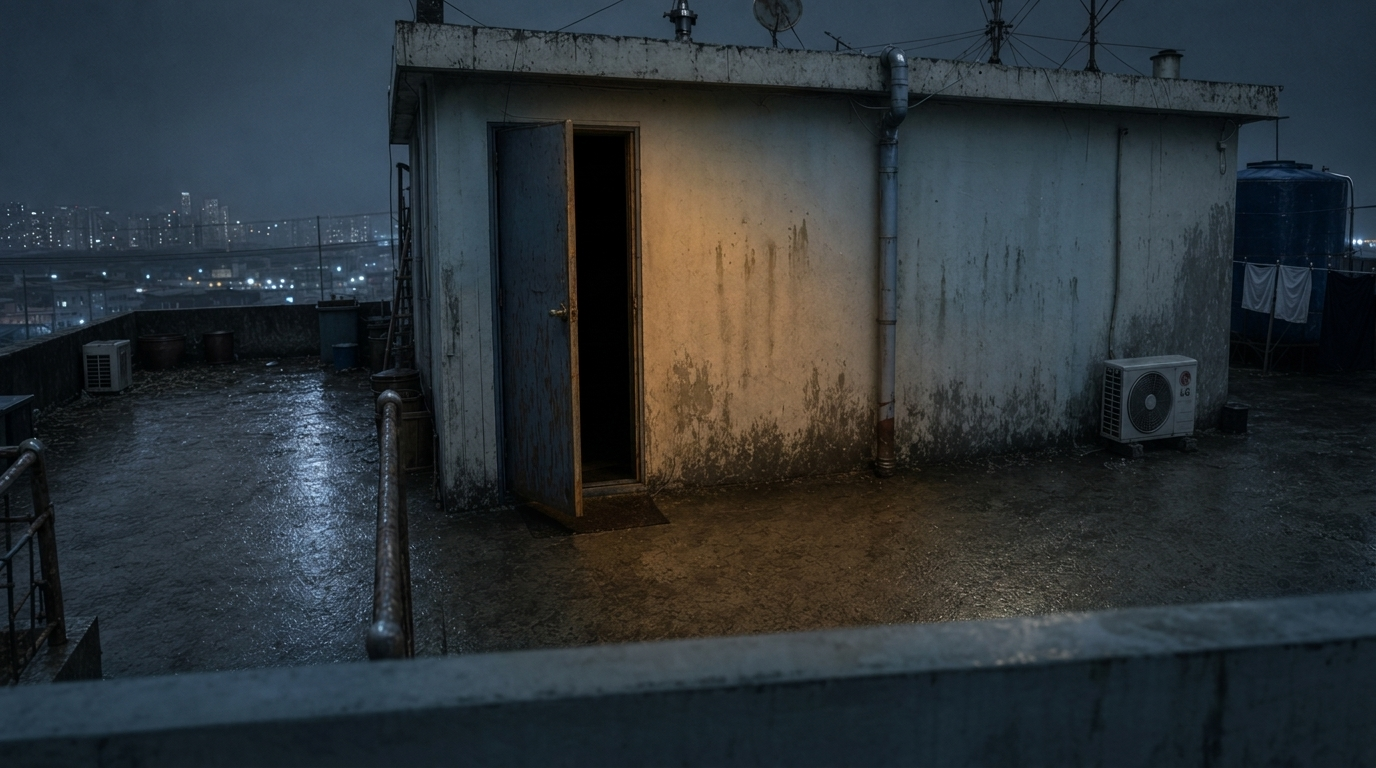
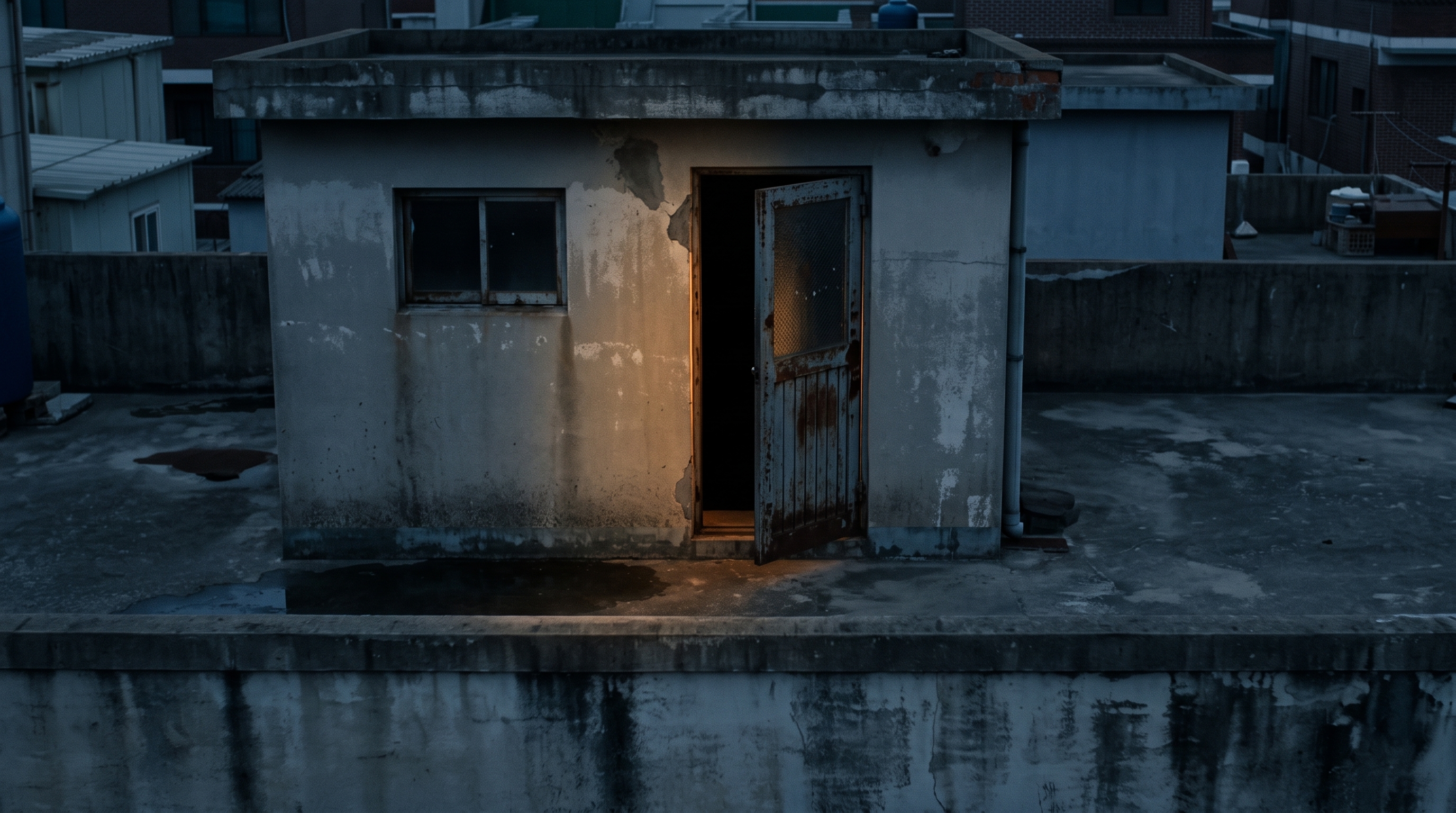
인물이나 이동 주체는 없고, 카메라는 옥상 F의 낮은 담 G 쪽에서 옥탑방 H의 철문 J를 정면 눈높이로 본다.
원본 최신 스틸 (기존 배경)
1차 remake (배경만 교체)
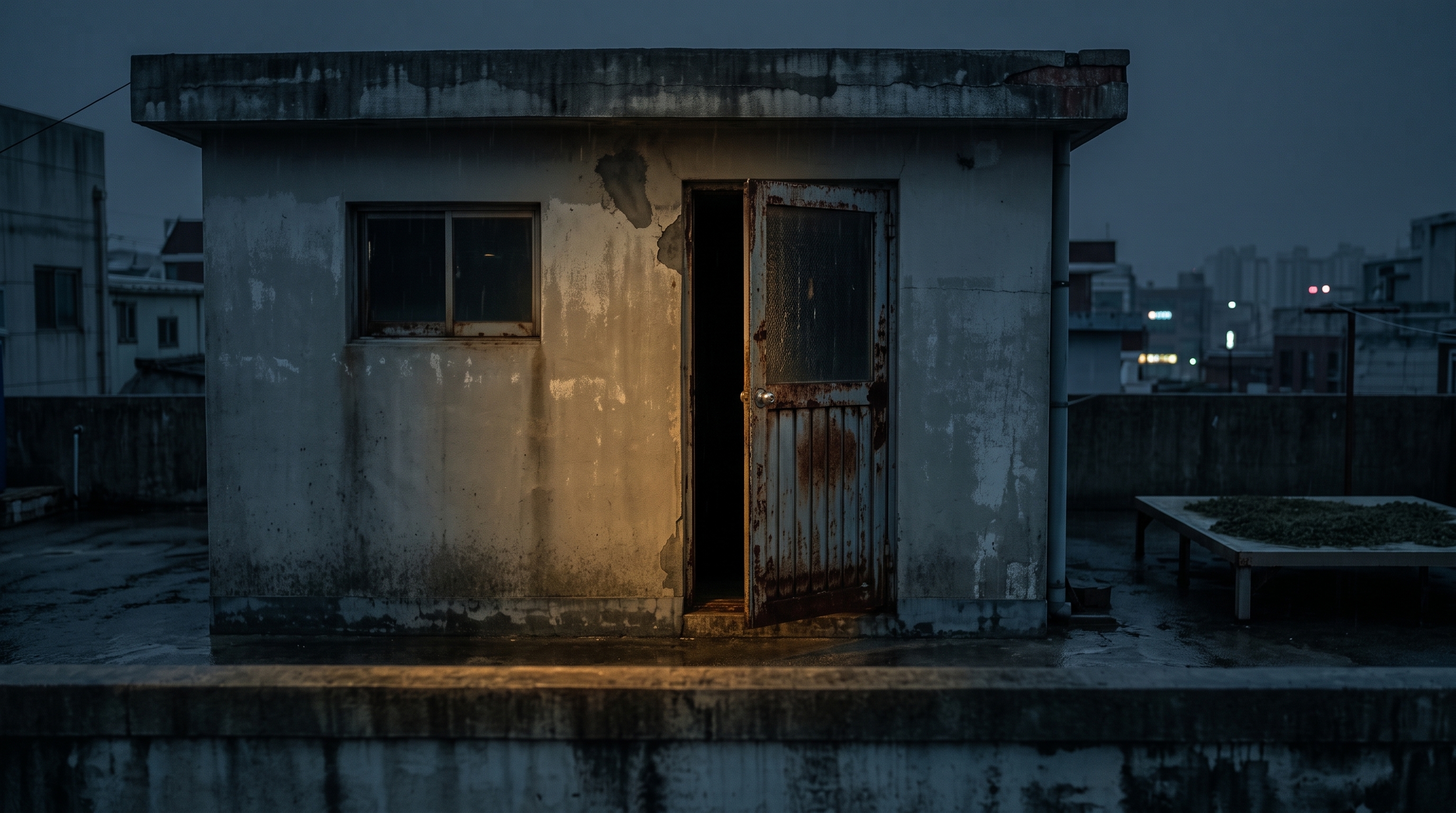
신규 (배경 교체 + blocking fp 참조)
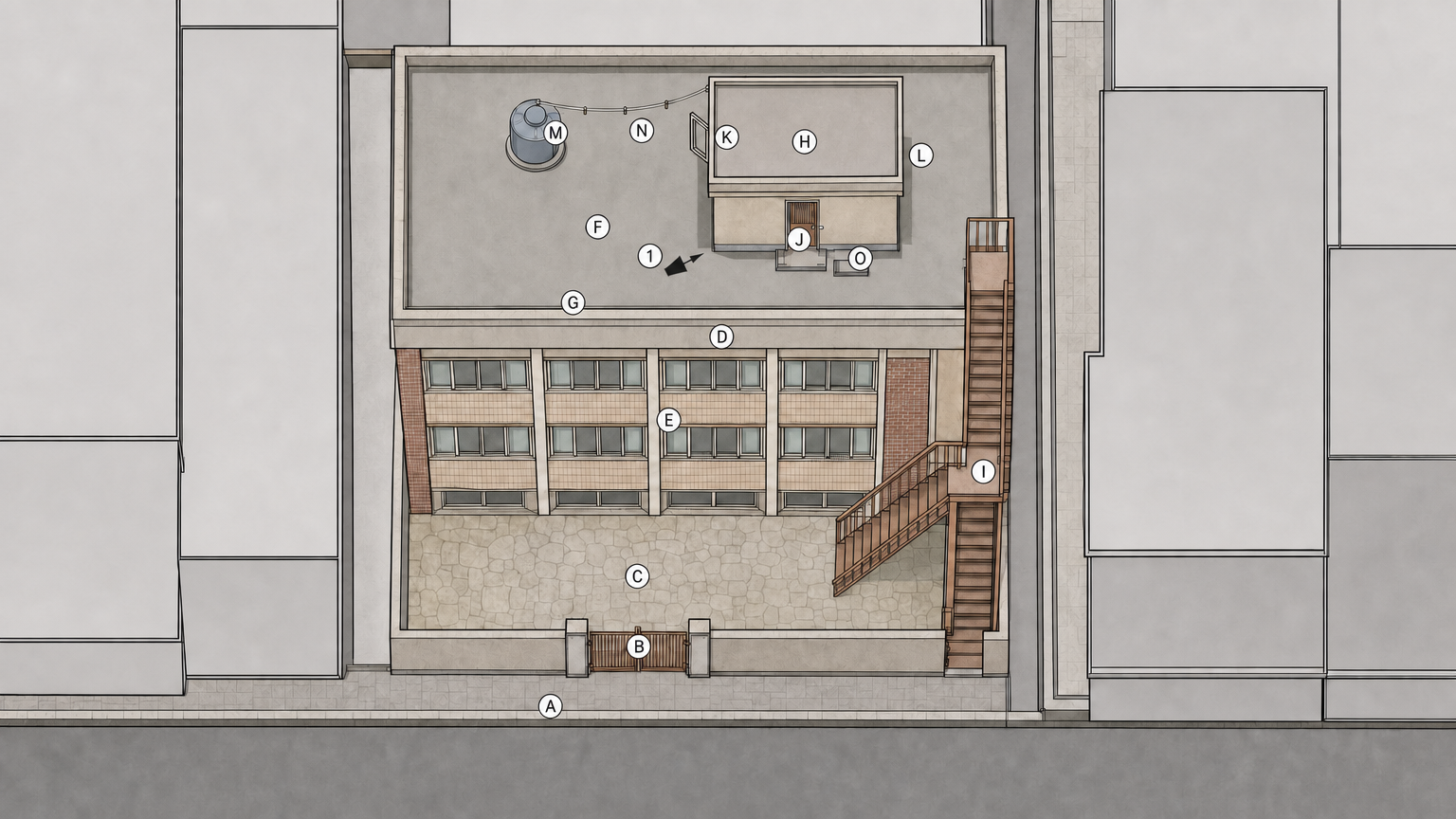
blocking fp — 엔티티(원형 숫자)+카메라(쐐기·화살표)
배경 참조 stairfix_nb2
⑯-2 원본 marked fp
| 마커 | 엔티티 | 배치(top-down) | 근거 인용 |
|---|---|---|---|
| 무인 샷 — 엔티티 없음 | |||
| ▲ | 카메라 (eye-level) | 위치: on F near G, across the roof-terrace landing from J 방향: squarely toward J on the front of H |
“옥상 위… 옥탑방 현관 철문”, “viewed squarely from a direct eye-level subjective viewpoint across the damp landing”, “low parapet in the lower frame” |
The attached image is a strict top-down exterior SITE PLAN whose
elements are identified by small plain CIRCLED LETTER markers.
REPRODUCE the attached plan EXACTLY — same geometry, same colours,
same circled letters, nothing moved, nothing redrawn — and ADD ONLY
the shot-staging marks listed below.

CAMERA MARK:
- position: on F near G, across the roof-terrace landing from J
- facing: squarely toward J on the front of H

Marker style: each added entity mark is a small plain CIRCLED DIGIT
(same graphic style as the existing circled letters), drawn once at
its stated position. The camera is ONE small solid dark wedge
(triangle) at its stated position with a short straight arrow showing
its facing direction. Apart from the existing circled letters, these
circled digits and the single camera wedge+arrow, add nothing: no
text, no words, no other markers, no legend, no compass, no people,
no objects.
Photorealistic cinematic still.

Reference image 1: pre-rendered BACKGROUND environment reference — layout/material/lighting identity

The half-open rooftop iron door is positioned in the middle-center background, viewed squarely from a direct eye-level subjective viewpoint across the damp landing. The environment is enveloped in a cold, muted blue-gray darkness. Contrasting this ambient shadow, a faint and sickly amber light spills outward from the black interior gap along one side of the door, casting an ominous and contaminated glow across the wet-stained concrete wall and the horizontal edge of the low parapet in the lower frame. The camera focuses entirely on the motionless threshold, isolating the doorway within the silent negative space of the rooftop.

Generate one image:
- use image 1 for this location's wall/floor/ceiling materials, furniture identity, and lighting mood
- follow the camera position, framing, and action requested in the prompt text — do NOT copy the camera position or composition of image 1 unless the prompt explicitly asks for it
- do NOT copy any people from image 1
- architectural openings (doors, windows, thresholds) must match image 1 — same position, type, and material; do NOT invent additional doors or windows unless the prompt text explicitly asks for them
- if the prompt text places the camera inside or at one of these openings, camera-side walls and door/window frames may appear only as local foreground edges — do NOT show the same opening again in the scene, and do NOT show the exterior facade of the structure that contains the camera out in front of it
- do not copy poses or compositions from reference images
- do not alter character identities where their face is visible in the scene
- each character's clothing/outfit must match that character's appearance reference image EXACTLY; if any clothing wording in the text conflicts with the reference image, follow the reference image and ignore that wording
- only render what the scene description asks for — if only a hand or wrist is described, do NOT add the character's face
- CRITICAL: Only render what the scene description explicitly describes. If a character's face is visible in the scene, match it to the reference. If only a body part is shown, do NOT add the face.
- CRITICAL: Output exactly ONE single continuous photograph of ONE moment — never a panel grid, collage, contact sheet, split-screen, storyboard sheet, or multiple sub-frames inside one image.
- CRITICAL: Every person must be physically grounded and weight-bearing — in real contact with a supporting surface, with body weight visibly carried by that contact. For a figure caught mid-action (falling, stumbling, collapsing, jumping off something), render a physically plausible instant: joints bent, weight clearly transferring, at least one believable point of contact or support — never a rigid body hovering, tilted or suspended in mid-air without support.

--- ref labels ---
[
 "background chain ref (L10B02 for L10) — match wall/floor/ceiling/lighting",
 "shot STAGING PLAN (top-down diagram of this same location — annotation only: NEVER draw or copy this diagram, its flat colours, markers or top-down view into the photograph): circled letters = structure identifiers; each circled digit = where that on-screen character/entity stands; the single dark wedge with arrow = the camera's position and facing direction for THIS shot. Use it only to place subjects and the camera consistently with the prompt text."
]
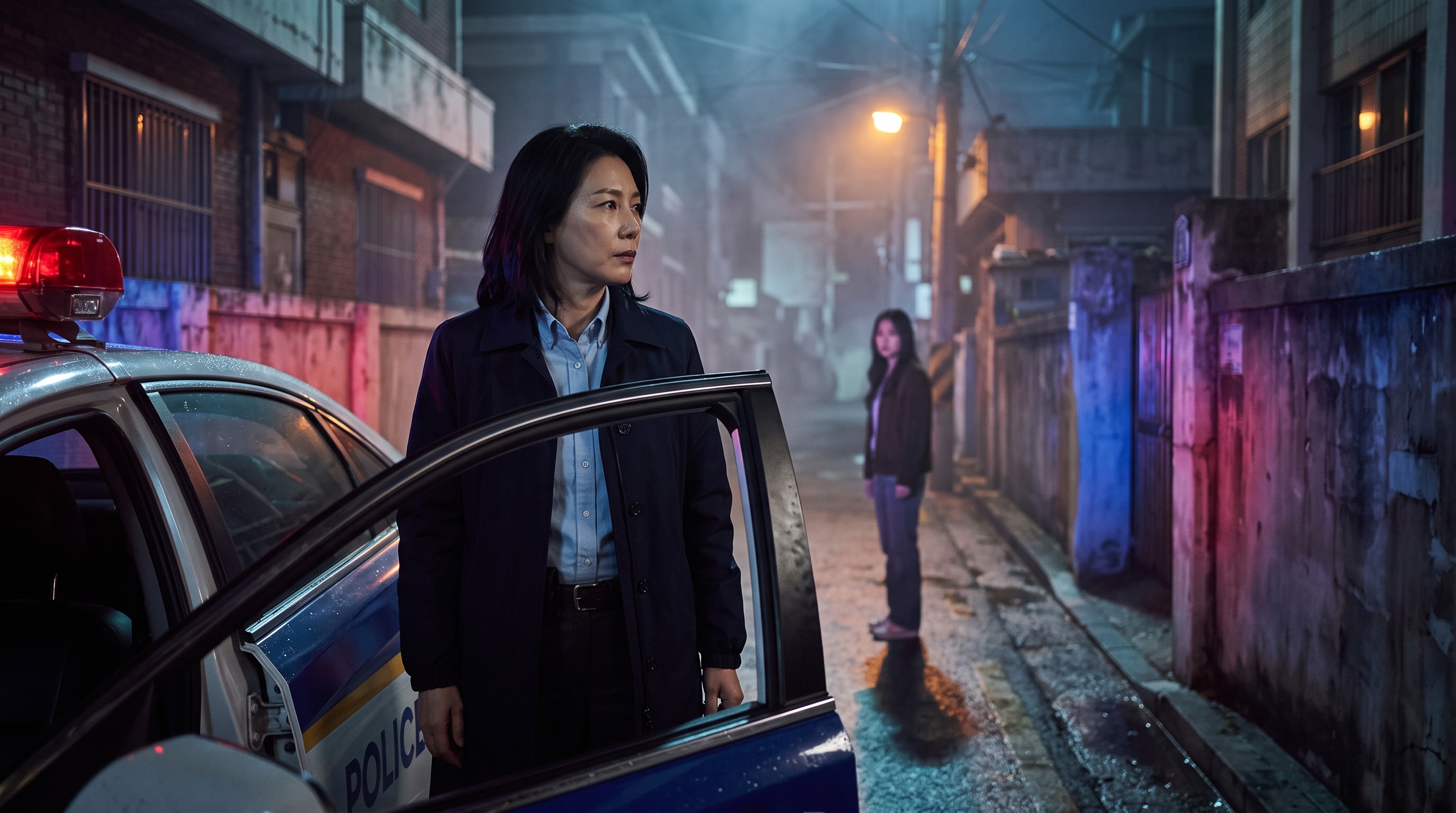
A 골목 초입 왼쪽의 경찰차 옆에 중년 여성이 서 있고, 젊은 여성은 B 쪽으로 더 들어간 A 골목 중간에 있으며, 카메라는 A 초입에서 B 방향을 본다.
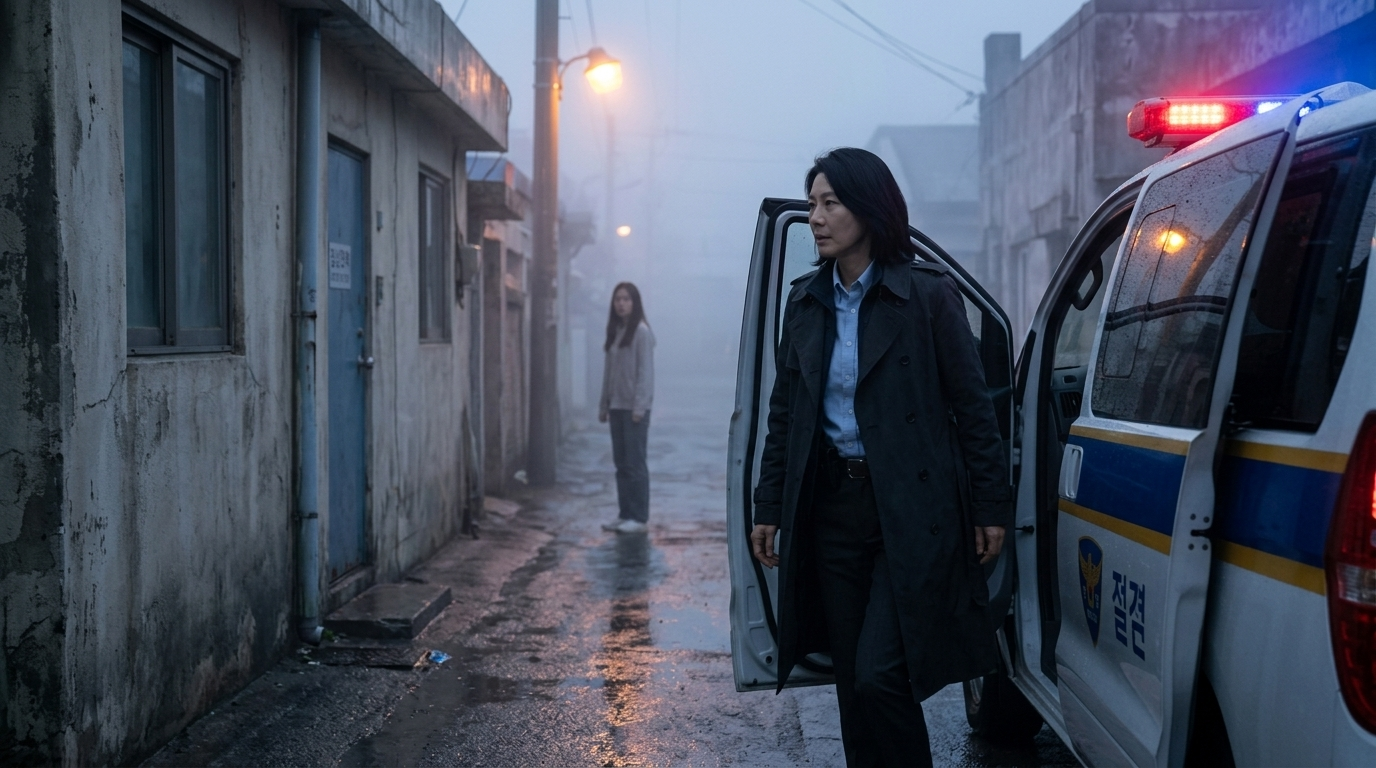
원본 최신 스틸 (기존 배경)
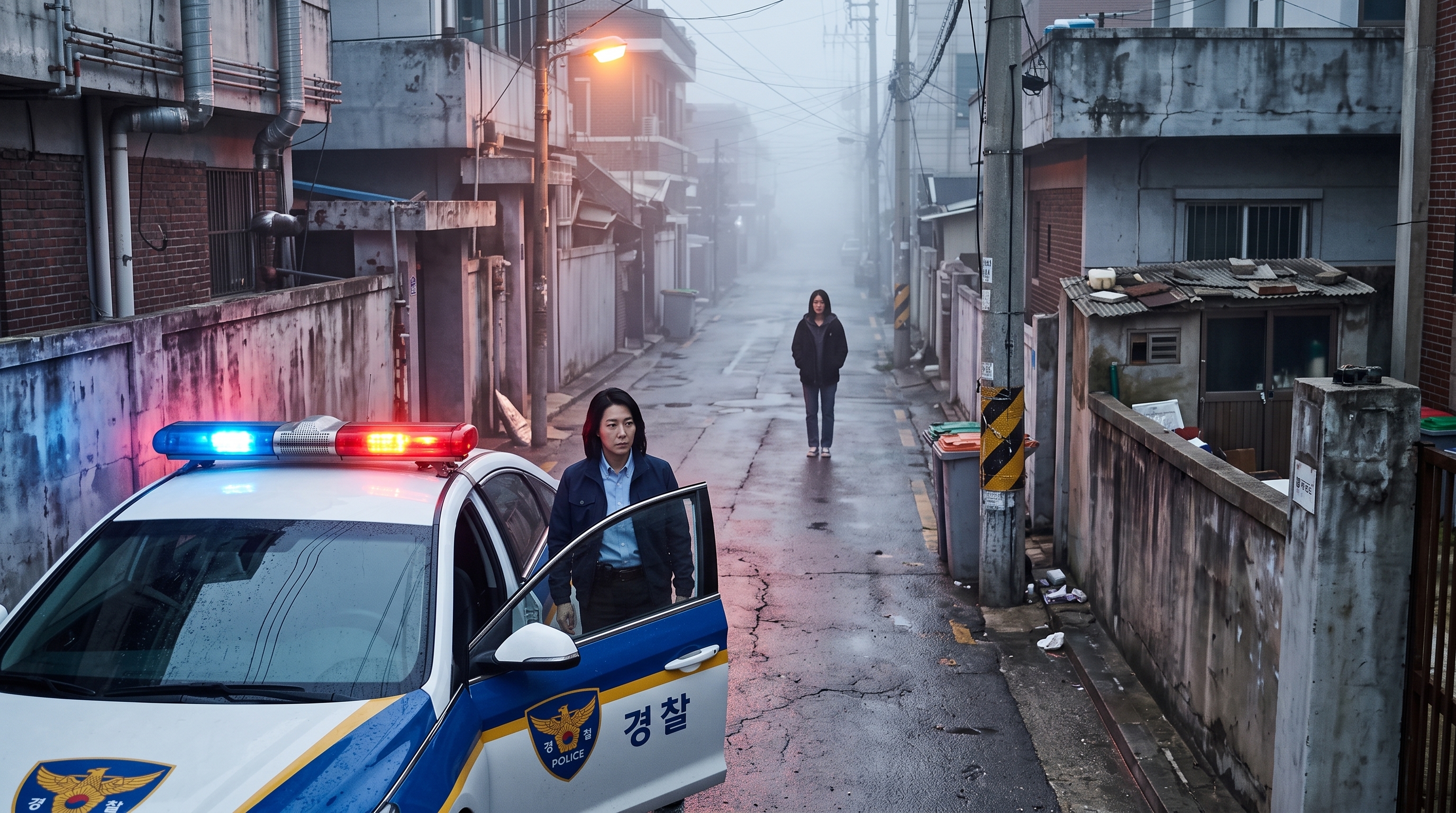
1차 remake (배경만 교체)
신규 (배경 교체 + blocking fp 참조)
blocking fp — 엔티티(원형 숫자)+카메라(쐐기·화살표)
배경 참조 stairfix_nb2
⑯-2 원본 marked fp
| 마커 | 엔티티 | 배치(top-down) | 근거 인용 |
|---|---|---|---|
| ① | 형사 코트의 중년 여성 (middle-aged woman in detective coat) | on A near the public road edge, beside the police vehicle on the left side of A, facing down A toward B (추정) | "차에서 내린 혜수", "by the police car", "half-stepping from the parked vehicle" |
| ② | 젊은 여성 (young woman) | on A farther down the alley toward B, mid-alley in the background | "멍하게 서 있는 수리영", "young Asian woman down the alley in the background", "stalled mid-alley" |
| ③ | 경찰 차량 (police vehicle) | on the left side of A near the public road edge, angled toward the camera (추정) | "open police vehicle side angles toward the camera on the left", "parked vehicle" |
| ▲ | 카메라 (chest-height / eye-level) | 위치: on A near the public road edge, just right of the open police vehicle side 방향: down A toward B and the distant young woman |
"upper body in frame at chest height", "middle-left foreground", "looking toward a young Asian woman down the alley in the background" |
The attached image is a strict top-down exterior SITE PLAN whose
elements are identified by small plain CIRCLED LETTER markers.
REPRODUCE the attached plan EXACTLY — same geometry, same colours,
same circled letters, nothing moved, nothing redrawn — and ADD ONLY
the shot-staging marks listed below.

ENTITY MARKS (digits are identifiers only):
1. middle-aged woman in detective coat — circled digit 1 at: on A near the public road edge, beside the police vehicle on the left side of A, facing down A toward B
2. young woman — circled digit 2 at: on A farther down the alley toward B, mid-alley in the background
3. police vehicle — circled digit 3 at: on the left side of A near the public road edge, angled toward the camera

CAMERA MARK:
- position: on A near the public road edge, just right of the open police vehicle side
- facing: down A toward B and the distant young woman

Marker style: each added entity mark is a small plain CIRCLED DIGIT
(same graphic style as the existing circled letters), drawn once at
its stated position. The camera is ONE small solid dark wedge
(triangle) at its stated position with a short straight arrow showing
its facing direction. Apart from the existing circled letters, these
circled digits and the single camera wedge+arrow, add nothing: no
text, no words, no other markers, no legend, no compass, no people,
no objects.
Photorealistic cinematic still.

Reference image 1: pre-rendered BACKGROUND environment reference — layout/material/lighting identity
Reference image 2: character appearance reference: Korean 40대 중반 여성, 성숙한 얼굴선과 짙은 검은 머리의 차분한 인상.

the character from Image 2 in a detective coat, an Asian middle-aged woman with mature facial features and dark natural hair by the police car, occupies the middle-left foreground, looking toward a young Asian woman down the alley in the background across the same damp exterior alleyway they both occupy. the character from Image 2 stands at a three-quarter angle from the right, upper body in frame at chest height, half-stepping from the parked vehicle, eyes fixed on the distant figure. The young Asian woman is softly focused in the rear, standing at a three-quarter angle from the left, stalled mid-alley, gazing into the distance. A damp exterior alleyway shrouded in cold misty fog and deep shadows, illuminated by strobing red and blue lights mixing with a weak amber street lamp to create colored reflections on the wet surfaces. The open police vehicle side angles toward the camera on the left, framing the character from Image 2's exit.

Generate one image:
- use image 1 for this location's wall/floor/ceiling materials, furniture identity, and lighting mood
- follow the camera position, framing, and action requested in the prompt text — do NOT copy the camera position or composition of image 1 unless the prompt explicitly asks for it
- do NOT copy any people from image 1
- architectural openings (doors, windows, thresholds) must match image 1 — same position, type, and material; do NOT invent additional doors or windows unless the prompt text explicitly asks for them
- if the prompt text places the camera inside or at one of these openings, camera-side walls and door/window frames may appear only as local foreground edges — do NOT show the same opening again in the scene, and do NOT show the exterior facade of the structure that contains the camera out in front of it
- use image 2 as character appearance reference — match the person's identity and outfit where visible in the scene
- do not copy poses or compositions from reference images
- do not alter character identities where their face is visible in the scene
- each character's clothing/outfit must match that character's appearance reference image EXACTLY; if any clothing wording in the text conflicts with the reference image, follow the reference image and ignore that wording
- only render what the scene description asks for — if only a hand or wrist is described, do NOT add the character's face
- CRITICAL: Only render what the scene description explicitly describes. If a character's face is visible in the scene, match it to the reference. If only a body part is shown, do NOT add the face.
- CRITICAL: Output exactly ONE single continuous photograph of ONE moment — never a panel grid, collage, contact sheet, split-screen, storyboard sheet, or multiple sub-frames inside one image.
- CRITICAL: Every person must be physically grounded and weight-bearing — in real contact with a supporting surface, with body weight visibly carried by that contact. For a figure caught mid-action (falling, stumbling, collapsing, jumping off something), render a physically plausible instant: joints bent, weight clearly transferring, at least one believable point of contact or support — never a rigid body hovering, tilted or suspended in mid-air without support.

--- ref labels ---
[
 "background chain ref (L03B03 for L03) — match wall/floor/ceiling/lighting",
 "character appearance reference: Korean 40대 중반 여성, 성숙한 얼굴선과 짙은 검은 머리의 차분한 인상.",
 "shot STAGING PLAN (top-down diagram of this same location — annotation only: NEVER draw or copy this diagram, its flat colours, markers or top-down view into the photograph): circled letters = structure identifiers; each circled digit = where that on-screen character/entity stands; the single dark wedge with arrow = the camera's position and facing direction for THIS shot. Use it only to place subjects and the camera consistently with the prompt text."
]
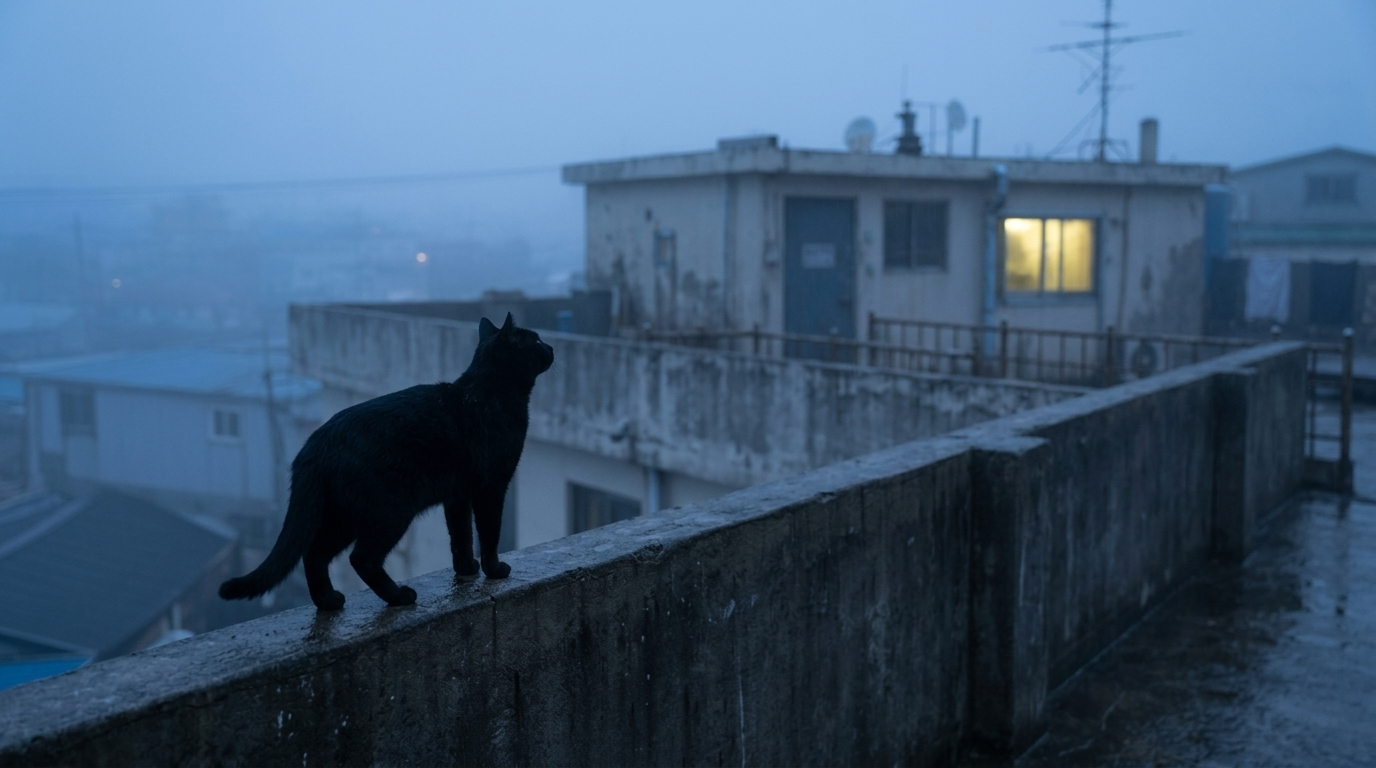
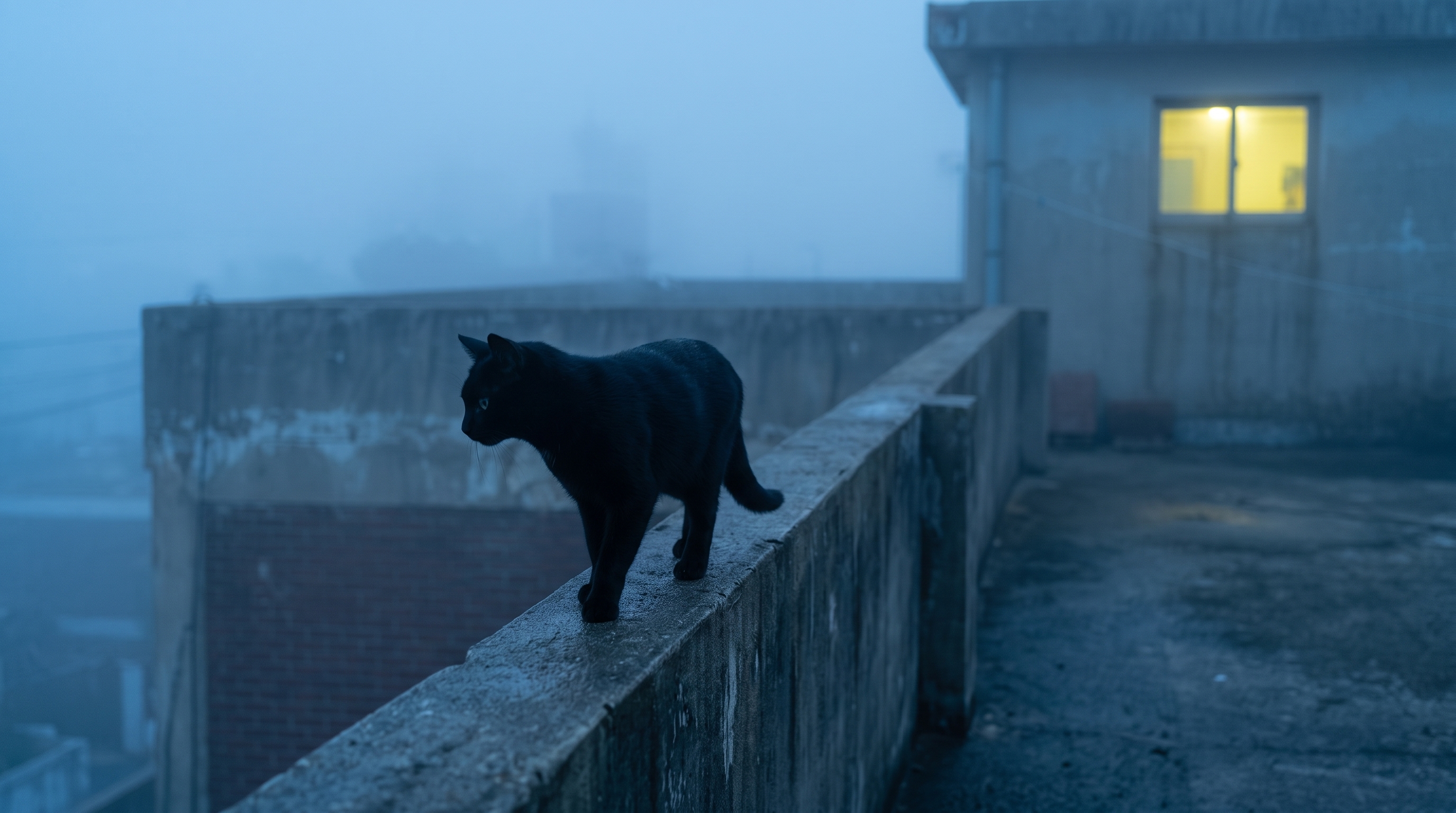
검은 고양이가 옥상 테라스 F의 낮은 벽 G 위/가에 있고 K 창문을 올려다보며, 카메라는 G 옆 낮은 위치에서 고양이와 K를 향한다.
원본 최신 스틸 (기존 배경)
1차 remake (배경만 교체)
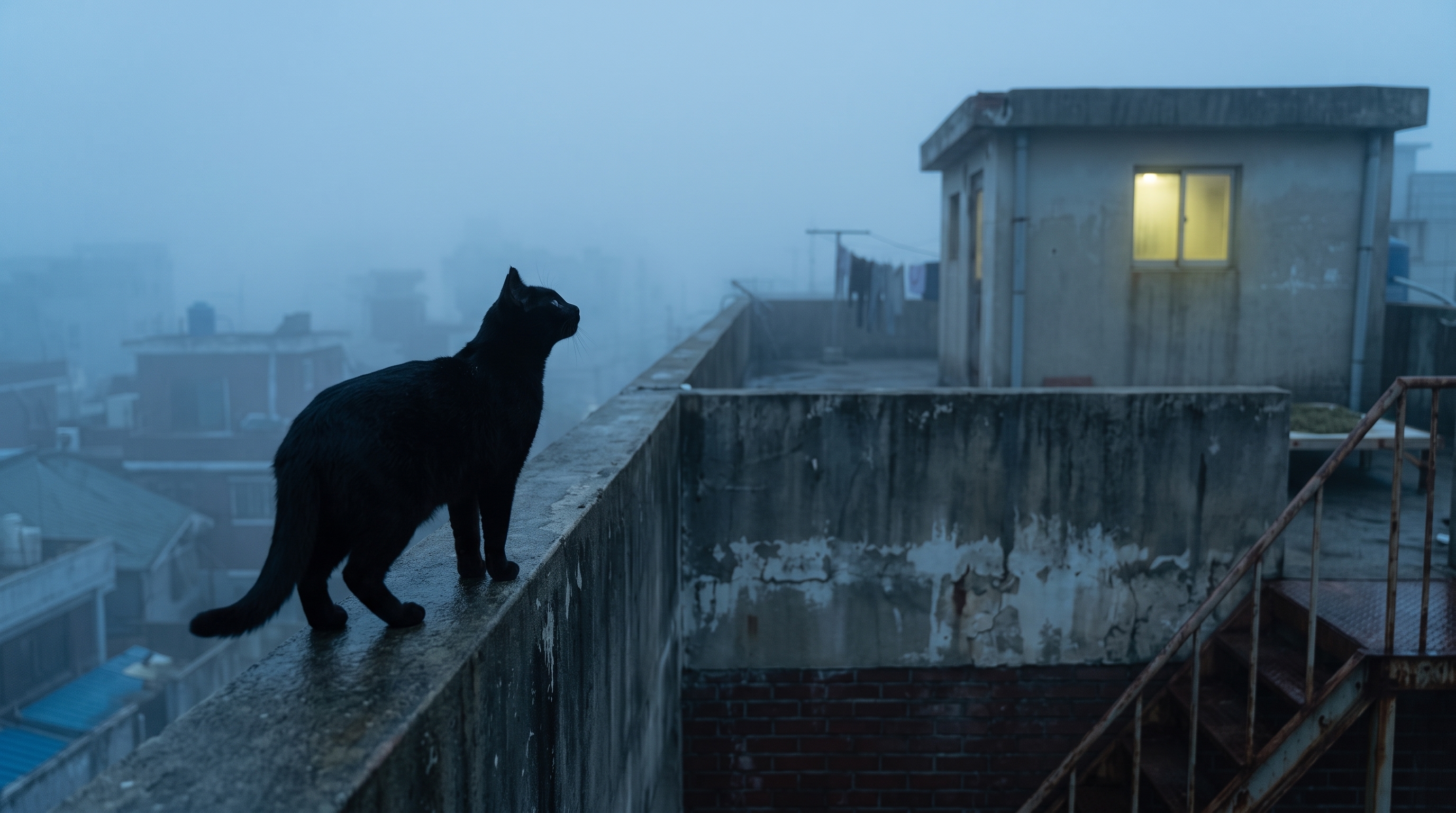
신규 (배경 교체 + blocking fp 참조)
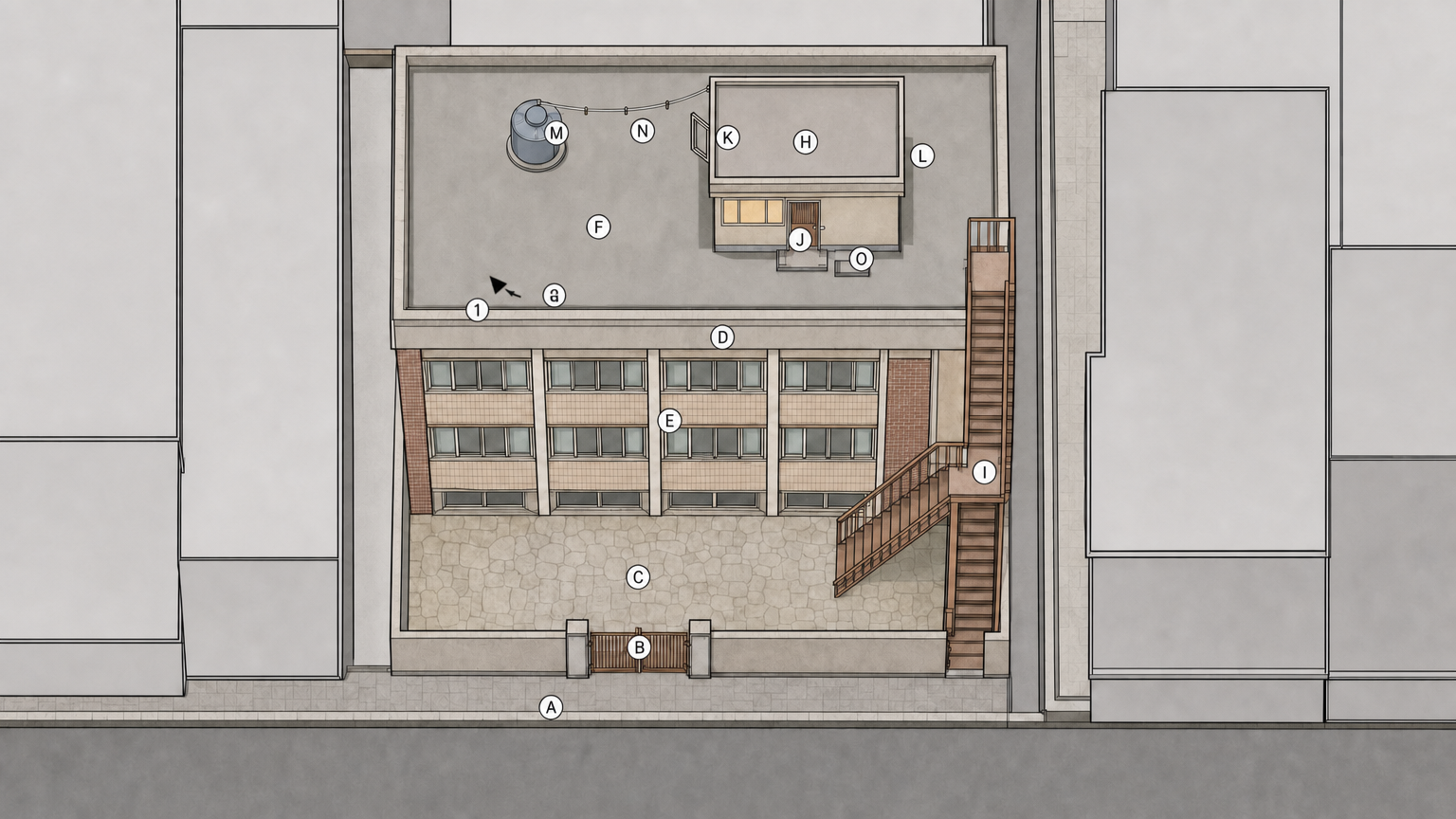
blocking fp — 엔티티(원형 숫자)+카메라(쐐기·화살표)
배경 참조 stairfix_nb2
⑯-2 원본 marked fp
| 마커 | 엔티티 | 배치(top-down) | 근거 인용 |
|---|---|---|---|
| ① | 검은 고양이 (black cat) | on G on the roof terrace F, partway along the low wall in the sightline toward rooftop-room window K | “black cat in the lower-center foreground”, “partway along the low concrete rooftop wall”, “looks up toward the lit rooftop window” |
| ▲ | 카메라 (low, at cat shoulder height) | 위치: on F beside G, close to entity 1, with K in the background 방향: toward entity 1 on G and the lit rooftop-room window K |
“The low camera at the cat's shoulder height captures its silhouette”, “looks up toward the lit rooftop window in the upper-right background” |
The attached image is a strict top-down exterior SITE PLAN whose
elements are identified by small plain CIRCLED LETTER markers.
REPRODUCE the attached plan EXACTLY — same geometry, same colours,
same circled letters, nothing moved, nothing redrawn — and ADD ONLY
the shot-staging marks listed below.

ENTITY MARKS (digits are identifiers only):
1. black cat — circled digit 1 at: on G on the roof terrace F, partway along the low wall in the sightline toward rooftop-room window K

CAMERA MARK:
- position: on F beside G, close to entity 1, with K in the background
- facing: toward entity 1 on G and the lit rooftop-room window K

Marker style: each added entity mark is a small plain CIRCLED DIGIT
(same graphic style as the existing circled letters), drawn once at
its stated position. The camera is ONE small solid dark wedge
(triangle) at its stated position with a short straight arrow showing
its facing direction. Apart from the existing circled letters, these
circled digits and the single camera wedge+arrow, add nothing: no
text, no words, no other markers, no legend, no compass, no people,
no objects.
Photorealistic cinematic still.

Reference image 1: pre-rendered BACKGROUND environment reference — layout/material/lighting identity

Focusing on the pre-existing black cat in the lower-center foreground, already partway along the low concrete rooftop wall where that path leads toward the near center of the frame and not into the old villa rooftop, in left profile as it looks up toward the lit rooftop window in the upper-right background. The low camera at the cat's shoulder height captures its silhouette with faint rim-lit edges preserving body volume against the cool blue ambient fill. Thick dawn fog desaturates the damp concrete parapet running parallel behind the cat. The sickly yellow glow from the window hangs in the misty distance, creating a faint occult point of warmth near the rooftop room.

Generate one image:
- use image 1 for this location's wall/floor/ceiling materials, furniture identity, and lighting mood
- follow the camera position, framing, and action requested in the prompt text — do NOT copy the camera position or composition of image 1 unless the prompt explicitly asks for it
- do NOT copy any people from image 1
- architectural openings (doors, windows, thresholds) must match image 1 — same position, type, and material; do NOT invent additional doors or windows unless the prompt text explicitly asks for them
- if the prompt text places the camera inside or at one of these openings, camera-side walls and door/window frames may appear only as local foreground edges — do NOT show the same opening again in the scene, and do NOT show the exterior facade of the structure that contains the camera out in front of it
- do not copy poses or compositions from reference images
- do not alter character identities where their face is visible in the scene
- each character's clothing/outfit must match that character's appearance reference image EXACTLY; if any clothing wording in the text conflicts with the reference image, follow the reference image and ignore that wording
- only render what the scene description asks for — if only a hand or wrist is described, do NOT add the character's face
- CRITICAL: Only render what the scene description explicitly describes. If a character's face is visible in the scene, match it to the reference. If only a body part is shown, do NOT add the face.
- CRITICAL: Output exactly ONE single continuous photograph of ONE moment — never a panel grid, collage, contact sheet, split-screen, storyboard sheet, or multiple sub-frames inside one image.
- CRITICAL: Every person must be physically grounded and weight-bearing — in real contact with a supporting surface, with body weight visibly carried by that contact. For a figure caught mid-action (falling, stumbling, collapsing, jumping off something), render a physically plausible instant: joints bent, weight clearly transferring, at least one believable point of contact or support — never a rigid body hovering, tilted or suspended in mid-air without support.

--- ref labels ---
[
 "background chain ref (L03B01 for L03) — match wall/floor/ceiling/lighting",
 "shot STAGING PLAN (top-down diagram of this same location — annotation only: NEVER draw or copy this diagram, its flat colours, markers or top-down view into the photograph): circled letters = structure identifiers; each circled digit = where that on-screen character/entity stands; the single dark wedge with arrow = the camera's position and facing direction for THIS shot. Use it only to place subjects and the camera consistently with the prompt text."
]