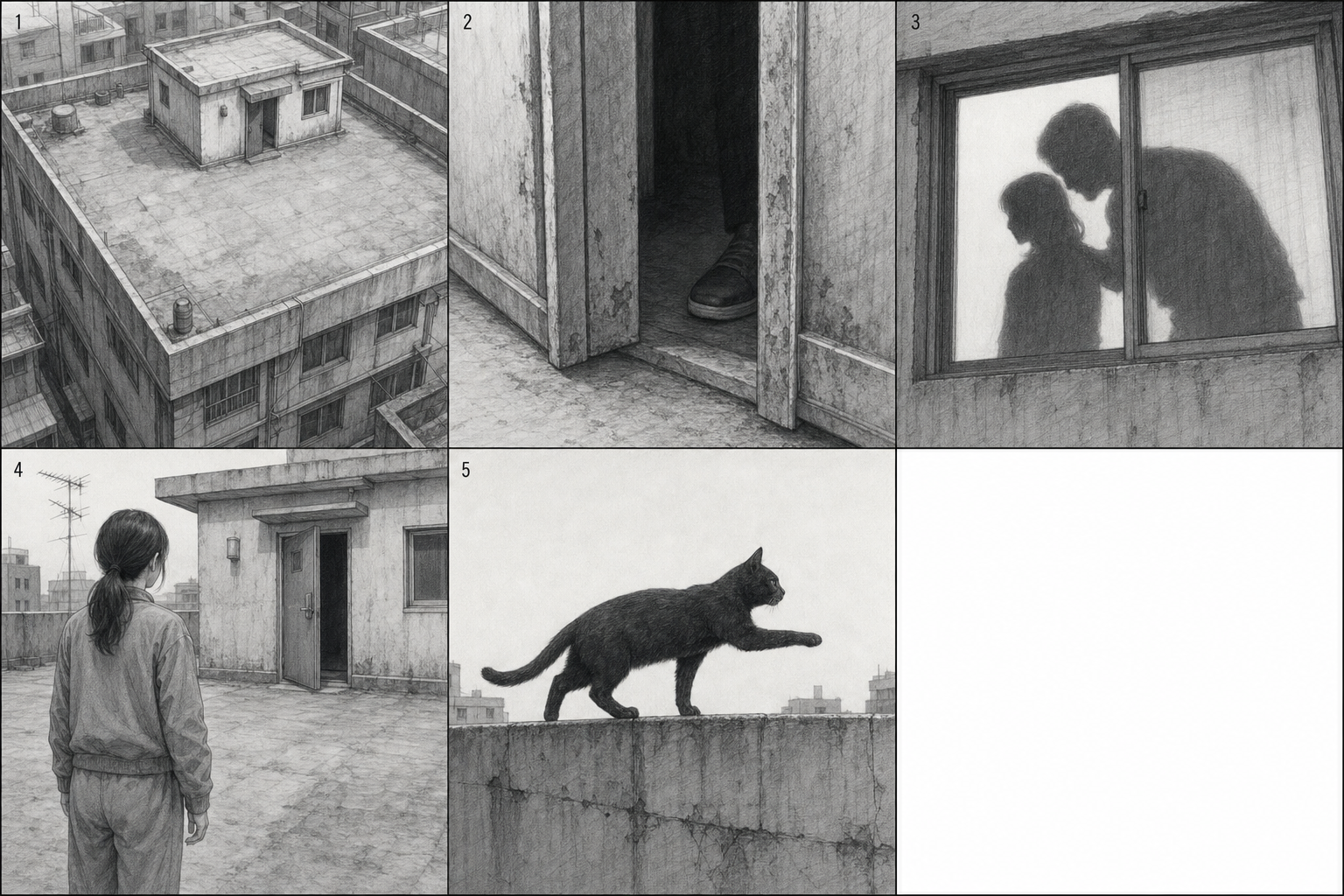
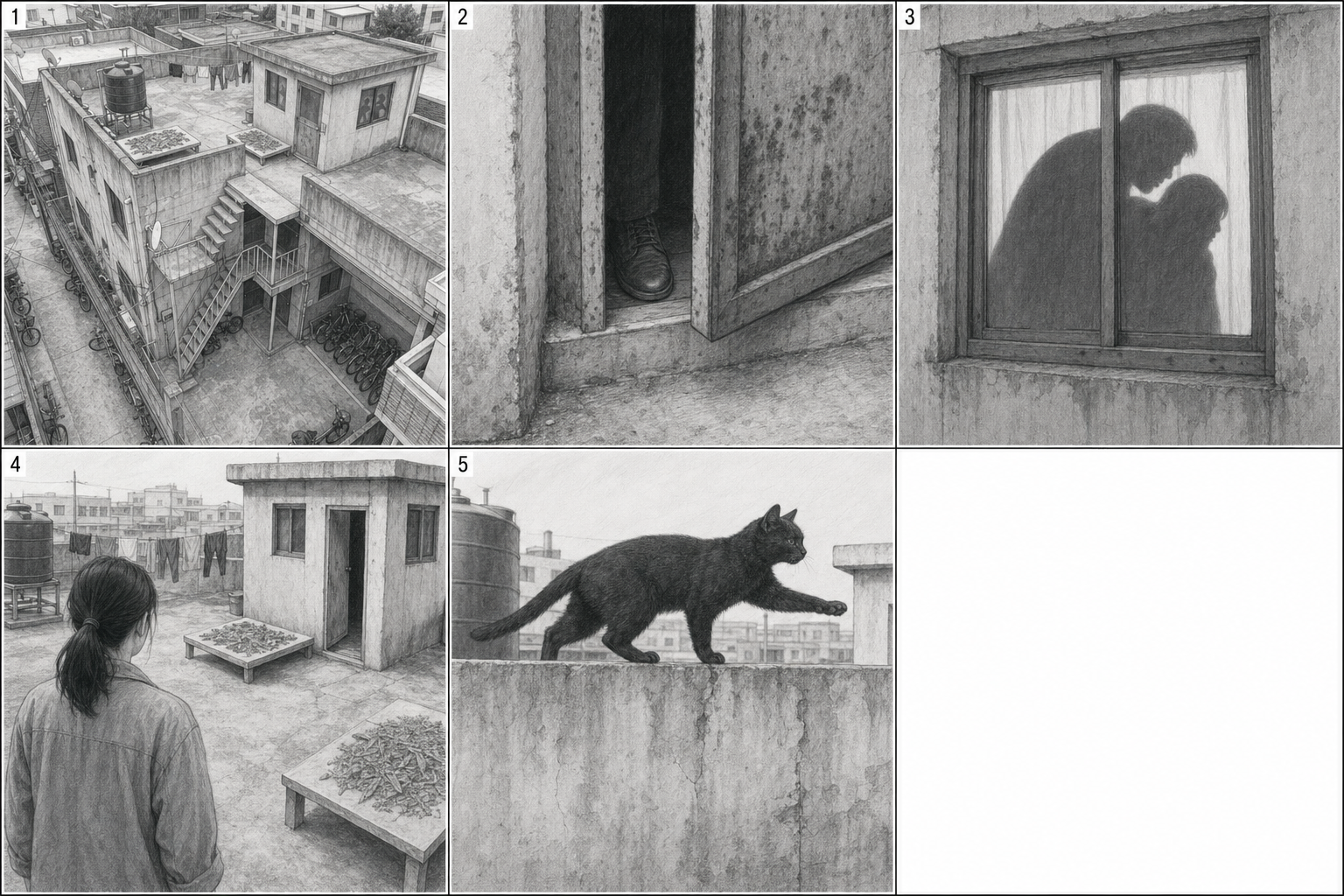
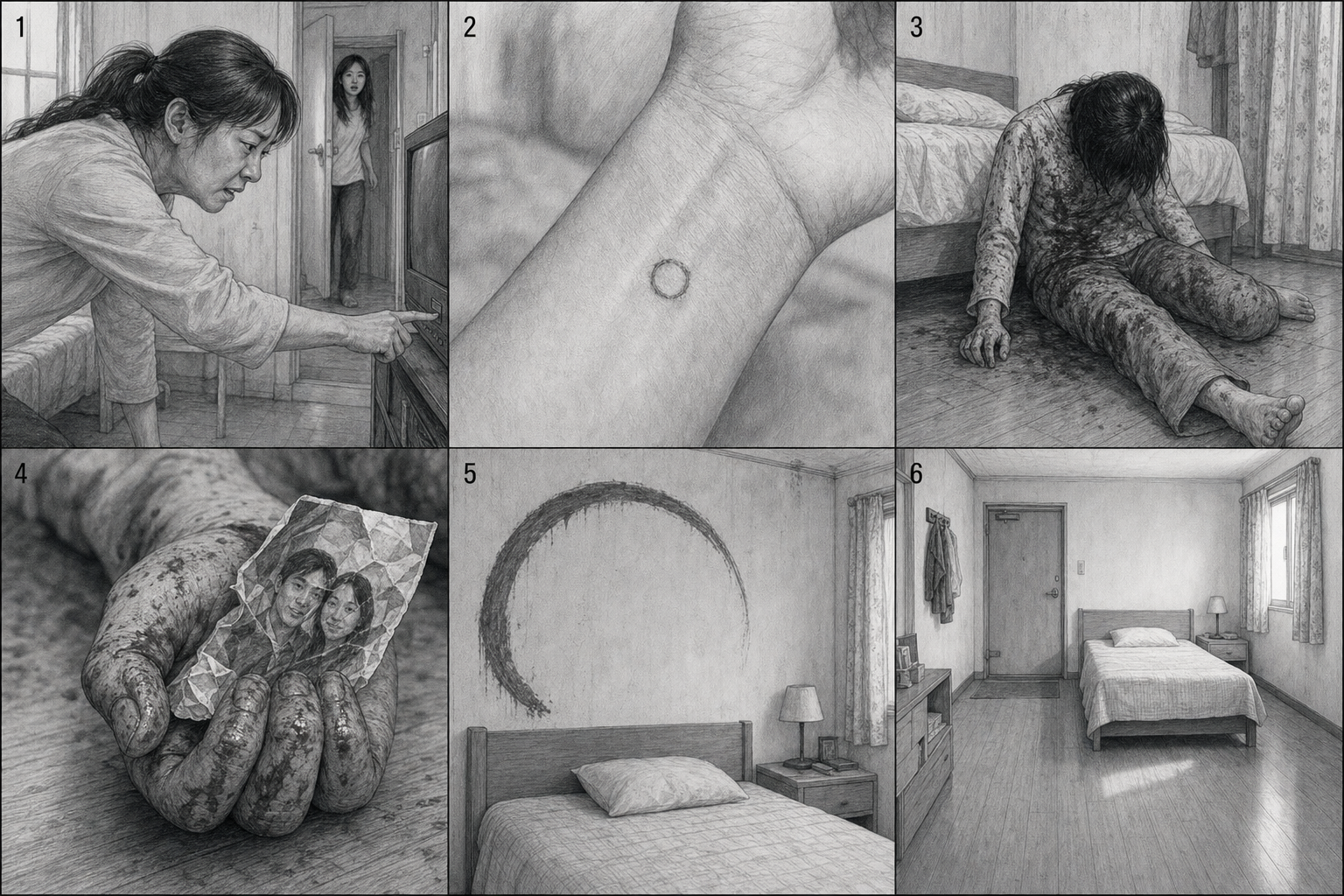
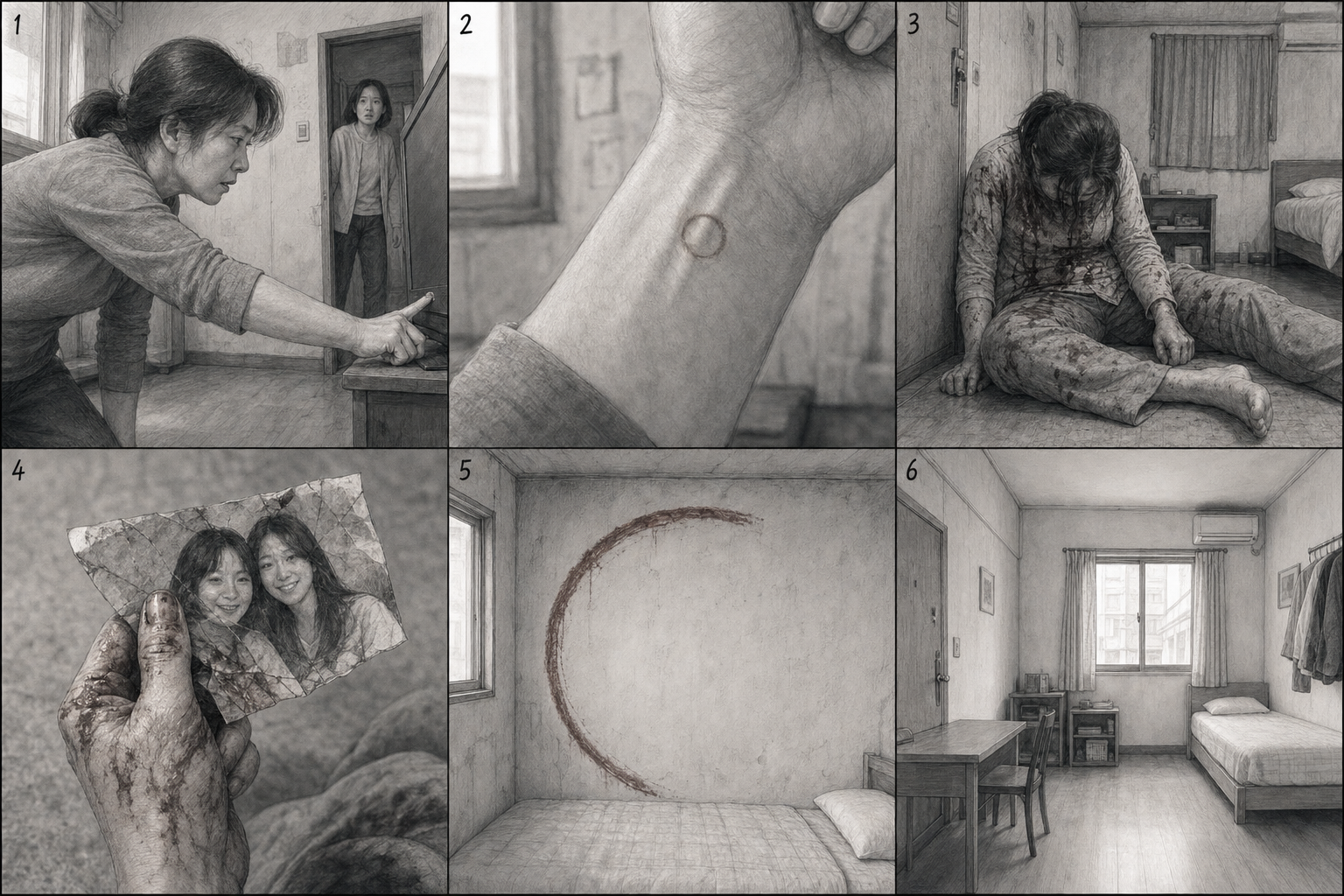
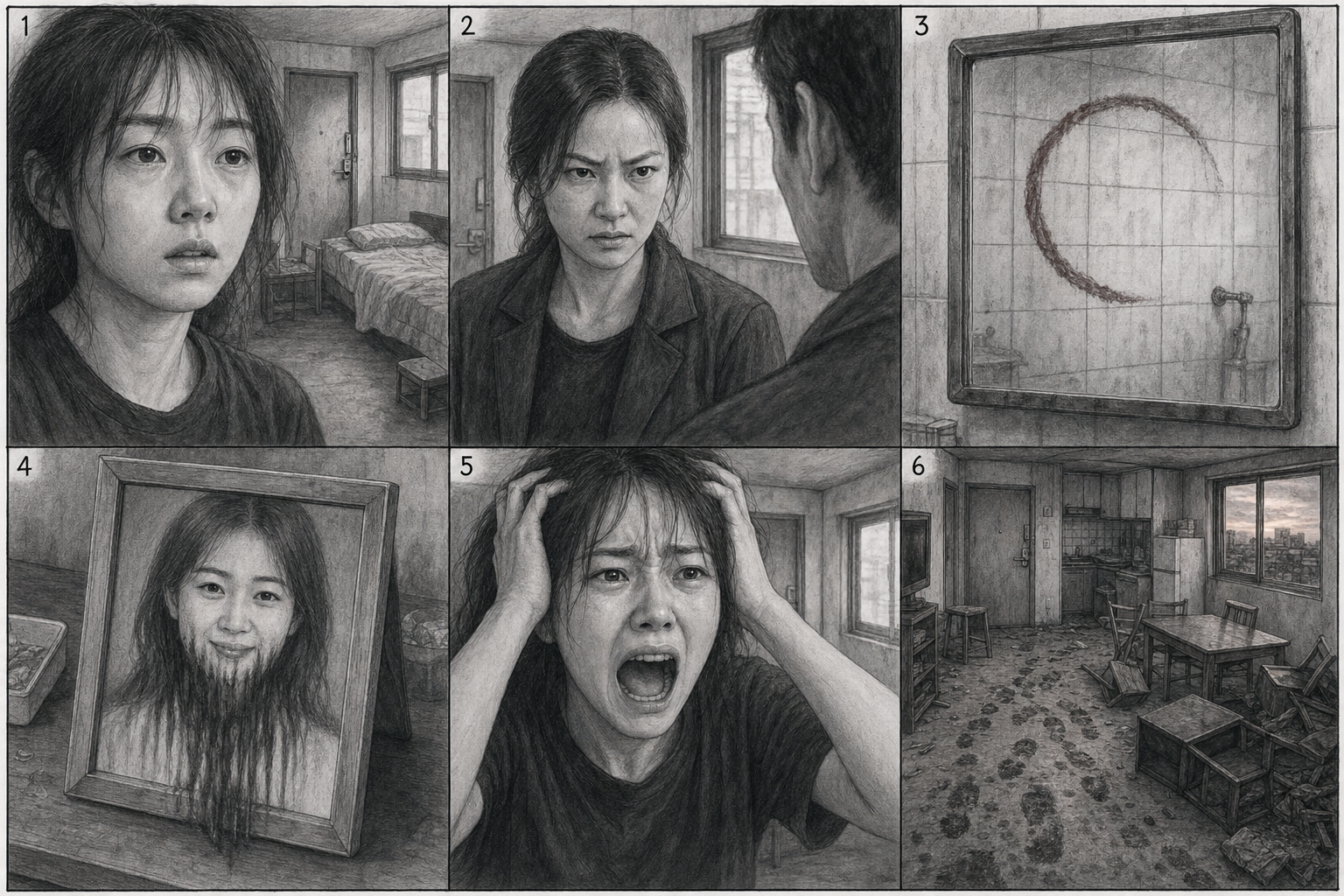
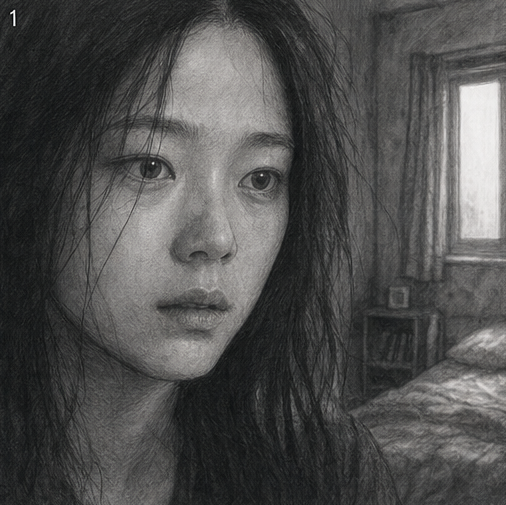
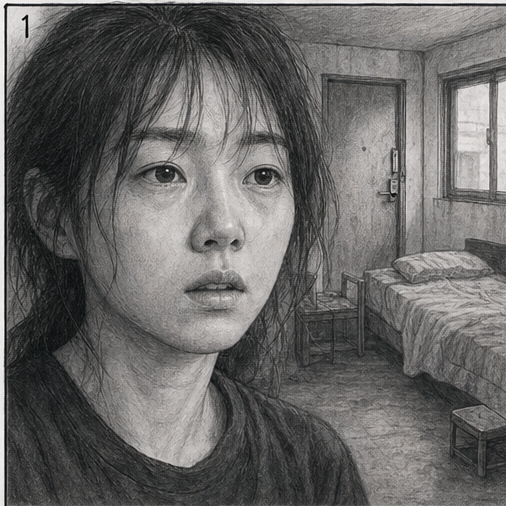
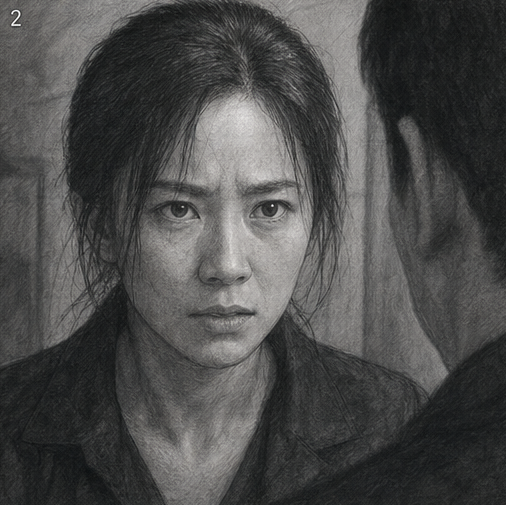
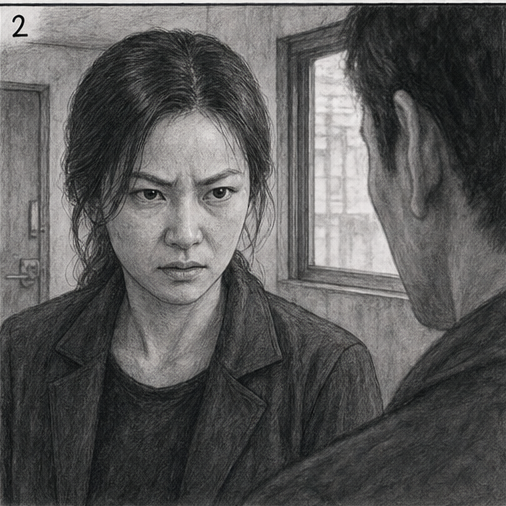
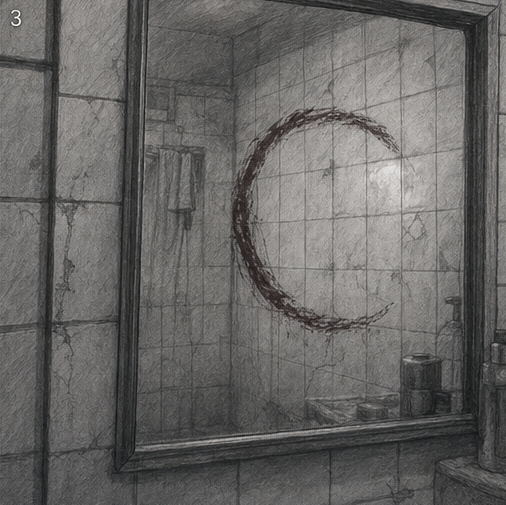
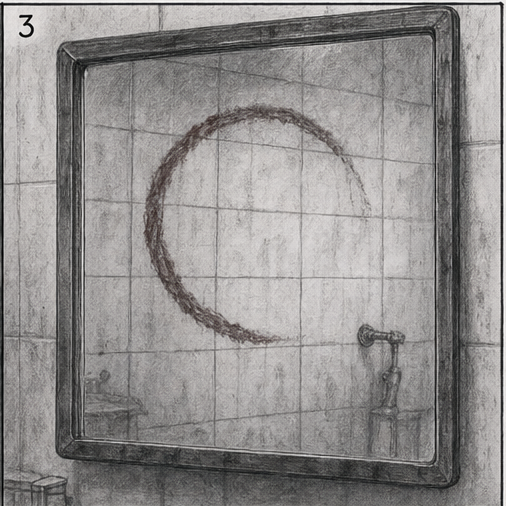
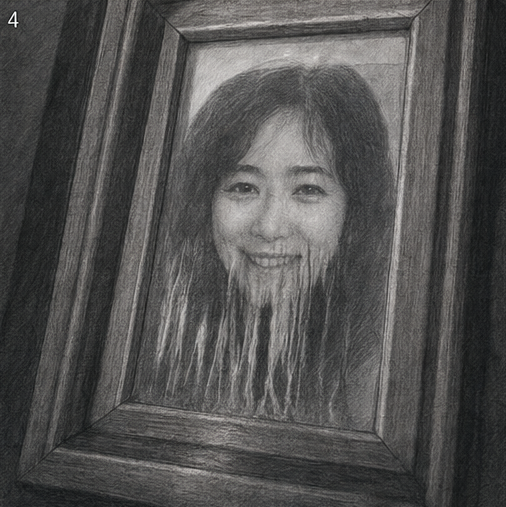
실험: s35 풀 런에서 옥탑 4그룹(외부·내부·계단·골목)은
같은 건물인데 콘티가 place_en 텍스트만 보고 그려져 건물 개체가
드리프트. 이번엔 production 2회차 W22 캐논 체인 산출
canon_bg_rooftop_villa_complex_master.png(nb2 3롤 → VLM 이중
판정 → 결함 수정)을 i2 콘티 생성에 BUILDING PHOTOGRAPH 참조로
첨부 — "패널이 이 건물의 어느 부분이라도 보여줄 땐 이 사진의 건축·
비례·고정물 위치를 따라 그려라(스타일·앵글은 복사 금지)". 좌=기존
s35(무참조) / 우=신규 s36(캐논 참조).
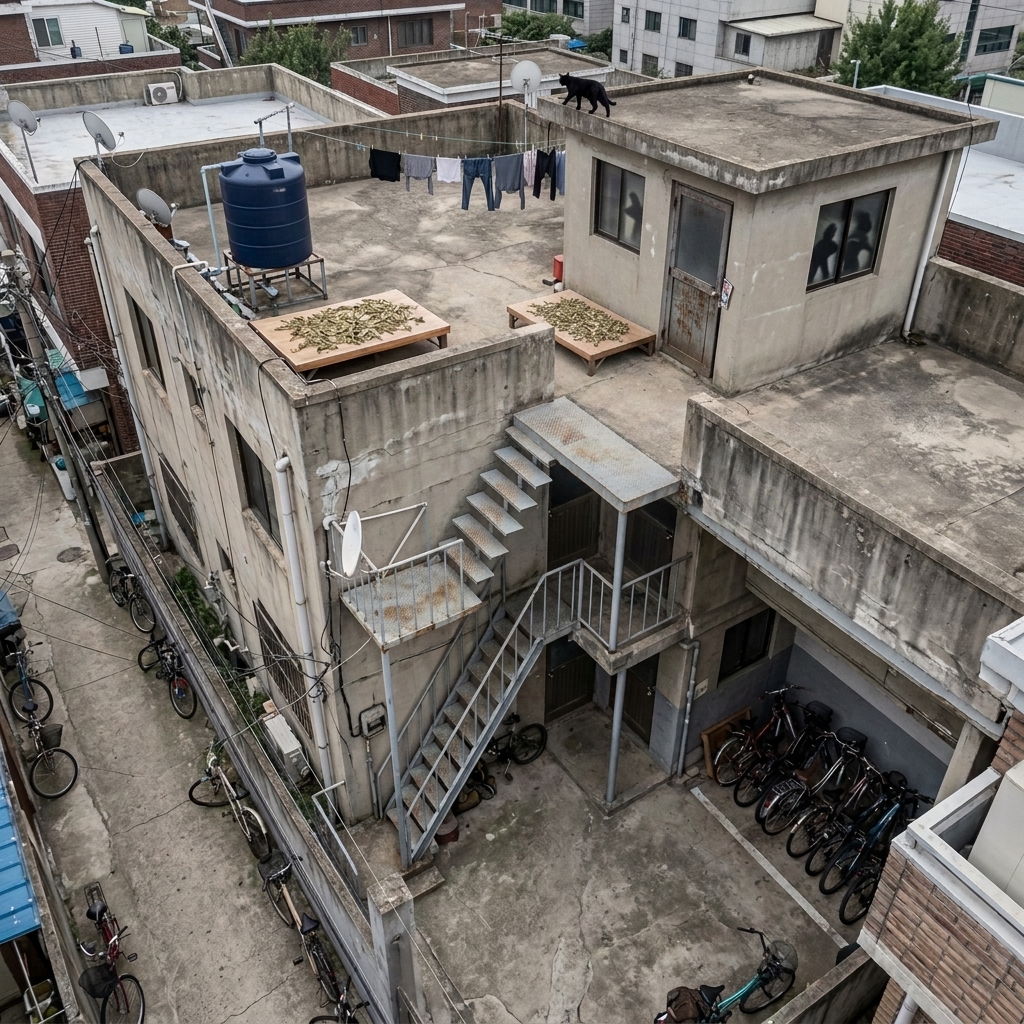
참조로 쓴 빌라 캐논
production 2회차(114a8883) outdoor_place_canon —
골목·마당(자전거)·외벽 철제 계단·옥탑방(문·창)·물탱크·빨래줄·낮은
난간이 한 프레임에 담긴 마스터. VLM(GPT+Gemini 합산) 판정 통과본.
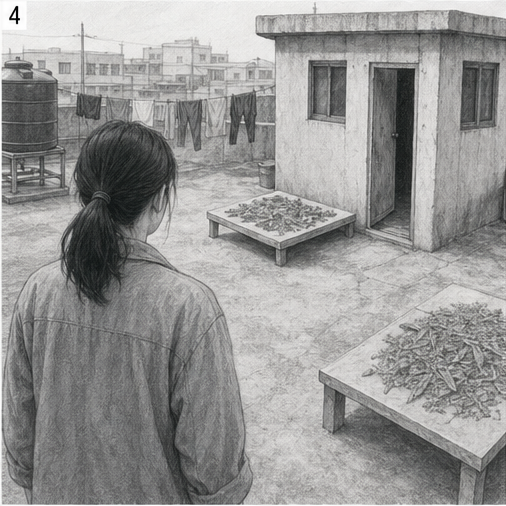
옥상·옥탑방 외부 (rooftop_room_exterior · 샷 5)
LOCATION lock: The flat rooftop of an aging low-rise apartment building, enclosed by a waist-high parapet. A small rooftop dwelling has a metal entrance door and a window visible from the open roof.
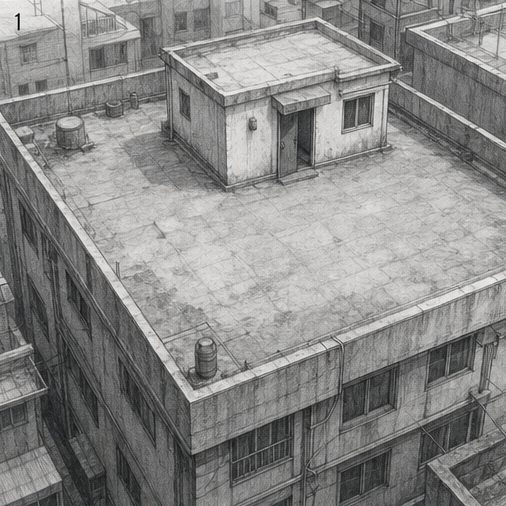
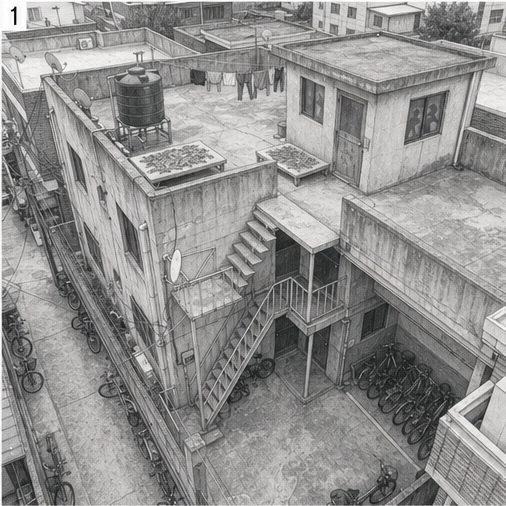
S4sh1 — 맑은 낮, 오래된 다세대 빌라 옥상 위에 자리 잡은 옥탑방을 높은 곳에서 내려다본 부감 구도
s35s36 캐논 참조
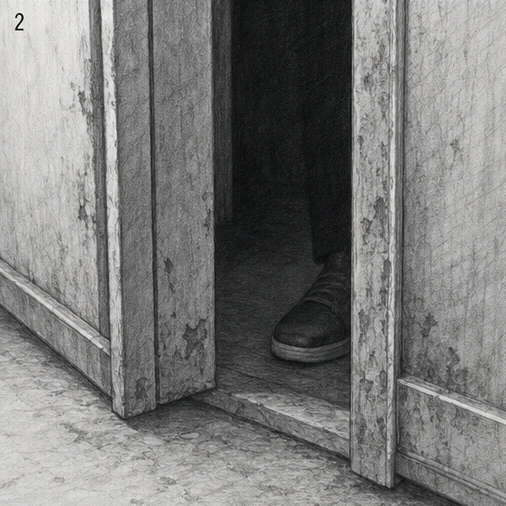
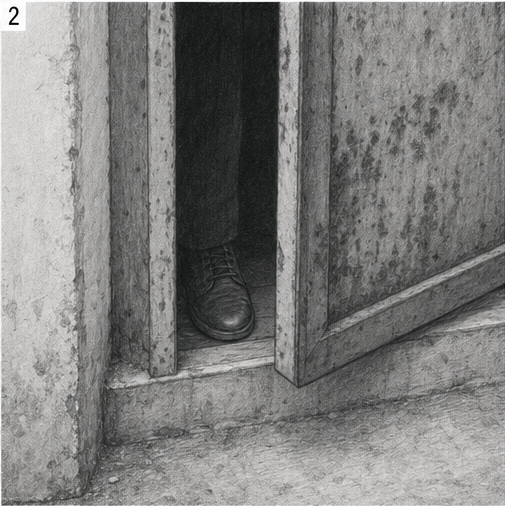
S10sh6 — 현관 철문이 아주 살짝 열린 틈새로 보이는 어두운 실내와 신발 앞코
s35s36 캐논 참조
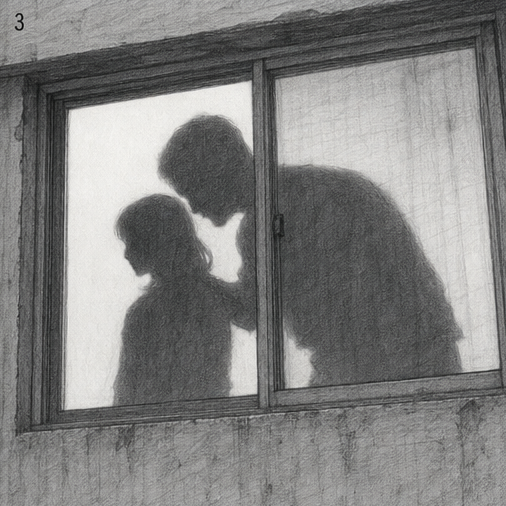
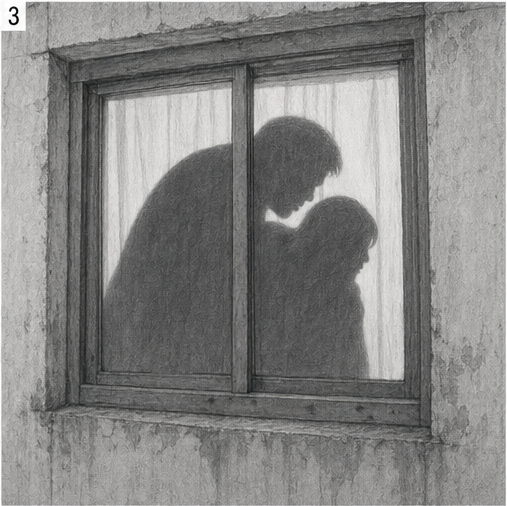
S10sh7 — 불이 켜진 옥탑방 창문에 거대한 그림자가 작은 그림자의 어깨 쪽으로 고개를 꺾은 형태가 맺혀 있는 정지 구도
s35s36 캐논 참조
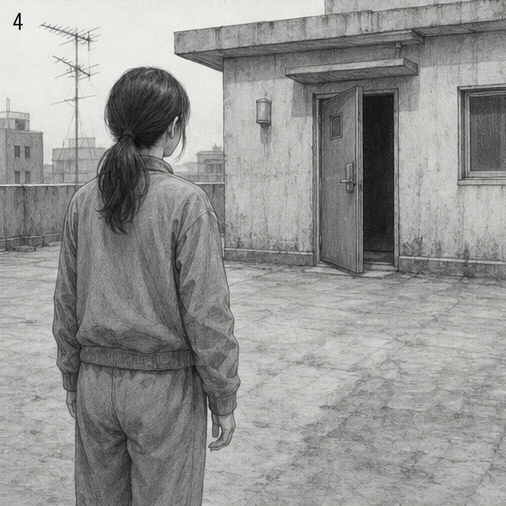
S11sh5 — 옥상에 선 수리영의 시선 끝에 반쯤 열려 있는 어두운 현관 철문이 보이는 정면 구도
s35s36 캐논 참조
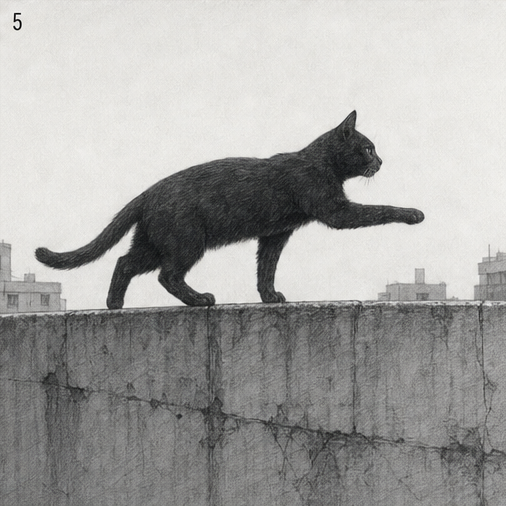
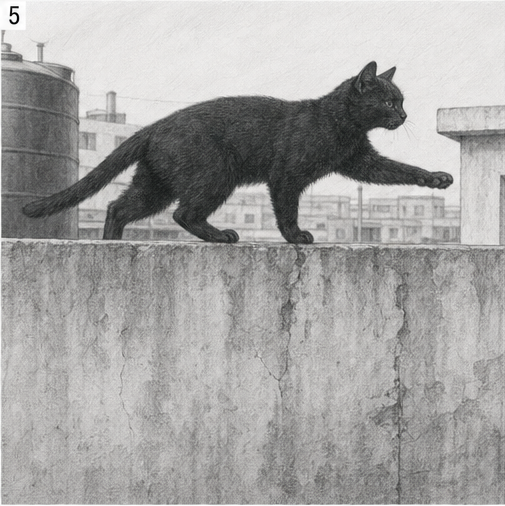
S17sh2 — 옥상 담벼락 위에서 한쪽 앞발을 허공으로 뻗은 검은 고양이의 측면
s35s36 캐논 참조
프롬프트 전문 (s36)
Draw ONE storyboard (conti) sheet: 6 panels made by TWO vertical cuts at exactly 1/3 and 2/3 of the width and ONE horizontal cut at exactly 50% of the height — a 3-column x 2-row grid, all six panels exactly equal.
STYLE: hand-drawn PRE-PRODUCTION STORYBOARD FOR A LIVE-ACTION FILM
SHOOT — the working drawings a professional film storyboard artist
makes for the director and cinematographer of a real movie:
REALISTIC adult human proportions and faces (ordinary Korean
adults, film-actor realism), true cinematic lens framing, and
naturalistic light-and-shadow blocking rendered in monochrome
graphite pencil tone on white paper.
ABSOLUTELY NOT manga, NOT anime, NOT cartoon, NOT webtoon, NOT
comic-book style: no stylized or enlarged eyes, no cute or
youthful idealized faces, no clean ink outlines — every panel
must read like a frame of a live-action film sketched in pencil.
No color anywhere.

THE LOCATION (same in all drawn panels): The flat rooftop of an aging low-rise apartment building, enclosed by a waist-high parapet. A small rooftop dwelling has a metal entrance door and a window visible from the open roof..

PURPOSE: each panel captures only the CAMERA COMPOSITION of one
shot — framing (close-up / medium / wide), where the subject sits in
the frame, and continuity between panels. Keep every panel
extremely simple: only what matters for composition.
MOVEMENT IS SHOWN BY THE FIGURE ITSELF, NEVER BY MARKINGS: convey
direction of travel purely through the body — stride mid-motion,
body lean into the path, back view vs front view, and the stated
size/depth cues. Do NOT draw arrows, motion lines, path lines,
speed lines or any diagram markings of any kind.

REALIZE FIGURATIVE LANGUAGE AS A LIVE-ACTION SHOT: the Korean shot
text may describe characters metaphorically, figuratively or with
exaggeration. Draw what a real movie camera would actually record
on a physical set — exaggerated or figurative impressions become
realistic staging choices (lighting, distance, angle, wardrobe),
not literal fantasy drawings.
EVERY CHARACTER IS A HUMAN BEING: unless the story explicitly
features non-human or virtual beings (as in science fiction or
fantasy), every character — however indirectly, vaguely or
figuratively the text describes them — IS a real human. When the
text gives no direct visual description of a person, IMAGINE one
and still draw them as a concrete, fully-formed human being:
always render the human form to the maximum extent — build,
posture, face, hands, clothing — never reduce a person to a shape,
blob, solid silhouette or abstract mass.

GEOMETRY — ANALYSE BEFORE DRAWING: from each panel's Korean shot
text, first work out the spatial facts and draw EXACTLY those, never
re-stage them: (a) each figure's DISTANCE from camera (tight insert /
close-up / medium / full / wide — a shot about a hand or an object
is a tight insert, not a two-shot); (b) each figure's FACING and
MOVEMENT DIRECTION relative to camera — '뒷모습' means seen from
BEHIND, moving AWAY from camera into the depth of the frame, not
sideways; a profile means lateral movement; (c) relative positions
and distances BETWEEN figures. Keep every established screen
direction consistent across panels (180-degree rule): a person who
leaves in one panel keeps the same on-screen direction wherever the
movement appears again.
SIZE & DEPTH ARE CONTRACTUAL: each panel states every figure's
apparent size in the frame and the explicit near/far depth order.
Draw exactly those proportions — a farther figure MUST be drawn
clearly smaller than a nearer one; never equalize figure sizes,
especially when several figures share a panel or their paths
relate to each other.
DEPARTING FIGURE — a figure running/walking AWAY must be
unmistakably departing, never approaching: seen exactly from behind
(back of the head only, no face, no chin, no cheek line), body
leaning into the path, mid-stride with one shoe sole toward the
camera. THE STATED SIZE/DEPTH WINS: draw the departing figure at
exactly the apparent size and depth the panel's FIGURES line states
(if stated FARTHER/small, it stays small in the distance — never
enlarge it into the foreground for drama).

CONTINUITY: all drawn panels are the SAME single location — fixed
features (doors, stairs, windows, poles, desks) keep the same
position and left/right relationships across panels so the panels
cut together as one continuous scene.

PANELS (one shot per panel, Korean shot text):

PANEL 1: 맑은 낮, 오래된 다세대 빌라 옥상 위에 자리 잡은 옥탑방을 높은 곳에서 내려다본 부감 구도
  MOVEMENT (follow exactly): static: No person is visible; the rooftop room remains fixed on top of the old multi-family villa beneath the high, downward-looking camera.
  FIGURES — apparent size & depth order (follow exactly): The rooftop room appears small, about ~1/6 of the frame height, and is FARTHER from the camera than the surrounding upper roof surfaces in the foreground.
PANEL 2: 현관 철문이 아주 살짝 열린 틈새로 보이는 어두운 실내와 신발 앞코
  MOVEMENT (follow exactly): The unknown man's shoe toe advances from the rooftop exterior through the narrowly opened iron doorway into the dark room, leading his unseen body inward.
  FIGURES — apparent size & depth order (follow exactly): The shoe toe is small, about ~1/10 of the frame height, and lies FARTHER from the camera than the NEARER iron door edges; the dark interior recedes farthest beyond it.
PANEL 3: 불이 켜진 옥탑방 창문에 거대한 그림자가 작은 그림자의 어깨 쪽으로 고개를 꺾은 형태가 맺혀 있는 정지 구도
  MOVEMENT (follow exactly): static: A real man appearing as a large dark silhouette, with normal human build, leans into Minsook and angles his head down toward her shoulder as she is caught beneath him.
  FIGURES — apparent size & depth order (follow exactly): The man's shadow fills roughly ~2/3 of the frame height, larger than Minsook's smaller shadow at about ~1/3; both people are FARTHER than the NEARER window surface, while their mutual camera-depth order is not established. Their silhouettes overlap at Minsook's shoulder, leaving almost no distance between their paths.
PANEL 4: 옥상에 선 수리영의 시선 끝에 반쯤 열려 있는 어두운 현관 철문이 보이는 정면 구도
  MOVEMENT (follow exactly): static: Suriyoung stands tensely on the rooftop with her body and gaze directed straight toward the half-open iron entrance door and its dark interior.
  FIGURES — apparent size & depth order (follow exactly): Suriyoung appears about ~1/2 of the frame height in the NEARER rooftop area, while the half-open door appears about ~1/3 and is FARTHER ahead along her line of sight.
PANEL 5: 옥상 담벼락 위에서 한쪽 앞발을 허공으로 뻗은 검은 고양이의 측면
  MOVEMENT (follow exactly): The black cat moves side-on across and over the rooftop wall toward the opposite side, extending one forepaw into the air as its body follows.
  FIGURES — apparent size & depth order (follow exactly): The cat appears medium-sized, about ~1/3 of the frame height, and is NEARER to the camera than the FARTHER side beyond the wall; the wall runs beneath its crossing path.

There are 5 shots but 6 panel slots: draw the shots in
panels 1..5 and leave the remaining panel(s) COMPLETELY
BLANK PURE WHITE — empty white paper, not even a frame line inside.

ABSOLUTELY NO TEXT anywhere: no words, letters, captions, labels,
sound effects or watermarks — the ONLY allowed marking is a small
shot number digit (1, 2, 3, 4, 5) in a corner INSIDE each drawn panel.
THE PANEL GRID FILLS THE ENTIRE IMAGE EDGE-TO-EDGE: no outer paper
margin, no border area, nothing drawn outside the panels — the
image must be mechanically cuttable along the stated cut lines.
Panels are separated only by thin straight black gutter lines at
the exact stated positions; ALL PANELS EXACTLY THE SAME SIZE.

REFERENCE (BUILDING PHOTOGRAPH — architectural grounding, not
style): the attached photograph shows the ACTUAL building where
every panel of this sheet takes place — an old Korean multi-unit
villa seen from above: a narrow ground-level alley and small
courtyard, an exterior steel staircase climbing the wall, and a
flat rooftop with a small rooftop room (its door and window), a
water tank, a clothesline and a low parapet.
Whenever a panel shows ANY part of this building — exterior walls,
the steel staircase, the rooftop, the rooftop room, the courtyard
or alley — draw THAT building: take its architecture, massing,
proportions, materials and the positions of its fixed features
(door, window, stairs, water tank, parapet) from this photograph,
translated into monochrome pencil storyboard drawing. Never invent
a different building and never contradict the photo's geometry.
For INTERIOR panels, stay consistent with this building's scale
and its window/door placement seen in the photo.
Do NOT copy the photograph's style, colors, camera angle or crop —
each panel keeps its own shot framing; the photo is spatial truth
only.
옥탑방 내부 (rooftop_room_interior · 샷 15)
LOCATION lock: A cramped, aging rooftop residence with a small living area, bedroom wall, sparse furniture, and a compact tiled bathroom. Fixed features include the metal entrance door, a window, a bed, and worn interior walls.
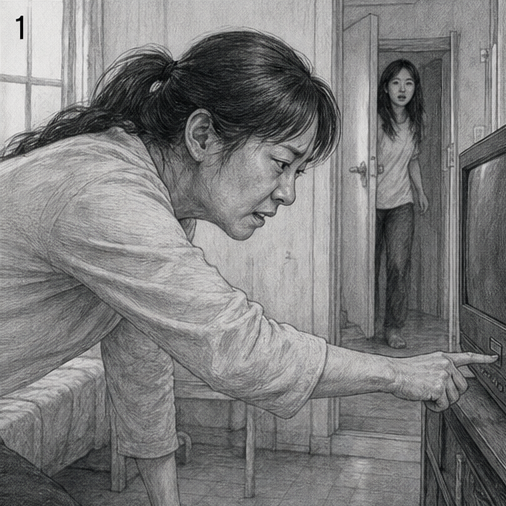
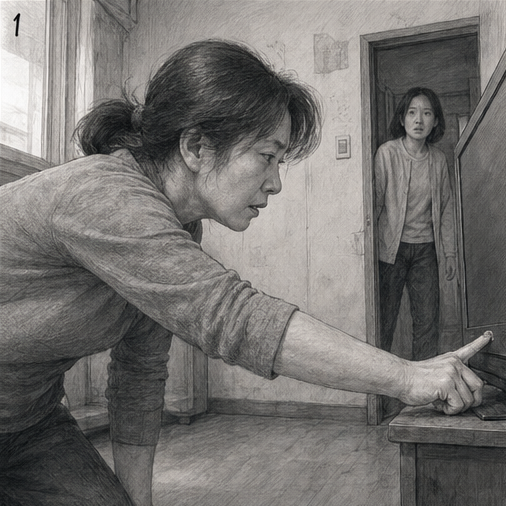
S5sh5 — 다급하게 상체를 기울이며 손가락 끝으로 TV 전원 버튼을 세게 누르고 있는 민숙의 측면 구도
s35s36 캐논 참조
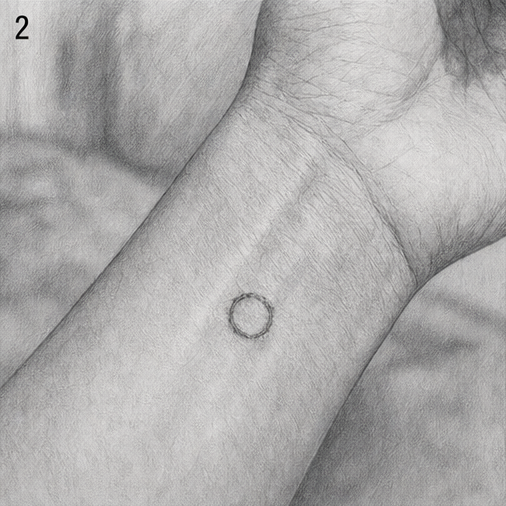
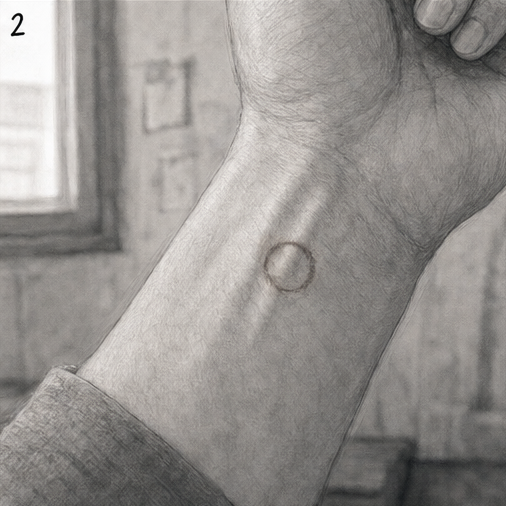
S5sh9 — 민숙의 손목에 선명하게 드러난 작은 원형 표식의 타이트 샷
s35s36 캐논 참조
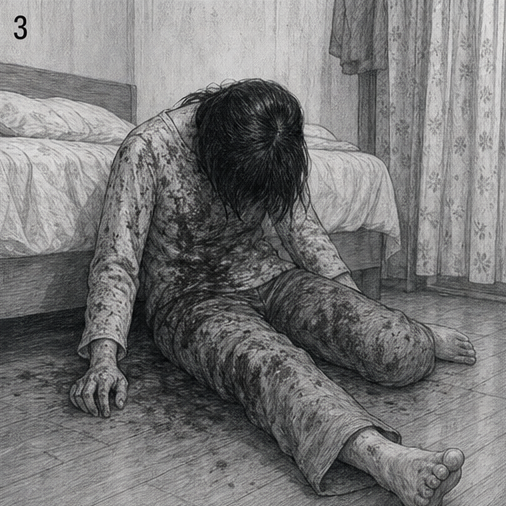
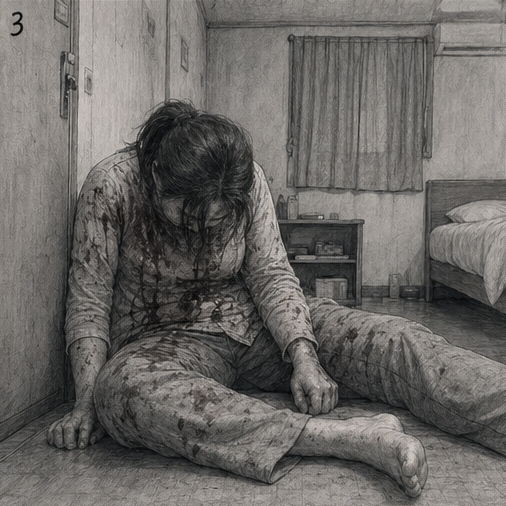
S12sh11 — 옷과 피부가 피투성이가 된 민숙이 바닥에 주저앉아 고개를 푹 숙인 정지 상태
s35s36 캐논 참조
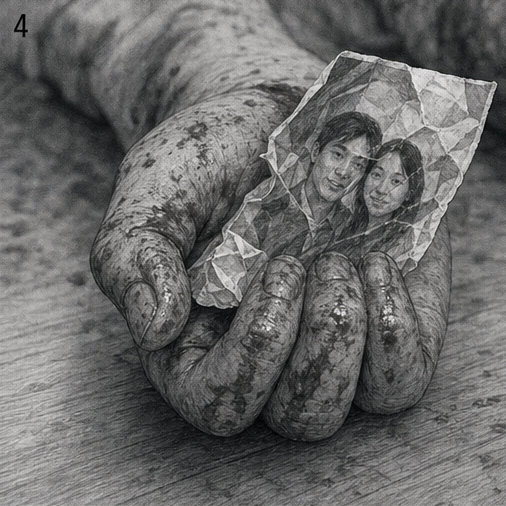
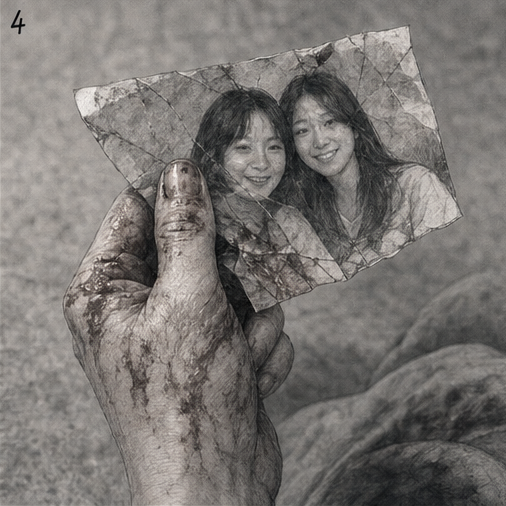
S12sh18 — 민숙의 손에 꽉 쥐어진 구겨진 사진의 타이트 샷
s35s36 캐논 참조
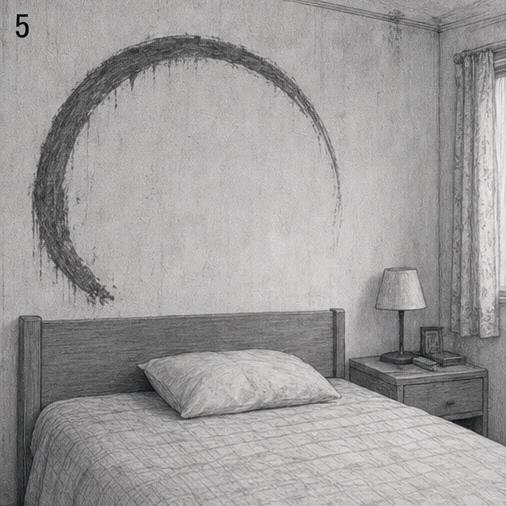
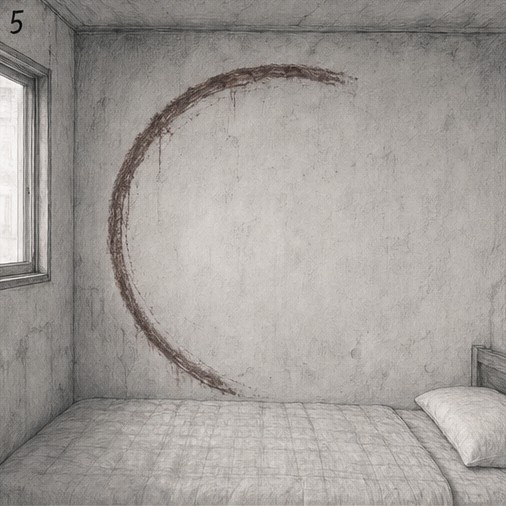
S12sh21 — 침대 위쪽 벽면에 붉은색 원형 표식이 절반쯤 나타난 상태
s35s36 캐논 참조
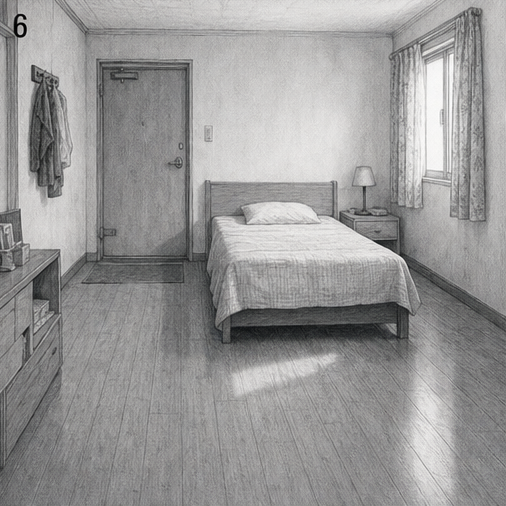
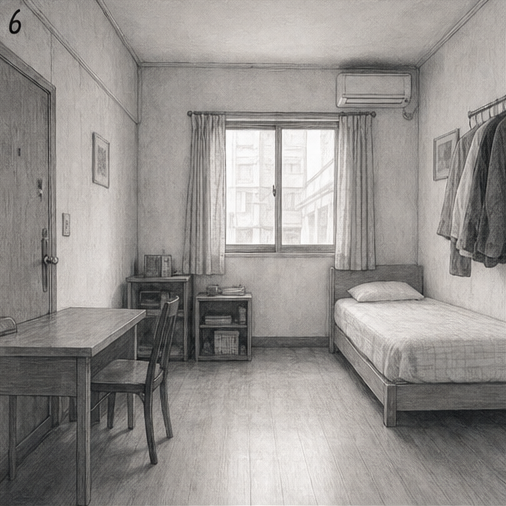
S14sh5 — 핏자국 없이 깨끗한 방 내부 전경
s35s36 캐논 참조
프롬프트 전문 (s36)
Draw ONE storyboard (conti) sheet: 6 panels made by TWO vertical cuts at exactly 1/3 and 2/3 of the width and ONE horizontal cut at exactly 50% of the height — a 3-column x 2-row grid, all six panels exactly equal.
STYLE: hand-drawn PRE-PRODUCTION STORYBOARD FOR A LIVE-ACTION FILM
SHOOT — the working drawings a professional film storyboard artist
makes for the director and cinematographer of a real movie:
REALISTIC adult human proportions and faces (ordinary Korean
adults, film-actor realism), true cinematic lens framing, and
naturalistic light-and-shadow blocking rendered in monochrome
graphite pencil tone on white paper.
ABSOLUTELY NOT manga, NOT anime, NOT cartoon, NOT webtoon, NOT
comic-book style: no stylized or enlarged eyes, no cute or
youthful idealized faces, no clean ink outlines — every panel
must read like a frame of a live-action film sketched in pencil.
No color anywhere.

THE LOCATION (same in all drawn panels): A cramped, aging rooftop residence with a small living area, bedroom wall, sparse furniture, and a compact tiled bathroom. Fixed features include the metal entrance door, a window, a bed, and worn interior walls..

PURPOSE: each panel captures only the CAMERA COMPOSITION of one
shot — framing (close-up / medium / wide), where the subject sits in
the frame, and continuity between panels. Keep every panel
extremely simple: only what matters for composition.
MOVEMENT IS SHOWN BY THE FIGURE ITSELF, NEVER BY MARKINGS: convey
direction of travel purely through the body — stride mid-motion,
body lean into the path, back view vs front view, and the stated
size/depth cues. Do NOT draw arrows, motion lines, path lines,
speed lines or any diagram markings of any kind.

REALIZE FIGURATIVE LANGUAGE AS A LIVE-ACTION SHOT: the Korean shot
text may describe characters metaphorically, figuratively or with
exaggeration. Draw what a real movie camera would actually record
on a physical set — exaggerated or figurative impressions become
realistic staging choices (lighting, distance, angle, wardrobe),
not literal fantasy drawings.
EVERY CHARACTER IS A HUMAN BEING: unless the story explicitly
features non-human or virtual beings (as in science fiction or
fantasy), every character — however indirectly, vaguely or
figuratively the text describes them — IS a real human. When the
text gives no direct visual description of a person, IMAGINE one
and still draw them as a concrete, fully-formed human being:
always render the human form to the maximum extent — build,
posture, face, hands, clothing — never reduce a person to a shape,
blob, solid silhouette or abstract mass.

GEOMETRY — ANALYSE BEFORE DRAWING: from each panel's Korean shot
text, first work out the spatial facts and draw EXACTLY those, never
re-stage them: (a) each figure's DISTANCE from camera (tight insert /
close-up / medium / full / wide — a shot about a hand or an object
is a tight insert, not a two-shot); (b) each figure's FACING and
MOVEMENT DIRECTION relative to camera — '뒷모습' means seen from
BEHIND, moving AWAY from camera into the depth of the frame, not
sideways; a profile means lateral movement; (c) relative positions
and distances BETWEEN figures. Keep every established screen
direction consistent across panels (180-degree rule): a person who
leaves in one panel keeps the same on-screen direction wherever the
movement appears again.
SIZE & DEPTH ARE CONTRACTUAL: each panel states every figure's
apparent size in the frame and the explicit near/far depth order.
Draw exactly those proportions — a farther figure MUST be drawn
clearly smaller than a nearer one; never equalize figure sizes,
especially when several figures share a panel or their paths
relate to each other.
DEPARTING FIGURE — a figure running/walking AWAY must be
unmistakably departing, never approaching: seen exactly from behind
(back of the head only, no face, no chin, no cheek line), body
leaning into the path, mid-stride with one shoe sole toward the
camera. THE STATED SIZE/DEPTH WINS: draw the departing figure at
exactly the apparent size and depth the panel's FIGURES line states
(if stated FARTHER/small, it stays small in the distance — never
enlarge it into the foreground for drama).

CONTINUITY: all drawn panels are the SAME single location — fixed
features (doors, stairs, windows, poles, desks) keep the same
position and left/right relationships across panels so the panels
cut together as one continuous scene.

PANELS (one shot per panel, Korean shot text):

PANEL 1: 다급하게 상체를 기울이며 손가락 끝으로 TV 전원 버튼을 세게 누르고 있는 민숙의 측면 구도
  MOVEMENT (follow exactly): Min-sook urgently pitches her upper body forward toward the TV and forcefully drives a fingertip into its power button to turn it off as Su-ri-young emerges from her room.
  FIGURES — apparent size & depth order (follow exactly): Min-sook's side-view upper body fills roughly 2/3 of the frame height, with her reaching hand and the TV button NEARER to the camera than her face and torso. The TV is FARTHER along her forward reach, and her body closes the short distance toward it.
PANEL 2: 민숙의 손목에 선명하게 드러난 작은 원형 표식의 타이트 샷
  MOVEMENT (follow exactly): static: Min-sook's wrist is held in view, with the sharply visible small circular mark facing the camera.
  FIGURES — apparent size & depth order (follow exactly): The wrist fills most of the tight frame, while the circular mark occupies a small area at its center. The skin and mark are the NEAREST and only principal subject, with any body or room detail FARTHER and out of focus.
PANEL 3: 옷과 피부가 피투성이가 된 민숙이 바닥에 주저앉아 고개를 푹 숙인 정지 상태
  MOVEMENT (follow exactly): static: lifeless Min-sook is collapsed against the floor in an asymmetric seated slump, her head dropped deeply forward, shoulders fallen, limbs limp, and body weight fully given way.
  FIGURES — apparent size & depth order (follow exactly): Min-sook's blood-covered body fills about 2/3 of the frame height and is the NEAREST principal figure. The floor directly beneath her is nearer than the surrounding bedroom and curtain area, which recede FARTHER behind her.
PANEL 4: 민숙의 손에 꽉 쥐어진 구겨진 사진의 타이트 샷
  MOVEMENT (follow exactly): static: lifeless Min-sook's limp hand remains curled tightly around a crumpled photograph, with the photograph exposed toward the camera.
  FIGURES — apparent size & depth order (follow exactly): The dead woman's hand fills roughly 2/3 of the tight frame, and the crumpled photograph fills about 1/3. The photograph is NEARER where it protrudes from her grasp, while her palm, wrist, and collapsed body lie progressively FARTHER behind it.
PANEL 5: 침대 위쪽 벽면에 붉은색 원형 표식이 절반쯤 나타난 상태
  MOVEMENT (follow exactly): A red circular mark spreads around the wall above the bed, progressing along a ring-like path as though an unseen brush is drawing it, with about half the circle formed.
  FIGURES — apparent size & depth order (follow exactly): The half-formed red circle fills roughly 1/2 of the frame height on the wall and is the principal visible object. The wall surface and mark are FARTHER than the nearer edge of the bed, with the red pigment visually sitting closest on that wall plane.
PANEL 6: 핏자국 없이 깨끗한 방 내부 전경
  MOVEMENT (follow exactly): static: the excessively tidy bedroom stands empty, with no bloodstains, red wall mark, or collapsed body remaining anywhere in the room.
  FIGURES — apparent size & depth order (follow exactly): The empty room fills the full frame; nearer floor and furniture edges occupy the foreground, while the bed, curtain, and clean back wall are FARTHER away. No person is visible, and the formerly occupied curtain area is now empty.

ABSOLUTELY NO TEXT anywhere: no words, letters, captions, labels,
sound effects or watermarks — the ONLY allowed marking is a small
shot number digit (1, 2, 3, 4, 5, 6) in a corner INSIDE each drawn panel.
THE PANEL GRID FILLS THE ENTIRE IMAGE EDGE-TO-EDGE: no outer paper
margin, no border area, nothing drawn outside the panels — the
image must be mechanically cuttable along the stated cut lines.
Panels are separated only by thin straight black gutter lines at
the exact stated positions; ALL PANELS EXACTLY THE SAME SIZE.

REFERENCE (BUILDING PHOTOGRAPH — architectural grounding, not
style): the attached photograph shows the ACTUAL building where
every panel of this sheet takes place — an old Korean multi-unit
villa seen from above: a narrow ground-level alley and small
courtyard, an exterior steel staircase climbing the wall, and a
flat rooftop with a small rooftop room (its door and window), a
water tank, a clothesline and a low parapet.
Whenever a panel shows ANY part of this building — exterior walls,
the steel staircase, the rooftop, the rooftop room, the courtyard
or alley — draw THAT building: take its architecture, massing,
proportions, materials and the positions of its fixed features
(door, window, stairs, water tank, parapet) from this photograph,
translated into monochrome pencil storyboard drawing. Never invent
a different building and never contradict the photo's geometry.
For INTERIOR panels, stay consistent with this building's scale
and its window/door placement seen in the photo.
Do NOT copy the photograph's style, colors, camera angle or crop —
each panel keeps its own shot framing; the photo is spatial truth
only.
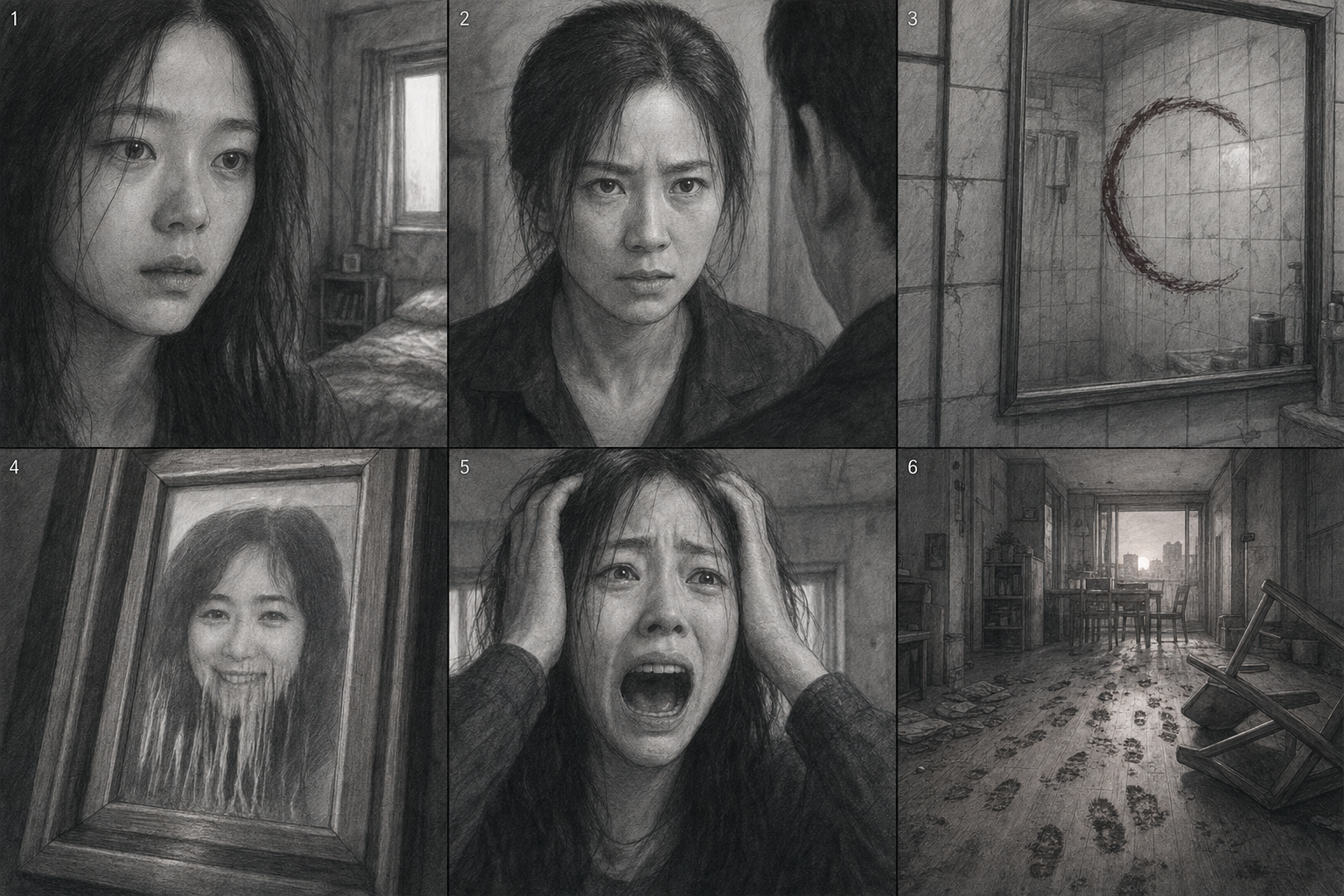
S18sh11 — 거울 속 반사된 욕실 타일 벽면에 붉은색 원형 표식이 절반쯤 나타난 상태
s35s36 캐논 참조
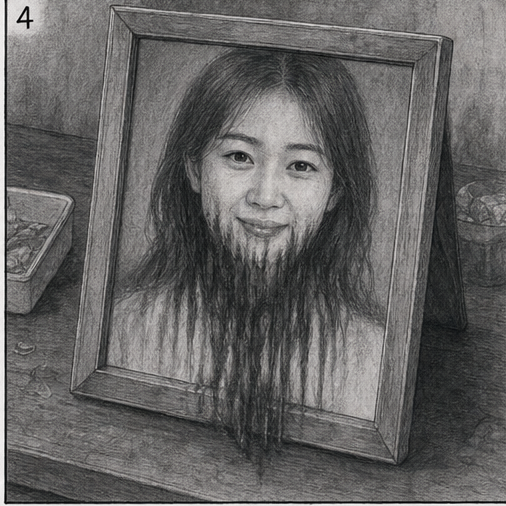
S18sh15 — 액자 속 민숙의 얼굴 부분 이미지가 아래로 일그러지며 흘러내리는 찰나
s35s36 캐논 참조
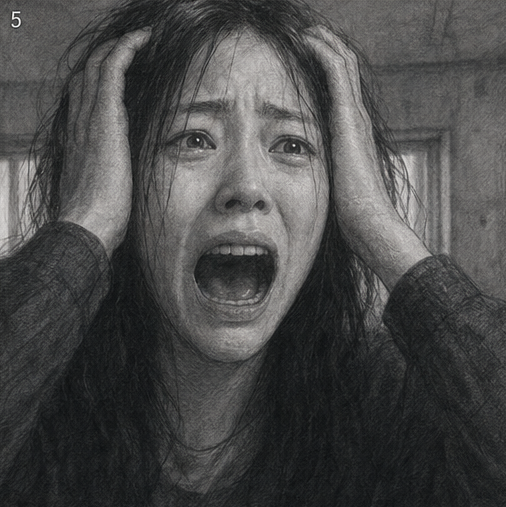
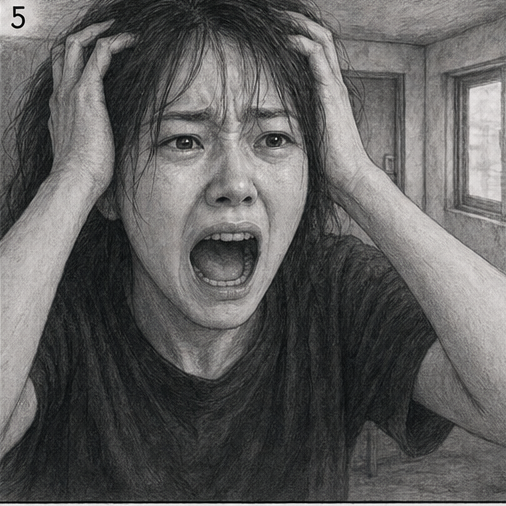
S18sh16 — 수리영이 두 손으로 머리를 감싸 쥐고 입을 크게 벌린 얼굴
s35s36 캐논 참조
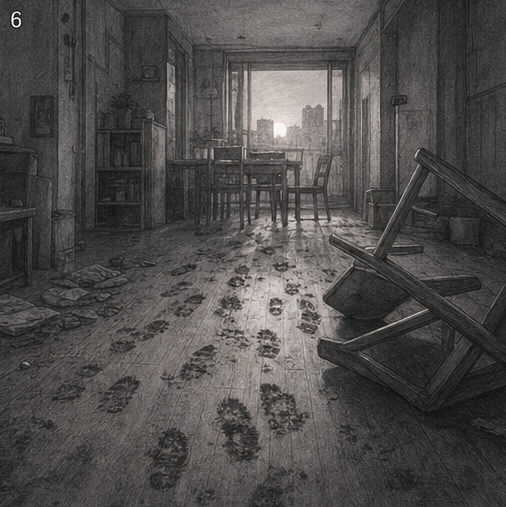
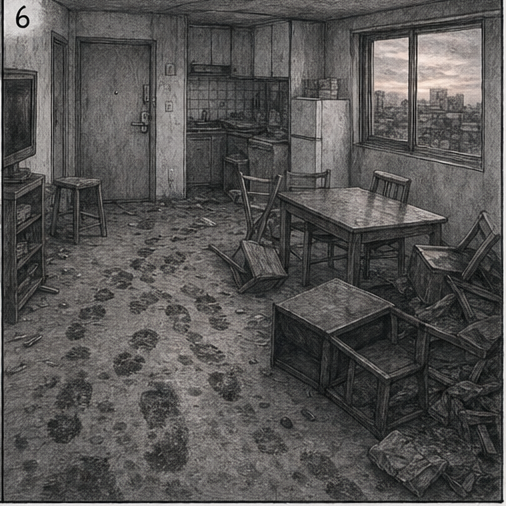
S25sh1 — 해질 무렵 옥탑방 거실, 흙 묻은 발자국들이 찍힌 바닥과 쓰러진 식탁 의자들이 보이는 전경
s35s36 캐논 참조
프롬프트 전문 (s36)
Draw ONE storyboard (conti) sheet: 6 panels made by TWO vertical cuts at exactly 1/3 and 2/3 of the width and ONE horizontal cut at exactly 50% of the height — a 3-column x 2-row grid, all six panels exactly equal.
STYLE: hand-drawn PRE-PRODUCTION STORYBOARD FOR A LIVE-ACTION FILM
SHOOT — the working drawings a professional film storyboard artist
makes for the director and cinematographer of a real movie:
REALISTIC adult human proportions and faces (ordinary Korean
adults, film-actor realism), true cinematic lens framing, and
naturalistic light-and-shadow blocking rendered in monochrome
graphite pencil tone on white paper.
ABSOLUTELY NOT manga, NOT anime, NOT cartoon, NOT webtoon, NOT
comic-book style: no stylized or enlarged eyes, no cute or
youthful idealized faces, no clean ink outlines — every panel
must read like a frame of a live-action film sketched in pencil.
No color anywhere.

THE LOCATION (same in all drawn panels): A cramped, aging rooftop residence with a small living area, bedroom wall, sparse furniture, and a compact tiled bathroom. Fixed features include the metal entrance door, a window, a bed, and worn interior walls..

PURPOSE: each panel captures only the CAMERA COMPOSITION of one
shot — framing (close-up / medium / wide), where the subject sits in
the frame, and continuity between panels. Keep every panel
extremely simple: only what matters for composition.
MOVEMENT IS SHOWN BY THE FIGURE ITSELF, NEVER BY MARKINGS: convey
direction of travel purely through the body — stride mid-motion,
body lean into the path, back view vs front view, and the stated
size/depth cues. Do NOT draw arrows, motion lines, path lines,
speed lines or any diagram markings of any kind.

REALIZE FIGURATIVE LANGUAGE AS A LIVE-ACTION SHOT: the Korean shot
text may describe characters metaphorically, figuratively or with
exaggeration. Draw what a real movie camera would actually record
on a physical set — exaggerated or figurative impressions become
realistic staging choices (lighting, distance, angle, wardrobe),
not literal fantasy drawings.
EVERY CHARACTER IS A HUMAN BEING: unless the story explicitly
features non-human or virtual beings (as in science fiction or
fantasy), every character — however indirectly, vaguely or
figuratively the text describes them — IS a real human. When the
text gives no direct visual description of a person, IMAGINE one
and still draw them as a concrete, fully-formed human being:
always render the human form to the maximum extent — build,
posture, face, hands, clothing — never reduce a person to a shape,
blob, solid silhouette or abstract mass.

GEOMETRY — ANALYSE BEFORE DRAWING: from each panel's Korean shot
text, first work out the spatial facts and draw EXACTLY those, never
re-stage them: (a) each figure's DISTANCE from camera (tight insert /
close-up / medium / full / wide — a shot about a hand or an object
is a tight insert, not a two-shot); (b) each figure's FACING and
MOVEMENT DIRECTION relative to camera — '뒷모습' means seen from
BEHIND, moving AWAY from camera into the depth of the frame, not
sideways; a profile means lateral movement; (c) relative positions
and distances BETWEEN figures. Keep every established screen
direction consistent across panels (180-degree rule): a person who
leaves in one panel keeps the same on-screen direction wherever the
movement appears again.
SIZE & DEPTH ARE CONTRACTUAL: each panel states every figure's
apparent size in the frame and the explicit near/far depth order.
Draw exactly those proportions — a farther figure MUST be drawn
clearly smaller than a nearer one; never equalize figure sizes,
especially when several figures share a panel or their paths
relate to each other.
DEPARTING FIGURE — a figure running/walking AWAY must be
unmistakably departing, never approaching: seen exactly from behind
(back of the head only, no face, no chin, no cheek line), body
leaning into the path, mid-stride with one shoe sole toward the
camera. THE STATED SIZE/DEPTH WINS: draw the departing figure at
exactly the apparent size and depth the panel's FIGURES line states
(if stated FARTHER/small, it stays small in the distance — never
enlarge it into the foreground for drama).

CONTINUITY: all drawn panels are the SAME single location — fixed
features (doors, stairs, windows, poles, desks) keep the same
position and left/right relationships across panels so the panels
cut together as one continuous scene.

PANELS (one shot per panel, Korean shot text):

PANEL 1: 수리영이 멍한 눈으로 텅 빈 방 안을 응시하는 얼굴 클로즈업
  MOVEMENT (follow exactly): static: pale-faced Su-ri-young holds her body rigid and stares blankly into the empty bedroom where she expected to find her mother's body.
  FIGURES — apparent size & depth order (follow exactly): Su-ri-young's face fills about 2/3 of the frame height and is the NEAREST figure. The empty room she watches is FARTHER beyond her eyeline, with no other person visible.
PANEL 2: 혜수가 날카로운 눈빛으로 김형사를 노려보는 모습
  MOVEMENT (follow exactly): static: Hye-su fixes a sharp, hostile stare toward Detective Kim, her face and body oriented directly at him.
  FIGURES — apparent size & depth order (follow exactly): Hye-su fills roughly 2/3 of the frame height and is the NEAREST visible figure. Detective Kim is the FARTHER target of her gaze, whether at the edge of the frame or just off-screen, with no crossing movement between them.
PANEL 3: 거울 속 반사된 욕실 타일 벽면에 붉은색 원형 표식이 절반쯤 나타난 상태
  MOVEMENT (follow exactly): A red circular mark suddenly develops across the bathroom tile wall seen in the mirror, extending around a ring-like path until roughly half is visible.
  FIGURES — apparent size & depth order (follow exactly): The mirror and reflected tiled wall fill most of the frame, while the half-formed red circle occupies about 1/2 of the reflected frame height. The mirror surface is physically NEARER to the camera, while the marked bathroom wall appears FARTHER within the reflection.
PANEL 4: 액자 속 민숙의 얼굴 부분 이미지가 아래로 일그러지며 흘러내리는 찰나
  MOVEMENT (follow exactly): The image of Min-sook's smiling face inside the framed photograph distorts and flows downward before Su-ri-young's eyes.
  FIGURES — apparent size & depth order (follow exactly): The framed photograph fills most of the close frame, and Min-sook's pictured face occupies roughly 1/2 of its height. The photograph's glass and frame are NEARER to the camera, while the collapsing facial image is visually FARTHER beneath the surface.
PANEL 5: 수리영이 두 손으로 머리를 감싸 쥐고 입을 크게 벌린 얼굴
  MOVEMENT (follow exactly): static: terrified and overwhelmed, Su-ri-young clamps both hands around her head and holds her mouth wide open in a scream, her posture rigid with panic.
  FIGURES — apparent size & depth order (follow exactly): Su-ri-young's face and hands fill about 3/4 of the frame height and form the NEAREST subject. Her hands sit slightly NEARER than her face on either side, while the room behind her is FARTHER and secondary.
PANEL 6: 해질 무렵 옥탑방 거실, 흙 묻은 발자국들이 찍힌 바닥과 쓰러진 식탁 의자들이 보이는 전경
  MOVEMENT (follow exactly): static: muddy footprints remain across the ransacked living-room floor among overturned dining chairs, indicating a prior path through the room but no current movement.
  FIGURES — apparent size & depth order (follow exactly): The footprint-marked floor fills the lower half of the wide frame, with the NEAREST prints and fallen chair parts in the foreground appearing larger. Additional prints, the dining area, and the open living-room window recede FARTHER into the room.

ABSOLUTELY NO TEXT anywhere: no words, letters, captions, labels,
sound effects or watermarks — the ONLY allowed marking is a small
shot number digit (1, 2, 3, 4, 5, 6) in a corner INSIDE each drawn panel.
THE PANEL GRID FILLS THE ENTIRE IMAGE EDGE-TO-EDGE: no outer paper
margin, no border area, nothing drawn outside the panels — the
image must be mechanically cuttable along the stated cut lines.
Panels are separated only by thin straight black gutter lines at
the exact stated positions; ALL PANELS EXACTLY THE SAME SIZE.

REFERENCE (BUILDING PHOTOGRAPH — architectural grounding, not
style): the attached photograph shows the ACTUAL building where
every panel of this sheet takes place — an old Korean multi-unit
villa seen from above: a narrow ground-level alley and small
courtyard, an exterior steel staircase climbing the wall, and a
flat rooftop with a small rooftop room (its door and window), a
water tank, a clothesline and a low parapet.
Whenever a panel shows ANY part of this building — exterior walls,
the steel staircase, the rooftop, the rooftop room, the courtyard
or alley — draw THAT building: take its architecture, massing,
proportions, materials and the positions of its fixed features
(door, window, stairs, water tank, parapet) from this photograph,
translated into monochrome pencil storyboard drawing. Never invent
a different building and never contradict the photo's geometry.
For INTERIOR panels, stay consistent with this building's scale
and its window/door placement seen in the photo.
Do NOT copy the photograph's style, colors, camera angle or crop —
each panel keeps its own shot framing; the photo is spatial truth
only.
Draw ONE storyboard (conti) sheet: 4 panels made by ONE vertical cut at exactly 50% of the width and ONE horizontal cut at exactly 50% of the height — a 2x2 grid, each panel exactly one quarter of the image.
STYLE: hand-drawn PRE-PRODUCTION STORYBOARD FOR A LIVE-ACTION FILM
SHOOT — the working drawings a professional film storyboard artist
makes for the director and cinematographer of a real movie:
REALISTIC adult human proportions and faces (ordinary Korean
adults, film-actor realism), true cinematic lens framing, and
naturalistic light-and-shadow blocking rendered in monochrome
graphite pencil tone on white paper.
ABSOLUTELY NOT manga, NOT anime, NOT cartoon, NOT webtoon, NOT
comic-book style: no stylized or enlarged eyes, no cute or
youthful idealized faces, no clean ink outlines — every panel
must read like a frame of a live-action film sketched in pencil.
No color anywhere.

THE LOCATION (same in all drawn panels): A cramped, aging rooftop residence with a small living area, bedroom wall, sparse furniture, and a compact tiled bathroom. Fixed features include the metal entrance door, a window, a bed, and worn interior walls..

PURPOSE: each panel captures only the CAMERA COMPOSITION of one
shot — framing (close-up / medium / wide), where the subject sits in
the frame, and continuity between panels. Keep every panel
extremely simple: only what matters for composition.
MOVEMENT IS SHOWN BY THE FIGURE ITSELF, NEVER BY MARKINGS: convey
direction of travel purely through the body — stride mid-motion,
body lean into the path, back view vs front view, and the stated
size/depth cues. Do NOT draw arrows, motion lines, path lines,
speed lines or any diagram markings of any kind.

REALIZE FIGURATIVE LANGUAGE AS A LIVE-ACTION SHOT: the Korean shot
text may describe characters metaphorically, figuratively or with
exaggeration. Draw what a real movie camera would actually record
on a physical set — exaggerated or figurative impressions become
realistic staging choices (lighting, distance, angle, wardrobe),
not literal fantasy drawings.
EVERY CHARACTER IS A HUMAN BEING: unless the story explicitly
features non-human or virtual beings (as in science fiction or
fantasy), every character — however indirectly, vaguely or
figuratively the text describes them — IS a real human. When the
text gives no direct visual description of a person, IMAGINE one
and still draw them as a concrete, fully-formed human being:
always render the human form to the maximum extent — build,
posture, face, hands, clothing — never reduce a person to a shape,
blob, solid silhouette or abstract mass.

GEOMETRY — ANALYSE BEFORE DRAWING: from each panel's Korean shot
text, first work out the spatial facts and draw EXACTLY those, never
re-stage them: (a) each figure's DISTANCE from camera (tight insert /
close-up / medium / full / wide — a shot about a hand or an object
is a tight insert, not a two-shot); (b) each figure's FACING and
MOVEMENT DIRECTION relative to camera — '뒷모습' means seen from
BEHIND, moving AWAY from camera into the depth of the frame, not
sideways; a profile means lateral movement; (c) relative positions
and distances BETWEEN figures. Keep every established screen
direction consistent across panels (180-degree rule): a person who
leaves in one panel keeps the same on-screen direction wherever the
movement appears again.
SIZE & DEPTH ARE CONTRACTUAL: each panel states every figure's
apparent size in the frame and the explicit near/far depth order.
Draw exactly those proportions — a farther figure MUST be drawn
clearly smaller than a nearer one; never equalize figure sizes,
especially when several figures share a panel or their paths
relate to each other.
DEPARTING FIGURE — a figure running/walking AWAY must be
unmistakably departing, never approaching: seen exactly from behind
(back of the head only, no face, no chin, no cheek line), body
leaning into the path, mid-stride with one shoe sole toward the
camera. THE STATED SIZE/DEPTH WINS: draw the departing figure at
exactly the apparent size and depth the panel's FIGURES line states
(if stated FARTHER/small, it stays small in the distance — never
enlarge it into the foreground for drama).

CONTINUITY: all drawn panels are the SAME single location — fixed
features (doors, stairs, windows, poles, desks) keep the same
position and left/right relationships across panels so the panels
cut together as one continuous scene.

PANELS (one shot per panel, Korean shot text):

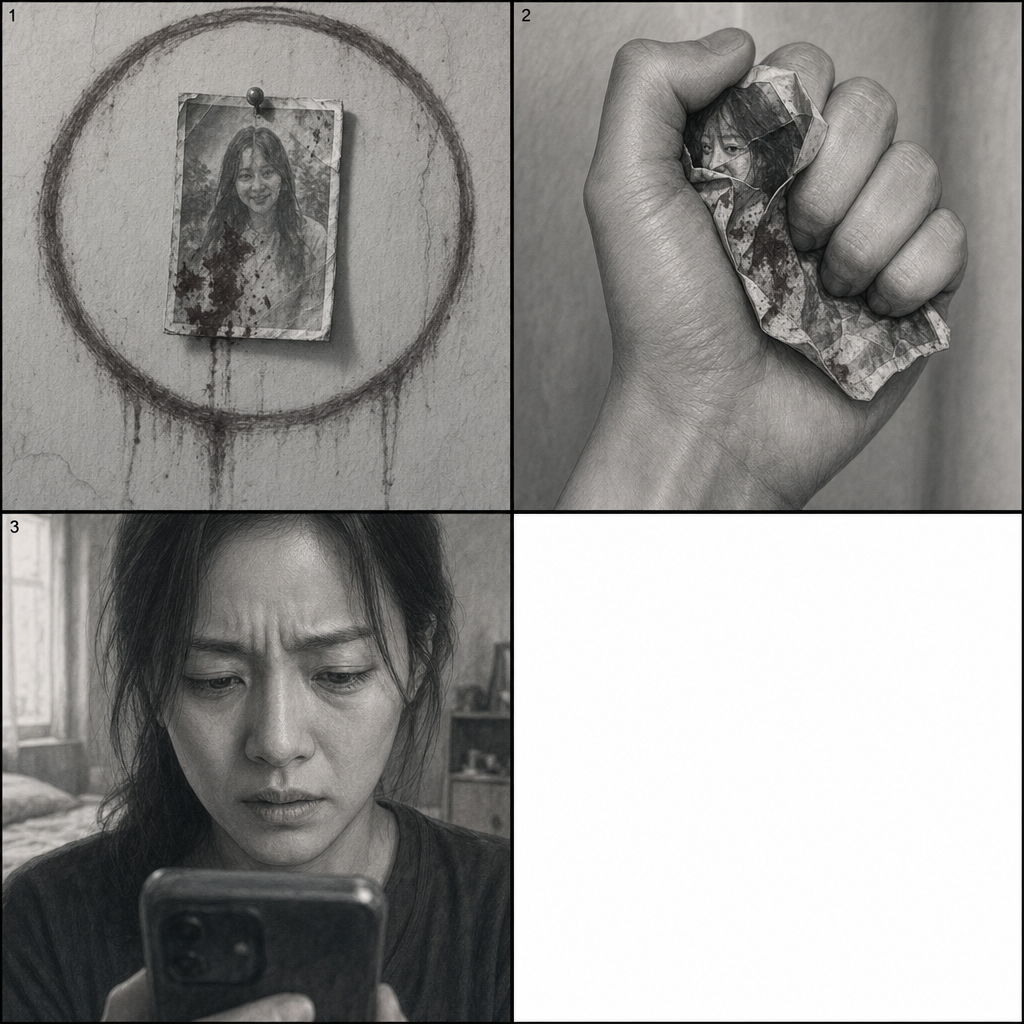
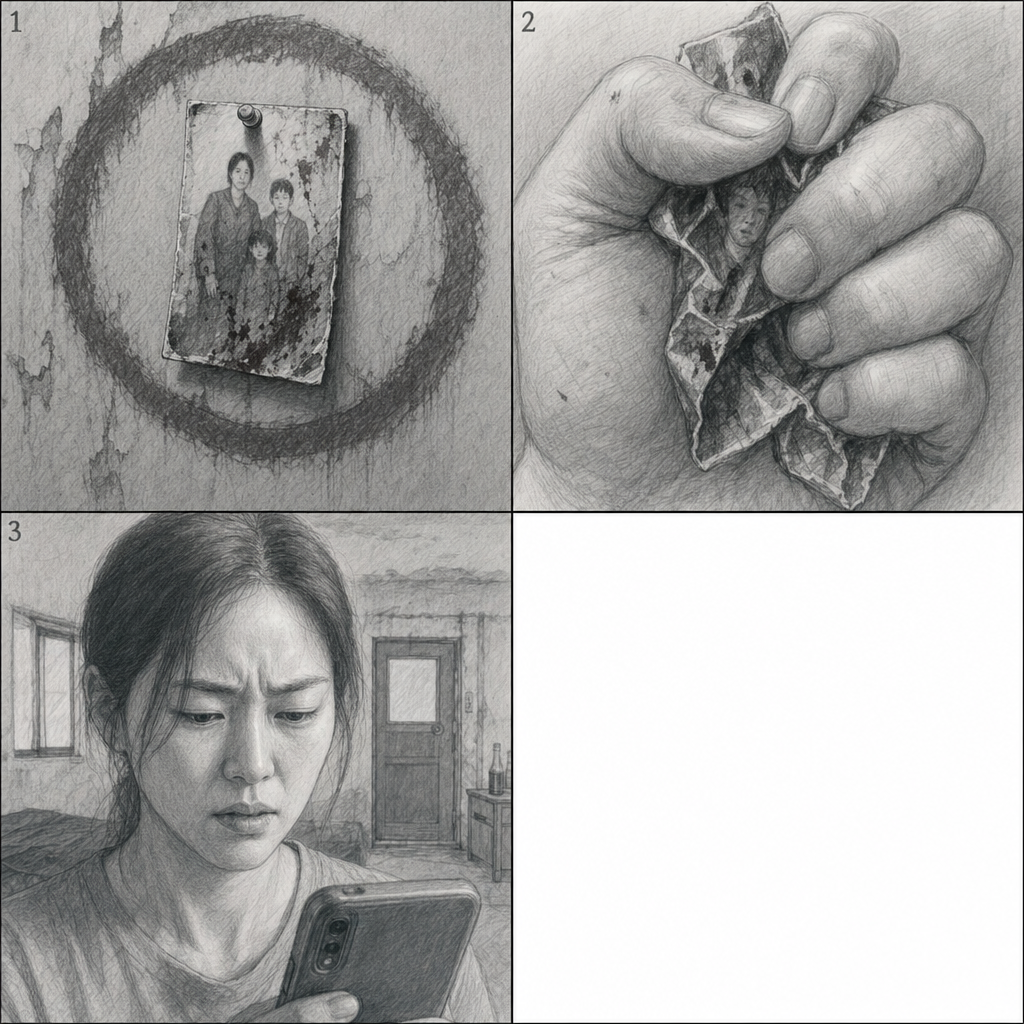
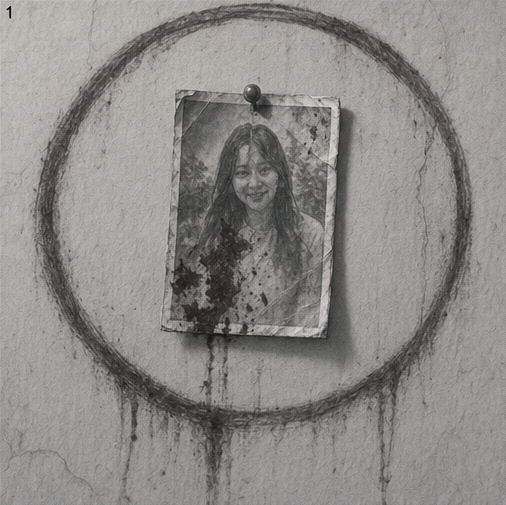
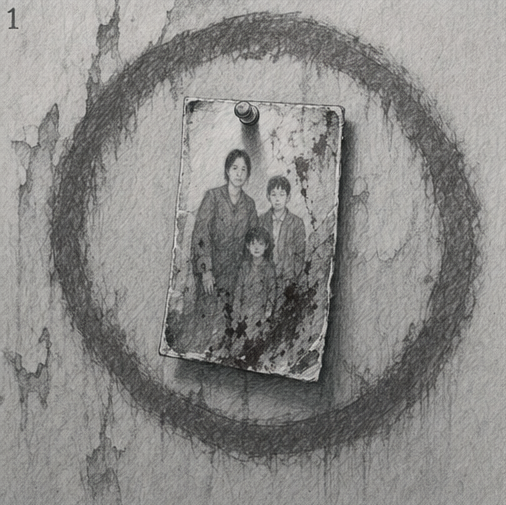
PANEL 1: 붉은 원 한가운데 피 묻은 낡은 흑백 사진이 벽에 꽂혀 있는 타이트 샷
  MOVEMENT (follow exactly): static: a bloodstained old photograph remains pinned at the center of the red circle on Su-ri-young's bedroom wall, facing outward toward the camera.
  FIGURES — apparent size & depth order (follow exactly): The photograph fills roughly 1/3 of the tight frame height, while the surrounding red circle occupies most of the frame. The photograph projects NEARER from the wall, and the red mark lies FARTHER against the flat wall surface behind it.
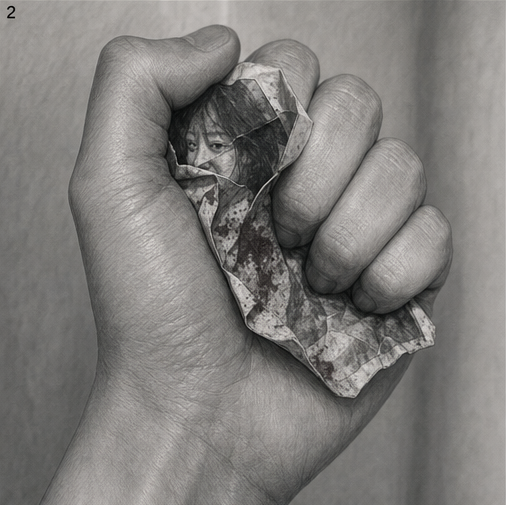
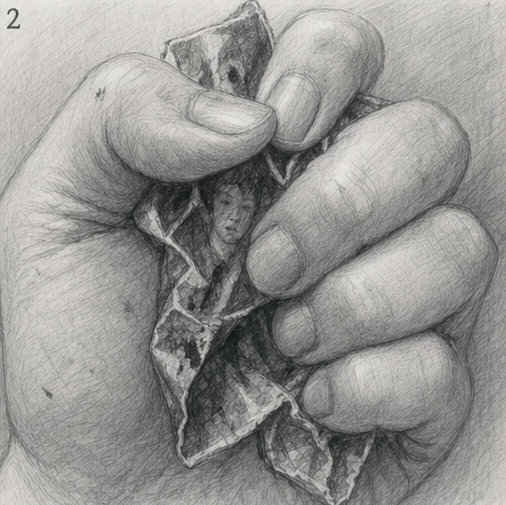
PANEL 2: 수리영의 손이 구겨진 사진을 꽉 움켜쥔 타이트 샷
  MOVEMENT (follow exactly): static: Su-ri-young's tense hand crushes the crumpled photograph in a tight grip as she holds it close.
  FIGURES — apparent size & depth order (follow exactly): Su-ri-young's hand fills roughly 2/3 of the tight frame, and the exposed portion of the photograph fills about 1/3. Her knuckles are NEARER to the camera, while the photograph is partly FARTHER inside her closed fingers.
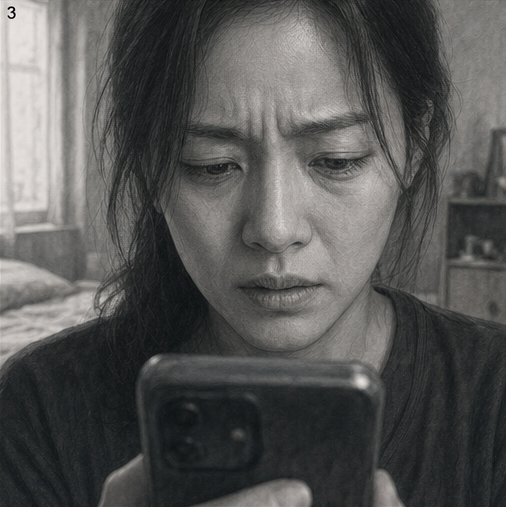
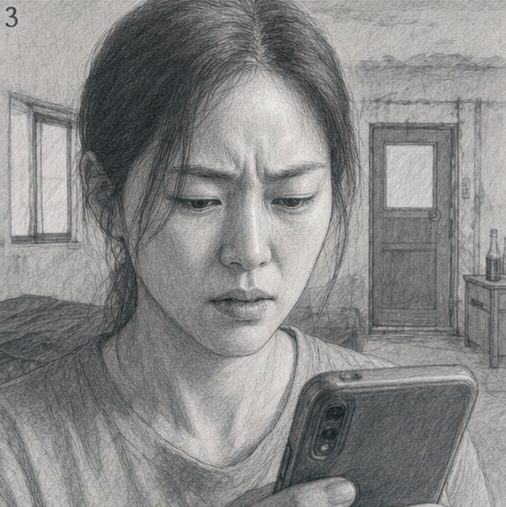
PANEL 3: 혜수가 미간을 깊게 찌푸린 채 스마트폰을 내려다보는 얼굴 클로즈업
  MOVEMENT (follow exactly): static: Hye-su lowers her gaze toward the smartphone and listens to Su-ri-young's recorded message with her brow deeply furrowed.
  FIGURES — apparent size & depth order (follow exactly): Hye-su's face fills about 2/3 of the close-up frame, while the smartphone occupies a smaller area below her face. The phone is NEARER to the camera, Hye-su's face is slightly FARTHER, and the room behind her is farthest.

There are 3 shots but 4 panel slots: draw the shots in
panels 1..3 and leave the remaining panel(s) COMPLETELY
BLANK PURE WHITE — empty white paper, not even a frame line inside.

ABSOLUTELY NO TEXT anywhere: no words, letters, captions, labels,
sound effects or watermarks — the ONLY allowed marking is a small
shot number digit (1, 2, 3) in a corner INSIDE each drawn panel.
THE PANEL GRID FILLS THE ENTIRE IMAGE EDGE-TO-EDGE: no outer paper
margin, no border area, nothing drawn outside the panels — the
image must be mechanically cuttable along the stated cut lines.
Panels are separated only by thin straight black gutter lines at
the exact stated positions; ALL PANELS EXACTLY THE SAME SIZE.

REFERENCE (BUILDING PHOTOGRAPH — architectural grounding, not
style): the attached photograph shows the ACTUAL building where
every panel of this sheet takes place — an old Korean multi-unit
villa seen from above: a narrow ground-level alley and small
courtyard, an exterior steel staircase climbing the wall, and a
flat rooftop with a small rooftop room (its door and window), a
water tank, a clothesline and a low parapet.
Whenever a panel shows ANY part of this building — exterior walls,
the steel staircase, the rooftop, the rooftop room, the courtyard
or alley — draw THAT building: take its architecture, massing,
proportions, materials and the positions of its fixed features
(door, window, stairs, water tank, parapet) from this photograph,
translated into monochrome pencil storyboard drawing. Never invent
a different building and never contradict the photo's geometry.
For INTERIOR panels, stay consistent with this building's scale
and its window/door placement seen in the photo.
Do NOT copy the photograph's style, colors, camera angle or crop —
each panel keeps its own shot framing; the photo is spatial truth
only.
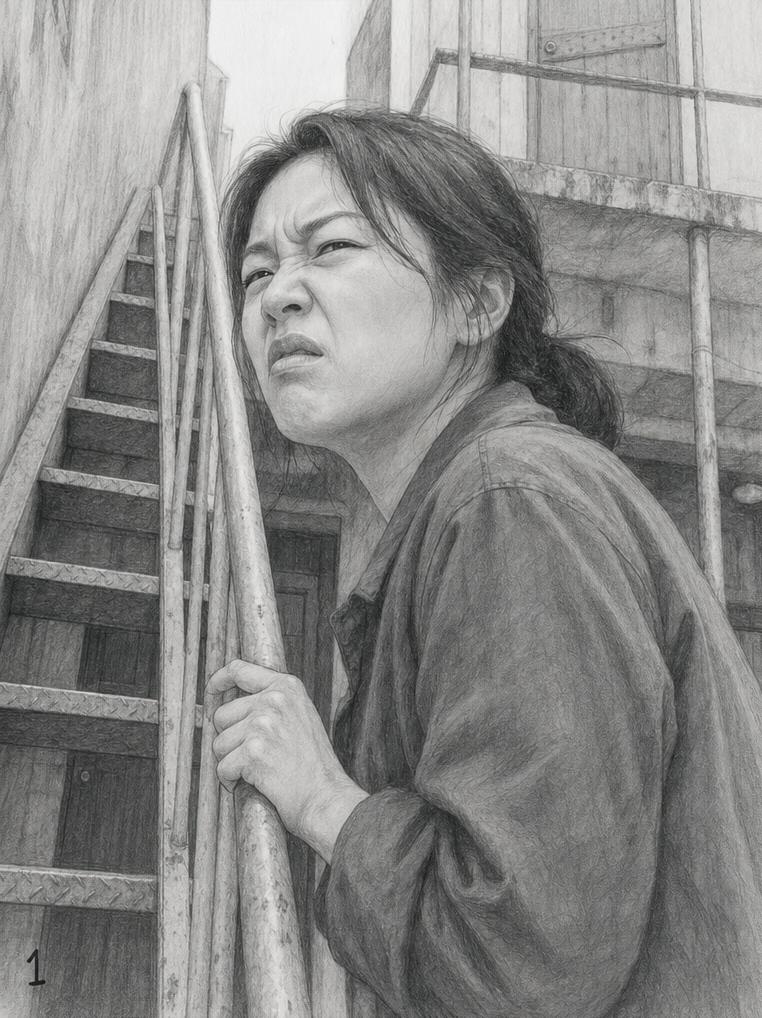
외부 철제계단 (exterior_metal_staircase · 샷 1)
LOCATION lock: A narrow exterior metal staircase attached to an old low-rise residential building. It has exposed steel steps and tubular pipe railings leading upward toward the roof.
시트 exterior_metal_staircase_0 (1샷: S11sh4)
s35 기존 콘티 (참조 없음)s36 신규 콘티 (빌라 캐논 참조)
패널별 비교 (1샷)
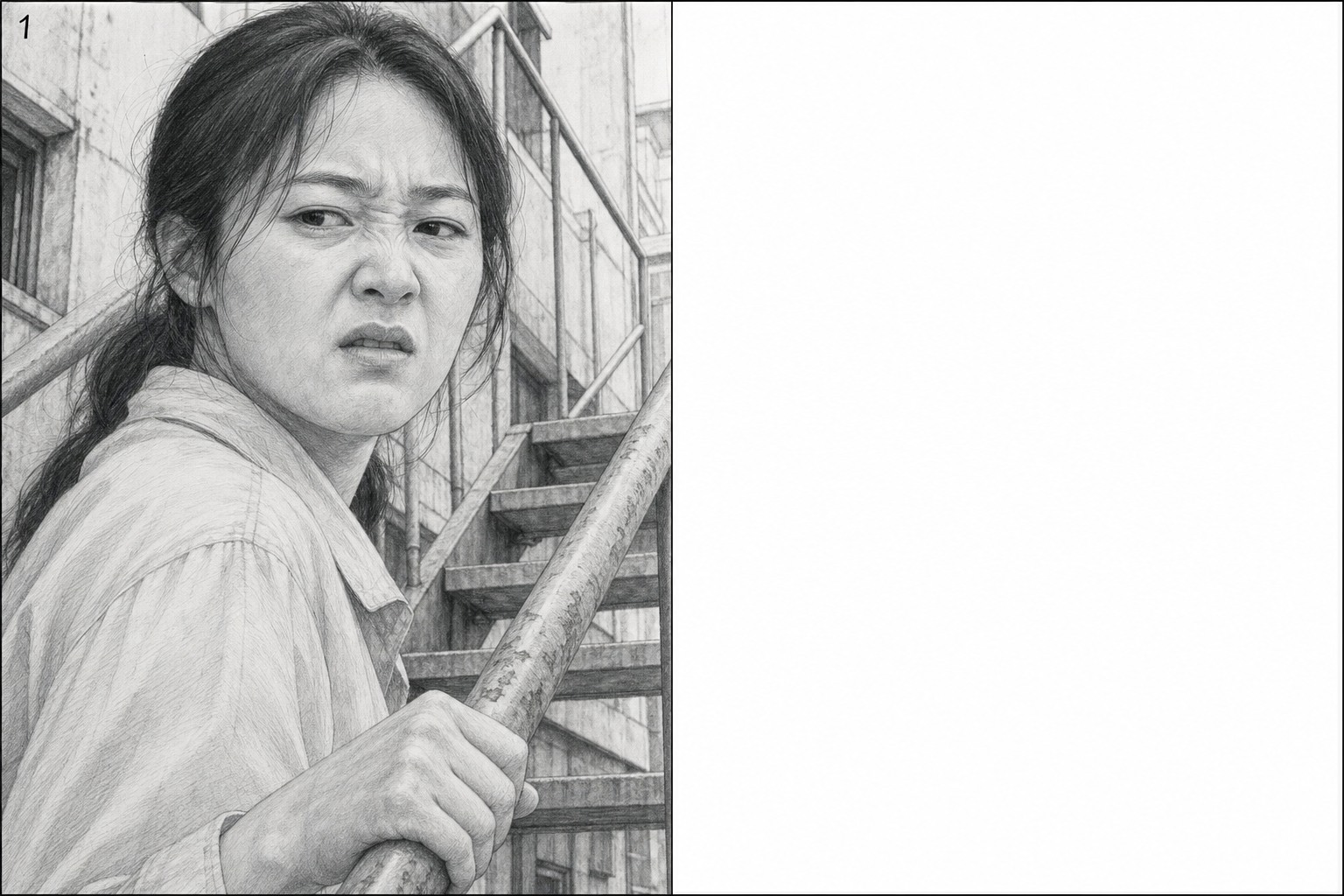
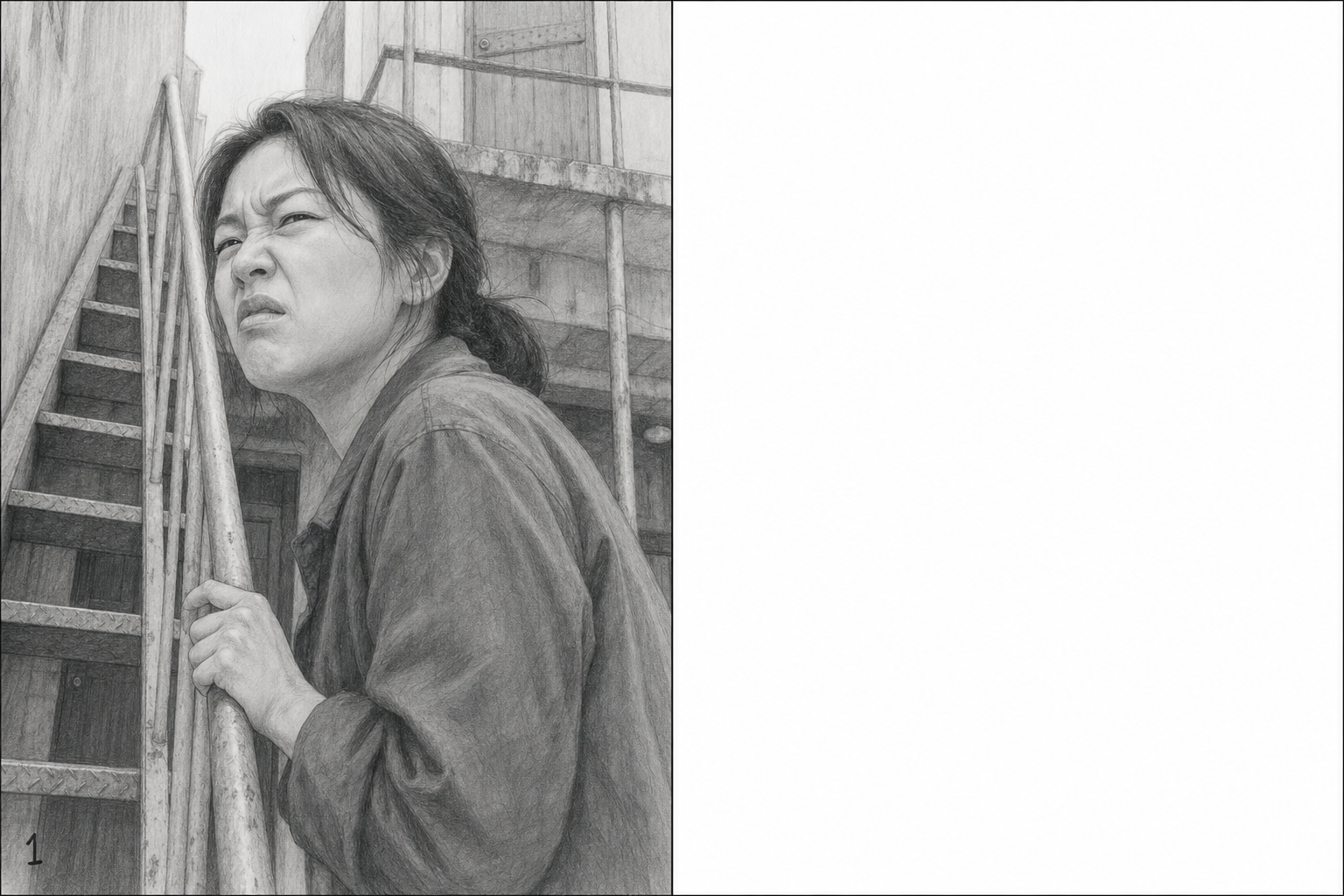
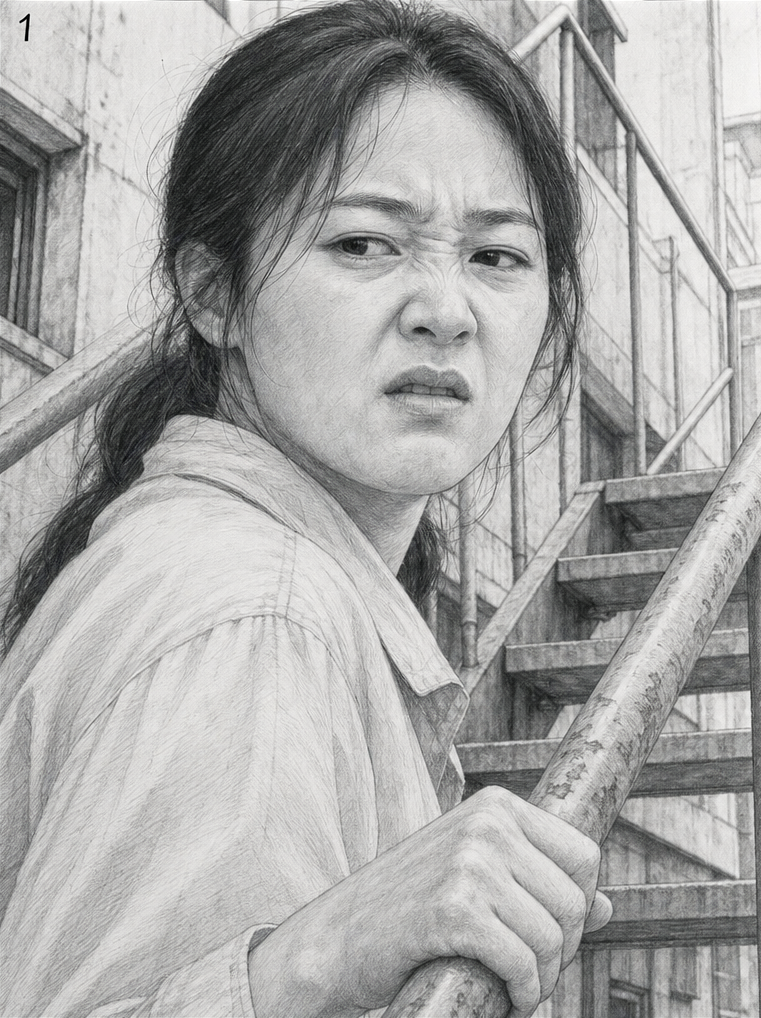
S11sh4 — 철제 파이프 난간을 손으로 잡은 수리영이 코끝을 찡그린 채 계단 중간에 서 있는 얼굴 클로즈업
s35s36 캐논 참조
프롬프트 전문 (s36)
Draw ONE storyboard (conti) sheet: 2 panels made by ONE vertical cut at exactly 50% of the image width — each panel is exactly half the width and the FULL height (1 row x 2 columns).
STYLE: hand-drawn PRE-PRODUCTION STORYBOARD FOR A LIVE-ACTION FILM
SHOOT — the working drawings a professional film storyboard artist
makes for the director and cinematographer of a real movie:
REALISTIC adult human proportions and faces (ordinary Korean
adults, film-actor realism), true cinematic lens framing, and
naturalistic light-and-shadow blocking rendered in monochrome
graphite pencil tone on white paper.
ABSOLUTELY NOT manga, NOT anime, NOT cartoon, NOT webtoon, NOT
comic-book style: no stylized or enlarged eyes, no cute or
youthful idealized faces, no clean ink outlines — every panel
must read like a frame of a live-action film sketched in pencil.
No color anywhere.

THE LOCATION (same in all drawn panels): A narrow exterior metal staircase attached to an old low-rise residential building. It has exposed steel steps and tubular pipe railings leading upward toward the roof..

PURPOSE: each panel captures only the CAMERA COMPOSITION of one
shot — framing (close-up / medium / wide), where the subject sits in
the frame, and continuity between panels. Keep every panel
extremely simple: only what matters for composition.
MOVEMENT IS SHOWN BY THE FIGURE ITSELF, NEVER BY MARKINGS: convey
direction of travel purely through the body — stride mid-motion,
body lean into the path, back view vs front view, and the stated
size/depth cues. Do NOT draw arrows, motion lines, path lines,
speed lines or any diagram markings of any kind.

REALIZE FIGURATIVE LANGUAGE AS A LIVE-ACTION SHOT: the Korean shot
text may describe characters metaphorically, figuratively or with
exaggeration. Draw what a real movie camera would actually record
on a physical set — exaggerated or figurative impressions become
realistic staging choices (lighting, distance, angle, wardrobe),
not literal fantasy drawings.
EVERY CHARACTER IS A HUMAN BEING: unless the story explicitly
features non-human or virtual beings (as in science fiction or
fantasy), every character — however indirectly, vaguely or
figuratively the text describes them — IS a real human. When the
text gives no direct visual description of a person, IMAGINE one
and still draw them as a concrete, fully-formed human being:
always render the human form to the maximum extent — build,
posture, face, hands, clothing — never reduce a person to a shape,
blob, solid silhouette or abstract mass.

GEOMETRY — ANALYSE BEFORE DRAWING: from each panel's Korean shot
text, first work out the spatial facts and draw EXACTLY those, never
re-stage them: (a) each figure's DISTANCE from camera (tight insert /
close-up / medium / full / wide — a shot about a hand or an object
is a tight insert, not a two-shot); (b) each figure's FACING and
MOVEMENT DIRECTION relative to camera — '뒷모습' means seen from
BEHIND, moving AWAY from camera into the depth of the frame, not
sideways; a profile means lateral movement; (c) relative positions
and distances BETWEEN figures. Keep every established screen
direction consistent across panels (180-degree rule): a person who
leaves in one panel keeps the same on-screen direction wherever the
movement appears again.
SIZE & DEPTH ARE CONTRACTUAL: each panel states every figure's
apparent size in the frame and the explicit near/far depth order.
Draw exactly those proportions — a farther figure MUST be drawn
clearly smaller than a nearer one; never equalize figure sizes,
especially when several figures share a panel or their paths
relate to each other.
DEPARTING FIGURE — a figure running/walking AWAY must be
unmistakably departing, never approaching: seen exactly from behind
(back of the head only, no face, no chin, no cheek line), body
leaning into the path, mid-stride with one shoe sole toward the
camera. THE STATED SIZE/DEPTH WINS: draw the departing figure at
exactly the apparent size and depth the panel's FIGURES line states
(if stated FARTHER/small, it stays small in the distance — never
enlarge it into the foreground for drama).

CONTINUITY: all drawn panels are the SAME single location — fixed
features (doors, stairs, windows, poles, desks) keep the same
position and left/right relationships across panels so the panels
cut together as one continuous scene.

PANELS (one shot per panel, Korean shot text):

PANEL 1: 철제 파이프 난간을 손으로 잡은 수리영이 코끝을 찡그린 채 계단 중간에 서 있는 얼굴 클로즈업
  MOVEMENT (follow exactly): static: Suri-young pauses midway up the staircase while ascending toward the rooftop, gripping the metal-pipe railing with a tense posture and wrinkling her nose at the sudden foul smell, her body oriented uphill.
  FIGURES — apparent size & depth order (follow exactly): Suri-young’s face fills ~2/3 of the frame height in close-up and is the nearest figure; her hand and the metal-pipe railing sit slightly farther from the camera as she remains midway on the stairs.

There are 1 shots but 2 panel slots: draw the shots in
panels 1..1 and leave the remaining panel(s) COMPLETELY
BLANK PURE WHITE — empty white paper, not even a frame line inside.

ABSOLUTELY NO TEXT anywhere: no words, letters, captions, labels,
sound effects or watermarks — the ONLY allowed marking is a small
shot number digit (1) in a corner INSIDE each drawn panel.
THE PANEL GRID FILLS THE ENTIRE IMAGE EDGE-TO-EDGE: no outer paper
margin, no border area, nothing drawn outside the panels — the
image must be mechanically cuttable along the stated cut lines.
Panels are separated only by thin straight black gutter lines at
the exact stated positions; ALL PANELS EXACTLY THE SAME SIZE.

REFERENCE (BUILDING PHOTOGRAPH — architectural grounding, not
style): the attached photograph shows the ACTUAL building where
every panel of this sheet takes place — an old Korean multi-unit
villa seen from above: a narrow ground-level alley and small
courtyard, an exterior steel staircase climbing the wall, and a
flat rooftop with a small rooftop room (its door and window), a
water tank, a clothesline and a low parapet.
Whenever a panel shows ANY part of this building — exterior walls,
the steel staircase, the rooftop, the rooftop room, the courtyard
or alley — draw THAT building: take its architecture, massing,
proportions, materials and the positions of its fixed features
(door, window, stairs, water tank, parapet) from this photograph,
translated into monochrome pencil storyboard drawing. Never invent
a different building and never contradict the photo's geometry.
For INTERIOR panels, stay consistent with this building's scale
and its window/door placement seen in the photo.
Do NOT copy the photograph's style, colors, camera angle or crop —
each panel keeps its own shot framing; the photo is spatial truth
only.
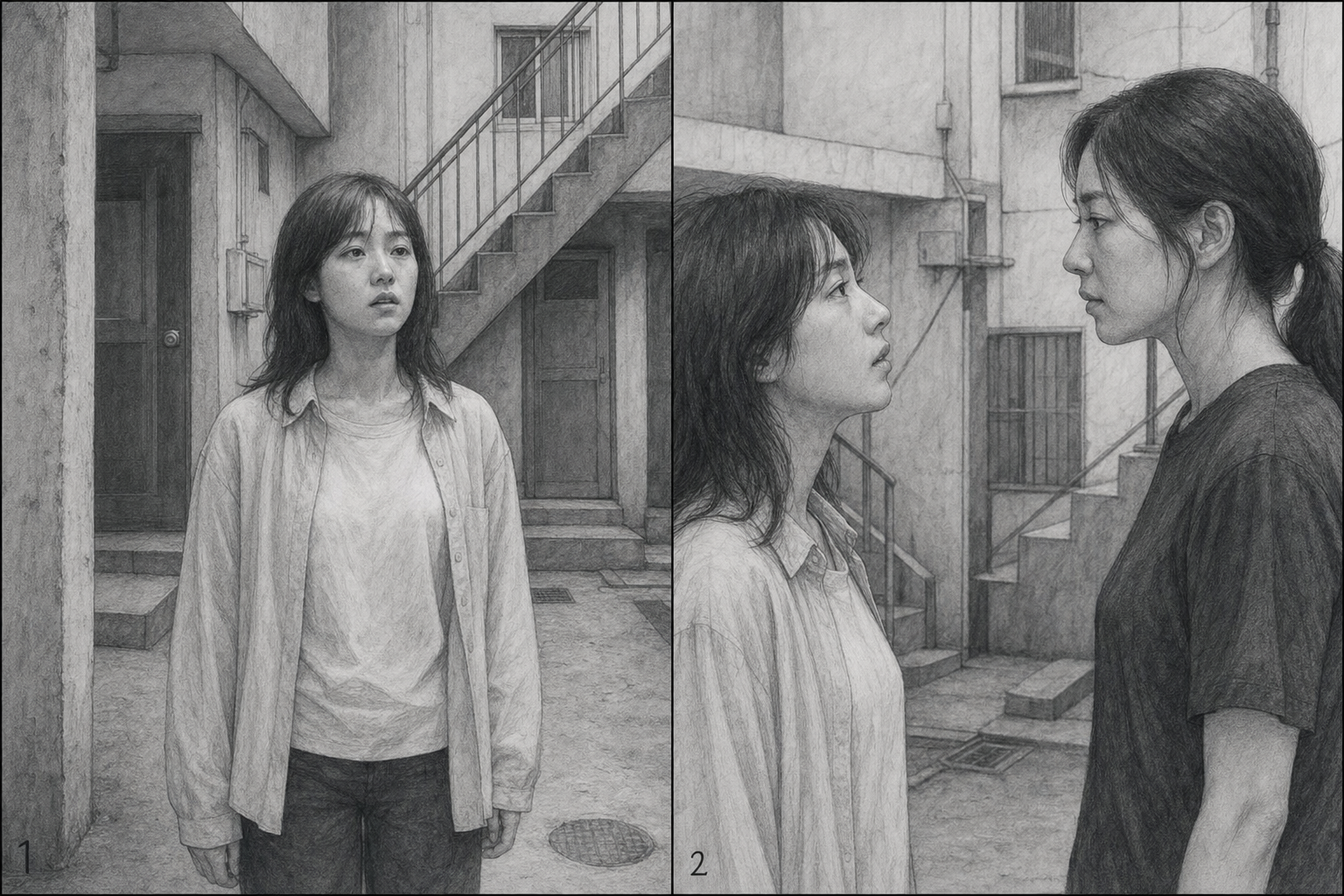
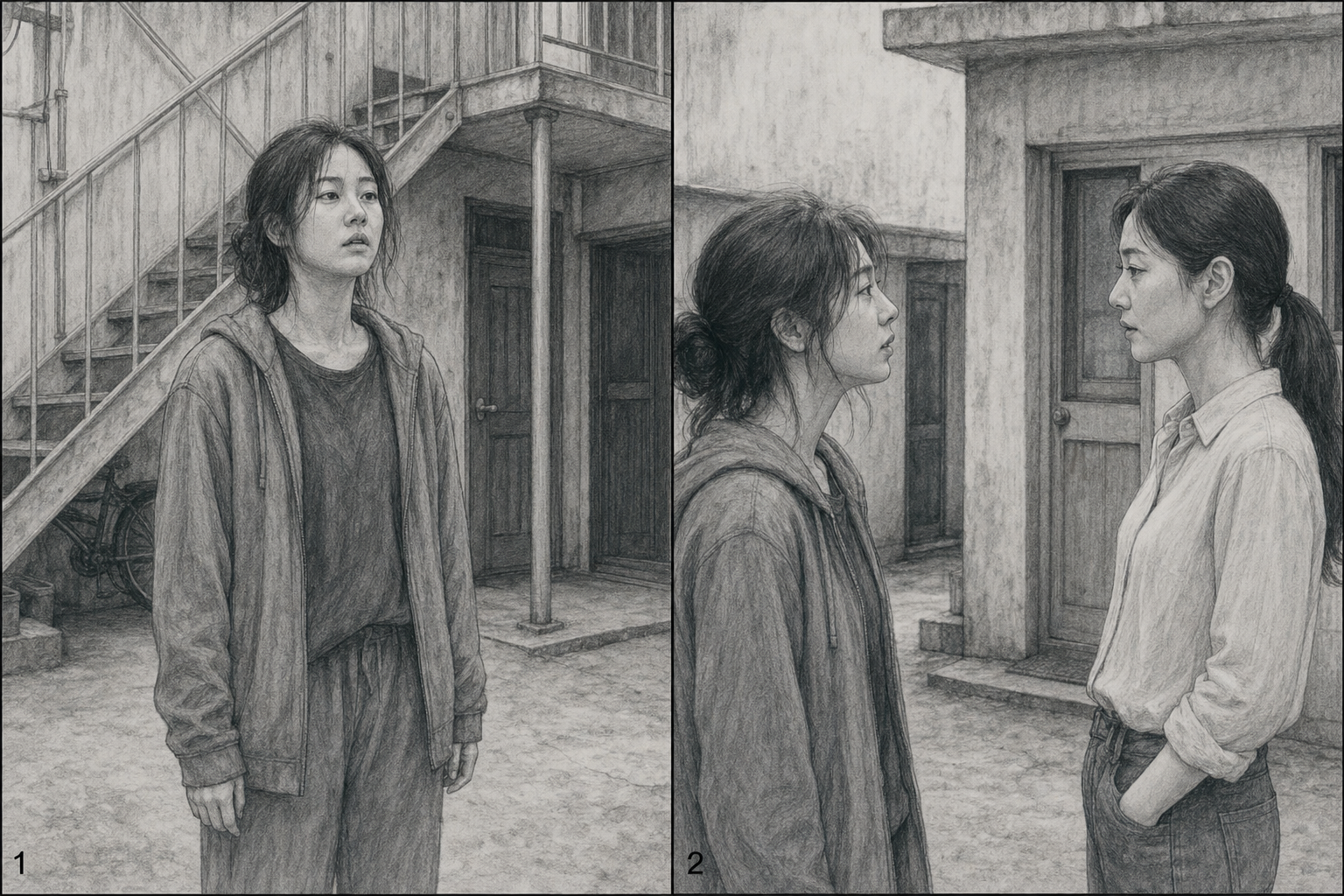
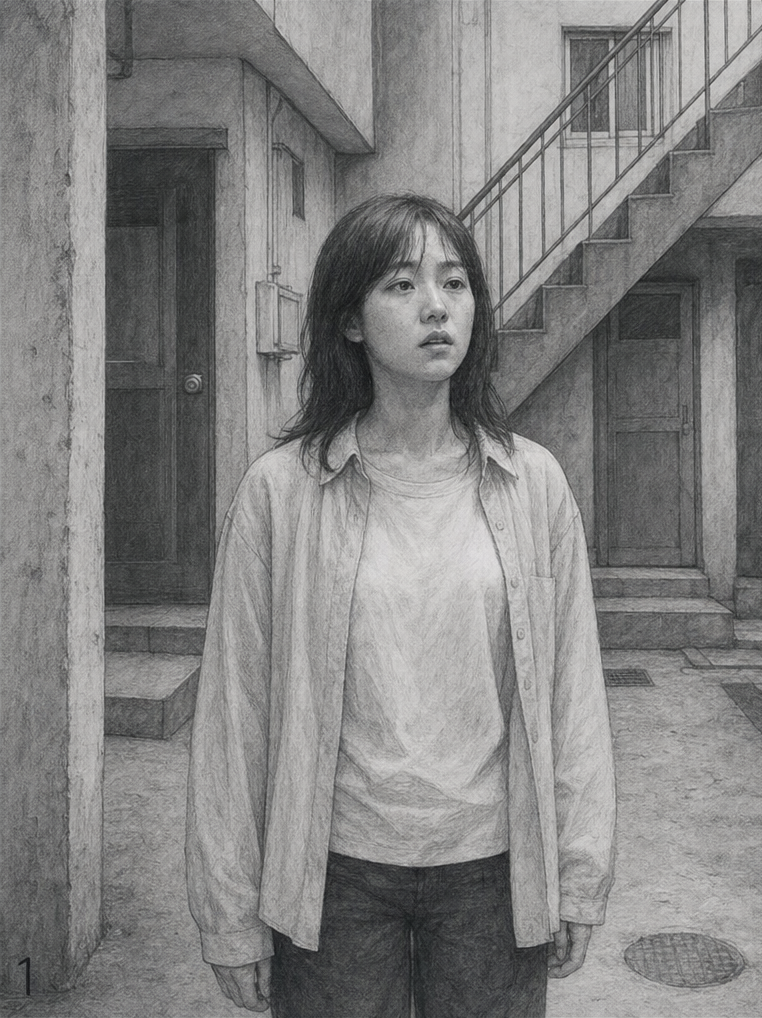
빌라 골목·마당 (residential_alley_courtyard · 샷 2)
LOCATION lock: A confined ground-level alley and small courtyard beside an aging multi-unit residential building. Concrete walls, building entrances, and the base of the exterior access structure frame the space.
Draw ONE storyboard (conti) sheet: 2 panels made by ONE vertical cut at exactly 50% of the image width — each panel is exactly half the width and the FULL height (1 row x 2 columns).
STYLE: hand-drawn PRE-PRODUCTION STORYBOARD FOR A LIVE-ACTION FILM
SHOOT — the working drawings a professional film storyboard artist
makes for the director and cinematographer of a real movie:
REALISTIC adult human proportions and faces (ordinary Korean
adults, film-actor realism), true cinematic lens framing, and
naturalistic light-and-shadow blocking rendered in monochrome
graphite pencil tone on white paper.
ABSOLUTELY NOT manga, NOT anime, NOT cartoon, NOT webtoon, NOT
comic-book style: no stylized or enlarged eyes, no cute or
youthful idealized faces, no clean ink outlines — every panel
must read like a frame of a live-action film sketched in pencil.
No color anywhere.

THE LOCATION (same in all drawn panels): A confined ground-level alley and small courtyard beside an aging multi-unit residential building. Concrete walls, building entrances, and the base of the exterior access structure frame the space..

PURPOSE: each panel captures only the CAMERA COMPOSITION of one
shot — framing (close-up / medium / wide), where the subject sits in
the frame, and continuity between panels. Keep every panel
extremely simple: only what matters for composition.
MOVEMENT IS SHOWN BY THE FIGURE ITSELF, NEVER BY MARKINGS: convey
direction of travel purely through the body — stride mid-motion,
body lean into the path, back view vs front view, and the stated
size/depth cues. Do NOT draw arrows, motion lines, path lines,
speed lines or any diagram markings of any kind.

REALIZE FIGURATIVE LANGUAGE AS A LIVE-ACTION SHOT: the Korean shot
text may describe characters metaphorically, figuratively or with
exaggeration. Draw what a real movie camera would actually record
on a physical set — exaggerated or figurative impressions become
realistic staging choices (lighting, distance, angle, wardrobe),
not literal fantasy drawings.
EVERY CHARACTER IS A HUMAN BEING: unless the story explicitly
features non-human or virtual beings (as in science fiction or
fantasy), every character — however indirectly, vaguely or
figuratively the text describes them — IS a real human. When the
text gives no direct visual description of a person, IMAGINE one
and still draw them as a concrete, fully-formed human being:
always render the human form to the maximum extent — build,
posture, face, hands, clothing — never reduce a person to a shape,
blob, solid silhouette or abstract mass.

GEOMETRY — ANALYSE BEFORE DRAWING: from each panel's Korean shot
text, first work out the spatial facts and draw EXACTLY those, never
re-stage them: (a) each figure's DISTANCE from camera (tight insert /
close-up / medium / full / wide — a shot about a hand or an object
is a tight insert, not a two-shot); (b) each figure's FACING and
MOVEMENT DIRECTION relative to camera — '뒷모습' means seen from
BEHIND, moving AWAY from camera into the depth of the frame, not
sideways; a profile means lateral movement; (c) relative positions
and distances BETWEEN figures. Keep every established screen
direction consistent across panels (180-degree rule): a person who
leaves in one panel keeps the same on-screen direction wherever the
movement appears again.
SIZE & DEPTH ARE CONTRACTUAL: each panel states every figure's
apparent size in the frame and the explicit near/far depth order.
Draw exactly those proportions — a farther figure MUST be drawn
clearly smaller than a nearer one; never equalize figure sizes,
especially when several figures share a panel or their paths
relate to each other.
DEPARTING FIGURE — a figure running/walking AWAY must be
unmistakably departing, never approaching: seen exactly from behind
(back of the head only, no face, no chin, no cheek line), body
leaning into the path, mid-stride with one shoe sole toward the
camera. THE STATED SIZE/DEPTH WINS: draw the departing figure at
exactly the apparent size and depth the panel's FIGURES line states
(if stated FARTHER/small, it stays small in the distance — never
enlarge it into the foreground for drama).

CONTINUITY: all drawn panels are the SAME single location — fixed
features (doors, stairs, windows, poles, desks) keep the same
position and left/right relationships across panels so the panels
cut together as one continuous scene.

PANELS (one shot per panel, Korean shot text):

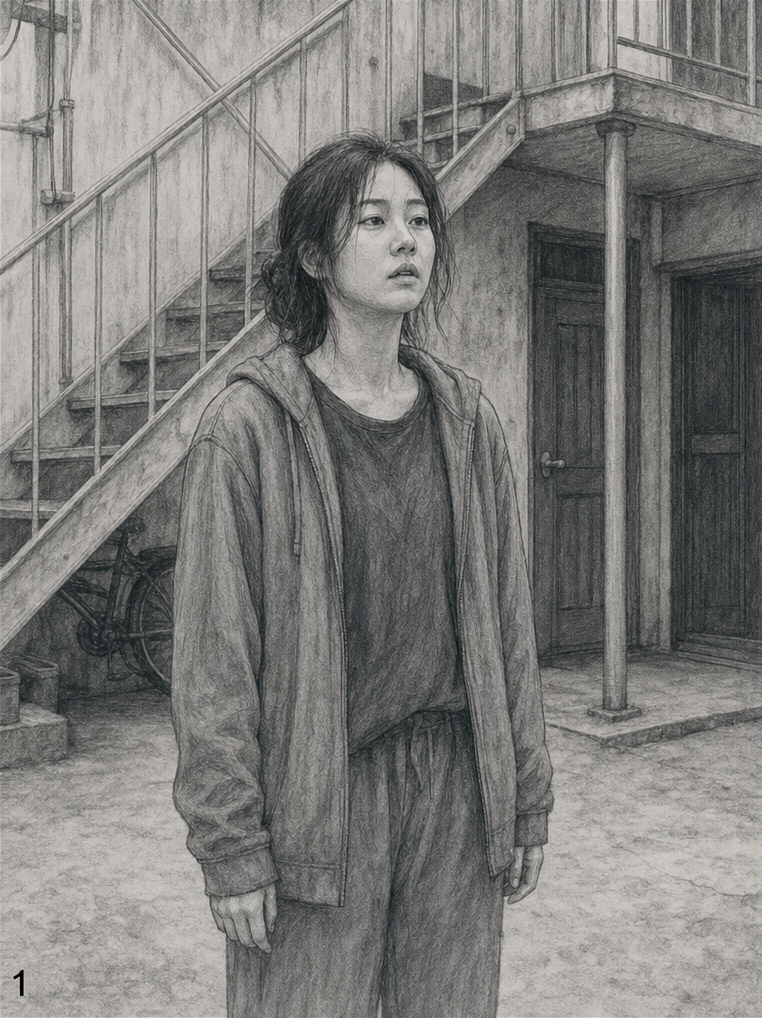
PANEL 1: 수리영이 초점을 잃은 눈으로 허공을 응시하며 서 있는 모습
  MOVEMENT (follow exactly): static: Su-ri-young stands motionless and dazed after coming down from the rooftop room, her unfocused eyes staring into empty space and her body lacking purposeful direction.
  FIGURES — apparent size & depth order (follow exactly): Su-ri-young is the only visible figure, so she is both the nearest and farthest person; her apparent fraction of frame height is unspecified in the source.
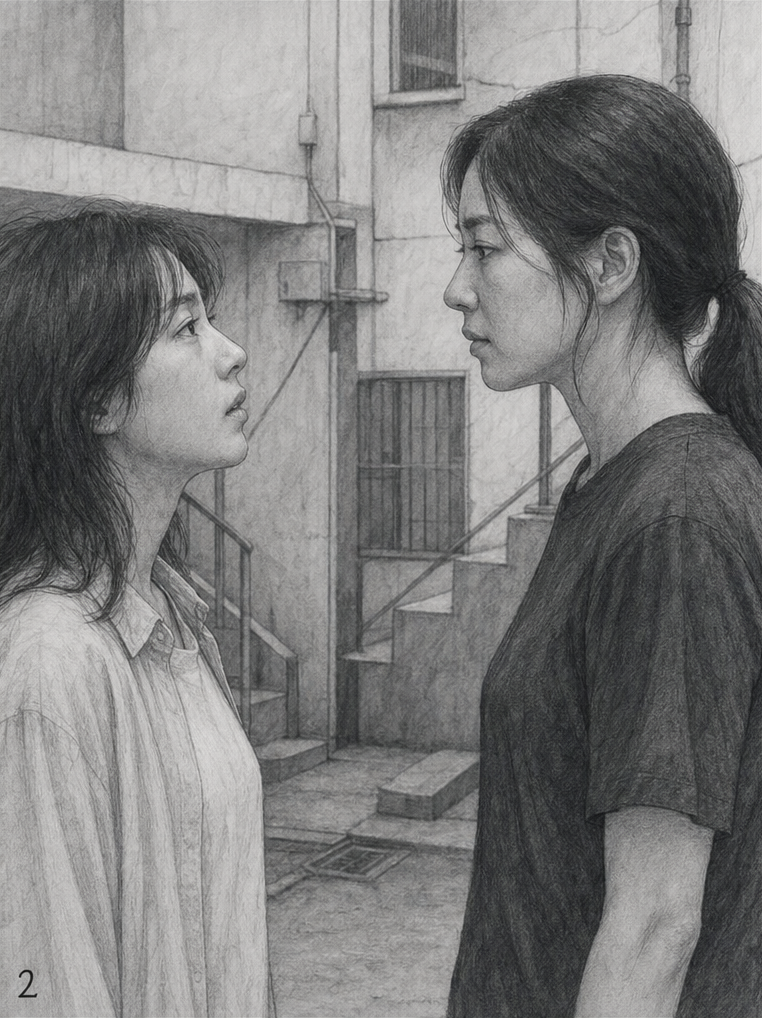
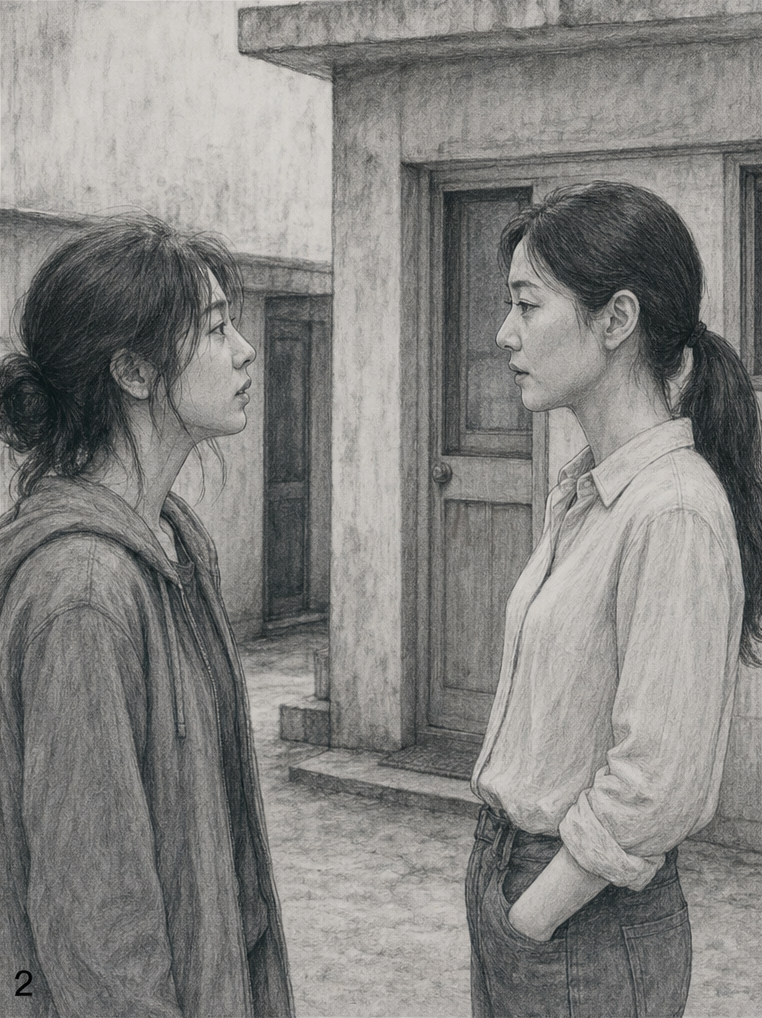
PANEL 2: 고개를 든 채 혜수의 얼굴을 마주보고 있는 수리영의 측면 구도
  MOVEMENT (follow exactly): static: Su-ri-young holds her head raised and faces Hye-su directly in side profile, looking up at her while remaining dazed and stationary.
  FIGURES — apparent size & depth order (follow exactly): Su-ri-young and Hye-su's face are visible facing each other, but their respective frame-height fractions and which is nearer to the camera are unspecified; their paths have converged at conversational distance, with neither moving past the other.

ABSOLUTELY NO TEXT anywhere: no words, letters, captions, labels,
sound effects or watermarks — the ONLY allowed marking is a small
shot number digit (1, 2) in a corner INSIDE each drawn panel.
THE PANEL GRID FILLS THE ENTIRE IMAGE EDGE-TO-EDGE: no outer paper
margin, no border area, nothing drawn outside the panels — the
image must be mechanically cuttable along the stated cut lines.
Panels are separated only by thin straight black gutter lines at
the exact stated positions; ALL PANELS EXACTLY THE SAME SIZE.

REFERENCE (BUILDING PHOTOGRAPH — architectural grounding, not
style): the attached photograph shows the ACTUAL building where
every panel of this sheet takes place — an old Korean multi-unit
villa seen from above: a narrow ground-level alley and small
courtyard, an exterior steel staircase climbing the wall, and a
flat rooftop with a small rooftop room (its door and window), a
water tank, a clothesline and a low parapet.
Whenever a panel shows ANY part of this building — exterior walls,
the steel staircase, the rooftop, the rooftop room, the courtyard
or alley — draw THAT building: take its architecture, massing,
proportions, materials and the positions of its fixed features
(door, window, stairs, water tank, parapet) from this photograph,
translated into monochrome pencil storyboard drawing. Never invent
a different building and never contradict the photo's geometry.
For INTERIOR panels, stay consistent with this building's scale
and its window/door placement seen in the photo.
Do NOT copy the photograph's style, colors, camera angle or crop —
each panel keeps its own shot framing; the photo is spatial truth
only.